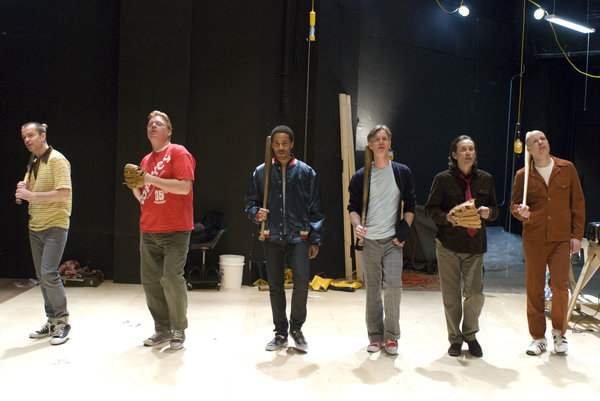
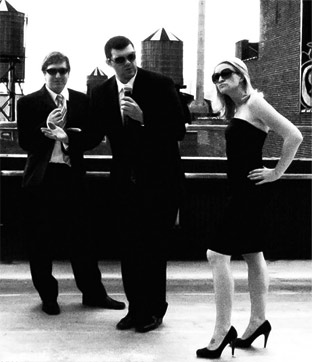
UNDER CONSTRUCTION will hold its New York premiere April 21 - May 7 at Dance Theater Workshop (photo by Michael Brosilow)
UNDER CONSTRUCTION
Dance Theater Workshop
219 West 19th St.
April 21 – May 7, $20-$35, 7:30
212-924-0077
www.dancetheaterworkshop.org
www.siti.org
Founded in 1992 by Anne Bogart and Tadashi Suzuki, Manhattan-based SITI Company specializes in presenting original multidisciplinary works that examine the nature of theater itself as well as unique interpretations of plays and text by such writers as August Strindberg, Virginia Woolf, Noël Coward, and William Shakespeare. In 2001, artistic director Bogart and playwright Charles L. Mee began a four-part road trip through the concept of the United States with bobrauschenbergamerica, followed in 2006 by Hotel Cassiopeia, set in the boxlike world of Joseph Cornell. The third part of the American Museum Cycle, Under Construction, which melds the down-home charm of Norman Rockwell with the visual flair of contemporary installation artist Jason Rhoades, holds its New York premiere April 21 – May 7 at Dance Theater Workshop as part of DTW’s Guest Artist Series. The always engaging Bogart and Mee will participate in preshow Lobby Talks April 25-27 and May 2 at 6:30, but you can get some of the inside scoop from her now in the below twi-ny talk.
twi-ny: You recently wrote on your blog that SITI “offers a gym for the soul.” How would you say Under Construction fits that description?
Anne Bogart: Because the play has no obvious narrative structure, Under Construction asks the viewer to put together the pieces. But when you do put the pieces together, using your associative and imaginative toolbox, the journey will be a buoyant and adventurous one.
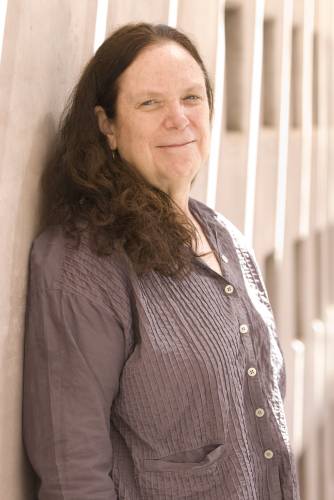
Artistic director Anne Bogart and SITI Company are on a mission to redefine and revitalize contemporary theater (photo by Michael Brosilow)
twi-ny: Under Construction is the third part of the American Museum Cycle, in which the work of American artists influences the productions directly and/or indirectly, including Robert Rauschenberg in bobrauschenbergamerica, Joseph Cornell in Hotel Cassiopeia, Norman Rockwell and Jason Rhoades in Under Construction, and James Castle in the upcoming Soot and Spit. How do you and Chuck decide which artists to build your stories around? Were there any artists you wanted to use that just didn’t work out?
Anne Bogart: It was Chuck Mee who suggested Robert Rauschenberg, Joseph Cornell, and James Castle. But for many years both Chuck and I had secretly harbored a fascination for Norman Rockwell. This mutual interest led toward Under Construction. But, in typical Chuck fashion, it was he who had the brilliant idea to juxtapose Norman Rockwell and his vision of America with the wild and woolly world of installation-artist Jason Rhoades. I once suggested to Chuck the idea of doing a play based upon Andy Warhol, but Chuck did not take the bait. The subject matter must be of interest to both of us. But in general, it is Chuck Mee who takes the lead in the choice of subject and the format of the play.
twi-ny: SITI’s stated mission is “to redefine and revitalize contemporary theater in the United States through an emphasis on international cultural exchange and collaboration.” How would you say the company is doing as it looks toward its twentieth anniversary next year? Do you think contemporary theater in general still needs to be redefined and revitalized?
Anne Bogart: Theater is the art form that perhaps, more than any other, needs to be redefined and revitalized on a regular basis. New forms and audience/actor relationships are in a constant state of flux. What was revolutionary fifteen years ago now feels antiquated. As for how SITI Company is doing, as we move into our nineteenth year of existence, we are reevaluating our processes and our methods of existence and looking with fresh eyes at our mission statement. Here is the new one that we just composed:
“SITI Company was built on the bedrock of ensemble and we believe that through the practice of collaboration, a group of artists could make a life together and have a significant impact upon both contemporary theater and the world at large. Through our performances, educational programs and collaborations with other artists and thinkers, SITI Company will continue to challenge the status quo, to train to achieve artistic excellence in every aspect of our work, and to offer new ways of seeing and of being as both artists and as global citizens. SITI Company is committed to providing a gymnasium-for-the-soul where the interaction of art, artists, audiences, and ideas inspire the possibility for change, optimism, and hope. We are hopeful for the future and look forward to the adventures that lie ahead.”
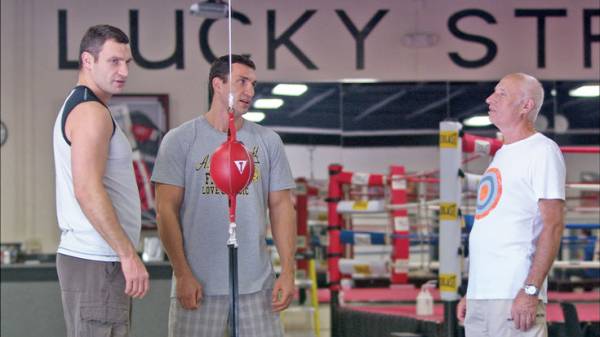
 When brothers Vitali and Wladimir Klitschko first entered the boxing arena in the 1990s, they were each like Ivan Drago in Rocky IV, seemingly unbeatable Russian machines. But both of them ended up facing tremendous adversity and rising up again, as depicted in the surprisingly intimate German documentary Klitschko. Director Sebastian Dehnhardt was given unlimited access to the brothers, their parents, Vitali’s wife, and other members of Team Klitschko, revealing the two skyscrapers to be much more than just a couple of great fighters. Both Vitali and his younger brother, Wladimir, are shown to be intelligent, well-spoken men (each with PhDs) who had one goal when they left kickboxing for professional boxing — to be heavyweight champions of the world. On their remarkable journey, Dehnhardt captures them training together, carefully watching each other’s performances in the ring, and playing chess. At one point Wladimir bans Vitali from his training camp, evoking the separation between “Irish” Micky Ward and his brother, Dicky Eklund, as seen in David O. Russell’s Oscar-nominated The Fighter, but the Klitschkos handle it very differently. The film features plenty of original fight footage in which Dehnhardt zooms in and slows things down to get breathtaking action shots from such contests as Vitali’s epic battle with Lennox Lewis, in which Klitschko got a horrifically deep gash over his left eye; Wladimir’s dizzying loss to Lamon Brewster; and both brothers taking on Corrie Sanders and Samuel Peter. Sharing their thoughts on the Klitschkos are longtime manager Bernd Bonte, Wladimir’s trainer Emanuel Steward, Vilati’s coach Fritz Sdunek, former champions Lewis, Brewster, and Chris Byrd, and boxing announcer Larry Merchant, none of whom have anything bad to say about the brothers, who come off as calm, thoughtful souls who love their mother dearly and rarely get riled up outside the ring. The film is disjointed, with an often hard-to-follow time line, and background information seems haphazard at best, but Klitschko is still a knockout of a film.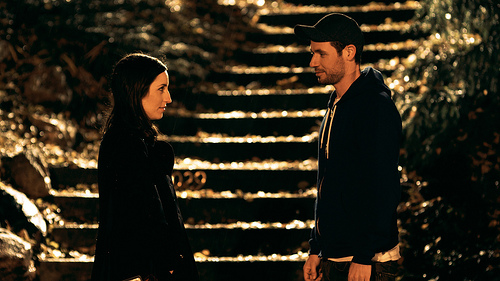
 In many ways, Stuck Between Stations is the quintessential American festival movie. The low-budget indie feels like a deeply personal work, teetering on the edge of collapsing into overwrought melodrama but always able to get back on track. Cowriter and coproducer Sam Rosen stars as Casper, a young man who returns to his Minneapolis home for his father’s funeral. At a bar he bumps into his childhood crush, Rebecca (Zoe Lister-Jones), a grad student whose life is being turned upside down, as the head of her department just discovered that Zoe has been having an affair with her husband. Casper gets into a fight with Rebecca’s friends, then ends up spending the rest of the very long night with her as they wander through Minneapolis visiting a bizarre circus, breaking into a house, and talking openly and honestly about their lives, revealing only little bits at a time. It takes a while to warm up to the two main characters, but once director and coproducer Brady Kiernan gets things rolling, Stuck Between Stations becomes a compelling, moving ride. To keep the protagonists on-screen the whole way, Kiernan, in his feature-length debut, employs split screens whenever the two are physically separated, a conceit that ends up working. The film also stars Michael Imperioli as Rebecca’s mentor/lover and Josh Hartnett as the leader of a late-night partying bike crew. The title comes from a 2006 song by the then-Minneapolis-based band the Hold Steady in which Craig Finn sings, “Boys and girls in America, they have such a sad time together.” Audiences will end up not having a sad time together watching Stuck Between Stations.