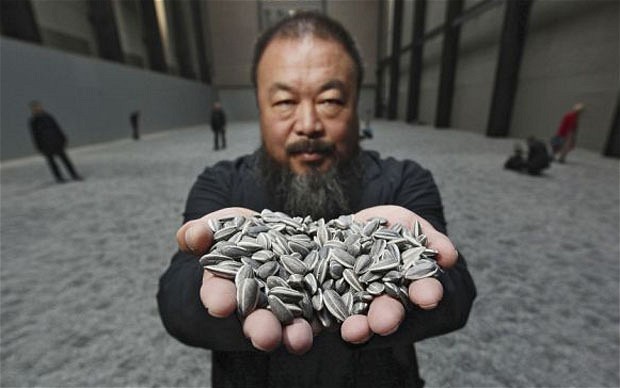
People around the world will gather in front of Chinese embassies on Sunday at 1:00 to show their support for missing artist Ai Weiwei (BBC photo)
Consulate-General of the People’s Republic of China in New York
520 12th Ave. between 42nd & 43rd Sts.
Sunday, April 17, free, 1:00
www.facebook.com/creativetime
On April 3, fifty-three-year-old controversial Chinese artist and activist was arrested in Beijing for what the government later called “economic crimes.” Ai has been missing ever since, leading to an international outcry against China’s continued abuse of human rights. People around the world will be showing their support of Ai on Sunday, April 17, at 1:00 as they bring chairs and sit down in front of Chinese embassies, evoking Ai’s 2007 Documenta projects “Fairytale — 1,001 Qing Dynasty Wooden Chairs” and “Fairytale — 1,001 Chinese Visitors,” the former consisting of said number of chairs, the latter involving 1,001 Chinese citizens temporarily moving to Kassel, Germany, the hometown of the brothers Grimm. “The point is: how to make everybody feel that all this is made for him or her, for each individual, and to enable the participants to have a very detailed and carefully planned trip that is free?” Ai explained to ArtZine China in 2007. “I see what kind of hopes, what kind of worries, what kind of frustrations . . . and waiting, and anticipating . . . then the dream, then imagination, then . . . maybe surprise. This of course reflects a great number of social, political, and economic factors, because we often have to ask who we are, what do we get from an event like this.” In many ways, Ai could have been referring to Sunday’s event, when protest participants will share their hopes and dreams that the artist will be freed. “1,001 Chairs for Ai Weiwei” is being sponsored by the innovative nonprofit organization Creative Time and was specifically suggested by art curator Steven Holmes. As Creative Time lays out, “Artist and activist Ai Weiwei is an internationally regarded figure who has fought for artistic freedom and for freedom of speech throughout his distinguished career, envisioning and shaping a more just and equitable society through his work. . . . Referencing the spirit of his work, ‘1001 Chairs for Ai Weiwei’ calls for his immediate release, supporting the right of artists to speak and work freely in China and around the world.”

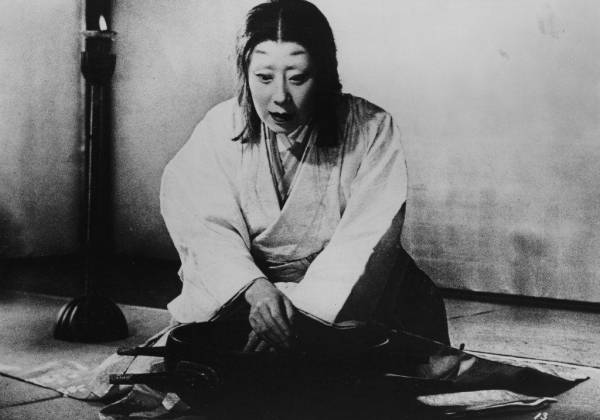
 Akira Kurosawa’s marvelous reimagining of Macbeth is an intense psychological thriller that follows one man’s descent into madness. Following a stunning military victory led by Washizu (Toshirô Mifune) and Miki (Minoru Chiaki), the two men are rewarded with lofty new positions. As Washizu’s wife, Asaji (Isuzu Yamada, with spectacular eyebrows), fills her husband’s head with crazy paranoia, Washizu is haunted by predictions made by a ghostly evil spirit in the Cobweb Forest, leading to one of the all-time classic finales. Featuring exterior scenes bathed in mysterious fog, interior long shots of Washizu and Asaji in a large, sparse room carefully considering their next bold move, and composer Masaru Sato’s shrieking Japanese flutes, Throne of Blood is a chilling drama of corruptive power and blind ambition, one of the greatest adaptations of Shakespeare ever put on film. Throne of Blood is screening April 17-18 as part of Film Forum’s “5 Japanese Divas” series, featuring four weeks of films starring Yamada, Machiko Kyo, Kimuyo Tanaka, Setsuko Hara, and Hideko Takamine, who play strong, determined women in such classic works as Yasujiro Ozu’s Early Summer (1951) and Tokyo Story (1953), Hiroshi Teshigahara’s The Face of Another (1966), Mikio Naruse’s Okaasan (1952) and Flowing (1956), Kurosawa’s The Idiot (1951) and Throne of Blood (1957), Keisuke Kinoshita’s Carmen Comes Home (1951) and Twenty-Four Eyes (1954), and Kenji Mizoguchi’s Ugetsu (1953), Sansho the Bailiff (1954), and Street of Shame (1956), among others.
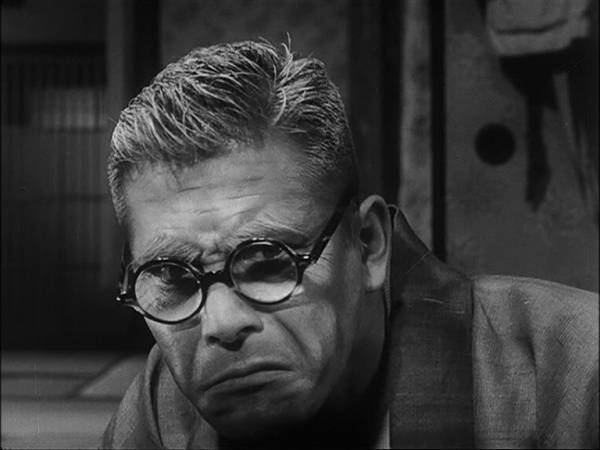
 Akira Kurosawa’s powerful psychological drama begins with a jazzy score over shots of a bustling Japanese city, people anxiously hurrying through as a Theremin joins the fray. But this is no Hollywood film noir or low-budget frightfest; Kurosawa’s daring film is about the end of old Japanese society as the threat of nuclear destruction hovers over everyone. A completely unrecognizable Toshirô Mifune stars as Nakajima, an iron foundry owner who wants to move his large family — including his two mistresses — to Brazil, which he believes to be the only safe place on the planet where he can survive the H bomb. His immediate family, concerned more about the old man’s money than anything else, takes him to court to have him declared incompetent; there he meets a dentist (the always excellent Takashi Shimura) who also mediates such problems — and fears that Nakajima might be the sanest one of all. I Live in Fear is screening this weekend at 11:00 am at the IFC Center as part of its Weekend Classics: Kurosawa series, with fifty percent of ticket sales benefiting the