Tag Archives: william shakespeare

macbitches

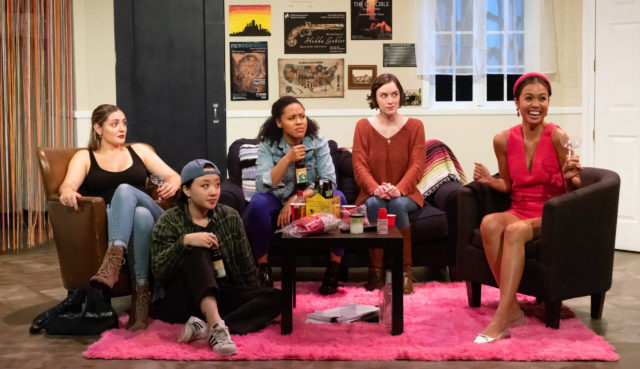
Five theater students discuss their upcoming production of the Scottish play in macbitches (photo by Wesley Volcy)

macbitches
Chain Theatre
312 West Thirty-Sixth St. between Eighth & Ninth Aves.
Wednesday – Sunday through September 10, $25
www.chaintheatre.org

One of the most iconic images of theater itself is that of Janus, the two-faced Roman god of beginnings and endings, sometimes depicted as happy on one side and sad on the other. Every play, of course, has a beginning and an ending, but it’s not always clear when a show starts, and too many works seem to be unable to find a satisfying conclusion. Such is the case with the world premiere of Sophie McIntosh’s aptly titled macbitches, running at the Chain Theatre through September 10.

As the audience enters the space, two characters are onstage, one embroidering, the other impatiently checking her cellphone. Is the play happening? Most audience members sat down, took out their own cellphones, engaged in conversation with their companion(s), or closed their eyes and rested, ignoring what was happening onstage. A few moments later, two more characters arrived through a side door and hung out in the area between the audience and the stage, one looking for someone, the other reading a book. Had the play begun? Few people in the audience paid attention; even the people sitting right in front of these two new characters, who were practically in their laps, remained glued to their phones.

A few of us took advantage of the activity and followed the actors while also exploring the set, a well-decorated living room in a dorm, with small posters of such plays as Hedda Gabler, The Crucible, and Metamorphoses in addition to a giant poster of Russian-American actress, director, producer, and screenwriter Alla Nazimova. A mood was being created and we were getting a feel for the characters through their facial gestures and movements, but the majority of the audience chose not to notice any of that until the lights went down, at which point there could be no argument: The show was underway.
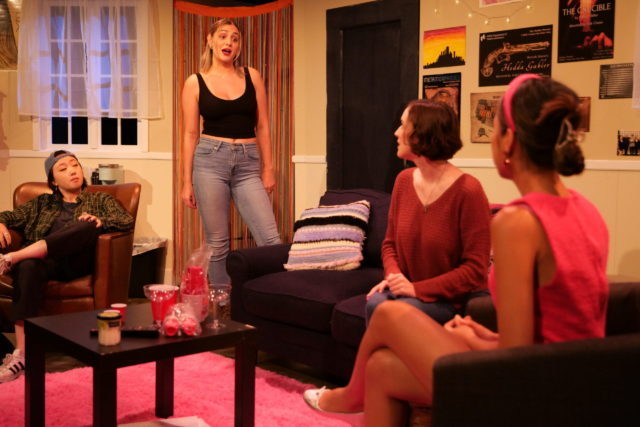
Rachel LaBeau (Caroline L. Orlando) shares her thoughts on theater and Shakespeare in world premiere (photo by Wesley Volcy)

Sophomore Piper Bell (Laura Clare Browne), junior Cam Witkowski (Morgan Lui), and seniors Alexis “Lexi” Lapp (Natasja Naarendorp) and Rachel LaBeau (Caroline L. Orlando) have gathered, anxiously awaiting the call board announcing who will be playing which role in the Minnesota college’s upcoming production of Macbeth. Rachel is fully expecting to be Lady Macbeth, having previously portrayed Hedda Tesman in Hedda Gabler, Janet Van de Graaff in The Drowsy Chaperone, Olivia in Twelfth Night, and Abigail Williams in The Crucible; Lexi is anticipating a key role as well, while Cam and Piper are eager for meaty supporting parts. But they all end up disappointed and more than a little surprised when unknown freshman Hailey Hudson (Marie Dinolan) from a small town in Indiana snags Lady M.

In order to find out who Hailey is, Rachel and Lexi decide to have a small get-together, inviting her to their dorm room. Piper, a perpetually upbeat virgin who grew up in a very Christian family, seems genuinely happy for Hailey, an adorable young woman who likes to say “cool” a lot.

“You must be so excited,” Piper says. “I am! Like literally so stoked,. I already told my parents and they’re gonna come see the show both weekends. They’re like really proud,” Hailey responds. “I’m proud! Oh man, when I gave you your tour last spring, I knew I had a good feeling about you and now look at you! Out there getting the lead your first semester!” Piper exclaims.

But Rachel and Lexi do not share Piper’s enthusiasm, for a few reasons. When Hailey, who refers to Macbeth as “Maccers,” says, “It’s not like Shakespeare is like totally pure . . . I mean, he probably wasn’t actually a real person, right?” Rachel nearly explodes. “Do not tell me you’re an Anti-Stratfordian,” she rages. “People who preach that Shakespeare could never have written his plays because he wasn’t educated enough or well-bred enough or whatever are ignorant, privileged pseudo-scholars who don’t want to believe that true art, true genius can come from anyone.”

Soon Rachel and Lexi are plying the innocent Hailey, who clearly is not enjoying her cosmo, with shots of Fireball and Svedka to help them pull off a devious plan.

Best friends Rachel (Caroline L. Orlando) and Lexi (Natasja Naarendorp) concoct a mean plan in macbitches (photo by Wesley Volcy)

Most of macbitches could pass the Bechdel test; although the five women talk about men — from classmates to the two school theater directors, Arik, who helms the plays, and Martin, who guides the musicals — it’s the ladies who are in charge of the narrative. In a way, they all have a version of Lady M inside them, making their own decisions as they search their desires.

But then the story turns on a dime, throwing everything that came before it under the bus as Rachel and Lexi become mean girls who seriously threaten Hailey. While it was clear that the two roommates had an ulterior motive for inviting Hailey over, what they aim to do is so extreme that it is difficult to believe. The play up till then had been thoroughly engaging, with well-drawn characters, excellent acting, smooth direction, and no men, reminiscent of Sanaz Toosi’s recent Wish You Were Here, about five close female friends in Iran, as well as Erica Schmidt’s ingenious 2019 Mac Beth for Red Bull, in which seven students at an all-girls school put on a contemporary version of the Scottish play.

While McIntosh (Ipswich, cityscrape), who is in Columbia’s MFA writing program, and director Ella Jane New (Chasing the River, Six Corners) raise important issues of misogyny, abuse, and harassment, the ending feels like it should be part of a different play. There was a moment that I thought the show would be over, and I would have found that satisfying, but the next scene, though meant to be shocking — not unlike the conclusion of Macbeth — instead was upsetting and disappointing. In Schmidt’s Mac Beth, women grab the power; in macbitches, they give it back.
HAMLET / ORESTEIA

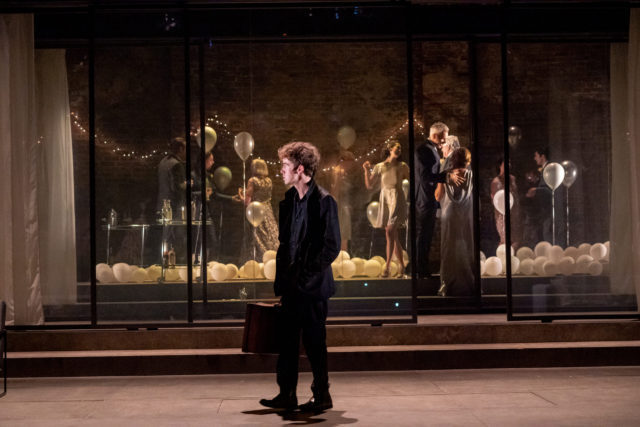
Alex Lawther is impressive as Hamlet in Robert Icke’s dazzling production at Park Ave. Armory (photo by Stephanie Berger)

HAMLET/ORESTEIA
Park Ave. Armory, Wade Thompson Drill Hall
643 Park Ave. at Sixty-Seventh St.
In repertory through August 13, $45-$199
www.armoryonpark.org/hamlet
www.armoryonpark.org/oresteia

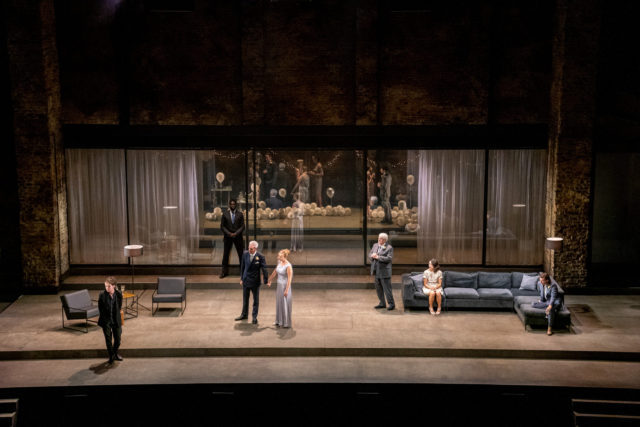
An overwhelming sense of grief and severe family dysfunction link Robert Icke’s ingenious pairing of Hamlet and Oresteia, running in repertory at Park Ave. Armory through August 13. You might not immediately think of the two tragedies, one written in English by William Shakespeare around 1600 about an introspective Danish prince, the other a Greek trilogy penned by Aeschylus in the fifth century BCE focusing on the conflicted son of a powerful king, as theatrical brethren, but Icke masterfully weaves them together over the course of seven thrilling hours.

Following up his superb one-person reimagining of Henrik Ibsen’s Enemy of the People starring Ann Dowd in a pandemic-reconfigured Wade Thompson Drill Hall at the armory, Icke returns with this extremely satisfying duo, which tackle similar themes in these contemporary versions. Whereas Icke makes subtle tweaks to Hamlet, he institutes much heavier changes to Oresteia.

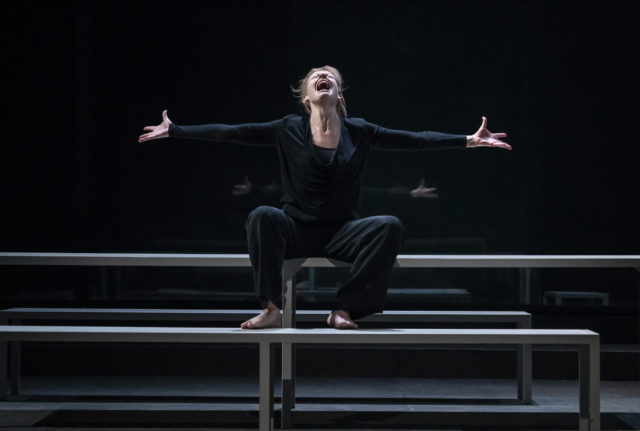
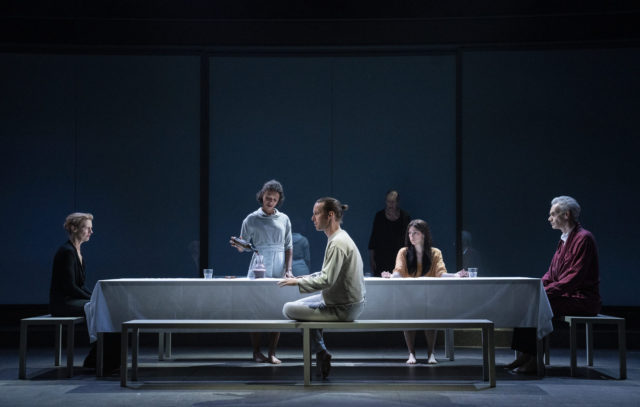
They both take place on Hildegard Bechtler’s expansive, relatively shallow horizontal set, with entrances at either side and a glassed-in back room with sliding doors that are alternately transparent, translucent, or opaque. For Hamlet, business chairs and a comfy L-shaped couch are brought on- and offstage in between rectangular marble stanchions, while for Oresteia, the furniture includes a long dinner table with benches, marble Greek pillars with exposed stone walls, and a large bathtub in the rear. Bechtler also designed the modern-day costumes, with intricate lighting by Natasha Chivers and sound by Tom Gibbons.

Hamlet, superbly played with a tender vulnerability by twenty-seven-year-old British actor Alex Lawther, is dismayed to find that his recently widowed mother, Gertrude (Jennifer Ehle), has married her late husband’s brother, Hamlet’s father, Claudius (Angus Wright), who is now the king of Denmark. The two seem very much in love, making out on the couch. But when Hamlet’s father’s ghost (David Rintoul), who appears on closed circuit security cameras wandering the empty, dungeonlike halls of Elsinore castle, tells his son that Claudius murdered him, Hamlet, who has been considering going back to school in Wittenberg, becomes obsessed with revenge, yet he lacks the resolve to take any kind of significant action in his life.

Klytemnestra (Anastasia Hille) and Agamemnon (Angus Wright) face each other across the family dinner table in Oresteia (photo by Joan Marcus)

Meanwhile, he seems destined to marry Ophelia (Kirsty Ryder), the daughter of Claudius’s chief adviser, Polonius (Peter Wight), and sister of the strong-willed Laertes (Luke Treadaway). Soon bodies are piling up, as Hamlet says, “with blood of fathers mothers daughters sons.”

In Oresteia, Agamemnon (Angus Wright), the king of Mycenae, is told by a seer, “By his hands alone. The child is the price. Fair winds.” Agamemnon and his brother, Menelaus (Peter Wight), need to sail their ships to Troy but are becalmed in Aulis, and Agamemnon interprets the prophecy to mean that he must kill his six-year-old daughter, Iphigenia (Elyana Faith Randolph or Alexis Rae Forlenza), in order to appease the gods and get the winds moving. The king is desperate to find another way, but both his brother and his herald, Talthybius (Josh Higgott), insist the deed must be done. When the queen, Klytemnestra (Anastasia Hille), deciphers the prophecy, she is of course furious, declaring, “You’re ill. You’re mad. To kill our child?” But she might not be able to stop him.

Ten years later, when Agamemnon returns from the war, bringing with him teenage captive Cassandra (Hara Yannas), he finds his family vastly changed. Bright young Orestes (Hudson Paul or Wesley Holloway) has grown into a conflicted teenager (Treadaway), daughter Electra (Tia Bannon) is jealous of Cassandra, and cousin Aegisthus (Angus Wright) has usurped Agamemnon’s place in the family. Soon bodies are piling up, and Klytemnestra warns Orestes, with more than a touch of wishful thinking, “You do not want blood on your hands.” Fathers, mothers, daughters, and sons are all in jeopardy.

Fear is central to both narratives. While Hamlet delivers his despair and anxiety directly to the audience in famous soliloquys, Oresteia unfolds in flashbacks as Orestes shares his memories with an unidentified woman (Ryder) who appears to be his therapist. Orestes tells her, “I watch it again, happening for the first time but — too late, too late to stop it. It pours out of me. But what if what’s next is — ? What if it’s better left sealed up, undisturbed?” The doctor responds, “We have to understand the truth.” Orestes: “What if it’s a dream? What if it’s a lie?” Doctor: “Then those lies reveal something about you. ‘Our self’ isn’t an absolute thing. It’s handfuls of memories and moments and people — and we form them into who we think we are. For most of us, it’s only partly true: one version of truth. A story.” Orestes: “A story. A story I’ve been through before. As a child. But I don’t know where it ends —”

Claudius (Angus Wright) and Gertrude (Jennifer Ehle) hold hands, much to Hamlet’s (Alex Lawther) consternation (photo by Stephanie Berger)

Looking backward and forward while fearing the end is also a leitmotif for each play. “I try and look forward rather than backward,” Agamemnon says. Hamlet explains, “I hold it not honesty to have it thus set down / for yourself sir should be old as I am / if like a crab you could go backward.” At dinner, Electra confesses, “I know. I was late. I have apologized. Let’s all just move forward.” When Orestes insists to the doctor that he can’t remember the past, she implores, “You will remember something. We just have to begin. Travel back along the road, all the way back to where it began.” Hamlet says to his mother, “Repent what’s past / Avoid what is to come.”

The words “end” or “ending” are repeated throughout all seven hours. “It’s ending. It is ending,” Agamemnon says. Hamlet explains to Claudius, “We fat all creatures else to fat us and we fat ourselves for maggots / that’s the end.” Talthybius tells Agamemnon and Menelaus, “No one thinks this thing is close to the end. It’s cut in deep, it’s gone too far for that. And our enemy is prepared, planning years beyond — so there’s no road to the end of this that’s swift.” Ophelia, losing control of her wits, babbles to Laertes, “I would give you some violets but they withered all when my father died / they say he made a good end / and will he not come again? / and will he not come again? / no no he is dead.”

Both works also explore the power of dreams. Hamlet famously says, “To die to sleep / to sleep perchance to dream / ay, there’s the rub / for in that sleep of death what dreams may come / when we have shuffled off this mortal coil / must give us pause.” Orestes asks the doctor, “What happens when I dream? What is knotting together with what — what is being made? Fear and wishes and — and if it’s me, if it’s just inside me with no meaning elsewhere, can’t I create something better than this, can’t I choose imagined hope rather than imagined fear?” Shortly after Klytemnestra awakes from a bad dream, Cilissa (Marty Cruikshank), Orestes’s nurse, recalls of him as a baby, “He screamed and screamed at night. Never a good sleeper.”

Icke, who is only thirty-five and was an associate director with the Almeida in London from 2013 to 2019, is now the Ibsen artist in residence at Ivo van Hove’s Internationaal Theater Amsterdam, and he has picked up van Hove’s obsession with using cameras to present live feeds on screens. (The projections are by Tal Yarden for Hamlet and Tim Reid for Oresteia.) In addition to the video surveillance that reveals Hamlet’s father’s ghost, there are news reports about young Fortinbras leading Norway’s military marching toward Denmark; press interviews with Agamemnon; and Claudius closely watching The Mousetrap, the play-within-a-play in which Hamlet discloses to Claudius that he knows he murdered his father. In addition, the screens are used for countdowns, ticking away the seconds during fifteen-, ten-, and five-minute intermissions in Oresteia like a doomsday clock. Meanwhile, articles of evidence and the exact times of characters’ deaths are detailed above the set like breaking news.

Klytemnestra (Anastasia Hille) can’t hold the pain inside any longer in Oresteia (photo by Joan Marcus)

Icke digs into 1960s music icons by featuring several Bob Dylan songs in Hamlet — one does not generally associate Dylan, and such tunes as Things Have Changed (“Standing on the gallows with my head in a noose / Any minute now I’m expecting all hell to break loose / People are crazy and times are strange / I’m locked in tight, I’m out of range”) and All Along the Watchtower (“There must be some kind of way outta here / Said the joker to the thief / There’s too much confusion / I can’t get no relief), as the soundtrack for a party with lots of dancing and balloons (of course, “Masters of War” would not exactly be the best choice either) — while Iphigenia sings verses from the Beach Boys’ “God Only Knows” in Oresteia (“God only knows what I’d be without you”).

The casting between the two plays is shrewdly resourceful. Wright is terrific as Claudius, Agamemnon, and Aegisthus, standing tall, speaking firmly, but not afraid to show the cracks in their armor. Peter Wright is stalwart as the loyal but ill-fated Polonius and Menelaus. Rintoul portrays the Player King and the ghost, haunting Claudius and Hamlet, respectively. Other key dualities that bring the works together include Bannon as Guildenstern and Electra, Treadaway as Laertes and Orestes, Abubakar as Marcellus and Calchas, Higgott as Horatio and Talthybius, Ryder as Ophelia and the doctor, Hara Yannas as Bernardo and Cassandra, and Athene Ross Waiton (in Hamlet only) as Francisco and the gravedigger, who makes a memorable appearance from under the stage, warbling Dylan’s “Sugar Baby.” Lia Williams was scheduled to play Gertrude and Klytemnestra but had to pull out after injuring her Achilles heel; Ehle and Hille are excellent as her respective replacements.

Both Hamlet and Orestes are onstage virtually the entire show, watching the proceedings when they’re not directly involved. They experience devastating loss that rips at their souls, and each has the opportunity to commit murder to avenge wrongdoing. Instead of wielding “a bare bodkin,” Hamlet puts a gun to Claudius’s head, while Orestes pulls a knife on one of his parents. But revenge will not necessarily relieve them of their deep trauma. “You must know your father lost a father / that father lost, lost his, and the survivor bound / in filial obligation for some term / to do obsequious sorrow / but to persever / in obstinate condolement is a course / of impious stubbornness / ’tis unmanly grief,” Claudius tells Hamlet. Referring to a murder in his family, the doctor tells Orestes, “You survived that trauma. We’re barely there in the moment it happens — we hardly feel it as it hollows us out — what hurts is the next second; awakening into what’s left — And I don’t think you’ve woken up. I’m not sure you want to wake up.” Orestes asks, “Why would I?” The doctor responds, “Fear. Of where you might be. Where you might really be.”

In a world turned upside down by a global pandemic that has killed nearly six and a half million people, Russia’s brutal invasion of Ukraine, climate change that is threatening the future of the planet, mass shootings in the United States committed with automatic assault weapons, and an insurrection that continues to jeopardize American democracy, many of us are afraid of where we might really be.

As Electra asks, “How do you mourn?” It’s a question we are all facing these days, in one way or another, a question brilliantly explored in Icke’s dueling plays.

DANCE WITH BACH

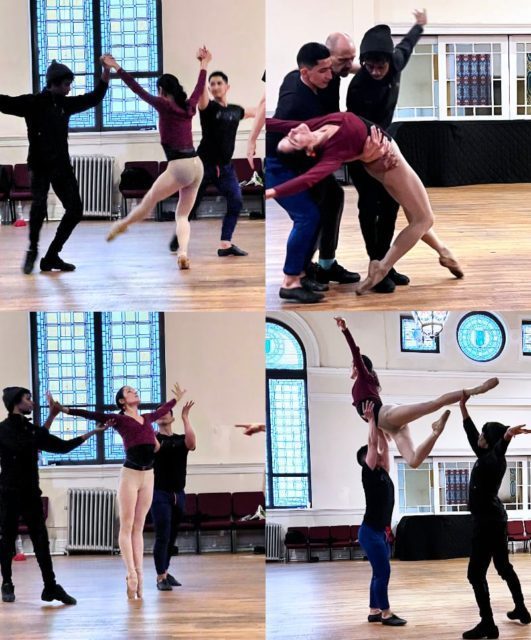
After two years, Dance with Bach is back (photo courtesy the Sebastians / Christopher Caines Dance)

Who: The Sebastians, Christopher Caines Dance
What: Music and dance celebrating Johann Sebastian Bach
Where: Good Shepherd-Faith Presbyterian Church, 152 West Sixty-Sixth St. between Amsterdam & Columbus Aves.
When: Friday, May 20, and Saturday, May 21, $20 virtual, $30-$50 in-person and virtual
Why: In 2014, the Sebastians, a chamber ensemble named after Johann Sebastian Bach, joined forces with Christopher Caines Dance to present Henry Purcell’s 1692 opera, The Fairy Queen, an adaptation of William Shakespeare’s A Midsummer Night’s Dream, merging baroque music with modern dance. Following a two-year delay because of the pandemic, the two companies are back together for Dance with Bach, a trio of Bach suites choreographed by Christopher Caines, taking place May 20-21 at the Good Shepherd-Faith Presbyterian Church by Lincoln Center as well as streaming online, photographed by multiple cameras. The program begins with Jean-Marie Leclair’s Ouverture from Deuxième récréation de musique d’une execution facile, Op. 8, followed by Bach’s Cello Suite No. 6 in D major, BWV 1012, performed on viola da spalla; English Suite No. 5 in E minor, BWV 810 for harpsichord; and Orchestral Suite No. 2 in B minor, BWV 1067 for flute, strings, and continuo.

“We are thrilled to finally bring Dance with Bach to fruition,” Sebastians artistic director Jeffrey Grossman said in a statement. “Christopher and the dancers had put in countless hours of rehearsal when we were forced to cancel our May 2020 performances. We discussed ways of producing the project virtually, with recorded music and dancers wearing masks, but decided there would be too many compromises. After such a long journey, the experience of being back in the same room with the dancers, to feel their energy and respond musically to their physicality, is incredible.” Caines added, “I am one lucky choreographer to have had this band really throw down the gauntlet by asking me to choreograph three iconic masterpieces by their namesake master composer. What a challenge! And my dancers could not be more thrilled at the prospect of taking the stage backed up by one of the finest baroque ensembles anywhere.”

The works will be danced by CCD members Michael Bishop, Elisa Toro Franky, Genaro Freire, Jeremy Kyle, Michelle Vargo, and Leigh Schanfein in addition to student dancers from New York Theatre Ballet School (Charlotte Anub, Audrey Cen, Josephine Ernst, Madeline Goodwin, Clara Rodrigues-Cheung, Emely Leon Rivas, Eva Sgorbati). The ensemble consists of David Ross on flute, Nicholas DiEugenio on violin, Daniel Lee on viola da spalla and violin, Jessica Troy on viola, Ezra Seltzer on cello, Nathaniel Chase on violone, and Grossman on harpsichord.

I LOVE THIS POEM: AN ONLINE READING

An all-star cast celebrates the power of poetry in online benefit for Literacy Partners

Who: Common, Julianne Moore, Liev Scheiber, Danai Gurira, Ethan Hawke, John Leguizamo, Tayari Jones, Cleo Wade, Kiese Laymon, Tommy Orange, Dinaw Mengestu, Kevin Kline, John Lithgow, Megha Majumdar, Zibby Owens, Mira Jacob, more
What: Online poetry reading benefiting Literacy Partners
Where: Literacy Partners online
When: Thursday, April 28, free with RSVP (donations accepted), 8:00
Why: On April 28 at 8:00, Literacy Partners will stream an encore presentation of “I Love This Poem: An Online Reading,” consisting of short works read by such actors as Common, Julianne Moore, Liev Scheiber, Danai Gurira, Ethan Hawke, John Leguizamo, Kevin Kline, and John Lithgow, hosted by Zibby Owens and Mira Jacob. Part of the organization’s literary and social justice series, the event, which was held on May 20, 2021, also features favorite poems read by two students, Angie and Monica. “We present this public reading in celebration of the power of poetry to heal, connect, and inspire us to advocate for a more just and equitable world,” Literacy Partners explains.

The evening includes poems by Fion Lim, Langston Hughes, Natalie Diaz, Billy Collins, Rabindranath Tagore, Lucille Clifton, John Keats, Alice Walker, William Shakespeare, Kim Addonizio, Pablo Neruda, Adrienne Rich, Rodolfo Gonzalez, and Maya Angelou. Literacy Partners was founded in 1973 to “emphasize support for individuals excluded from education because of racial or ethnic segregation and discrimination, economic challenges, sexism, or immigration status.”

JANE ANGER, OR . . .

William Shakespeare (Michael Urie) is suffering from writer’s block during the plague in Jane Anger (photo by Valerie Terranova)

JANE ANGER
New Ohio Theatre
154 Christopher St.
Tuesday – Sunday through March 26, $25-$75
newohiotheatre.org
www.janeangerplay.com

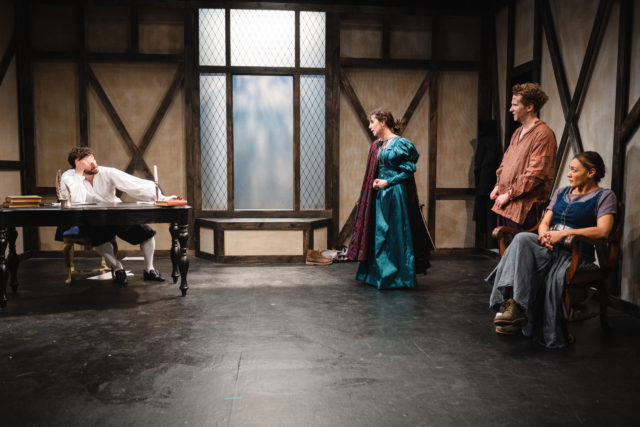
Talene Monahon’s Jane Anger is a frenetic farce that believes if you hit the audience with a nonstop, relentless barrage of jokes, enough are going to stick to make the experience worthwhile. The laughs actually begin with the full title, which is: Jane Anger or The Lamentable Comedie of Jane Anger, that Cunning Woman, and also of Willy Shakefpeare and his Peasant Companion, Francis, Yes and Also of Anne Hathaway (also a Woman) Who Tried Very Hard. And I’m happy to say that more than enough jokes hit their target to make this a very funny evening.

It’s 1606, and London is in the midst of yet another plague. Addressing the audience directly at the start of the play, Jane Anger (Amelia Workman) immediately equates that time with recent global affairs. “It’s back, baby!” she announces. “The death carts are out, the plague screecher is running around screeching, the playhouses have closed, fleas are swarming the streets, people are freaking out.”

With the city in lockdown, including the theater, William Shakespeare (Michael Urie) is stuck in his home, suffering an extreme case of writer’s block. With no place to go, Francis Sir (Ryan Spahn), an apprentice actor with the King’s Men — who appears to be much older than the nearly sixteen years he claims to be — asks for shelter from the Bard, who agrees to let him live on the floor in his writing room. The quaint Elizabethan set, by Joey Mendoza, features a large window in the back that functions as an entrance, above where Francis sleeps.

“Sixteen? This seems most improbable to me,” the Bard says. “You seem somewhat older and uglier and more weathered in the face.” Francis replies, “The poverty, sir. It has coarsened me. I assure you I am a mere youth. A boy, a stripling, a youngker!”

Real-life partners Michael Urie and Ryan Spahn star in new play by Talene Monahon (photo by Valerie Terranova)

Feeling a ton of pressure — during the 1593 plague, Shakespeare wrote the poems Venus and Adonis and The Rape of Lucrece and worries that now he will be outpaced by the prolific Ben Jonson and even Thomas Middleton — the Bard ultimately decides to pen King Lear, even though there is already another play about the same monarch, purportedly written by Thomas Kyd, called King Leir. But to make the story his own, Shakespeare is going to change Leir to Lear and Cordella to Cordelia.

Soon the Dark Lady of Shakespeare’s sonnets, Jane, his muse, pays a surprise visit on her former lover. “You’re alive. You came!” the Bard declares. “Aw! Not any time that you would remember,” Jane ribaldly answers.

Jane has a favor to ask of Shakespeare: She needs him to sign a document endorsing a pamphlet she is trying to get published by William Jaggard. (In fact, a woman going by the name Jane Anger did publish a highly influential 1589 pamphlet entitled “her Protection for Women. To defend them against the SCANDALOUS REPORTES OF a late Surfeiting Lover, and all other like Venerians that complaine so to bee overcloyed with womens kindnesse.”) But Will wants to finish his new play before helping Jane — and he’s not exactly sure about woman writers, as an earlier exchange with Francis revealed.

Francis: Sir. You need not fret. This shall all pass. Your genius is surely not imperiled by the plague-writing of other men or women or anyone —
Will: Men or who?
Francis: . . . Women, sir . . . ?
Will: Frankie! Was that your sarcasm again? A woman writing? What, sitting at a little desk with her quill? Scribbling away in her skirt?? “Look at me! I’m a woman writing!”
Francis: “Look at me! I’m a woman forming words out of my mind and then making sentences out of them.”
Will: “Look at me! I’m a woman who can spell!” HA HA.
Will and Francis: HA HA HA HA HA HA HA HA HA.

When Francis asks, “What is a Cunning Woman? Is that like a physician? Or a Barber-Surgeon?” Shakespeare replies, “Yes, Frankie, it’s similar but the differences are the person has breasts and makes less money.”

Next to join in the fray is Shakespeare’s detested wife, Anne Hathaway (Monahon). He purposely hasn’t seen her in seven years and seemingly refuses to acknowledge the prior existence of their son, Hamnet, who died a decade before, most likely from the plague. Anne Hathaway is always referred to by her full name, Anne Hathaway, and yes, there are inside references to the current actress, Anne Hathaway, who portrayed Viola in Twelfth Night at the Delacorte in 2009.

“Simply put, Anne Hathaway is Death to a writer’s process,” Shakespeare declares, adding a moment later, “For whatever reason, people don’t seem to like Anne Hathaway. It’s a bit of a thing, actually.”

The high jinks speed up with four characters onstage as egos clash, revelations are made, and the silliness only increases, with Monty Python-esque humor.

Amelia Workman stars as the title character in Talene Monahon’s Jane Anger (photo by Valerie Terranova)

An earlier, shorter iteration of Jane Anger, called Frankie and Will, was streamed during the pandemic, with the action taking place in Urie (Angels in America, Buyer & Cellar) and Spahn’s (Moscow Moscow Moscow Moscow Moscow Moscow, How to Load a Musket) Manhattan apartment; the real-life partners did numerous virtual presentations over the last two years, and they both starred in Michael Kahn’s eccentric production of Hamlet for Shakespeare Theater Company in 2018, with Urie as the title character and Spahn as his old friend Rosencrantz. Having acted together so often — in addition to cohabitating — the pair has an instant chemistry, in this case reminiscent of Abbott & Costello.

Director Jess Chayes (HOME/SICK, The Antelope Party) holds nothing back, letting the characters fire away at will, pun intended. Plenty of jokes miss their target — repeated references to the Pony Rule, the equivalent of social distancing, fall flat — but plenty nail the bull’s-eye.

Monahon, who previously wrote How to Load a Musket and starred in Widower’s Houses for TACT, is lithe and demure as the somewhat simpleminded, self-deprecating Anne Hathaway, while the ever-dependable Workman (Fefu and Her Friends, Tender Napalm) is bold and fierce as the unabashed, forward-thinking Jane.

In her pamphlet, Anger wrote, “At the end of men’s fair promises there is a Labyrinth, and therefore ever hereafter stop your ears when they protest friendship, lest they come to an end before you are aware whereby you fall without redemption. The path which leads thereunto, is Mans wit, and the mile’s ends are marked with these trees, Folly, Vice, Mischief, Lust, Deceit, and Pride. These to deceive you shall be clothed in the raiments of Fancy, Virtue, Modesty, Love, True meaning, and Handsomness. . . .” Monahon and Chayes capture that spirit in this madcap comedy.

THE MERCHANT OF VENICE

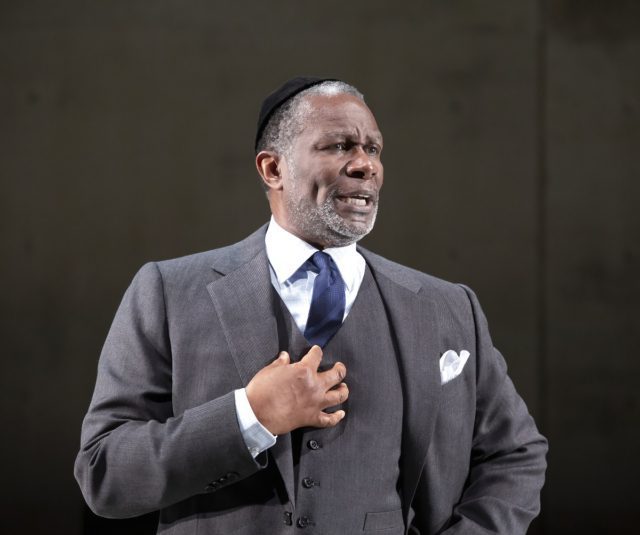
John Douglas Thompson is extraordinary as Shylock in TFANA production of The Merchant of Venice (photo by Henry Grossman)

THE MERCHANT OF VENICE
Theatre for a New Audience, Polonsky Shakespeare Center
262 Ashland Pl. between Lafayette Ave. & Fulton St.
Through March 6, $75-$85
866-811-4111
www.tfana.org

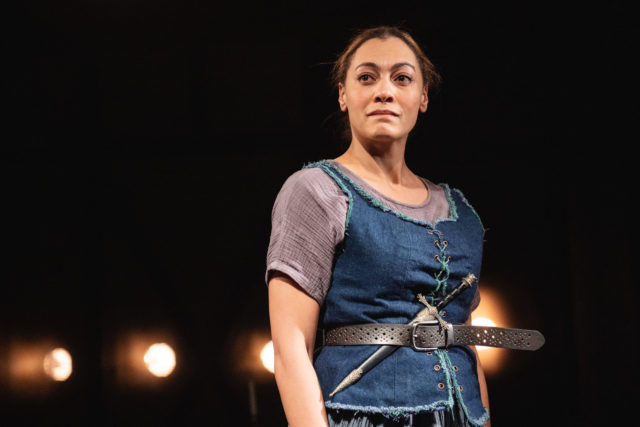
Arin Arbus reimagines a Merchant of Venice for this moment in time in her ingenious adaptation of the Bard’s challenging tragedy, continuing through March 6 at TFANA’s Polonsky Shakespeare Center. A coproduction with DC’s Shakespeare Theatre Company, the play is Arbus’s fourth collaboration with classical treasure John Douglas Thompson, following Macbeth, Othello, Ibsen’s A Doll’s House, and Strindberg’s The Father. Thompson is heart-wrenching as Shylock, the first professional Black actor to play the role in New York City since Ira Aldridge in the 1820s.

When the lights go out, the full ensemble comes out in regular dress, signaling they are performers, not the characters they are about to portray. A moment later the show begins, with the cast in contemporary costumes by Emily Rebholz — blazers, jeans, sneakers, gym clothes, suits. Riccardo Hernandez’s set is an imposing faux marble wall and steps, with a large black hole in the upper center, as if the sun and moon are both gone. The characters enter and leave through two doors, the wings, or the aisles, almost as if they’re part of the audience.

In order to woo the wealthy, beautiful heiress Portia (Isabel Arraiza), the noble Bassanio (Sanjit De Silva) asks his close friend, Venetian merchant Antonio (Alfredo Narciso), to borrow three thousand ducats from respectable Jewish moneylender Shylock. Shylock is tired of being mocked because of his religion, and he lets Antonio know it. He tells the brash Antonio, “Many a time and oft / In the Rialto you have rated me / About my moneys and my usances: / Still have I borne it with a patient shrug, / For sufferance is the badge of all our tribe. / You call me misbeliever, cut-throat dog, / And spit upon my Jewish gaberdine, / And all for use of that which is mine own. / Well then, it now appears you need my help: / Go to, then; you come to me, and you say / ‘Shylock, we would have moneys:’ you say so; / You, that did void your rheum upon my beard / And foot me as you spurn a stranger cur / Over your threshold: moneys is your suit / What should I say to you? Should I not say / ‘Hath a dog money? is it possible / A cur can lend three thousand ducats?’ Or / Shall I bend low and in a bondman’s key, / With bated breath and whispering humbleness, Say this; / ‘Fair sir, you spit on me on Wednesday last; / You spurn’d me such a day; another time / You call’d me dog; and for these courtesies / I’ll lend you thus much moneys’?”

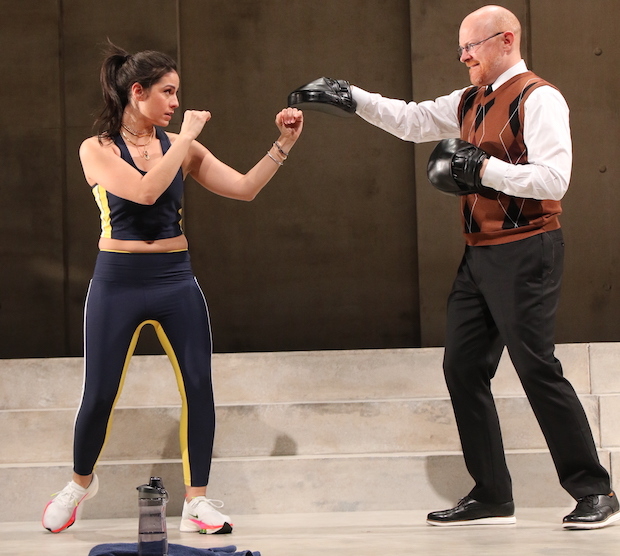
Portia (Isabel Arraiza) works out with her servant Balthazar (Jeff Biehl) in The Merchant of Venice (photo © Gerry Goodstein)

It’s a powerful speech that sets the stage for the relationship between Shylock and the others; he is clearly well educated and eloquent, but despite his passionate entreaty, the Christians treat him with scorn and disdain. Antonio needs to obtain the money for Bassanio, but he cannot help but still belittle Shylock.

“I am as like to call thee so again, / To spit on thee again, to spurn thee too,” he tells him. “If thou wilt lend this money, lend it not / As to thy friends; for when did friendship take / A breed for barren metal of his friend? / But lend it rather to thine enemy, / Who, if he break, thou mayst with better face / Exact the penalty.”

The penalty is a harsh one: Instead of charging Antonio interest, Shylock says he will take a pound of Antonio’s flesh if he doesn’t return the three thousand ducats in three months’ time. Certain that his merchant ships will come back successfully a month before the agreement ends, Antonio signs the contract.

Antonio and Bassiano are often accompanied by their sycophantic bros: snarky, sunglasses-wearing, cocktail-swilling yuppie Gratiano (Haynes Thigpen), who is funny until he isn’t; Solanio (Yonatan Gebeyehu) and Salerio (Graham Winton); and Lorenzo (David Lee Huynh), who wants to elope with Shylock’s daughter, Jessica (Danaya Esperanza), and convert her to Christianity to further her father’s shame. In addition, Shylock’s servant, the goofy Lancelot Gobbo (Nate Miller), who wears his jeans very low, quits his job with the moneylender and moves on to Bassiano. “For I am a Jew, if I serve the Jew any longer,” Lancelot says.

Meanwhile, two suitors beat Bassanio to try to win Portia’s hand. First Prince Morocco (Maurice Jones), then Prince of Aragon (Varín Ayala), must choose wisely among three caskets, one of which holds the key to Portia’s heart — and fortune. On the gold one is inscribed, “Who chooseth me shall gain what many men desire,” on the silver “Who chooseth me shall get as much as he deserves,” and on the lead “’Who chooseth me must give and hazard all he hath.”

Portia is attended by her servant Balthazar (Jeff Biehl) and her maid, Nerissa (Shirine Babb); the latter is supremely efficient, while the former offers comic relief, flirting hysterically with many of the men he meets and, when Portia asks for music, uses his iPhone. (The sound and original music is by Justin Ellington.)

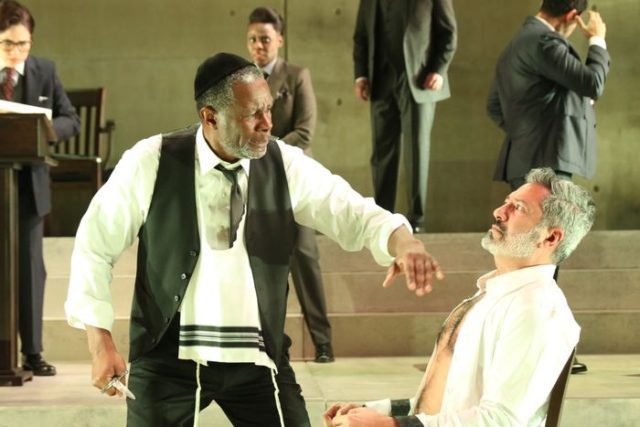
Shylock (John Douglas Thompson) demands a pound of flesh from Antonio (Alfredo Narciso) in Shakespeare tragedy (photo © Gerry Goodstein)

It all leads up to one of the great trial scenes in all of theater, a brutal battle of wits in which Shylock, who is suing Antonio for his pound of flesh, represents not only Jews and Blacks, both of whom have histories of being enslaved and discriminated against up to the present day, but, in essence, all of humanity who have suffered hatred and oppression at the hands of tyrants and bigots.

Throughout its four-century existence, The Merchant of Venice has likely been performed by troupes that glorified anti-Semitism and was cheered on by audiences that agreed with Antonio and his friends’ views of Jews, as well as by companies and audiences that had deep sympathy for Shylock’s plight. But Arbus achieves something different.

The casting is diverse but not random; by having Shylock and Jessica portrayed by Black actors, Arbus is making a powerful statement, particularly in the socioeconomic reckoning that has taken hold in the wake of the police murder of George Floyd. With his gentle cracked whisper of a hoarse voice that comes from deep in his soul, the British-born Thompson (Jitney, The Iceman Cometh) is unforgettable as Shylock, not merely following in the footsteps of Laurence Olivier, F. Murray Abraham, George C. Scott, Al Pacino, Jonathan Pryce, and Patrick Stewart but making the role his own.

When Shylock, who is repeatedly referred to as a dog, a villain, a cur, and the devil, asks, “If you prick us, do we not bleed? / If you tickle us, do we not laugh? / If you poison us, do we not die? / And if you wrong us, shall we not revenge?” Thompson is speaking for all the downtrodden; Shakespeare’s words echo down the ages: Sojourner Truth’s “Ain’t I a Woman?” speech leaps to mind as well. When Shylock tells the court, “Proceed to judgment: by my soul I swear / There is no power in the tongue of man / To alter me: I stay here on my bond,” Thompson speaks for all who resist injustice.

Arraiza shines as Portia, whether working out, dressed in an elegant gown with stiletto heels, or disguised as a learned doctor. Arbus ratchets up the homoeroticism by having Bassanio and Antonio be very good friends, while Biehl practically waves the Gay Pride flag as Balthazar. As serious as the subject matter is, Arbus includes plenty of fun and good humor; Biehl and Miller in particular often make vocal and gestural asides that are hilarious and certainly not in the original script.

“The quality of mercy is not strained, / It droppeth as the gentle rain from heaven / Upon the place beneath. It is twice blest: / It blesseth him that gives and him that takes,” Portia says in Act 4. We are blessed to have such a thrilling production of this dark tragedy; if only all were blessed equally with mercy in these dark times.

PERICLES 2021

Who: Red Bull Theater
What: Online reading and discussions about Shakespeare’s Pericles
Where: Red Bull Theater YouTube and Facebook
When: Livestreamed events October 4, 11, 18, 25, 28, free with advance RSVP
Why: Last year Red Bull Theater presented “Othello 2020,” a deep dive into the Shakespeare tragedy through performances and discussions. This year Red Bull is digging into one of Shakespeare’s lesser-known works, Pericles, about the Prince of Tyre, who sets out on a series of adventures when the answer to a riddle goes awry. In a statement, Red Bull founding artistic director Jesse Berger explains, “Shakespeare’s Pericles is at the heart and soul of Red Bull in many ways: our founding play, Jacobean in period, hopeful in spirit, and about the power of imagination at its core. ‘It hath been used as restoratives,’ the poet Gower says right at the beginning of the play. To me, this play is about restoring hope and peace after a period of turmoil and tragedy. I’ve always loved the idea of this play as a hero journey, and a play about the healing power of storytelling itself. As the play that began the life of our theater company, it seems most appropriate that we explore this play anew, continuing our journey — toward our twentieth year of existence as a company, reemerging out of the pandemic shutdown, and inviting new voices to be in creative conversation with the play and the Western classical canon.”

Red Bull’s inaugural production, in 2003, featured Daniel Breaker in the title role, with Raphael Nash Thompson as Gower and Cerimon; on October 4, Thompson, who also portrayed Gower in Sir Trevor Nunn’s version at TFANA in 2016, performed the prologue “To sing a song that old was sung” and discussed the play in a RemarkaBULL Podversation with Red Bull associate artistic director Nathan Winkelstein that you can watch here. “Exploring Pericles in 2021” began on October 11 and continues October 18, with BIPOC artists Grantham Coleman, Kimberly Chatterjee, Callie Holly, Mahira Kakkar, Jordan Mahome, Anthony Michael Martinez, Clint Ramos, Kenny Ramos, Madeline Sayet, and Craig Wallace delving into what Pericles means today. On October 25, Kent Gash will direct a livestreamed benefit reading of the play, with Coleman as Pericles. The programming concludes October 28 with an interactive Bull Session featuring Gash, scholar Noémie Ndiaye, and members of the company.

“Over the last two decades, Pericles has been produced around the world more often than in the entire twentieth century,” writes Ndiaye, an assistant professor of English at the University of Chicago. “The play was wildly popular in its own time, and it is now poised to become one of the twenty-first century favorite rediscovered Shakespearean plays. It may have caught the attention of contemporary theatermakers invested in diversifying Shakespeare in part because its geographical location, which moves between ancient Lebanon, Turkey, Libya, and Greece, makes it suitable for cross-cultural multiracial casting. And, certainly Pericles is a fertile terrain for racial investigation. Yet at the same time, the play’s consistent characterization of ‘fairness’ (a word used twenty-three times) as the feminized object of Pericles’s desire and the curative means of his salvation frames his journey as a romantic quest for whiteness and white world-making at the dawn of modernity. It is that fraught and complex racial terrain with which contemporary theatermakers must reckon when they stage Pericles today, finding new creative ways of doing Shakespeare better, Shakespeare with us and for us.”