Tag Archives: william shakespeare

IZZARD HAMLET NEW YORK

Eddie Izzard plays nearly two dozen characters in one-woman Hamlet (photo by Carol Rosegg)

IZZARD HAMLET NEW YORK
The Greenwich House Theater
27 Barrow St. at Seventh Ave. South
Tuesday – Sunday through March 16, $81-$125
Orpheum Theatre
126 Second Ave. between Seventh & Eighth Sts.
Tuesday – Sunday, March 19 – April 14
www.eddieizzardhamlet.com

Eddie Izzard doesn’t make things easy for herself.

In winter 2022–23, she presented a one-woman version of Charles Dickens’s Great Expectations at the Greenwich House Theater. The wonderful two-hour, two-act show was adapted by Izzard’s brother Mark and directed by Selina Cadell. Now the trio is taking on William Shakespeare’s classic revenge tragedy, Hamlet, with the full crew from the previous play. The production more than lives up to its great expectations.

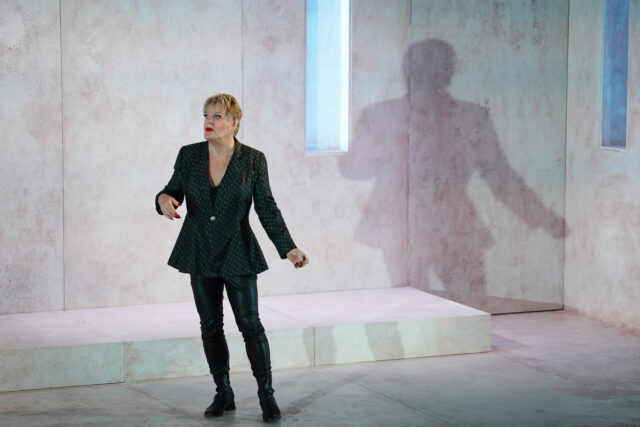
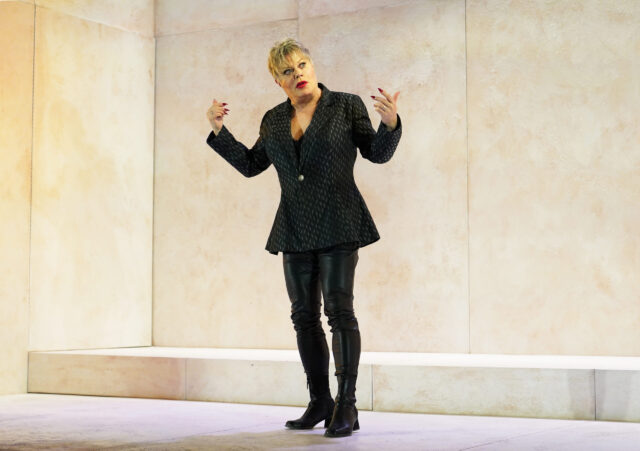
Izzard once again is dressed in a goth steampunk outfit, designed by Tom Piper and Libby DaCosta, this time consisting of black boots, tight black leather pants, and a silvery black-and-green long peplum blazer over a neckline-revealing top. Piper’s set is a long, rectangular space with three narrow, vertical windows, recalling a room in a tower where damsels in distress are imprisoned as well as a room in a psychiatric facility where someone having difficulty with reality is treated. Tyler Elich’s lighting shifts among several emotional colors that shine through the windows and a panel running along the underside of the set’s ceiling.

Izzard casts an impressive figure onstage, appearing much bigger than her five-foot-seven frame. In a mesmerizing tour de force, she portrays twenty-three characters, including Prince Hamlet; the ghost of Hamlet’s father, the recently murdered king; Claudius, the king’s brother and Hamlet’s uncle, who now wears the crown; Gertrude, Hamlet’s mother who married her former brother-in-law before her husband’s body was cold; Hamlet’s best friend, Horatio; Hamlet’s true love, Ophelia; Ophelia’s father, Polonius, Claudius’s most trusted councilor; Laertes, Ophelia’s brother; and Fortinbras, the prince of Norway; in addition to the leader of a traveling theater company, two gravediggers, various Danish soldiers and courtiers, and others.

Eddie Izzard’s Hamlet has been extended at Greenwich House Theater and will then move to the Orpheum (photo by Carol Rosegg)

There are no costume changes; when shifting between characters, Izzard slightly alters her voice and position onstage, running back and forth, twisting her body, or adjusting her posture. But she brings down the house with Rosencrantz and Guildenstern, for whom she uses her hands when they speak, the effect enhanced by the deep red polish on her fingernails. (Just wait till you see how she deals with a fencing duel; the movement direction is by Didi Hopkins.)

Izzard delivers all the famous monologues (“O, that this too too solid flesh would melt,” “To be, or not to be,” “O, what a rogue and peasant slave am I!” et al.) beautifully, lending each line its own nuance; it is never mere recitation. The few times Izzard, who is dyslexic, stumbled over a word or two, she quickly corrected it, displaying that she is in complete command of not only the text but what it means. The lack of props enhanced the power of the language and the intricacies of the plot. At one point, when a loud, distracting crinkling noise could be heard in the mezzanine, Izzard, in stride, directed a laserlike gaze at the perpetrator without missing a beat. She also occasionally ambles determinedly offstage, wandering through the aisles, making eye contact with the crowd as Hamlet shares his foibles.

The Aden-born Izzard is best known as a comedian, which might explain some of the inappropriate laughter intermittently coming from a handful of audience members the night I went. There are some very funny moments, but overall it’s a pretty serious drama.

In the last nine years, I’ve seen ten productions of and/or involving Hamlet, ranging from a German avant-garde version at BAM and an intense intellectual staging at Park Avenue Armory to a modern-day BIPOC update at the Public and on Broadway and a wildly unpredictable and flatulent interpretation at Japan Society.

Izzard Hamlet New York is another memorable adaptation to add to the ever-growing list.

[Mark Rifkin is a Brooklyn-born, Manhattan-based writer and editor; you can follow him on Substack here.]

UNDER THE RADAR: HAMLET | TOILET

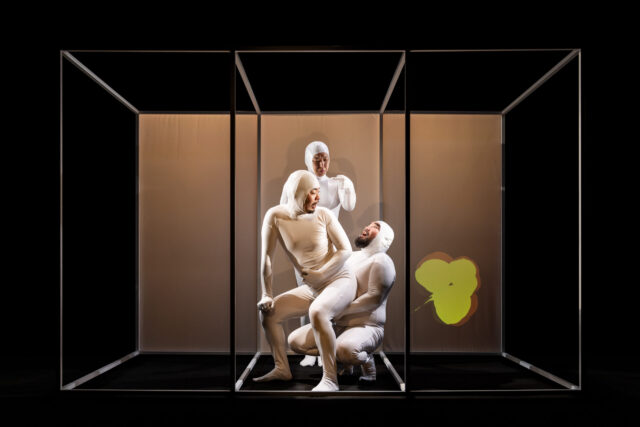
Hamlet (Takuro Takasaki) is in desperate need of a bowel movement in HAMLET | TOILET (photo © Maria Baranova)

HAMLET | TOILET
Japan Society
333 East 47th St. at First Ave.
January 10-13, $35
japansociety.org

To go, or not to go? That is the multilayered question asked in Yu Murai and Kaimaku Pennant Race’s absurdist, scatological HAMLET | TOILET, continuing at Japan Society through January 13 as part of the Under the Radar festival.

As you enter Japan Society, you are greeted by a different kind of step and repeat; instead of posing in front of a show logo, you can snap a selfie with a glitteringly white Japanese Toto washlet on a red platform, a fancy toilet with such special features as a heated seat and a bidet. It sets the mood for what is to follow, ninety minutes of controlled chaos involving more flatulence than the beans scene in Mel Brooks’s Blazing Saddles.

Murai has previously reimagined works by William Shakespeare in Romeo and Toilet and Ashita no Ma-Joe: Rocky Macbeth, wildly unpredictable tales that incorporate dance, music, strange props, and bizarre costumes. HAMLET | TOILET sits comfortably within that oeuvre. The production takes place in and around a three-stall installation, an open cube with a back wall and no doors. The three actors, Takuro Takasaki, G. K. Masayuki, and Yuki Matsuo, are dressed in unflattering white body-hugging latex suits reminiscent of the spermatozoa in Woody Allen’s Everything You Always Wanted to Know About Sex* (*But Were Afraid to Ask).

Plenty of flatulence is on the menu in unique adaptation of Hamlet at Japan Society (photo © Maria Baranova)

The essence of the Bard’s tragedy is in there, somewhere: Hamlet’s (Takasaki) uncle, Claudius (Masayuki), has killed Hamlet’s father, married his mother, and become king. Hamlet is in love with Ophelia (Masayuki), whose brother, expert fencer Laertes (Matsuo), is not a Hamlet fan. Hamlet’s besties, Horatio (Masayuki) and Marcellus (Matsuo), have encountered the ghost of their friend’s father, who tells his son that his murder must be avenged. To do so, Hamlet has to face his conscience, which is not lodged in his brain or heart but in his painful belly — the load he is carrying is an intensifying bowel movement that his multidimensional constipation will not allow him to release.

For much of the show, the actors are in the middle stall, trying to take dumps, either squatting by themselves or sitting on a cushiony human bowl formed by the other two actors. They gleefully pass gas that is projected in colorful animation by Takashi Kawasaki, accompanied by the appropriate sounds. The characters discuss aspects of making number two in ways that no play or novel that I know of ever has; no bathroom subject or feces joke is off limits, regardless of how silly or lowbrow. Nobody can find relief, not even from Ophelia’s headdress, which consists of dozens of rolls of toilet paper.

Amid deep dives into the shape, consistency, aroma, and chocolatey nature of human waste, Murai also delves into cowardice, sanity, suffering, and revenge. The dialogue is similarly mixed; Hamlet veterans will appreciate such real Shakespearean lines as “That adulterate beast won to his shameful lust . . . my queen,” “Never make known what you have seen [and heard] tonight,” “[I am going to] put an antic disposition on,” and “I should have fatted all the region kites / With this slave’s offal: bloody, bawdy villain!”

Purists might grimace at the more coarse language, such as “Something must be born that will trace a single line / like a magnificent line of feces / straight through all of this wonderful society,” “Please, just this once / couldn’t it be soft and gently flow like water,” “You must cleanly and completely defecate me!” and “In a world that is moved by the strict laws of almighty God / that which should not have moved has passed / That’s why my movement will not pass!” Even the subtitles themselves are in on the fun, changing the spelling and capitalization of nec-ASS-arily and BUTT (instead of but).

The three actors occasionally break out into song and dance; the music is by DJ and hip-hop producer Tsutchie from Shakkazombie, with hilarious choreography by Shinnosuke Motoyama. There’s far too much repetition, as numerous jokes spew out like the preparation for a colonoscopy, and in one scene the play makes fun of that itself as repeated statements fill up the subtitles monitor in ever-smaller type. But just when you think the production is merely a fart-fantasy concocted by Eric Cartman or Beavis and Butt-Head, Murai slips in something ridiculously clever so you won’t lose your appetite; it’s not merely Shakespeare as bathroom reading, although that’s in there too. Murai is not claiming that Shakespeare, or theater in general, is full of shit, but it might be in need of a thorough cleansing.

Which brings us back to the original question: To go, or not to go? HAMLET | TOILET is certainly not for everyone; some gags were met with laughter and applause, while others received random chuckles or guffaws — or silence. If you do get a ticket — the January 12 performance will be followed by an artist Q&A — be sure to use the facilities, which have several washlets, in addition to doors to ASSure your privacy.

[Mark Rifkin is a Brooklyn-born, Manhattan-based writer and editor; you can follow him on Substack here.]

ALL THE DEVILS ARE HERE: HOW SHAKESPEARE INVENTED THE VILLAIN

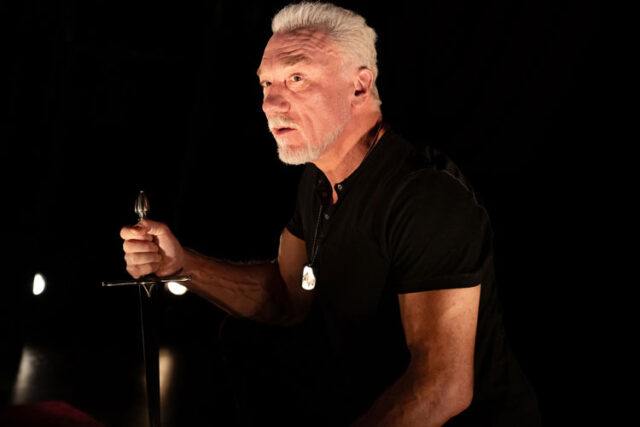
Patrick Page explores the history of villainy in Shakespeare’s plays in captivating one-man show at DR2 (photo by Julieta Cervantes)

ALL THE DEVILS ARE HERE: HOW SHAKESPEARE INVENTED THE VILLAIN
Daryl Roth Theatre
103 East 15th St. between Irving Pl. & Park Ave.
Tuesday – Sunday through March 31, $110-$160
allthedevilsplay.com

In May 2021, Tony nominee Patrick Page presented a streaming version of his one-man show All the Devils Are Here: How Shakespeare Invented the Villain, recorded in Shakespeare Theatre Company’s empty Sidney Harman Hall in DC. At the time, I wrote, “Page knows what of he speaks; in addition to having portrayed his fair share of Shakespeare baddies, he has played Scar in The Lion King, Scrooge in A Christmas Carol, the Green Goblin in Spider-Man: Turn Off the Dark, Hades in Hadestown, and the Grinch in Dr. Seuss’s How the Grinch Stole Christmas, villains all in one form or another. His command of Shakespeare and the concept of evil is bold and impressive, but he is down-to-earth enough to throw in plenty of surprising modern-day pop-culture references to keep it fresh and relevant to those who might not know much about the Bard or Elizabethan theater.” His bravura performance provided a vital dose of theater to the drama-starved during the lockdowns, and I named it Best Solo Shakespeare Play in twi-ny’s third Pandemic Awards.

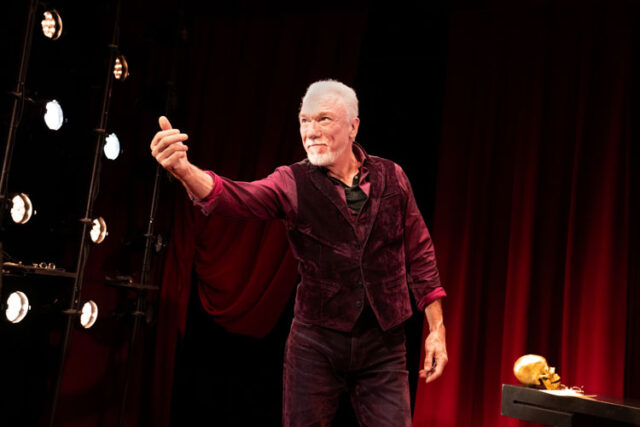
He has now brought the show to the Daryl Roth Theatre in Union Square, adapting it for a live audience in the intimate space that seats a mere ninety-nine people. Arnulfo Maldonado’s set features a desk and a chair in front of a red curtain, with various props stored on lighting scaffolds on either side of the stage. Primarily dressed in a red velvet outfit with a vest (the costumes are by Emily Rebholz, with chilling lighting by Stacey Derosier and sinister sound by Darron L West), Page makes only minor garment changes and uses minimal props, including a skull, a dagger, a book, and other items, as he portrays Lady Macbeth (Macbeth), Richard of Gloucester (Richard III), Shylock (The Merchant of Venice), Malvolio (Twelfth Night), Claudius (Hamlet), Angelo (Measure for Measure), Iago (Othello), and other villainous Shakespeare creations. He connects the development of these evildoers to Shakespeare’s own maturation as a playwright, comparing Barabas from Christopher Marlowe’s The Jew of Malta to Aaron the Moor from Titus Andronicus. Exploring the mindset of psychopaths, Page draws a through line among the characters.

“Think of it: It’s a superpower!” he proclaims. “You might become a wizard on Wall Street or an Academy Award–winning producer. You might even become president of the United States. That is a psychopath.”

Page regularly drops in contemporary references, from Facebook and House of Cards to Succession and Uma Thurman as well as a bit of juicy gossip about the Bard.

With his deep, resonant voice and buff body, Page is a mesmerizing performer; it’s easy to be carried away by his imposing stage presence, and the audience’s trust in him is well placed. Simon Godwin, the artistic director of Shakespeare Theatre Company, previously directed Page as King Lear and expertly lets him strut his stuff in All the Devils Are Here as Page delivers a master class in villainy.

Patrick Page beckons the audience to join him on a unique Shakespeare ride in All the Devils Are Here (photo by Julieta Cervantes)

At a talkback after the show I saw, I asked Page about how he adapted the streaming film into the current live play. He responded, “A one-man show is already such a strange thing for an actor because acting is by its very nature a reciprocal process. You really are a reactor. You don’t generate a lot of stuff when you’re in a play with people. You’re simply reacting, listening, reacting, listening, reacting, listening, reacting. So in a one-man show, it’s different. With no audience, of course, you have to make up a lot in your imagination of what might be going on. Now I still have to make up some, but at least you’re there.

“So I feel the vibrations, I feel the energy, I feel the listening, I hear the laughs (as much as I can hear), and that you become my acting partner in the show. And my overall objective, of course, is to communicate this story to you as clearly as I can. And it’s very, very helpful to have someone there listening and thinking, you know, how you would tell a story differently to different people. And so I’m aware that there are people in the audience who have, let us say, a depth of experience with Shakespeare. I’m aware that there are people who’ve had very little experience with Shakespeare. I’m aware that there are people who have had only bad experiences, which many of us have had. It’s likely that you have had bad experiences. And someone tried to get you to read King Lear when you were in high school and, of course, it was completely indecipherable, never meant to be read in that way. So I’m aware of that as I’m telling the story. And that’s part of what animates it.”

With humor and gravitas, Page (Coriolanus, Cymbeline, Casa Valentina, Spring Awakening) deepens our experience of Shakespeare, offering a gift that will stay with you as you continue on your personal adventures with the Bard.

[Mark Rifkin is a Brooklyn-born, Manhattan-based writer and editor; you can follow him on Substack here.]

PUBLIC WORKS: THE TEMPEST

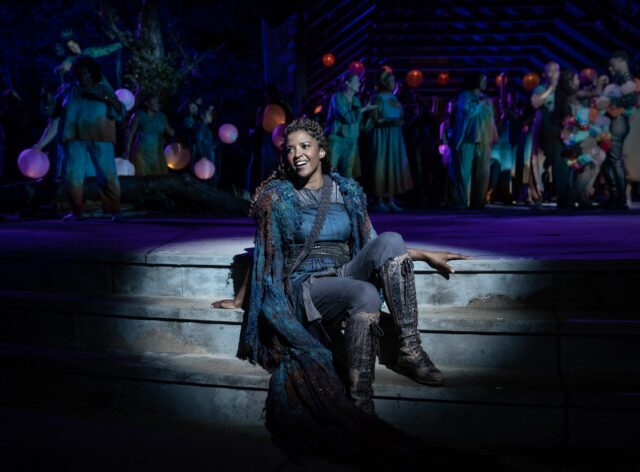
Renée Elise Goldsberry is sensational as Prospero in Public Works musical adaptation of The Tempest (photo by Joan Marcus)

THE TEMPEST
Central Park, Delacorte Theater
Through September 3, free, 8:00
publictheater.org

In 2013, the Public Theater inaugurated its Public Works program, which partners with community organizations throughout the five boroughs, with a musical adaptation of William Shakespeare’s The Tempest, featuring music and lyrics by Todd Almond, who played Ariel alongside Laura Benanti as the Goddess, Norm Lewis as Prospero, Carson Elrod as Caliban, and some two hundred nonprofessional actors from such local groups as the Fortune Society, the Brownsville Recreation Center, the Children’s Aid Society, DreamYard, and Domestic Workers United.

In 2015, Michael Greif directed a nonmusical Shakespeare in the Park version with Sam Waterston as Prospero, followed in 2019 by Laurie Woolery’s streamlined Mobile Unit adaptation with Myra Lucretia Taylor as the sorcerer.

Woolery is back in charge for the latest iteration, a brand-new lighthearted Public Works interpretation with music and lyrics by Miami native and Columbia grad Benjamin Velez in his full-fledged New York debut. Public Theater artistic director Oskar Eustis promised in his introduction we will all be able to boast, “I was there” as Velez’s career takes flight.

Ariel (Jo Lampert) orchestrates drama with the help of her minions in The Tempest (photo by Joan Marcus)

Tony winner Renée Elise Goldsberry (Hamilton, As You Like It) is sensational as Prospero, the rightful duke of Milan who has fled to a remote island after her brother, Antonio (Anthony Chatmon II), usurped her crown with the help of his friend Alonso, the king of Naples (Joel Frost), twelve years earlier. Living with her sixteen-year-old daughter, Miranda (Naomi Pierre), she now rules over dozens and dozens of spirits in addition to her slave, the deformed Caliban (Theo Stockman), and her indentured servant, the sprite Ariel (Jo Lampert).

In the thrilling opening number, a vengeful Prospero declares, “I call upon the skies, the eyes of justice watching over / There sail my enemies, I send the breeze their way / I summon every cloud to be a shroud on those who wronged me / They took my life so now I vow to make them pay! . . . I’ll finally be free / of the tempest in me.”

The shipwreck brings Antonio and Alonso to the island, along with Sebastian (Tristan André), Alonso’s brother; Ferdinand (Jordan Best), Alonso’s son; Gonzalo (Susan Lin), Alonso’s councilor; and the comic relief of Stephano (Joel Perez), the king’s butler, and Trinculo (Sabrina Cedeño), the king’s fool. Prospero sends out Ariel, who can make herself invisible, to create mayhem with her trusted spirits; meanwhile, Miranda and Ferdinand fall in love.

Velez’s songs, with playful orchestrations by Mike Brun, range from the bouncy “Vibin’ on to You,” in which Miranda and Ferdinand proclaim their affection for each other, to “A Crown Upon Your Head,” a chance for Sebastian and Alonso to scheme to take over, although the number is hampered by overpreening choreography (by Tiffany Rea-Fisher) at the end; from the fun but too long “A Fool Can Be a King,” in which the Three Stooges–like trio of Stephano, Trinculo, and Caliban imagine Stephano ruling the island, to Caliban’s mostly unnecessary “The Isle Is Full of Noises.” Goldsberry brings down the house with the rollicking, hilarious “Log Man,” in which Prospero considers the love between Miranda and Ferdinand, singing, “Innocence flies like the last gasp of summer / Childhood dies in the arms of a lover / Nobody tries to hold on like a mother / But one day you have to let go / When she meets her log man.”

Alexis Distler’s set repurposes Beowulf Boritt’s design for this summer’s earlier Hamlet, with the six-piece band playing in part of a house that is sinking into the ground, next to the gutted main section. Wilberth Gonzalez’s costumes are based in water and earth colors and textures, with unique headpieces for most characters; Ariel’s transformation is a highlight, as are Caliban’s ratty, chainlike vestment and Prospero’s goth steampunk dress. David Weiner’s lighting and Jessica Paz’s sound expertly incorporate the large cast, with as many as eighty-eight performers onstage at once.

Sone classic lines get cut and plot points get condensed across one hundred minutes, and the finale is anticlimactic, but the spirit of the show is intoxicating. It’s a joy to see established actors working with first-timers and regulars from the Brownsville Recreation Center, the Casita Maria Center for Arts & Education, the Center for Family Life, the Children’s Aid Society, DreamYard, Domestic Workers United, the Fortune Society, and the Military Resilience Foundation, including Brianna Cabrera, Patrick O’Hare, Vivian Jett Brown, and Edwin Rivera as Spirit Ancestor lead singers.

This Tempest bids a fond farewell to the Delacorte as we know it, as the sixty-one-year-old theater begins a two-year renovation after the show ends its one-week run September 3. As Antonio usually says, but not in this version, “What’s past is prologue.”

[Mark Rifkin is a Brooklyn-born, Manhattan-based writer and editor; you can follow him on Substack here.]

A TALE OF TWO SHAKESPEARE ADAPTATIONS: THE COMEDY OF ERRORS / ROMEO AND JULIET

A fab cast sings and dances its way through exuberant production of The Comedy of Errors (photo by Peter Cooper)

PUBLIC THEATER MOBILE UNIT: THE COMEDY OF ERRORS
Multiple locations in all five boroughs
Through May 21, free (no RSVP necessary)
Shiva Theater, May 25 – June 11, free with RSVP
publictheater.org

Last Saturday, I did a Shakespeare doubleheader. In the afternoon, I saw the Public Theater’s Mobile Unit touring production of The Comedy of Errors, followed in the evening by NAATCO’s off-Broadway premiere of Hansol Jung’s Romeo and Juliet. The former turned out to be the most fun I’ve ever had at a Shakespeare play. The latter, by a writer whose previous show was wildly exhilarating and utterly unforgettable, started strong but couldn’t quite sustain it, ending up being not so much fun.

The Mobile Unit is now in its twelfth year of bringing free Shakespeare to all five boroughs, presenting works in prisons, shelters, and underserved community centers as well as city parks. On May 13, it pulled into the Richard Rodgers Amphitheater in Marcus Garvey Park, where part of the audience sat on the stage, on all four sides of a small, intimate square area where the action takes place; attendees could also sit in the regular seats, long concrete benches under the open sky.

Emmie Finckel’s spare set features a wooden platform and a bright yellow stepladder that serves several purposes. Lux Haac’s attractive, colorful costumes hang on racks at the back, where the actors perform quick changes. Music director and musician Jacinta Clusellas and guitarist Sara Ornelas sit on folding chairs, performing Julián Mesri’s Latin American–inspired score; Ornelas is fabulous as a troubadour and musical narrator, often wandering around the space and leading the cast in song. The lyrics, by Mesri and director and choreographer Rebecca Martínez, who collaborated on the adaptation, are in English and Spanish and are not necessarily translated word for word, but you will understand what is going on regardless of your primary tongue. As the troubadour explains, “I should mention that most of / this show will be performed in English / though it’s supposed to / take place in two states in Ancient Greece. / But don’t be surprised / if these actors switch their language.”

Trimmed down to a smooth-flowing ninety minutes, the show tells the story of a pair of twins, Dromio (Gían Pérez) and Antipholus (Joel Perez), who were separated at birth. In Ephesus, Dromio serves Antipholus, a wealthy man married to the devoted Adriana (Danaya Esperanza) but cheating on her with a lusty, demanding courtesan (Desireé Rodriguez). The other Dromio and Antipholus arrive in Ephesus and soon have everyone running around in circles as the mistaken identity slapstick ramps up.

Adriana (Danaya Esperanza) and Dromio (Gían Pérez) are all mixed up in The Comedy of Errors (photo by Peter Cooper)

Meanwhile, the merchant Egeon (Varín Ayala) is facing execution because he is from Syracuse, whose citizens are barred from Ephesus, per a decree from the Duchess Solina (Rodriguez); the goldsmith Angelo (Ayala) has made a fancy gold rope necklace for Antipholus but gives it to the wrong one; the Syracuse Dromio is confounded when Adriana’s kitchen maid claims to be his wife; the Syracuse Antipholus falls madly in love with Luciana (Keren Lugo), Adriana’s sister; and an abbess (Rodriguez) is determined to protect anyone who seeks sanctuary.

In case any or all of that is confusing, the troubadour clears things up in a series of songs that explain some, but not all, of the details, and the Public also provides everyone with a cheat sheet. Again, the troubadour: “In case you missed it / or took a little nap / Here’s what’s been happening / since we last had a chat / We’ll do our best / but we confess / this plot is really putting our skills to the test.”

It all comes together sensationally at the conclusion, as true identities are revealed, conflicts are resolved, and love wins out.

Martínez (Sancocho, Living and Breathing) fills the amphitheater with an infectious and supremely delightful exuberance. The terrific cast interacts with the audience, as if we are the townspeople of Ephesus. Gían Pérez (Sing Street) and Joel Perez (Sweet Charity, Fun Home) are hilarious as the two sets of twins, who switch hat colors to identify which brother they are at any given time. Esperanza (Mary Jane, for colored girls . . .) shines as the ever-confused, ultradramatic Adriana, Lugo (Privacy, At the Wedding) is lovely as Luciana and the duchess, Rodriguez is engaging as Emilia and the courtesan, and Ayala (The Merchant of Venice, The Taming of the Shrew) excels as Angelo, Egeon, and Dr. Pinch.

But Ornelas (A Ribbon About a Bomb, American Mariachi) all but steals the show, switching between leather and denim jackets as she portrays minor characters and plays her guitar with a huge smile on her face, words and music lifting into the air. Charles Coes’s sound design melds with the wind blowing through the trees and other people enjoying themselves in the park on a Saturday afternoon. There are no errors in this comedy.

The Mobile Unit continues on the road with stops at A.R.R.O.W. Field House and Corona Plaza in Queens and Johnny Hartman Plaza in Manhattan before heading home to the Shiva Theater at the Public for a free run May 25 through June 11.
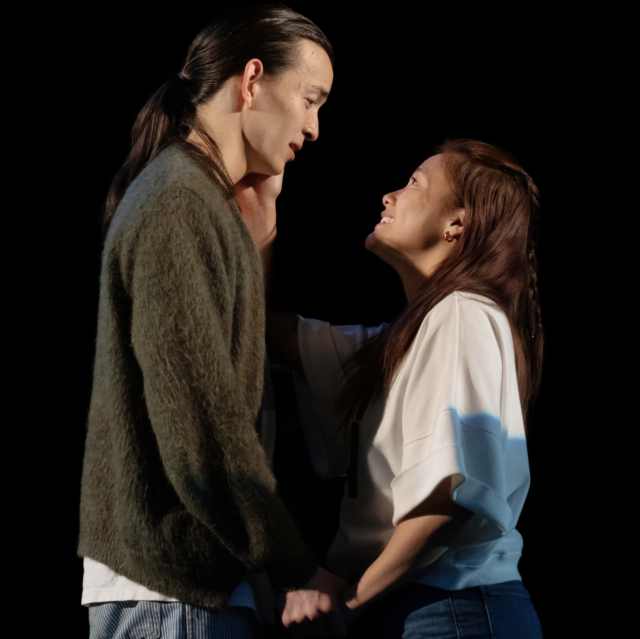
Romeo (Major Curda) and Juliet (Dorcas Leung) have a tough time of it at Lynn F. Angelson Theater (photo by Julieta Cervantes)

ROMEO AND JULIET
Lynn F. Angelson Theater
136 East Thirteenth St. between Third & Fourth Aves.
Monday – Saturday through June 3, $40
naatco.org

In February, I called Hansol Jung’s Wolf Play at MCC “the most exhilarating hundred minutes you will spend in a theater right now.” Alas, her follow-up, a profoundly perplexing adaptation of Romeo and Juliet making its off-Broadway premiere at the Lynn F. Angelson Theater through June 3, is unable to decide whether it is a wacky farce or a serious drama, ending up as its own kind of comedy of errors.

The confusion starts as the audience enters the space, where a handmade sign says to pick one side; the stage is a circular platform cut in half by a muslin curtain. Every person stops to consider which of the two sides might be better, asking the usher and looking back and forth at the possibilities. I watched as one woman, after selecting one side, got up several times to question whether she had chosen correctly. In this case, assigned seating might have been better, or instead dividing the sections into “Montague” and “Capulet.”

The play, a collaboration between the National Asian American Theatre Company and the Oregon Shakespeare Festival’s Play On Shakespeare Project that debuted at Red Bank’s Two River Theater, begins with some funny slapstick as Daniel Liu fumbles with opening the curtains, which are tied by thick white rope to opposing scaffolds. Liu provides comic relief throughout the two-and-a-half-hour show, portraying multiple characters, including Lady Capulet in a white gown. (She’s later played by a coatrack.)

While a chorus delivers the prologue — “Two households, both alike in dignity / (In fair Verona, where we lay our scene), / From ancient grudge break to new mutiny, / Where civil blood makes civil hands unclean. / From forth the fatal loins of these two foes / A pair of star-cross’d lovers” — Capulet servants Sampson and Gregory engage in a conversation that makes sure we realize that this is not going to be a traditional production. “Gregory, I swear, man, we can’t be no one’s suckers,” Sampson says. “There’s some people I’d be happy to suck on,” Gregory responds. “Well, they can suck my cum and then succumb to my sword,” Sampson adds. The wordplay may be in the spirit of ribald Elizabethan theater, but it can feel like a pretty harsh divergence from the actual text. Jung and codirector Dustin Wills aren’t able to balance the juxtapositions as the story meanders; this adaptation assumes that the audience essentially knows what’s going to happen so necessary plot development can be skipped.

Juliet’s father has picked Count Paris (Rob Kellogg) to be her husband, but she has fallen head-over-heels for Romeo (Major Curda), scion of the Capulets’ sworn enemy, the Montagues. A swordfight between Romeo’s cousin, Mercutio (Jose Gamo), and Juliet’s cousin, Tybalt (Kellogg), lays the groundwork for more blood to follow, along with heartbreak and a classic finale that has never made complete sense.

But Jung (Wild Goose Dreams, Cardboard Piano, Human Resources) and Wills (Montag, Plano) get so caught up in theatrical hijinks — the actors climb the scaffold to operate spotlights, random props that had been tucked under the circular platform are suddenly crowding the stage, a soundboard spits out digital beats (the music is by Brian Quijada), the fourth wall is inconsistently broken — that it is hard for the audience to maintain focus and care about the characters. Junghyun Georgia Lee’s set also echoes NAATCO’s recent production of Edward Albee’s A Delicate Balance, in which rows of hundreds of glasses and books were visible underneath the stage but were not used in the play.
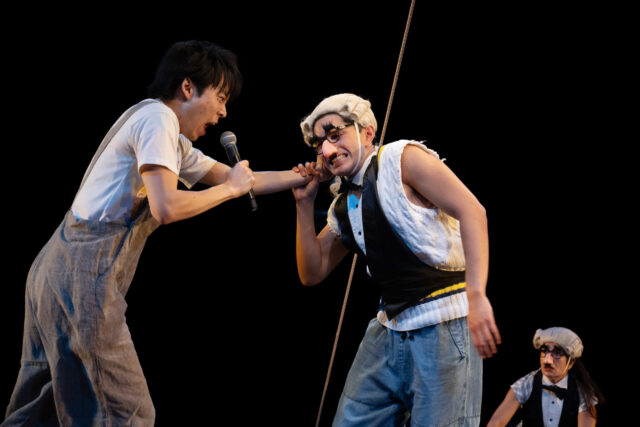
Peter (Daniel Liu), Potboy (Jose Gamo), and Servingman (Purva Bedi) engage in some silliness in Hansol Jung’s adaptation of Romeo and Juliet (photo by Julieta Cervantes)

The mood goes from an irreverent send-up with contemporary language to a serious interpretation using Shakespeare’s original words; it’s like Jung is unable to decide which way to go, much like the audience entering the theater. It’s a shame, because the show has its clever moments of inspiration. Mariko Ohigashi’s random costumes include Juliet’s sweatshirt that says “Abbondanza” on two lines, while Romeo’s T-shirt proclaims, “Count Your Fucking Rainbows”; Juliet wears cute and fluffy animal slippers; Friar Laurence (Purva Bedi) is dressed in oversized pants with suspenders; and Mercutio is styled like a boy band star. (However, the Groucho glasses are confounding.) Two trapdoors allow Romeo and Juliet to escape from everyone else. When things get tense, Romeo often strums a few notes on his guitar, which elicits laughter.

Even with a makeout scene, Leung (Miss Saigon, Snow in Midsummer) and Curda (KPOP!) never catch fire. Kellogg (Red Light Winter, Twelfth Night) is stalwart as Paris, Bedi (Dance Nation, India Pale Ale) is an adorable Friar Laurence, and Lee Huynh (War Horse, A Clockwork Orange) is fine as Capulet, but NAATCO cofounder Mia Katigbak (Awake and Sing, A Delicate Balance) seems to be in an alternate version of the play, Gamo (The Great Leap, The Heart of Robin Hood) overdoes it as Mercutio and Potboy, and Zion Jang is too goofy as Benvolio, while poor Liu’s (You Will Get Sick, GIRLS) shtick grows repetitive by the second act as he alternates between Lady Capulet and Peter and screams in agony a lot.

The play completely loses its already tenuous focus when Peter inexplicably insists that the musicians play “Purple Rain,” which is more than just head-scratchingly bizarre but downright annoying. It’s as if Jung and Wills were so phenomenally successful with Wolf Play that nobody wanted to just tell them no, that the Prince song makes no sense in the context of this Romeo and Juliet. Unfortunately, it’s all too representative of what ends up being a lost opportunity, a would-be comedy of too many errors.
NEW PLACE PLAYERS: OTHELLO

Desdemona (Alanah Allen) and Othello (Eliott Johnson) share an intimate moment in Bard tragedy (photo by Carol Rosegg)

OTHELLO
Casa Clara
218 East Twenty-Fifth St. between Second & Third Aves.
Wednesday – Sunday through March 25, $29-$99
newplaceplayers.org

One of the myriad wonderful things about Shakespeare plays is how malleable they are, offering plenty of opporunity for productions to get creative by twisting, turning, and reshaping how the plot unfurls even when using the exact original dialogue. And it doesn’t have to be done in large venues with star-studded casts; smaller, more intimate versions by lesser-known companies can deliver new insights into narratives you thought you knew so well.

Such is the case with New Place Players’ splendid adaptation of Othello in Casa Clara, a former Kips Bay foundry built in 1848 that is now a four-story town house where photographer Clara Aich lives and works. The maximum audience size is only fifty, about half sitting in unmatched chairs on either side of the central, horizontal stage area, with the other half sitting in seats on both sides of the long, narrow entryway.

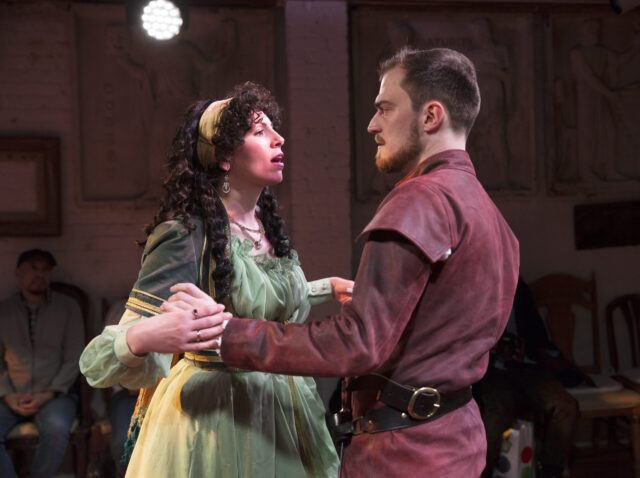
The walls are filled with drawings, empty frames, and ancient, classical-looking bas-reliefs Aich has collected on her travels around the world, giving the play a dramatic, old feeling, as it takes place during the Ottoman-Venetian Wars of the early 1570s. The atmosphere is enhanced by Shawn Lewis’s spare set, highlighted by a few rooms in balconies at the front and back of the “stage,” Jennifer Paar’s period costumes, and a chamber music score performed by Anna Bikales on harp, Daniel Keene on lute and gong, and music director, composer, and sound designer Flavio Gaete on viola, consisting of Renaissance consort music, including works by father-and-son Elizabethan court composers John and Robert Johnson, contemporaries of Shakespeare’s. The lighting is by Ethan Steimal, who incorporates two skylights.

Director Makenna Masenheimer and cultural competency consultant Ianne Fields Stewart waste no time establishing good vs. evil and exposing the racism of that era. Between 1596 and 1601, several Privy Council documents called for the expulsion and trading of “blackamoores.” In the opening scene, Iago (Conor Andrew Hall) appears wearing a black cape that evokes cartoon villain Snidely Whiplash, an animated mashup of wicked slavemaster Simon Legree and the dastardly Hollywood generic villain who ties damsels to train tracks. Roderigo (Nathan Krasner) is the wealthy white accomplice who does Iago’s bidding because he lusts after Desdemona (Alanah Allen), who is in love with Iago’s boss, military hero Othello (Eliott Johnson).

Bianca (Rose Kanj) and Cassio (Matthew Iannone) have at it in Othello at Casa Clara (photo by Carol Rosegg)

Iago pretends to be an honest and loyal man, but he is a deceiving master manipulator determined to take Othello down, at least in part because of rumors that Othello has slept with his wife, Emilia (Helen Herbert), who is Desdemona’s faithful attendant. “I follow him to serve my turn upon him,” Iago tells Roderigo. He also acknowledges, “I am not what I am.”

Roderigo and Iago alert Brabantio (Matthew Dudley), Desdemona’s rich politician father, that he must save his daughter from Iago’s arms at that very moment. “Even now, now, very now, an old black ram is tupping your white ewe,” Iago advises Brabantio. “Awake the snoring citizens with the bell, or else the devil will make a grandsire of you.” What could be worse than having a grandchild who is part Black?

A showdown ensues in which Desdemona, a vision in a white gown, asserts her love for Othello, whose “otherness” is increased by his wearing a North African turban associated with Muslims. But Iago is not about to let a public declaration of love get in the way of his evil plans. He tricks Emilia into helping him foster the belief that Desdemona and Iago’s chief ensign, Cassio (Matthew Iannone), are having an affair. Cassio, meanwhile, is spending more and more time with Bianca (Rose Kanj), a courtesan who has fallen in love with him, but Cassio’s career comes first.

The players also include the forthright Lodovico (Topher Kielbasa), kin to Brabantio and Desdemona; the chief magistrate, the Duke of Venice (Ryan Joseph Swartz); Montano (Aaron McDaniel), the governor of Cyprus; Gratiano (Dudley), Brabantio’s brother; and various messengers, officers, senators, and townspeople. No matter what happens and what anyone says, Iago is determined to ruin Othello and Desdemona, doing whatever is necessary to keep his nefarious scheme intact.

New Place Players will perform Othello through February 25 at Casa Clara (photo by Carol Rosegg)

New Place Players have previously presented immersive versions of The Tempest at the 3 West Club in Midtown and the Players by Gramercy Park, Twelfth Night at the Casa Duse Supper Club in Park Slope, and A Midsummer Night’s Dream at Casa Duse, Villa Lewaro in Irvington, and the Players. Their Othello is worth seeing just for the environs; during the pandemic, I watched a stream of Group.BR’s 2018 Inside the Wild Heart, a live performance filmed at Casa Clara that you could now navigate through online using the interactive Gather Town platform, allowing you to experience different parts of Clarice Lispector’s play in different rooms at your own pace. It made me yearn to be in the actual space.

Othello is best enjoyed by sitting in the main staging area, where the actors make eye contact with audience members and come as close as possible physically without actually touching them. The cast got off to a slow start the afternoon I saw it; the production was delayed because two of the actors were out sick, leaving the company to scramble. Understudy Swartz took over the roles of Brabantio and Gratiano and was a standout; stage manager Kyra Bowie did extra duty by reading for the Duke of Venice on an iPad, her purple boots beautifully anachronistic.

The closeness between the actors, who are trained in the Lecoq movements, and the audience created an unspoken camaraderie, as if we were fellow citizens familiar with the characters and setting. The story unfolded with a clear, precise progression, the misogyny, classism, and racism unmistakable but not heavy-handed.

I’ve seen three productions of Othello since 2016: Shakespeare in the Park with Corey Stoll as Iago, Chukwudi Iwuji as Othello, and Heather Lind as Desdemona, Sam Gold’s adaptation at New York Theatre Workshop (Daniel Craig, David Oyelowo, Rachel Brosnahan), and a noh version at Japan Society, in addition to watching Orson Welles’s 1952 film (Micheál MacLiammóir, Welles, Suzanne Cloutier).

The show at Casa Clara was the first time I truly felt how terribly the women are treated, how they are assumed to be strumpets and whores who can’t make their own decisions and think for themselves. Iago, in full beard and mustache, repeats to Brabantio several times, “Put money in your purse,” as if women can be bought like chattel. Othello himself is all too quick to listen to Iago and distrust his devoted wife. We might have come a long way in four-hundred-plus years, but misogyny, classism, and racism are still all too real in 2023.

BAM NEXT WAVE: HAMLET

Thomas Ostermeier and Theater Schaubühne Berlin’ Hamlet continues at BAM through November 5 (photo © Stephanie Berger)

Who: Theater Schaubühne Berlin
What: Hamlet
Where: Brooklyn Academy of Music, Harvey Theater at the BAM Strong, 651 Fulton St.
When: October 27 – November 5, $74-$175
Why: Five years ago, Lars Eidinger electrified Brooklyn with his stunning portrayal of Richard III, the wildest and best I have ever seen, in Thomas Ostermeier and Theater Schaubühne Berlin’s ferocious adaptation at the BAM Harvey Theater. Eidinger, Ostermeier, and Schaubühne Berlin are back at the Harvey with their frantic take on the Bard’s Hamlet, running through November 5. The tragedy has been seen here in New York in numerous recent versions and reimaginings, from Robert Icke’s staging at Park Ave. Armory in repertory with The Oresteia and James Ijames’s Pulitzer Prize–winning Fat Ham at the Public to Potomac Theatre Project’s revival of Tom Stoppard’s Dogg’s Hamlet at Atlantic Stage 2, Dead Centre’s Hamnet at BAM Fisher, and Yaël Farber’s variation starring Ruth Negga at St. Ann’s Warehouse.

You can expect Eidinger to be a prince of Denmark unlike any other in this 165-minute adaptation, directed by Thomas Ostermeier and translated into German by dramaturg Marius von Mayenburg. The cast pairs Damir Avdic as Horatio and Guildenstern, Konrad Singer as Laertes and Rosencrantz, Robert Beyer as Osric and Polonius, amid other dual depictions, but it is Eidinger front and center, a mesmerizing actor who never holds anything back. You have been warned.

Lars Eidinger reinvents the prince of Denmark in Hamlet at BAM (photo © Stephanie Berger)

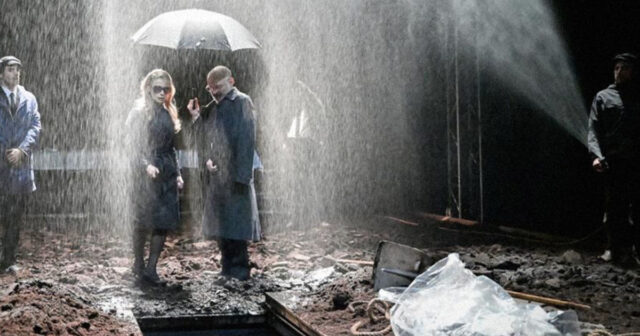
Update: It takes only minutes to realize that this Hamlet will resemble nothing you’ve ever seen. It opens with Eidinger, who at forty-six is about twice the age of his title character, beginning the “To Be, or Not to Be” soliloquy, which is supposed to unfurl in Act III. But he delivers only a few lines before joining the funeral of his murdered father, the former king, while his mother, Gertrude, and uncle, Claudius, stand under an umbrella at the burial. A cemetery worker has trouble with the coffin, water is sprayed from a hose, and the already unbalanced Hamlet, looking a bit doofy in his suspenders, falls face-first into the dirt over his father’s grave.

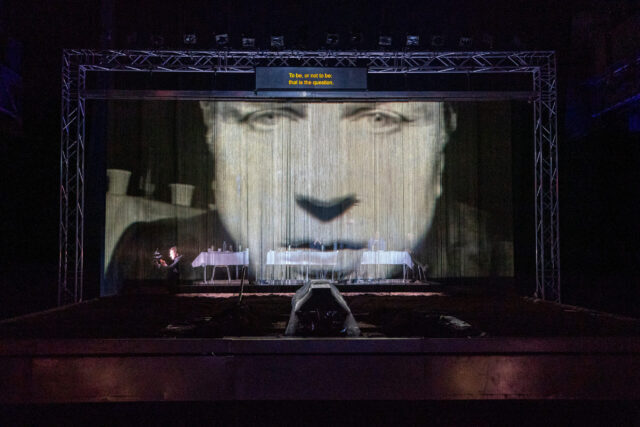
It’s Hamlet as vaudeville shtick, but with a camera that Hamlet uses to film himself and others as nefarious truths come out. Jan Pappelbaum’s set features lots of dirt and two white tables that move between the front and back of the stage, separated by a hanging curtain on which the live video is projected. (The costumes are by Nina Wetzel, music by Nils Ostendorf, video by Sébastien Dupouey, and lighting by Erich Schneider.)

A few moments later, when Claudius says, “But now, my nephew Hamlet, and my son — ,” a shocked Hamlet, unaware that his mother is betrothed to his uncle, does a double take and wonders aloud, “What? I didn’t get that,” then says to himself the more well known line, “A little more than kin, and less than kind.”

Eidinger is given free rein by Ostermeier, like an improv comic portraying the prince of Denmark. At one point, Eidinger jumped off the stage and approached a young man sitting front and center in the first row, wearing a black mask and a hoodie. Eidinger, who speaks German as Hamlet but English when he goes off-script, tried to get the man to interact with him, with no luck, leading to some yucks. Later, Eidinger tossed a shovel that accidentally bounced off the stage and landed near a woman in the audience. In the middle of his dialogue, Eidinger realized what happened and asked the woman if she was okay. It’s often hard to know what is scripted and when Eidinger is going with his instincts; just wait till you see his fencing battle with Laertes.

Even when he’s not lumbering across the stage (and off it), Hamlet is toying around, as if he has ADHD, banging on the table like a spoiled child and putting silly things on his face. The rest of the cast — Damir Avdic as Horatio and Guildenstern, Konrad Singer as Laertes and Rosencrantz, Robert Beyer as Osric and Polonius, Urs Jucker or Thomas Bading as Claudius and the ghost king, and Jenny König as Gertrude and Ophelia, a pairing that intensifies Hamlet’s cries of incest — is merely in service of Eidinger.

It can be a bit much in the 105-minute first act, which can get so chaotic it loses the narrative thread; if you’re not familiar with the story, you’re unlikely to know what’s going on all the time, especially with the doubling of characters who don’t change costumes. But the show comes together fabulously in the forty-five-minute second act — Eidinger even assures us that it’s much shorter than the first act — as the plot is more apparent and Hamlet (and Eidinger) is somewhat more focused if still as wildly unpredictable. There’s a method to his madness, even if Polonius’s classic pronouncement, “Though this be madness, yet there is method in’t,” has been cut from the production. You also won’t hear anything about a “rogue and peasant slave,” “pernicious woman,” or “damned villain,” but Hamlet will command you to “please switch off your mobile phones!”

Hamlet explains, “It’s all just theater and yet also reality.” Throughout Shakespeare’s tragedy, Hamlet is battling reality, encountering ghosts and interpreting events through his own warped world view. But Ostermeier and Eidinger continually remind us that we are watching theater. And what theater it is, unique, original, flabbergasting, exciting, hilarious, and downright strange.