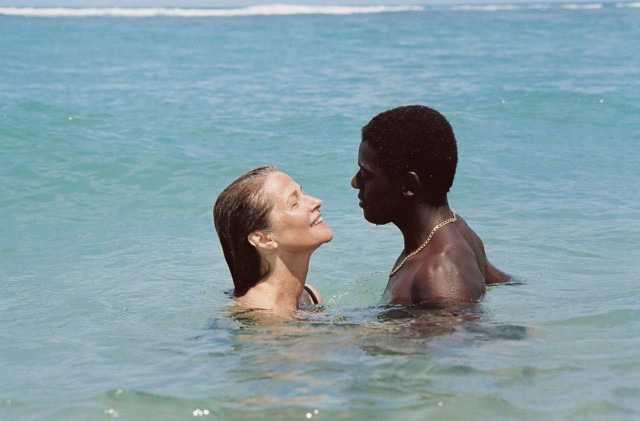
Charlotte Rampling stars in Laurent Cantet’s sexually charged postcolonial drama, HEADING SOUTH
WEEKEND CLASSICS: HEADING SOUTH (VERS LE SUD) (Laurent Cantet, 2005)
IFC Center
323 Sixth Ave. at West Third St.
February 12-15, 11:00 am
Series runs through March 6
212-924-7771
www.ifccenter.com
 Winner of the Golden Lion at the 2005 Venice Film Festival, Laurent Cantet’s Heading South is a captivating, disturbing look at misguided passion in a postcolonial world. Based on three short stories by Dany Lafèrriere, the film is set in late 1970s Haiti, at a resort where wealthy white women come to be served — in all possible ways — by the local black men. Karen Young stars as Brenda, a troubled woman who returns to the beach resort for the first time in three years, seeking to find the sexual release with Legba (Ménothy Cesar) that changed her life. But she has a rival in Ellen (Charlotte Rampling), a longtime island regular who has taken Legba under her wing (and under her sheets). Sue (Louise Portal) tries to maintain the peace while dallying with her own boy toy, Neptune (Wilfried Paul). And observing it all from a cold distance is the resort manager, Albert (Lys Ambroise), a proud, distinguished gentleman who resents having to serve white people almost as much as he resents the black escorts who sell their bodies. As the three women convince themselves that they are truly in love, danger lurks from the nearby city, as Port-Au-Prince is about to explode. And yet no matter what happens, things are bound to continue as is, with young Eddy (Jackenson Pierre Olmo Diaz) ready to take over for the next generation. Heading South is a well-acted, well-written examination of sex and love, power and poverty, and race and politics, with trouble and turmoil seething beneath virtually every scene. It’s screening at eleven o’clock in the morning February 12-14 as part of the IFC Center’s eight-film Weekend Classics tribute to Rampling, being held on the occasion of the release of her latest movie, 45 Years, which has earned the British actress, model, and singer her first Oscar nomination; the series continues through March 6 with François Ozon’s Under the Sand, Michael Cacoyannis’s The Cherry Orchard, and Dick Richards’s Farewell, My Lovely.
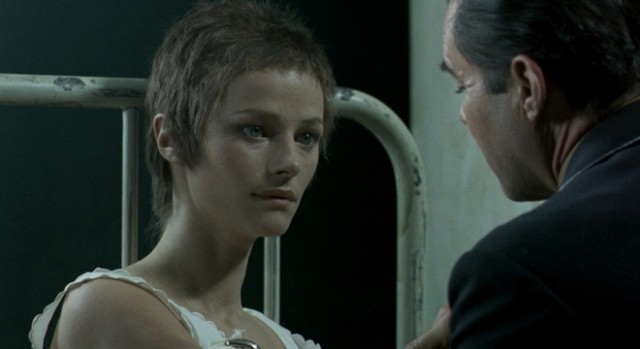
 Disgraceful Nazi porn or searing allegory about the devastating after-effects of the Holocaust on victims as well as Europe as a whole? Lurid exploitation or sensitively drawn, poignant exploration of a severe case of Stockholm syndrome? You can decide for yourself when Liliana Cavani’s ever-so-kinky, extremely controversial 1974 drama, The Night Porter, screens at the very strange time of eleven o’clock in the morning February 5-7 as part of the IFC Center’s eight-film tribute to Charlotte Rampling, being held on the occasion of the release of her latest movie, 45 Years, which has earned the British actress, model, and singer her first Oscar nomination. Rampling is downright frightening as Lucia, a young woman who was tortured as a sex slave by SS officer Maximilian Theo Aldorfer (Dirk Bogarde) in a Nazi concentration camp. It’s now 1957, and Lucia has arrived in Vienna with her husband (Marino Masé), a prominent American conductor. Lucia and Max, who is the night porter at the fashionable Hotel zur Oper, instantly recognize each other, and the moment hangs in the air, neither sure what the other will do. They say nothing, and soon the two of them have seemingly journeyed back to the camp, involved in a dangerous descent into sex and violence behind closed doors. But a small group of Max’s Nazi friends, including Klaus (Philippe Leroy), Hans Folger (Gabriele Ferzetti), and Stumm (Giuseppe Addobbati), who have dedicated themselves to destroying documents — and witnesses — as former members of the SS are brought to trial, become suspicious of Max’s bizarre relationship with Lucia, who could make trouble for them all.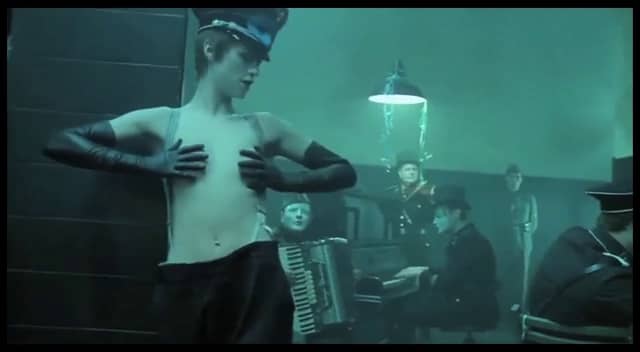
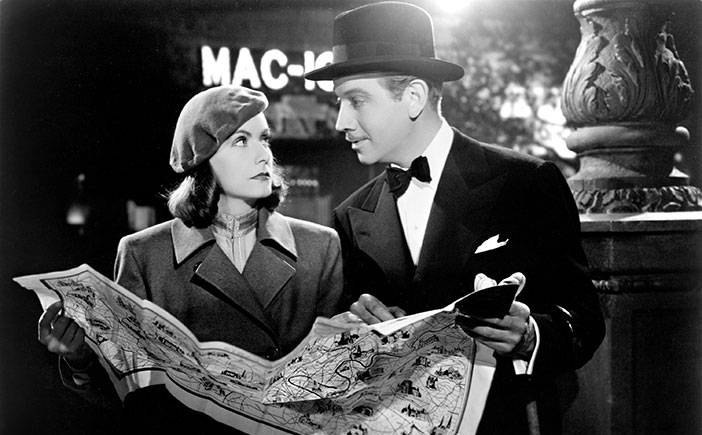
 Greta Garbo laughs — and says she doesn’t want to be alone — in Ernst Lubitsch’s magnificent pre-Cold War comedy Ninotchka, which is being shown October 3-5 in a DCP projection as part of the IFC Center Weekend Classics series “1939 — Hollywood’s Golden Year.” In her next-to-last film, Garbo is sensational as Nina Ivanovna “Ninotchka” Yakushova, a Russian envoy sent to Paris to clean up a mess left by three comrade stooges, Iranov (Sig Ruman), Buljanov (Felix Bressart), and Kopalsky (Alexander Granach). The hapless trio from the Russian Trade Board had been sent to France to sell jewelry previously owned by the Grand Duchess Swana (Ina Claire) and now in the possession of the government following the 1917 Russian Revolution. But the duchess’s lover, Count Léon d’Algout (Melvyn Douglas), gets wind of the plan and attempts to break up the deal while also introducing the three men to the many decadent pleasures of a free, capitalist society. Then in waltzes the stern, by-the-book Ninotchka, who wants to set the Russian men straight, as well as Léon. “As basic material, you may not be bad,” she tells him atop the Eiffel Tower, “but you are the unfortunate product of a doomed culture.” At first, Ninotchka speaks robotically, spouting the company line, but she loosens up considerably once Léon shows her what communism has been depriving her of, yet it’s difficult for her to turn her back on the cause, leading to numerous hysterical conversations — the razor-sharp script was written by Charles Brackett, Walter Reisch, and Billy Wilder, based on a story by Melchior Lengyel — that serve as both a battle of the sexes and social commentary on the Russian and French ways of life. “I’ve heard of the arrogant male in capitalistic society. It is having a superior earning power that makes you that way,” Ninotchka tells Léon shortly after meeting him on a Paris street. “A Russian! I love Russians! Comrade, I’ve been fascinated by your Five-Year Plan for the last fifteen years,” Léon responds, to which Ninotchka tersely replies, “Your type will soon be extinct.” Nominated for four Academy Awards, including Best Picture, Best Actress, Best Original Story, and Best Screenplay, Ninotchka is one of the most delightful romantic comedies ever made, filled with little surprises every step of the way (including a serious cameo by Bela Lugosi), serving up a blueprint that has been followed by so many films for three-quarters of a century ever since. The IFC Center series celebrating Hollywood’s most spectacular year continues through November 9 with such other splendid fare as Wuthering Heights, The Wizard of Oz, and Gone with the Wind.
 The final installment in his self-described Loser Trilogy (following Drifting Clouds and