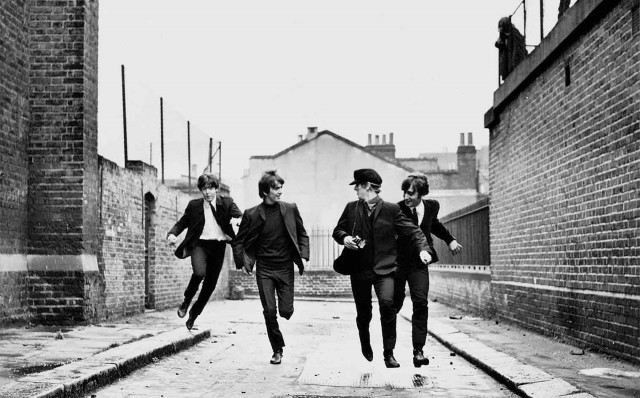
The Fab Four are on the run in A HARD DAY’S NIGHT, screening at Lincoln Center as part of Richard Lester retrospective
A HARD DAY’S NIGHT (Richard Lester, 1964)
Film Society of Lincoln Center, Walter Reade Theater
165 West 65th St. between Eighth Ave. & Broadway
Saturday, August 8, 1:00
Festival runs August 7-13
212-875-5050
www.filmlinc.org
www.thebeatles.com
 The Beatles are invading America again with the fiftieth anniversary restoration of their debut film, the deliriously funny anarchic comedy A Hard Day’s Night. Initially released on July 6, 1964, in the UK, AHDN turned out to be much more than just a promotional piece advertising the Fab Four and their music. Instead, it quickly became a huge critical and popular success, a highly influential work that presaged Monty Python and MTV while also honoring the Marx Brothers, Buster Keaton, Jacques Tati, and the French New Wave. Directed by Richard Lester, who had previously made the eleven-minute The Running Jumping & Standing Still Film with Peter Sellers and would go on to make A Funny Thing Happened on the Way to the Forum, Petulia, and The Three Musketeers, the madcap romp opens with the first chord of the title track as John Lennon, Paul McCartney, George Harrison, and Ringo Starr are running down a narrow street, being chased by rabid fans, but they’re coming toward the camera, welcoming viewers into their crazy world. (George’s fall was unscripted but left in the scene.) As the song blasts over the soundtrack, Lester introduces the major characters: the four moptops, who are clearly having a ball, led by John’s infectious smile, in addition to Paul’s “very clean” grandfather (Wilfrid Brambell, who played a dirty old man in the British series Steptoe and Son, the inspiration for Sanford and Son) and the band’s much-put-upon manager, Norm (Norman Rossington). Lester and cinematographer Gilbert Taylor (Dr. Strangelove or: How I Learned to Stop Worrying and Love the Bomb, Repulsion, Star Wars) also establish the pace and look of the film, a frantic black-and-white frolic shot in a cinema-vérité style that is like a mockumentary taking off from where François Truffaut’s 400 Blows ends. The boys eventually make it onto a train, which is taking them back to their hometown of Liverpool, where they are scheduled to appear on a television show helmed by a hapless director (Victor Spinetti, who would star in Help as well) who essentially represents all those people who are dubious about the Beatles and the sea change going on in the music industry. Norm and road manager Shake (John Junkin) have the virtually impossible task of ensuring that John, Paul, George, and Ringo make it to the show on time, but there is no containing the energetic enthusiasm and contagious curiosity the quartet has for experiencing everything their success has to offer — while also sticking their tongues out at class structure, societal trends, and the culture of celebrity itself.
Lester and Oscar-nominated screenwriter Alun Owen develop each individual Beatle’s unique character through press interviews, solo sojourns (the underappreciated Ringo goes off on a kind of vision quest; George is mistaken by a fashion fop for a model), and an endless stream of spoken and visual one-liners. (John sniffs a Coke bottle; a reporter asks George, “What do you call your hairstyle?” to which the Quiet One replies, “Arthur.”) Oh, the music is rather good too, featuring such songs as “I Should Have Known Better,” “All My Loving,” “If I Fell,” “Can’t Buy Me Love,” “I’m Happy Just to Dance with You,” “This Boy,” and “She Loves You.” The working name for the film was Beatlemania, but it was eventually changed to A Hard Day’s Night, based on a Ringo malapropism, forcing John and Paul to quickly write the title track. No mere exploitation flick, A Hard Day’s Night is one of the funniest, most influential films ever made, capturing a critical moment in pop-culture history and unleashing four extraordinary gentlemen on an unsuspecting world. Don’t you dare miss this glorious eighty-five-minute explosion of sheer, unadulterated joy. The restoration, courtesy of Janus Films, is screening August 8 at the Walter Reade Theater as part of the Film Society of Lincoln Center tribute series “Richard Lester: The Running Jumping Pop Cinema Iconoclast” and will be preceded by The Running Jumping & Standing Still Film. The festival runs August 7-13 and consists of most of the now-eighty-three-year-old Philadelphia native’s films, including Robin and Marian, The Bed Sitting Room, Juggernaut, Cuba, The Royal Flash, and the above-mentioned titles. “Growing up, I always thought of Richard Lester as one of the 1960s’ most typically English filmmakers — not just because of his irreverent and absurd sense of humor and his feel for English life but also for the affectionate way he sent up familiar icons from the Beatles to the Three Musketeers to even Superman,” Film Comment editor and FSLC senior programmer Gavin Smith said in reference to the series. “Imagine my surprise when I first learned he was actually an expat Yank. Regardless, he’s still a great English filmmaker!”
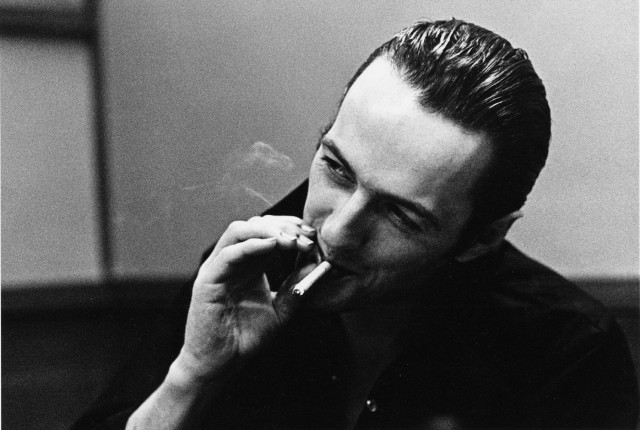
 Director Julien Temple, who has made two outstanding documentaries about the Sex Pistols (The Great Rock and Roll Swindle and The Filth and the Fury), turns his camera on Joe Strummer of the British punk group the Clash in The Future Is Unwritten. Temple collects remarkable home movies of Strummer, from his early days as young John Mellor, a career diplomat’s son, through his time as the leader of one of the most famous and controversial bands in the world and his death at the age of fifty from a congenital heart defect. Strummer’s friends and family gather around a campfire in Brooklyn’s Empire St.-Fulton Ferry Park and talk about Strummer’s life and career, sharing keen insight in a format that the musician loved; his campfire get-togethers came to be known as Strummerville, a place for people to assemble and discuss life, art, and anything else that came to mind. Temple adds lots of footage of the Clash in action, as well as clips from Strummer’s earlier band, the 101ers, made up of squatters fighting the power, and his last band, the Mescaleros. Temple also brings some of Strummer’s drawings to life, animating them in humorous ways. Strummer essentially narrates the film himself, as Temple includes audio excerpts from Strummer’s “Last Call” radio show and interviews he gave over the years. Temple, a close friend of Strummer’s, paints a fascinating portrait of the complex man, featuring stories from the likes of Bono, Johnny Depp, Flea, Mele Mel, Courtney Love Cobain, Martin Scorsese, Steve Jones, John Cusack, Matt Dillon, Steve Buscemi, Damien Hirst, Roland Gift, Don Letts, Mick Jones, and many others. And there’s lots of music as well, of course, including several versions of “White Riot.” The Future Is Unwritten is screening August 1 at 3:30 in the “I Was There: The Music Docs of Julien Temple” sidebar of Lincoln Center’s annual “Sound + Vision” series, which also includes The Filth and the Fury, The Clash: New Year’s Day ’77, Dave Davies: Kinkdom Come, Ray Davies: Imaginary Man, Glastonbury, Never Mind the Baubles: Christmas with the Sex Pistols, and The Liberty of Norton Folgate, with Temple on hand for various introductions and Q&As.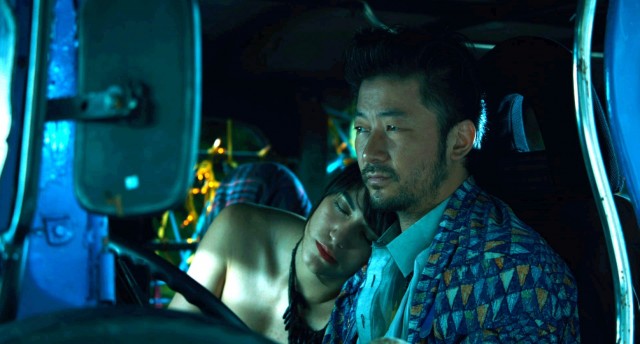
 If you’re in the mood for something very different at the fourteenth annual New York Asian Film Festival, look no further than Khavn de la Cruz’s Ruined Heart: Another Love Story Between a Criminal & a Whore. Expanding his fifteen-minute 2012 short, Khavn has created a visually arresting film that weaves its way through the gritty streets of an almost postapocalyptic Manila slum bursting with flashes of red, yellow, blue, and green. Using virtually no dialogue — the only words are from occasional poetry and several songs, and the very few times that characters speak, no translation is offered — Khavn tells the story of a Criminal (Japanese star Tadanobu Asano) on the run with a Whore (Mexican actress Nathalia Acevedo), attempting to get away from the Godfather (Filipino poet and playwright Vim Nadera). The multinational cast also includes the Friend (Andrew Puertollano) and the Lover (Russian-born actress Elena Kazan, who grew up in Berlin and now lives in Mumbai), but the real stars are Khavn’s mesmerizing score, Frances Grace Mortel’s art direction, Frances Soeder’s production design, Carlo Francisco Manatad’s frantic editing, and Christopher Doyle’s dizzying cinematography, which at times has Asano doing the camerawork himself as he runs through small passageways and back alleys.
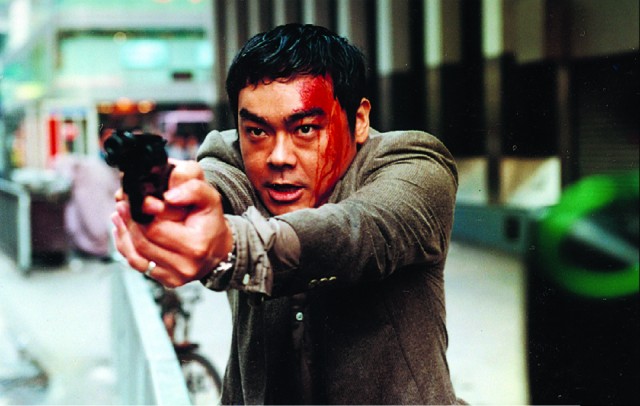
 The fourteenth annual New York Asian Film Festival is saluting legendary Hong Kong director Ringo Lam, presenting him with the Lifetime Achievement Award. Lam, who turns sixty this year, will be at Lincoln Center for screenings of two of his works, City on Fire on June 27 and Full Alert on June 28. In the latter, Lam’s follow-up to his disappointing Hollywood debut, the Jean-Claude Van Damme vehicle Maximum Risk, Lau Ching-wan stars as Officer Pao, a member of Hong Kong’s Special Crime Bureau who becomes involved in a case that turns deeply personal. After arresting explosives expert Mak Kwan (Francis Ng) for the brutal murder of an architect, Pao is determined to find the rest of Mak’s Taiwanese crew, which is led by mainland boss Jie (Jack Gao), and prevent the robbery of a mysterious vault. Pao and his team track Mak’s girlfriend, Chung Lai Hung (Amanda Lee), who knows more than she’s letting on, while Pao and Mak become immersed in a tense, psychological game of cat and mouse, exploring what it feels like to kill someone. There are numerous incredulous plot twists and a rather lame car chase, but the guerrilla filmmaking style of Lam and cinematographer Ardy Lam, ranging through the streets of a Hong Kong about to be handed over from the British to the Chinese, is supremely effective, as are the lead performances by Lau and Ng, evoking the relationships portrayed earlier by Robert De Niro and Al Pacino in Michael Mann’s Heat and later by Andy Lau and Tony Leung in Andrew Lau and Alan Mak’s Infernal Affairs. The use of mobile phones and surveillance technology feels much older than 1997, displaying how far we have come so fast. Lam saves the heavy violence for the spectacular finale, letting the emotions build before exploding. Nominated for five Hong Kong Film Awards, including Best Film, Best Director, and Best Actor (Lau), Full Alert is screening at the Walter Reade Theater on June 28 at 2:00, with Lam on hand to introduce it. The New York Asian Film Festival continues at Lincoln Center through July 6 with more than three dozen new and old films from China, Korea, Japan, the Philippines, Cambodia, and other Southeast Asian countries, including Sabu’s Chasuke’s Journey, Kinji Fukasuku’s Battles without Honor and Humanity, Im Sang-soo’s The President’s Last Bang, Wang Xiaoshuai’s Red Amnesia, Im Kwon-taek’s Revivre, and Sion Sono’s Tokyo Tribe.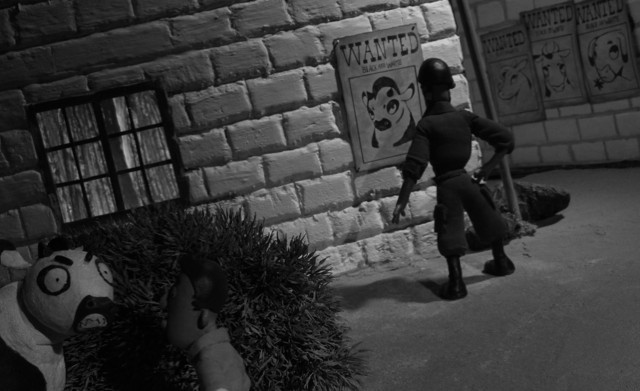
 The never-ending battle between Israel and the Palestinians is reduced to a single incident attempting to be a microcosm of the conflict in the relatively silly and uneven documentary The Wanted 18. In 1988, shortly after the first Intifada began, an Israeli kibbutz sold eighteen cows to the Palestinian town of Beit Sahour. As the small, tight-knit community rallied around the cows, seeing them as a crucial part to their goal of freedom and independence, the Israelis grew suspicious of the Palestinians’ growing self-sufficiency and declared the cows “a threat to the national security of the state of Israel.” Codirectors Amer Shomali, whose family came from Beit Sahour, and Canadian Paul Cowan (Going the Distance, Westray) tell the story of the fight over the cows through contemporary interviews, drawings, reenactments, archival footage, and stop-motion animation in which four of the cows share their thoughts on the matter: Rivka (voiced by Holly Uloth “O’Brien”), Ruth (Heidi Foss), Lola (casting director Rosann Nerenberg), and Goldie (Alison Darcy). The heavily one-sided tale delves into such issues as taxation, bigotry, boycotts, curfews, and civil disobedience, as people from Beit Sahour give first-person accounts of what happened, along with Ehud Zrahiya, who at the time was advisor to the Israeli military governor on Arab affairs. “We were concerned that Beit Sahour may become a model for other places,” Zrahiya admits. “We were certainly concerned that this might infect other places and would spread to other localities throughout the West Bank.”