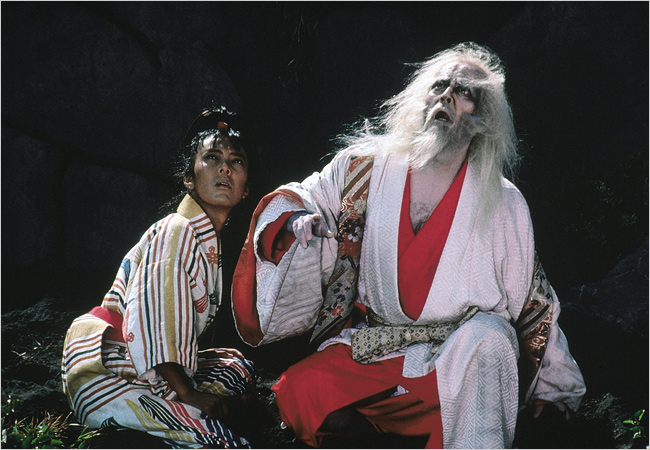
The Fool (Peter) sticks by Hidetaro (Tatsuya Nakadai) as the aging lord descends into madness in Kurosawa masterpiece RAN
RAN (Akira Kurosawa, 1985)
IFC Center
323 Sixth Ave. at West Third St.
July 22-24, $13, 11:00 am
Series continues through September 11
212-924-7771
www.ifccenter.com
 Inspired by the story of feudal lord Mori Motonari and Shakespeare’s King Lear, Akira Kurosawa’s Ran is an epic masterpiece about the decline and fall of the Ichimonji clan. Aging Lord Hidetora (Tatsuya Nakadai) is ready to hand over his land and leadership to his three sons, Taro (Akira Terao), Jiro (Jinpachi Nezu), and Saburo (Daisuke Ryû). But jealousy, misunderstandings, and outright deceit and treachery result in Saburo’s banishment and a violent power struggle between the weak eldest, Taro, and the warrior Jiro. Hidetaro soon finds himself rejected by his children and wandering the vast, empty landscape with his wise, sarcastic fool, Kyoami (Peter), as the once-proud king descends into madness. Dressed in white robes and with wild white hair, Nakadai (The Human Condition), in his early fifties at the time, portrays Hidetaro, one of the great characters of cinema history, with an unforgettable, Noh-like precision. Kurosawa, cinematographers Asakazu Nakai, Takao Saitô, and Masaharu Ueda, and Oscar-winning costume designer Emi Wada bathe the film in lush greens, brash blues, and bold reds and yellows that marvelously offset the white Hidetaro. Kurosawa shoots the first dazzling battle scene in an elongated period of near silence, with only Tôru Takemitsu’s classically based score playing on the soundtrack, turning the film into a thrilling, blood-drenched opera. Ran is a spectacular achievement, the last great major work by one of the twentieth century’s most important and influential filmmakers. Ran will be screening at 11:00 am on July 22, 23, and 24 as part of the IFC Center’s Weekend Classics — Kurosawa series, which continues with Dreams (July 29-31) and Rhapsody in August (August 5-7); ticket sales benefit Japan Society’s Earthquake Relief Fund.
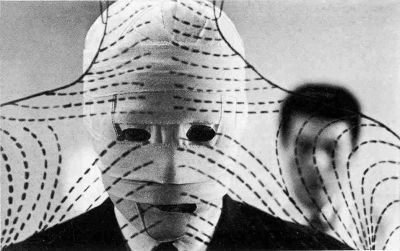
 Kôbô Abe and director Hiroshi Teshigahara collaborated on five films together, including the marvelously existential Woman of the Dunes in 1964 and The Face of Another two years later. In The Face of Another, Tatsuya Nakadai (The Human Condition, Kill!) stars as Okuyama, a man whose face has virtually disintegrated in a laboratory accident. He spends the first part of the film with his head wrapped in bandages, a la the Invisible Man, as he talks about identity, self-worth, and monsters with his wife (Machiko Kyo), who seems to be growing more and more disinterested in him. Then Okuyama visits a psychiatrist (Mikijirô Hira) who is able to create a new face for him, one that would allow him to go out in public and just become part of the madding crowd again. But his doctor begins to wonder, as does Okuyama, whether the mask has actually taken control of his life, making him as helpless as he was before. Abe’s remarkable novel is one long letter from Okuyama to his wife, filled with utterly brilliant, spectacularly detailed examinations of what defines a person and his or her value in society. Abe wrote the film’s screenplay, which tinkers with the time line and creates more situations in which Okuyama interacts with people; although that makes sense cinematically, much of Okuyama’s interior narrative, the building turmoil inside him, gets lost. Teshigahara once again uses black and white, incorporating odd cuts, zooms, and freeze frames, amid some truly groovy sets, particularly the doctor’s trippy office, and Tōru Takemitsu’s score is ominously groovy as well. As a counterpart to Okuyama, the film also follows a young woman (Miki Irie) with one side of her face severely scarred; she covers it with her hair and is not afraid to be seen in public, while Okuyama must hide behind a mask. But as Abe points out in both the book and the film, everyone hides behind a mask of one kind or another. The Face of Another is screening April 7 as part of Film Forum’s “5 Japanese Divas” series, featuring four weeks of films starring Kyo, Isuzu Yamada, Kimuyo Tanaka, Setsuko Hara, and Hideko Takamine, who play strong, determined women in such classic works as Yasujiro Ozu’s Early Summer (1951) and Tokyo Story (1953), Hiroshi Teshigahara’s The Face of Another (1966), Mikio Naruse’s Okaasan (1952) and Flowing (1956), Akira Kurosawa’s The Idiot (1951) and Throne of Blood (1957), Keisuke Kinoshita’s Carmen Comes Home (1951) and Twenty-Four Eyes (1954), and Kenji Mizoguchi’s Ugetsu (1953), Sansho the Bailiff (1954), and Street of Shame (1956), among others.
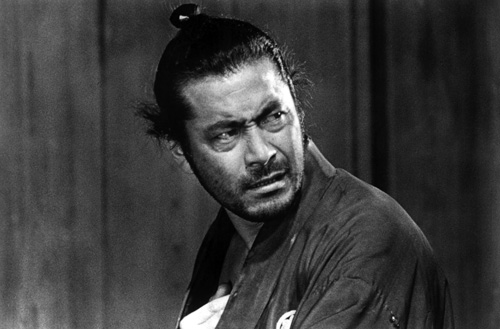
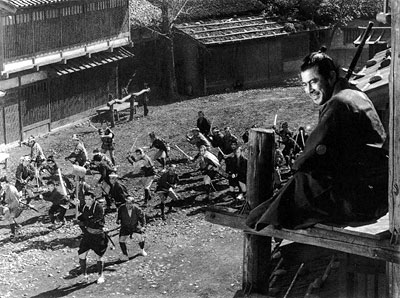
 In Akira Kurosawa’s sort-of sequel to YOJIMBO based on Shūgorō Yamamoto’s short story “Peaceful Days,” Toshirō Mifune returns as Tsubaki Sanjuro, a rogue samurai who shows up in a small town looking for food and fast money and takes up with a rag-tag group of wimps who don’t trust him when he says he will help them against the powerful ruling gang. Also back is Tatsuya Nakadai, this time as his accomplice Hanbei. Funnier than most Kurosawa samurai epics, the film is unfortunately brought down a notch by a bizarre soundtrack that ranges from melodramatic claptrap to a jazzy big-city score. The film is being screened at BAMcinématek as part of the series Kurosawa’s Samurai, which concludes November 21 with the King Lear epic RAN.