Tag Archives: Reed Birney

SOMETHING VERY GOOD IS ABOUT TO HAPPEN: GUS BIRNEY ON SEAGULL, NEW NETFLIX SERIES, AND HAILING FROM ACTING ROYALTY

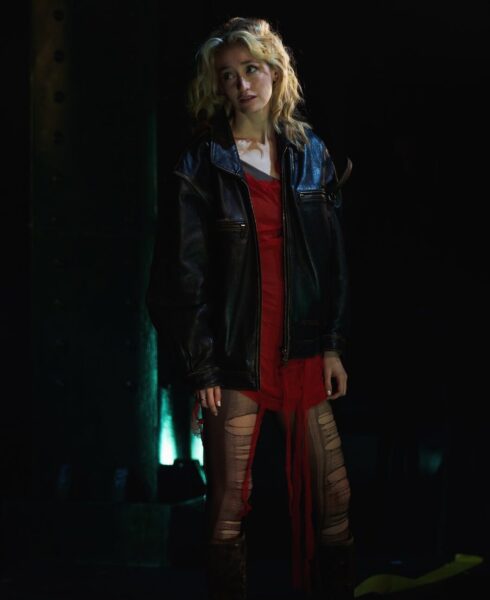
Gus Birney stars as Nico in Eli Rarey and Sasha Molochinikov’s Seagull: True Story at the Public Theater (photo by Kir Simakov)

SEAGULL: TRUE STORY
LuEsther Hall, the Public Theater
425 Lafayette St. at Astor Pl.
Tuesday – Sunday through May 3, $109
publictheater.org

In Seagull: True Story, Eli Rarey and Alexander Molochnikov’s dark comedy about a Russian troupe trying to stage Anton Chekhov’s 1896 classic tragicomedy in the midst of Russia’s invasion of Ukraine, Masha, portraying Nina in the play-within-a-play, asks, “Why is it so dark?” The part is played by Gus Birney, and, for her, the future is nothing but bright.

At the age of twenty-six, Birney is a rising star, and not just because she was named one by Porter magazine. Best known for her roles as Jane Humphrey in Dickinson and Gaynor Phelps in Shining Vale, she is now creeping out horror fans as Portia in the Netflix series Something Very Bad Is Going to Happen. She excelled as a call girl in Anne Kaufman’s revival of Lorraine Hansberry’s The Sign in Sidney Brustein’s Window at BAM and on Broadway, was heartbreaking as Dora, a Russian Jew who dreams of becoming a movie star, in Igor Golyak’s brilliant Our Class at BAM. then played Jessica, Shylock’s daughter, in Golyak’s wild and woolly adaptation of Shakespeare’s The Merchant of Venice at Classic Stage.

Birney hails from acting royalty; her father is Tony and Drama Desk Award winner Reed Birney (The Humans, House of Cards), her mother is SAG Award nominee Constance Shulman (Orange Is the New Black, Well, I’ll Let You Go), and her older brother, Ephraim (Chester Bailey), is a writer and actor as well.

In The Seagull, Nina Zarechnaya is an ingenue who falls for writer Boris Trigorin while wannabe playwright and director Konstantin Treplev, the son of once-beloved actress Irina Arkadina, is desperately in love with her. A dreamer, Konstantin declares, “I am increasingly convinced that it’s not about old or new forms, but about the fact that what a person writes, not thinking about forms at all, they write because it flies freely from their soul!” That is the same attitude Rarey and Molochnikov bring to Seagull: True Story, a vastly entertaining, thrillingly unpredictable, and insightful exploration of theater, family, and war, running at the Public though May 3, inspired by real events that happened to Molochnikov. Birney shines as Masha and Nico, offering two different interpretations of Nina, opposite Eric Tabach as Kon, Zuzanna Szadkowski as Kon’s mother, Elan Zafir as the dramaturg Anton, and a “fantastic” Andrey Burkovskiy as the MC and other roles. (On April 12, Molochnikov will play Kon, his onstage alter ego, and participate in a postshow Q&A.) At one point, Nico, as Nina, says, “I’m the seagull. No, that’s not right, I’m an actress.”

An actress ready, willing, and able to take chances, Birney recently Zoomed with me from her parents’ New York City apartment, discussing Russian theater, her latest streaming venture, family, pets, and acting.

twi-ny: How are things? Because you’re really busy right now, aren’t you?

gus birney: Oh my gosh, I know! It’s been a really cool period of time, because I have this TV show that just came out right alongside doing this play. It’s been so exciting. This is like an alternate reality of my life where, Oh, there’s a lot going on, but it’s nice to be in a high for a second.

twi-ny: I wanted to start by delving right into Seagull: True Story. I remember speaking with you last May at the opening at La MaMa. It was an all-star opening; Igor Golyak was there, Mikhail Baryshnikov, and various Russian dignitaries. What were your thoughts about the play when you saw it that night? Did you have any inkling that you were going to be in it later?

gb: Well, to answer your first question, when I saw it I was incredibly jealous that I was not in it. I was like, this is so cool. Everyone up there looks like they’re having so much fun. It just felt like an explosion of color and life and passion. I think I hadn’t finished Our Class. I can’t remember if I was still doing it. It had finished, but Our Class was in that same world, but it was so heavy and depressing and dark.

And so it felt like the lighter version of Our Class where it was the same kind of colorfulness, but just so much dance and music, even though this play explores very heavy subjects as well. I had auditioned for a workshop of it with Sasha, and we kept having conversations about me doing it, but the timing never worked out for either of us.

And I saw Stella [Baker] do it and she’s fantastic in the show. And I thought, this is so great. I’m jealous that I’m not in it. And then, about a month ago, they called me and said Stella has a conflict, would you be willing to jump in? It was around the time that Something Very Bad was going to come out. So I knew I’d be limited on timing. And they were incredible because they made it work. I had seven days of rehearsal; I’d never done anything like that — it was so fast. But it’s been a blast. I really have had such a good time; I love it.
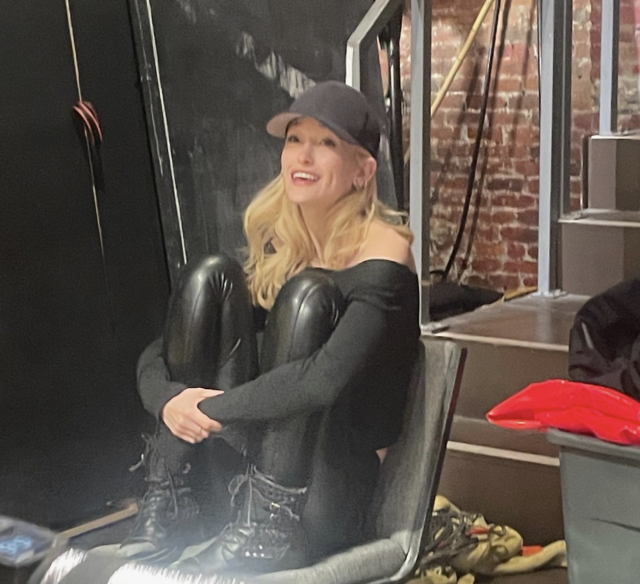
Gus Birney takes a break during rehearsals for The Merchant of Venice at Classic Stage (photo by twi-ny/mdr)

twi-ny: The rehearsal process sounds like the play itself, sort of all over the place, in a good way, fast and furious, nonstop.

gb: Yes, definitely.

twi-ny: Have you ever done Chekhov before?

gb: No, I’ve never done it, and now I’ve read The Seagull and I’m dying to be in the Chekhov Seagull; I would love to play Nina. But I do feel like this is great because I get a little touch of that and I’m exploring it in a totally different way.

twi-ny: In a November 2022 essay in Rolling Stone, Sasha wrote, “The world loves Russian theater.” It seems right now that Russian theater loves you. You’ve previously appeared in Igor’s Our Class and The Merchant of Venice. Both directors have unique visions of classic plays and how to adapt them to today’s world. I’m thinking also of Dmitry Krymov, another Russian émigré who’s doing a Vanya adaptation at La MaMa, which I don’t know if you’ll get to see because they’re running at the same time as Seagull. You’re of Polish descent, as we’ve talked about before, but how did you come to fit into this Russian theater niche in New York?

gb: You tell me; I don’t know what happened. Two and a half years ago, I got the audition for Our Class and had no idea what to expect. I read it. I thought it was a beautiful piece, but on paper, it is a completely different experience than what the outcome ended up being. I feel like that’s the same with Sasha’s Seagull. On paper, it looks like one thing, but then you see the finished product and it’s, like, whoa.

Honestly, I don’t know. I feel like I walked into this magical world that I had never thought I would be entering into and that now I never want to leave. I did Sidney Brustein right before I did Our Class, and I learned so much. I was also so terrified and felt way over my head with what I was doing because I didn’t go to acting school, and I felt I was, like, Oh my gosh, I’m entering into this world blind, and I felt like there was this right way and wrong way to do things.

Then I did Our Class and there was no such thing as a mistake. There was no such thing as a wrong move. What I love so much about this Russian world is that mess is right. Mistakes are correct. As someone who’s a very anxious performer, it’s given me this whole new sense of freedom. Like, Oh my gosh, the things you don’t like about yourself and the days that you’re, like, I was bad, or I screwed up this, or I said this line instead of this. No, that’s interesting. It’s different. It’s exciting. And it’s given me this whole newfound confidence in myself.

twi-ny: That’s a great way to put it, because being in the audience for these shows feels the same way. You’re from New York City acting royalty. You’ve been acting since you were three, when you were an elephant in a parade.

gb: Oh my gosh, you know this? Did I tell you this?

twi-ny: You did not tell me this, but I leave no stone unturned. By ten, you’re in Thoroughly Modern Millie, singing “Jimmy.” Your father is Reed Birney, your mother is Constance Shulman; I’ve seen them both many times onstage. I loved your mother in a play called Shhhh. I don’t know if you saw it.

gb: I loved her in that too! It’s one of my favorites!

twi-ny: I love that show. And I’ve also seen them many times in the audience. So when they’re not onstage or filming a movie or television series, they’re going to the theater. And your brother is also a terrific actor. Here’s something that you wrote a few years ago:

“The least interesting thing about my parents is the fact that they’re actors. They’re multifaceted, complicated, curious, hilarious, full of life human beings who also sometimes yell at me to be less self-involved.”

So what is the most interesting thing about your family, and what’s the most important lesson you’ve learned from them?

gb: Oh, wow.

twi-ny: Is that too big a question?

gb: No. I’m going to answer with a cliché answer, but my parents are genuinely extraordinarily kind human beings. And they really instilled that in us. Not to pat myself on the back, but I do think that, in my head, kindness and respect, from top to bottom on a set for whoever’s there, was always the number one priority in their heads. We’re an incredibly close family. I’m literally at their apartment right now, and I have my own, but I stay here almost every night. Yeah, we’re all best friends. My mom used to say, Treat every person in a conversation like they’re the only person in a room. And I hope and strive to do that. They do that constantly. Whether they quit acting tomorrow or they continue, it doesn’t matter. It’s about being a kind human being in this world, which I don’t think we have enough of sometimes.
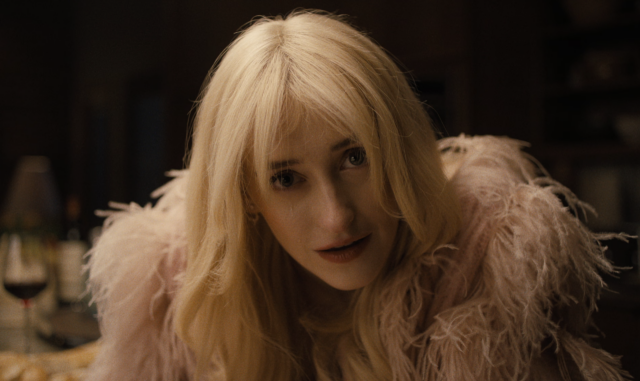
Gus Birney stars as Portia in Haley Z. Boston’s Something Very Bad Is Going to Happen (photo courtesy Netflix)

twi-ny: Definitely. The last time I spoke with you, you said that your father was considering retirement. Maybe it was after Lunar Eclipse.

gb: You know, he’s always saying that. I’m sure if you see him, he would be saying that to you, but he’s not going to.

twi-ny: Good. I’ve seen him and your brother, Ephraim, in Chester Bailey. Although I didn’t see it in Williamstown, you’ve acted with your mother in The Rose Tattoo. Which brings me to a favorite cult film of mine, Strawberry Mansion. Your cousin Albert makes this film and all the Birneys are in it except for you. Where are you?

gb: I don’t know! Why wasn’t I there! There wasn’t a part for me, I guess.

twi-ny: It’s a crazy movie.

gb: Yeah, it is crazy. Albert’s insane. He’s amazing, but he lives in his own crazy world.

twi-ny: Well, you’re in so many other things. At sixteen, you start doing TV, theater, and films. You’ve already amassed more than forty credits in ten years. So you’re incredibly busy. Now you’ve got Something Very Bad Is Going to Happen. What’s it like going from these three different media, at such a fast pace?

gb: Yes, yes. You know, I learn something through each medium. I have such a respect for theater because that’s how I was raised. I feel like it’s the best way to start out as an actor because it just rounds you in your body and your voice. I feel so lucky to be able to dive into each of these specific worlds of what it is to be an actor. They all feel so different.

I don’t know, you said forty credits and in my head I’m like, Really, have I done that much? But no, it’s so cool. I’m twenty-six now and I still feel like I’m thirteen so much of the time. But it’s good to have moments where I’m really proud of myself.

The show that just came out yesterday is one of the most exciting jobs I’ve ever had. I had such a good time doing it. I’m so happy that the world can see it now. And I feel a little protective over it, because who knows how it’s going to do? Who knows? It’s so crazy what catches on and what doesn’t. And I’m kind of just like, it doesn’t matter what happens with it. I’m so proud of the show. And I’m so happy that it’s out in the zeitgeist and anyone can see it.

twi-ny: Do you have a dream role?

gb: Oh, wow. I don’t know. Someone asked me the other day and I had such a strange answer. They asked, What role would you want adapted to screen from a book? And I said I’d want to play Sally in the live-action version of The Nightmare Before Christmas, because something I get a lot is that I look like a Tim Burton character. And so I would love to play a Tim Burton character. But in a play, definitely right now, the Nina thing is kind of forefront in my head; I would love to play this part and do my little spin on it.

I love The Glass Menagerie; I always talk about that play. I would love to be Laura in that. I did a reading of Who’s Afraid of Virginia Woolf? recently; I would love to be Honey. So we’ll see. There’s so many things I want to do.
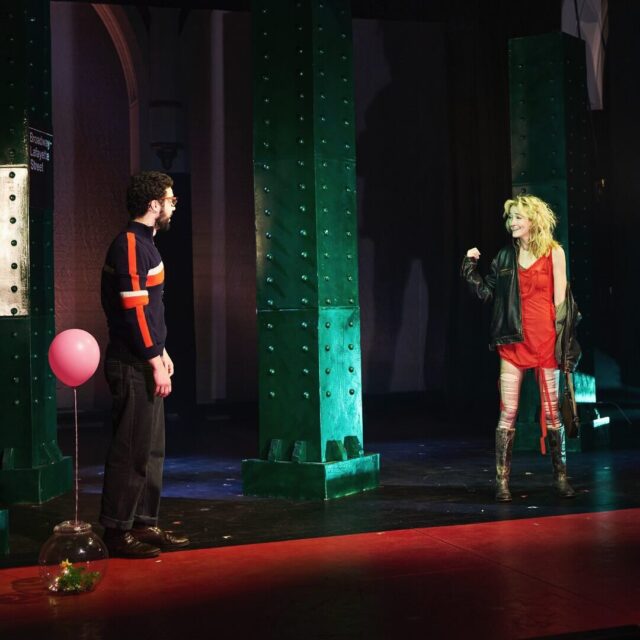
Kon (Eric Tabach) and Nico (Gus Birney) meet cute in Seagull: True Story (photo by Kir Simakov)

twi-ny: You’ve mentioned how anxious you get as an actress, but I have a feeling maybe a little bit in real life as well, and you used to describe yourself as shy and strange, particularly when thinking back on your childhood. Today, with all these things going on, can I ask how you feel about yourself, particularly about the confidence you’re building with each performance?

gb: Yeah! Definitely still shy and strange. I did an interview this morning on New York Live and I rewatched it before talking to you and I was, like, Oh my gosh, Gus, you’re so strange. But no, I think what’s happened is I am shy and strange and I also feel such confidence in what I am now.

Oh my gosh, who is this?

twi-ny: This is our kitty, Tuki. She gets in on every Zoom call.

gb: I’m so glad; she can stay for the rest of it. She’s the cutest. I feel like the world is trying to tell me to get an animal because I saw these puppies this morning and now I see this little sweetie and it’s like I just need to.

twi-ny: New York City apartments are not the same without an animal, but you’re not spending enough time in your own apartment to have an animal, a pet.

gb: It’s true. Yeah, that’s what will force me to grow up. Yes, but anyway, I feel like I have a whole other level of confidence in whatever I am at this point in my life, so yes.

twi-ny: One last thing. Having met you several times, seeing you onstage and television, and watching some of your interviews, I can’t help but notice that one of the words that comes up over and over again is fun. You just look like you are having the most fun time. Being in your presence brings happiness. That seems to be your approach to life.

gb: Yes, I think so. I try. I am definitely anxious. We’ve talked about this, but I do think I’m a really positive, optimistic person, and I really love that about myself. Yeah, like how cool is my job — or our job, because you’re also in this artistic crazy world.

You know, it is terrifying what is going on at this point in history, so let’s enjoy the moments where it’s light. In this play I get to dance, I get to sing, I get to run around, and it’s the coolest thing to just compartmentalize for two hours out of your day and just be free. So yes, I appreciate you saying that. That’s what I would strive to be: happy.

[Mark Rifkin is a Brooklyn-born, Manhattan-based writer; you can follow him on Substack here.]
AWAITING THE PENUMBRA: LUNAR ECLIPSE AT SECOND STAGE

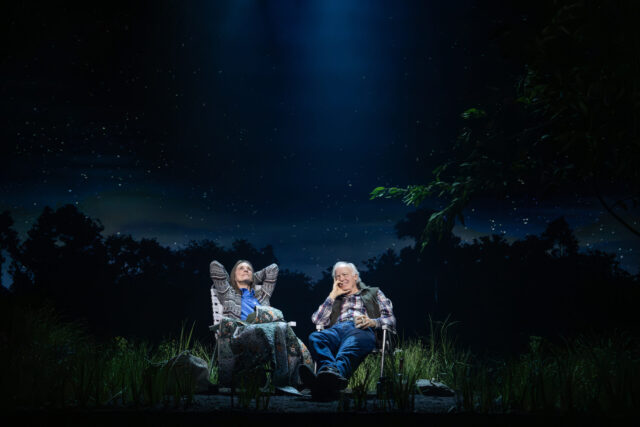
Em (Lisa Emery) and George (Reed Birney) take stock of their life together in Donald Margulies’s Lunar Eclipse (photo by Joan Marcus)

LUNAR ECLIPSE
The Pershing Square Signature Center
The Irene Diamond Stage
480 West 42nd St. between Tenth & Eleventh Aves.
Tuesday – Sunday through June 22, $74-$114
2st.com

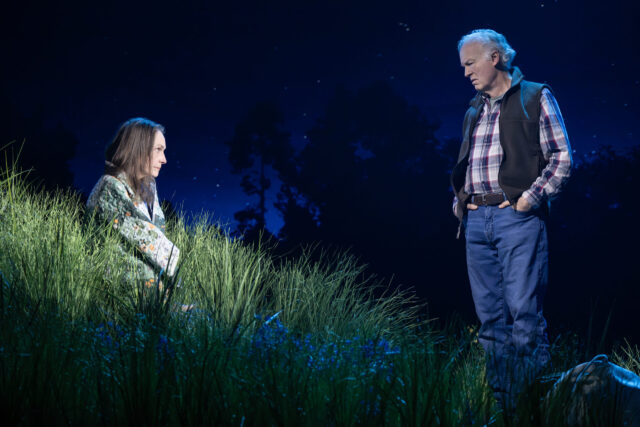
Donald Margulies’s immeasurably moving and intelligent Lunar Eclipse begins with a man (Reed Birney) sitting in a folding chair under a tree in the middle of a grassy field, crying inconsolably. He tries to hide his sorrow when a woman (Lisa Emery) arrives, but soon they are both digging deep into their lives as the earth passes between the sun and the moon.

The couple is named George and Em, after George Gibbs and Emily Webb, the neighbors who fall in love in Thornton Wilder’s Our Town. Although the play is not specifically about those two characters, it does echo Wilder’s approach, making them represent any wife and husband looking back after fifty years, the good times and the bad. It’s nearly impossible to not imagine yourself in one of those chairs — regardless of your current age — next to your longtime partner, taking stock of your accomplishments and failures as the sky turns from bright to dark to bright again.

For ninety minutes, George and Em bicker over minute things, discuss their children, remember their first night together, and honor the many dogs they had, buried around them in that field. Although no time period is given, cellphones never appear. George and Em talk about their health problems; George is afraid he’s starting to lose his mind. He says, “Feel like I’m at sea, sometimes, in the middle of a storm. Looking for a place to land only there’s no land in sight.” Em replies, “You’re the sharpest man I know.” But George insists he is changing, and not for the better. “Isn’t that something? To think that we’re here? At this stage? Already? Look at us: Almost done. Lights out.”

As the total eclipse begins, George pulls out his binoculars, laments having had his telescope stolen, and hopes to see the rare Japanese Lantern Effect. Em asks George why he was crying, and although he is initially hesitant, he eventually tells her. They talk a lot about love and death.

Describing a troubling experience he’d had very early that morning, a kind of walking nightmare, George says, “My heart . . . was racing . . . I could feel blood rushing to my head. I could hear it in my ears. Afraid if I said anything, if I made any sound at all, if I’d budged one inch, everything would just . . . crack.”

She kisses his hand, and he wonders why she did that. He is worried about the future of humanity. She asks if she has ever done anything that surprised him. He’s sorry to hear about her sadness. In some ways they evoke not only Wilder’s George and Emily but also Edward Albee’s George and Martha from Who’s Afraid of Virginia Woolf?, although not nearly as extreme, nonviolent, and relatively sober.

They’re not rich, they don’t have a close, loving family, and they recently said goodbye to their last dog, but they still care about each other, even if he doesn’t want to admit it.

George: Anything I can do to help . . .
Em: You mean that?
George: Of course I mean that.
Em: Thank you. That’s kind of you to say.
George: I’m not being kind. I’m your husband.

Em (Lisa Emery) and George (Reed Birney) remember the good times and the bad in beautiful Second Stage play (photo by Joan Marcus)

Em sums up their life — all of our lives — when she then says, “The worst thing in the world that could possibly happen happens and you go to sleep and morning comes and whataya know, you wake up and you’re still breathing. You didn’t die during the night. That’s your punishment, I guess: You live another day. And all the days after that.”

Presented by Second Stage at the Signature Center, Lunar Eclipse is a near-masterpiece by the Brooklyn-born, New Haven–based Margulies, who won the Pulitzer Prize in 2000 for Dinner with Friends, was a finalist for two other Pulitzers (for Sight Unseen and Collected Stories), and won the Thornton Wilder Prize for literary translation in 2018. Margulies dedicated the work to his father-in-law, George Street, a Kentucky farmer who died in 2010.

Walt Spangler’s set is a lovely, inviting grassy expanse beautifully lit by Amith Chandrashaker, with Sinan Refik Zafar’s nature sounds encompassing the theater, immersing the audience in the experience, along with Grace Mclean’s gentle music. S. Katy Tucker’s video projections follow the course of the eclipse in the sky behind the actors, who are dressed in Jennifer Moeller’s casual costumes. My lone quibble is when dark clouds are projected as George mentions dark clouds hanging over him.

Drama League nominee Kate Whoriskey (Clyde’s, Sweat) directs the show with a compassionate, tender hand, giving plenty of room for Margulies’s poetic dialogue to shine out of the shadows. For the next lunar eclipse, you’ll want to find a grassy, private space where you can sit next to your loved one and enjoy the event, but be careful what you share.

Tony winner Birney (Chester Bailey, The Humans) and Drama Desk nominee Emery (Six Degrees of Separation, A Kind of Alaska) are sensational together, he both gentle and brash as George, who admits to being disappointed with how his life ended up, she touching and considerate as Em, who believes she did the best she possibly could.

Which is all any of us can ask for.

[Mark Rifkin is a Brooklyn-born, Manhattan-based writer and editor; you can follow him on Substack here.]
CHESTER BAILEY

Real-life father and son Reed Birney and Ephraim Birney star in Chester Bailey at the Irish Rep (photo by Carol Rosegg)

CHESTER BAILEY
Irish Repertory Theatre, Francis J. Greenburger Mainstage
132 West 22nd St. between Sixth & Seventh Aves.
Wednesday – Sunday through November 20, $50-$70
212-727-2737
irishrep.org

Chester Bailey is one of the best plays of the year, a pristine example of the beauty and power of live drama.

In January 2015, the Irish Rep presented a free staged reading of Emmy-nominated writer and producer Joseph Dougherty’s Chester Bailey at the DR2 Theatre, directed by Emmy and Tony nominee Ron Lagomarsino and featuring Tony nominee Reed Birney as a doctor caring for a young man (Noah Robbins) who has suffered extreme, unspeakable trauma.

The show has been transformed into a touching, gorgeous, must-see production, running at the Irish Rep through November 20. Birney stars as Dr. Philip Cotton, a specialist working with soldiers, including amputees, suffering from battle fatigue and “other injuries that might keep a man from getting back to the life he had as a civilian.” It’s 1945, near the end of WWII, and Dr. Cotton has accepted a position at a Long Island hospital named after Walt Whitman, the poet who served as a nurse during the Civil War.

“The families of the men I was treating wanted their sons and husbands to be the way they were before the Solomons and the Philippines,” Dr. Cotton tells us. “I tried. Tried to take that look out of their eyes. That look acquired in the jungle. My successes were ‘limited.’”

Dr. Cotton’s newest case is Chester Bailey — played by Birney’s son, Ephraim Birney — a man in his midtwenties who refuses to acknowledge that he has lost both eyes and hands in a horrific incident at the Brooklyn Navy Yard, where he worked along the keel of a mine sweeper. Dr. Cotton might technically be unable to take that look out of Chester’s eyes, but the character is played with eyes and hands that are filled with emotion. Chester is overwhelmed with guilt because his parents got him the job in order to keep him out of the war; he had wanted to enlist, like most of the men he knew were doing, but his mother was determined to protect him.

Chester Bailey (Ephraim Birney) creates his own reality out of trauma in superb New York premiere (photo by Carol Rosegg)

“One night, I was reading the paper in the kitchen with the radio on, listening to the war news, and my folks came in and my mother was smiling,” he explains directly to the audience. “She said, ‘We’ve got a late Christmas present for you, Chester. Your father got you a job at the Navy Yards. Isn’t that wonderful?’ When she said job, she meant reserved occupation. She meant I wouldn’t be drafted because I’d be doing war work. Doing my patriotic part, but coming home to Vinegar Hill at the end of my shift. . . . My father looked up at me and I could see in his eyes this was just how it was going to be and there was nothing either one of us could do about it.” The horrible irony was that Chester ended up with the type of injuries men get on the field of battle anyway.

Chester has created a fantasy world in which he can still see and touch things. He describes in detail a copy of van Gogh’s Langlois Bridge at Arles that he thinks is hanging in his room. The 1888 painting relates to Chester’s state of mind: It depicts a woman in black standing on a small drawbridge under blue skies, holding a black umbrella as if in a dark storm. In the actual historical war, the bridge was blown up by the Germans in 1944, so it wouldn’t have existed in 1945 when Chester was supposedly seeing the print of it, made by an artist who would shortly thereafter cut off his own ear and live in an asylum. In fact, Chester believes that the only lasting effect the incident had on him was that he lost one ear. Meanwhile, we learn that Dr. Cotton is color blind, so he cannot process critical aspects of the painting that Chester believes is on the wall.

The first part of the play primarily goes back and forth between Chester and Dr. Cotton talking to the audience, delivering monologues about themselves. Chester discusses his parents and recalls going dancing with a former girlfriend at Luna Park, heading into Manhattan by himself for what he hoped would be a night of revelry, and falling instantly in love with a young red-haired woman selling papers at a newsstand in Penn Station.

Dr. Cotton carefully watches Chester sharing these memories, as if he’s not in the room with him, then adds elements from his own personal and professional life that intersect with similar themes that Chester’s deals with, just from a different angle; the doctor discusses his daughter, Ruthie; his wife’s infidelity and their eventual divorce; his career choices; going to the country club; his flirtation with his boss’s wife; and waiting at Penn Station to get home to Turtle Bay after work.

“It was difficult for Chester’s father to visit him on Long Island,” Dr. Cotton says. “He’d come on weekends, get off the train at the same station I used before I moved, walk the mile and a half around Holy Rood Cemetery to the hospital on Old Country Road. I think of him standing on the platform I used. Each of us waiting for the light of the westbound. Waiting. Not thinking. Trying not to think.”

In the second half, doctor and patient interact, as Dr. Cotton is determined to make Chester face what has happened to him and Chester keeps insisting he has eyes that can see and hands that can touch. Revisiting the incident, Chester tells his incorrect version. “Remember anything else?” Dr. Cotton says. “Nothing real,” Chester responds. “Do you remember anything that isn’t real?” the doctor asks before exploring Chester’s dreams and hallucinations.

The Irish Rep is justly celebrated for its sets, and Chester Bailey is no exception. Two-time Tony winner John Lee Beatty’s (Sweat, Junk) stage design combines a hospital room with bed, wheelchair, and table with the grandeur of old Penn Station, with stanchions in concrete blocks and a curved metal ceiling seemingly made out of railroad tracks. Brian MacDevitt’s lighting includes dangling lightbulbs that glow like stars in the night sky, going on forever in the mirrored walls. “The concourse of Penn Station is like the hull of a ship turned upside down, like you were looking up at the keel,” Chester says. “But instead of being all dark like where I work, it’s light. The light is just in the air. And there are no shadows. You want to know what the light looks like in heaven? You go to the main concourse of the Pennsylvania Station.” Beatty and MacDevitt have captured that image beautifully.

One of New York’s finest, most consistent actors, Reed Birney (The Humans, Man from Nebraska) inhabits the role from the very start, portraying Cotton not as a heroic wartime doctor but as a man with his own shortcomings. Whether he wants to or not, he becomes a kind of father figure to Chester, made all the more palpable since Ephraim (Exploits of Daddy B, Leon’s Fantasy Cut), who was cast first, is his son. While Reed moves slowly and carefully, Ephraim is much more active, jumping around with an eagerness that counters his character’s inability to come to terms with what has happened to him.

Two-time Drama Desk–nominated director Ron Lagomarsino (Digby, Driving Miss Daisy) guides the ninety-minute show with a graceful elegance; there’s nary a stray note in the play, which is not just about the travails of a single man but about family and everyday existence, about the big and small moments. The relationship between parents and their children are echoed here by a doctor and patient who happen to be father and son. At one point, Chester asks Dr. Cotton why he didn’t go into his father’s printing and binding company. “How come it wasn’t Cotton and Son?” he wonders. Dr. Cotton answers, “He wanted me to go to college. I wanted to be a doctor.” It takes on extra meaning in that Ephraim has followed his father and mother, actress Constance Shulman, into the family business. (All three appeared in the offbeat 2022 film Strawberry Mansion.)

Early on, Dr. Cotton states, “If there’s one thing reality can’t tolerate, it’s competition.” It’s a great line in a great play that brilliantly explores the human condition and the realities that each of us creates to help us deal with whatever life throws our way.

STRAWBERRY MANSION

Dream auditor James Preble (Kentucker Audley) meets a fantastical young woman (Grace Glowicki) in Strawberry Mansion

STRAWBERRY MANSION (Kentucker Audley & Albert Birney, 2021)
Quad Cinema
34 West 13th St. between Fifth & Sixth Aves.
Through Thursday, March 3
212-255-2243
quadcinema.com

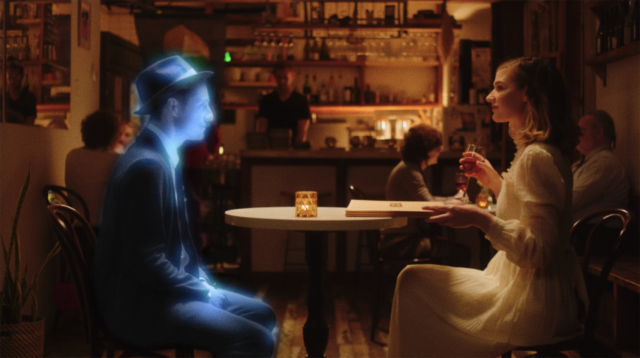
Kentucker Audley and Albert Birney follow up their 2017 codirecting debut, Sylvio, about a well-dressed gorilla working as a debt collector while he pursues his goal of having his own puppet show, with the equally bizarre but utterly fabulous Strawberry Mansion, continuing at the Quad through March 3. It’s 2035, and government auditor James Preble (Audley) has been assigned to investigate Bella Isadora (Penny Fuller), an elderly woman who lives in a strawberry-colored house in the middle of nowhere, behind a sign that announces, “The End.” The soft-spoken, all-business Preble is tasked with reviewing Bella’s dreams, which are now taxable; she has stored them on two thousand analog VHS tapes, which have been outlawed. Preble puts on an outlandish metal headset and watches Bella’s fanciful dreams on the tapes, calculating what Bella will have to pay. But Bella also gives him her own homemade electric helmet, which takes Preble into another world, where he encounters Bella as a beautiful young woman (Grace Glowicki) offering him a freedom he’s never known, amid impending danger. When Bella’s family shows up — her mean son, Peter (Reed Birney), his witchy wife, Martha (Constance Shulman), and their dullard son, Brian (Ephraim Birney), Preble learns more about the deep intrigue he’s involved in and is soon fighting for his own survival as he seeks the truth.

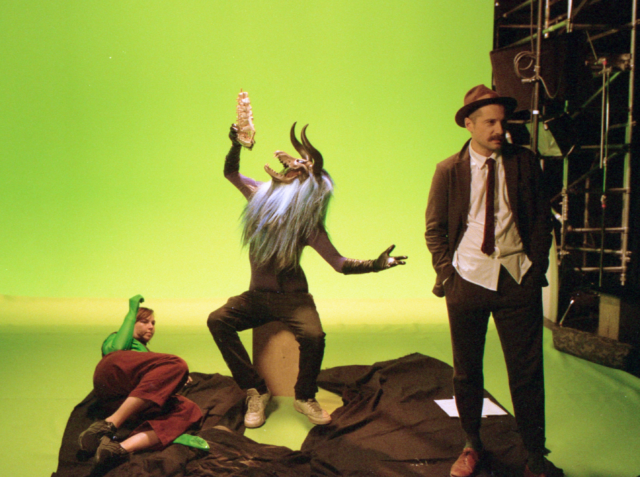
Strawberry Mansion is endless fun, a neonoir surreal fantasy thriller that evokes Michel Gondry’s wildly imaginative duo, Be Kind, Rewind and The Science of Sleep. It’s like David Lynch and Guy Maddin codirected an episode of Pee-Wee’s Playhouse based on a Stranger Things script by John Carpenter and David Cronenberg. The film switches between a muted palette and fanciful, bright hues, with settings that have a DIY quality as the story bounces between different times and locations with a seemingly reckless abandon; well-deserved kudos go to cinematographer Tyler Davis, production designer Becca Brooks Morrin, costume designer Mack Reyes, art director Lydia Milano, propmaster Marnie Ellen Hertzler, and set decorator Paisley Isaacs for creating an alternate universe that will have you thoroughly delighted while scratching your head, but don’t think too hard about what it all means. Electronic musician Dan Deacon composed the ultracool score.

Strawberry Mansion is more than just a surreal adventure into a supremely weird future; it is also a clever satire of overconsumption, social media, and the advertising algorithms that dominate our daily lives. It seems the only food available is Cap’n Kelly fried chicken (and the new chicken shake with gravy!) and Red Rocket cola, which come in containers broadcasting their prominent logos. And the use of VHS tapes instead of digital media harkens back to a lost past that we can never get back. Technical advancement is not always for the best, as we keep learning every day. In fact, Audley and Birney shot Strawberry Mansion digitally, then had it transferred to 16mm to give it that special look and create the old-fashioned atmosphere.

Audley (Open Five, Holy Land) portrays Preble as a 1970/’80s-style private eye in a low-budget Saturday matinee, with a great ’stache, while Albert Birney (The Beast Pageant, Tux and Fanny) appears as a frog waiter and blue demon. Fuller, who has received two Tony and six Emmy nominations (winning one) in her distinguished sixty-year career (Applause, The Elephant Man), has an absolute blast as Bella, a smile perpetually on her warm, charming face.

Dream auditor James Preble (Kentucker Audley) has quite a job to do in Strawberry Mansion

It’s a family affair, as Albert Birney’s aunt, uncle, and cousin, Constance Shulman, Reed Birney, and their real-life son, Ephraim, play Bella’s kinfolk, with Tony winner Reed (The Humans, Mass) and Shulman (Orange Is the New Black, Doug) chewing up as much scenery as they can. Linas Phillips is Preble’s oddball friend, Peter, while Lawrence Worthington and Shannon Heartwood are Richard and Marcus Rat and Mack Reyes is the stowaway. Oh, and don’t forget Sugarbaby the turtle.

Strawberry Mansion has all the earmarks of a cult classic, the kind of flick that should have fans lining up at theaters for midnight screenings dressed like the characters, tossing around props, eating fried chicken, and calling out favorite lines. I’m not going to tell you who I’m going as, as that might reveal too much about me.

PLAYWRIGHTS HORIZONS FIFTIETH ANNIVERSARY VIRTUAL GALA

Who: Heather Christian, Mykal Kilgore, Carla R. Stewart, Ali Stroker, Marinda Anderson, Cassie Beck, Quincy Tyler Bernstine, Reed Birney, Aya Cash, Kirsten Childs, Milo Cramer, Sarah DeLappe, Larissa FastHorse, Jesse Tyler Ferguson, Peter Friedman, Dave Harris, Lucas Hnath, Michael R. Jackson, Sylvia Khoury, Taylor Mac, Matt Maher, John-Andrew Morrison, Kelli O’Hara, Annie Parisse, Pedro Pascal, Max Posner, Tori Sampson, Rhea Seehorn, Lois Smith, Paul Sparks, Jeremy Strong, Sanaz Toossi, more
What: Fiftieth anniversary virtual gala
Where: Playwrights Horizons online
When: Wednesday, June 23, free with RSVP (donations encouraged), 8:00
Why: Over the course of fifty years, seven Pulitzer Prizes, thirteen Tony Awards, and forty-seven Obies, Playwrights Horizons has lived up to its mission as “a writer’s theater dedicated to the support and development of contemporary American playwrights, composers, and lyricists and to the production of their new work.” On June 23 at 8:00, PH will celebrate its golden anniversary with a virtual gala featuring appearances by a wide range of creators with connections to the company, which is based on West Forty-Second St. The evening will be highlighted by a quartet of performances: Carla R. Stewart singing “Lifted” from Tori Sampson’s If Pretty Hurts Ugly Must be a Muhfucka, Mykal Kilgore singing “Memory Song” from Michael R. Jackson’s A Strange Loop, Heather Christian delivering “Recessional” from Prime: A Practical Breviary, and Ali Stroker singing “Her Sweater” from Kirsten Guenther and Ryan Scott Oliver’s Mrs. Sharp. In addition, among those wishing PH a happy anniversary will be Quincy Tyler Bernstine, Reed Birney, Sarah DeLappe, Larissa FastHorse, Jesse Tyler Ferguson, Lucas Hnath, Taylor Mac, Kelli O’Hara, Annie Parisse, Pedro Pascal, Lois Smith, and Paul Sparks.

THE SHOW GOES ON: CASA VALENTINA

Harvey Fierstein and the cast of Casa Valentina will reunite for MTC’s “The Show Goes On”

Who: Harvey Fierstein, Reed Birney, John Cullum, Gabriel Ebert, Tom McGowan, Patrick Page, Nick Westrate, Mare Winningham
What: Cast reunion and watch party
Where: Manhattan Theatre Club YouTube
When: Thursday, March 18, free, noon
Why: In November, Manhattan Theatre Club kicked off a new monthly series, “The Show Goes On,” revisiting previous productions with members of the cast and crew watching filmed excerpts and talking about their experiences. In November, director Trip Cullman, narrator Rebecca Naomi Jones, music director Justin Levine, and costar Will Swenson looked at 2012’s Murder Ballad, which also featured Karen Olivo and John Ellison Conlee. In December, actors Jon Hoche and Paco Tolson explored 2016’s Vietgone, by Qui Nguyen. In January, writer-director John Patrick Shanley and star Timothée Chalamet discussed 2016’s Prodigal Son. And in February, Stephanie Berry, who played, Aunt Mama, shared insight into 2018’s Sugar in Our Wounds, written by Donja R. Love and directed by Saheem Ali.

The March edition of “The Show Goes On,” each of which runs between fifteen and twenty minutes, reunites the cast of 2014’s Casa Valentina, Harvey Fierstein’s first drama in more than a quarter century. The play, inspired by a true story, takes place in June 1962 at a Catskills bungalow where men spend weekends cross-dressing and acting like women, a safe haven where they can celebrate their feminine side. Joining in the watch party will be Fierstein and most of the original cast: Reed Birney, John Cullum, Gabriel Ebert, Tom McGowan, Patrick Page, Nick Westrate, and Mare Winningham. At the time, I wrote, “Cross-dressing might be somewhat de rigueur these days on Broadway (Kinky Boots, A Gentleman’s Guide to Love & Murder, Cabaret, Hedwig and the Angry Inch), but Fierstein, [director Joe] Mantello, and an extremely talented and beautiful cast offer a very different take on this misunderstood culture, treating it with humor, intelligence, honor, courage, and, perhaps most important, dignity.” Like its title says, the show does go on, living on YouTube after its initial airing.

SMITHTOWN

Michael Urie, Ann Harada, Constance Shulman, and Colby Lewis deliver interconnected monologues in Drew Larimore’s Smithtown

SMITHTOWN
The Studios of Key West
February 13 – March 13, $20
tskw.org

Drew Larimore’s Smithtown is set not in the nearby North Shore municipality on Long Island but in a fictional midwestern college town in the aftermath of a terrible tragedy. The sixty-five-minute virtual play, presented by the Studios of Key West through March 13, explores the incident from four different perspectives, in a quartet of interlinked Zoom monologues that slowly reveal how it unfolded, through jealousy, thoughtlessness, ambition, and accident.

The show, directed by opera librettist Stephen Kitsakos, begins with the indefatigable, always charming Michael Urie (Torch Song, Buyer & Cellar) as Ian A. Bernstein, a grad student on the first day of teaching the new Smithtown College class Introduction to Ethics in Technology. Frazzled and uneasy, Bernstein explains that they will be examining how technology, and the cell phone in particular, can be used “as a tool, as a device, as a weapon.” He then begins to detail a specific event involving himself and his ex-girlfriend that went horribly wrong, revealing an alarming blindness to his own role in the event.

The action then shifts to Ann Harada (Avenue Q, Emojiland) as perky Bonnie, aka Text Angel, a former guidance counselor at Smithtown High School who now makes a living by sitting in front of a computer in her basement, sending uplifting messages to people in need of “digitized self-esteem.” She says of a new client, “I’ve got a seven-hundred-pound woman in Akron, Ohio, who’s got the bottomless kung pao chicken at Ling’s Chinatown Buffet eyeing her like a hooker. This time next year we’ll have you posing in the swimsuit edition, hotcakes.”

In the third scene, Colby Lewis (Hamilton, Five Guys Named Moe) plays Eugene Pinkerton, a jack-of-all-trades at the Smithtown Heritage Center who is making a YouTube video praising the cultural glories of the town. But a chip on his shoulder gets in the way: “Our nation’s finest artists live in small-town America; we should be looking there for our next great minds and hearts and not write folks like me off as folksy hacks,” he says. He then talks about his own art exhibit, which he calls “groundbreaking,” work “that will put those avant-garde folks in New York to shame,” defending the indefensible subject matter.

Smithtown concludes with Constance Shulman (Orange Is the New Black, Steel Magnolias) as Cindy, a woman welcoming an unseen couple to the neighborhood. She’s in her kitchen, offering them lemon cookies and explaining that it’s been a rough year, separating from her husband and having trouble sleeping. “I’d like nothing more than to take an eraser to wipe away any trace. That way you never have to . . . ,” she says, her voice trailing off with sadness. She changes the discussion to her obsession with Facebook and also shows a picture on her phone of her estranged husband — an old photo of Shulman’s real-life spouse, actor Reed Birney. As the overall story comes full circle, it’s likely to hit you like a brick.

Larimore (The New Peggy, The Cannibals of McGower Country) wrote Smithtown before the pandemic, but it has been revamped for online viewing in a way that makes it feel like it’s very much about these current troubled times as it deals with loneliness and connection. The play is bookended by terrific performances by Urie and Shulman, two of New York’s finest actors. Urie, who has been very busy during the coronavirus crisis, participating in numerous benefit readings, conversations, and short plays, lends a complexity to the deeply disturbed Bernstein; just watch how he corrects himself each time he says “girlfriend,” following it up with “ex-girlfriend.” And Shulman is extraordinary as a woman trapped with her memories, desperate to reach out and not be alone, something we can all appreciate as we’re sheltering in place, so many of us unable to see our loved ones. Technology can bring us together, but as Smithtown demonstrates, by crowd-sourcing away our personal responsibility, it can also tear us apart.