Tag Archives: NYU Skirball Center for the Performing Arts

ELEVATOR REPAIR SERVICE: SEAGULL

Elevator Repair Service puts its unique spin on Anton Chekhov’s The Seagull (photo by Ian Douglas)

SEAGULL
NYU Skirball Center for the Performing Arts
566 La Guardia Pl. between Third & Fourth Sts.
Through July 31, $50-$60 (use code FB25 for $25 tickets)
212-945-2600
nyuskirball.org
www.elevator.org

I’m beginning to think I might never see another traditional production of Anton Chekhov’s 1895–96 classic, The Seagull. Perhaps more than any other playwright, Chekhov’s works almost demand reinvention for the stage in the twenty-first century. His tragicomic take on human relationships and society’s ills invite modern, often extensive reinterpretation and experimentation.

As often as Shakespeare’s plays are reimagined, they almost always still contain the Bard’s original dialogue; it’s the staging that changes. The same is not necessarily true about Chekhov, as evidenced by such recent successes as Arlekin Players Theatre’s hybrid The Orchard (The Cherry Orchard), Aaron Posner’s Life Sucks. (Uncle Vanya), and Halley Feiffer’s Moscow Moscow Moscow Moscow Moscow Moscow (Three Sisters).

As far as The Seagull goes, over the last ten years I’ve seen Posner’s Stupid Fucking Bird at the Pearl in 2016, a deliriously chaotic yet controlled rave-up sticking to the main plot but told with an intoxicating irreverence; Jeffrey Hatcher’s Ten Chimneys, at St. Clement’s in 2012, which goes behind the scenes of an upcoming Broadway revival of The Seagull starring Alfred Lunt and Lynne Fontanne; and Christopher Durang’s Vanya and Sonia and Masha and Spike, a delightful all-star mashup of The Seagull, Three Sisters, and Uncle Vanya that ran on and off Broadway in 2013.

Elevator Repair Service, the downtown company whose literary adaptations include William Faulkner’s The Sound and the Fury, Shakespeare’s Measure for Measure, James Joyce’s Ulysses, and F. Scott Fitzgerald’s The Great Gatsby — the much-admired eight-hour Gatz — now turns its unusual techniques on Chekhov with Seagull, continuing at NYU Skirball through July 31. Nearly three hours with one intermission, the play self-referentially refers to itself regularly, with actors occasionally speaking to the audience as themselves, not as their characters. It begins with a long monologue by company member Pete Simpson, who talks about the Skirball space itself. “One of these two corkscrew, fluted, gold leaf columns is structural and holds up the building above us. The other is hollow, insubstantial, and does nothing but sit there and look pretty in an attempt to make things look symmetrical.”

When he said that under each chair are three flags, a red one that “will tell us you feel physically threatened or uncomfortable,” a checkered one to use if you just “wanna talk,” and a third to order food, I saw the woman sitting across the aisle from me reach below her seat to see if the flags were really there. (They’re not.) But it signals that this production is going to veer wildly between the real and the imagined, although all of it turns out to be Chekhovian in one way or another, even if, as Simpson, who also plays the teacher Semyon, explains, “95% of tonight’s text both original and adapted has been written by our company’s own Gavin Price,” who portrays wannabe playwright Konstantin.

Director John Collins leaves the central plot intact: The twentysomething Konstantin has invited friends and family over to a lovely lake house to watch his latest play, to be performed by Nina (Maggie Hoffman), a nervous actress he is desperately in love with. Konstantin is hoping to prove to his mother, famous actress Irina (Kate Benson), that he has talent and a purpose in life; Irina, who chastises him regularly in front of everyone, has arrived with her new beau, well-respected and successful writer Boris Trigorin (Robert M. Johanson), who takes a liking to Nina.

Also at the presentation are Patricia (Laurena Allan), Irina’s ailing sister; farmer Ilya (Julian Fleisher), who is a big fan of Irina’s, and his wife, Paulina (Lindsay Hockaday); Masha (Susie Sokol), the farmers’ daughter who is in love with Konstantin but might be married off to Semyon; Yakov (John Gasper), who works at the lake house; and Gene (Vin Knight), a doctor who has an innate charm that lures the ladies, including Paulina.

In the middle of the play-within-a-play, Irina asks, “Is this supposed to be symbolic?” A moment later, she says, “Something smells. Is that part of the effect?” A disgusted Konstantin eventually has to stop the show because of his mother’s interruptions.

Shortly after Patricia has an asthma attack, Benson, Hoffman, and Susie have a discussion as themselves, commenting on how much they enjoyed the previous scene and what Chekhov’s play is about. The play resumes as Konstantin presents Nina with a seagull he just shot.
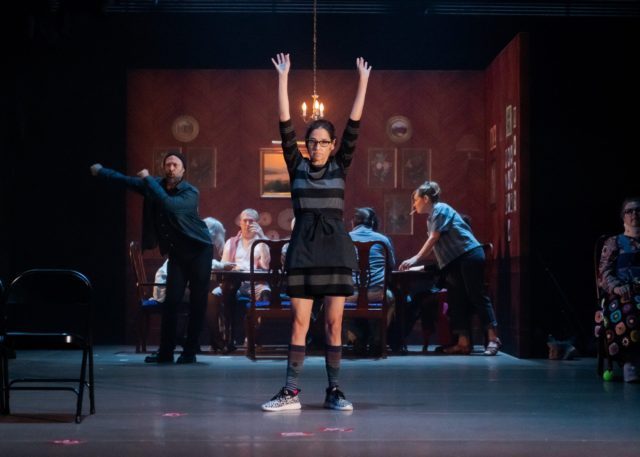
Masha (Susie Sokol) leads the characters in a strange game in Seagull (photo by Ian Douglas)

Following intermission, Sokol points out how long she has been with ERS, explains the set design, and expresses her disappointment that one of Masha’s key lines has been cut: “I’m in mourning for my life.” Soon various characters consider leaving the lake house, Irina insists she has no money to help anyone, and Konstantin sports a bloody bandage wrapped around his head. “You . . . Symbolist!” Irina again accuses her son. “Miser!” he replies. “You amateur!” she declares. It all goes downhill from there.

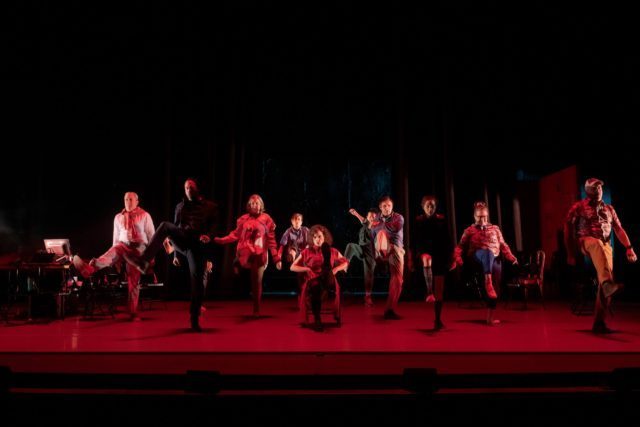
The set by dots, so ably described by Sokol, features a row of folding chairs in the front that the characters move about depending on the action. Downstage right is a table with electronic equipment, while upstage left is a cozy dinner table with pictures on the wall. The lighting is by Marika Kent, with sound by Price and Gasper and purposely mismatched costumes by Kaye Voyce, ranging from Nina’s elegant red dress to Irina’s short skirt, heels, and tights.

Collins’s direction may appear disordered as the fictional plot battles it out with the actors’ thoughts and some events happen either offstage or in the background — as when several characters sit down to eat but we can’t make out exactly what they are saying to one another, although it does turn into a terrific bingo-style dance number. But there is a method to his madness, even if it’s not necessarily always clear what he’s up to; numerous pieces of dialogue reflect back on the play we’re watching, as if ironically commenting on what is happening in Seagull at Skirball.

“It’s not easy, you know, acting in your play. There aren’t any ordinary people in it,” Nina tells Konstantin, who responds, “Ordinary people! We have to show life not the way it is, or the way it should be, but the way it is in dreams!” Nina retorts, “But nothing happens in your play! It’s all one long speech. And I think a play ought to have a love story.” Meanwhile, Collins emphasizes Chekhov’s Hamlet references, with Konstantin echoing the young prince, Irina a different kind of Gertrude, Boris representing Claudius, and Nina an embellished Ophelia.

“It was a strange play, wasn’t it?” Nina asks Boris about Konstantin’s show. Boris replies, “I’m afraid I didn’t understand a thing. But it was interesting to watch. You were wonderful. And of course, the set was magnificent!” Most people in the audience seemed to agree with that analysis of ERS’s production, although a handful walked out during the first act and others did not return after intermission; however, those who stayed, the vast majority of the crowd, gave the performers a standing ovation at the end.

Seagull is not for everyone’s taste. It is long — 173 minutes, as Simpson tells us — it is confusing, it is pedantic, and it can be self-referential to a fault, particularly as the cast passes around a microphone and cord, going in and out of character. And don’t get me started on the awful noise made when Patricia is pushed around in a chair. But it all continues founding artistic director Collins’s thirty-plus-year mission of experimenting with new theatrical forms, in original works and unique adaptations.

Hamlet asked himself, “To be or not to be.” In Seagull, Patricia answers, “Just go on living, whether you feel like it or not.” The same can be said for theater itself.
PANEL DISCUSSION & MARATHON READING OF KAFKA’S “THE TRIAL”

(photo by Natalia Kabanow)

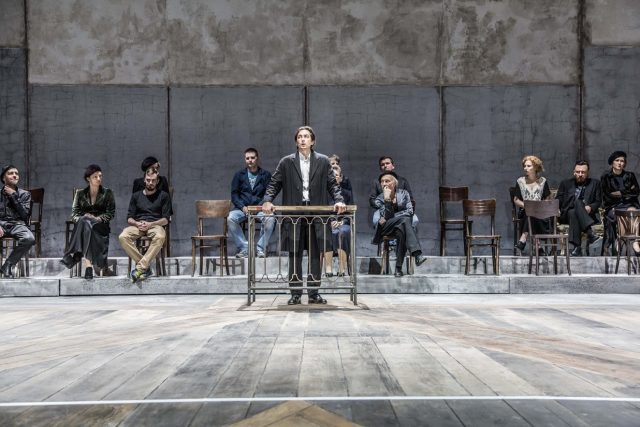
Cancellation of Krystian Lupa’s Polish version of Franz Kafka’s The Trial at NYU Skirball has led to panel discussion and marathon reading in defense of artistic freedom (photo by Natalia Kabanow)

NYU Skirball Center for the Performing Arts
566 La Guardia Pl.
Sunday, March 8, free, 1:00 – 10:00
212-992-8484
nyuskirball.org

NYU Skirball is facing its own Kafkaesque drama in its attempt to stage a Polish version of Franz Kafka’s The Trial. Krystian Lupa’s adaptation was scheduled to come to the Washington Square theater March 7-8, but the show was canceled when the Adam Mickiewicz Institute (AIM) cut off its funding. “Kafka’s The Trial is the story of political corruption, government censorship, and social malevolence — a story that mirrors our current global realities,” Skirball director Jay Wegman said in a statement. “Sadly, and ironically, the Polish government has pulled its funding in an attempt to silence Krystian Lupa, making this North American premiere impossible.” In a revealing Theatermania article, Wegman went toe-to-toe with AIM acting director Barbara Schabowska, arguing over what really happened, whether it was censorship, sloppiness, or incompetence.

Instead, Skirball is hosting a panel discussion and marathon reading of The Trial, presented in conjunction with the Public Theater, New York Theatre Workshop, PEN America, and CUNY’s Segal Center. The free March 8 program begins at 1:00 with “Art in Danger, Artists at Risk,” a panel featuring Monika Fabijanska, Holly Hughes, Felix Kaputu, André Lepecki, Julie Trébault, and Lupa, moderated by Catharine R. Stimpson, as they explore issues of artistic freedom, particularly amid the global populist movement. “The declaration of Minister Gliński is clear,” Lupa said in a statement. “Artists who do not sympathize with the current leadership’s cultural policy, who criticize its values, decisions, and actions, will be treated as enemies of Poland and will not be supported by the Ministry of Culture and National Heritage in any form.” From 3:00 to about 10:00, there will be a marathon reading of Kafka’s posthumously published 1925 novel, with such special guests as Salman Rushdie, Kathleen Chalfant, Zadie Smith, and Kwame Anthony Appiah. Advance RSVP is recommended but not required; there will also be limited spots available to the public the day of the event. “Someone must have been spreading lies about Josef K, for without having done anything wrong he was arrested one morning.” And so it begins.

ANNE TERESA DE KEERSMAEKER: MITTEN WIR IM LEBEN SIND / BACH6CELLOSUITEN

(photo by Anne Van Aerschot)

The North American premiere of Anne Teresa De Keersmaeker and Rosas’ Mitten Wir Im Leben Sind/Bach6Cellosuiten takes place at the Skirball Center this week (photo by Anne Van Aerschot)

NYU Skirball Center for the Performing Arts
566 La Guardia Pl.
February 13-15, $50-$60, 7:30
212-998-4941
nyuskirball.org
www.rosas.be/en

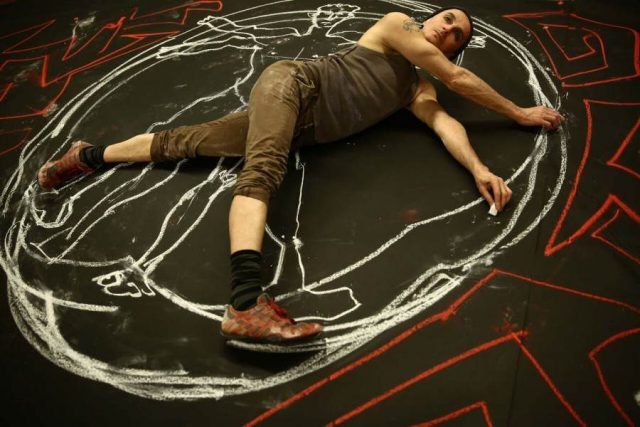
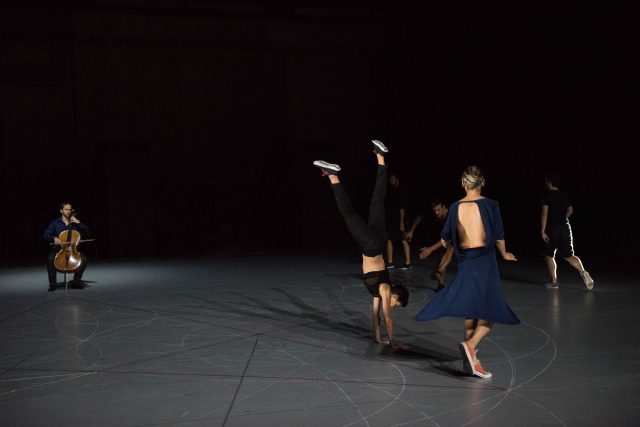
If you haven’t seen Belgian choreographer Anne Teresa De Keersmaeker and Rosas perform in New York City, you haven’t been paying attention. She and her company have presented A Love Supreme at New York Live Arts in 2017, Six Brandenburg Concertos at Park Avenue Armory in 2018, and Transfigured Night at Baryshnikov Arts Center in 2019. This week de Keersmaeker and Rosas are performing the North America premiere of Mitten Wir Im Leben Sind / Bach6Cellosuiten (In the Midst of Life / Bach’s Cello Suites) at NYU’s Skirball Center, a series of solos accompanied by master French cellist Jean-Guihen Queyras, who plays a 1696 cello by Gioffredo Cappa, with de Keersmaeker joining each dancer for a duet.

The two-hour piece, which debuted at the 2017 Ruhrtriennale in Germany in 2017, consists of six Bach sections written between 1717 and 1723 (BWV 1007-1012) — the allemande, courante, sarabande, two minuets, and gigue — created with and danced by Boštjan Antončič, Marie Goudot, Julien Monty, Michaël Pomero, and De Keersmaeker. The stark staging, in which the dancers move across a black space around a seated Queyras, with swirling white chalk marks and green and red tape placed on the light-colored floor, features costumes by An D’Huys, sound by Alban Moraud, and lighting by Luc Schaltin. The title comes from Martin Luther’s version of the Latin antiphon “Media vita in morte sumus”; the Lutheran hymn reads, in part: “In the midst of life / We are in death / Who shall help us in the strife / Lest the Foe confound us? / Thou only, Lord, Thou only!” In addition, Bach wrote a freestanding chorale (BWV 383) based on Luther’s three-stanza liturgy; de Keersmaeker has also discussed how she saw the Luther quote on the tombstone of legendary choreographer Pina Bausch. The February 14 show will be followed by a talk with de Keersmaeker and Queyras, moderated by Center for Ballet and the Arts founder and director Jennifer Homans.

THE BUILDERS ASSOCIATION: ELEMENTS OF OZ

Unique app is key part of multimedia Elements of Oz

The Builders Association is restaging multimedia Elements of Oz at Skirball Center this weekend

NYU Skirball Center for the Performing Arts
566 La Guardia Pl.
December 7-8, $20-$25
212-992-8484
www.elementsofoz.com
nyuskirball.org

Three years ago, we saw the Builders Association’s multimedia Elements of Oz at the 3LD Art and Technology Center. The multimedia presentation is now back for three shows at NYU Skirball, December 7 at 3:00 and 7:30 and December 8 at 3:00, closing out Skirball’s yearlong celebration of the fiftieth anniversary of Stonewall. Below is our slightly amended review of the December 2016 production.

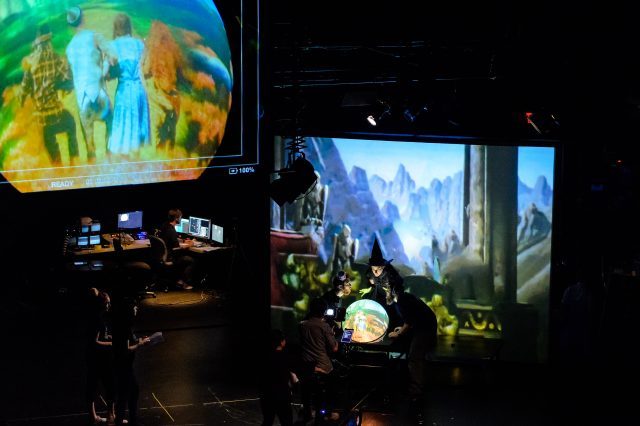
The Builders Association (Sontag:Reborn, Invisible Cities) takes audiences on a wild trip down the yellow brick road as it deconstructs and reconstructs The Wizard of Oz in its fun and innovative multimedia experimental production Elements of Oz. Conceived by Marianne Weems, Moe Angelos, and James Gibbs, directed by Weems, and cowritten by Gibbs and Angelos, Elements of Oz delves into the legend and legacy of the classic 1939 film, sharing little-known stories, reenacting key scenes, and examining its online presence, including theories about how the book and movie are metaphors for the U.S. monetary system and gold standard. The show presents a small corp of actors who reenact and reshoot key scenes, creating a new version via multiple monitors that project what is happening onstage and freeze-frames taken from previous scenes. The piece is performed by Angelos, Sean Donovan, and Hannah Heller, who each portray several characters — all three play Dorothy Gale at various points. They not only switch roles, they also shift from commenting on the film to acting in its re-creation, and from past to present, telling tales of 1939 moviemaking and its ongoing reverberations in popular culture.

Following a YouTube overture, Angelos delivers the first of many “talking points,” giving inside information to the audience. “It’s a masterpiece,” she says about the film, “but all we see is the magic. We don’t see all the brutal work and failure.” Elements of Oz reveals how much of that magic was made as stage manager April Sigler, associate lighting designer Elliott Jenetopulos, video designer Austin Switser, production manager Brendan Regimbal, and technical director Carl Whipple set up and break down Neal Wilkinson’s sets, filming short scenes that are then edited live to mimic the original, shot by shot, and played back on a large onstage screen as well as the monitors that fill the theater. Meanwhile, Moe relates stories about Margaret Hamilton and her double, Betty Denko, suffering major injuries; how “Somewhere Over the Rainbow” was almost left on the cutting-room floor; that some of the munchkins were repurposed as flying monkeys; and what really happened when the film went from black-and-white to color.

Just as The Wizard of Oz made use of cutting-edge technology, so does Elements of Oz, which has a unique innovation of its own. During the show, which is based on both the film and the book by L. Frank Baum, there are moments that are best viewed through your smart phone or tablet via a free augmented reality app, designed by John Cleater, that enhances what you’re watching by adding visual and aural effects, from snow to giggling munchkins to other cool surprises. Angelos (the Five Lesbian Brothers), Donovan (Thank You for Coming: Play), and Heller (The World Is Round) are hysterical as they change from role to role, with Angelos as Dorothy and Glinda, the mustachioed Donovan as Dorothy, Uncle Henry, Mike Wallace, the Scarecrow, the Tin Man, Salman Rushdie, and the Wizard, and Heller as Dorothy, Aunt Em, the Wicked Witch, the Scarecrow, Judy Garland, and Ayn Rand. (The costumes are by Andreea Mincic, with lighting by Jennifer Tipton, sound design and original music by Dan Dobson, and interactive design and programming by Jesse Garrison.) Originally presented by Peak Performances @ Montclair State University, the goofy and charming Elements of Oz is probably about twenty minutes too long, as things get a little repetitive, and as fun as the app is, you’ll find yourself at times looking at your phone, waiting for the next bit of AR to take place, instead of watching what is happening onstage. But like the original book and film, Elements of Oz is an enjoyable mind-expanding journey — and be sure to keep that app on as you exit Skirball and head toward Washington Square Park.

TWI-NY TALK: JOHN KELLY — UNDERNEATH THE SKIN

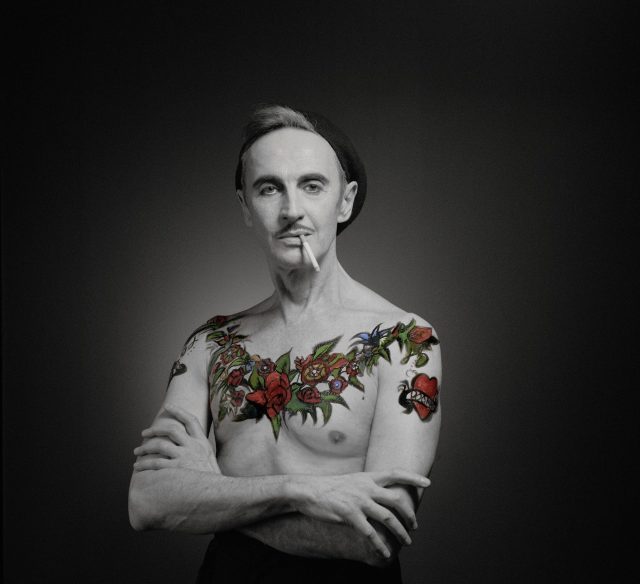
John Kelly takes on the persona of Samuel Steward in Underneath the Skin (photo by Josef Astor)

John Kelly takes on the persona of Samuel Steward in Underneath the Skin (photo by Josef Astor)

NYU Skirball Center for the Performing Arts
566 La Guardia Pl.
October 11-12, $35-$45, 7:30
212-992-8484
nyuskirball.org

“I like to move people. That’s my job, to move people. I’m not an entertainer; I’m an engager,” performance artist extraordinaire John Kelly told me in a phone interview earlier this week as he was hunkered down, preparing his latest show, Underneath the Skin, for its world premiere October 11-12 at NYU’s Skirball Center. For four decades, Kelly has been creating shows in which he takes on the persona of other artists, including Egon Schiele in Pass the Blutwurst, Bitte, Caravaggio in The Escape Artist, Joni Mitchell in Paved Paradise, and Antonin Artaud in Life of Cruelty. In the multimedia Underneath the Skin, Kelly, who is also a visual artist, filmmaker, dancer-choreographer, vocalist, songwriter, and author, explores the life and career of poet, professor, tattoo artist, novelist, diarist, and “sexual renegade” Samuel Steward. The Ohio-born Steward, who died in Berkeley in 1993 at the age of eighty-four, left behind a highly influential legacy despite constant systemic roadblocks because of his sexuality.

“Misfortune to a degree followed him, but maybe misfortune followed every gay man in those days,” said Kelly, who did extensive research for the show, which he wrote, directed, choreographed, produced, scored, designed the set and costumes for, and did the video editing. The piece, which is completely constructed of Steward’s words, also features Chris Harder, Alvaro Gonzalez, and Hucklefaery (ne’ Ken Mechler). “Every hour at this point is crucial,” Kelly noted, but he was still very generous with his time as we spoke about Steward, the AIDS epidemic, cultural amnesia, recalibration, and autobiography. Kelly will also be appearing at the Neue Galerie’s Café Sabarsky on November 26 in a cabaret concert of original music as well as songs by Bertolt Brecht, Kurt Weill, Charles Aznavour, Danny Elfman, and others.

twi-ny: Since the mid-1980s, you’ve been taking on the persona of other artists. What initially attracted you to do these kinds of character studies? As a child, were you doing impersonations, or were you drawn to artists?

John Kelly: I grew up assuming I’d be a visual artist. I could draw — I got that gift from my father. But then I switched to dance and ballet training, and modern when I was about seventeen. I came upon Schiele in art school and he became one of my early inspirations. So my performance work about him was a way of merging my dance background with my visual art practice, literally to embody an artist onstage, to see what that would look like.

The thing about the niche in my career focusing on the character of artists — my work has been fifty-fifty autobiographical or semiautobiographical or metaphorical, and then fifty percent focusing on actual characters from history, whether it was a real person or a mythological character like Orpheus. And I guess the reason with that is that when I do the autobiographical or metaphorical or semiautobiographical works, there’s an urgency in me that is wanting to get out. And then when I focus on an existing character, there’s something in their life story and work that speaks to me, and I’m able to embody them to some degree and also satisfy my need to express certain parts of myself and what I’m going through at any given moment.

(photo by Paula Court)

John Kelly traced his own life and career in the autobiographical Time No Line (photo by Paula Court)

twi-ny: When you were doing the autobiographical Time No Line, did you learn anything about yourself that you hadn’t realized before?

jk: I’ve been keeping journals since 1977, and I started scanning them because I wanted to get another copy, with an eye to an eventual memoir. But one of the things that fueled Time No Line was that I’m a survivor of my generation. My generation was pretty much wiped out by the AIDS epidemic, and I’m watching a couple of things: I’m watching the absence of my tribe in the world and the absence of those voices and the absence of our intergenerational dialogue between my generation and younger generations, and also I’m seeing my generation’s history being written by younger people who weren’t there and who probably had no way of really getting it.

I imagine they’re highly educated and well-intended — I just hope they get it right because they’re accessing the dead heroes, like David Wojnarowicz and Marsha P. Johnson; they’re not accessing the live heroes or the last survivors necessarily. With the world the way it is right now, there is a focus on activism in the kind of street sense of activism, but I embody a different kind of activism. I decided my place was on the stage, not on the streets, and that said, I made many pieces directly or tangentially about the AIDS epidemic and issues of survival and grief and all that.

It’s exacerbated by digital technology, it’s exacerbated by short attention spans, it’s exacerbated by a culture of narcissism and entitlement. Half the youth generally doesn’t really care to look back; they just assume that the ground they are standing on is solid and has always been there.

twi-ny: And they can like something on Facebook or post an article and then they’re done.

jk: Exactly. So it’s an uphill battle, and I do what I can to connect the dots. . . . But the upside of technology is that you can be on a platform like Facebook and connect and have dialogue and be reminded that our lives are still valid.

twi-ny: That leads us right into Underneath the Skin, about Samuel Steward, who, like you, was a diarist. What inspired you to take on his persona?

jk: I had read Justin Springs’s book [Secret Historian: The Life and Times of Samuel Steward, Professor, Tattoo Artist, and Sexual Renegade] about four years ago and I really loved it. Then Jay Wegman, who runs Skirball, said, “I want to commission you to make a piece about him,” and I was like, “Whoa. Hey, let me think about this.” So then I went to Steward’s actual writings and drawings and the rest, and I avoided Springs’s amazing take on Steward because I had to formulate my own relationship to this man and his work. And also to witness it in context; probably the most profound aspect of his whole thing is that he prevailed and he took enormous chances at a time when literally if you went to a gay bar, you couldn’t even face the person next to you; you had to face front, and there were police outside waiting to arrest you if you didn’t have payola. And if you were arrested, your name and address were put in the newspaper. Those were the decades in which he was functioning and flourishing, albeit behind closed doors.

twi-ny: A lot of people still don’t know about the cops waiting to arrest gay people, in bars right around where Skirball is now.

jk: Exactly. That’s cultural amnesia; it’s a sad history to be reminded of.

Samuel Steward is subject of John Kelly’s latest performance piece

Samuel Steward is subject of John Kelly’s latest performance piece

twi-ny: What do you think Steward would have thought about what’s going on today?

jk: From his vantage point between 1950 and 1984, he was already speaking to younger audiences and saying you have no idea what it was like. So to imagine him now, and maybe if he had survived the AIDS epidemic — he died December 31, 1993, at the height of the epidemic — I imagine he’d by joyful in the advancements that have occurred.

twi-ny: Do you think he would have taken quickly to the internet, which could have provided a forum for his different kind of works?

jk: The thing is, he wanted to write authentically and he couldn’t. I mean, he did, but he eventually maybe wrote most authentically when he wrote as Phil Andros for his erotic literature. I don’t call it pornography; I call it erotic literature because it’s beautifully written.

He wrote a novel, Angels on the Bough, in 1936, and he got fired from a teaching job for it because he had a positive presentation of a prostitute. He couldn’t be out. I think he might have a low tolerance for the minutiae of policing ourselves and the immediate vilification of any wavering from abject correctness, even with people who are coming from two generations earlier. He might have a hard time navigating that, or maybe he would endorse it. There’s no way of knowing. He was a smart man.

twi-ny: I don’t know if you’ve seen Dave Chappelle’s latest comedy special, but he does a bit about the LGBTQ community and how it overpolices itself, and some people find it very funny and others think it’s highly offensive.

jk: Basically, the whole planet is recalibrating; the whole culture is recalibrating. And we’re in the process of recalibrating what really wants to happen and what does not want to happen anymore. And it’s a learning curve. . . . Especially on the internet, where there’s maybe no real consequence attached to a response, which could have a ripple effect and have enormous consequences.

twi-ny: Do you see anybody today continuing his legacy?

jk: When I think of Samuel Steward, I think of a gentle soul who had to put a hardened shell around himself because he wasn’t able to — he lived life freely, but he couldn’t live his life completely freely. . . . His greatest contribution was that he kept all this stuff, and it comes down to us, and that the ephemera and the archives are what speak to a life pretty fully lived in a time when it was illegal to do any number of the things that he did.

DANIEL FISH: WHITE NOISE

White Noise

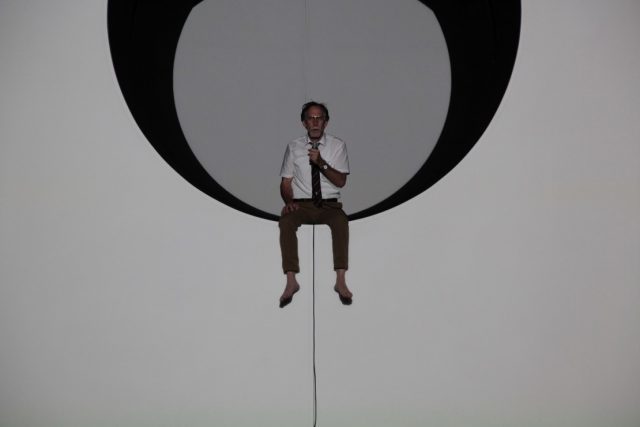
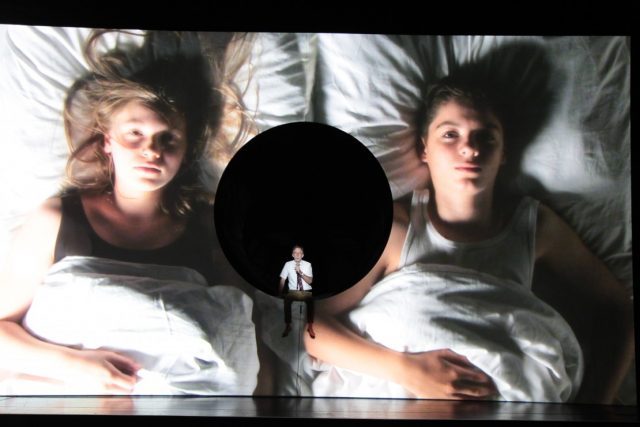
Bruce McKenzie stars in Daniel Fish’s multimedia adaptation of Don DeLillo’s White Noise

NYU Skirball Center for the Performing Arts
566 La Guardia Pl.
September 20-22, $55-$65
212-992-8484
nyuskirball.org

I first encountered the endlessly inventive, unpredictable work of Daniel Fish four years ago with A (radically condensed and expanded) Supposedly Fun Thing I’ll Never Do Again, a brilliantly devised piece that combined a tennis-ball machine with actors performing lines spoken by author David Foster Wallace from audiobooks, interviews, and speeches. The New Jersey–born, New York City–based creator also involves film and classic theater in his avant-garde oeuvre, which includes adaptations of Molière’s The Misanthrope, Clifford Odets’s Paradise Lost, Shakespeare’s A Midsummer Night’s Dream and The Merchant of Venice, Michel Gondry’s Eternal Sunshine of the Spotless Mind, and Nicholas Ray’s Bigger Than Life, a piece titled Tom Ryan Thinks He’s James Mason Starring in a Movie by Nicholas Ray in Which a Man’s Illness Provides an Escape from the Pain, Pressure, and Loneliness of Trying to Be the Ultimate American Father, Only to Drive Him Further into the More Thrilling Though Possibly Lonelier Roles of Addict and Misunderstood Visionary. More recently, his Tony-winning revival of Oklahoma! is dividing audiences and critics at Circle in the Square.

White Noise

Daniel Fish’s White Noise runs at NYU Skirball September 20-22

Fish now has turned his attention to consumerism run rampant as depicted in one of the best American novels of the second half of the twentieth century, Don DeLillo’s National Book Award–winning White Noise. Initially staged last year by Theater Freiburg and Ruhrfestspiele Recklingshausen in Germany, the seventy-minute multimedia work, running September 20-22 at NYU’S Skirball Center, focuses on DeLillo’s extensive use of lists within his narrative. For example: “The ashram is located on the outskirts of the former copper-smelting town of Tubb, Montana, now called Dharamsalapur. The usual rumors abound of sexual freedom, sexual slavery, drugs, nudity, mind control, poor hygiene, tax evasion, monkey-worship, torture, prolonged and hideous death.” And: “You know how I am. I think everything is correctible. Given the right attitude and the proper effort, a person can change a harmful condition by reducing it to its simplest parts. You can make lists, invent categories, devise charts and graphs. This is how I am able to teach my students how to stand, sit and walk, even though I know you think these subjects are too obvious and nebulous and generalized to be reduced to component parts. I’m not a very ingenious person but I know how to break things down, how to separate and classify. We can analyze posture, we can analyze eating, drinking and even breathing. How else do you understand the world, is my way of looking at it.”

White Noise: Freely Inspired by the Novel by Don DeLillo is performed by Bruce McKenzie as Hitler Studies professor Jack Gladney, with live music by composer and percussionist Bobby Previte. The bold projections are by Jim Findlay (including an appearance on video by nineteen German teenagers), with sets by Andrew Leiberman and costumes by Doey Lüthi. I could make a long list of reasons why you should see this, but it’s not really necessary. Just go if you want to experience another unusual theatrical adventure by the amazing Mr. Fish.

BAD NEWS! I was there…

(photo by Ian Douglas)

Eight messengers descend to deliver tragic tales in JoAnne Akalaitis’s BAD NEWS! I was there . . . (photo by Ian Douglas)

NYU Skirball Center for the Performing Arts
566 La Guardia Pl. at at Washington Square South
September 6-8, $40
212-992-8484
nyuskirball.org

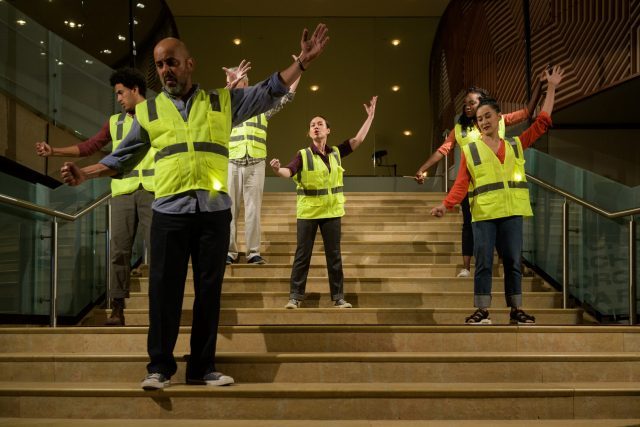
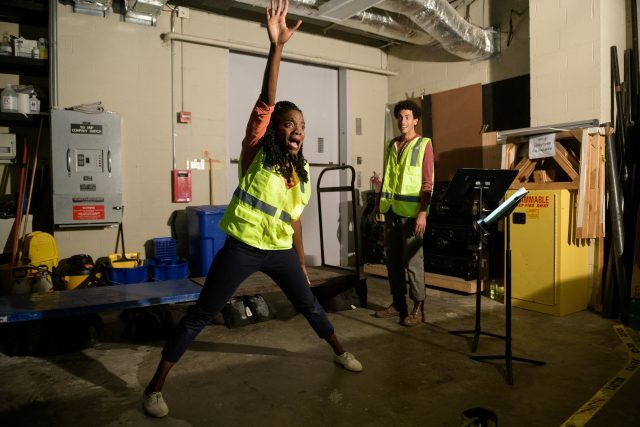
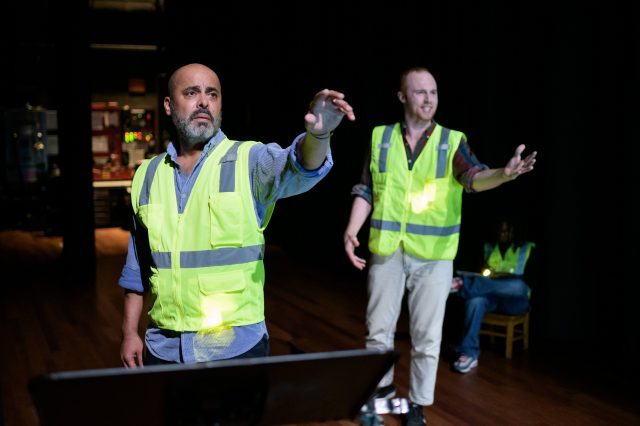
The good news is that five-time Obie winner JoAnne Akalaitis’s BAD NEWS! I was there . . . is a salient, pertinent, and entertaining work. The bad news is that it’s all too true. Initially workshopped five years ago at Poet’s House and debuting at the Guthrie last year, BAD NEWS! is a clarion call that relates Greek tragedy to what is happening around the world today. The ninety-minute show takes audiences, divided into four groups, through numerous spaces in NYU’s Skirball Center, where it continues through September 8; in each location, two messengers in yellow safety vests with flashlights in the pocket over their heart deliver tales of disaster, murder, catastrophe, suicide, violence, butchery, incest, and war as a young child (Jah-Sire Burnside, Devin Coleman, Donovan Coleman, and Riley Velazquez) sits nearby, reading superhero comic books. The audience is separated from the performers by yellow caution tape, a constant reminder of impending doom. “In death there is nothing but death,” the cast says in unison.

(photo by Ian Douglas)

JoAnne Akalaitis’s BAD NEWS! I was there . . . takes audiences all around the NYU Skirball Center (photo by Ian Douglas)

The dialogue and songs (the music is by Bruce Odland), presented in English, Greek, Latin, French, and German, have been adapted from classical literature by Sophocles, Euripedes, Lucius Annaeus Seneca, Jean Racine, and Aeschylus, translated by Anne Carson, Bertolt Brecht, Ezra Pound, W. B. Yeats, Ted Hughes, Caryl Churchill, and others. Eight seminal tragic figures are represented: Medea (Katie Lee Hill), Thyestes (Jenny Ikeda), the Bacchae (Rocco Sisto), Phèdre (Kelley Curran), Oedipus (Howard Overshown), Antigone (Henry Jenkinson), Orestes (Jasai Chase Owens), and Hecuba (Rachel Christopher). Guides (Ahsan Ali, Maya Carte, ESJAE, Josh Fulton, ALEXA GRÆ, Chloé Worthington, Isabella Peterson, Milo Longenecker, and Aigner Mizzelle) carry lights as they lead the groups through narrow hallways, up and down stairs, and into various rooms; they also serve as a Greek chorus, singing in unison in the background. Along the way, white sheets with the title of the show written in what looks like blood hover. Curiously, there are not enough chairs to seat everyone at each stop, so if you can stand, let the elderly, infirm, or pregnant sit down.

(photo by Ian Douglas)

Immersive production at Skirball Center warns of impending doom (photo by Ian Douglas)

As you watch one section, you can clearly hear snippets from at least one other part (the first four scenes run concurrently and can be seen in any order), creating a cacophony of bad news, as if you’re being overwhelmed by social media and television reports. (Julie Archer designed the sets and costumes, with lighting by Jennifer Tipton and sound by Odland.) It all culminates in a grand finale that brings all four groups together, making one last stand. Created and directed by Akalaitis, the cofounder of Mabou Mines and former head of the New York Shakespeare Festival, BAD NEWS! is about bearing witness, in the past and the present; it asks us to pay attention to what is going on across the globe and to speak up when we see danger. “I was there and I will tell you everything” is the play’s constant refrain. (For example, when no Holocaust survivors are left on earth, what happens to their stories, especially with so many conspiracy theorists claiming it’s a hoax, and so many people on the internet believing them?) The show is accompanied by a multimedia lobby installation on Greek tragedy, supplemented with articles on the refugee crisis, Donald Trump, neo-Nazis, and other current events, and the audience is asked to write down their own personal bad news on a sheet of paper. After the performance, you’re encouraged to have a free drink, talk about what you just experienced, and read aloud one of the anonymous pieces of bad news. “I speak the truth. All evils are revealed,” one character says early on. The actors are not just delivering tragic news from ancient tales; they’re warning us about today, and tomorrow. And that’s a good thing, if only more people would listen.