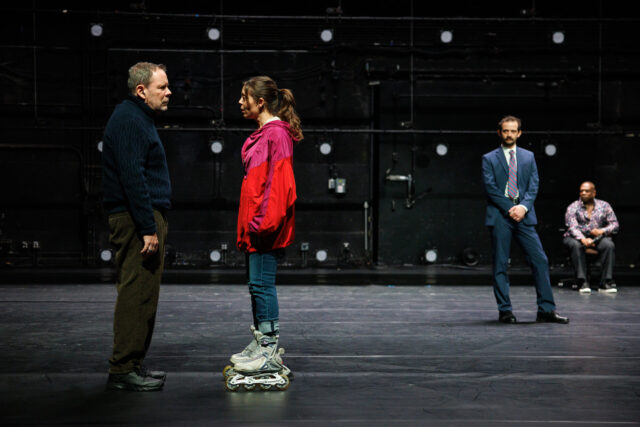
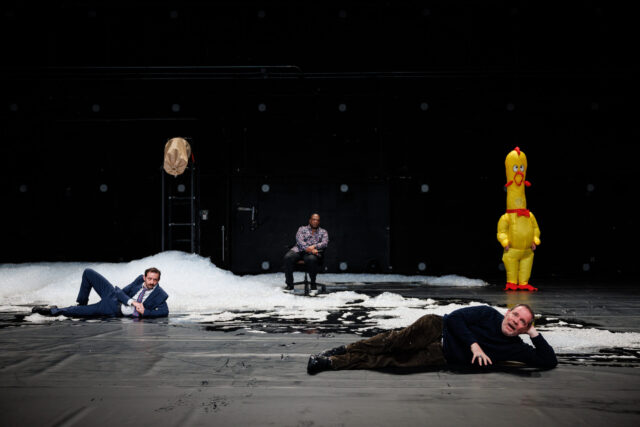
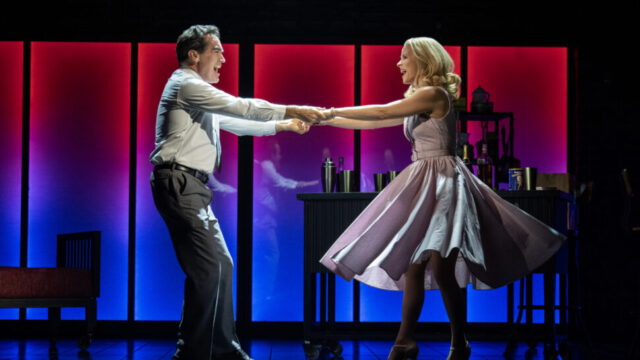
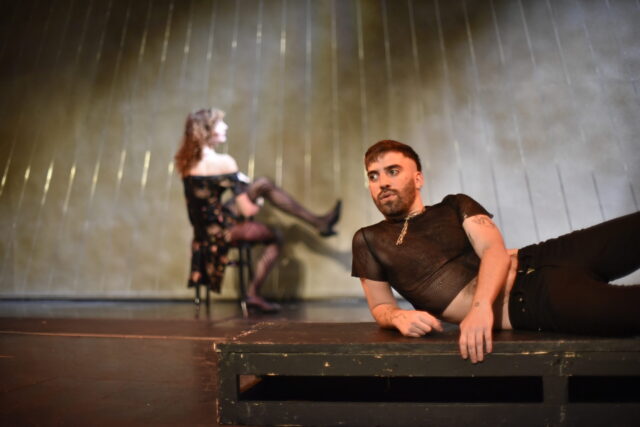
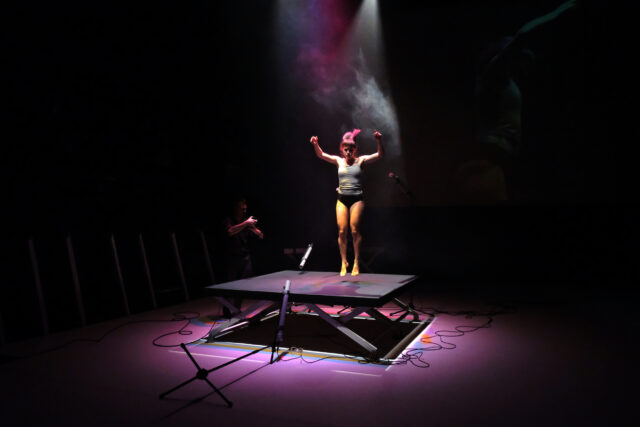
Thomas Jay Ryan, Jennifer Seastone, Will Brill, and Greig Sargeant bring a C-Span discussion to vivid life in Kramer/Fauci (photo by Maria Baranova)
KRAMER/FAUCI
NYU Skirball Center for the Performing Arts
566 La Guardia Pl.
February 11-21, $60-$90 nyuskirball.org
Daniel Fish again proves his genuine creative genius with the wildly entertaining and unpredictable Kramer/Fauci, running at NYU Skirball through February 21.
On November 30, 1993, C-Span host Steve Scully spoke about the AIDS crisis with Dr. Anthony Fauci, the director of the National Institute of Allergy and Infectious Diseases at the National Institutes of Health, and playwright and activist Larry Kramer, author of the novel Faggots and the play The Normal Heart and cofounder of Gay Men’s Health Crisis and ACT UP (AIDS Coalition to Unleash Power). For sixty minutes, while Fauci was in the studio with Scully and Kramer was beamed in onscreen from New York City, they discussed government funding, drug research, bigotry, public awareness, and more, in addition to taking phone calls from viewers.
Fish has transformed that visually dry program into an exciting, rich theatrical experience with such unusual elements as a woman on roller skates, a hilarious colorful costume, and a whole lot of bubbles.
As audience members enter the auditorium, six rows of nine lights apiece are blazing from the back of the stage, reminding me of a flag too bright to bear looking at — except for a colleague of mine who had (knowingly?) brought sunglasses. The show starts slowly in the empty space: Scully (Greig Sargeant) sits in the middle in a chair, Dr. Fauci (Will Brill), in a crisp suit, stands closer to the front to Scully’s right, and Kramer (Thomas Jay Ryan), in a turtleneck, hovers against the back wall to Scully’s left. The three begin reciting the exact transcript from the interview, as Scully raises a question about President Clinton’s formation of a new task force. Fauci provides a relatively straightforward bureaucratic response, but Kramer gives a hint of what’s to come when he criticizes the technology C-Span is using — he is unable to see Scully or Fauci but can only hear them, although he complains about the earpiece as well — and says, “This is a task force to identify what the stumbling blocks are, we know what they are: a lot of bureaucracy, a lot of red tape, a lot of stupid laws by Congress, and a lot of idiots, uhhhhhhh, putting their two cents worth, uh uhhh, how are you gonna get rid of all of these things is what I want to know and I have yet to hear a task force form to tell me that.”
After several minutes of physical stasis, Fauci and especially Kramer start moving around the stage as they argue over how recent administrations dealt with AIDS, what the real number of people afflicted with the disease are (and will be), how much money is needed for research, and why more is not being done. When Scully brings up the topic of the AIDS epidemic being normalized, Fauci begins, “Larry and I have had conversations about this many, many times over the years, and I a-appreciate it and in many respects, remire . . . admire the, the rage that he has about a very, very difficult problem. But I think you have to . . .” Kramer cuts him off, proclaiming, “Tony, if you start that business about science isn’t done that way, I’m gonna come on there and slap your face.” Fauci peacefully responds, “Nah . . . nah . . . All right, Larry, hang on for a sec. I love you, Larry . . . Uh . . . The fact is that the real solutions will in fact, come from the science.”
Scully occasionally cuts away to play audio footage of news conferences and to take calls, each of which is delivered by Jennifer Seastone in a few different voices, first riding in circles on roller skates and later donning an oddball costume. (The costumes are by Terese Wadden, with set by Jim Findlay, lighting by Scott Zielinski, and sound by Tei Blow.) Movement director Beth Gill soon has Kramer making his way over to Fauci and the roving callers, hugging one of Skirball’s golden pillars, and approaching the audience. It ranges from absurdly comical to substantially confrontational, all of it fascinating and compelling.
And then, the bubbles.
Expect the unexpected in Daniel Fish’s inventive re-creation of a C-Span program on AIDS (photo by Maria Baranova)
In A (radically condensed and expanded) Supposedly Fun Thing I’ll Never Do Again, the New Jersey–born, New York City–based Fish used tennis balls and existing text in a play about the work of Infinite Jest author David Foster Wallace. Fish earned a Tony for his unique staging of Oklahoma!, in which the audience was served chili at intermission. In White Noise, he used bold, giant projections and an actor sitting in a large, dark circle in the middle of a screen to tell part of Don DeLillo’s treatise on consumerism gone mad. And in Elektra, Sophocles’s title character, played by Brie Larson, was a kind of punk goddess spitting out some of Beyoncé’s “Daddy Lessons” while an unexplained blimp floated nearby.
For Kramer/Fauci, the actors wear earpieces that feed them the lines in order to maintain the precise pace and tone of the original program. Tony winner Brill (Stereophonic,Oklahoma!) is cool, calm, and collected as the cool, calm, and collected Fauci, who might not have gained as much fame for his work on AIDS but became a divisive and highly public figure during the Covid-19 pandemic. Two-time Drama Desk Award winner Ryan (Eureka Day,Dance Nation) is sensational as Kramer, a deeply concerned, knowledgeable, and emotional activist who is fed up with the government’s response to what he insists is a plague, not merely an epidemic or crisis.
The play centers on the complex friendship between Fauci and Kramer, who strongly disagree on how to deal with AIDS. It is summed up best in this exchange, which, like everything else, is taken verbatim from the transcript, with every pause and repetition:
Kramer: It’s all of this rhetoric of yours and everybody else in the bureaucracy. You know, I want to say something about, about Tony Fauci because I think the world must think I ha—, I hate him or something the way I’m going on tonight. I love Tony, actually I d—, I think I probably have a more complicated relationship with Tony than anybody in my entire life. He is a man, an ordinary man who was being asked to play God and he is being punished because he cannot be God. And that is a terrible situation to be in to be the lightning rod for all of us. Uhhhh . . . he has had to deal with Reagan and Bush and defend those monsters, for all we know he probably kept the labs open when John Sununu and Gary Bauer, and other awful bigots, probably wanted them closed, and he had to do it at a price, probably uh at a price for his own soul that we’ll never know that that he had to say things that in his heart he never believed. But he is there and he has been the, this this this incredible fighter for us and for AIDS. I just get angry when he puts on this bureaucratic suit and out comes this boilerplate, uhhhhh, that like Donna Shalala said the same, they, all his rhetoric that doesn’t mean anything. Tony, more than anyone in this world, knows how awful everything is, knows what has to be done, knows that he should have been given a lot more money to do it, knows who all these terrible people are, and yet he can never say it in public like I can say it in public. Scully: Dr. Fauci, let me go back to an earlier question . . . Kramer: Why don’t you respond to that, Anthony? Scully: Oh, go ahead, Doctor. Fauci: I love you, Larry. [Laughs.]
The play is eerily prescient of so much of the ensuing debate about public health. Most of us well remember what happened during Covid-19, when Fauci was at odds with the Trump administration, and today the battle over vaccines rages on with new updates every day, while the LGBTQ community has a growing fight on its hands, about a lot more than just the taking down of a Pride flag. However, Fish doesn’t reference any of that, instead keeping his focus on communicating the drama of this extraordinary debate between two dedicated, extremely intelligent men trying to do what’s best for an ailing population. How he chooses to punctuate and illustrate the power of their conflict with stunning, dumbfounding, and yet somehow near-perfect staging is where his genius lies.
[Mark Rifkin is a Brooklyn-born, Manhattan-based writer; you can follow him on Substack here.]
Jack Ferver reimagines Our Town through a deeply personal queer lens in My Town (photo by Jeremy Jacob)
MY TOWN
NYU Skirball Center for the Performing Arts
566 La Guardia Pl.
November 21-22, $42-$57, 7:30 nyuskirball.org jackferver.com
“Oh, earth, you’re too wonderful for anybody to realize you,” Emily Webb says in Thornton Wilder’s Our Town. “Do any human beings ever realize life while they live it? — every, every minute?”
Dancer, actor, choreographer, and professor Jack Ferver has been sharing their unique and impassioned realizations about life in deeply personal and intensely funny and frightening shows since 2007; their works are complex, intoxicating fusions of pop culture, Hollywood glitz and glamour, childhood trauma, and loneliness, filtered through a distinctively queer sensibility. Their latest piece, My Town, running November 21 and 22 at the NYU Skirball Center, incorporates Emily, a romantic idealist who serves as the heart and soul of Wilder’s 1938 Pulitzer Prize–winning drama about the fictional early-twentieth-century American community of Grover’s Corners.
In a 2010 review of Rumble Ghost, an intimate story about the search for a missing child inspired by the 1982 film Poltergeist, I noted that Ferver “once again makes viewers squirm for a whole range of reasons.” For more than fifteen years, they have both challenged and delighted audiences with such obsessive yet relatable pieces as All of a Sudden, a reimagination of Tennessee Williams’s 1959 melodrama Suddenly, Last Summer; Night Light Bright Light, an examination of the 1964 suicide of dancer, actor, and choreographer Fred Herko; and Everything Is Imaginable, in which Ferver is like a devilish cherub paying tribute to Judy Garland and Martha Graham while asking us all to take stock of our lives.
“Artists are the stomachs of society. We digest the indigestible,” they told me in a 2012 interview focusing on Two Alike. “That means we explore all terrains. Gender and sexuality roles are assigned or taken in hopes of a sense of self, as a branch of the ego. And the ego begins with ‘Me, not me.’ As an artist I make my work so that people donʼt feel as lonely as I have felt. Therefore my work expands into something more akin to ‘I am you.’”
It’s been six years since Ferver presented a major work, yet they’ve been extraordinarily busy, teaching, choreographing for other creators, curating an upcoming Graham exhibition at Bard, making the film Nowhere Apparent with their partner, Jeremy Jacob, and revisiting the Little Lad, the bizarrely affecting character they played in a 2007 Starburst commercial for its new berries and cream flavor that went viral during the pandemic.
I recently met with Ferver over Zoom, discussing the creative process, Wilder and Williams, the Little Lad, growing up in Wisconsin, pets, and more.
Jack Ferver introduces Nomi to Tuki over Zoom (screenshot by twi-ny/mdr)
twi-ny: Oh, who’s that?
jack ferver: Here’s Nomi. She is a Parson Terrier and we got her in February of ’21 from a really great rescue org, Korean K9. Who’s that baby?
twi-ny: This is Tuki. She’s Maine Coon and Siberian, with a little Ragdoll. And she’s just adorable and cute and fluffy. This is all fur. She’s not very heavy. It’s just fur, and look at that tail!
jf: She’s so sweet. I know that we’re very blessed with our animal angels.
jf: Nomi was four. We had been looking for a dog for a while and she looked so sad. She had come from breeding and also a meat market. My partner said, “This looks like the saddest dog I’ve ever seen.” And I said, “Let’s go get her.” And then we got her and she’s just completely changed my life. We have both changed. They said, I don’t think she’ll ever play. Our trainer wasn’t sure if she ever would. And she plays every morning. I mean, I’ve really moved upstate, for two reasons. One was because of Bard, where I’m a professor. The other was that she was just so happy up here. But in just a moment, she will need to go back to the city.
twi-ny: Since I last saw you, you became a TikTok sensation with the Little Lad, garnering two million followers. How did that come to be?
jf: Well, someone had posted the commercial during the lockdown and told people to do things with it. I wasn’t on TikTok. Friends of mine were and started messaging me, saying there’s all these people impersonating that character and using the advertisement.
It was the fall of 2021, so we’re still kind of in the lockdown. Like, how are we returning? There’s just this day where I said, I’m not going to do anything. I don’t have the capacity or the bandwidth. And then there was this day where I said, Just go to Fourteenth Street and get a wig and do it. And I did; I did one post and overnight it had hundreds of thousands of followers.
And then within a few months it was a million and then it went up to two million. And my partner, Jeremy Jacob, who’s a visual artist and a filmmaker and made the video and music for My Town, we made one film together where the Little Lad is trying to track down their mom, who is supposedly Anna Wintour. We did that. I did some other long-format YouTubes and a bunch of TikToks and people really loved it. I haven’t opened TikTok in so long. The Little Lad hasn’t shown themselves since, wow, July 2023, which was pretty much when I started working on this show. I loved doing it.
I think a benefit that I hadn’t foreseen with it was I was really curious how my work would get to places in America where it’s simply not going to tour. There are curators in cities in America who wouldn’t feel comfortable with my work, with its queerness and its femmeness and its examination of trauma, and also use the use of humor.
I started to receive all of these emails from young people who had found the Little Lad and then found my website; there were some incredibly touching emails. Years ago, when I started making my work, I saw how broke I was going to be. I said, Well, you better have a good sentence, like one that you can remember, because this is going to be so hard. It certainly has been.
What I always loved from art was that it made me feel less alone. So that was my sentence, that I’d make work for people to feel less alone. And so to receive emails from people who were able to then get this material that I saw no way of ever getting to them. . . . Also, in the lockdown, I opened up almost all of the works of mine that I have documentation for, which aren’t all of them, but for all the ones I do, I opened them for free on my website so that people would have access to that. And I’ve kept it open because it’s my way of dealing with what we have culturally and what we don’t — or rather don’t have in terms of support culturally.
twi-ny: That also relates to the audience, which wants to know Jack Ferver. So much of your work is about queer isolation; it really all comes together with Little Lad and the two million followers —
jf: Little Lad was such a place of just complete play. In a lot of my pieces, there has been playfulness. There’s also been, and I think probably always will be, a lot of darkness, a lot of dealing with really difficult material. So to have this other [creation] that’s not close to me, I think that was also the thing that was so fun, that it was so far from me.
Someone who was so important to me when I was growing up was Paul Reubens. I was eight when Pee-Wee was coming out. And so to be a lonely, queer, bullied kid who saw this queer-in-every-which-way character taking up space, having a lot of fun. . . . I don’t think the Little Lad would have ever existed if it hadn’t been for Paul Reubens. Pee-wee was so informative for the Little Lad. I certainly didn’t think about it when I did the commercial.
I was paid very little for it, because this was before YouTube was monetized. And it was like the Twin Peaks of commercials. It was so strange, so desired that it instantly went to YouTube and was being watched there. It stopped running on the networks, so that stopped the paychecks.
twi-ny: I was looking back at the last time I saw one of your live shows, and it’s been a while.
jf: It’s been a long time.
twi-ny: Over the last six years, you played Arkadina in The Seagull: The Rehearsal, you did It’s Veronique at Hesse-Flatow, you worked with Parker Posey on Abracadabra. Oh, you were talking before about having fun; I had a blast at The Last Bimbo of the Apocalypse, which you choreographed. So much fun, and very serious elements too. You also did Is Global Warming Camp? at MASS MoCA. And now you’re curating a Martha Graham exhibition, one of your heroes, at the New York Public Library. I kind of know why you haven’t been around for six years.
Jack Ferver and Parker Posey collaborated on Abracadabra (Instagram photo courtesy Jack Ferver)
jf: The last show in New York was Everything Is Imaginable; we did it in 2018 and it came back in 2019. And then that year, I was also the AIDS Oral History fellow with Jeremy at the New York Public Library of the Performing Arts, the Jerome Robbins Dance Division. So that year of 2019 through 2020 was spent with that archive.
We did a lecture performance in January of 2020. Working with that archive answered so many questions for me, or I would say really reified answers I had about where people were who would be mentors for me and what had happened with funding. It was an incredible and devastating event. It was an audience that was filled with a lot of women who afterwards said, “Thank you for saying my friend’s name, which I haven’t heard in years.” And then in rolled this pandemic and the lockdown and I left and went and lived at Parker’s and taught and wrote and really had time to reassess and have space and to think about what it was that I wanted to do artistically, in many aspects of life, and then because art is the big forerunner of what I do in my life, what I wanted to do. So much of the lockdown was spent writing and then the MASS MoCA show came up, which I started working on in 2021 and it went up in 2022. Then Jeremy and I made [Nowhere Apparent] through All Arts. It’s still streaming on the All Arts platform.
With MASS MoCA, it was this question, I’ve created this show, am I gonna try and get these presenters from NYC or from wherever to come to North Adams in the early fall? I really had met full burnout with trying to do that with presenters.
So at that time, Garen Scribner, who was in Everything Is Unimaginable, was changing paths to being a manager and said, I would love to be your manager. And I said, Great. So then Jay Wegman, who used to be the artistic director of Abrons, had given me free space for ten years when he was there. That’s how I made most of my work. And so Garen said, Let’s have a conversation with Jay, who was now at Skirball.
twi-ny: That’s the connection.
jf: I’ve been working on [My Town] since the summer of 2023. I’ve never worked harder on a piece. A lot of the things that are, I would say, more familiar if I look back at some of the formal things in my work, such as the use of film, that isn’t there. It begins sheerly by fiction of a story that’s not me, that’s about a schoolteacher and her student in 1911 in this town that I live in now, and then through trauma time starts to collapse.
A lot of characters emerge through this show, which is also something very different. And there’s a different approach to the solo format, which I might be doing for quite a while, I think, inside of my work. Through this work, I’m literally having more time alone. That Joan Didion quote: “Do not complain. Work harder. Spend more time alone.” And so my writing practice and my movement practice have just had so much more space.
I love teaching at Bard. I feel so grateful that I love to teach so much, and I feel so grateful I’m at Bard, which makes total sense for the way I work. It’s so interdisciplinary, and I work with professors from different parts of the college.
twi-ny: Are you hopeful for our next generation of writers and performance artists?
jf: That really solidified for me too during the AIDS Oral History Project, that I’m one of the bridge makers. We’ll never fix that gap, and we’ll never heal that canyon. But some of us will work to help build the bridge and those students, our students, will continue to be that bridge.
This piece has just been — oh, Mark, if I performed it a thousand times, I would never perform it for as many hours as I’ve rehearsed it.
twi-ny: It’s a solo piece.
jf: It is.
twi-ny: You’re very influenced by previous media: plays, movies, television, like Black Swan,Poltergeist,Suddenly, Last Summer,The Maids. So you’ve chosen in this case to take on Our Town, which is maybe the most famous play for its numerous characters.
jf: Yes.
twi-ny: And you’ve turned it into this one-person show. Why Our Town?
jf: A lot of the work had already been made. And then there was this moment where the character of Emily Webb emerged for me. And it emerged at a point in the process when, in the way I was talking and describing things, I was reminded of the stage manager. Then Emily Webb arrived and also Simon Stimson, the “queer-coded” chorus leader who hangs himself. I talked about both of them in Is Global Warming Camp? I talked about their deaths in that piece. And I was curious about why this woman meets her death in childbirth and then the queer-coded one hangs himself.
So I became really interested in tapping into, perhaps, could Emily get revenge with the stage manager before going back to the cemetery? It’s a very brief moment in the show. I was contacted by the Wilder estate; I felt very happy to be contacted by them. There’s nothing really of Our Town in there. There’s a part where it’s my fantasy if Emily got to confront the stage manager. But I think where I see the haunting of Our Town in it is that there’s someone describing things that aren’t there, that aren’t onstage. So many of my works don’t have a set. They generally have taken place in an “empty space,” to quote Peter Brook. It’s this thing of me using the power of my imagination to evoke the audience’s power of imagination. So much of that for me came from dance, but I also really see where that also comes from this experiment that Wilder did for America.
As Wilder’s essay that he put out to the American theatergoers says, you were just here for the soporific and for the baubles and for being entertained and you are asleep at the wheel. And so I’m gonna strip everything down. I connected very much in that way with Wilder. I will use language to evoke where we are. So that is where Our Town happens from. And I’d also say, yes, that I’m so many characters through this work. I’m very rarely me. And if I am, it’s some aspect of self. What I see from my work is that the stage is the psyche. It’s the psychic space.
I think this has been true of all of my work. And now it’s very clear to me that I am playing all of the aspects of self that get shattered in trauma and then jockey for attention. So when I’ve worked with a cast, they have also been aspects of self or aspects of whether they’re coming to it from a more narcissistic position or from a more victimized position.
They are all the shattered aspects that happen from trauma, and they will look to jockey and fight and spar to get the audience’s attention, to get the attention of the witnessers.
twi-ny: I wonder if that’s why you often don’t have a lot of set design. You were talking about this black space inside yourself or inside your mind, and right now you’ve chosen to be on Zoom in a dark corner.
jf: [laughs] Yes, this is where I do take my calls.
twi-ny: Last night I saw The Seat of Our Pants at the Public Theater, a musical adaptation of Wilder’s The Skin of Our Teeth. So clearly his estate is having fun with people taking Thornton to other levels.
jf: Well, I think of Wilder and I think of Williams; I would love to, if I ever have it in me, to write a more narrative play — I’ve always been so curious of what it would be like for the two of them at a bar. They were obviously so creative, so utterly American, and very angry, incredibly angry artists, and a lot of their work comes from revenge. It’s clear on the page. Our Town is a deeply vengeful play. It is so much of an agony of how people are not waking up and are not being awake to the present moment.
I wish that we had more of that content of trying to wake us up. I mean, we’re so polarized; I’m the billionth person to say that. That’s not new news of how polarized we are, so inside of our own vectors, and so unwilling to see the other person.
twi-ny: It’s very scary. So Emily Webb took what you were already working on in this other direction, gave another part to it. What was the initial genesis before Our Town was even on the page?
jf: First it was Wisconsin Death Trip, the book by Michael Lesy, which has those photos and police records from the late 1800s into the early 1900s.
twi-ny: That’s where you grew up, in Wisconsin.
jf: I did. I grew up relatively close to where a lot of that material for that book takes place. So first there was that, and then, as I went on, that began to fall away. And because I was researching where I grew up, what was it like as the town was forming, and what was it like where I am now? Because they look very similar. Where I have landed looks very similar to where I grew up, which is a big shock because I was very, “I’m getting out of this town.” That real queer kid adventure of “I’m going to move to New York City and . . .”
twi-ny: Be a star!
jf: Yeah. Where I grew up was on the Wisconsin River, on the train tracks facing the Wisconsin Ferry Bluffs. And now I live on Amtrak. Just down the street are the train tracks, the Hudson River, and the Catskills. So I thought, Okay, let me do research between these two towns. Then that began to fall away. I don’t know where this story came from of this schoolteacher and her student in 1911 in a town that is maybe this town that I live in now. And I wrote this really long, incredibly detailed, graphic, honestly . . . novella. I started to read it to a friend of mine and I said, This is going to be my next piece. And he said, Well, it can’t be because you’ve written a novella and no one will sit through this. You could do this as a book on tape. I think I was at page twenty and still reading what was going on for them. And he said, You can’t. What’s the show? It’s a show. We’re not going to sit through . . .
twi-ny: Five hours of . . .
jf: Yeah, five hours of reading a story. That was what began. I think part of where that came from was really this interest in what happens to this schoolteacher, who’s marked as a woman in my script but she might possibly be a trans man, though she doesn’t have language for that at that time.
I won’t say more than that of what happens to her and the student. But I decided to have there be a traumatic event that rips through time. And that will tie this town back to Wisconsin, and I thought about portals and trauma and how we have memories of places that perhaps we’ve been or haven’t been. I thought about amnesis, this recollection of something that we haven’t experienced but feels very familiar, a knowledge of something that we haven’t directly experienced. What is that? There’s so much that opened, I believe, inside of the collective consciousness during the lockdown, and I’m so curious about what it will be to keep those psychic doors open, art’s ability to keep those psychic doors open. I started going through those doors: I’ll take a long walk to the cemetery, I’ll take a run through the woods. I don’t think if I was spending so much time alone and in nature . . . I don’t know if these doors would have opened that way.
twi-ny: That’s fascinating. Speaking of opening doors, My Town is going to be at Skirball. I’m thinking of the shows that I’ve seen of yours, they take place mostly in great spaces but small ones; this one is huge. How did Skirball and its size figure into the work?
jf: Immediately I knew that Jeremy was gonna have to make a video. It’s too big of a space. At one point it was a duet and then I cut that part. [laughs] There was another section that happened in this show that is another show. It’s just another show, and maybe I will make that other show.
But that duet needed to just go away. There were actual scenic pieces that were going to be constructed. And as it went on, I just thought the way that my experience of going to Skirball has been . . . they do screenings of films there. I’ve never seen a film screened there, but there’s times where it reminds me that I could be coming here to see the first screening of The Phantom of the Opera. It has this very grand theater feeling to it. So I wanted Jeremy to make a video that wouldn’t be illustrative to what I was saying but that would provide another element of projection, which I mean both literally and metaphorically, so that there would also be this projective element that’s happening while I am working through all of these projections and the audience is projecting onto me, onto the roles I’m playing, and then also dealing with their projections of this projection. So that was where the screen came from. There’s a large screen that’s behind me that I wouldn’t say I interact with as much as it is functioning as another part of the mind. And in the ways that, as Freud said, we’re always doing at least two things. And formally, I thought there needs to be something more here for the audience.
Jack Ferver plays multiple aspects of their self in My Town (photo by Jeremy Jacob)
And then Jeremy went further and said, I also think the whole piece has to be underscored, and so wrote an entire score — pending on how I do it. Every show is slightly different every time. This show has very specific reasons why it’s different every time that I won’t say; I’ll just leave that a secret. So it rides somewhere between sixty and sixty-five minutes, and the score has cues in it that’s from my text. I foresee our collaboration continuing on in that way. I always knew it was going to be me; at one point I thought it might be two people. Then I was like, Nope, it’s just me. Me and this video. I was also really interested in the size of it, and one person out there trying to work through something really difficult, because that is also what I experience people to be like right now. They have community and they have friends, but a lot of the people I see or what I see reflected back are a lot of people feeling very isolated in a very huge space.
twi-ny: Well, I’ve seen several solo shows at Skirball; it is a huge space. I’m not trying to scare you —
jf: Fortunately, I first got to do this piece at EMPAC in Troy, New York. We had a technical residency there, and I had it set up so it would feel the same as Skirball. So I’ve already tested it out.
For me, it’s the hardest performance I’ve ever done. It’s a gauntlet. I pretty much don’t stop moving through the majority of it. The text is so incredibly dense, and because I’m dealing with temporal disorder it has tricky syntax shifts that are . . .
twi-ny: But that’s your own fault. You gave it to you.
jf: I run best on a muddy track. I really wanted to let go of a lot of things and go through these doors that were opening and really listen to this writing that was coming through. In the lockdown, I wrote at least sixty pages of poetry that maybe no one will ever see. There are two poems that made it into this piece, modified. And there are reasons that they’re in the work, which I won’t say. I think it gets explained as the piece goes on. My desire for pushing my writing and pushing the psychological iconographies of my choreography has always continued to grow. So I wanted to push myself to do the hardest thing I had done so far.
twi-ny: Judging by what I’ve seen of your work previously, I know how hard you push yourself and how much you open up and reveal of yourself. I can’t wait to see this one.
jf: Yes. I’m terrified. It’s a piece that is so terrifying and so freeing all at once. But I don’t think the piece works as well if that’s not the state that I’m in. I’ve made it so that there’s no way to do it not terrified. Formally it’s just so hard, and again it has a psychological reason in it, which is when we hunt for memories and when we try to understand and make sense of extreme trauma and the way that the massive crush of heterogeneous voices falling upon us while we ask for something good to be done creates such a hardship of not becoming bitter, not shutting down, not coldly and decisively picking a lane and sticking to it.
Allowing oneself to remain open is something that I also wanted this work to encourage people to do and really to do through also what I don’t see much of right now, which is mystery and humor, and not easy humor — I mean, I’m great at that, but the humor that comes from recognition.
[There will be a talkback with Ferver following each performance. Mark Rifkin is a Brooklyn-born, Manhattan-based writer and editor; you can follow him on Substack here.]
Keanu Reeves and Alex Winter star in Broadway smash version of Samuel Beckett’s Waiting for Godot (photo by Andy Henderson)
WAITING FOR GODOT
Hudson Theatre
141 West Forty-Fourth St. between Sixth & Seventh Aves.
Tuesday – Sunday through January 4, $98.56-$558.88 godotbroadway.com www.thehudsonbroadway.com
“There’s nothing to do,” Vladimir tells Estragon in Samuel Beckett’s 1953 masterpiece Waiting for Godot.
There’s plenty to do for Beckett fans in New York City right now, much but not all of it a most excellent adventure.
The talk of the town is Keanu Reeves and Alex Winter reprising — well, channeling? — their roles from 1989’s Bill & Ted’s Excellent Adventure and the 1991 and 2020 sequels in Godot at the Hudson Theatre. Action star Reeves is making his Broadway debut as Estragon (Gogo) in Jamie Lloyd’s bumpy adaptation, while Winter returns to the Great White Way for the first time in forty-four years as Vladimir (Didi).
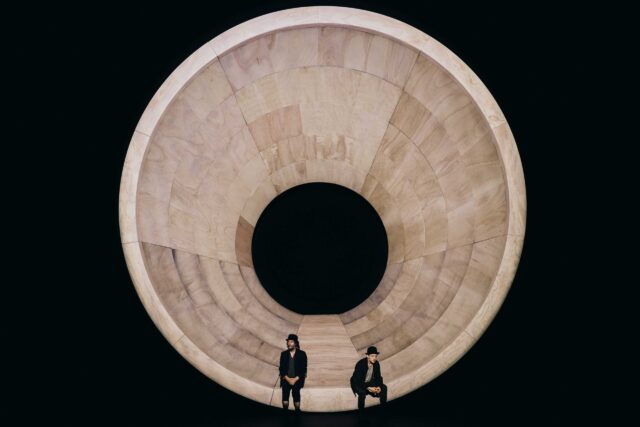
Reeves and Winter follow in the formidable footsteps of such duos as Michael Shannon and Paul Sparks, Ian McKellen and Patrick Stewart, and Robin Williams and Steve Martin and, for the most part, hold the audience’s attention. Gogo and Didi usually find themselves in a strange, dark wasteland, with only a single bare tree, a country road, and a solitary stone as they contemplate life and death, heaven and hell, and existence and humanity, but Lloyd and set designer Soutra Gilmour locate them inside a giant tube that is part tunnel, part circular skateboard ramp, part existential void in space. Resembling abandoned vaudevillians in all black, sporting impressive bowlers (the costumes are also by Gilmour), they sit at the edge of the tube, feet dangling, waiting for the mysterious Godot to arrive and, perhaps, bring meaning to their sad, pathetic lives.
They are visited instead by the loud, blustery Pozzo (Brandon J. Dirden) and his menial, an apparent servant named Lucky (Michael Patrick Thornton). Pozzo usually leads Lucky around by a rope around his neck — evoking master and slave, circus ringleader and animal performer while referencing the rope Gogo had mentioned earlier when he and Didi considered hanging themselves — but here Lloyd has the verbally abusive Pozzo pushing Lucky, who is in a wheelchair, altering their dynamic. Curiously, Lucky breaks the fourth wall several times, acknowledging the audience and encouraging them to clap after he does his dance (with his head and hands). In addition, a young boy (Eric Williams or Zaynn Arora) shares important information with Gogo and Didi.
Lloyd (A Doll’s House,Sunset Blvd.) has slimmed down the show to just over two hours including intermission, so the pacing works well. Lloyd’s decision to get rid of nearly all the usual props, including a key carrot that Gogo chews in an annoying manner, seems like overkill. There’s a perpetual droning hum of doom hovering over the proceedings (the sound is by Ben and Max Ringham), contrasting Jon Clark’s subtle lighting shifts, highlighted by dazzling surprises at the end of each act.
Reeves and Winter may not display a wide range of emotions, but they avail themselves well enough to keep the audience engaged. At one point Didi says, “This is not boring you I hope,” looking out at us, and we essentially answer no.
Bill and Ted enthusiasts may whoop when Gogo says, “Back to back like in the good old days,” and the two actors stand back to back and play air guitar, echoing what they do in the film series, but the reference feels out of place in a show that exists in a barren emptiness and is about nothing (and everything).
“The only true wisdom consists in knowing that you know nothing,” Bill says in the first movie, quoting Socrates. Ted responds, “That’s us, dude.”
Party on, dudes!
Stephen Rea is mesmerizing as a man listening to his past in Krapp’s Last Tape (photo courtesy Patricio Cassinoni)
KRAPP’S LAST TAPE
NYU Skirball Center for the Performing Arts
566 La Guardia Pl.
Through October 19, $83-$130 nyuskirball.org
“Nothing to say,” an old man declares in Samuel Beckett’s 1958 autobiographical classic, Krapp’s Last Tape, a fascinating kind of companion piece to Waiting for Godot.
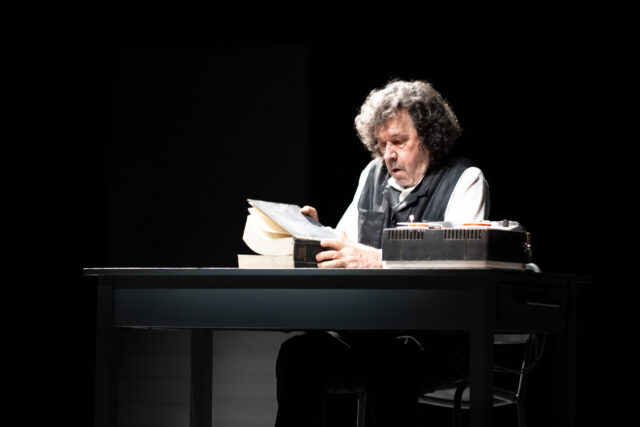
In 2012, Irish actor Stephen Rea decided to go into a studio and perform the prerecorded sections of Krapp’s Last Tape, in case he was ever asked to do the one-man show, in which a dissatisfied man listens to tapes his younger self made thirty years before. Rea is now touring the play, which continues at the NYU Skirball Center through October 19.
Jamie Vartan’s spare set features a desk in the center, an overhead hanging light, and a door at the back, stage right. Paul Keogan’s shadowy lighting maintains an old-fashioned vaudeville black-and-white feel. The past is present in both Vicky Featherstone’s taut staging and the theme of the play.
The show begins with Krapp slowly opening a hilariously long drawer and removing a banana. He eats the fruit — the yellow of the banana stands out from the otherwise colorless gloom — and tosses the peel onto the floor, where, of course, he soon slips on it. He does not make the same mistake twice.
To celebrate his birthday, he is going to listen to one of his old reel-to-reel tapes, the one he made when he turned thirty-nine, discussing his life. He brings in the machine and a stack of tapes, carefully searching for box three, spool five, taking great delight in saying the word “spool” over and over again. “Thirty-nine today, sound as a bell, apart from my old weakness, and intellectually I have now every reason to suspect at the . . . crest of the wave — or thereabouts,” he listens to his old self explain. “Good to be back in my den, in my old rags. Have just eaten I regret to say three bananas and only with difficulty refrained from a fourth. Fatal things for a man with my condition. Cut ’em out! The new light above my table is a great improvement. With all this darkness round me I feel less alone. In a way. I love to get up and move about in it, then back here to . . . me. Krapp.”
Not much has changed in those thirty years; his loneliness in the darkness is palpable. He looks up the meaning of “viduity,” sings, and recalls a romantic evening on a lake. But the tape does not provide him with happiness; he barks out, “Just been listening to that stupid bastard I took myself for thirty years ago, hard to believe I was ever as bad as that. Thank God that’s all done with anyway.”
What’s next? Well, the play’s French title is La Dernière Bande, or “The Last Tape.”
Krapp’s Last Tape has previously been performed by such actors as Patrick Magee, Harold Pinter, Brian Dennehy, and Michael Gambon; I’ve seen it with John Hurt at BAM and, earlier this year, F. Murray Abraham at the Irish Rep. The play, a haunting examination of time, memory, and the futility of language, works best in more intimate quarters; it gets a bit lost at the Skirball, even at only about fifty minutes.
Rea (A Particle of Dread,Cyprus Avenue) inhabits the character with a graceful elegance despite Krapp’s pathetic, sad-sack circumstances, at times recalling Buster Keaton, one of Beckett’s favorites. It’s a bravura performance that I would have loved to see in a significantly smaller venue.
Druid production of Samuel Beckett’s Endgame comes to Irish Arts Center for monthlong run (photo by Ros Kavanagh)
ENDGAME
Irish Arts Center, JL Greene Theatre
726 Eleventh Ave. between Fifty-First & Fifty-Second Sts.
October 22 – November 23, $25-$86 irishartscenter.org
“Nothing is funnier than unhappiness,” Nell tells Nagg in Samuel Beckett’s 1957 chess-inspired Endgame, which takes place during some kind of apocalypse as four characters contemplate their fate in a dingy basement dungeon, two of them living in garbage cans.
In a conversation in the Skirball program for Krapp’s Last Tape, Stephen Rea tells director Vicky Featherstone and Dr. Tanya Dean, “Endgame is a tough thing. I remember Beckett saying he loved Endgame, and he didn’t like Waiting for Godot. And I said, ‘Well, it’s been absorbed.’”
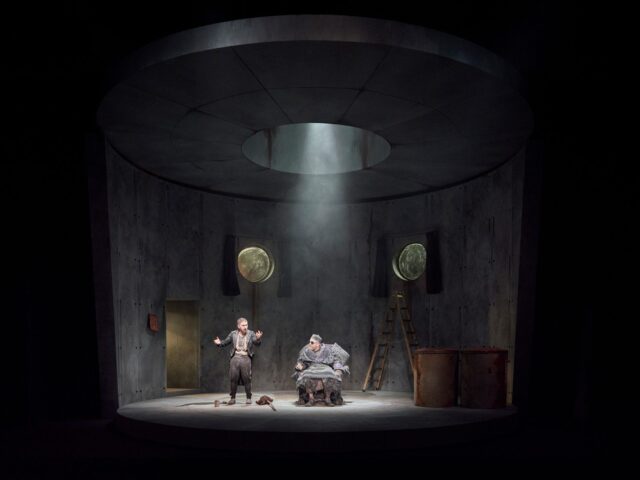
Rea played Clov in the 1976 Royal Court production of Endgame; I’ve seen the show twice, in 2008 at BAM with Max Casella, Alvin Epstein, Elaine Stritch, and John Turturro, and in 2023 at the Irish Rep with John Douglas Thompson, Bill Irwin, Joe Grifasi, and Patrice Johnson Chevannes. From October 22 through November 23, Galway’s Druid theater company will be presenting Endgame at the Irish Arts Center, with Tony winner Marie Mullen, Bosco Hogan, Aaron Monaghan, and Rory Nolan, directed by Tony winner Garry Hynes. As with Soutra Gilmour’s set for Waiting for Godot on Broadway, Francis O’Connor’s scenic design for Endgame also emphasizes the circularity of life.
Monaghan, who plays Clov, previously starred as Estragon opposite Marty Rea (no relation to Stephen) in Druid and Hynes’s Waiting for Godot at Lincoln Center’s 2018 White Light Festival. Hynes also helmed a stunning Richard III starring Monaghan in 2019 as well as The Beauty Queen of Leenane at BAM in 2017, with Marty Rea and Mullen.
Endgame is part of Druid’s fiftieth anniversary celebration. In the play, Clov shouts, “The end is terrific!” But luckily for theatregoers, the end appears to be nowhere in sight for Druid, or for seeing Beckett in New York.
[Mark Rifkin is a Brooklyn-born, Manhattan-based writer and editor; you can follow him on Substack here.]
Isabelle Huppert portrays Mary, Queen of Scots in third collaboration with Robert Wilson (photo by Lucie Jansch)
ROBERT WILSON & ISABELLE HUPPERT: MARY SAID WHAT SHE SAID
NYU Skirball Center for the Performing Arts
566 La Guardia Pl.
February 27 – March 2, $125 nyuskirball.org
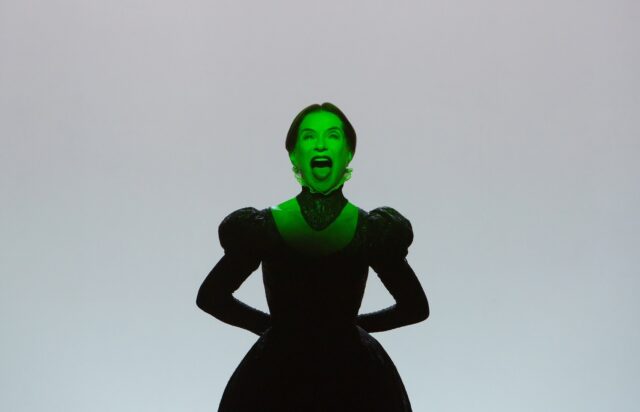
In October 2005, French superstar Isabelle Huppert performed Sarah Kane’s blistering solo piece, 4.48 Psychose, at BAM’s Harvey Theater. For ninety-five minutes, the Oscar-nominated, BAFTA, César, and Cannes–winning actress stood stock-still — except for occasionally scanning the audience or extending a finger — portraying a woman who had just suffered a mental breakdown.
In New York, Huppert has also appeared in Florian Zeller’s The Mother at the Atlantic in 2019 and, at BAM, in Krzysztof Warlikowski’s Phaedra(s) in 2016 and Robert Wilson’s Quartett in 2009.
Always ready to take on artistic challenges, Huppert has teamed up with Wilson for the third time with Mary Said What She Said, in which Huppert, who has made more than 135 films, including The Lacemaker,Heaven’s Gate,The Piano Teacher, and Elle, gets inside the head of Mary, Queen of Scots, the sixteenth-century Scottish monarch. The show is divided into three parts consisting of eighty-six paragraphs, beginning with “Memory, open my heart.”
Wilson, who has dazzled the world with such wildly unpredictable and visually stunning productions as Einstein on the Beach,The Black Rider, and The Old Woman, is the director of the Théâtre de la Ville-Paris commission as well as the set and lighting designer. The text, which is performed in French with English surtitles, is by longtime Wilson collaborator, novelist, and essayist Darryl Pinckney, using Mary’s own letters and Stefan Zweig’s 1935 biography of the queen in his research. The music is by Ludovico Einaudi, who has worked with such experimental composers as Luciano Berio and Karlheinz Stockhausen.
The US premiere at NYU Skirball runs February 27 to March 2; all tickets are $125 to see one of the greatest actors of our era in a show by one of the most inventive creators of our time, promising to be something special. As a bonus, Huppert will participate in a talkback following the 7:30 show on March 1.
[Mark Rifkin is a Brooklyn-born, Manhattan-based writer and editor; you can follow him on Substack here.]
DRAMA DESK AWARDS
NYU Skirball Center for the Performing Arts
566 La Guardia Pl.
Monday, June 10, $105-$205, 6:15 nyuskirball.org dramadeskaward.com
Balcony tickets are still available for the sixty-ninth annual Drama Desk Awards, honoring the best of theater June 10 at the Skirball Center. Founded in 1949, the Drama Desk (of which I am a voting member) does not differentiate between Broadway, off Broadway, and off off Broadway; all shows that meet the minimum requirements are eligible. Thus, splashy, celebrity-driven productions can find themselves nominated against experimental shows that took place in an East Village elevator or Chelsea loft. But that doesn’t mean there won’t be plenty of star power at the awards presentation.
Sutton Foster and Aaron Tveit will cohost the event; among the nominees this year are Jessica Lange for Mother Play, Patrick Page for All the Devils Are Here: How Shakespeare Invented the Villain, Rachel McAdams for Mary Jane, Leslie Odom Jr. for Purlie Victorious: A Non-Confederate Romp Through the Cotton Patch, Sarah Paulson for Appropriate, Brian d’Arcy James and Kelli O’Hara for Days of Wine and Roses, Bebe Neuwirth for Cabaret at the Kit Kat Club, Dorian Harewood for The Notebook, and Michael Stuhlbarg for Patriots. The Drama Desk also does not distinguish between male and female; the acting categories have ten nominees each, regardless of gender, with two winners. Thus, d’Arcy James is competing against his costar, O’Hara, for the same prize, although they both could take home the award.
Brian d’Arcy James and Kelli O’Hara are both nominated for Days of Wine and Roses and will participate in the 2024 Drama Desk Awards (photo by Joan Marcus)
Among this year’s presenters are Laura Benanti, Matthew Broderick, Montego Glover, Lena Hall, James Lapine, Debra Messing, Ruthie Ann Miles, Andrew Rannells, Brooke Shields, Seth Rudetsky, Shoshana Bean, Corbin Bleu, James Monroe Iglehart, and Steven Pasquale. O’Hara will perform a special tribute to William Wolf Award honoree André Bishop, Foster and Nikki M. James will both sing, and Nathan Lane will receive the Harold S. Prince Award for Lifetime Achievement. Others being honored are the How to Dance in Ohio Authentic Autistic Representation Team, lighting designer Isabella Byrd, and press agent Lady Irene Gandy.
[Mark Rifkin is a Brooklyn-born, Manhattan-based writer and editor; you can follow him on Substack here.]
Bruno Isaković and Nataša Rajković’s Yira, yira (Cruising, cruising) is part of QNYIAF (photo by Silvija Dogan)
QUEER NEW YORK INTERNATIONAL ARTS FESTIVAL
NYU Skirball Center for the Performing Arts
566 La Guardia Pl. between Third & Fourth Sts.
February 7 – 17, $25
212-945-2600 nyuskirball.org
After a six-year break, the Queer New York International Arts Festival returns to the city, taking place February 7-17 at NYU Skirball. Started by Queer Zagreb founder Zvonimir Dobrović in 2012 at Abrons Arts Center, the fest consists of works that address queerness in today’s society, this year with presentations from Argentina, Brazil, Canada, Croatia, and Germany, including live performances, installations, and public talks.
The 2024 QNYIAF kicks off February 7 with Croatian artist Arijana Lekić Fridrih’s From5to95, a hybrid video installation and online project in which Croatian women from the ages of five to ninety-five share their personal stories about gender inequality. On February 7 and 8, Croatian artists Bruno Isaković and Nataša Rajković’s Yira, yira (Cruising, cruising), which premiered in Argentina in 2019, is performed by sex workers Juan Ejemplo, Leandra Atenea Levine Hidalgo, Pichón Reyna, and Sofía Tramazaygues, exploring the relationship between client and sex worker.
Bruno Isaković and Mia Zalukar’s Kill B. reimagines the Bride from Quentin Tarantino films (photo by Hrvoje Zalukar)
Isaković collaborates with fellow choreographer and dancer Mia Zalukar on Kill B., inspired by Quentin Tarantino’s Kill Bill. Playing February 9 and 10, the piece focuses on the character of the Bride as well as artistic hierarchical structures and their own professional partnership. On February 13, Toronto-based performance artist Clayton Lee goes through his sexual history in The Goldberg Variations, which mashes up Johann Sebastian Bach with WCW and WWE wrestler and actor Bill Goldberg, host of the 2018-19 competition series Forged in Fire: Knife or Death and a contestant on The Celebrity Apprentice. Some iterations have included smells and live snakes, so be ready.
On February 15, Argentinian interdisciplinary artist Tiziano Cruz will deliver the autobiographical performance lecture Conference, followed by a discussion. His piece Soliloquy — I woke up and hit my head against the wall was about his mother; in Conference he turns his attention to his ancestors and his late sister. On February 16, Brazilian artist Wagner Schwartz’s performance lecture La Bête is an interactive solo in which he activates a plastic replica of one of Lygia Clark’s rearrangeable hinged metal sculptures known as bichos, or “beasts,” and then the audience does the same, except with Schwartz’s naked body.
QNYIAF concludes February 17 with Raimund Hoghe Company members Emmanuel Eggermont and Luca Giacomo Schulte’s An Evening with Raimund, a tribute to German choreographer, dancer, and journalist Raimund Hoghe, who died in 2021 at the age of seventy-two; excerpts from his works will be performed by seven dancers. “To see bodies on stage that do not comply with the norm is important — not only with regard to history but also with regard to present developments, which are leading humans to the status of design objects,” Hoghe said. “On the question of success: It is important to be able to work and to go your own way — with or without success. I simply do what I have to do.”
[Mark Rifkin is a Brooklyn-born, Manhattan-based writer and editor; you can follow him on Substack here.]
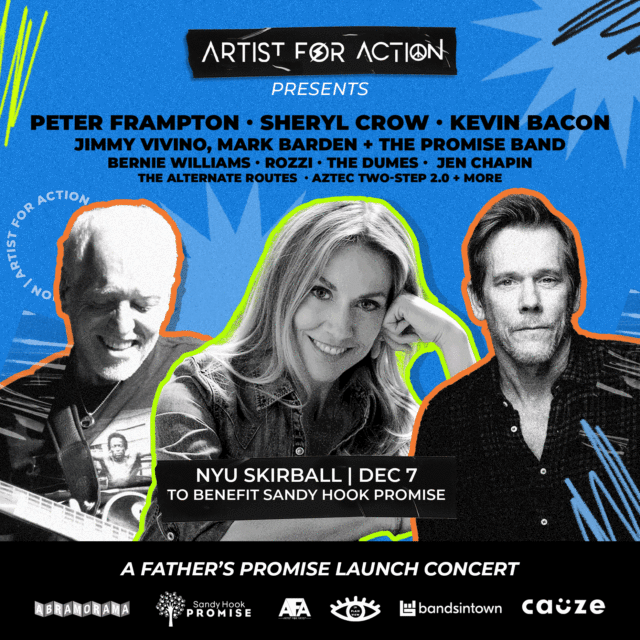
Who: Jimmy Vivino, Mark Barden, Sheryl Crow, Peter Frampton, Kevin Bacon, Bernie Williams, Rozzi, the Dumes, the Alternate Routes, Jen Chapin, Aztec Two-Step 2.0, more What:Benefit concert for Sandy Hook Promise celebrating film launch Where:NYU Skirball Center for the Performing Arts, 566 La Guardia Pl. between Third & Fourth Sts. When: Thursday, December 7, $81-$256, 7:30 Why: “Music succeeds when politics and religion fail,” Darryl “DMC” McDaniels says in A Father’s Promise: The Story of a Father’s Promise to End Gun Violence, a documentary opening December 8 at LOOK Dine-In Cinema W57. Directed by Rick Korn and executive produced by Sheryl Crow, the film follows musician Mark Barden as he takes action after his seven-year-old son Daniel was one of twenty-six people murdered at Sandy Hook Elementary in Newtown, Connecticut, on December 14, 2012.
Barden, cofounder of Sandy Hook Promise, and filmmaker Korn teamed up with Matthew Reich and Neal Saini to form Artist for Action to Prevent Gun Violence. On December 7 at NYU Skirball, Barden and the Promise Band will join musical director Jimmy Vivino and a group of all-stars to celebrate the launch of the film; among the special guests performing live will be Crow, Peter Frampton, Kevin Bacon, Bernie Williams, Rozzi, the Dumes, the Alternate Routes, Jen Chapin, and Aztec Two-Step 2.0. The evening will be filmed for a future documentary, continuing to raise funds and awareness about the horrors of gun violence, the leading cause of death for children and teens in America.
[Mark Rifkin is a Brooklyn-born, Manhattan-based writer and editor; you can follow him on Substack here.]