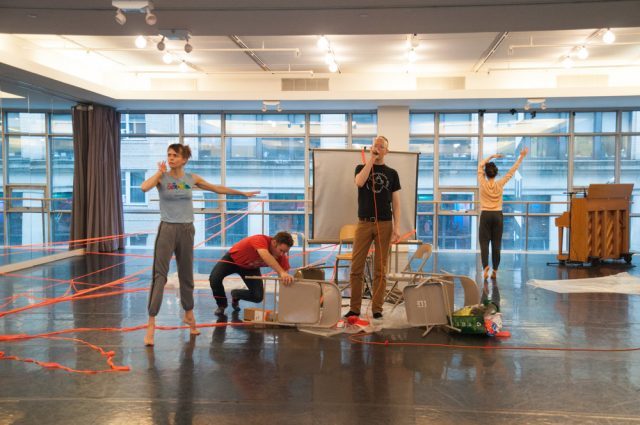
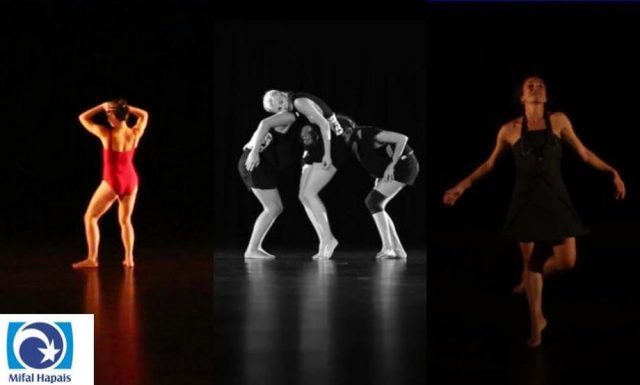
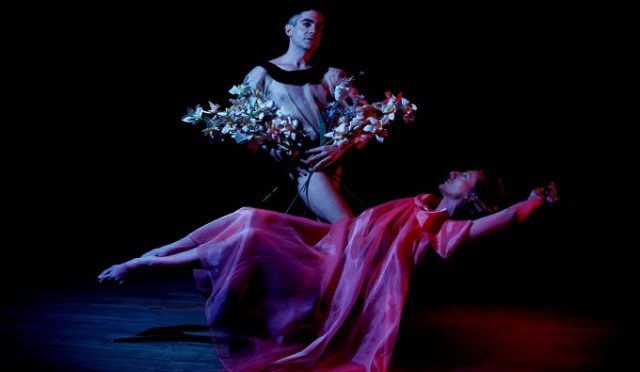
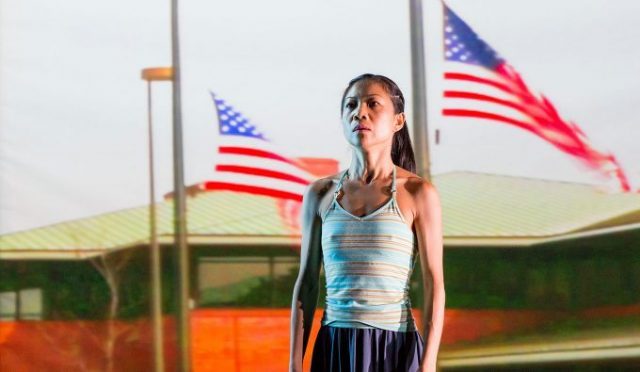
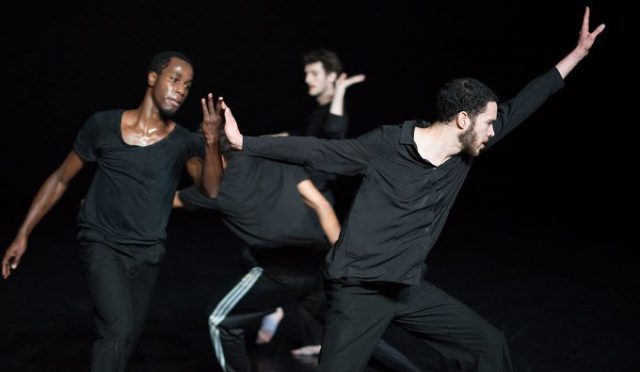
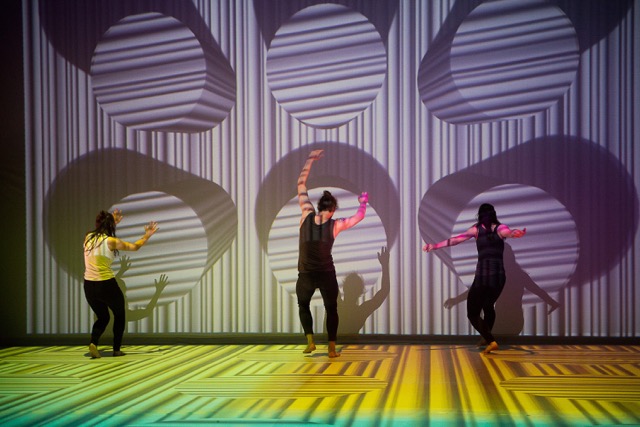
Joanna Kotze has been dancing in New York since 1998 and creating her own works since 2009, collaborating with a wide range of artists and performing virtually nonstop. The South Africa-born, Brooklyn-based dancer, choreographer, and teacher will be at New York Live Arts this week with her latest commission, the interdisciplinary What will we be like when we get there, running March 28-31. The piece, part of the New York Live Arts Live Feed residency program, has been developed at the Sedona Arts Center, the Lower Manhattan Cultural Council on Governors Island, Bennington College, Jacob’s Pillow, the 92nd Street Y, the Milvus Artistic Research Center, and other locations around the world and now will make its world premiere in Manhattan. The interdisciplinary work, inspired by the 2016 presidential election and exploring personal connections impacted in the wake of that, was conceived and directed by Kotze (FIND YOURSELF HERE; It Happened It Had Happened It Is Happening It Will Happen) and choreographed and performed by Bessie Award winner Kotze, visual artist Jonathan Allen, sound designer, composer, and musician Ryan Seaton, and dancer and choreographer Netta Yerushalmy; the lighting is by Kathy Kaufmann. The March 28 performance will be followed by a discussion with Allen about his lobby exhibition of related paintings, “Knowing That Your House Is on Fire,” on view March 26 through April 13; the March 29 performance will feature a Stay Late Conversation moderated by Okwui Okpokwasili; and the March 31 show will be followed by live music curated by Seaton.
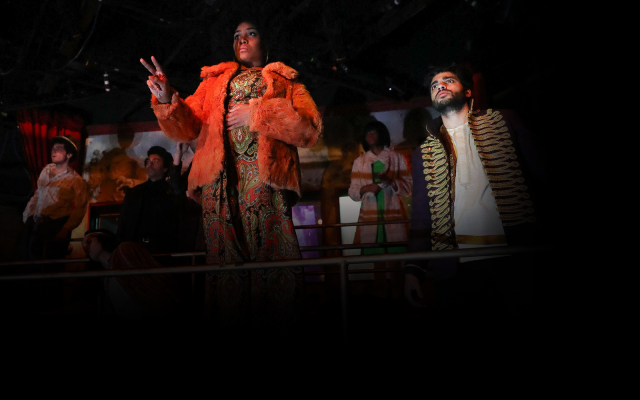
The Hendrix Project kicks out the jams at the BRIC House as part of the Public Theater’s Under the Radar festival (photo by Nicolas Savignano)
Once upon a time, January was considered a relative artistic wasteland, as people suffered from a post-holidays letdown with a dearth of high-quality movies and Broadway shows opening up. But this century continues to fill that void with more and more cutting-edge, experimental, and offbeat music, dance, and theater with a growing list of performance festivals around the city. You can catch cabaret at Pangea, opera at Prototype, dance at American Realness, the 92nd St. Y, and New York Live Arts, jazz at JazzFest, Irish theater at Origin’s 1st, and a little of everything at Under the Radar and COIL, the latter back where it belongs at the renovated PS122. Below are only some of the highlights of this exciting time to try something that might be outside your comfort zone and take a chance on something new and different to kick off your 2018, especially with the majority of tickets going for about twenty-five bucks.
UNDER THE RADAR
Public Theater and other venues
425 Lafayette St. by Astor Pl.
January 4-15 www.publictheater.org
After by Andrew Schneider, performed by Alicia ayo Ohs and Andrew Schneider, with Kedian Keohan and Peter Musante, January 4, 6, 7, 8, 11, 13, 14, Public Theater, Martinson Hall, $25
Parallel Lives: Billie Holiday & Edith Piaf, created and directed by Nona Hendryx, performed by Joey Arias, Tamar Kali, Liza Jesse Peterson, and Etienne Stadwjck, January 5-6, Joe’s Pub, $45
The Gates: An Evening of Stories with Adam Gopnik, January 5, 10, 12, 13, 14, Public Theater, Newman Theater, $25
The Hendrix Project, by Roger Guenveur Smith & CalArts Center for New Performance, performed by Samantha Barrow, Morgan Camper, Hannah Cruz, Jasmine Gatewood, Heaven Gonzalez, Ariyan Kassam, Liam O’Donnell, Dante Rossi, Henita Telo, Max Udell, Ieva Vizgirdaite, and Christopher Wentworth, January 11-14, BRIC House, $25
Pursuit of Happiness, Nature Theater of Oklahoma & EnKnapGroup, NYU Skirball, January 12-14, $25
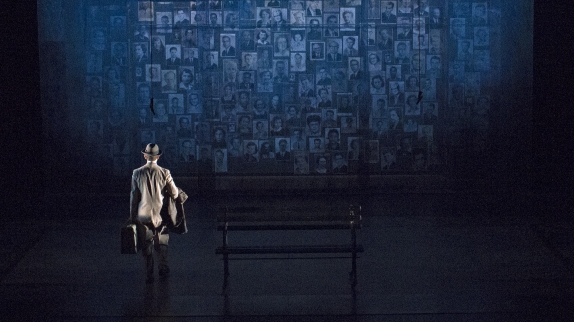
Gregory Spears and Greg Pierce’s Fellow Travelers goes back to the Lavender Scare of the 1950s (photo by Philip Groshong)
Acquanetta, by composer Michael Gordon, librettist Deborah Artman, director Daniel Fish, and conductor Daniela Candillari, with Mikaela Bennett, Amelia Watkins, Eliza Bagg, Timur, and Matt Boehler, Gelsey Kirkland Arts Center, January 9-13, $30-$75
Out of Bounds — Breaking Ice: The Battle of the Carmens, by Alicia Hall Moran, new vocal work for an ice-skating audience, January 11, Bank of America Winter Village at Bryant Park, free, 1:40; January 14, location TBD, free, 2:30
Fellow Travelers, by composer Gregory Spears, librettist Greg Pierce, director Kevin Newbury, and conductor George Manahan, with Aaron Blake, Joseph Lattanzi, Devon Guthrie, Vernon Hartman, Marcus DeLoach, Christian Pursell, Paul Scholten, Alexandra Schoeny, and Violetta Lopez, January 12-14, Gerald W. Lynch Theater at John Jay College of Criminal Justice, $30-$55
Out of Bounds: The Future Is Open, by Tori Wrånes, newly commissioned site-specific work, Washington Square Park, Northwest Corner, January 18-19, free, 5:30
Michelle Ellsworth’s The Rehearsal Artist promises an intimate experience at American Realness
AMERICAN REALNESS
Abrons Arts Center and other venues
466 Grand St. at Pitt St.
January 9-16 americanrealness.com
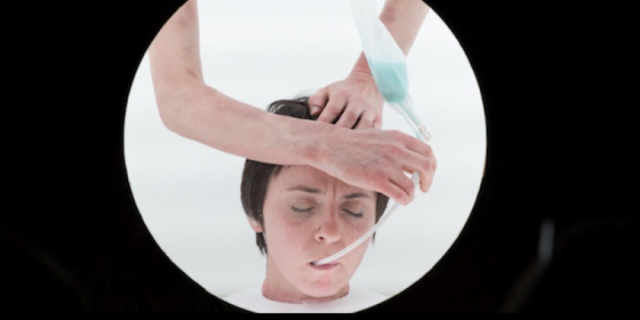
The Rehearsal Artist, by Michelle Ellsworth, January 9-11, the Invisible Dog Art Center, $25, 1:15 – 8:45
Variations on Themes from Lost and Found: Scenes from a Life and Other Works by John Bernd, by Ishmael Houston-Jones and Miguel Gutierrez, with Nick Hallett and Jennifer Monson, Danspace Project, January 9, 11, 12, 13, $22-$25
#PUNK, by nora chipaumire, Abrons Arts Center Playhouse, January 11-13, $25
I <3 PINA, by Neal Medlyn, Abrons Arts Center Experimental Theater, January 11, 12, 13, 14, 16, $25
This, by Adrienne Truscott, Abrons Arts Center Playhouse, January 14-16, $25
ORIGIN’S 1st IRISH FESTIVAL
Multiple venues
January 9-29 www.1stirish.org
Dyin’ for It, by Derek Murphy, with Maria Deasy, Adam Petherbridge, Sarah Street, and Aoife Williamson, the Cell, January 17-28, $30
Guy Walks into a Bar, by Don Creedon, New York Irish Center, January 18, 25, $20-$25, 7:15
ShakesBEER with an Irish Twist, pub crawl, Stone St., January 27, February 3, $49 (includes four drinks), 3:00
Dear Mr. Beckett: Letters from the Publisher, with Billy Carter and Olwen Fouéré, the Irish Consulate, January 29, free with advance RSVP, 1:00
WINTER ALT-FEST
Pangea NYC
178 Second Ave.
January 10-16 www.pangeanyc.com
Salty Brine: How Strange It Is, January 10, 17, 24, 31, February 7, $20, 7:30
Penny Arcade: Longing Lasts Longer, January 11, 14, $20, 7:00
Sven Ratzke: From Amsterdam to Mars, January 14, $20, 9:00
Tammy Faye Starlite: An Evening of Light, Tammy Faye channels Nico, accompanied by Keith Hartel, January 16, $20, 7:00
Gilles Peterson hosts British Jazz Showcase, with the Comet Is Coming, Nubya Garcia, Yazz Ahmed, and Oscar Jerome, Le Poisson Rouge, January 10, $20-$25, 7:00
Winter JazzFest Marathon, more than fifty artists at eleven venues, January 12-13, $50-$60 one day, $85-$95 both days
Ravi Coltrane Presents Universal Consciousness: Melodic Meditations of Alice Coltrane, Le Poisson Rouge, January 14, $35-$45, 7:00
A Tribute to Geri Allen, with Angela Davis, Esperanza Spalding, Craig Taborn, Dee Dee Bridgewater, Farah Jasmine Griffin, Ingrid Jensen, Jack DeJohnette, Jaimeo Brown, Jeff Tain Watts, Kassa Overall, Kris Davis, Linda May Han Oh, Maurice Chestnut, Mino Cinelu, Ravi Coltrane, S. Epatha Merkerson, Tia Fuller, Vijay Iyer, and others, benefit for the Geri Allen Estate, the New School Tishman Auditorium, January 15, $35-$100
Deerhoof Meet Wadada Leo Smith and Nicole Mitchell: Maroon Cloud, Le Poisson Rouge, January 17, $25-$35, 8:00
Body of Work, by Atlanta Eke, PS122, January 10-11, $25
visions of beauty, by Heather Kravas, PS122, January 10-13, $25
Jupiter’s Lifeless Moons, by Dane Terry, PS122, January 12, 13, 14, 16, 17, $25
he his own mythical beast, by David Thomson, PS122, January 31, February 1, 2, 4, $25
Our of Israel returns to the 92nd St. Y for its eighth season
OUT OF ISRAEL: 70 YEARS OF ISRAEL, 70 YEARS OF DANCE / OPEN DOORS: 92Y HARKNESS DANCE CENTER ARTISTS IN RESIDENCE SHOWCASE
92nd St. Y www.92y.org
Out of Israel: works by choreographers Itzik Galili and Roi Assaf performed by Troy Ogilvie, a solo by Roni Chadash, a new composition by DANAKA collective, and films by Joseph Bach and Shamel Pitts, guest curated by Dana Katz, January 12 at 12 noon and January 13 at 8:00, $10 in advance, $20 at the door
Open Doors: works by choreographers Joanna Kotze, Kensaku Shinohara, Pam Tanowitz, and Larissa Velez-Jackson with Jillian Peña, January 12 at 8:00 and January 13 at 4:00, $25-$29
Jack Ferver will present his work-in-progress Everything Is Imaginable as part of Live Artery at New York Live Arts
LIVE ARTERY
New York Live Arts
219 West 19th St.
January 13-15 newyorklivearts.org
Saturday, January 13, $10 each
Abby Zbikowski, abandoned playground (excerpt), 12 noon; Kimberly Bartosik, I hunger for you (work-in-progress), 2:00; RoseAnne Spradlin, “X,” 3:00; Netta Yerushalmy, Paramodernities (work-in-progress), 5:00; Susan Marshall, Construction (collaboration with So Percussion) and Closed System (work-in-progress), 6:00; Walter Dundervill, Skybox (excerpt), 7:00
Sunday, January 14, $10 each
Joanna Kotze, What will we be like when we get there (work-in-progress), 1:00; Kota Yamazaki, Darkness Odyssey Part 2: I or Hallucination (excerpt), 4:00; Bill T. Jones/Arnie Zane Company, The Deep Blue Sea, 5:00; Deborah Hay/Eric Geiger, Jess Humphrey & Leslie Seiters, Pause, 6:00; RoseAnne Spradlin, “X,” 8:00; Jack Ferver, Everything Is Imaginable (work-in-progress), 8:30
Monday, January 15, $10 each
Netta Yerushalmy, Paramodernities (work-in-progress), 11:00 am; Jennifer Nugent & Paul Matteson with Ted Coffey, Visual Proof, 1:00; Jack Ferver, Everything Is Imaginable (work-in-progress); 3:30; Joanna Kotze, What will we be like when we get there (work-in-progress), 5:00; Kimberly Bartosik, I hunger for you (work-in-progress), 6:30
ZviDance relies on the participation of the audience in new evening-length piece, Like (photo courtesy ZviDance)
New York Live Arts
219 West 19th St. between Seventh & Eighth Aves.
November 8-11, $20-$25
212-924-0077 newyorklivearts.org www.zvidance.com
ZviDance founder and artistic director Zvi Gotheiner concludes his trilogy about social interaction and technology with Like, making its world premiere at New York Live Arts November 8-11. Following 2010’s Zoom and 2014’s Surveillance, the new evening-length piece allows the audience to participate in the proceedings by using their cell phones to vote in a reality-television dance competition to determine the course of events and dancers. Choreographed by the Israeli-born, New York City-based Gotheiner, the work features eight dancers, a score by Scott Killian, lighting by Mark London, and media design by Joshua Higgason, with numerous cameras, computers, and screens following the action and providing resampled live streams, prerecorded news footage, and real-time interviews with the performers as well as members of the audience.
New York Live Arts
219 West 19th St. between Seventh & Eighth Aves.
September 27-30, 7:30
212-924-0077 newyorklivearts.org www.rosas.be/en
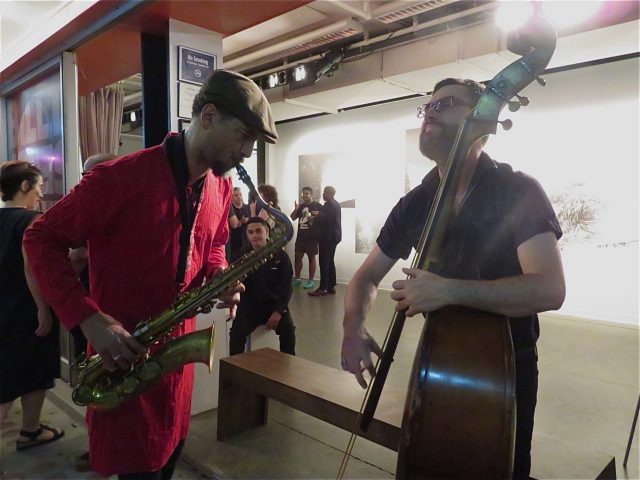
Bill T. Jones’s New York Live Arts strives to encompass more than just dance, a goal achieved with their stunning production of A Love Supreme, Belgian choreographer Anne Teresa De Keersmaeker and Spanish dancer and choreographer Salva Sanchis’s newly rewritten version of their 2005 evening-length piece, which continues at NYLA through September 30. Thirty minutes before the piece begins onstage in the theater, saxophonist Tony Jarvis and bassist Nathan Peck move about the waiting audience in the lobby space and head out into the street of passersby and onlookers as they perform excerpts from John Coltrane’s masterful, boundary-breaking 1965 album, the original recording of which serves as the soundtrack of De Keersmaeker and Sanchis’s collaboration. You don’t need a ticket to just hang out, get a drink, and watch Jarvis and Peck interact with each other in a way that only jazz allows, creating a spiritual conversation of dissonance and beauty. This prelude serves as an ingenious introduction to what follows inside the theater, as four male dancers embody the roles of the four main musicians on the record. The show begins in silence, with Thomas Vantuycom as saxophonist Coltrane, Jason Respilieux as bassist Jimmy Garrison, Bilal El Had (or Robin Haghi) as pianist McCoy Tyner, and José Paulo dos Santos as drummer Elvin Jones. They are all barefoot, dressed in black, with black tape dividing the black floor into a flurry of geometric patterns.
Tony Jarvis and Nathan Peck perform a Coltrane overture to get the audience in just the right mood for A Love Supreme (photo by twi-ny/mdr)
After several minutes, the music starts, the glorious four-part suite consisting of “Acknowledgement,” “Resolution,” “Pursuance,” and “Psalm,” which Coltrane performed only once live in its entirety. “You see, one thing about that music is that it showed you that we had reached a level where you could move the music around,” Tyner told NPR in 2012. “John had a very wonderful way of being flexible with the music, flexing it, stretching it. You know, we reflected that kind of thing. He gave us the freedom to do that.” That idea translates beautifully into De Keersmaeker and Sanchis’s choreography, in which the dancers follow the general progression of the “sheets of sound,” as Coltrane described it, ranging from solos to duets to trios to quartets but never just mimicking what is being played. When a musician takes a solo, that respective dancer improvises. Meanwhile, the other dancers stand aside and watch, just as jazz musicians do. All four performers are outstanding, with Vantuycom brilliant in the lead, swirling with his elongated arms, making angular gestures, and gliding across the floor as Coltrane soothes the soul.
New York Live Arts
219 West 19th St. between Seventh & Eighth Aves.
September 27-30, 7:30
212-924-0077 newyorklivearts.org www.rosas.be/en
In December 1964, saxophonist John Coltrane made one of the greatest jazz records of all time, A Love Supreme, a four-part suite consisting of “Acknowledgement,” “Resolution,” “Pursuance,” and “Psalm,” featuring Coltrane on tenor and soprano sax, Jimmy Garrison on double bass, Elvin Jones on drums and percussion, and McCoy Tyner on piano. In 2005, Belgian choreographer Anne Teresa De Keersmaeker and Spanish dancer and choreographer Salva Sanchis created the four-part dance suite A Love Supreme, set to Coltrane’s legendary music; they have now revisited the piece, rewriting it for four male dancers from De Keersmaeker’s Rosas company. The fifty-five-minute dance work, which will be performed by José Paulo dos Santos, Bilal El Had / Robin Haghi, Jason Respilieux, and Thomas Vantuycom, investigates the desire for happiness through mysticism and spirituality, incorporating jazzlike improvisation into the movement, with each dancer interpreting one of the musicians on the record: Vantuycom is Coltrane, Respilieux is Garrison, El Had / Haghi is Tyner, and dos Santos is Jones. When the musicians improvise, so will the dancers.
“Taking on A Love Supreme fits with the idea of revisiting and rewriting Rosas’s repertoire for a new generation of dancers,” De Keersmaeker said in a statement. “What is interesting about the piece, in addition to its intrinsic connection with this milestone of twentieth-century music, is the way it combines improvised and written choreography.” Sanchis, who was part of the original cast in 2005, added, “On the whole, A Love Supreme is more suitable for a dance performance than a simple collection of songs. The music poses a structure with a beginning and an end, offering a kind of dramaturgical accessibility.” The New York City premiere of A Love Supreme runs at New York Live Arts September 27-30 at 7:30, with saxophonist Tony Jarvis performing a tribute to the seminal album at seven o’clock each night. The September 28 show will be followed by a Stay Late Conversation moderated by NYU associate professor and associate chair André Lepecki; there will be a Shared Practice workshop September 30 at 2:00 ($20) with Rosas rehearsal director Bryana Fritz and Respillieux; and on September 30 at 5:00 ($10), NYLA artistic director Bill T. Jones will be joined by music historian Ashley Kahn and bassist and composer Reggie Workman for the special Coltrane program “Bill Chats — The Man and His Music.” Tickets are sold out for all four shows, but there will be a standby line each evening to see what De Keersmaeker calls “essentially a piece about defying gravity. It is a piece about the relationship between mankind and the planet, between the vertical and the horizontal.”
Jody Oberfelder Projects will present The Brain Piece at New York Live Arts June 28 – July 1 (photo by Christopher Duggan)
JODY OBERFELDER PROJECTS: THE BRAIN PIECE
New York Live Arts
219 West 19th St. between Seventh & Eighth Aves.
Wednesday, June 28, gala benefit $200, 7:30
June 29 – July 1, $25-$35, 7:00 & 9:00
212-691-6500 newyorklivearts.org www.jodyoberfelder.com
New York-based director, choreographer, dancer, and filmmaker Jody Oberfelder’s The Brain Piece, premiering at New York Live Arts June 28 – July 1, continues her exploration of our internal organs, following on her extraordinary 2013 piece, 4Chambers, an immersive, multimedia, interactive journey inside the human heart. Performed by Oberfelder, Mary Madsen, Pierre Guilbault, and Hannah Wendel along with ten dancer docents, The Brain Piece is divided into two parts, “Mind Matters / Head Space” and “World of Brain,” combining film, visual art, installation, dance, music, and text for an audience limited to 72 members. The cerebral, multimedia piece includes her award-winning short film Dance of the Neurons, made with Eric Siegel, which turns firing synapses into a colorful, joyous dance. Oberfelder, a travel and yoga enthusiast and former lead singer of the punk band the Bagdads, founded Jody Oberfelder Projects in 1989 and has previously presented such works as The Titles Comes Last, Moved, Re:Dress, and Throb. The charming, gregarious, always energetic creator took a break from rehearsals to tell twi-ny all about The Brain Piece.
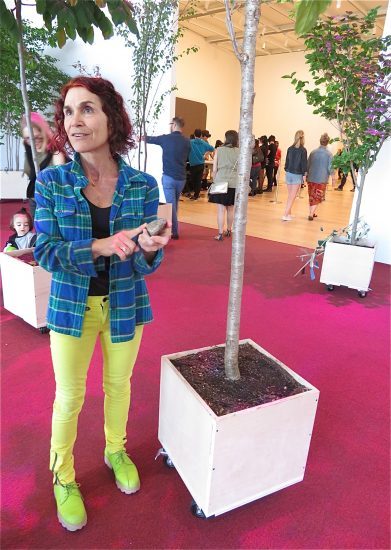
twi-ny: We recently bumped into each other at the Whitney Biennial, where you were serving as a docent for Asad Raza’s “Root sequence. Mother tongue,” an installation of living trees paired with specific objects, one of which you contributed. As museumgoers made their way through the exhibit, I couldn’t help but think of it as a kind of improvisatory dance with nature, especially with you there. What was that experience like?
jody oberfelder: We’re actually called caregivers. The people who pass through sometimes don’t know we’re positioned as such as we, as you describe, do this improvisatory dance with people in conversation. The show has been up since March and we’ve seen the trees go from bare, to blossom, to leafing, and now they can’t wait to get planted outside. Many people have passed through. Asad’s work balances organic, inorganic, and human all in the space. Having a person in the room is as important as the trees and the caregiver’s placed object. I’m learning that conversation is often this invisible thread that links things together in the present.
twi-ny: Your work is very scientific; were you interested in science when you were a kid?
jo: I would not say I grew up with a scientific bent. I had a fourth-grade teacher, Mr. Dowd, who explained the digestive system with panache (“…and out the other end” — we were all snickering). I’ve come to science through the body, and through a curiosity about what makes us alive. There is a beautiful ecosystem within us and a giant cosmos outside of us. Did you ever see that film by Charles and Ray Eames — Powers of Ten — it’s all about zooming out and zooming in. That, to me, is what science is about. Things can be very specific and very vast.
twi-ny: Yes, Powers of Ten is quite eye-opening. How did you find/choose your science collaborators — Dr. Wei Ji Ma, Cecilia Fontanesi, and Ed Lein — and what did each one bring to The Brain Piece?
Word of mouth.
Cecilia is a dancer and a neuroscientist. She met one of my dancers, Mary Madsen, at a party. I loved talking with her from the very beginning. The thing she said, “The brain is everywhere in the body,” totally clicked with my premise of dancers illuminating brain life.
Wendy Suzuki, who helped illuminate the brain-body connection for me, introduced Wei Ji to me. Wei Ji has been a great collaborator. He comes to rehearsals to “fact check” and advise. He’s in Dance of the Neurons. I audited his class at NYU on illusion. We did a combo lecture / performance in Amsterdam.
Another neuroscientist introduced Ed Lein to me: Gary Marcus. My company manager at the time, Clare Cook, was giving him private Pilates lessons. Gary and I had several conversations, which culminated in him saying, “You know, you should meet Ed from the Allen Institute for Brain Science. He specializes in the biology of neurons.” Ed and I had a back and forth on a kind of Skype sketchpad, and he drew little pictures of how neurons are formed that eventually became the literal storyboard for Dance of the Neurons. I embellished, of course, and played with all the ways neurons “dance” and form synaptic connection. I’m most grateful to these scientists, who are also artists.
twi-ny: Without giving too much away, how will the physical space of New York Live Arts come into play? Only the second half will take place in the theater on a proscenium stage, correct?
jo: It’s my hope that there really is no separation between the sections, that the more experience-based portions of the work continue to inform the world of the brain in the theater. There are nine films in part two. When you go to movies, you don’t question that the actors are not that big. I think the problem with live theater is that we’re in a long shot for too long. I’m creating an atmosphere of a giant brain with moving parts. I think this is the nature of brain plasticity: zoom in for close-ups, see what the alignment of neurons are doing at this time, how we’re constantly in a perceptual loop.
Jody Oberfelder served as a caregiver at the Whitney Biennial (photo by twi-ny/mdr)
twi-ny: 4Chambers involved a significant amount of interaction, at one point bringing the audience into physical contact with the dancers. Will there be anything similar in The Brain Piece?
jo: You’ll see.
twi-ny: Good answer. I only recently learned that the doctor who performed the autopsy on Albert Einstein actually removed his brain and brought it home to study. What is the most unusual thing you learned about the brain while making this piece?
jo: That the brain is a noisy place and we’re constantly trying to figure things out and make sense of the world. And that our bodies are the vehicles for us to sensorially enter the world. Ask a neuroscientist to define “mind” and they have no clear thing to pin down. There were philosophers, then psychiatrists, and now great discoveries in seeing the pictures in the brain, seeing what makes things go off, decay, or become more plastic, make connections: That’s the dance of neurons. But the mind — it’s like vapor. We breathe in present and past. It’s in constant motion. And dancers are the perfect vehicles to convey this movement.
twi-ny: How have the two works brought the heart and the mind together for you?
jo: The heart leads to the mind. When working on 4Chambers, I interviewed Wendy, who talked about the sympathetic and parasympathetic nervous system and how all the way down from our brains our hearts operate. We feel our hearts, but it’s triggered by the mind. You know how what your brain is doing by what your heart is doing, and vice versa. “I can put my hand on your heart and feel your heartbeat, but if I put my hand on your skull, I can’t feel your thoughts.”
twi-ny: Regarding Dance of the Neurons, your choreography has always been very cinematic, and The Brain Piece includes that short film, which has been garnering prizes at festivals. How do you see the two disciplines merging in your work?
jo: Thank you. Someone at a festival said I was a filmic choreographer. I like that. I’m pretty visual. Like a filmmaker, I’m in the business of arranging time and space and hidden narrative. I use a lot of improvisation around ideas and look for dancers who can take the ball and run with it. I like to think that if I give the performers imaginative tasks, the content will form, and it’s my job as a director and choreographer to prepare for a rehearsal with a loose storyboard of possibilities, then go deeply inside the physical investigation for the interaction with audience members, the films, and the onstage content. Devising content is a matter of honing in on what feels right.
I worked with a wonderful dramaturg this time around: Jessica Applebaum. The piece has had many renderings. She helped me not be afraid of the complexity of the subject matter and to go forward making. Details and big picture always in mind. Jessica has also left me a lot of space these last months to figure it out on my own. Today our neuroscientist, Wei Ji, was there to see me finish the finale in our last moments of our last rehearsal!
I love it now. I’m even surprised by it.
twi-ny: I’m very much looking forward to being surprised by it as well. This might be an obvious closing question, but now with the heart and the brain covered, do you anticipate continuing to explore the mind-body connection with different organs as the focus?
jo: The sex organs will probably be combined with the guts. Like when you feel something in your gut. Intuition. Power.
Okwui Okpokwasili’s POOR PEOPLE’S TV ROOM makes its New York premiere April 19-29 at NYLA (photo by Mena Burnette of xmbphotography)
New York Live Arts
219 West 19th St. between Sixth & Seventh Aves.
April 19-22, 26-29, $15-$35, 7:30
212-924-0077 newyorklivearts.org
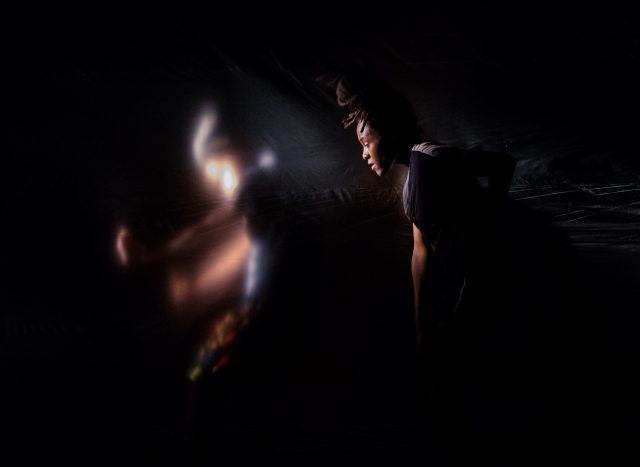
Three-time Bessie-winning dancer, choreographer, actress, and writer Okwui Okpokwasili will present the New York premiere of Poor People’s TV Room at New York Live Arts this week, a multidisciplinary exploration of forgotten black and brown women, inspired by the Igbo Women’s War of 1929 in her parents’ native Nigeria as well as the Black Lives Matter movement, Boko Haram, and colonialism. The work, which is the result of a two-year residency at NYLA, features songs, choreography, and text by Okpokwasili and visual designer Peter Born and will be performed by Okpokwasili, Thuli Dumakude, Katrina Reid, and Nehemoyia Young. “Focusing on cultural and historical memory, Poor People’s TV Room is a kind of rumination on absence — how particular forms of mediation, particular ways of looking and framing in attempting to create visibility, may hasten invisibility,” the Bronx-raised, Brooklyn-based Okpokwasili (Bronx Gothic, Pent Up: A Revenge Dance) said in a statement. “I’m thinking of the ‘Bring Back Our Girls Movement’ and the meme culture. I’m thinking about attempts to recover seminal historical moments from the margins, and what to recover. I am also considering Nollywood and cultural creation and projection and popular mythmaking.” The show, which debuted earlier this year at the Walker Center’s Out There festival, will run at NYLA April 19-22 and 26-29. “It is a space of becoming and unbecoming,” Okpokwasili added. To read Okpokwasili’s thoughts about the current political situation in America, go here.