Tag Archives: New York Live Arts

TWI-NY TALK: DONNA UCHIZONO — LIVE IDEAS: THE WORLDS OF OLIVER SACKS

(photo by Mia}

Donna Uchizono will present two works during NYLA festival celebrating Oliver Sacks (photo by Mia}

LIVE IDEAS: THE WORLDS OF OLIVER SACKS — RE: AWAKENINGS (DANCE)
New York Live Arts
219 West 19th St.
Thursday, April 18, 8:00, and Saturday, April 20, 4:00, $40
Festival runs April 17-21
212-691-6500
www.newyorklivearts.org
www.ladonnadance.org

In the preface to the 1990 edition of his bestseller Awakenings, Dr. Oliver Sacks wrote, “It is now 21 years since my patients’ awakenings, and 17 years since this book was first published; yet, it seems to me, the subject is inexhaustible — medically, humanly, theoretically, dramatically. It is this which demands new additions and editions, and which keeps the subject for me — and, I trust, my readers — evergreen and alive.” In celebration of Sacks’s upcoming eightieth birthday (on July 9) and the thirtieth anniversary of the publication of Awakenings, New York Live Arts is hosting its first Live Ideas festival, “The Worlds of Oliver Sacks,” five days of special programs that medically, humanly, theoretically, and dramatically examine and explore the good doctor’s inexhaustible contributions to the field of science and the arts. The festival includes the world premiere of Bill Morrison’s short film Re: Awakenings; a series of talks delving into Sacks’s work with people who have Tourette’s, Parkinson’s, and hearing loss; an evening of music and dance with the Orchestra of St. Luke’s, choreographer Aletta Collins, dancer Daniel Hay-Gordon, and conductor Tobias Picker; back-to-back presentations of Harold Pinter’s A Kind of Alaska, the first with spoken words, the second in American Sign Language; and such panel discussions as “Disembodiedness: Body Image & Proprioception,” “Musicophilia & Music Therapy,” “Neurologists & Philosophers Consider Sacks at 80,” and “Minding the Dancing Body,” the latter bringing together NYLA executive artistic director Bill T. Jones, Miguel Gutierrez, Colin McGinn, Alva Noë, and Gwen Welliver.

Sacks himself will participate in an Opening Keynote Conversation with Jones and will introduce a screening of the 1974 British television documentary Awakenings, followed by a Q&A. “Live Ideas” also features a pair of works by New York-based choreographer Donna Uchizono, performed by Levi Gonzalez, Hristoula Harakas, and Rebecca Serrell Cyr: a “Sacksian version” of Uchizono’s 1999 State of Heads and the newly commissioned Out of Frame. Earlier this week Uchizono discussed her involvement in this inaugural festival while preparing for the April 18 and 20 shows.

twi-ny: How did you get involved in “Live Ideas: The Worlds of Oliver Sacks” in the first place, and how familiar were you with his work prior to becoming part of the festival?

Donna Uchizono: I received a phone call from [NYLA artistic director] Carla Peterson asking me if I would be interested in creating a work about Awakenings based on Oliver Sacks’s work. I was, of course, completely honored and intrigued while simultaneously humbled by the offer. My father had his PhD in psychology and was interested in the workings of the brain. My father had a great love for books and had a huge library. Oliver Sacks’s books were among the many books my father owned. He gave me a copy of The Man Who Mistook His Wife for a Hat to read quite a long time ago. I had also seen the film Awakenings so was somewhat familiar with the horrible loneliness and “silent scream” of sleeping sickness. Heartbreaking. It’s quite a different challenge being commissioned to create a work about a specific topic other than a concept that is driven by oneself. The new work is turning out to be much more representational than work that I normally create, which I think is quite natural given the subject and the context in which it will be performed.

twi-ny: You’ll be presenting State of Heads, which premiered at Dance Theater Workshop in 1999. Why did you choose this to be part of your Sacks presentation?

Donna Uchizono: Coming out of a much larger discussion, the reasons for State of Heads being in the program are many and beyond the scope of this writing. But when the suggestion to move away from a program that included a play, music, and dance on one evening, to that of separate evenings of dance, music, and theater, State of Heads was discussed as a piece that may be included in the evening of dance because of its movement vocabulary. As I wrote in the choreographer’s notes, State of Heads explores the feeling of waiting and the passage of time in the state of hiatus where familiar time and scale are pushed. Using the separation of the head from the body as a point of departure, in an exploration of disjointedness and the sense of a will apart from the mind driving the movement, surprisingly created a world of endearingly odd characters. State of Heads reveals endearment in the awkward where the ordinary become extraordinary. The accounts of the patients that Oliver Sacks writes about in his book Awakenings are remarkable, where most definitely the ordinary become extraordinary and where profound “humanness” is found in the most unlikely places and time.
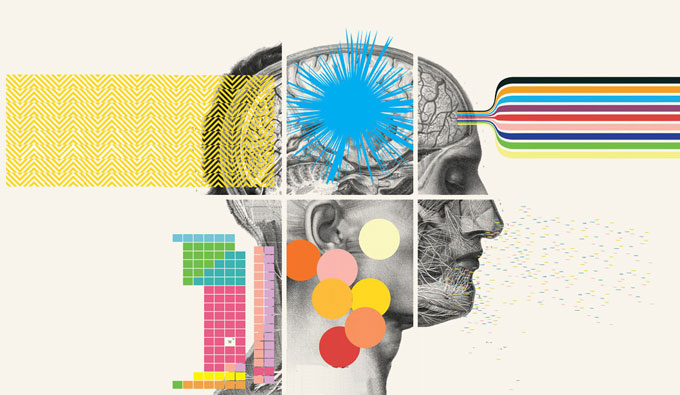
Live Ideas festival runs April 17-21 at New York Live Arts

Live Ideas festival runs April 17-21 at New York Live Arts

twi-ny: You’re also debuting Out of Frame, incorporating text from Dr. Sacks’s work. What was it like transforming his scientific studies into dance?

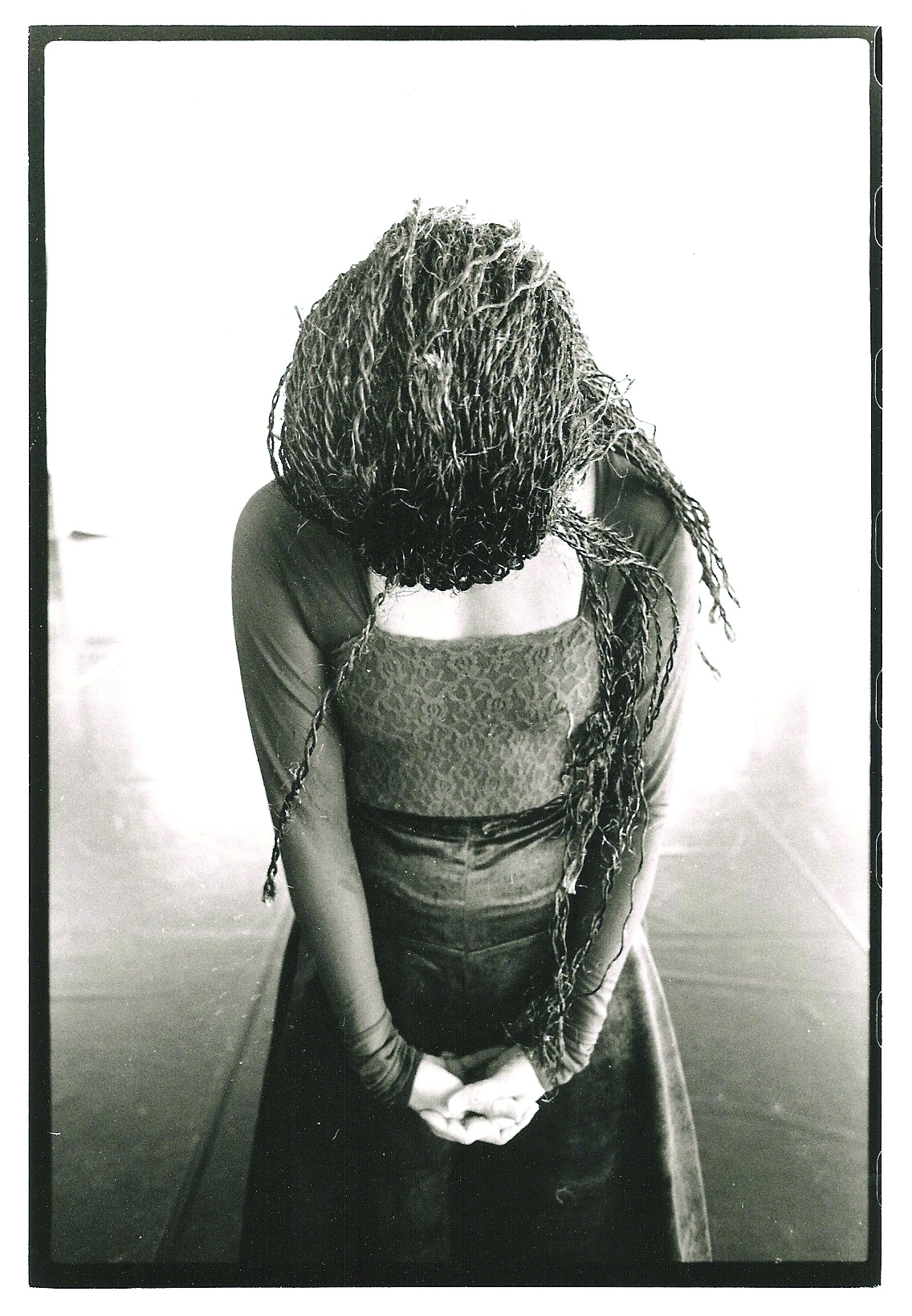
Donna Uchizono: I rarely use text in my work, but Oliver Sacks is not only a neurologist of note, he is also a well-known writer, thus it seemed natural to use his words. It was Oliver Sacks’s words that conjured up the images and movement for Out of Frame. I made a conscious decision not to view Bill Morrison’s film that incorporates actual archival footage or revisit the film Awakenings while creating the new work. I did not want to imitate but rather to create the movement vocabulary and images from Sacks’s writings. I was deeply moved by Dr. Sacks’s humane understanding of the plight of his patients. It was the idea of compassion and the need for tenderness towards the individuals that drives the work, rather than his scientific studies. The short solo seems to float between three states — the physical torque of the disease, the human beneath the dress, and the dreamlike temporary state of L-DOPA.

twi-ny: This year marks the twenty-fifth anniversary of your choreographic debut. What are some of the key differences in being a New York City dancer-choreographer in 1988 as opposed to today?

Donna Uchizono: I feel quite lucky to be part of a generation that started to show their work during the late 1980s and early ’90s. At that time it seemed as if anything was possible. We could design spaces, design programs, and find places to create. We were not yet aware of the looming financial shutdown that was about to happen. We looked around at other choreographers and there seemed to be a possible linear path moving from individual and emerging choreographer to having a small dance company. By the mid-’90s the financial wall had crumbled. I think it is much harder to make work now. Well, it is for me anyway. Young choreographers today seem to be much more aware that there is no obvious financial path. What remains the same is the need to make work.

twi-ny: You’ve had a long relationship with Dance Theater Workshop, which recently morphed into New York Live Arts. What do you think of the new venue?

Donna Uchizono: I have had a long relationship with with the wonderful and dedicated Carla Peterson, who continues to champion experimental artists. I am quite thrilled and honored to be in this Live Ideas festival, and the staff at NYLA have treated me with openness and generosity.
HIROAKI UMEDA: “HAPTIC” AND “HOLISTIC STRATA”

Hiroaki Umeda

Hiroaki Umeda will perform a pair of mind-blowing solo pieces March 7-9 at New York Live Arts

New York Live Arts, Bessie Schönberg Theater
219 West 19th St. between Seventh & Eighth Aves.
March 7-9, $20, 7:30
212-691-6500
www.newyorklivearts.org
www.hiroakiumeda.com

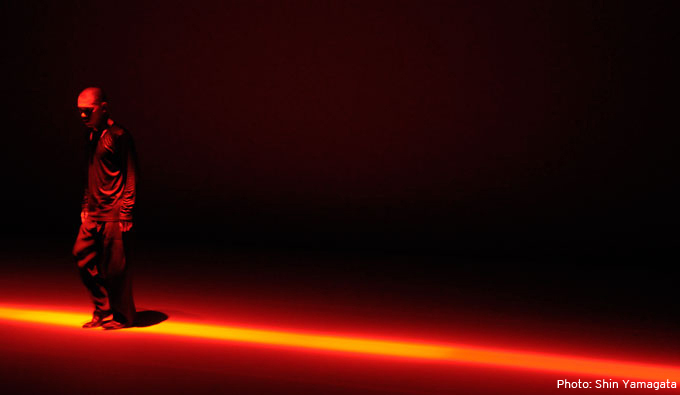
The last time Tokyo-based multimedia movement artist Hiroaki Umeda performed in New York, in May 2009 at Japan Society, we used such superlatives as “dazzling” and “eye-popping” in describing his solo pieces Adapting for Distortion and Accumulated Layout, concluding by calling him “a rising star in the global modern dance community. . . . making only his third appearance in the United States with this show at Japan Society; one can only hope there will be many more.” It’s nearly four years later, but Umeda is back in the city this week, performing Haptic and Holistic Strata March 7-9 at New York Live Arts. In the former, Umeda moves on a lighted rectangular floor with a rectangular backdrop that continually change color as he moves for extended periods of time in one place to electronic noise. In the latter, Umeda is enveloped by black-and-white projections as computerized sounds interact with his movement. As always, Umeda explores visual perception using cutting-edge technology in ways that can blow your mind. The March 7 show will be preceded by the Come Early Conversation “The Visual Atmosphere in Dance” with Hélène Lesterlin, while the March 8 performance will be followed by the Stay Late Discussion “The Process of Creating Haptic and Holistic Strata” with NYLA artistic director Carla Peterson.

COIL: MAGICAL

MAGICAL

Anne Juren exposes her body and more in MAGICAL collaboration with Annie Dorsen at New York Live Arts

ANNE JUREN AND ANNIE DORSEN: MAGICAL
New York Live Arts, Bessie Schönberg Theater
219 West 19th St. between Seventh & Eighth Aves.
January 17-18, 7:30, and January 19, 6:00, $30
212-691-6500
www.newyorklivearts.org

In Magical, Anne Juren and Annie Dorsen recontextualize five seminal works in the history of feminist performance art, restaging them as theatrical entertainment for the twenty-first century. New Yorker Dorsen (cocreator of Passing Strange) and the Vienna-based Juren (founder of Wiener Tanz-und Kunstbewegung), who previously collaborated on Pièce Sans Paroles, explore ideas of illusion and transformation as Juren brings together the five radical pieces, which all date from between 1964 and 1975, taking them out of the avant-garde art gallery world and into a respected performance venue dedicated to movement artistry. They also add numerous magic tricks, designed by Steve Cuiffo, that play with reality and spectators’ perception. “Perhaps our generation has gotten a little comfortable inside the trap,” Dorsen tells Olivia Jane Smith in the program notes. “Have we won the right to self-exploit? Or self-objectivize?” The solo piece examines these questions and more in five re-creations, beginning with Carolee Schneeman’s Interior Scroll, in which Schneeman’s voice can be heard in a moving gold box, reading text that, back in 1975, came out of her vagina. Juren next appears in a kitchen as she reimagines Martha Rosler’s Semiotics of the Kitchen, picking up a knife and making violent motions and exposing a breast and filling a cup with milk. She then takes on Yoko Ono’s Cut Piece, using scissors to snip away pieces of her dress and undergarments until she is naked, then wraps part of the dress around her face and, as Marina Abramović did in Freeing the Body, starts dancing wildly, but this time to loud music that includes Led Zeppelin’s “Whole Lotta Love,” in which Robert Plant famously screams, “Way down inside.”

After a film clip of Schneeman’s Meat Joy, Juren returns to Interior Scroll, pulling surprising things out of her vagina that deal with power, further exerting her control over the proceedings. It’s a tour-de-force sixty minutes that both honors those performance artists who came before her and forces the audience to consider issues of voyeurism, nudity, and the continually changing role of women in society. Back in the ’60s, Virginia Slims might have proclaimed, “You’ve come a long way, baby,” but Magical confirms what we all know: There’s still a long way to go. Magical continues at New York Live Arts through January 19 as part of PS 122’s Coil festival. The January 17 performance will be proceeded at 6:30 by the Come Early Conversation “The Feminist Performance Art Canon,” while the January 18 show will be followed by the Stay Late Discussion “Strategies of Illusion and Transformation in Modern Performance,” with Vallejo Gantner and Carla Peterson. Juren and Dorsen will also host a Shared Practice class on January 19 at 1:30 involving trance and improvisation in choreography.

COIL 2013

Multiple venues
January 3-19, $20-$30 per performance, $75 passport for five shows, $122 for ten
www.ps122.org

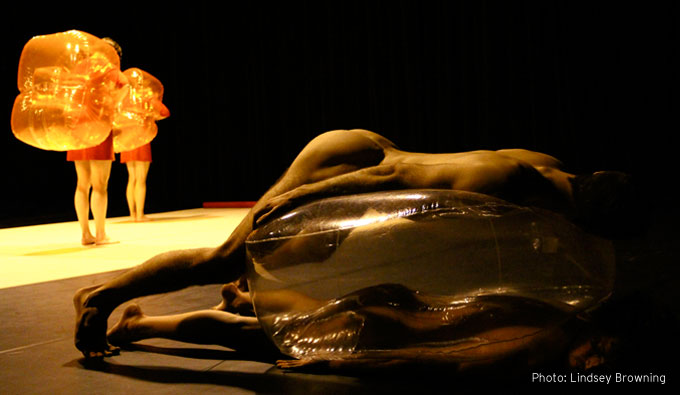
Every January, Performance Space 122 uncoils its COIL festival, several weeks of cutting-edge experimental dance, theater, art, and music. The 2013 winter celebration runs January 3-19 at multiple venues in Manhattan, Brooklyn, and Queens but not at PS122 itself, which is undergoing a major renovation. COIL actually got an early start last month with Kristen Kosmas’s There There at the Chocolate Factory (through January 12), in which a woman has to suddenly replace Christopher Walken in a one-person show with the help of her Russian translator. Radiohole presents the world premiere of Inflatable Frankenstein at the Kitchen January 5-19, offering an unusual look at Mary Shelley’s book and James Whale’s film. In fall 2011, Emily Johnson brought her dazzlingly original The Thank-You Bar to New York Live Arts; now she and her Catalyst company is bringing Niicugni to the Baryshnikov Arts Center, a work that explores time and place. Annie Dorsen and Anne Juren examine femininity through a magic show with nudity in Magical, making its U.S. premiere January 15-19 at New York Live Arts. The BodyCartography Project follows up its 2011 COIL presentation, Symptom, with Super Nature, an ecological dance at Abrons Arts Center with live music by Zeena Parkins and scenic installation by Emmett Ramstad that is also part of the fourth annual American Realness festival. Other performances include the return of Pavel Zuštiak / Palissimo’s Amidst and Brian Rogers’s Hot Box. From January 15 to 18, COIL will host SPAN, a free noon dialogue with some of the artists, and the annual Red + White Party takes place January 13 at SPiN NYC with Ping-Pong, the Vintage DJ, and the National Theater of the United States of America. COIL offers a great opportunity to experience exciting new directions in the multidisciplinary arts, and with most tickets no more than twenty dollars and running times less than seventy minutes, you can’t give much of an excuse not to check a few things out.

RUDE MECHS: DIONYSUS IN 69

Rude Mechs will faithfully restage Performance Group environmental theater classic DIONYSUS in 69 at New York Live Arts

New York Live Arts
219 West 19th St. between Seventh & Eighth Aves.
November 6-10, $30
212-924-0077
www.newyorklivearts.org
www.rudemechs.com

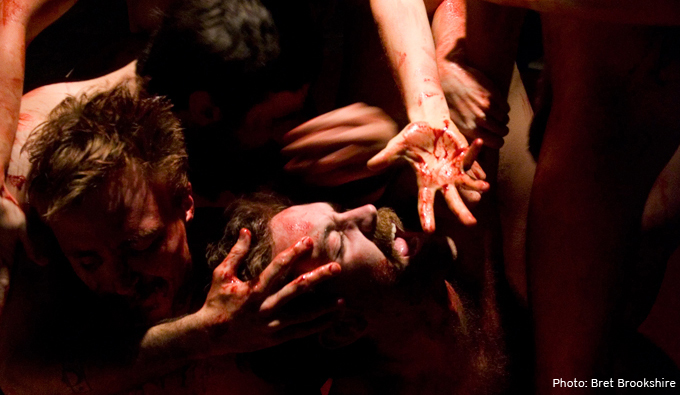
In 1968, the Performance Group, an experimental SoHo theater company founded by artistic director Richard Schechner the year before, staged Dionysus in 69, an avant-garde version of Euripides’ Greek tragedy The Bacchae, which involves the beautiful young partying god Dionysus; Pentheus, the king of Thebes, who took over for his grandfather Cadmus; the blind prophet Teiresias; and Pentheus’s mother, Agauë. The production was filmed by Brian De Palma, who had been impressed by the participatory environmental show that melds audience and performer. Now the Austin-based Rude Mechs, who specialize in organic theatrical performances, are faithfully restaging Dionysus in 69 at New York Live Arts, using the original production and film as sources for the evening-length piece, which features, among other things, full-frontal male and female nudity. Once again the audience gets in on the action, as all seats are general admission on wooden platforms on the floor or accessed via ladders. The show runs November 6-10; on November 8, there will be a preperformance conversation, “The (Re)performance of Discussing Dionysus in 69,” with Schechner and Rude Mechs co-artistic producing directors Madge Darlington and Shawn Sides, while on November 9 there will be a special talk following the 7:30 performance, “Discussing Dionysus in 69, NOW,” with Schechner, Darlington, and Sides speaking with writer and dance critic Elizabeth Zimmer.

TWI-NY TALK: JOHN JASPERSE

John Jasperse revisits FORT BLOSSOM at New York Live Arts this week

FORT BLOSSOM REVISITED (2000/2012)
New York Live Arts
219 West 19th St. between Seventh & Eighth Aves.
May 9-12, $15-$30, 7:30
May 11, 10:00 pm show added by popular demand
212-691-6500
www.newyorklivearts.org
www.johnjasperse.org

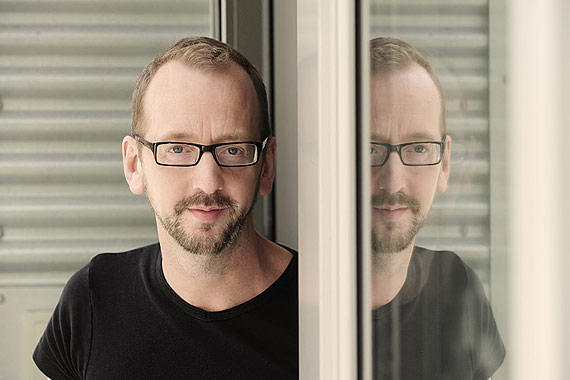
Manhattan-based dancer and choreographer John Jasperse speaks eloquently about his profession both on- and offstage. For more than twenty years, the Bessie Award winner has been challenging and engaging audiences with complex productions that cleverly combine movement, music, visuals, and text in unusual ways, never taking the easy way out. Although he usually performs in his own pieces, he’ll be on the sidelines this week when he brings an updated version of his 2000 work, Fort Blossom, to New York Live Arts. An intellectual and personal exploration of the limits of the human body, the gaze of the viewer, and the effects of time, Fort Blossom was originally performed at the Kitchen by Jasperse, Miguel Gutierrez, Parker Lutz, and Juliette Mapp; the expanded Fort Blossom revisited features Ben Asriel, Lindsay Clark, Erika Hand, and Burr Johnson, with music by Ryoji Ikeda, lighting by Stan Pressner, and costumes by Deanna Berg. There will be a preshow talk with Mapp on May 9 and a discussion following the early show on May 11 with members of the cast and crew; in addition, a bonus late-night 10:00 show on May 11 has just been added by popular demand. A smart, funny, and deeply introspective artist, Jasperse shares his fascinating creative process in our latest twi-ny talk.

twi-ny: What made you want to go back and reexamine Fort Blossom at this time?

John Jasperse: I wasn’t planning on revisiting this work. I have rarely remounted old repertory; I’m more interested in making new work. The occasion to do so came out of an invitation from Lisa Kraus, programmer at Bryn Mawr Presents, who wanted to have my work as part of their 2011–12 presenting season. When it became clear that a new work wasn’t possible, she asked me if there was any work that I wanted to revisit. I immediately thought of Fort Blossom. Very quickly the idea emerged to not only remount the work as it was but to substantially expand it. Subsequently, I contacted Carla Peterson at New York Live Arts to join in the adventure. I have long felt that Fort Blossom was an initial gesture that didn’t actually fully get finished.

Fort Blossom was originally conceived as a work-in-progress towards the first work I made for BAM, which was later called Giant Empty. Fort Blossom was made at a very special juncture that I would be hard pressed to describe concretely. It was made with Miguel Gutierrez, Parker Lutz, and Juliette Mapp, a group of dancers whom I had consistently worked with for a number of years at that point. We rehearsed Fort Blossom for less than two months and presented it at the Kitchen in May of 2000. Then we had a break for the summer. When we returned to rehearsals in the fall to continue work on Giant Empty, it gradually became clear that the “special juncture” of the group had ended and that it was the beginning of the dissolution of that group, that those dancers were getting ready to move on to other things. Giant Empty was the last project I made with Miguel and Parker; Juliette made one more, a duet project called just two dancers. So Giant Empty took a turn of sorts, and it became about our history together in a way — about things coming together and things falling apart.

In the process and also in part in response to the idea of doing my first work for a larger proscenium venue, the simplicity of the design of Fort Blossom got left behind as well as the starkness of the contrasts in the work in favor of an evolving visual environment and a more complicated tapestry where ideas were being approached from multiple angles. I remember a moment of crisis at the end of the process of Giant Empty where there was a discussion in the group about whether or not the men’s duet from Fort Blossom still belonged in Giant Empty. I remember thinking and saying aloud that it represented the last vestige of what I originally wanted the work to be, and as such, it was too problematic to remove it — that it would feel like some sense of me was being removed from the work if I took that choice.

Of course, that is silly, since Giant Empty was also made by me in collaboration with others. I have always felt that it is more interesting to respond to circumstance, to acknowledge and take advantage of what is actually happening rather than to willfully deny that reality and try and thrust some other thing upon the present.

But that willingness to accept things “as they are” is tricky, in part because things aren’t often just or only as they appear at first. In truth, things are always many different ways, all at the same time, so there is also practice in choosing what to align yourself with that is manifest in the present. To speak of how this played out in Giant Empty, to say that things are falling apart, places the focus on their eventual separation and dissolution, to energize that aspect of a potential future in the present. There is also the possibility of looking at the same situation and marveling at the fact that these seemingly different, separate entities are miraculously floating in a dialogue with one another that is perfect just as it is right now, and celebrating that instead of projecting some perceived inevitable fall from grace upon them. The shifts in how we see something (in how we perceive a body, a relationship, or the present moment) are clearly manifest as such in Fort Blossom, and I think after all these years, I have finally realized that there is a profound aspect of hope embedded in Fort Blossom, and in its simplest terms, it is a hope for a multiplicity of connectivity that isn’t compartmentalized and exists in a space beyond shame.

So much emphasis gets placed on the naked men, but it is very important to remember that they cohabitate a space with clothed women. The four figures are together with the simple contrast throughout the hour. The difference (which is initially a difference of division) remains throughout the work, but there is a way in which it becomes both relevant and irrelevant, and I think this is key to the work.

Bessie Award winner John Jasperse speaks openly and honestly about the multiple sides of dance (photo by Chris Taggart)

twi-ny: What have you discovered about yourself and the work in revisiting it?

John Jasperse: I think this work has again taught me something about the power of hope. I would be remiss to not mention something here about aging. I was originally in this work and chose to recast it without me in it. I thought long and hard about the young body vs. older body. I have been concerned that I would be criticized for not being in it this time around, for casting it with younger men. I was clear that redoing Fort Blossom with me and a noticeably younger man would add a whole other dimension to the work that I felt would complicate matters without knowing what to do with this complication. When we made Fort Blossom, it was not with a notion of an idealized body; quite the contrary, it was with the bodies that we had which happened to be of a certain age. The idea to recast the work with peers of my own age did occur to me, to have our bodies reflect the passage of time, but I wasn’t able to complete the picture in my mind of who this would be. And some of the dancing in the second half of the work was challenging for me at the time twelve years ago and would be even more challenging for me now.

So I chose to work with people who were roughly the same age as we were then. Doing it this time around with a younger cast than my current age and being a director from outside, not a dancer in the work, I was concerned that I would be shifted into a role of voyeur. But again, this brings me back to a practice of how you look at something, of what aspect you invest in. And I have found that this can help define both how your experience it and how others experience your intention and your presence in that role. In Fort Blossom revisited (2000/2012), I have really been able to step up to the plate as a director in a way that I have seldom felt in making a new work, because I understand from memory what this terrain is; I’m not trying to invent it all from ether. So while we are trying things, it is as if we have a script for a play and we are playing with how we might interpret it. Or we are developing a scene that is missing and needed by the preexisting context. So I’m more easily able to say what I want because the field is much more delimited than in a totally new work. Contrary to feeling like this is stifling, I have noticed what a relief that is to others to be directed in that way, and I’ve wondered how this experience will color my going back into the studio on new work, where there isn’t a “preexisting script” of sorts.

twi-ny: You’re one of the busiest dancer-choreographers out there; in the last few years alone, you’ve done Becky, Jodi and John at the former Dance Theater Workshop, Truth, Revised Histories, Wishful Thinking, and Flat Out Lies at the Joyce, Misuse Liable to Prosecution and Canyon at BAM, and now Fort Blossom revisited (2000/2012). Are you just constantly going nonstop? I’m getting a picture of you just running and running and running around, like you do in Canyon.

John Jasperse: I’m not sure that I’m any busier than any other dance artist. It is not an easy profession. I am aware of a balancing act, which could also be described as a stretching of bringing together circumstances that don’t naturally meet. That tension of the stretching is likely shared by any dance maker trying to make work today, and certainly by any artist working in New York City. It takes a lot of stamina, or perhaps a better word is “tenacity,” to keep that going. But I feel like I’m a dance artist/choreographer and I want to be doing that right now while I have some vibrancy in that. It is important to find ways to regenerate, and it is important to know that the well can run dry. I’m aware that I’m not so good at pushing back to make the space that I need for regeneration, and I’m aware that can take a toll on the work. I’m also aware that you as an individual are the only person who can take that responsibility on, as the machine of nonprofit arts production is hungry and it must be fed, so there is enormous momentum pushing towards working 24/7.

twi-ny: In regard to nonprofit arts production, several years ago at a post-performance talk you very openly and honestly discussed how difficult it is to make a living as a dancer in New York City. Are things getting better or worse these days?

John Jasperse: I worry that my dealing with these issues and trying to talk openly and honestly about them sounds like I am whining about my situation. I am incredibly grateful for the luck and good fortune that I have had as a dance maker in being able to do what I do. I feel very fortunate to have people interested in the worlds that I create, and I am grateful that this recognition has allowed me to keep working.

I feel that there are shifts in the current climate that ease some of the above pressures and shifts which are more challenging from a pragmatic standpoint. Doris Duke Charitable Trust just announced their first in a series of substantial unrestricted grants for performing artists, US Artists has developed a fellowship program for artists which is filling a gap made in part by the decrease in individual artist funding when the NEA stopped funding artists directly. Many of these opportunities are one-time grants. They create substantial support in a delimited period but don’t/can’t address the ongoing concerns of sustaining a practice over a long period of time.

I would like to see justice in general in the world. I’d like to think that the work that I make is participating in this greater collective effort. Since money is our primary mutually agreed system of valuation, I would like to see more ethics reflected in how money gets spent in the domain of culture. A budget is a value system, and while I have to accept some level of what value others place on things (including the value of my own work to them), I also feel that I need to be proactive in asserting my own values and ethics in budgets, which I am at least partially in control of.

twi-ny: When you do get a chance to slow down and take a step back, what kinds of things do you like to do when you’re not dancing or choreographing?

John Jasperse: I’m still trying to figure that out. I have some energy over the last years in gradually trying to make a calmer living space. I think this is partly trying to create the space for the slowing down to occur in.

IVY BALDWIN: AMBIENT COWBOY

Ivy Baldwin’s AMBIENT COWBOY premieres this week at New York Live Arts

New York Live Arts
219 West 19th St. between Seventh & Eighth Aves.
May 2-5, $15-$20, 7:30
212-691-6500
www.newyorklivearts.org
www.ivybaldwindance.org

In such works as Here Rests Peggy and Bear Crown, Brooklyn-based dancer and choreographer Ivy Baldwin has combined a unique sense of space with sonic and architectural elements to create highly emotional and physical pieces. Her latest evening-length work, Ambient Cowboy, which is having its world premiere May 2-5 at New York Live Arts, was inspired by master architect Philip Johnson’s Glass House in New Canaan, Connecticut, a National Historic Site with structures that have no interior walls, only glass exteriors. Ambient Cowboy will be performed by Baldwin, Molly Poerstel, Lawrence Cassella, and Eleanor Smith, with sound design by Justin Jones, lighting by Chloë Z Brown, and a live, evolving set by painter and installation artist Anna Schuleit that changes every night. The May 2 show will be preceded by a talk with Ryan Tracy, while the May 4 performance will be followed by a discussion with Brian Brooks.