Tag Archives: National Yiddish Theatre Folksbiene

FASCISM ON THE MARCH: THEATRICAL DEPICTIONS OF HATE AND ANTISEMITISM THEN AND NOW

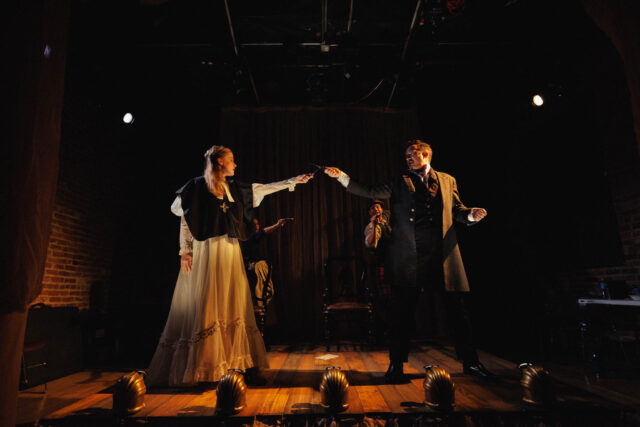
Torrey Townsend’s Jewish Plot takes a unique look at antisemitism (photo by Ken Yotsukura)

JEWISH PLOT
Theatre 154
154 Christopher St. between Greenwich & Washington Sts.
Through November 8, $52.24 – $73.24
www.jewishplot.com

About halfway through the shrewdly inventive Jewish Plot, one of the actors (Madeline Weinstein) reads a ferocious monologue by playwright Torrey Townsend that includes the following breathless diatribe:

“I’m just not hot right now / not exciting / not commercial / not happening / what I should do is make a pivot and frontface with something new / what I should do is start writing about Jews / it’s a subject that people love! / my god people love stories about Jews / it doesn’t even matter / stories about rich Jews / stories about poor Jews / stories about secular Jews / stories about religious Jews / Jews during World War Two / and Jews joining the underground / and Jews trying to escape the camps / and Jews being helped by non-Jews to escape the camps / and Jews being helped by other Jews to escape the camps / and Jews coming to America and assimilating / and Jews coming to America and not assimilating / and Jews experiencing trauma / yes especially above all else Jews experiencing trauma / Jews in the past experiencing trauma / Jews in the present experiencing trauma / Jews half in the past and half in the present experiencing trauma / Jews in multiple dimensions of time and place experiencing trauma / Jews beyond time and place experiencing trauma / Jews as stand-ins for all humans / the timeless truth of all humans experiencing trauma / modern Jews and ancient Jews and Biblical Jews experiencing trauma. . . .”

Right now there are numerous off-Broadway shows that tackle Jewish identity and trauma, coming at a fraught time when the mayoral race involves accusations of antisemitism and there is an uneasy ceasefire in the war in Gaza between Israel and Hamas: Jewish Plot at Theatre 154, Hannah Senesh at Theatre Row, Awake and Sing! at St. George’s Episcopal Church, Slam Frank: A New Musical at Asylum NYC, and Playing Shylock at the Polonsky Shakespeare Center; in addition, the Mint’s Crooked Cross and William Spatz’s Truman vs. Israel closed last weekend. Below I take a closer look at four of them, which I saw on four successive days.

Jewish Plot seemed problematic from the start. First, it had to move from the Brick in Brooklyn to Theatre 154 in the West Village because of an electrical fire. Then, the night I went, Weinstein made a long announcement about how various actors and musicians had quit, but the show, an adaptation of I. W. Bruntmole’s 1889 Jewish Plot; or, The Semite of Mayfair, which deals with antisemitism in Victorian England, would go on, with four performers who would do their best with the technical aspects such as sound and lighting. Oh, and Townsend was in a dressing room still putting finishing touches on the second act.

In Bruntmole’s play, Baron Morris von Azenberg (Eddie Kaye Thomas), who is Jewish, is engaged to actress Sophia Fitzkernerton (Tess Frazer), who is not. But she has to break up with him because, despite his prominent station, her family has forbidden her to marry a Jew; her mother calls the Baron a “Jew devil,” while her brothers refer to him as “the filthy Jew beast.”

The devastated Baron heads off to the Sgorg Inn, where he meets the Abbé Artemis de Romantis (Frazer), who blames all the world’s ills on the Jews. “There’s nothing in the past two thousand years that doesn’t come down to the Jews,” he tells innkeepers Owen (Neil D’Astolfo) and Conner (Weinstein). “The Jews have the money, the Jews are the ones who have robbed the Catholic Church of its power, the Jews are the ones who have brought down the French Empire. Everything’s been a plot, an ingeniously worked-out plot orchestrated by the sons of Israel, the Zionists, the New World Order — call it by any other name. — The Jews control the algorithm; all the rest of us are mice scampering around inside their system.” Offended by the Abbé’s insinuations, the Baron challenges him to a duel.
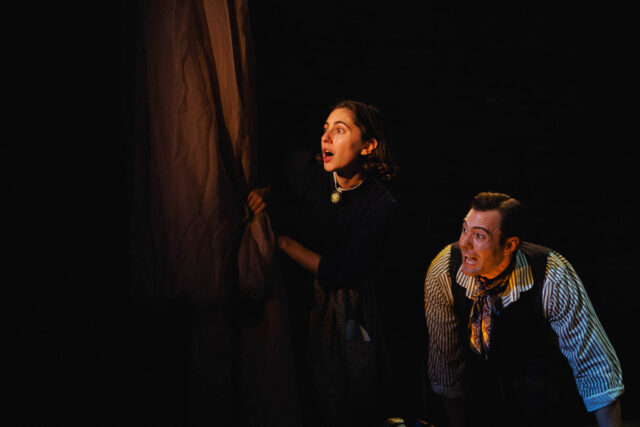
Madeline Weinstein, Neil D’Astolfo — and the audience — can’t believe what they see at Theatre 154 (photo by Ken Yotsukura)

In the second act, Townsend delivers a furious screed about Jewish theater, taking on Itamar Moses (The Ally), Jesse Eisenberg (The Revisionist), Tom Stoppard (Leopoldstadt), and, primarily, Joshua Harmon (Bad Jews), while also bringing up such antisemitic tropes as Jews “eatin’ Christian babies, and drinkin’ their blood!”

Townsend throws in a litany of anachronistic references, intimating how antisemitism continues over time. “This is a Super Bowl of scapegoating, a primordial Mardi Gras,” Townsend writes. It’s a brutal yet hilarious monologue, way too long, but it is as Jewish as it gets, particularly when he includes his mother. “Imagine a Jewish story without a Jewish mother,” he opines parenthetically. He also brings up his grandfather, Meyer Steinglass, “the head and front of the Zionist effort,” who wrote speeches for Golda Meir and raised $35 billion for Israel Bonds.

Lovingly directed with chaotic flair by Sarah Hughes, Jewish Plot is wonderfully titled; it’s about the millennia-old plot against Jews, the supposed plot by Jews to control the world, the plot of Jewish plays, and the burial plot, as antisemitism has resulted in so much death. Weinstein (The Ally) is sensational in the wildly unpredictable work, serving as our personable guide through the neverending scourge of hatred and prejudice that comes with being Jewish.
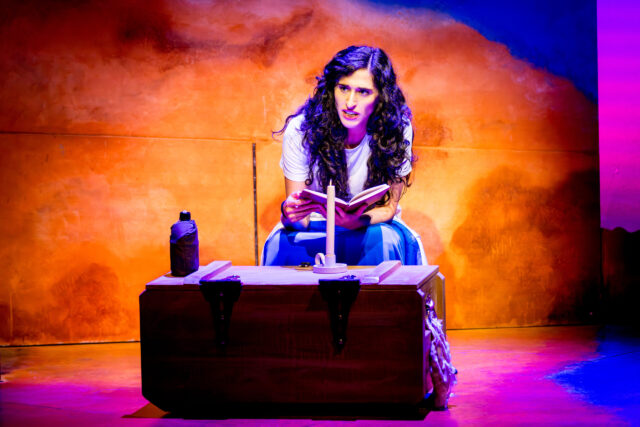
David Schechter’s Hannah Senesh tells the inspiring story of a real Jewish hero (photo by Tricia Baron)

HANNAH SENESH
National Yiddish Theatre Folksbiene at Theatre Row
410 West 42nd St. between Ninth & Tenth Aves.
Tuesday – Sunday through November 9, $92.50
bfany.org
nytf.org/hannah-senesh

Writer-director David Schechter’s Hannah Senesh, presented by the National Yiddish Theatre Folksbiene at Theatre Row through November 9, is framed by the title character’s mother, Catherine, sitting in a chair, proudly telling the audience in heavily accented English about seeing her daughter in a Budapest prison in 1944, locked up with other underground Zionists. “Hannah’s behavior before the members of the Gestapo was quite something. She always stood up to them, warning them plainly of the bitter fate what they would suffer after they lose the war,” Catherine says. “Even the warden of the prison, who I can only describe to you as . . . inhuman . . . animal . . . even he considered it a privilege to visit her cell daily to argue with her fearless criticism of the German rule and her prophecies of Allied victory. He knew she was Jewish, but he also knew that she was a British paratrooper who had come to fight them. And having been taught for years that Jews never fight back, they will accept the vilest treatment what you give them . . . he was struck . . . by her courage.”

In between, Hannah tells her true story, based on her diaries and other writings (translated by Marta Cohn and Peter Hay), taking us from Budapest in 1934, when, at the age of twelve, she declares herself a vegetarian and complains about a party dress her mother has bought her, through her teen years as she describes her ideal boy and her fury when she wins a school election but it is invalidated because she is Jewish, to her decision to become a Zionist. Quoting Polish writer Nahum Sokolow, she explains, “Zionism is the movement of the Jewish people for its revival.”

Shortly after turning eighteen, she immigrates to British Mandate Palestine, where she lives on a kibbutz. But as Hitler and the Nazis continue their march through Europe, Hannah decides she has to get her mother out before it’s too late, so she volunteers for a dangerous mission.
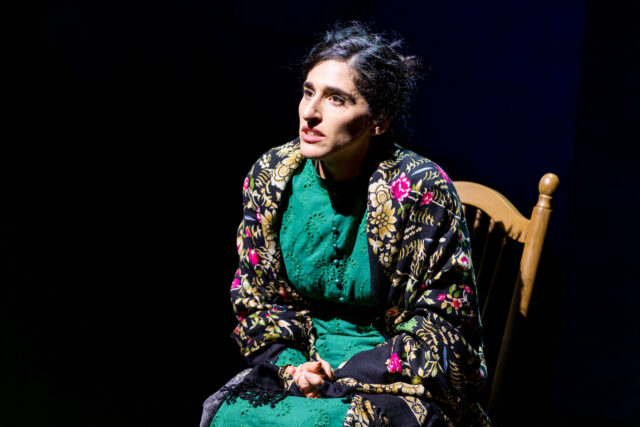
Jennifer Apple portrays both Hannah Senesh and her mother, Catherine, in poetic show (photo by Tricia Baron)

Jennifer Apple is terrific as both Hannah and Catherine, the former with a gleefully idealistic view of life, the latter more pragmatic; Hannah often flits about onstage, singing, dancing, and twirling a large blue-and-white multipurpose cloth that evokes what will be the colors of the Israeli flag, while Catherine, in dowdy clothing, is tense and controlled. The set features the chair and a writing desk surrounded by walls on which the sun, clouds, storms, and abstract shapes are projected.

The music, arranged by Steven Lutvak, includes Schechter’s adaptation of “Soon” and Liz Swados’s “One, Two, Three” in addition to Senesh’s popular poem “A Walk to Caesarea (‘Eli, Eli’),” in which she sings, “Oh Lord, my G-d / I pray that these things never end / The sand and the sea / The rush of the waves / The crash of the heavens / The prayer of man.”

The narrative doesn’t focus enough on what made Hannah a beloved hero in Israel — I actually had to Google her when I got home to find out more of the details — and the late inclusion of a second character (Simon Feil) feels unnecessary, but the play does a good job introducing us to this extraordinary young woman.

I can’t help but wonder what she would do if she were alive today.
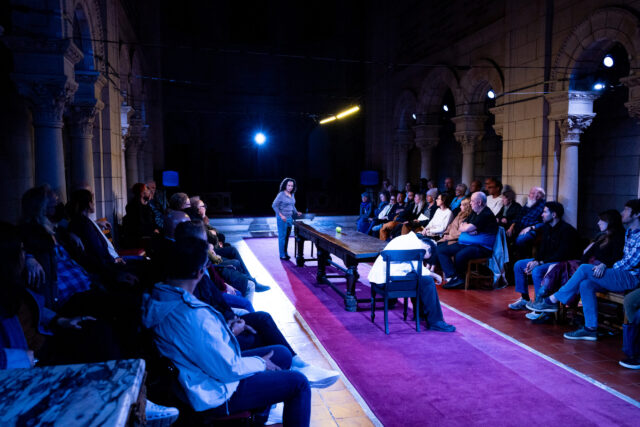
Sea Dog’s adaptation of Awake and Sing!, about a Jewish family, takes place in a church (photo by Jeremy Varner)

AWAKE AND SING!
St. George’s Episcopal Church
209 East Sixteenth St. at Rutherford Pl.
Through November 8, $25-$75, 7:30
www.seadogtheater.org

Zionism and Israel don’t come up in Clifford Odets’s 1935 family melodrama, Awake and Sing!, but the play, currently enjoying a sublime ninetieth-anniversary production from Sea Dog Theater at St. George’s Episcopal Church, does deal with antisemitism, and assimilation, in its own way.

In her 1983 book From Stereotype to Metaphor: The Jew in Contemporary Drama, Ellen Schiff calls it “the earliest quintessentially Jewish play outside the Yiddish theatre. It bears the unmistakable stamp of authenticity, exactly what one would wish from a Jewish dramatist writing a slice of Jewish life problem play.”

This is the third production of Awake and Sing! that I’ve reviewed. In 2013, I saw an excellent all-Asian adaptation from NAATCO at Walkerspace, and in 2017 I caught a superb Yiddish version from New Yiddish Rep at the 14th Street Y. Sea Dog’s rendition features a diverse cast, which makes the story more universal without sacrificing its Jewishness.

It’s 1933, and the Berger family is struggling to get by in a cramped Bronx apartment. Matriarch Bessie Berger (Debra Walton) wants her children to marry well, but son Ralph (Trevor McGhie), a wannabe entertainer, is secretly dating a young woman from a poor family, and daughter Hennie (Daisy Wang) is not particularly fond of her two suitors, the acerbic and cynical Moe Axelrod (Christopher J. Domig) and the plain, uninspiring Sam Feinschreiber (Sina Pooresmaeil). Bessie’s husband, Myron (Juan Carlos Diaz), is a timid, ineffectual man with a taste for gambling, while Bessie’s elderly father, Jacob (Gary Sloan), wanders around the apartment listening to Enrico Caruso and spouting Marxist doctrine. Bessie’s brother, Morty (Alfred C. Kemp), who has a successful fashion business, stops by once in a while to defend capitalism and help out financially, but apparently not as much as he could.
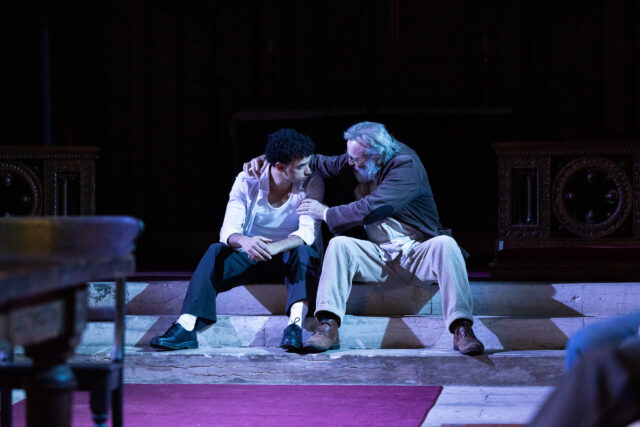
Jacob (Gary Sloan) tries to get through to his grandson, Ralph (Trevor McGhie), in multigenerational Clifford Odets drama (photo by Jeremy Varner)

An early conversation emphasizes the family’s religion.

Myron: The whole world’s changing right under our eyes. Presto! No manners. Like the great Italian lover in the movies. What was his name? The Sheik . . . No one remembers? [Exits]
Ralph: Jake . . .
Jacob: Noo?
Ralph: I can’t stand it.
Jacob: There’s an expression — “strong as iron you must be.”
Ralph: It’s a cock-eyed world.
Jacob: Boys like you could fix it some day. Look on the world, not on yourself so much. Every country with starving millions, no? In Germany and Poland a Jew couldn’t walk in the street. Everybody hates, nobody loves.

When Hennie gets pregnant and the man who did it leaves town, the close-knit but argumentative family has some important decisions to make, facing difficult choices in very hard times.

Director Erwin Maas and production designer Guy De Lancey, who previously collaborated on Sea Dog’s moving Tuesdays with Morrie, make good use of the church’s narrow chantry. The audience sits in two rows on either side of the space, which is centered by a long table with chairs at each end and a green apple in the middle, the only prop in the show. The characters occasionally walk behind columns, down the hall, and into nooks, where their consternation is livestreamed on four video monitors. The actors’ voices do reverberate in the high ceilings, but your ears will quickly get accustomed to that.

Odets, the son of Eastern European Jewish immigrants, chose the title from the Old Testament, Isaiah 26:19, which declares, “Awake and sing, ye that dwell in dust,” but the added exclamation point seems almost like a tease as the men and women pursue an American dream that feels always out of their grasp, as if they will never be able to get out of the dust.

Many historians have likened this current time in the United States to 1930s Germany and the rise of fascism, and that undercurrent bristles under the play, since, with the benefit of hindsight, we know where things are heading for Jack, Morty, and the Jews of Europe.

The more things change. . . .
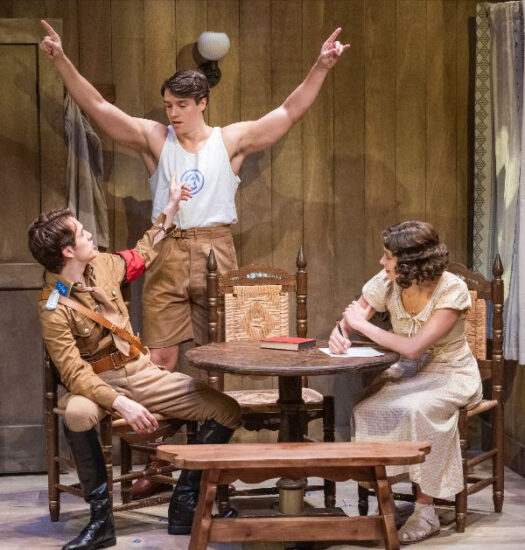
Mint revival is a timely look at the growth of fascism (photo by Todd Cerveris Photography)

CROOKED CROSS
The Mint Theater at Theatre Row
410 West 42nd St. between Ninth & Tenth Aves.
Closed November 1
minttheater.org
bfany.org

Sally Carson’s Crooked Cross begins on Christmas Eve, 1932, and there’s no doubt as to what it’s about and where things are heading: The title refers to the Nazi swastika.

The American premiere of the 1935 play, based on Carson’s 1934 novel, comes courtesy of the Mint Theater, which specializes in reviving lost or forgotten works. The show closed November 1 at Theatre Row but leaves a lasting impression.

In the small German town of Kranach, Moritz Weissmann (Ty Fanning) is in love with Lexa Kluger (Ella Stevens), who lives with her brothers, Helmy (Gavin Michaels) and Erich (Jakob Winter), and their parents (Katie Firth and Liam Craig). Moritz, who recently lost his mother, is taking care of his aging father (Douglas Rees).

A few months later, at a ball in a Munich hotel, Moritz is accosted by a young man (Ben Millspaugh) wearing a uniform with a swastika badge on it who yells, “Blast you! . . . You filthy Jew . . . beastly foreigner! Get out of the way . . . or I’ll . . .” Lexa is shocked by the altercation, saying, “I didn’t know it was like that.” Moritz considers ending his relationship with Lexa so as not to put her in harm’s way, but there’s no avoiding it once Helmy, Erich, and their friend Otto (Jack Mastrianni), who desires Lexa, have all joined the party and go everywhere in their brown storm trooper uniforms with swastikas on the arm. (The frightening costumes are by Hunter Kaczorowski.)

When Lexa tells Helmy that she doesn’t want to give up Moritz, he accuses her of being selfish. “But Helmy, what is being selfish? I’ve thought of so many things lately. And the more I think, the more everything gets a different value,” she tells him. “I’m sure of one thing, I can say this about Moritz, and it’s rare to be able to say it about anyone – I don’t want a single thing different about him, there’s nothing I don’t want or don’t love about Moritz.” Helmy bitterly replies, “Only his being a Jew.” Lexa answers quietly, “Perhaps even that.”

Carson pulls no punches as the Nazi party quickly grows and Moritz has to reevaluate his future in Germany with his father and Lexa.
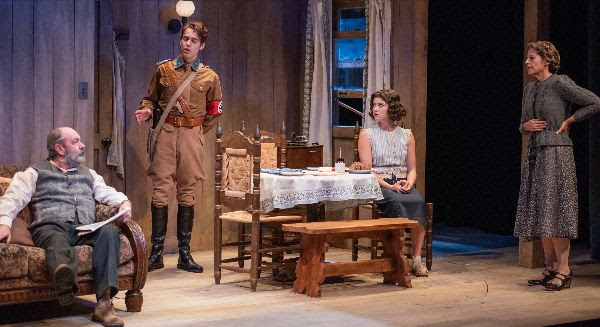
A close German family is torn apart by Nazism in Sally Carson’s Crooked Cross (photo by Todd Cerveris Photography)

“The German youth had been brought up to believe that their country was ‘beaten’ and ‘second-class.’ They developed a feeling of inferiority,” Carson said at a 1935 postshow discussion. “Then along came Hitler who said, ‘You are not second rate and you are not going to be.’ This creed inspired the young people. . . . Whether he will continue to bamboozle the people much longer, no one knows.” The British author never saw the full force of the Nazis in WWII; she died in 1941 at the age of thirty-eight. Crooked Cross was the first of a trilogy that continued with 1936’s The Prisoner and 1938’s A Traveller Came By.

Adroitly directed by Jonathan Bank on Alexander Woodward’s cramped living room set (which converts to other tight spaces), Crooked Cross is a warning sign in 2025, nearly begging the audience to squarely face what is happening in America and around the world, to the Jews, refugees, and other minorities. The narrative avoids getting preachy, instead making its points with expert precision. The fine cast is led by a stellar performance by Stevens, in her New York debut, as Lexa, a caring and honest young woman who represents all of us who believe that the worst will not happen, that humanity can never go that far.

But as Jewish Plot, Hannah Senesh, Awake and Sing!, Crooked Cross, and so many other works dealing with antisemitism, bigotry, and injustice have revealed across the last ninety years and more, it would be folly to underestimate the power and reach of hate.

[Mark Rifkin is a Brooklyn-born, Manhattan-based writer and editor; you can follow him on Substack here.]
THE JOY OF YIDDISH THEATER: IN DIM SUM PORTIONS

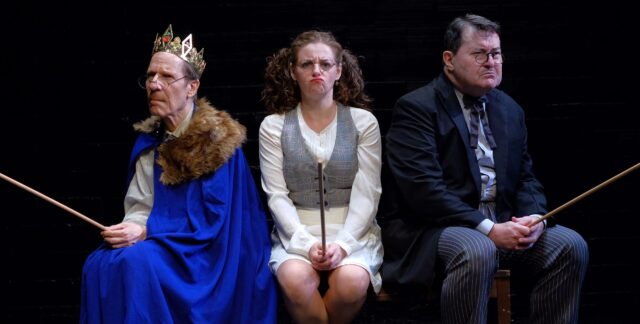
Steve Sterner, Yelena Shmulenson, and Allen Lewis Rickman share the joys of Yiddish in The Essence (photo by Jonathan Melvin Smith)

THE ESSENCE: A YIDDISH THEATRE DIM SUM
Theatre 154
154 Christopher St. between Greenwich & Washington Sts.
January 7-12, $52.37
www.everyonesyiddish.com
www.congressforjewishculture.org

If you believe that everything sounds better in Yiddish — as I do — then The Essence: A Yiddish Theatre Dim Sum is for you.

For more than ten years, this eighty-five-minute presentation has been staged in the northeast and Europe, offering a vaudeville-influenced history of Yiddish theater through comedy sketches, songs, and informational background inspired by Nahma Sandrow’s 1977 book, Vagabond Stars. The play’s subtitle works in multiple ways: dim sum means “touch the heart” in Chinese, and Yiddish certainly touches the heart (as well as the soul and the gut); dim sum is a meal made up of small dishes, like skits; and there is a long connection between Jews and Chinese food.

But most of all, it’s a celebration of a language that goes back a thousand years and has supposedly been on its deathbed time and time again but still keeps going. As Leo Rosten wrote in his introduction to his classic 1968 dictionary, The Joys of Yiddish, this book “illustrates how beautifully a language reflects the variety and vitality of life itself; and how the special culture of the Jews, their distinctive style of thought, their subtleties of feeling, are reflected in Yiddish; and how this in turn has enhanced and enriched the English we use today.”

Originally presented by the New Yiddish Rep and now by the Congress for Jewish Culture (CJC), The Essence, the follow-up to CJC’s Bashevis’s Demons at Theater 154, is a tasty chronological performance lecture starring actor, pianist, silent film accompanist, and cruciverbalist Steve Sterner, a native New Yorker who also serves as musical director; actor, audiobook narrator, and pianist Yelena Shmulenson, who was born in Belarus and raised in Ukraine; and Queens native Allen Lewis Rickman, who also wrote and directed the show. All three have worked with the National Yiddish Theatre Folksbiene, which has dazzled audiences with Yiddish productions of The Golden Bride, The Sorceress, Fiddler on the Roof, and more. Rickman (Relatively speaking, The Big Bupkis! A Complete Gentile’s Guide to Yiddish Vaudeville) and Shmulenson (The Megillah for Itzik Manger, The Golem of Havana) previously teamed up in the CJC’s The Dybbuk and Tevye Served Raw and portrayed the nineteenth-century shtetl couple in the prologue of the Coen brothers’ film A Serious Man.

They take the audience on a rollicking journey through such Yiddish songs as “A Shtetele,” “Nit Bashert,” and “Dona, Dona” and scenes from such early Yiddish shows as Di Kishufmakherin, Moshiakh in Amerike, and Dem Shuster’s Tokhter. Some bits work better than others, but there’s plenty here to make you smile, laugh, and nod in agreement. “Yiddish is an amazing language for expressing emotion, and it’s an incredible language for humor,” Shmulenson says.

Yelena: You see, in Yiddish you can’t just say something, you have to make it interesting. You can’t say —
Steve: “To be or not to be . . . that is the question.”
Yelena: You have to say “Zayn oder nit zayn . . . du ligt der hint bagrubn.”
Steve: “To be or not to be . . . that’s where the dog is buried.”

They gleefully discuss how colorful Yiddish curses are and list the many Yiddish words for son, unfortunately, and imbecile. “When the going gets tough, the Yiddish start cursing,” Rickman explains. “It’s opera, it’s poetry . . . Yiddish cursing is sculpture made from hate.”

The cast tells stories about Avrom Goldfadn, the failed newspaper publisher, failed medical student, failed teacher, failed ladies’ hat shop manager, and successful poet who was the Father of Yiddish Theater; describe how amateur groups put on Yiddish plays in concentration camps during WWII; delve into the German Jews known as the Yekes, who wanted to assimilate in America and actively campaigned against Yiddish theater coming here; and how John Barrymore, Paul Robeson, Orson Welles, Al Capone, Cole Porter, and kings and queens were enthralled with Yiddish theater. “In Paris even antisemites went to Yiddish theater,” Sterner points out. Rickman adds, “None of those people understood Yiddish, but they all went, anyhow.”

You don’t have to know any Yiddish to find the joy in The Essence, as English supertitles are projected on a small, framed horizontal screen above a red curtain, behind which the actors change costumes as they move from shtick to shtick, proving that, as Rickman writes in the program, “Yiddish theater is not any one thing, and it never was. It was naturalistic, expressionistic, melodramatic, and intimate. It was — and is — bombast and nuance, singing and silence, art and trash. It’s been around for a century and a half, and it’s been absolutely everything. The only thing that ties it together is its history of innovation, and, of course, the language.”

And as Rosten writes, “What other language is fraught with such exuberant fraughtage?”

Hobn a groys moltsayt!

[Mark Rifkin is a Brooklyn-born, Manhattan-based writer and editor; you can follow him on Substack here.]
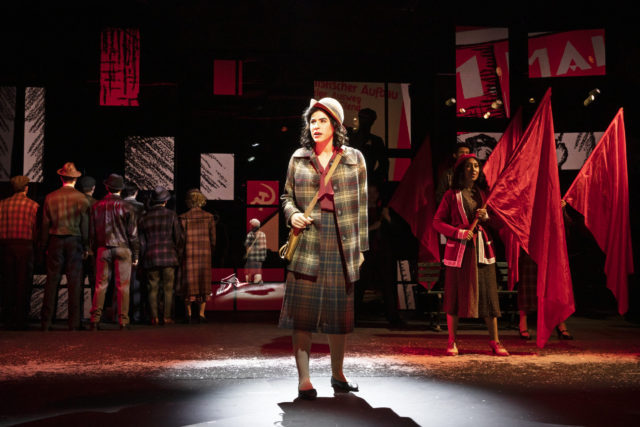
HARMONY: A NEW MUSICAL

Barry Manilow musical tells real-life story of the Comedian Harmonists (photo by Julieta Cervantes)

HARMONY: A NEW MUSICAL
National Yiddish Theatre Folksbiene
Museum of Jewish Heritage — A Living Memorial to the Holocaust
Edmond J. Safra Hall, 36 Battery Pl.
Through May 15, $79-$129
nytf.org/harmony

“A Bulgarian singing waiter, a doctor, a bass from the Comic Opera, a musical prodigy, a whorehouse pianist . . . and a Polish Rabbi walk into a bar,” Josef Roman “Rabbi” Cykowski (Chip Zien) says near the beginning of Harmony, the biographical musical that opened tonight at the Museum of Jewish Heritage — A Living Memorial to the Holocaust, presented by the National Yiddish Theatre Folksbiene.

Throughout his nearly sixty-year career, Brooklyn-born songster Barry Manilow has won a Tony, two Emmys, a Grammy, and an honorary Clio for his classic jingles and has released more than three dozen albums (including eight gold and eight platinum records) that have sold more than eighty-five million copies. But his favorite creative endeavor is Harmony, the twenty-five-plus-years-in-the-making musical about the Comedian Harmonists, the real-life a cappella German singing group whose international success was ultimately thwarted by the Nazis; composer Manilow and his longtime collaborator, Queens native Bruce Sussman, who wrote the book and lyrics, seek to restore the Harmonists’ legacy in this glittering show.

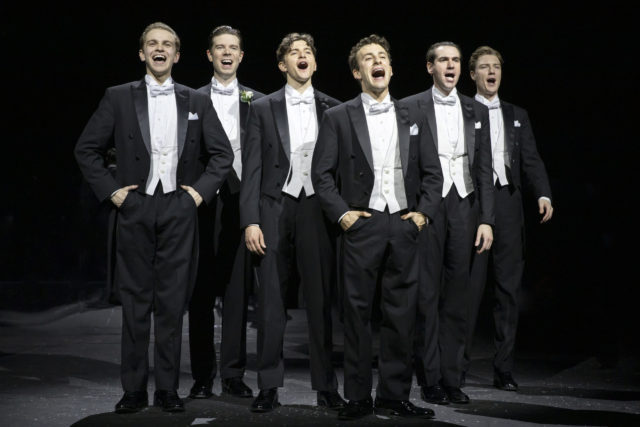
The story is told in flashback by the older Rabbi, who details how the group formed and became a sensation despite some initial stumbles; he pontificates on many of the choices they made, especially those by his younger self (Danny Kornfeld), while sometimes joining them in song. Originally known as the Melody Makers, the ensemble was put together by actor and composer Harry Frommerman (Zal Owen) and consisted of Rabbi, Comic Opera bass Robert “Bobby” Biberti (Sean Bell), medical student Erich Collin (Eric Peters), piano player Erwin “Chopin” Bootz (Blake Roman), and singing waiter Ari “Lesh” Leshnikoff (Steven Telsey). In addition to their glorious harmonies and goofy charm, they used their voices as instruments, making it sound like they were performing with a band.

Ruth (Jessie Davidson) is ready to fight what’s coming in Germany in Harmony (photo by Julieta Cervantes)

As their fame spreads, Rabbi falls in love with Mary (Sierra Boggess), a Christian who considers converting to Judaism but is also worried about the growing anti-Semitism emerging from the National Socialists, and Chopin marries Ruth (Jessie Davidson), a staunch Jewish activist who is ready to fight against the rise of the far right. As Nazi officers start showing up at their concerts, including a standartenführer (Andrew O’Shanick) and his wife, Ingrid (Kayleen Seidl), who are huge fans, the Comedian Harmonists realize they are caught in the middle of something a lot bigger than themselves and have to take a long, hard look at their personal and professional futures.

Harmony premiered at La Jolla Playhouse in 1997, with Danny Burstein as Rabbi and Rebecca Luker as Mary. (The two got married in 2000 and remained so until Luker’s tragic death in 2020.) Manilow and Sussman, writing partners for more than forty years, have continued to tweak the show since then; today it feels oddly prescient as dictators and the far right gain power around the world and so many oppressed people become refugees as they try to escape bad situations that are only getting worse. It is also an excellent way to celebrate the little-known a cappella group, as there are only limited archival footage and audio recordings available online, in addition to a 1991 German documentary, a 1997 German biopic, and a 2010 English-language book.

The six actors portraying the Comedian Harmonists are terrific, forming a cohesive unit in, well, perfect harmony. Director and choreographer Warren Carlyle (After Midnight, On the Twentieth Century) has fun with the sextet, particularly in a scene in which they have no pants. Characters often enter and leave through the aisles, approximating the feel of watching the Comedian Harmonists in a 1920-’30s theater rather than a contemporary venue. And the Museum of Jewish Heritage is just the right place to stage this show, an institution dedicated to preserving the Jewish experience before, during, and after the Holocaust.

Chip Zien gives a bravura performance as Rabbi Josef Roman Cykowski and others in Harmony (photo by Julieta Cervantes)

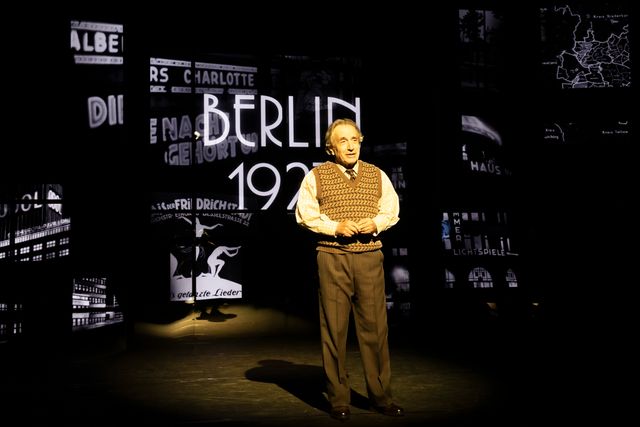
The musical is about a tight-knit ensemble, but it’s worth seeing for Zien (Into the Woods; Caroline, or Change) alone; a New York City theater treasure, Zien is spectacular as Rabbi, who can’t help but get emotional as he watches mistakes his younger self and the troupe make. Zien also dazzles by taking on a number of minor roles, changing costumes — and wigs — lightning fast as he transforms himself into Marlene Dietrich, Richard Strauss, and Albert Einstein. (The costumes, which range from humble street clothes to pristine tuxedos to Nazi uniforms, are by Linda Cho and Ricky Lurie, with hair and wigs by Tom Watson.) Zien leaves Ana Hoffman to regale us as Josephine Baker, who did in fact perform with the Harmonists.

Three-time Tony winner Beowulf Boritt’s set is anchored by a wall of mirrors that reflects the performers — and the conductor, who leads the orchestra from a pit in the right side of the audience — and also on which are projected archival photographs, text identifying the time and place, and Nazi symbols. Among the locations are various nightclubs in Berlin, Tivoli Park in Copenhagen, a movie set in Cologne, a night train to Munich, the tailor shop where Mary works, and Carnegie Hall, where the Comedian Harmonists headlined in 1933.

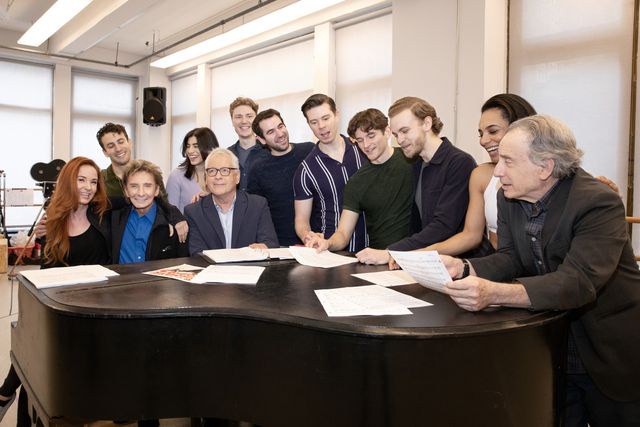
Barry Manilow and Bruce Sussman rehearse with the cast of Harmony (photo by Julieta Cervantes)

At 165 minutes (with intermission), the show, featuring music direction and additional arrangements by John O’Neill, is at least a half hour too long, dragging primarily during the romantic numbers; there’s much more life when the German boy band is performing and when the political tension increases — to a point where the characters are making potential life-or-death decisions.

And as much as Harmony is specifically about the Comedian Harmonists, it also reminds us how we all should be with others, particularly in times of strife. As the cast sings in the title song: “Oom-pah-pah, oom-pah-pah, / Oom-pah oom-pah oom-pah, / Harmony, / We sing in harmony / Like the robins in Herald Square. / Harmony, / The thing is harmony, / Always knowing there’s someone there. / In this joint / All encounters with counterpoint / End in harmony. / And it’s clear / No man’s a solo here. / Not even me! Me! Me! Me! Me! Me! / No solo mio! / Just harmony.”

THE GARDEN OF THE FINZI-CONTINIS

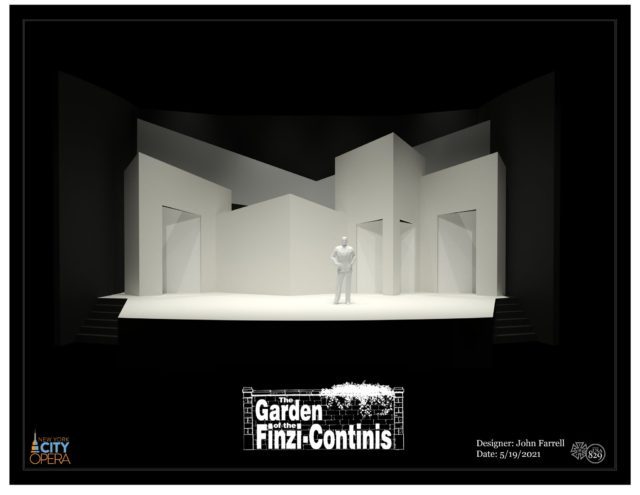
The set for The Garden of the Finzi-Continis is designed by John Farrell

THE GARDEN OF THE FINZI-CONTINIS
New York City Opera / National Yiddish Theatre Folksbiene
Museum of Jewish Heritage — A Living Memorial to the Holocaust
Edmond J. Safra Hall, 36 Battery Pl.
January 27 – February 6, $50-$125
855-449-4658
nycopera.com/shows/finzi
nytf.org/finzi-continis

Giorgio Bassani’s semiautobiographical 1962 novel, The Garden of the Finzi-Continis, opens ominously enough with a description of the elaborate Finzi-Contini crypt, followed by an evaluation of their home. Bassani writes, “If the tomb of the Finzi-Contini family could be called a ‘horror,’ and smiled at, their house, isolated down there among the mosquitoes and frogs of the Panfilio Canal and the outlets of the sewers, and nicknamed enviously the magna domus, at that, no, not even after fifty years could anyone manage to smile.” The story, about a wealthy Jewish family that is more concerned with playing tennis than noticing the Fascism and anti-Semitism swirling around them in 1930s Italy, was turned into an Oscar-winning film by Italian director Vittorio De Sica starring Dominique Sanda and Helmut Berger.

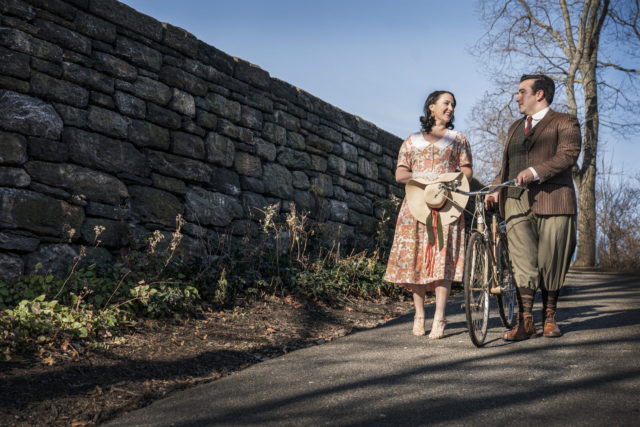
Rachel Blaustein and Anthony Ciaramitaro star in world premiere of opera adaptation of The Garden of the Finzi-Continis (photo © Sarah Shatz)

The Museum of Jewish Heritage will be hosting the world premiere of a new American opera based on the book, running January 27 to February 6 in Edmond J. Safra Hall. A coproduction of New York City Opera and National Yiddish Theatre Folksbiene, the show features a score by Ricky Ian Gordon (The Grapes of Wrath, the upcoming Intimate Apparel) and libretto by Michael Korie (The Grapes of Wrath, Harvey Milk), direction and choreography by Richard Stafford, and James Lowe conducting. “The Garden of the Finzi-Continis not only continues New York City Opera’s mission to produce new and important works by American composers, it will also continue NYCO’s tradition of showcasing outstanding talent,” NYCO general director Michael Capasso said in a statement. “I am very excited about our cast, which includes many young and emerging artists in leading roles alongside established NYCO stalwarts.” Rachel Blaustein and Brian James Myer star as Micól and Alberto Finzi-Contini, respectively, with Grammy winner Mary Phillips as Mama, Franco Pomponi as Papà, and Anthony Ciaramitaro as Giorgio; the sets are by John Farrell, with costumes by Ildiko Debreczeni and lighting by Susan Roth.

Ildiko Debreczeni designed the costumes for world premiere opera

“This important new work illuminates an important part of Italian Jewish history, and sadly, its themes of discrimination and anti-Semitism still resonate in our world today,” NYTF artistic director Zalmen Mlotek added. [Ed. note: The run has been pushed back a week because of the current omicron surge; the above dates have been adjusted.]

TWI-NY AT TWENTY: TWENTIETH ANNIVERSARY GALA CELEBRATION OF THIS WEEK IN NEW YORK

Who: Works by and/or featuring Moko Fukuyama, Joshua William Gelb, Gabrielle Hamilton, Jace, Elmore James, Jamal Josef, Katie Rose McLaughlin, Sara Mearns, Zaire Michel, Zalman Mlotek, Alicia Hall Moran, Patrick Page, Barbara Pollack, Seth David Radwell, Jamar Roberts, Tracy Sallows, Xavier F. Salomon, Janae Snyder-Stewart, Mfoniso Udofia, Anne Verhallen
What: This Week in New York twentieth anniversary celebration
Where: This Week in New York YouTube
When: Original air date: Saturday, May 22, free with RSVP, 7:00 (now available on demand)
Why: In April 2001, I found myself suddenly jobless when a relatively new Silicon Alley company that had made big promises took an unexpected hit. I took my meager two weeks’ severance pay and spent fourteen days wandering through New York City, going to museums, film festivals, parks, and tourist attractions. I compiled my experiences into an email I sent to about fifty friends, rating each of the things I had done. My sister’s husband enthusiastically demanded that I keep doing this, and This Week in New York was born.

Affectionately known as twi-ny (twhy-nee), it became a website in 2005 and soon was being read by tens of thousands of people around the globe. I covered a vast array of events – some fifteen thousand over the years – that required people to leave their homes and apartments and take advantage of everything the greatest city in the world had to offer. From the very start, I ventured into nooks and crannies to find the real New York, not just frequenting well-known venues but seeking out the weird and wild, the unusual and the strange.

For my tenth anniversary, we packed Fontana’s, a now-defunct club on the Lower East Side, and had live music, book readings, and a comics presentation. I had been considering something bigger for twenty when the pandemic lockdown hit and lasted longer than we all thought possible.

At first, I didn’t know what twi-ny’s future would be, with nowhere for anyone to go. But the arts community reacted quickly, as incredible dance, music, art, theater, opera, film, and hybrid offerings began appearing on numerous platforms; the innovation and ingenuity blew me away. The winners of twi-ny’s Pandemic Awards give you a good idea of the wide range of things I covered; you can check out part one here and part two here. (Part III is now up as well.)

I devoured everything I could, from experimental dance-theater in a closet and interactive shows over the phone and through the mail to all-star Zoom reunion readings and an immersive, multisensory play that arrived at my door in a box. Many of them dealt with the fear, isolation, and loneliness that have been so pervasive during the Covid-19 crisis while also celebrating hope, beauty, and resilience. I’ve watched, reviewed, and previewed more than a thousand events created since March 2020, viewing them from the same computer where I work at my full-time job in children’s publishing.

Just as companies are deciding the future hybrid nature of employment, the arts community is wrestling with in-person and online presentations. As the lockdown ends and performance venues open their doors, some online productions will go away, but others are likely to continue, benefiting from a reach that now goes beyond their local area and stretches across the continents.

On May 22 at 7:00, “twi-ny at twenty,” produced and edited by Michael D. Drucker of Delusions International and coproduced by Ellen Scordato, twi-ny’s business manager and muse, honors some of the best events of the past fourteen months, including dance, theater, opera, art, music, and literature, all of which can be enjoyed for free from the friendly confines of your couch. There is no registration fee, and the party will be available online for several weeks. You can find more information here.

Please let me know what you think in the live chat, which I will be hosting throughout the premiere, and be sure to say hello to other twi-ny fans and share your own favorite virtual shows.

Thanks for coming along on this unpredictable twenty-year adventure; I can’t wait to see you all online and, soon, in real life. Here’s to the next twenty!

ESN: SONGS FROM THE KITCHEN — CHANUKAH EDITION!

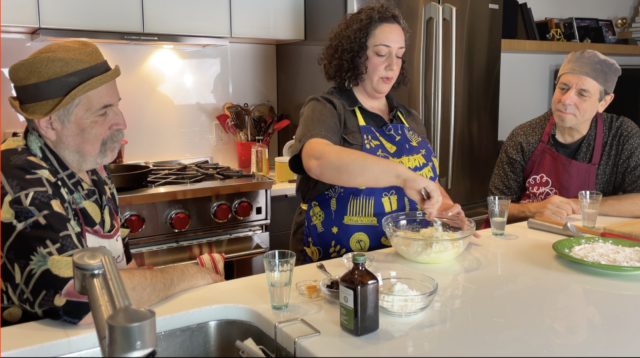
Lorin Sklamberg, Sarah Gordon, and Frank London celebrate a Yiddish Chanukah with food and music

Who: Sir Frank London, Lorin Sklamberg, Sarah Gordon
What: Streaming Chanukah event
Where: National Yiddish Theatre Folksbiene online
When: November 28 – December 6, free (donations accepted)
Why: Named for the Yiddish word for eat, “essen,” National Yiddish Theatre Folksbiene’s ESN series combines cooking and music. It now turns to the Festival of Lights for a special presentation available on demand November 28 through December 6. The show, in English and Yiddish, features ESN creators Frank London and Lorin Sklamberg of the Klezmatics and fourth-generation Yiddish singer Sarah Mina Gordon sharing holiday music and cooking demonstrations. Directed and edited by Stephanie Lynne Mason and Adam B. Shapiro, “Songs from the Kitchen — Chanukah Edition!” will feature latkes, syrniki, varenikes, banya pontschkes, and schmaltz and gribnenes alongside fun, festive tunes.

TWI-NY AT TWENTY: ANNIVERSARY CELEBRATION

Who: Works by and/or featuring Moko Fukuyama, Joshua William Gelb, Gabrielle Hamilton, Jace, Elmore James, Jamal Josef, Katie Rose McLaughlin, Sara Mearns, Zaire Michel, Zalman Mlotek, Alicia Hall Moran, Patrick Page, Barbara Pollack, Seth David Radwell, Jamar Roberts, Tracy Sallows, Xavier F. Salomon, Janae Snyder-Stewart, Mfoniso Udofia, Anne Verhallen
What: This Week in New York twentieth anniversary celebration
Where: This Week in New York YouTube
When: Saturday, May 22, free with RSVP, 7:00 (available on demand through June 12)
Why: In April 2001, I found myself suddenly jobless when a relatively new Silicon Alley company that had made big promises took an unexpected hit. I took my meager two weeks’ severance pay and spent fourteen days wandering through New York City, going to museums, film festivals, parks, and tourist attractions. I compiled my experiences into an email I sent to about fifty friends, rating each of the things I had done. My sister’s husband enthusiastically demanded that I keep doing this, and This Week in New York was born.

Affectionately known as twi-ny (twhy-nee), it became a website in 2005 and soon was being read by tens of thousands of people around the globe. I covered a vast array of events – some fifteen thousand over the years – that required people to leave their homes and apartments and take advantage of everything the greatest city in the world had to offer. From the very start, I ventured into nooks and crannies to find the real New York, not just frequenting well-known venues but seeking out the weird and wild, the unusual and the strange.

For my tenth anniversary, we packed Fontana’s, a now-defunct club on the Lower East Side, and had live music, book readings, and a comics presentation. I had been considering something bigger for twenty when the pandemic lockdown hit and lasted longer than we all thought possible.

At first, I didn’t know what twi-ny’s future would be, with nowhere for anyone to go. But the arts community reacted quickly, as incredible dance, music, art, theater, opera, film, and hybrid offerings began appearing on numerous platforms; the innovation and ingenuity blew me away. The winners of twi-ny’s Pandemic Awards give you a good idea of the wide range of things I covered; you can check out part one here and part two here.

I devoured everything I could, from experimental dance-theater in a closet and interactive shows over the phone and through the mail to all-star Zoom reunion readings and an immersive, multisensory play that arrived at my door in a box. Many of them dealt with the fear, isolation, and loneliness that have been so pervasive during the Covid-19 crisis while also celebrating hope, beauty, and resilience. I’ve watched, reviewed, and previewed more than a thousand events created since March 2020, viewing them from the same computer where I work at my full-time job in children’s publishing.

Just as companies are deciding the future hybrid nature of employment, the arts community is wrestling with in-person and online presentations. As the lockdown ends and performance venues open their doors, some online productions will go away, but others are likely to continue, benefiting from a reach that now goes beyond their local area and stretches across the continents.

On May 22 at 7:00, “twi-ny at twenty,” produced and edited by Michael D. Drucker of Delusions International and coproduced by Ellen Scordato, twi-ny’s business manager and muse, honors some of the best events of the past fourteen months, including dance, theater, opera, art, music, and literature, all of which can be enjoyed for free from the friendly confines of your couch. There is no registration fee, and the party will be available online for several weeks. You can find more information here.

Please let me know what you think in the live chat, which I will be hosting throughout the premiere, and be sure to say hello to other twi-ny fans and share your own favorite virtual shows.

Thanks for coming along on this unpredictable twenty-year adventure; I can’t wait to see you all online and, soon, in real life. Here’s to the next twenty!