Tag Archives: MoMA

MARINA ABRAMOVIĆ: THE ARTIST IS PRESENT

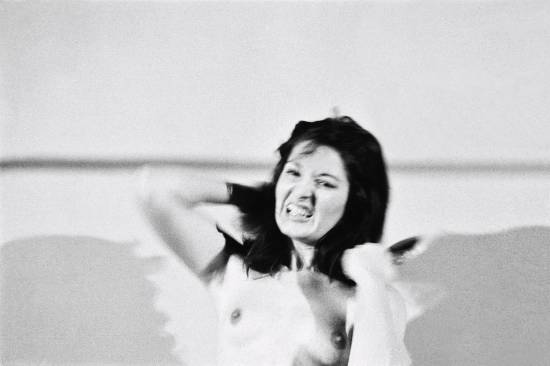
Marina Abramović, “Art Must Be Beautiful, Artist Must Be Beautiful,” video (black and white, sound) (courtesy Pamela and Richard Kramlich, San Francisco)

Museum of Modern Art
West 54th St. between Fifth & Sixth Aves.
Through May 31 (closed Tuesdays; Fridays free from 4:00 to 8:00)
Admission: $20 (includes same-day film screening)
212-708-9400
www.moma.org
online slideshow

With Tim Burton having already departed the museum and William Kentridge scheduled to leave May 17, the great triple play of March and April comes down to Yugoslavian-born performance artist Marina Abramović, whose emotionally and physically exhausting and exhilarating career retrospective continues at MoMA through the end of the month. “The Artist Is Present” chronologically follows Abramović’s forty-plus-year career through film, video, photographs, slide shows, audio, assorted ephemera, and, most excitingly, restagings of five of her performances using actors and models. Abramović puts herself in the center of her work, using her body to comment on politics, sexuality, gender, war, civil rights, and art itself. Establishing what she and longtime partner Ulay (Uwe Laysiepen) called “Art Vital,” their time- and space-based actions required “no rehearsal, no predicted end, no repetition, extended vulnerability, taking risks, exposure to chance, and direct contact,” among other perameters they set to elicit “primary reactions” from the audience, who sometimes became part of the piece. For example, in “Rhythm O,” Abramović stood naked in front of people, inviting them to pick up an object on a table and use it against her. Her collaboration with Ulay from 1975 to 1988 included the two running into each other over and over (“Relation in Space”), locking mouths for more than ten minutes (“Breathing In / Breathing Out”), screaming at each other (“AAA-AAA”), and standing with a bow and arrow ready to fly between them (“Rest Energy”). Several of their dual performances are re-created at MoMA, including “Point of Contact,” with two well-dressed people facing each other, their pointer fingers extended almost, but not quite, touching; “Relation in Time,” in which two people with long hair sit back-to-back, their hair tied together in a knot; and “Imponderabilia,” with two naked people stand on either side of a narrow doorway, forcing visitors to slide sideways between them, the space so tight that physical contact must be made.
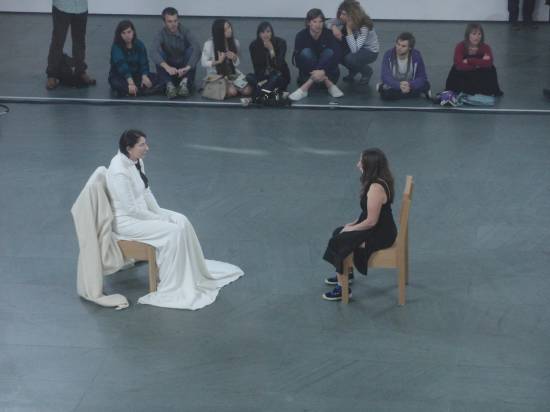
By the close of the exhibit, Marina Abramović will have performed “The Artist Is Present” for more than seven hundred hours (photo by twi-ny/mdr)

The centerpiece of the show is “The Artist Is Present,” which takes place in the spacious Marron Atrium. Every day, beginning from the retrospective’s opening on March 14 and continuing through its close on May 31, Abramović sits silently in a chair, facing a visitor, staring at one another for as long as the person wants, only a bare wooden table between them. For minutes or hours, the two do not move a muscle, never taking their eyes off each other, creating a tense, powerful mood throughout the museum. (The piece can be viewed from several floors.) On May 1, Abramović decided to take away the table, lending yet more tension and power, as if the entire room were on the edge of explosion. In many ways, this new performance, based on Abramović and Ulay’s 1981-87 “Nightsea Crossing,” is a fitting microcosm of the survey as a whole, with Abramović herself inviting — or, perhaps more correctly, challenging — the viewer to participate in her art and, by extension, her life, eliminating the boundary between artist and audience.
WILLIAM KENTRIDGE: FIVE THEMES

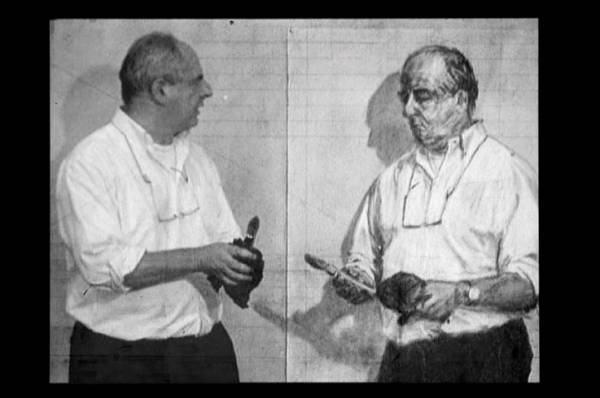
William Kentridge, from “7 Fragments for Georges Méliès,” 35mm and 16 mm animated film transferred to video, 2003 (courtesy of the artist and Marian Goodman Gallery)

William Kentridge, from “7 Fragments for Georges Méliès,” 35mm and 16 mm animated film transferred to video, 2003 (courtesy of the artist and Marian Goodman Gallery)

Museum of Modern Art
West 54th St. between Fifth & Sixth Aves.
Through May 17 (closed Tuesdays; Fridays free from 4:00 to 8:00)
Admission: $20 (includes same-day film screening)
212-708-9400
www.moma.org

In 2001, William Kentridge burst onto the New York art scene with an awe-inspiring show at the New Museum of Contemporary Art in SoHo, introducing to many the unique style employed by this South African artist who creates remarkable films made from charcoal drawings. Nearly ten years later, Kentridge is back with a bang, as multiple exhibits and special events have displayed the breadth of his work and his ingenuity, from his production of Shostakovich’s THE NOSE at the Met and his book of watermarks at Dieu Donné to screenings of his films with live music at the World Financial Center to a quartet of his “Drawings for Projection” series opening at the Jewish Museum on May 2. The centerpiece is the sensational display at MoMA, which continues through May 17. Arranged in a beautifully “generous layout,” as curator Klaus Biesenbach noted at the opening, “William Kentridge: Five Themes” features a bevy of rooms dedicated to the many worlds the artist has created via drawing, film, and a pair of model theaters. Kentridge himself is evident in much of his work, either as a character in his films or through the smudges, erasures, and new markings visible in his animation as he moves from page to page, revealing his unique and fascinating methods, laying himself—Jewish, white, a descendant of a well-known legal family in Johannesburg—bare. “The studio is an enclosed space, not just physically but also psychically, like an enlarged head; the pacing in the studio is the equivalent of ideas spinning around in one’s head, as if the brain is a muscle and can be exercised into fitness, into clarity,” he writes in the exhibition catalog, to which he has contributed several essays alongside a major examination by Mark Rosenthal, who organized the show at its first stop, SFMoMA.

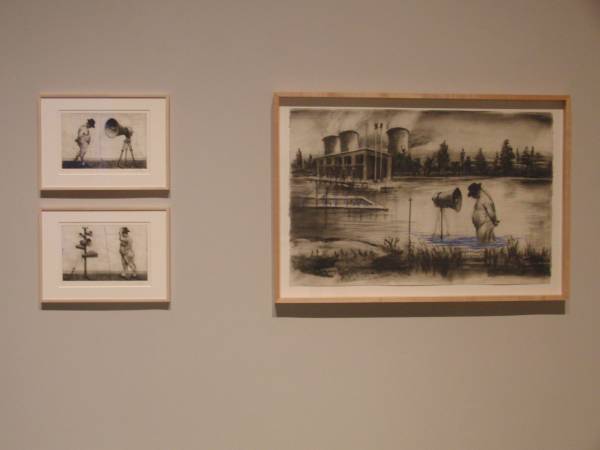
William Kentridge, “Man with Megaphone Cluster,” “Untitled (Man with Megaphone),” etching, aquatint, drypoint, and engraving with roulette and crayon additions, 1998, and “Drawing for the film ‘Stereoscope,’” charcoal and pastel on paper, 1998-99 (photo by twi-ny/mdr)

William Kentridge, “Untitled (Man with Megaphone),” “Man with Megaphone Cluster,” etching, aquatint, drypoint, and engraving with roulette and crayon additions, 1998, and “Drawing for the film ‘Stereoscope,’” charcoal and pastel on paper, 1998-99 (photo by twi-ny/mdr)

At the heart of Kentridge’s oeuvre is his series of films depicting wealthy industrialist Soho Eckstein, naked dreamer Felix Teitlebaum, and the woman caught in between, Mrs. Eckstein. In such short films as “Stereoscope,” “Monument,” “History of the Main Complaint,” and “Mine,” all made without a script or a storyboard, Kentridge relates their continuing tale in an abstract narrative bursting with emotion, incorporating greed and loneliness, love and loss, and the division of the self. (It is not a coincidence that both Soho and Felix resemble the artist himself.) But “Thick Time: Soho and Felix” is only one of the themes that runs through the exhibit. “Ubu and the Procession” includes two films that harken back to Alfred Jarry’s Ubu character, reimagining him in South Africa; “The Magic Flute” and “The Nose” take visitors behind the scenes of Kentridge’s recent productions of the two operas, the first held at BAM in 2007, the latter at the Met in March. “Artist in the Studio” consists of “7 Fragments for Georges Méliès,” seven films on view together in one room, all of which reveal the artist at work. The excellent catalog contains a must-have DVD that goes even further into Kentridge’s process, presenting discarded snippets, fascinating revelations about his method, and complete versions of his first experimental short as well as the full-length “Tide Table.” “I believe that in the indeterminacy of drawing—the contingent way that images arrive in the work—lies some kind of model of how we live our lives,” Kentridge has said. “The activity of drawing is a way of trying to understand who we are and how we operate in the world.” This exciting survey at MoMA is all that and more.

TIM BURTON

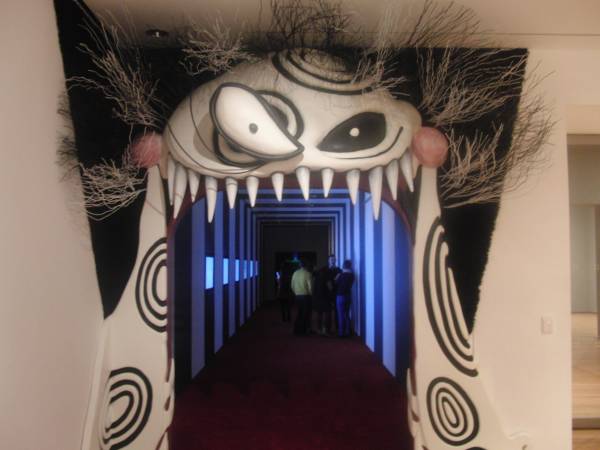
Creepy exhibition entrance leads to a treasure trove of Burtonalia (photo by twi-ny/mdr)

Creepy exhibition entrance leads to a treasure trove of Burtonalia (photo by twi-ny/mdr)

Museum of Modern Art
West 54th St. between Fifth & Sixth Aves.
Through April 26 (closed Tuesdays; Fridays free from 4:00 to 8:00)
Admission: $20 (includes same-day film screening), advance timed tickets recommended
212-708-9400
www.moma.org
www.timburton.com
twi-ny slideshow

There are only three weeks left in MoMA’s wildly popular Tim Burton retrospective, so you better hurry over if you want to see this vastly entertaining show. (The museum is even extending its hours over the last three days, staying open until 8:45.) More than seven hundred objects are on view, from early sketchbooks and movie models to watercolors and sculpture, from robots and wild short films (Stainboy gets a corridor all to himself!) to costumes and storyboards. It’s a carnival of excess, a virtual wonderland for fans of Burton’s eclecticism. While Burton’s movies are often hit (SWEENEY TODD, EDWARD SCISSORHANDS, SLEEPY HOLLOW, ED WOOD) or miss (BIG FISH, PLANET OF THE APES, BATMAN RETURNS), he has developed an often dazzling visual style that is evident throughout the exhibit. Raised in Burbank and currently based in London, Burton seems to have saved everything he has ever done, every idea that came his way, and has included it in the survey, from his early fascination with horror and Vincent Price to his foray into his own fractured fairy tales (just wait till you see the Hansel and Gretel show he made for Disney) and his creative reinvention of stop-motion animation. It’s all here, bringing to life the ecstatic imagination of a crazed genius who’s yet to fully grow up. (which is not necessarily a bad thing).

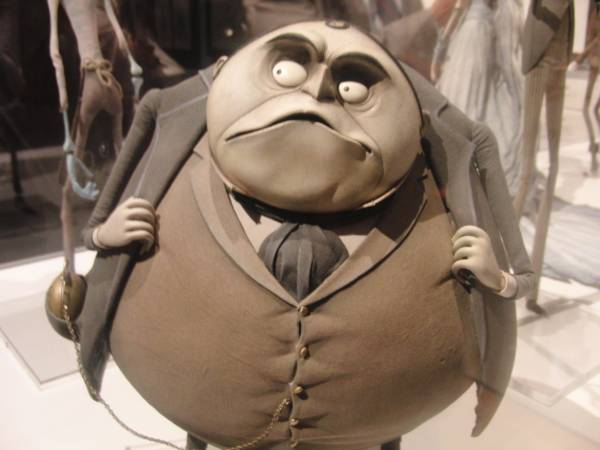
Mackinnon & Saunders, "General Bonesapart puppet," metal, cloth, resin, foam latex, and silicone, 2005 (photo by twi-ny/mdr; courtesy of Warner Bros. Entertainment, Inc.)

Mackinnon & Saunders, "General Bonesapart puppet," metal, cloth, resin, foam latex, and silicone, 2005 (photo by twi-ny/mdr, figure courtesy Warner Bros. Entertainment, Inc.)

Fans of Burton’s movies will have a field day with original drawings, vitrines filled with favorite characters, and a reel of the auteur’s earliest shorts, dating from when he was a teenager. In addition to the exhibit, the film series “Tim Burton and the Lurid Beauty of Monsters” still has several screenings left, including THE BRAIN THAT WOULDN’T DIE (Joseph Green, 1962) on April 8, Tex Avery cartoons on April 9, INVADERS FROM MARS (William Cameron, 1953) on April 16, and 20 MILLION MILES TO EARTH (Nathan Juran, 1957) on April 25.

NO AGE

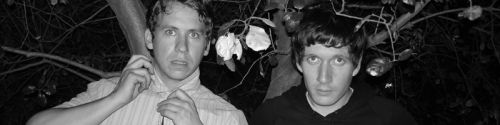
L.A. punk band No Age will be playing several very offbeat shows in the city

L.A. punk band No Age will be playing several very offbeat shows in the city

Wednesday, October 14, (le) poisson rouge, $15, 10:00
Thursday, October 15, Museum of Modern Art, $15, 7:30
Friday, October 16, New Museum of Contemporary Art, $15-$20, 7:00
Saturday, October 17, Above the Auto Parts Store, 8:00
http://www.myspace.com/nonoage

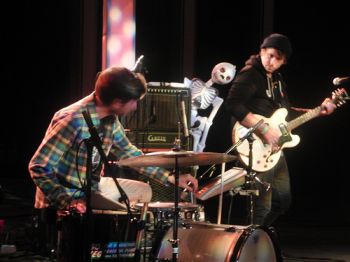
No Age rocks out next to Rodin's Balzac statue at MoMA (photo by twi-ny/mdr)

No Age rocks out next to Rodin's Balzac statue at MoMA (photo by twi-ny/mdr)

LA experimental punksters Dean Spunt and Randy Randall are coming to NYC for an extremely ambitious four-night stand, doing something quite different for every show. “The music is an invitation and rallying call for individuals to get involved in a community which celebrates art and experimentation,” Randall notes on their Sub Pop page. “It’s DIY on a different scale, an attempt to reacquaint people with the notion that art is a crucial part of everyday life.” Their artistic sojourn begins on October 14 at (le) poisson rouge with Woods and Silk Flowers. The next night, they’ll be at MoMA’s PopRally! skateboard party that’s part of the Spike Jonze film exhibition. On October 16, they’ll play live accompaniment to Jean-Jacques Annaud’s film THE BEAR at the New Museum. And on October 17, they’ll be Above the Auto Parts Store with Male Bonding and Soft Circle.