Tag Archives: MoMA

AN AUTEURIST HISTORY OF FILM: CITIZEN KANE

Orson Welles masterpiece is screening at MoMA this week as part of month-long look at 1941

CITIZEN KANE (Orson Welles, 1941
MoMA Film, Museum of Modern Art
11 West 53rd St. between Fifth & Sixth Aves.
May 4-6, 1:30
Tickets: $10, in person only, may be applied to museum admission within thirty days, same-day screenings free with museum admission, available at Film and Media Desk
212-708-9400
www.moma.org
www2.warnerbros.com/citizenkane

Citizen Kane is the best-made film we have ever had the pleasure to watch — again and again and again — and it is even more brilliant on the big screen. A young, brash, determined Orson Welles created a masterpiece unlike anything seen before or since — a beautifully woven complex narrative with a stunning visual style (compliments of director of photography Gregg Toland) and a fabulous cast of veterans from his Mercury radio days, including Everett Sloane, Joseph Cotten, Ray Collins, Paul Stewart, and Agnes Moorehead. Each moment in the film is unforgettable, not a word or shot out of place as Welles details the rise and fall of a self-obsessed media mogul. The film is prophetic in many ways; at one point Kane utters, “The news goes on for twenty-four hours a day,” foreseeing today’s 24/7 news overload. And it doesn’t matter if you’ve never seen it and you know what Rosebud refers to; the film is about a whole lot more than just that minor mystery. Like every film Welles made, Citizen Kane was fraught with controversy, not the least of which was a very unhappy William Randolph Hearst seeking to destroy the negative of a film he thought ridiculed him. Kane won only one Oscar, for writing — which also resulted in controversy when Herman J. Mankiewicz claimed that he was the primary scribe, not Welles. The film lost the Oscar for Best Picture to John Ford’s How Green Was My Valley, but it has topped nearly every greatest-films-of-all-time list ever since. Citizen Kane will be screening May 4-6 at 1:30 as part of MoMA’s ongoing series “An Auteurist History of Film,” focusing on the director as creator and which this month looks back at that banner year of 1941 with How Green Was My Valley (May 11-13, 1:30), John Huston’s The Maltese Falcon (May 18-20, 1:30), and Preston Sturges’s The Lady Eve (May 25-27, 1:30).
ANDY WARHOL: MOTION PICTURES

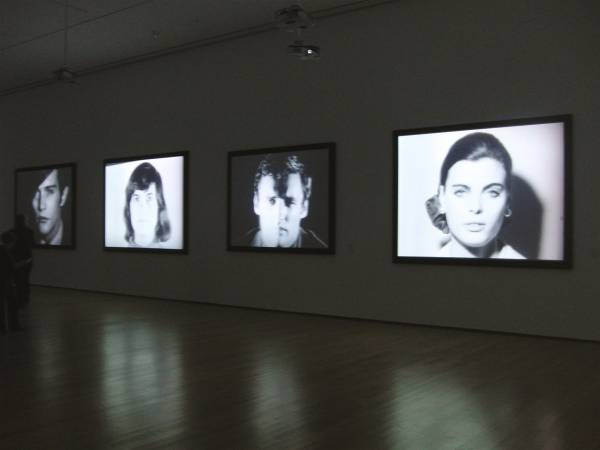
“Andy Warhol: Motion Pictures,” installation shot, 16mm film (black and white, silent), © 2010 The Andy Warhol Museum, Pittsburgh, PA, a museum of Carnegie Institute. All rights reserved (photo by twi-ny/mdr)

Museum of Modern Art
The International Council of the Museum of Modern Art Gallery, sixth floor
11 West 53rd St. between Fifth & Sixth Aves.
Wednesday – Monday through March 21, $20 (includes admittance to same-day film programs)
212-708-9400
www.moma.org

From 1964 to 1966, Andy Warhol attempted to film nearly everyone who entered the Factory, capturing them in four-minute silent black-and-white segments he called “Screen Tests,” with the subjects usually just staring directly into the camera the entire time. MoMA has turned one of its sixth-floor spaces into a moving-portrait gallery, as twelve of the Screen Tests are being shown concurrently, hung on the walls like a series of large-scale paintings, with visitors feeling like they’ve just walked into a (rather introspective) Factory gathering. Shot at twenty-four frames per second but projected at sixteen, the shorts have a beautiful, slow, loving pace to them, but several of them have tragic elements if you are familiar with the person’s ultimate fate. For this rare display, curator Klaus Biesenbach has selected the following Factory celebrities and would-be Superstars: poet-activist Allen Ginsberg; musician Lou Reed; actor and painter Dennis Hopper; Kathe Dees; actress and art collector Baby Jane Holzer (who brushes her teeth); Japanese actress Kyoko Kishida; writer-activist-theorist Susan Sontag; art patron Ethel Scull; actress and socialite Edie Sedgwick, who died of an overdose of prescription medication and alcohol in 1971 at the age of twenty-eight; model-actress Donyale Luna, who died of an overdose in 1979 at the age of thirty-three; actor Paul America, who died in a car accident in 1982 at the age of thirty-eight; actress and Velvet Underground singer Nico, who died from a cerebral hemorrhage in 1988 at the age of forty-nine; and Italian actor and musician Gino Piserchio, who died in 1989 of an AIDS-related infection at the age of forty-four. The Screen Tests are supplemented by several of Warhol’s heavily influential, controversial films, from the same early 1960s period, that deal with humanity’s deepest needs and desires, including BLOW JOB, EAT, SLEEP, and KISS, the latter shown in the seated back screening room. On March 2, the full five-and-a-half-hour SLEEP will be screened in the rear gallery, while the complete eight-hour EMPIRE will be shown on alternate Fridays, February 18 and March 4 and 18. Also, in conjunction with the exhibit, there will be a MoMA Talk on March 3 at 6:00, “Warhol, On Screen, Off Screen,” with writer John Giorno and artist Conrad Ventur, moderated by curator Klaus Biesenbach. And finally, if you visit the above website, you can even make your own Warhol Screen Test.

THE CONTENDERS 2010: EXIT THROUGH THE GIFT SHOP

Banksy reveals only so much of himself in new documentary

Banksy reveals only so much of himself in new documentary

EXIT THROUGH THE GIFT SHOP (Banksy, 2010)
MoMA Film
Museum of Modern Art
11 West 53rd St. between Fifth & Sixth Aves.
Saturday, January 22, 8:00
Tickets: $10, in person only, may be applied to museum admission within thirty days, same-day screenings free with museum admission, available at Film and Media Desk
212-708-9400
www.moma.org
www.banksyfilm.com

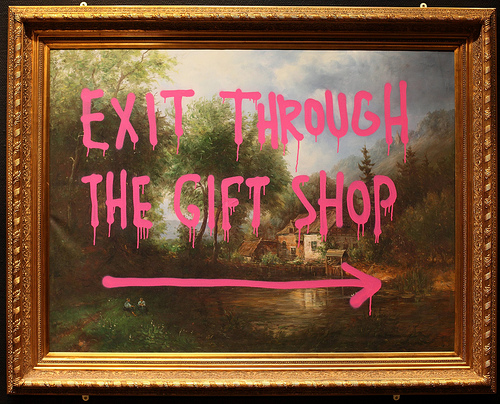
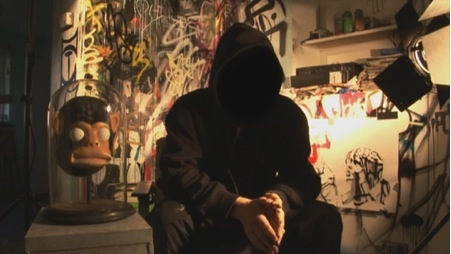
In 1999, L.A.-based French shopkeeper and amateur videographer Thierry Guetta discovered that he was related to street artist Invader and began filming his cousin putting up his tile works. Guetta, who did not know much about art, soon found himself immersed in the underground graffiti scene. On adventures with such famed street artists as Shepard Fairey, Swoon, Ron English, and Borf, Guetta took thousands of hours of much-sought-after video. The amateur videographer was determined to meet Banksy, the anarchic satirist who has been confounding authorities around the world with his striking, politically sensitive works perpetrated right under their noses, from England to New Orleans to the West Bank. Guetta finally gets his wish and begins filming the seemingly unfilmable as Banksy, whose identity has been a source of controversy for more than a decade, allows Guetta to follow him on the streets and invites him into his studio. But as he states at the beginning of his brilliant documentary, EXIT THROUGH THE GIFT SHOP, Banksy—who hides his face from the camera in new interviews and blurs it in older footage—turns the tables on Guetta, making him the subject of this wildly entertaining film.

Guetta is a hysterical character, a hairy man with a thick accent who plays the jester in Banksy’s insightful comedy of errors. Billed as “the world’s first Street Art disaster movie,” EXIT, which is narrated by Welsh actor Rhys Ifans (DANNY DECKCHAIR) and features a soundtrack by Portishead’s Geoff Barrow sandwiched in between Richard Hawley’s declaratory “Tonight the Streets Are Ours,” is all the more exciting and intriguing because the audience doesn’t know what is actually true and what might be staged; although the film could be one hundred percent real and utterly authentic, significant parts of it could also be completely made up. Who’s to say that’s even Banksy underneath the black hood, talking about Guetta, who absurdly rechristens himself Mr. Brainwash? It could very well be Banksy’s F FOR FAKE, Orson Welles’s marvelous 1974 pseudo-documentary, or it could be on the straight and narrow from start to finish. No matter. EXIT THROUGH THE GIFT SHOP is riotously funny, regardless of how you feel about street art, Banksy, and especially the art market itself (as the title so wryly implies).

EXIT THROUGH THE GIFT SHOP is being screened at the Museum of Modern Art on January 22 as the conclusion to the series “The Contenders 2010,” a collection of influential and innovative international movies the institution believes will stand the test of time. Previous films in the series included Luca Guadagnino’s I AM LOVE, Christopher Nolan’s INCEPTION, Roman Polanski’s THE GHOST WRITER, David Fincher’s THE SOCIAL NETWORK, Tom Hooper’s THE KING’S SPEECH, Debra Granik’s WINTER’S BONE, Lixin Fan’s LAST TRAIN HOME, and Lisa Cholodenko’s THE KIDS ARE ALL RIGHT.

THE CONTENDERS 2010: THE SOCIAL NETWORK

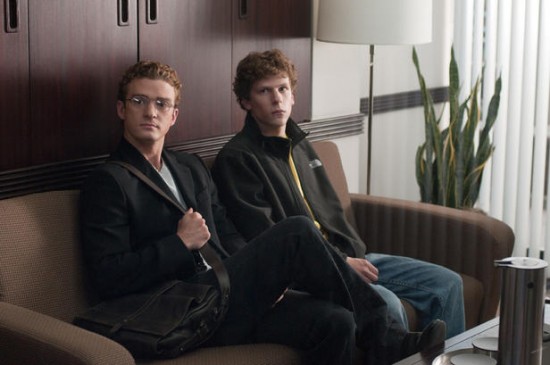
Justin Timberlake and Jesse Eisenberg are a couple of high-profile whiz kids in David Fincher’s THE SOCIAL NETWORK

THE SOCIAL NETWORK (David Fincher, 2010)
MoMA Film
Museum of Modern Art
11 West 53rd St. between Fifth & Sixth Aves.
Tuesday, December 14, 8:30
Series continues through January 22
Tickets: $10, in person only, may be applied to museum admission within thirty days, same-day screenings free with museum admission, available at Film and Media Desk
212-708-9400
www.moma.org
www.thesocialnetwork-movie.com

One of the most widely praised films of 2010, THE SOCIAL NETWORK is being screened at the Museum of Modern Art on Tuesday night as part of the series “The Contenders 2010,” a collection of influential and innovative international movies the institution believes will stand the test of time. MoMA has already shown such works as Luca Guadagnino’s I AM LOVE, Christopher Nolan’s INCEPTION, Roman Polanski’s THE GHOST WRITER, and Mads Brügger’s THE RED CHAPEL, and upcoming films include Yael Hersonski’s A FILM UNFINISHED, Mark Romanek’s NEVER LET ME GO, and Banksy’s EXIT THROUGH THE GIFT SHOP. In THE SOCIAL NETWORK, Jesse Eisenberg stars as computer whiz kid Mark Zuckerberg as he develops what became Facebook while attending Harvard. The film is told primarily in flashback as Zuckerberg is being sued for having allegedly stolen the idea from the Winklevoss twins (both played by Arnie Hammer). Zuckerberg is depicted as a spiteful, mean-spirited, self-indulgent person trying to prove to his ex-girlfriend (Erica Albright) that he will amount to something. Justin Timberlake is outstanding as the fast-moving, smooth-talking Sean Parker, the founder of Napster who loves living the high life. For a young man who created a social media platform where people collect friends, Zuckerberg made a lot of enemies on his way to the top. The film was written by Aaron Sorkin (A FEW GOOD MEN, THE WEST WING), who makes an appearance as an ad executive meeting with Zuckerberg, and directed by David Fincher, who has made such other terrific films as FIGHT CLUB, ZODIAC, and THE CURIOUS CASE OF BENJAMIN BUTTON. Eisenberg (THE SQUID AND THE WHALE, ADVENTURELAND) will participate in a Q&A following the MoMA screening.

CONVERSATIONS WITH CONTEMPORARY ARTISTS: REINVENTING ARTIST COMMUNITIES

Mildred’s Lane artist project will be discussed at MoMA panel on November 8

Museum of Modern Art, Celeste Bartos Theater
The Lewis B. and Dorothy Cullman Education and Research Building
11 West 53rd St. between Fifth & Sixth Aves.
Monday, November 8, and Wednesday, November 17, $10 each, 6:00
212-708-9781
www.moma.org

On November 8, MoMA director Glenn D. Lowry will moderate “Reinventing Artist Communities” with artists Mark Dion and J. Morgan Puett and critic Alastair Gordon, who will be discussing the Mildred’s Lane project, while on November 17 MoMA senior deputy director of curatorial affairs Peter Reed will moderate a talk with artists Andrea Zittel and Lisa Anne Auerbach about their High Desert Test Sites. Dion’s “Rescue Archaeology” uncovered fascinating historical artifacts under MoMA during its renovation and reconstruction earlier this decade, while Puett’s large-scale installations combine living environments with multimedia performance art; the two are collaborating on the Mildred’s Lane Historical Society and Museum in Pennsylvania, which “incorporates questions of our relation to the environment, systems of labor, forms of dwelling, new sociality — all of which compose an ethics of comportment.” Zittel, whose “Small Liberties” Whitney Altria exhibit consisted of customized Wagon Stations, and Auerbach, who keeps journals about the project, are two of the cofounders of High Desert Test Sites, which invites artists to create alternative, experimental living spaces in desert communities “to challenge traditional conventions of ownership, property and patronage.”

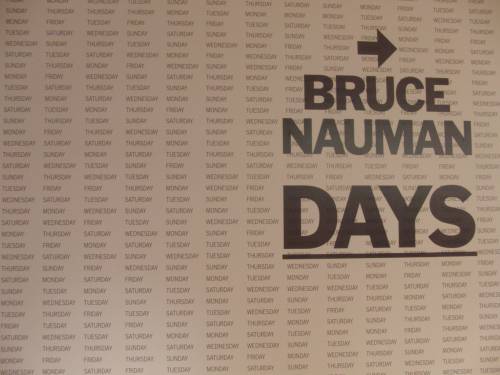
BRUCE NAUMAN: DAYS

The days go flying by in Bruce Nauman’s audiovisual installation at MoMA (photo by twi-ny/mdr)

Museum of Modern Art
11 West 53rd St. between Fifth & Sixth Aves.
Through August 23
Admission: $20 (includes same-day film screening)
212-708-9400
www.moma.org

As the August doldrums begin to take hold, it’s getting harder and harder to even remember what day it is. To add to the confusion, multimedia performance artist Bruce Nauman has installed “Days” at MoMA. For nearly fifty years, the Indiana-born Nauman, who has been based in New Mexico since 1979, has been challenging the conventions of art and language via neon sculptures, film and video, live performances, and unique installations. Created for the 2009 Venice Biennale, “Days” is not really much to look at: fourteen relatively bland speakers in two rows, with a handful of stools between them in an otherwise empty room. But oh, what beautiful noise reverberates throughout the gallery. Nauman recorded seven people reading off the days of the week, each person given a different, random order, none following the established Sunday, Monday, Tuesday, etc. Visitors can approach a particular speaker, where that specific voice and order will gain prominence, or can stand off to the side or in the middle and let all the days of the week reverberate in ways that end up being more comforting than confusing. By having men, women, and children of different ages and speech patterns calling out the days, Nauman allows the viewer/listener an opportunity to contemplate time as both a personal reality and a metaphysical concept. We recommend grabbing a stool, sitting in the middle of the room, and letting the “music” roll over you like waves on the beach. As far as forgetting what day it is goes, you should try to remember Fridays, when admission to MoMA is free after 4:00, and Tuesdays, when the museum is closed. And as long as you’re there, you might as well check out a couple of other pretty sweet exhibits, including “Matisse: Radical Invention, 1913–1917,” “Pictures by Women: A History of Modern Photography,” and “The Original Copy: Photography of Sculpture, 1839 to Today.”

WARM UP

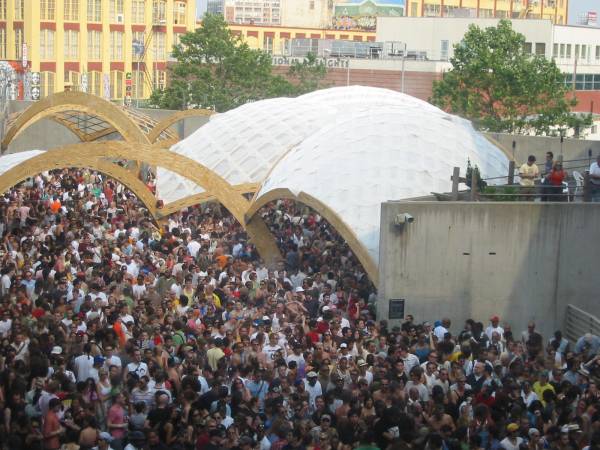
Prepare for some massive crowds at weekly PS1 Warm Up (photo by twi-ny/mdr)

MoMAPS1
22-25 Jackson Ave. at 46th Ave.
Saturdays from 2:00 to 9:00, July 3 – September 4
Tickets: $15 (free for Long Island City residents)
718-784-2084
www.ps1.org/warmup

One of the hottest, sweatiest weekly dance parties of every summer will get people moving and grooving beginning on July 3 when Warm Up returns to PS1 in Queens. The series features live bands and DJs from all over the world, including Spain, Sierra Leone, France, Sweden, Canada, and Brooklyn, playing in the shadow of Solid Obectives — Idenburg Liu’s “Pole Dance,” winner of the annual Young Architects Program and displayed in the courtyard. The opening-day lineup is a mere taste of things to come, with live sets from Delorean, Janka Nabay and the Bubu Gang, and Glasser, with John Talabot and Korallreven manning the turntables. On the horizon are Kalup Linzy and JD Samson on July 24, Animal Collective DJ’ing on July 31, a DFA showcase with James Murphy and Pat Mahoney on August 7, DJ ?uestlove and These Are Powers on August 14, and Holy Ghost!, House of House, and DJ Mehdi on closing night, September 4. And don’t forget to check out the expansive “Greater New York” exhibition. PS1 is one of the treasures of New York City, with something to see and do in every little nook and cranny, so be prepared for anything and everything.