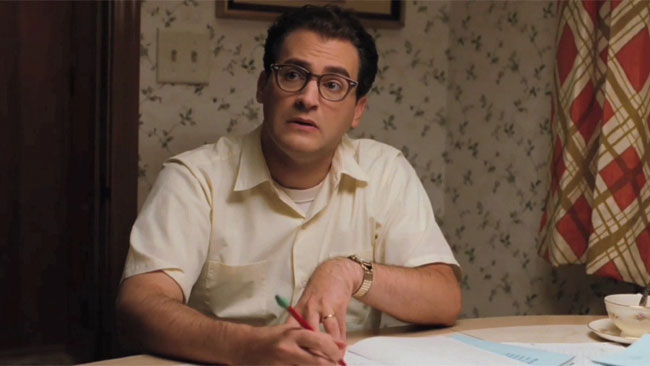
Joel and Ethan Coen’s Oscar-nominated A SERIOUS MAN kicks off MoMA tribute to Focus Features
A SERIOUS MAN (Joel & Ethan Coen, 2009)
MoMA Film, Museum of Modern Art
11 West 53rd St. between Fifth & Sixth Aves.
Thursday, May 3, and Friday, May 4, 4:00
Series runs May 3-20
Tickets: $12, in person only, may be applied to museum admission within thirty days, same-day screenings free with museum admission, available at Film and Media Desk beginning at 9:30 am
212-708-9400
www.moma.org
www.focusfeatures.com
 The Coen brothers take their unique brand of dry, black comedy to a whole new level with A Serious Man. Poor Larry Gopnik (a remarkably even-keeled Michael Stuhlbarg) just keeps getting dumped on: His wife, Judith (Sari Lennick), wants to leave him for, of all people, touchy-feely Sy Ableman (Fred Melamed); his brother, Arthur (Richard Kind), keeps hogging the bathroom so he can drain his cyst; his son, Danny (Aaron Wolf), won’t stop complaining that F-Troop isn’t coming in clearly and is constantly on the run from the school drug dealer (Jon Kaminsky Jr.); his daughter, Sarah (Jessica McManus), wants to get a nose job; one of his students (David Kang) has bribed him for a passing grade; his possible tenure appears to be in jeopardy; and he gets no help at all from a series of funnier and funnier rabbis. But Larry keeps on keepin’ on in the Jewish suburbs of Minnesota in 1967, trying to make a go of it as his woes pile higher and higher. Joel and Ethan Coen have crafted one of their best tales yet, nailing the look and feel of the era, from Hebrew school to Bar Mitzvah practice, from office jobs to parking lots, from the Columbia Record Club to transistor radios, from television antennas to the naked neighbor next door. The Coens get so many things right, you won’t mind the handful of mistakes in the film, and because it’s the Coens, who’s to say at least some of those errors weren’t intentional? A Serious Man is a seriously great film, made by a pair of seriously great filmmakers. And while you don’t have to be Jewish and from Minnesota to fall in love with it, it sure can’t hurt. A Serious Man is screening May 3 and 4 at MoMA as part of the series “Focus Features: 10th Anniversary Salute,” which pays tribute to the New York-based distributor responsible for such cutting-edge breakthrough independent films as Ang Lee’s Brokeback Mountain, Fernando Meirelles’s The Constant Gardener, Roman Polanski’s The Pianist, and Sofia Coppola’s Lost in Translation, all of which are part of this festival, which runs May 3-20.
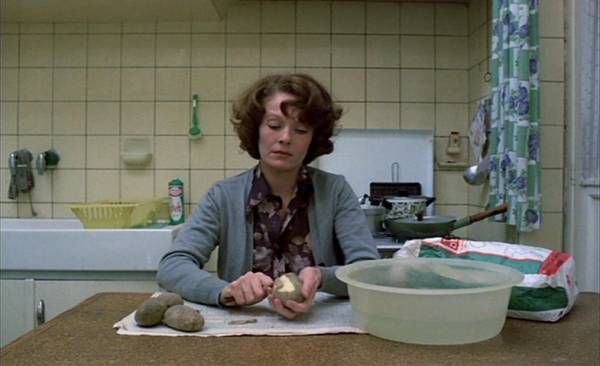
 Chantal Akerman’s groundbreaking film follows the drab life of the title character, a bored housewife who goes about her day nearly silently, moving agonizingly slowly, as she makes breakfast for her husband, sends him off to work, takes in a few johns, cleans the sink, etc. Just another ordinary day, not nearly as colorful as the one Séverine Serizy (Catherine Deneuve) experiences in Belle de Jour (Luis Buñuel, 1967). Delphine Seyrig (Stolen Kisses, The Discreet Charm of the Bourgeoisie, The Day of the Jackal) is mesmerizing as Jeanne Dielman — you won’t be able to take your eyes off her, and with good reason. This ultimate feminist film was made with an all-female crew, and if it’s anything, it’s absolutely memorable, love it or hate it. Oh, actually, it’s long too — nearly three and a half hours. Jeanne Dielman is screening on Thursday and Friday with Maya Deren’s avant-garde classic Meshes of the Afternoon as part of MoMA’s “Carte Blanche: Cindy Sherman” series, a collection of films curated by photographer Cindy Sherman in conjunction with her glorious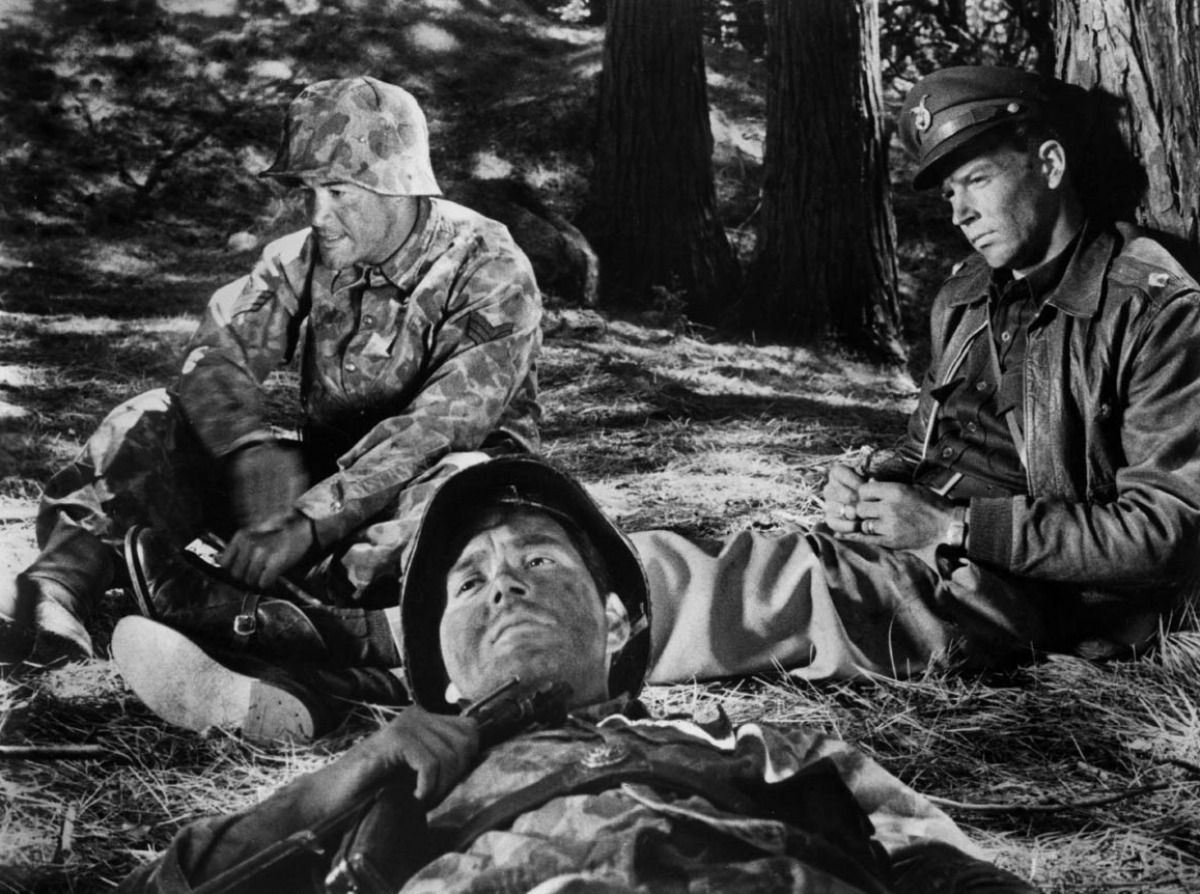
 The annual New Directors, New Films series, a joint presentation of MoMA and the Film Society of Lincoln Center, has been highlighting works by up-and-coming international directors for more than forty years. But the 2012 slate of films includes one intriguing surprise: Stanley Kubrick’s 1953 seldom-seen psychological war drama, Fear and Desire. Kubrick’s first full-length film, made when he was twenty-four, is a curious tale about four soldiers (Steve Coit, Kenneth Harp, Paul Mazursky, and Frank Silvera) trapped six miles behind enemy lines. When they are spotted by a local woman (Virginia Leith), they decide to capture her and tie her up, but leaving Sidney (Mazursky) behind to keep an eye on her turns out to be a bad idea. Meanwhile, they discover a nearby house that has been occupied by the enemy and argue over whether to attack or retreat. Written by Howard Sackler, who was a high school classmate of Kubrick’s in the Bronx and would later win the Pulitzer Prize for The Great White Hope, and directed, edited, and photographed by the man who would go on to make such war epics as Paths of Glory, Full Metal Jacket, and Dr. Strangelove or: How I Learned to Stop Worrying and Love the Bomb, Fear and Desire features stilted dialogue, much of which is spoken off-camera and feels like it was dubbed in later. Many of the cuts are jumpy and much of the framing amateurish. Kubrick was ultimately disappointed with the film and wanted it pulled from circulation; instead it was preserved by Eastman House in 1989 and restored twenty years later, which is good news for film lovers, as it is fascinating to watch Kubrick learning as the film continues. His exploration of the psyche of the American soldier is the heart and soul of this compelling black-and-white war drama that is worth seeing for more than just historical reasons. “There is a war in this forest. Not a war that has been fought, nor one that will be, but any war,” narrator David Allen explains at the beginning of the film. “And the enemies who struggle here do not exist unless we call them into being. This forest then, and all that happens now, is outside history. Only the unchanging shapes of fear and doubt and death are from our world. These soldiers that you see keep our language and our time but have no other country but the mind.” Fear and Desire lays the groundwork for much of what is to follow in Kubrick’s remarkable career.
 The Raid: Redemption is a nonstop claustrophobic thrill ride through a fifteen-story apartment complex where danger lurks around every corner and behind nearly every door. The gated, heavily protected building is run by Tama (Ray Sahetapy), a well-connected drug lord who enjoys terrorizing and killing traitors and enemies. Early one morning Jaka (Joe Taslim) leads his elite special forces unit on a raid of the complex, ordered to get Tama and end his brutal reign. As Jaka’s team falls one by one, it is left to a determined young rookie, Rama (Iko Uwais), to complete the mission, which is not quite what it appears to be. Written, directed, and edited by Welsh-born Gareth Huw Evans, The Raid: Redemption is a furious, testosterone-heavy action flick filled with breathtaking scenes of ultraviolence countered by moments of intense, quiet drama where one wrong move will be a character’s last. Primarily shot with a handheld camera that puts the audience in the middle of the battle, the film uses a variety of weapons in the well-choreographed fight scenes, from machine guns and pistols to serrated knives and machetes, while focusing on the martial art of Pencak Silat. Uwais, a former truck driver and Silat champion who was discovered by Evans while the director was researching a documentary on the martial art — the two previously teamed up on 2009’s Merantau — is outstanding as Rama, a father-to-be who might have met his match in Mad Dog (Yayan Ruhian), one of Tama’s chief operatives and a killer who prefers using his hands, fists, and feet to eliminate his opponents. (Uwais, Ruhian, and Evans collaborated on the action choreography.) Buoyed by a pulsating score by Joseph Trapanese and Linkin Park’s Mike Shinoda and evoking elements of the first Die Hard, Assault on Precinct 13, and New Jack City, The Raid: Redemption is a pulse-pounding, wildly successful film that has kicked off a franchise, with two sequels in the works. (Here’s hoping the translator does a better job in the next two movies, taking a much-needed crash course in punctuation.) Even the credits are awesome, with dozens of characters listed as Hole Drop Attacker, Riot Van Shooter, Carrying Bowo Fighter, Machete Gang, AK47 Attacker, Panic Man, Tortured Man, and Junkie Guy. “I deal in blood and mayhem,” Evans, who has been based in Indonesia since 2007, states in the film’s production notes. Indeed he does.
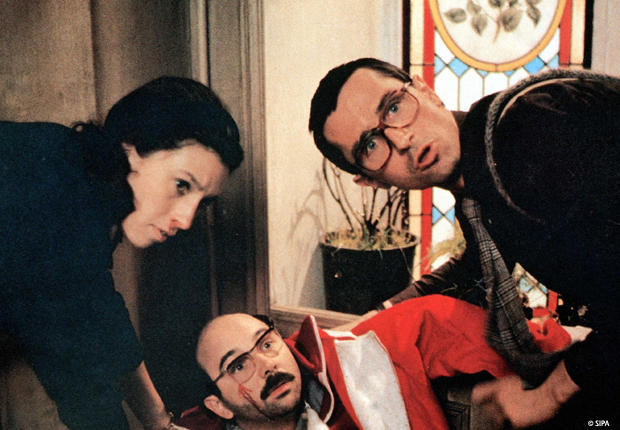
 While here in America, Christmas movie traditions tend to be on the more sappy side, like the treacly It’s a Wonderful Life, Miracle on 34th St., or any one of a number of updated versions of A Christmas Carol, France has a very different idea of what qualifies as a holiday favorite. Le père Noël est une ordure, also known as Santa Stinks (or the closer translation Father Christmas Is a Bastard), has been a cult classic going on thirty years now. The no-holds-barred seasonal slapstick satire is the creation of Jean-Marie Poiré and the members of the popular Le Splendid café-théâtre company, who spend a New Year’s Eve together like you’ve never seen before. Thérèse (Anémone) and Pierre (Thierry Lhermitte) work at a suicide-prevention hotline, but they are not very good at helping lonely, depressed people, as shown early on when a man calls from a phone booth and quickly puts a bullet in his head when no one at the SOS Detresse Amitié really listens to him. Meanwhile, their cranky coworker, Madame Musquin (Josiane Balasko), gets trapped in an elevator, desperate to get to her Christmas Eve dinner; young transvestite Katia (Christian Clavier) stops by looking for a little love; neighbor Preskovic (Bruno Moynot) keeps bringing over the most disgusting homemade treats imaginable; and low-level crook Félix (Gérard Jugnot) wanders around in a Santa suit, chasing rabbits and wielding a gun while his pregnant wife, the obnoxiously chatty Josette (Marie-Anne Chazel), does everything she can to get away from him while also commenting on all the fun. Le père Noël est une ordure has no sympathy for the holiday season, instead reveling in low-grade humor, over-the-top violence, and surprising plot twists that are not at all what you’d expect from a Christmas movie. With that in mind, MoMA has chosen to present the U.S. theatrical premiere of this French farce with a one-week run beginning December 28 so as not to ruin your Christmas celebration. (And to further save you from potential ruination, be sure to pay no attention whatsoever to Nora Ephron’s all-star 1994 dud, Mixed Nuts, which was loosely based on Le père Noël est une ordure.)