Tag Archives: Molière

TICKET ALERT: LINCOLN CENTER FESTIVAL 2016

(photo by Manuel Harden)

Jonathan Pryce will play Shylock in Shakespeare’s Globe production of THE MERCHANT OF VENICE at Lincoln Center Festival this summer (photo by Manuel Harden)

Multiple venues at Lincoln Center
July 13-31, $30-$125
Tickets on sale now
www.lincolncenterfestival.org

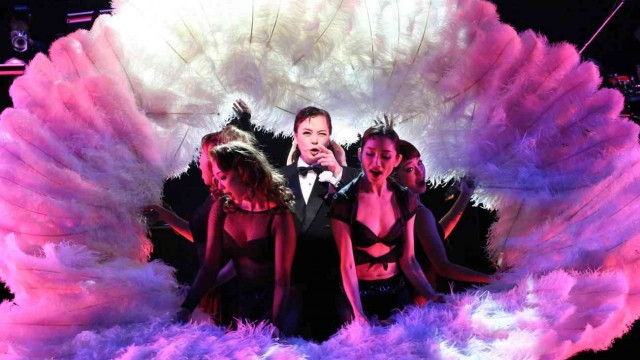
For twenty years, one of the highlights of every summer arts season has been the Lincoln Center Festival, and 2016 is no exception, with another stellar lineup of dance, music, opera, and theater from around the globe. The festival begins with six presentations by Japan’s Kanze Noh Theatre at the Rose Theater in Jazz at Lincoln Center. Led by Grand Master Kiyokazu Kanze, the troupe, which rarely ventures outside its home country, will perform Okina with Kanze’s son, Saburota, and Hagoromo on July 13, Sumida Gawa, Busshi, and Shakkyo on July 14, Hagoromo, Kaki Yamabushi, and Sumida Gawa on July 15, Okina and Aoi No Ue on July 16 at 1:30, Hagoromo, Busshi, and Aoi No Ue on July 16 at 7:30, and Okina and Shakkyo on July 17. From July 13 to 16 at the Gerald W. Lynch Theater, visual artist Jennifer Wen Ma directs composer Huang Ruo’s Ming Dynasty romantic opera, Paradise Interrupted. Japan’s Takarazuka Revue will bring “All That Jazz” and more to the David H. Koch Theater July 20–24 with an all-female version of Chicago, with a rotating cast, lyrics in Japanese, and Bob Fosse’s original choreography. Shakespeare’s Globe, which recently staged the marvelous Broadway double shot of Twelfth Night and Richard III, will make its Lincoln Center debut July 20–24 at the Rose Theater with Jonathan Pryce in The Merchant of Venice, directed by Jonathan Munby. British company 1927 reinvents a traditional tale in Golem, incorporating animation, puppetry, crazy set design and costumes, and general absurdity July 26–31 at the Lynch.
(photo by Maiko Miagawa and Nobuhiko Hikichi)

Japan’s Takarazuka Revue will present an all-female version of CHICAGO at Lincoln Center Festival (photo by Maiko Miagawa and Nobuhiko Hikichi)

The National Ballet of Canada waltzes into the Koch Theater July 28–31 with Tony winner Christopher Wheeldon’s unique take on The Winter’s Tale, featuring music by Joby Talbot, scenic design by Tony winner Bob Crowley, and silk effects by Basil Twist. In addition, Goran Bregović’s Wedding and Funeral Orchestra marches into David Geffen Hall July 15–16; Reich/Reverberations pays tribute to Steve Reich July 16, 19, and 21 with Sō Percussion, Ensemble Signal, and JACK Quartet; C.I.C.T. / Théâtre des Bouffes du Nord’s version of Molière’s Le Bourgeois Gentilhomme goes for laughs July 20–24 at the Lynch, directed by Denis Podalydès and with choreography by Kaori Ito; musicians Wang Li and Wu Wei team up on July 23 at the Stanley H. Kaplan Penthouse; and a few days later Sō Percussion’s Trilogy takes over the Penthouse, with Eric Cha-Beach, Josh Quillen, Adam Sliwinski, and Jason Treuting playing works by Reich, Dessner, and Lang on July 28, Xenakis, Ergun, and Trueman on July 29, and Cage, Lansky, and Mackey on July 30. There are various special ticket packages that can save you between twenty and thirty-five percent if you go for multiple shows, but those deals are going fast.
QUAY BROTHERS: ON DECIPHERING THE PHARMACIST’S PRESCRIPTION FOR LIP-READING PUPPETS

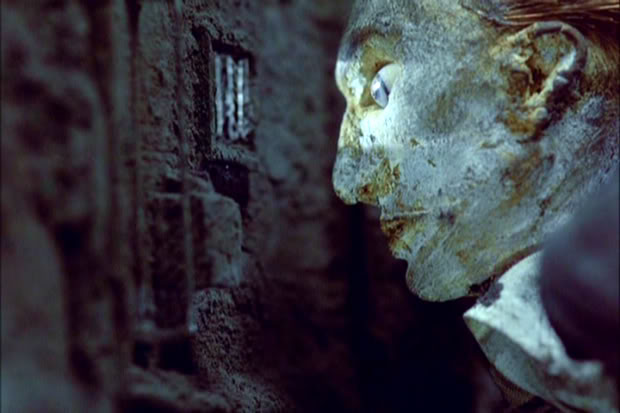
Career retrospective offers a dazzling look into the surreal world of the Brothers Quay (still from STREET OF CROCODILES, 1986)

Museum of Modern Art
11 West 53rd St. between Fifth & Sixth Aves.
Wednesday–Monday through January 7
Museum admission: $22.50 ($12 can be applied to the purchase of a film ticket within thirty days)
212-708-9400
www.moma.org

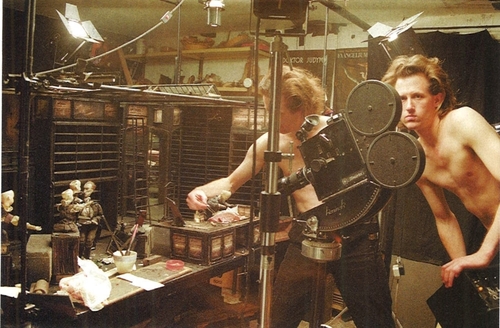
When MoMA Film associate curator Ron Magliozzi first approached twins Stephen and Timothy Quay about putting together a career retrospective at the Museum of Modern Art, the brothers weren’t sure why people would be interested in delving into their history and working process, but they opened their London studio to Magliozzi and helped design the appropriately strange and wonderful exhibit “On Deciphering the Pharmacist’s Prescription for Lip-Reading Puppets.” Similar in concept to the “Tim Burton” blockbuster a few years back, the Quay Brothers show is filled with paintings and drawings, film and video, early self-portraiture, photographs, collages, book and album covers, etchings, engravings, commercials, and other fascinating paraphernalia associated with their rather eclectic career, spread across several floors. Born in rural Pennsylvania in 1947 to a machinist father and homemaker mother, the Quays were heavily influenced by illustrator and naturalist Rudolf Freund, whom they met in the late 1960s; Polish poster art from the 1960s, which they saw in a 1967 exhibition at the Philadelphia College of Art; and avant-garde, experimental shorts by Jan Lenica and Walerian Borowczyk.

Quay Brothers, detail, “O Inevitable Fatum, Rehearsals for Extinct Anatomies, décor,” wood, fabric, glass, metal, 1987 (photo by twi-ny/mdr)

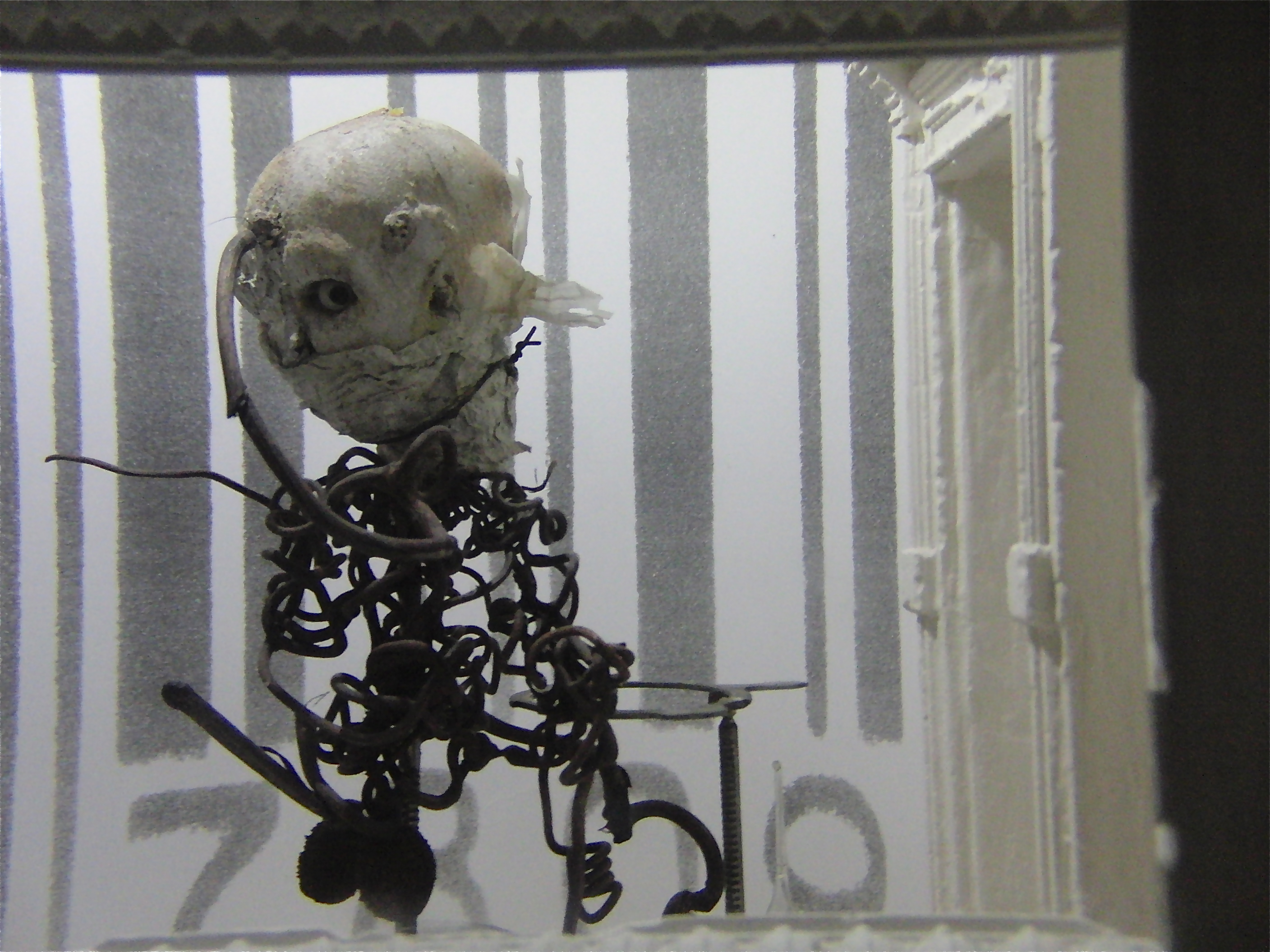
The MoMA show is set up like a labyrinth, with treats around every corner, from oil snowscapes done when the brothers were still in single digits to short films made when they were in school, from the creepy Black Drawings of the mid-1970s and stage designs for opera, theater, and dance by Béla Bartók, Eugene Ionesco, Molière, Sergei Prokofiev, Georges Feydeau, E. T. A. Hoffman, and others to their British television documentaries, made with longtime producer Keith Griffiths and including the absolutely insane documentary Igor, the Paris Years Chez Pleyel, in which paper cut-outs of Bolshevik poet Vladimir Mayakovsky, French writer and filmmaker Jean Cocteau, and Russian-born composer Igor Stravinsky hang out and do rather odd things in Paris. All of these works lend intrigue and insight to the primary sections of the exhibition, dedicated to the marvelous short films the Quays are renowned for, dark, dazzling stop-motion animations with puppets that relate mesmerizing tales set in a mysterious world of dreams and nightmares that delve into the subconscious. The Quay Brothers’ breakthrough came in 1986 with Street of Crocodiles, adapted from a Bruno Schulz short story, starring eyeless puppets with open heads and taking place in a Kinetoscope, featuring themes and elements that appear in many of their films, including machines, thread, scissors, repetitive movement, screws, bones, metal shavings, and aching, experimental music. Getting its own room, the film is followed by a two-minute outtake that has never been shown before. Among the many other classic Brothers Quay shorts on view in the galleries are In Absentia, The Cabinet of Jan Svankmajer, Rehearsals for Extinct Anatomies, The Sandman, and the dazzling color films This Unnameable Little Broom and The Comb (from the Museums of Sleep). Downstairs outside the Titus Theaters is “Dormitorium,” a terrific collection, previously seen at Parsons the New School for Design in 2009, of film décors, glass-enclosed sets from many of the above-mentioned films as well as many others. And on the first floor by the up escalator you can find “Coffin of a Servant’s Journey,” a short film inside a coffin that can be watched by only one person at a time.

Quay Brothers, “Quay Brothers self-portrait,” photographic enlargement (Atelier Koninck QbfZ)

“On Deciphering the Pharmacist’s Prescription for Lip-Reading Puppets” is a magical trip inside the bizarre, surreal world of the Quay Brothers, an exhibition that was a long time coming and has been handled splendidly. It’s also an exhibition that requires a lot of time to be properly enjoyed, so don’t rush through it or you’ll miss so many of its myriad hidden treasures. And as far as the title itself goes, we’ll leave that to the Quays to describe themselves, as they do in the catalog in a faux interview with sixteenth-century composer Heinrich Holtzmüller: “In our mind it’s more of a teasing inducement for a journey. Not a grand journey but a tiny one . . . around the circumference of an apple. We’re no doubt gently abusing the anticipation that the prescriptive side is courting both a rational illegibility as well as an irrational legibility. Hopefully the intrigued will engage with the ambiguity. And besides, the prescription is only mildly inscrutable and one certainly won’t die from it, considering that thousands of people a year reportedly die from misread prescriptions.” You were expecting anything different?

(MoMA will be screening the Quay Brothers’ latest full-length film, Franz Kafka’s The Metamorphosis, on January 6-7 in Titus Theater 1, with a live musical score performed by Mikhail Rudy. Also on January 7, “The Essential Shorts, Part 2” will screen six shorts in the Education and Research Building, including Rehearsals for Extinct Anatomies, Nocturna Artificialia, Ex Voto, This Unnameable Little Broom: Epic of Gilgamesh, Maska, and Bartók Béla: Sonata for Solo Violin.)