Tag Archives: Molière

A TALE OF TWO CLASSICS: TARTUFFE AND PYGMALION

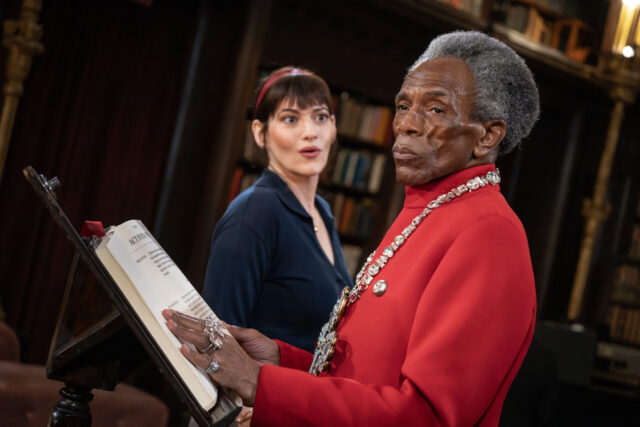
Cleante (Hannah Beck) has plenty of reason to not trust Tartuffe (André De Shields) in playful revival (photo by Joan Marcus)

ANDRÉ DE SHIELDS IS TARTUFFE
House of the Redeemer
7 East Ninety-Fifth St. between Fifth & Madison Aves.
Through November 23, $72 – $162
www.tartuffenyc.com
www.houseoftheredeemer.org

Two classic plays dealing with power and control are currently running off Broadway, one wisely built around its beloved star, the other celebrating the author but detracting from the story.

Star power needs to shine in a suitable setting, and André de Shields has one befitting his resplendence in the House of the Redeemer. Built in 1914–16, the mansion was originally owned by Edith Shepard Fabbri, a great granddaughter of Commodore Cornelius Vanderbilt, and her husband, Ernesto Fabbri, an associate of J. Pierpont Morgan’s. By midcentury it was deeded to the Episcopal Church, run by the Sisters of St. Mary until 1980, and designated a New York City Landmark in 1974.

Today it is home to concerts, Bible study, yoga, morning and evening prayers, cancer patients from Sloan-Kettering, and, through November 23, the gallantly titled and playfully rendered André De Shields Is Tartuffe. The scandalous 1664 French farce is being presented to a limited audience of one hundred a night in the historic library, which was constructed in an Italian ducal palace in the early 1600s and transported in two parts to New York City from Italy during WWI, serving as the centerpiece of the mansion.

The audience, sitting on three sides of the action, does not get to see the centerpiece of the show until the third act. Upon arriving at the House of the Redeemer, ticket holders are led into a salon with portraits, lenticular photos of Tartuffe, and a note from him that reads, “Tonight’s exorcism will redeem you as my true sycophants. The hour is upon you to seek within the sacred shelves of this salon and library six keys, six crosses, and six scrolls which will quicken your souls to a new dawn, a new day, a new life, and a new way . . . of . . .” There are also copies of D. H. Lawrence’s Lady Chatterley’s Lover, Jonathan Swift’s A Modest Proposal, and other books in the room, setting the literary mood. In the library, music director Drew Wutke is playing such sing-along pop songs as Billy Joel’s “Only the Good Die Young,” Journey’s “Don’t Stop Believin’,” and the Proclaimers’ “I’m Gonna Be (500 Miles)” as the cast interacts with the audience, effectively shifting the tone.

Under Keaton Wooden’s whimsical direction, Ranjit Bolt’s 1991 verse translation unfurls on Kate Rance’s elegant set: just a few chairs, a pink couch, a lectern, and a Persian carpet. A long table at one end boasts seasonal decorations and a few more open books. The play begins with the characters introducing themselves: patriarch Orgon (Chris Hahn), who is hiding financial difficulties from his family; his second wife, Elmire (Amber Iman); his children, Damis (Tyler Hardwick) and Marianne (Alexandra Socha); his mother, the aristocratic Mme. Pernelle (Todd Buonopane), who goes everywhere with her (stuffed) dog, Flipote; the all-knowing housemaid, Dorinne (Phoebe Dunn), who never hesitates to speak her mind; Valère (Charlie Lubeck), who is engaged to Marianne; and Cleante (Hannah Beck), Elmire’s philosophical sister who is in love with Damis’s sibling.

Orgon and his mother have fallen under the spell of a man the others refer to as an “evil, scheming, cleverly charismatic, pretty sleazy, and potentially ruinous priest” named Tartuffe (De Shields). The stage is set early on, in this wonderful piece of dialogue:

Mme P: I’ve heard you say things that were sane. / And yet, to me, this much is plain: / My son should bar you — drive you hence. / He would if he had any sense. / You stand on shaky moral ground, / The mode of life that you expound / Is one that no one should pursue — / No decent person, in my view.
Damis: Your friend Tartuffe would jump for joy . . .
Mme P: You should pay him more heed, my boy. / Tartuffe’s a good man — no, the best, / And if there’s one thing I detest / It is to see a fool like you / Carping at him the way you do.
Damis: The man is a censorious fraud / And yet he’s treated like a lord! / He’s seized control, that’s what he’s done / No one can have an ounce of fun / Do anything but sleep and eat / Unless it’s sanctioned by that creep.
Dorine: Name just one thing he hasn’t banned, / Condemned as “sinful,” out of hand — / We have some harmless pleasure planned / And straight off he prohibits it, / The pious, pompous, piece of —
Mme P: – SHHHHH! / How else are you to get to Heaven? / He should ban six things out of seven / And you should love him, all of you — / In fact, my son should force you to.

Orgon is besotted with Tartuffe, who he claims has changed his life and set him free; he declares with no remorse, “Yes, I could see my family die / And not so much as blink an eye.” When he announces that he is going to give Marianne to Tartuffe instead of to Valère, no one is happy, especially Marianne, but she lacks the ability to defy her father’s wishes. And Orgon’s devotion to Tartuffe only grows more intense and problematic as time goes on.
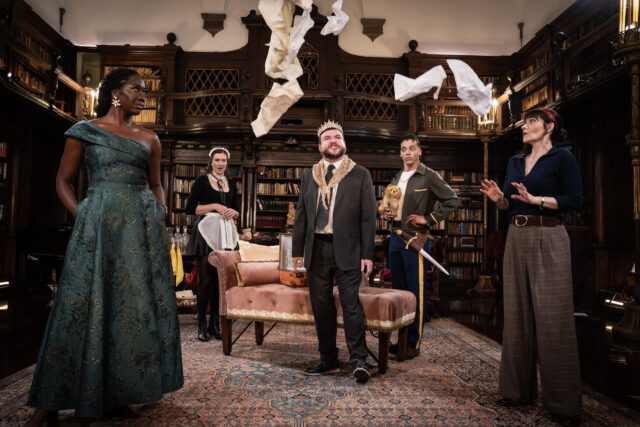
A family is torn apart by a con man in André De Shields Is Tartuffe (photo by Joan Marcus)

Ah, yes, and then there’s De Shields himself. He is once again given the most grand of grand entrances, as he was in Cats: The Jellicle Ball. I wrote at the time about the Tony, Obie, and Grammy winner, “This is André De Shields’s world; we only live in it.” Tartuffe only reinforces that statement.

“Here comes Tartuffe!” Dorine declares, but she is really proclaiming, “Here comes André!” In the script, it merely says, “Tartuffe enters. It deserves its own page.” There is nothing else.

Twin doors open, and there is he, Tartuffe, in a spectacular cardinal-like floor-length red robe, a giant bejeweled cross around his neck and chest, shiny rings on almost every finger, and dark sunglasses. (The costumes, a mix of period chic and standard contemporary, are by Tere Duncan.) He preens to the audience as he prepares to chew as much scenery as possible through the rest of the play, with Tartuffe making bold confessions, secretly seeking romance, and lying through his teeth, his personal hypocrisy evoking that of the Catholic church and the upper classes. He is a magnetic con man — with fantastic silver hair — who knows precisely how to play the game, ready to improvise as necessary.

When Damis tells Orgon how the priest tried to seduce Elmire, Tartuffe admits, “Why should I try to hoodwink you? / Brother, your son speaks true: I am / A sinner, yea, a wicked man! / My rank iniquities are rife / And every instant of my life / Is foul with sin! Yes, all the time / I add another heinous crime / To a long list. I roll among / The other swine in swathes of dung! / Small wonder Heaven is content / To sit and watch my punishment. / Whatever charge he wants to lay, / Nothing, not one word, will I say / In my defense — I lack the pride. / Let me be loathed and vilified. / Believe him! Give your wrath full rein! / Cast me into the street again / Like any felon. Shame? Disgrace? / I merit them in any case, / Lay ignominy at my door, / I’ve earned it, fifty times and more!” But Orgon attacks his son as his love and respect for Tartuffe intensifies.

The show is a hilarious romp, with stand-out performances by Tony, Emmy, and Grammy winner De Shields, Tony nominee Iman, and Dunn, who is always worth watching, even when Dorinne is not in a scene. It can get a little goofy at times, and if you’re in the second or third row you might have some trouble seeing every detail, but it’s all so sweet-natured that you can forgive it its minor sins.

Among those who have previously portrayed Tartuffe onstage and on film are Raúl E. Esparza, Emil Jannings, Gérard Depardieu, Antony Sher, and John Wood; later this month, Matthew Broderick will play Tartuffe in a new adaptation by Lucas Hnath at New York Theatre Workshop. None of them get to have their name in the title.
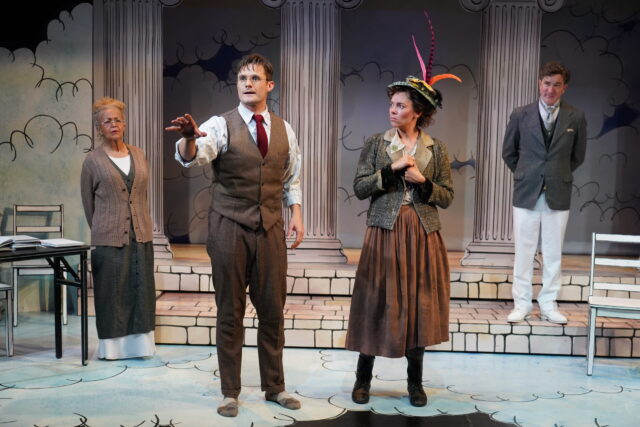
Professor Henry Higgins (Mark Evans) has plans for Eliza Doolittle (Synnøve Karlsen) in Gingold production Bernard Shaw’s Pygmalion (photo by Carol Rosegg)

BERNARD SHAW’S PYGMALION
Theatre Row
410 West 42nd St. between Ninth & Dyer Aves.
Wednesday – Sunday through November 22, $36.50 – $92.50
gingoldgroup.org
bfany.org

Upon entering the theater to see Gingold Theatrical Group’s twentieth anniversary production of Bernard Shaw’s Pygmalion — yes, the playwright’s name is part of the title — audience members are greeted by a series of posters featuring Al Hirschfeld drawings of George Bernard Shaw, including Shaw standing on the shoulders of William Shakespeare and Shaw painting a self-portrait with a colorful background. Lindsay Genevieve Fuori’s set is like a Hirschfeld tableaux, with a few chairs and tables, two steps leading to the facade of an opera house / temple with four ionic columns, a gable, and a raking cornice, and clouds with a hint of blue; in addition, there is a gold phonograph and a black recording machine that uses wax cylinders.

Hovering above is a caricature of Shaw as a winged angel, looking down as if he is a puppet master pulling all the strings. Several times during the show, thunder and lightning emerge from Shaw, reasserting his power and control over the proceedings. It comes off more as distraction than homage, artificially interrupting the narrative. Also disturbing any sense of flow is the intermittent appearance of four gods (Carson Elrod, Teresa Avia Lim, Lizan Mitchell, and Matt Wolpe, in multiple roles) who address the audience directly. They are based on a framing concept Shaw had drafted for the 1938 film adaptation but eventually scrapped; the dialogue Gingold founding artistic director David Staller uses is verbatim from the 1945 production with Gertrude Lawrence and Raymond Massey.

“Once upon a time, when we gods had a little more respect, you humans loved us. You built temples to us. We were always with you. Watching. Weaving our spells. And laughing at you,” Goddess 1 (Mitchell) says at the beginning. Goddess 2 (Lim) concurs, adding, “We laughed at you a lot. We still do.” There are not many laughs in this romantic comedy, and the satirical social commentary gets lost in the shenanigans.

The play, famously turned into the beloved 1956 musical My Fair Lady by Alan Jay Lerner and Frederick Loewe, was inspired by the Greek myth of the sculptor Pygmalion, a lonely man who carves a statue of a perfect woman he calls Galatea and then begs the gods to make real, which they do, but, as Goddess 1 explains, “There was a catch. A clause. A little hiccup that Pygmalion hadn’t thought to negotiate. The statue came to life, but with her own thoughts and feelings, with her own will. This possibility had somehow never occurred to Pygmalion. Oh, you funny humans. You men, in particular. And this, people: This is the story of that artist as reimagined by our friend, Mr. George Bernard Shaw.”

In Pygmalion, professor Henry Higgins (Mark Evans) is a persnickety phonetician lacking manners or social skills. When he encounters a poor, raggedy flower seller named Eliza Doolittle (Synnøve Karlsen) who speaks in what he considers a low-class Cockney accent, he makes a bet with his only friend, the far more practical Col. Pickering (Elrod). “You see this creature with her kerbstone English: the English that will keep her in the gutter to the end of her days,” he says to Pickering, right in front of Eliza, as if she’s not a person but a piece of clay. “Well, sir, in six months I could pass that girl off as a duchess at an Ambassador’s Garden Party.”

And so Higgins goes about molding Eliza into what he believes will be an honorable and respectable woman of society without paying attention to what Eliza wants, which is just to run her own flower shop. She defends herself by repeating over and over, “I’m a good girl, I am!” but that has no impact on Higgins, who treats her like she’s nothing more than a scientific experiment, referring to her as “so deliciously low. So horribly dirty. . . . I shall make a duchess of this draggle-tailed guttersnipe.”
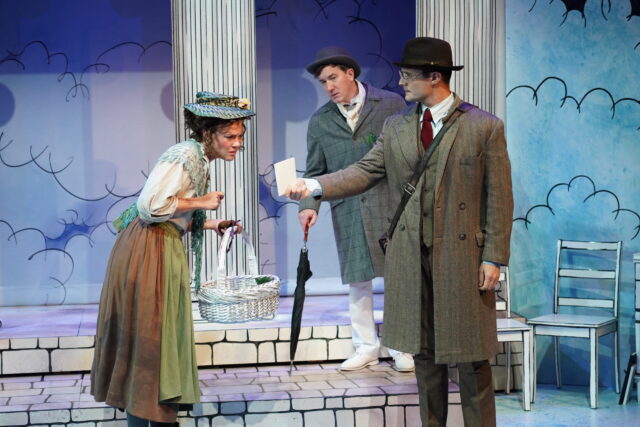
Professor Henry Higgins (Mark Evans) has something to show Eliza Doolittle (Synnøve Karlsen) as Freddy (Matt Wolpe) looks on (photo by Carol Rosegg)

Meanwhile, Higgins’s mother (Mitchell) is not a fan of her son’s plan, pointing out to him and Pickering when they discuss the problem of transforming Eliza into a lady, “No, you two infinitely stupid male creatures: the problem of what is to be done with her afterwards.” Eliza’s estranged father, Alfred (Wolpe), is seeking a payoff to look the other way. Higgins’s housekeeper, Mrs. Pearce (Mitchell), insists that Higgins treat Eliza like a woman with her own mind. And Freddy (Wolpe), the sister of the prim and proper Clara (Lim), takes a shine to Eliza.

However, in inventing a new Eliza, Higgins gets more than he bargained for.

Goddess 1 strikes at the heart of the play when she says, “This is about human nature and human ridiculousness. It’s about . . . what is it about? About how easy it is to hide from ourselves. To hide from life. To wear the mask.” But Staller, who has previously helmed productions of such Shaw works as Mrs. Warren’s Profession, Heartbreak House, Arms and the Man, and Caesar & Cleopatra, with mixed results, can’t capture the essence of Shaw’s words in his staging. The humor falls flat, the acting is inconsistent, and the movement is too stagnant.

Staller might be among the most knowledgeable Shaw scholars on the planet — Gingold’s Project Shaw has presented all-star readings of every Shaw play, including “The Shewing-Up of Blanco Posnet” with André De Shields — but Bernard Shaw’s Pygmalion feels like a piece of marble that still requires a lot of chiseling and forming. Cue the lightning and thunder.

[Mark Rifkin is a Brooklyn-born, Manhattan-based writer and editor; you can follow him on Substack here.]
MOLIÈRE IN NEW YORK: SOCIAL SATIRE IS NOT ALWAYS THE BEST MEDICINE

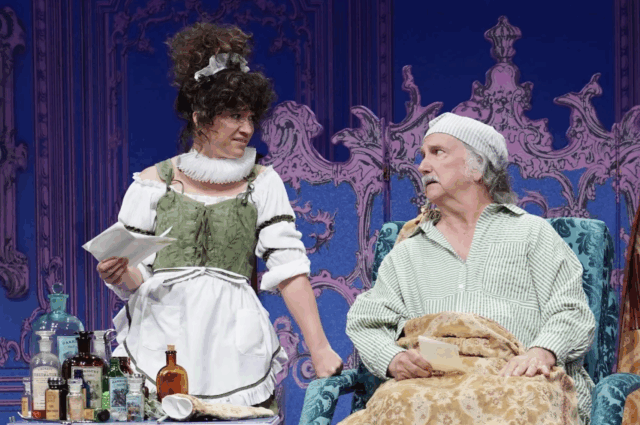
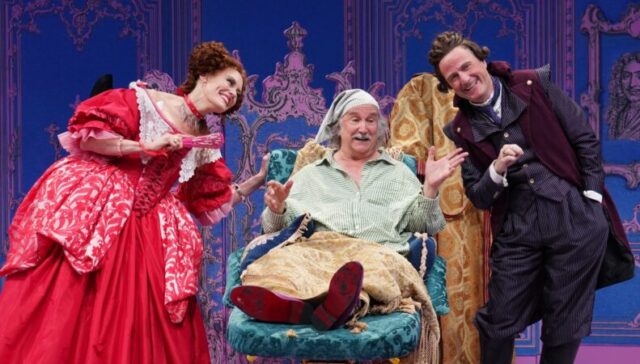
Sarah Stiles and Mark Linn-Baker stand out in Red Bull adaptation of Molière’s The Imaginary Invalid (photo by Carol Rosegg)

THE IMAGINARY INVALID
New World Stages
340 West Fiftieth St. between Ninth & Tenth Aves.
Wednesday – Monday through June 29, $69-$140
www.redbulltheater.com
newworldstages.com

Two madcap farces loosely based on Molière satires about wealth and class are currently running off Broadway, and both throw everything at the wall, hoping enough will stick. One succeeds significantly more than the other, but neither turns out to be exemplary.

In 2017, writer Jeffrey Hatcher and Red Bull artistic director Jesse Berger teamed up on a hilarious adaptation of Nikolai Gogol’s 1836 The Government Inspector, taking aim at health care, education, the court system, surveillance, class distinction, poverty, power, the institution of marriage, and government itself. They followed that up in 2021 with an overbaked version of Ben Jonson’s 1610 The Alchemist, which also skewered health care and class distinction. Their latest collaboration, an adaptation of Molière’s final play, 1673’s The Imaginary Invalid, falls somewhere in between, a frantic comedy about money, loyalty, and faith in science, based on a new translation by Mirabelle Ordinaire.

Continuing at New World Stages through June 29, The Imaginary Invalid takes place on two-time Tony winner Beowulf Boritt’s flimsy yet elegant set, a Louis XIV–style blue and pink room with a dressing screen, a mobile hospital bed, portraits of Molière and prancing cherubs on the wall, and doors at either side that will be peeked through and slammed repeatedly over the course of eighty-five frenetic, if repetitive, minutes. The master of the house, Argan (a delightful Mark Linn-Baker), is a rich hypochondriac who spends most of his time in bed, in his pajamas, slippers, and night cap, complaining about various aches and pains, losing feeling in his buttocks, and evacuating his bowels at scheduled times. His maid, Toinette (a riotous Sarah Stiles), takes care of him in a cheeky manner, lobbing subtle, and not-so-subtle, bombs at him.

Argan’s daughter from his first marriage, Angélique (Emilie Kouatchou), has fallen in love with Cléante (John Yi), but Argan has just promised her to Thomas Diafoirus (Russell Daniels), the doofus son of his surgeon (Arnie Burton). Argan is also tended to by Dr. Diafoirus’s brother, Dr. Purgon (Burton), who takes advantage of Argan’s hypochondria, and Dr. Fleurant (Burton), an enema specialist who dresses like a low-rent Batman TV villain. Meanwhile, Argan’s second wife, the voluptuous but devious Béline (Emily Swallow), is plotting with her lover, the lawyer Monsieur de Bonnefoi (Manoel Felciano), to change Argan’s will so she gets everything and Angélique nothing.

Béline (Emily Swallow) and de Bonnefoi (Manoel Felciano) try to trick Argan (Mark Linn-Baker) in Molière comedy at New World Stages (photo by Carol Rosegg)

The only one who is aware of all that is going on is Toinette, who relishes the insanity and inanity but is not about to lose her job over the scheming and deceptions.

Hatcher and Berger fill The Imaginary Invalid with inconsistent and intermittent fourth-wall breaking, clever and mundane anachronisms, self-referential inside jokes, playful props, and enough rear-end references that if I never hear another word about buttocks and enemas it will be too soon. But it’s also silly fun, even if it is more Three Stooges and Looney Tunes than Marx Brothers and Abbott and Costello, despite direct nods to Groucho and A&C.

Tilly Grimes’s costumes are a romp all their own, particularly the Joe “Stinky” Besser baby sailor outfit Daniels wears as Thomas, along with Béline’s lavish red gown and pouffy hairdo. Music director and composer Greg Pliska adds to the frivolity with parodies of such French songs as “La Vie en Rose,” “La Marseillaise,” “Hooray for Captain Spaulding,” and “I Dreamed a Dream.” Tracy Bersley’s movement choreography is appropriately frenetic.

At one point, when Toinette is arguing with Argan that he is getting bad advice from his wife and doctors, he says, “Look, when I’m sick, I call a doctor! When I want something dusted, I don’t call you because you don’t dust!” She answers, “I see. You won’t listen to me because I’m a servant.” Argan: “And a woman.” Toinette: “Well, if you need to hear the same said by a man, I refer you to Monsieur Molière.” To which Argan replies: “Molière! Molière writes plays! If I were his doctor, I wouldn’t prescribe him a single pill! I’d say: ‘Die, playwright, like a show without a star!’”

An ill Molière died on February 17, 1673, shortly after collapsing onstage during a production of The Imaginary Invalid that he was directing and starring in and which included the following lines: “To the Devil with him! If I were a doctor, I would be revenged on him for his impertinence, and when he was sick, I would let him die without relief. He would cry and beg in vain, but I would not prescribe him the least bleeding or enema, and would say to him, ‘Die! Die! Molière!, that will teach you to make fun of doctors.’”

The Imaginary Invalid makes fun of doctors and patients, of health care and the law, of greed and avarice, and of theater itself. “Is there a cure?” Argan asks. Well, both the Bible and the Mayo Clinic agree that laughter is the best medicine.

Taylor Mac reveals hypocrisy inherent in arts funding in Prosperous Fools (photo by Travis Emery Hackett)

PROSPEROUS FOOLS
Theatre for a New Audience, Polonsky Shakespeare Center
262 Ashland Pl. between Lafayette Ave. & Fulton St.
Tuesday-Sunday through June 29, $95-$125
www.tfana.org

A few years before The Imaginary Invalid, Molière wrote Le Bourgeois gentilhomme (The Middle Class Gentleman), the story of a rich bourgeois man obsessed with becoming an accepted member of the French aristocracy. Taylor Mac (who uses the pronoun judy) reimagines the play, now called Prosperous Fools, as a contemporary skewering of wealth, power, art, philanthropy, and celebrity, set at a gala fundraiser for a nonprofit ballet company. Adding elements from judy’s personal experiences at gala fundraisers — as a waiter, a guest, a performer, and an honoree — Mac delivers a frustrating, often confusing, and overly repetitive production that only settles down with a brilliant final monolog that spreads the blame for the terrible situation nonprofits find themselves in today.

Begun twelve years ago as a commission for an institution that ultimately rejected it, the show was turned down by numerous other New York City companies before being picked up by Theatre for a New Audience, which is presenting it at the Polonsky Shakespeare Center through June 29, directed by Tony and Obie winner Darko Tresnjak, who is unable to keep it from careening way out of control.

Mac stars as the Artist, who is choreographing a three-hour ballet relating the Greek myth of Prometheus, who stole fire from the gods and gave it to humans; he paid the price by being tied to a rock and having his liver eaten over and over again by an eagle throughout eternity. Just about everything that can go wrong does as the Artist, the dancer playing Prometheus (Ian Joseph Paget), and the three muses (Em Stockwell, Megumi Iwama, and Cara Seymour) prepare for the evening. The lights aren’t working, the orchestra doesn’t have the full score, and not everyone is thrilled that one of the honoree donors, dimwitted billionaire $#@%$ (Jason O’Connell), is morally and ethically challenged.

“I know you wouldn’t be able to do this work without $#@!$’s financial support, but he’s also a real estate petroleum mogul who makes pharmaceutical heroin out of endangered species,” the Intern (Kaliswa Brewster) says to the Artist, pointing out that the oligarch was also “that judge on that show where they made poor people compete for who could be the best beggar.”

The conversation continues until the Artist explains, “Buckle up! You want a life in the arts, this is what it looks like. You work for free, you beg for permission to ask for permission to do what you’ve worked for free to do, and after years of this humiliation, you finally break through, get yourself a patron, and he represents everything you’ve been fighting against your entire life. So organize the sheet music, fetch my coffee, and then go home and eat your top rhamen!”

The Philanthropoid (Jennifer Regan) readies to debase herself to both honorees, $#@%$ and glamorous actress and humanitarian activist ####-### (Sierra Boggess), whose main cause is helping impoverished children around the world. “I am not allowed happiness beyond the children,” she declares. ####-### is occasionally joined by a living prop, the Pot-Bellied Child (Aerina Park DeBoer), and uses the Intern, who is poor and Black, as an example of what is wrong with society. Walking around with a clipboard, the Stage Manager (Jennifer Smith) tries to keep everything running but doesn’t have much luck and takes offense when her clothes are ridiculed as those of “the working man.”

Meanwhile, $#@%$ demands that he needs his Wally Shawn in order to hang out with cultured people; American actor, writer, and living legend Wallace Shawn, he of The Princess Bride, Young Sheldon, My Dinner with Andre, and so many other beloved classics, is not available, so the Artist dresses up as him and fairly adequately speaks like him. “Couldn’t you hire the actual Wally Shawn?” the Artist asks. The Philanthropoid responds, “Money can’t buy everyone.”

As the gala proceeds, so does the mayhem, which describes the production as well.

The Intern (Kaliswa Brewster), $#@%$ (Jason O’Connell), the Philanthropoid (Jennifer Regan), and the Stage Manager (Jennifer Smith) aren’t the only ones who are confused about Prosperous Fools (photo by Hollis King)

Taken individually, Prosperous Fools should be another blast by Mac, whose previous works include Gary: A Sequel to Titus Andronicus, The Lily’s Revenge, and A 24-Decade History of Popular Music. Alexander Dodge’s set, with an Astor Plaza–like cube, square plastic swimming pool, and headless animals, is a hoot, as are Anita Yavich’s costumes, although $#@%$ dressed as Elon Musk in the first act and Donald Trump in the second feels like overkill. The boisterous choreography is by Company XIV’s Austin McCormick, with music by Oran Eldor.

However, there is too much of everything. Jokes go on too long and are repeated, the purposeful overacting grows tiresome, and, something I thought I’d never say, no more Wallace Shawn, please! Many of Mac’s points are currently being made in the Amazon Prime series Étoile, which deals with a dancer swap between Paris and New York, a worrisome gala, an ethically and morally challenged oligarch throwing his money around to get whatever he wants, along with an eclectic choreographer who believes he is misunderstood. (DeBoer is in both Étoile and Prosperous Fools.)

The show concludes with a marvelous monolog by the Artist that brilliantly narrows down what it’s all about, making each and every one of us complicit in the hypocrisy without even mentioning DOGE — performers, choreographers, donors, artistic directors, woke gatekeepers, and, perhaps most courageously, the audience. “Do you deserve because you try? / And do you own what you can buy? / Does charity absolve your greed? / Does wanting much make others need?” he asks. “Is selling out what you deplore? / And how then have you been a whore? / Should you be thanked for being wealthy? / Should you be shamed, is that unhealthy?”

Both The Imaginary Invalid and Prosperous Fools could use a second opinion. Calling Dr. Howard, Dr. Fine, Dr. Howard!

[Mark Rifkin is a Brooklyn-born, Manhattan-based writer and editor; you can follow him on Substack here.]

DOUGLAS DUNN + DANCERS: GARDEN PARTY

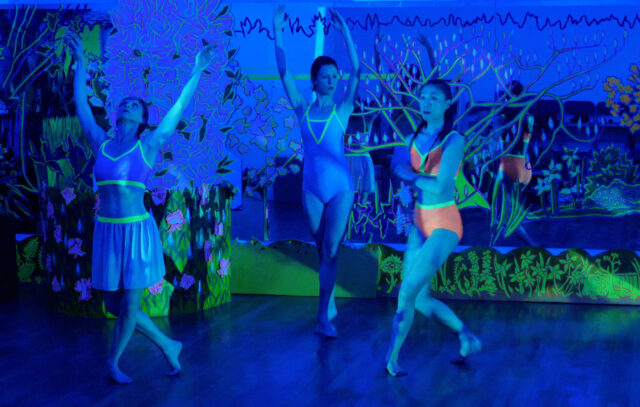
Douglas Dunn’s Garden Party is back for a return engagement (photo by Jacob Burckhardt)

GARDEN PARTY
Douglas Dunn Studio
541 Broadway between Spring & Prince Sts., third floor
September 6-10, $20 floor cushions, $25 chairs
www.douglasdunndance.com

This past April, Douglas Dunn + Dancers presented the world premiere of Garden Party at the company’s third-floor Soho loft studio. The sixty-minute piece is now returning for an encore run September 6-10; tickets are $20 for floor cushions or $25 for a chair.

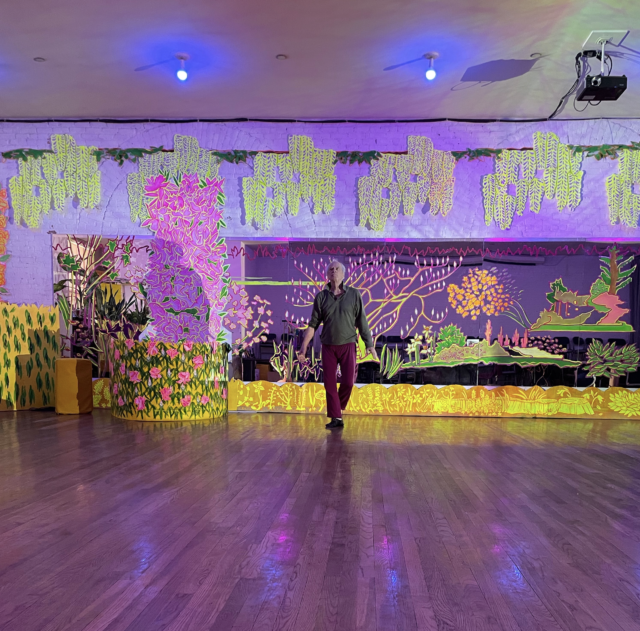
Longtime Dunn collaborator Mimi Gross designed the colorful costumes and scenery, bathing the space in lushly painted trompe l’oeil walls and ceiling and a long horizontal mirror covered with pink, yellow, and green flowers, plants, trees, clouds, raindrops, and other natural elements. The work is performed by Dunn, Alexandra Berger, Janet Charleston, Grazia Della-Terza, Vanessa Knouse, Emily Pope, Paul Singh, Jin Ju Song-Begin, Timothy Ward, and Christopher Williams, with lighting and projections by Lauren Parrish, sound by Jacob Burckhardt, and preshow live music by guitarist and composer Tosh Sheridan.

The soundtrack consists of pop and classical tunes (Robert de Visée, John Lennon & Yoko Ono, Bach, Mark Knopfler & Emmylou Harris, more), birdsong, and poetry (by John Keats, Anne Waldman, Molière, Rainer Maria Rilke, John Milton, Stephanie Jacco, and others, read by Dunn, Waldman, Jacco, and Della-Terza). In an April twi-ny talk, Dunn noted, “The feel of this evening was clear to me the day the title hit me (about three years ago, the pandemic postponing the project). The lavish beauty of Mimi’s set completely fulfills my initial intuition . . . as if she’d read my dancing mind.”

Tickets are limited; the show sold out its April premiere, so don’t hesitate if you want to be part of this intimate experience.

DOUGLAS DUNN + DANCERS: GARDEN PARTY

Alexandra Berger, Janet Charleston, and Christopher Williams rehearse Douglas Dunn’s Garden Party (photo by Mimi Gross)

GARDEN PARTY
Douglas Dunn Studio
541 Broadway between Spring & Prince Sts., third floor
April 24-30, $15-$20
www.douglasdunndance.com
www.mimigross.com

All dancer and choreographer Douglas Dunn needed to do was give Mimi Gross the title of his new production and the painter, set and costume designer, installation artist, and teacher was off to the races.

Born in California in 1942, Dunn has been collaborating with Gross, a native New Yorker born in 1940, since Dunn presented Foot Rules in 1979; they’ve worked together some two dozen times since, including on 1980’s Echo, 1981’s Skid, 1988’s Matches, 1995’s Caracole, 2007’s Zorn’s Lemma, and 2017’s Antipodes. They met quite serendipitously.

“I’d been working with Charles Atlas on film, video, and costumes for several years. Being then in a moment unavailable, he suggested Mimi,” Dunn explained via email. “She made wonderful apparel for an hour-long duet for Deborah Riley and me called Foot Rules. What I noticed right away was her love of color.”

“Charlie Atlas was presenting live performances which he made up and directed. That is how I first met Charlie, and then I met Douglas,” Gross added. “They had been making dances and videos together. When Douglas asked Charlie if he could make some costumes for a new dance he was choreographing with Deborah Riley, Charlie was super busy — he was working with Merce Cunningham full-time — and recommended me to do it. I had made many costumes for movies with cardboard and hot glue . . . nothing to be washed! Or worn many times! Quite a challenge. Of course, I said sure. And then through the decades on and off we have shared many projects, sets and costumes, sometimes sets, sometimes costumes, sometimes both — very open, warm, clear mutual caring to work within our shared possibilities, never knowing how it will come out.”

Douglas Dunn emerges from his pulpit in Mimi Gross’s fantastical Garden Party installation (photo by twi-ny/mdr)

Dunn and Gross are currently at work on their latest project, Garden Party, which runs April 24-30 at Douglas Dunn + Dancers’ SoHo loft studio. Last week I attended a rehearsal of the sixty-minute piece, which features Dunn, Grazia Della-Terza, Alexandra Berger, Janet Charleston, Vanessa Knouse, Emily Pope, Paul Singh, Jin Ju Song-Begin, Timothy Ward, and Christopher Williams moving through the spectacular space created by Gross, consisting of lushly painted trompe l’oeil walls and ceiling and a long horizontal mirror, covered with pink, yellow, and green flowers, plants and trees, clouds, raindrops, and more. While the plants at the right are fake — Dunn told me at the rehearsal that he had “planted” some of them himself — the greenery at the left is real, repurposing the plants that were already in the studio.

There’s also a colorful pulpit where Dunn spends much of the show; he had specifically requested it, asking for it to be based on the design at Grace Church on Broadway. The dancers glide across the floor like blossoming flowers, in solos, pas de deux, and trios, celebrating birth, life, and growth; however, the soundtrack of pop and classical songs (Robert de Visée, John Lennon & Yoko Ono, Bach, Mark Knopfler & Emmylou Harris, more), birdsong, and poetry (by John Keats, Anne Waldman, Molière, Rainer Maria Rilke, John Milton, Stephanie Jacco, and others, read by Dunn, Waldman, Jacco, and Della-Terza) touch on loss and loneliness. A few of the dancers occasionally sit on an inviting white park bench, and Dunn clutches a plush bird named April.

“Mimi always helps me see color; I always see line first,” Dunn explained. “We got along just fine and knew right away how much to interact and how much to let the other alone. She often saw historical references in the dancing and she’d take off from there. We’re both dead serious but also insistent on having a good warm time relating when preparing for a new dance show. The feel of this evening was clear to me the day the title hit me (about three years ago, the pandemic postponing the project). The lavish beauty of Mimi’s set completely fulfills my initial intuition . . . as if she’d read my dancing mind.”

Douglas Dunn’s Garden Party runs April 24-30 in SoHo loft studio (photo by Jacob Burckhardt, 2023)

“The new dance had been talked about a long while ago,” Gross noted. “All of 2021-22, I made many landscape drawings, and then, when the pandemic seemed to subside, I painted these flowers last summer and called them ‘Feel Good Flowers.’ When Douglas asked me if I would make a garden and sets about ‘Early Spring,’ he said, ‘Fill up the studio.’ That was just what I was doing anyway. I asked him if I could paint it with this stylization, and that I didn’t know exactly how I would do it. He was fine with that. I made a big drawing of a bird and discussed the texture and color with Sue Julien, who fabricated it. Both Sue and David Quinn made an amazing contribution fabricating the costumes from my drawings. Douglas wanted each dancer to be different, with different leg lengths. That is all he had said. I pored over my Ballet Russe books, and Charles James and I made drawings. The only common link is the fluorescent yellow in each costume.”

The collaboration extends to Lauren Parrish, who designed the lighting and projections, and sound designer Jacob Burckhardt. The show will be preceded by live music from guitarist and composer Tosh Sheridan, who has released such albums as Tosh, Tosh Sheridan Trio, and solo/duo.

“All of these plain facts are fine and good and relate our collaborating history, but it is the depth of poetic reality where we really collaborate,” Gross concluded, “by dance and by making an atmosphere for the dance.”

And what an atmosphere Dunn and Gross have created for Garden Party.

CELEBRATING MOLIÈRE’S 400th BIRTHDAY

Who: Lisa Gorlitsky, Margaret Ivey, Postell Pringle, Adam Gopnik, Erica Schmidt, Comédie-Française
What: Celebration of Molière’s quadricentennial
Where: FIAF, Florence Gould Hall and Skyroom, 55 East 59th St. between Madison & Park Aves.
When: March 10-12, 24, 30, $20-$45 (three-event package $75)
Why: Jean-Baptiste Poquelin was born into a bourgeois family in early 1622 in Paris. Nicknamed “le Nez” because of his relatively large proboscis, he eventually became better known as poet, playwright, and actor Molière. In celebration of the four hundredth anniversary of his birth, the French Institute Alliance Française is hosting a trio of special events. Taking place March 10-12 at 7:30 ($45) at FIAF’s Florence Gould Hall, “Molière Turns 400: 17th Century Paris Meets 21st Century New York” consists of staged excerpts, complete with sets, costumes, and live music, from The Misanthrope, The School for Wives, and Tartuffe, with Lisa Gorlitsky, Margaret Ivey, and Postell Pringle and directed by Lucie Tiberghien, the founding artistic director of Molière in the Park, which performed livestreamed adaptations of all three works during the pandemic lockdown. The March 10 presentation will be followed by a reception.

Ivo van Hove’s adaptation of Molière’s uncensored Tartuffe screens at FIAF March 24

On March 24 at 7:00 ($25), New Yorker staff writer Adam Gopnik and director Erica Schmidt will be at the FIAF Skyroom for the talk “Modernizing Molière,” available in person and via livestream. Gopnik contributed the foreword to Molière: The Complete Richard Wilbur Translations, while Schmidt directed Molière’s The Imaginary Invalid at Bard SummerScape in 2012, starring her husband, Peter Dinklage. The fête concludes March 30 at 7:00 ($35) in Florence Gould Hall with a screening of Molière’s uncensored Tartuffe or the Hypocrite by Comédie-Française, directed by Ivo van Hove from the original script, which was censored by Louis XIV in 1664; the filmed version stars Christophe Montenez and features a score by Oscar-winning composer Alexandre Desplat.

A VERY MODERN CLASSICAL EVENING AT THE PICNIC HOUSE STARRING SAMIRA WILEY

A VERY MODERN CLASSICAL EVENING AT THE PICNIC HOUSE
The Picnic House in Prospect Park
40 West Dr. behind Litchfield Villa
Thursday, December 9, and Friday, December 10, free with advance RSVP, 7:00
www.moliereinthepark.org
www.prospectpark.org

In May 2019, Molière in the Park put on its inaugural event, a staged reading of The Misanthrope by Jean-Baptiste Poquelin, aka Molière, at Lefrak Center at Lakeside in Prospect Park, followed in August by a staged reading of the French playwright’s The School for Wives at the Picnic House in Prospect Park. In 2020, because of the pandemic lockdown, the troupe presented four virtual Zoom readings, The Misanthrope with Heidi Armbruster, Kaliswa Brewster, Chris Henry Coffey, Naomi Lorrain, Jared McNeill, Jennifer Mudge, Postell Pringle, Tamara Sevunts, and Samira Wiley; The School for Wives with Tonya Pinkins, Brewster, Cristina Pitter, Tamara Sevunts, Mirirai Sithole, Carolyn Michelle Smith, and Corey Tazmania; a fun adaptation of Molière’s Tartuffe, with Raúl E. Esparza, Wiley, Brewster, Toccarra Cash, Coffey, Lorrain, McNeill, Chloé Noble, Mudge, Rosemary Prinz, and Carter Redwood; and Christina Anderson’s terrific new play, pen/man/ship, which takes place in 1896 aboard a ship bound for Liberia, featuring Crystal Lucas-Perry, Kevin Mambo, McNeill, and Pringle.

The company returned to in-person outdoor shows this past May with Tartuffe at Lefrak Center, with Andy Grotelueschen, Kate Rigg, Pringle, McNeill, Lizzy Brooks, Mudge, Nicole Ansari, Redwood, Coffey, and Marjan Neshat. Next up is “A Very Modern Classical Evening at the Picnic House,” an exciting pairing on December 9 and 10 at 7:00 of Richard Wilbur’s translation of Molière’s one-act comedy in verse, The Imaginary Cuckold, and Martinique-born Gaël Octavia’s Family — which asks the question “What is the disease that spreads through us and our families when social conventions of any kind force us into hiding?” — translated by Katharine Woff and MIP founding artistic director Lucie Tiberghien, with Wiley, Brewster, Brooks, Alanna Darby, Lisa Gorlitsky, and Nate Miller appearing in both; each work will be followed by a Q&A with members of the cast and crew. Admission is free with advance RSVP.

MOLIÈRE IN THE PARK: PEN/MAN/SHIP

Who: Molière in the Park theater company
What: Livestreamed performances and Q&As
Where: FIAF Facebook and Molière in the Park YouTube
When: Saturday, December 12, free with RSVP, 2:00 & 7:00 (show will be available for viewing through January 3)
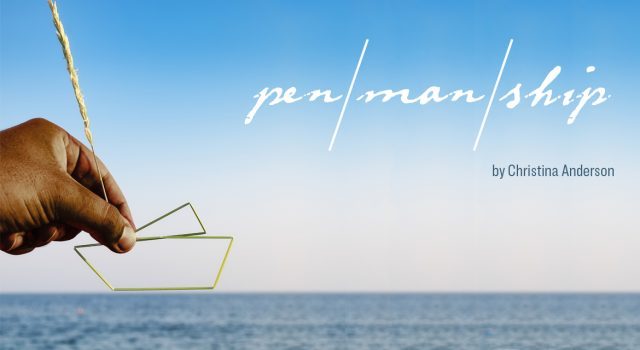
Why: After staging Zoom adaptations of three classic seventeenth-century plays by Jean-Baptiste Poquelin — better known as Molière — Brooklyn-based Molière in the Park is getting significantly more contemporary with its latest live, online production, playwright, TV writer, and educator Christina Anderson’s new work, Pen/Man/Ship. Following The Misanthrope, Tartuffe, and The School for Wives, Molière in the Park moves into the late nineteenth century with Pen/Man/Ship, which takes place in 1896 aboard a ship heading for Liberia shortly after the US Supreme Court decided in Plessy v. Ferguson to uphold the constitutionality of racial segregation under the concept of “separate but equal.” The cast features Crystal Lucas-Perry, Kevin Mambo, Jared McNeill, and Postell Pringle; the parable is directed by Molière in the Park founding artistic director Lucie Tiberghien using Liminal Entertainment Technologies’ StreamWeaver software, which takes actors out of Zoom boxes and puts them in front of backgrounds that more resemble indoor and outdoor sets while also allowing the tech crew to work together regardless of where they are. Copresented with the French Institute Alliance Française (FIAF) in partnership with the Prospect Park Alliance and the LeFrak Center at Lakeside, the play will be performed live twice on December 12, at 2:00 and 7:00, followed by Q&As with the creatives; a recording will be available for on-demand viewing through January 3.