Tag Archives: Mainstage Theater

WISH YOU WERE HERE

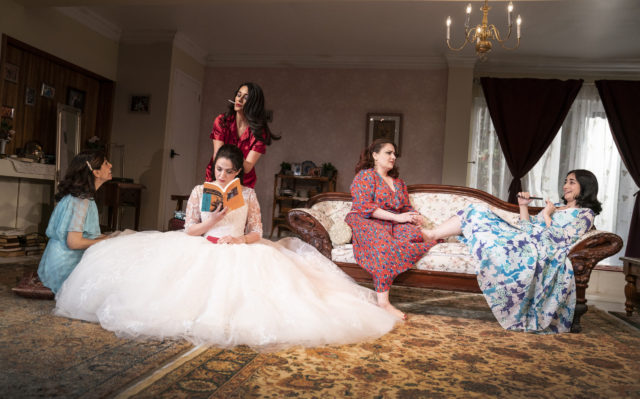
Five friends get ready for a wedding in world premiere of Sanaz Toossi’s Wish You Were Here at Playwrights Horizons (photo by Joan Marcus)

WISH YOU WERE HERE
Playwrights Horizons, Mainstage Theater
416 West 42nd St. between Ninth & Tenth Aves.
Tuesday – Sunday through June 5, $49-$89
www.playwrightshorizons.org

First-generation Iranian-American playwright Sanaz Toossi follows up her wonderful professional debut, English, which ran earlier this year at the Atlantic, with the even better Wish You Were Here, which opened tonight at Playwrights Horizons.

Written in 2018 as her NYU thesis in response to Donald Trump’s Muslim travel ban and anti-immigration policies, English is set in a TOEFL classroom in Karaj, Iran, in 2008, where four Iranian adults are learning to speak English as they and their teacher question the meaning of home and how language and culture impact their identity.

Written in 2019 as a response to Trump’s threat to retaliate against Iran after the Western Asian republic shot down an unmanned US drone, Wish You Were Here follows the trials and tribulations of five close female friends in Karaj from 1978 to 1991 who experience what Toossi calls “detached homesickness” as the nation goes through major changes, from the Islamic Revolution to the Iran-Iraq War.

The story unfolds in ten scenes that all take place in the same well-accoutred living room. Salme (Roxanna Hope Radja) is in a giant wedding gown, getting ready for her special day. Shideh (Artemis Pebdani) is giving Zari (Nikki Massoud) a pedicure, announcing so everyone can hear, “Your toes are disgusting.” (There are a lot of bare feet throughout the play.) Nazanin (Marjan Neshat) makes adjustments to the dress while flirting with Rana (Nazanin Nour), who is très elegant in her shiny silk pajamas, smoking a cigarette as she does Salme’s hair.

As they continue to primp, they regale one another with a string of hysterical dirty jokes and good-natured insults. “I’m steaming out of my dress, Shideh,” Nazanin says, referring to her nether regions. “Ew,” Shideh replies. “My pussy could iron a shirt,” Nazanin adds. Rana asks, “Oh what kind of shirt?”
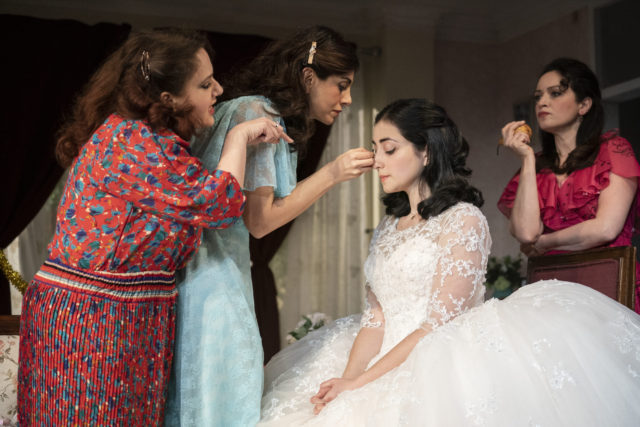
Shideh (Artemis Pebdani) has a lot to say as Nazanin (Marjan Neshat) applies makeup to Zari (Nikki Massoud) and Salme (Roxanna Hope Radja) hovers behind them (photo by Joan Marcus)

“If a man saw her toes, I think his penis would fall off,” Shideh says about Zari. Rana admits, “Silk does not breathe well. Whatever you’re smelling is me and I don’t want to talk about it.” And Zari advises Salme what to do when encountering a man’s member: “When you first see one, smile. Smile so big. Smile bigger than you’ve ever smiled in your life. Like you need to swallow a plate.”

It’s an enchanting scene in which we fall in love with the characters while learning key facts about each of them: Shideh is studying to be a doctor and is considering going to school in America; Salme is the most religious one, regularly praying, believing that you “can’t jinx G-d’s will”; the easygoing Zari is in the market for a husband; and the ultracool Rana and the occasionally mean Nazanin plan to avoid marriage and children, although Nazanin lets it be known that she wants to eventually return to Iran after living it up in Miami. (Coincidentally, in English, Neshat plays a teacher who made a life for her and her family in London but came back to Karaj, perhaps regretting that decision.)

A year later it is Zari who is getting married, but a pall is cast over the proceedings when Shideh mentions Rana’s name; Rana, who is Jewish, has gone missing, along with her parents and brother. Salme is trying to find her, but Nazanin says, as if trying to convince herself, “If she wanted to vanish into thin air, with no trace, no word, without shit, then that’s how she wanted to do it.”
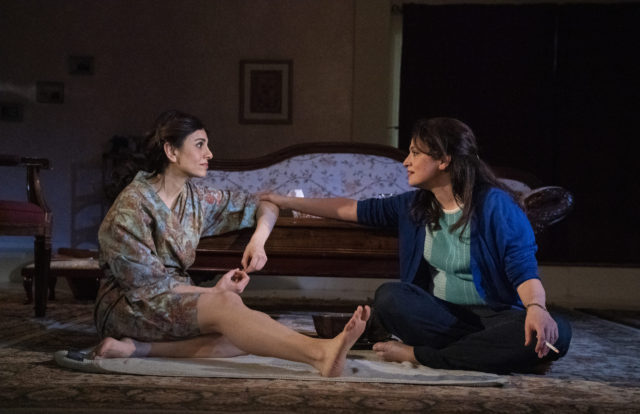
Nazanin (Marjan Neshat) and Salme (Roxanna Hope Radja) cement a bond in Wish You Were Here (photo by Joan Marcus)

But as we soon discover, Nazanin has a problem with people leaving, whether it’s a friend moving away with a new husband, another friend going off to study abroad, or a best friend disappearing in a country becoming ever-more dangerous. As many Iranians choose to escape their homeland because of war and an oppressive regime, Nazanin feels stuck, resenting those who attempt to make a new life for themselves and their family instead of getting out while she still can. It’s a bitter pill, especially when seen in retrospect. “Why don’t I want to leave?” she wonders. It’s a question people ask themselves every day across the globe.

Wish You Were Here is directed by Gaye Taylor Upchurch (Animal, The Year of Magical Thinking) with a warm and welcoming intimacy that invites us into these women’s complex lives with, as the characters often say, “no judging.” The comforting set is by Arnulfo Maldonado, with handsome costumes by Sarah Laux, subtle lighting by Reza Behjat, and meticulous sound by Sinan Refik Zafar and Brian Hickey.

The hundred-minute play was also written by Toossi as a love letter to her mother and her mother’s friends, immigrants who started all over in the United States; parts of the story are based on real experiences. Toossi, who was born and raised in Orange County, California, and is now based in Brooklyn, has beautifully depicted the ups and downs, the sheer joys and the petty jealousies, that define female friendship.

Over the course of thirteen years, Iran underwent tremendous change, but Toossi does not focus so much on world events as on how they impact the women’s relationships with each other; the scenes involving only two of the women at a time are particularly emotional and heart-wrenching as Toossi explores the many layers of attachment, mere cordiality, and sincere love the women share. While Salme is afraid of pulling off the tape when Nazanin is waxing her legs for fear of hurting her physically, Zari is not afraid to tell Nazanin, “You have a way of making me feel really lonely.”

The cast is exceptional; it truly does seem like you’re watching five friends go about their daily existence, dealing with love and loss as they dance wildly to a song on the radio, hide under a table during a bombing, kneel down to pray to Mecca, or deliver yet another pussy joke. In between scenes, the actors make minor changes to the living room to indicate a shift in location, moving around tables or opening the curtain in the back to reveal a bright garden. It’s as if the five actors, and the audience, need a short break from the intensity of the play while getting ready to see what the next year holds in store for everyone. I can’t wait to see what Toossi has in store for all of us next.
TAMBO & BONES

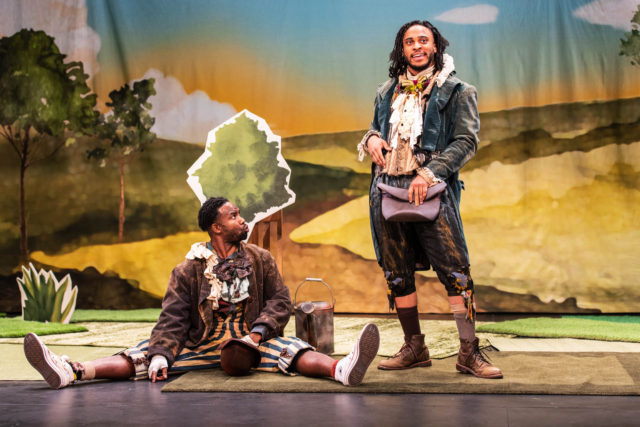
Tambo (W. Tré Davis) and Bones (Tyler Fauntleroy) channel Didi and Gogo from Waiting for Godot in new David Harris play (photo by Marc J. Franklin)

TAMBO & BONES
Playwrights Horizons, Mainstage Theater
416 West 42nd St. between Ninth & Tenth Aves.
Tuesday – Sunday through February 27, $30-$54
www.playwrightshorizons.org

In the past few years, several shows by Black playwrights have shattered the fourth wall in unique ways, challenging their majority white audiences by separating the line between fact and fiction, audience and performer. Two such examples are Jordan E. Cooper’s Ain’t No Mo’ and Jackie Sibblies Drury’s Pulitzer Prize–winning Fairview, both of which included participatory elements that placed systemic racism front and center while understanding precisely where their bread was buttered, balancing humor with recrimination.

David Harris’s new show, Tambo & Bones, which opened tonight at Playwrights Horizons, turns the tables on Black trauma porn in similar ways, incorporating Afrofuturism in its self-referential exploration of the past, present, and future of Black performers entertaining white audiences. Aggressively directed by Taylor Reynolds with a razor-sharp sense of wit and whimsy, the show, divided into three sections, expands on the concepts of minstrelsy — what Harris, who was a popular spoken word poet, refers to as “Black performative capitalism” — and freedom in different, not-always-obvious forms while scrutinizing what is real (life), what is fake (theater), and how they intertwine.

As Harris contends in his Playwright’s Perspective program note, “The most fun part about writing is that every writer I know is a fucking liar. Some think this is radical political work. Some think writing is to channel the ancestors and the woo-woos to put voice to page. But all of this is just tactic. This was the realization that made me stop doing poetry slams and start to focus on theater. I wasn’t growing as an artist; I was growing as someone who could perform identity. Spoken word capitalizes on an idea of the authentic identity. The real person. But here, in this theater, all of us know that every second of this experience is fake. And there is infinite possibility in that reality. And the pleasure is in the possibility.”

The play begins in a garden that looks like it was made for an elementary school musical. In his stage directions, Harris refers to it as “a fake ass pasture. Some fake ass trees and a fake ass bush. A fake ass sky with a fake ass sun. A lil bit of fake ass grass. Yo it’s fake ass pastoral out here.” Tambo (W. Tré Davis) is trying to grab a nap, moving a cardboard tree so he can relax in the shade. “It ain’t fake if I believe in it,” he says, getting to the heart of what theater is about, at least for a few hours.

But then Bones (Tyler Fauntleroy) arrives and ruins his friend’s rest by asking the audience for quarters so he can visit his son in the hospital for his birthday, all of which turn out to be lies. He also performs a lame trick with a knife to get more quarters. Tambo insists he is going about it all wrong.

“You gotta make em think. Stimulation, know what I mean?” Tambo explains. “And how do you do that?” Bones asks. Tambo replies, “You gotta deliver a treatise on race in America.” Bones: “Whaaaaaat?” Tambo: “Yup. Trendy intellectual shit.”

The scene is Harris’s reimagining of Samuel Beckett’s Waiting for Godot; both men wear old-fashioned hats and raise existential questions while waiting for something to happen. Bones is dressed in a raggedy costume that resembles Lin-Manuel Miranda’s military uniform in Hamilton, a show that used a Black and brown cast to entertain a predominantly white audience that patted themselves on the back for enjoying such a racially diverse musical about the Founding Fathers. But Tambo and Bones are not as passive as Vladimir and Estragon; instead of waiting for a mystery man to arrive, they go after the person responsible for their situation: the playwright.

“Why did this n—a write us into a minstrel show?” Tambo proclaims. “He could’ve written anything he wanted, and he chose to write this. You couldn’t give us no quarters in your show? You had to make us struggle n shit?” Bones replies, “Maybe he wanted all the quarters for himself.”

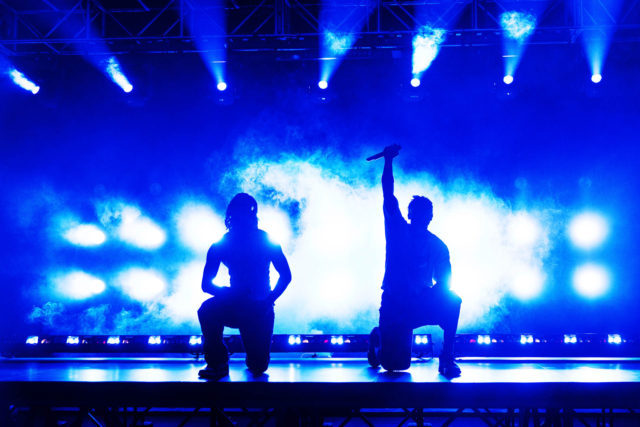
David Harris world premiere includes a hip-hop concert at Playwrights Horizons (photo by Marc J. Franklin)

In the second part, Tambo and Bones have become hip-hop superstars, covered in bling and rapping on a smoky stage with their names in lights. They blast such songs as “Started from the Cotton,” “Bootstrappin,” “Racism Is Bad,” and “Crack Rocks Crackin” as the audience, most of whom have probably never been to a live rap concert, dance in their seats, sing along, and wave their hands in the air like they just don’t care. But while Bones is reveling in their newfound wealth and success, Tambo still feels a responsibility to speak truth to power. “We here to have a mothafuckin party,” Bones shouts to the adoring crowd. Tambo adds more quietly, “And also provide commentary on some shit.”

The third section takes place four hundred years in the future — not a random number — as a seminar looks back at the legacy of Tambo and Bones and the history of race relations in America. It’s not an easy pill to swallow, reminding me of such other recent plays as Thomas Bradshaw’s 2019 revival of Southern Promises and Jeremy O. Harris’s Slave Play in how they relate to the audience.

Davis (Seared, Zooman and the Sign) and Fauntleroy (Tempest, Looking for Leroy) portray their carefully constructed stereotyped characters with a savvy appreciation of what they stand for in today’s world, paradigms of the Black experience in America, in theater and the rest of society, which tends to be not as forgiving as well-heeled off-Broadway audiences. “I’m just pondering my purpose n shit,” Bones says in the pasture. “You ain’t happy wit ya life as it is?” Tambo asks. “I read somewhere that happiness is just an illusion like sunlight,” Bones answers.

The first two sections feature stellar sets by Stephanie Osin Cohen, costumes by Dominique Fawn Hill, lighting by Amith Chandrashaker and Mextly Couzin, sound by Mikhail Fiksel, and music by Justin Ellington. The final scene is more ramshackle; it feels like Harris knew exactly what he wanted to say but is still working on how to accomplish it, resulting in a messy conclusion that still provides plenty of food for thought.

“It is not enough to demand insight and informative images of reality from the theater,” Bertolt Brecht wrote, describing what he called the alienation effect. “Our theater must stimulate a desire for understanding, a delight in changing reality. Our audience must experience not only the ways to free Prometheus, but be schooled in the very desire to free him. Theater must teach all the pleasures and joys of discovery, all the feelings of triumph associated with liberation.”

Tambo & Bones is a prime example of the alienation effect, but it comes with a fierce smackdown. By the end, you may simultaneously want to cheer wildly and cower in your seat. Harris (White History, Incendiary) and Reynolds (The Most Spectacularly Lamentable Trial of Miz Martha Washington, Plano) use form and genre to overturn expectations and confront an audience that is likely to revel in that challenge, then further contemplate what happened when they get home and think more about the show.

“Throughout my life, I’ve found myself continually in white spaces, and continually rebelling against white spaces, and continually finding that that rebellion has also led to me gaining in some way,” Harris admits in a Playwrights conversation with Reynolds. “I literally ask myself: what am I doing here besides trying to gain the currency of laughter, or the currency of someone thinking that I’m cool for writing this? Am I putting this up for an audience just because I want an audience?” Reynolds replies, “It’s awesome to hear you dig a little deeper into the play’s relationships with and to whiteness. And it’s not just that we are being held down by specific white people who have enslaved us — it’s also capitalism. The play puts capitalism on blast and I am so intrigued to see what the response will be from Playwrights Horizons audiences.”

Having now witnessed that response, I can say that it is, at the very least, intriguing. Harris’s next play, Exception to the Rule, will have its world premiere at Roundabout Underground in April. I already have my tickets.

HEROES OF THE FOURTH TURNING

(photo by Joan Marcus)

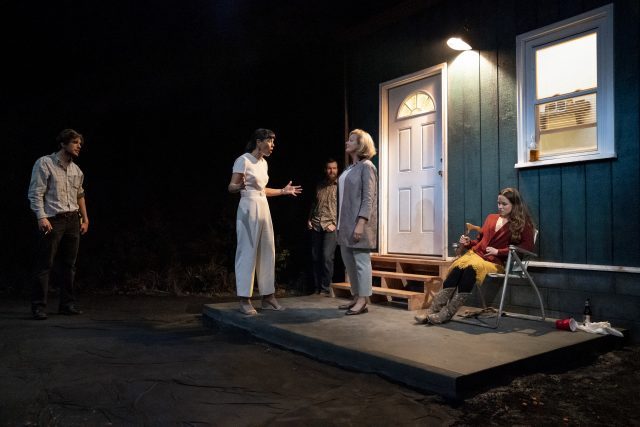
It’s Catholic conservative against Catholic conservative in world premiere of Will Arbery’s Heroes of the Fourth Turning at Playwrights Horizons (photo by Joan Marcus)

Playwrights Horizons, Mainstage Theater
416 West 42nd St. between Ninth & Tenth Aves.
Tuesday – Sunday through November 10, $49-$89
www.playwrightshorizons.org

Almost every day we see news about the cannibalistic infighting among the Democrats as the moderate, liberal, and progressive wings argue over policy and identity politics while the original field of more than two dozen candidates to challenge President Donald Trump is whittled down. What appeared to be a slam dunk has been hampered by uncertainty and venomous attacks on their own. Tired of watching them yelling at one another? Then perhaps it’s time to hear some Republicans ripping each other apart, as playwright and filmmaker Will Arbery twists audience expectations in his unnerving and wickedly poignant Heroes of the Fourth Turning, making its world premiere at Playwrights Horizons through November 10. New York City theatergoers who are used to seeing liberal-minded works that attack, and often deride, religious conservatives and Trump supporters are in for a surprise as Arbery, who was raised in a Christian conservative home in Dallas, Texas, brings together five Republicans who are also hampered by uncertainty and let loose some venomous attacks. “We are living in barbaric times,” Justin says.

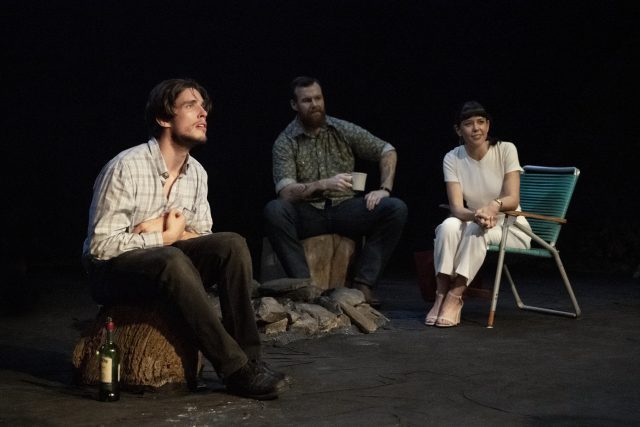
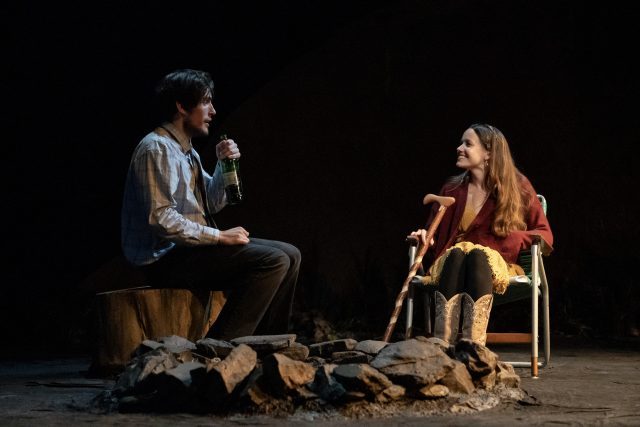
It’s August 19, 2017, one week after the Charlottesville riot and two days before the solar eclipse, and a group of friends are mingling in Justin’s backyard in the small town of Lander, Wyoming, pop. 7,000. (The cozy evening set is by Laura Jellinek.) He’s hosting a party for Dr. Gina Presson (Michele Pawk), who has just been inaugurated president of Transfiguration College of Wyoming, the alma mater of Justin (Jeb Kreager), Emily (Julia McDermott), Kevin (John Zdrojeski), and Teresa (Zoë Winters). They all graduated Transfiguration over the past fifteen years, and all are in the path of totality, a scientific term relating to the eclipse as well as a metaphor for their attempts to find their individual paths in the world. Although the Republicans control the White House and Congress, the friends are concerned about the Democrats. “There are more of them. We lost the popular vote, by a lot. And they’re mobilizing. In many ways, they are in power. And they’re trying to wipe us out,” Justin says. “There’s a war coming,” Teresa warns.

(photo by Joan Marcus)

Kevin (John Zdrojeski), Justin (Jeb Kreager), and Teresa (Zoë Winters) pray for better times in new political play (photo by Joan Marcus)

Kevin, who drinks, smokes, and snorts too much, is an off-balance clod who spurts out whatever’s on his mind, which pisses off the cold, calculating Teresa, who has moved to Brooklyn. “Don’t say gross things in a holy space,” Teresa declares after he makes a rude remark. “This isn’t a holy space; it’s just Justin’s house,” Kevin replies. “The panopticon, Kevin, Catholicism is the panopticon. This is a holy space,” Teresa explains. “It’s also a profane space,” Kevin responds.

They bicker over the Virgin Mary, morality, identity, the LGBT community, Trump, Hillary Clinton, Barry Goldwater, abortion, Patrick Buchanan, and more, making many of the same arguments that liberals do; in fact, if you were to switch a few names or words here and there, it could be a battle between lefties. There’s also a sexual energy that looms, from a past secret to possible future hook-ups.

The verbal sparring heats up when the distinguished Gina joins them and is not happy about Teresa’s unyielding support of far-right ideologues. Gina — a right-wing mirror of Hillary Clinton, down to her personal style — tells her, “These new people on the right, they’re not true conservatives. They’re charlatans, they’re hucksters. And honestly, darling, they’re a bit racist.” Meanwhile, Emily, who is very ill with what appears to be Lyme disease, is somewhere in the middle, searching for the human element. “Wow, she is . . . I’m sorry but she is such a hypocrite,” she says of Teresa. “At the ceremony, she had a little audience and she was trying to get me to admit that my liberal friend was a bad person. And I’m sorry, but I think it’s unfair to argue that I should cut ties with someone just because they’re on the other side. I can’t see things in black-and-white like that. I have a full faith, it’s my rock, it’s my pain, it’s my everything — and I also am friends with whoever I want to be friends with.”

(photo by Joan Marcus)

Kevin (John Zdrojeski) and Emily (Julia McDermott) discuss love and politics in Heroes of the Fourth Turning (photo by Joan Marcus)

Arbery (Plano, Evanston Salt Costs Climbing) was inspired by William Strauss and Neil Howe’s 1997 book The Fourth Turning: An American Prophecy — What the Cycles of History Tell Us About America’s Next Rendezvous with Destiny and his own family: He was raised in Texas by Catholic conservatives who were not a bunch of numbskull deplorables but fellow citizens with a different point of view. Teresa explains that there are four turnings, each one lasting about a generation: High, Awakening, Unraveling, and Crisis. In the play, as in America today, we are at Crisis mode. Not only won’t Republicans listen to Democrats, and liberals won’t listen to conservatives, but all the caterwauling within the same party is creating chaos; empathy and compassion have all but disappeared when it comes to politics. “Trump was made possible by the uneducated. . . . Liberty is being attacked, by both sides, and it’s tragic to see. Polarities make way for a tyrant,” Gina says, but Teresa proclaims, “Trump is a Golem molded from the clay of mass media and he’s come to save us all.”

Danya Taymor’s (Daddy, Pass Over) sharp, eagle-eyed direction smooths over some rough patches and carefully avoids turning the play into the kind of political posturing and manufactured conflicts we see on television news and social media, and monologues delivered by the three actresses are downright exhilarating, even if your personal opinions are completely contrary to theirs. In fact, the three female characters are stronger than the two males, and that shows in the acting; McDermott (Epiphany, Queens), Tony winner Pawk (A Small Fire, Hollywood Arms), and Winters (White Noise, An Octoroon) kick the men’s butts. But the real star of the show just might be sound designer Justin Ellington; the play begins with a blaring gunshot, and Ellington later lets loose a shrill, mysterious explosion of loud noise several times, a clarion call that perhaps is meant to wake us up to what is happening to every one of us, no matter who you plan to vote for in 2020.

IF PRETTY HURTS UGLY MUST BE A MUHFUCKA

(photo by Joan Marcus)

Tori Sampson’s If Pretty Hurts Ugly Must Be a Muhfucka investigates beauty through adult fairy tale (photo by Joan Marcus)

Playwrights Horizons, Mainstage Theater
416 West 42nd St. between Ninth & Tenth Aves.
Tuesday – Sunday through April 5, $49-$89
www.playwrightshorizons.org

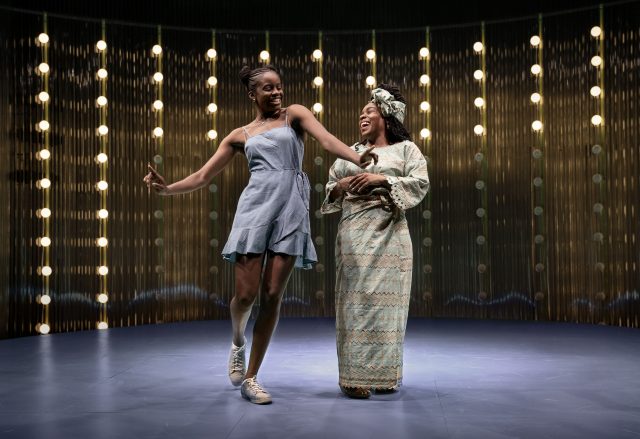
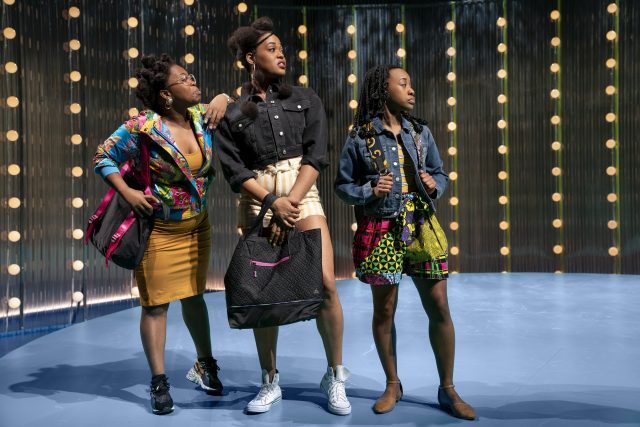
“There can only be one star. So why you hatin’?” Chorus (Rotimi Agbabiaka) asks at the beginning of Tori Sampson’s chaotic If Pretty Hurts Ugly Must Be a Muhfucka, which opened tonight at Playwrights Horizons. The 110-minute play is a contemporary folktale investigating the concept of beauty, both inner and outer, as it relates to black women, a mashup of “Cinderella” and “Snow White” as seen through the lens of Beyoncé’s “Pretty Hurts” video. Akim (Níkẹ Uche Kadri), considered the most beautiful young woman in the village of Affreakah-Amirrorkah, is about to turn eighteen, but her overprotective parents (Maechi Aharanwa and Jason Bowen) have forbid her to attend a society party honoring the milestone. Three of her frenemies (think evil stepsisters), Massassi (Antoinette Crowe-Legacy), Adama (Mirirai Sithole), and Kaya (Phumzile Sitole), are going and lord it over her as they jealously plot.

(photo by Joan Marcus)

Local beauty Akim (Níkẹ Uche Kadri) shimmies with her mother (Maechi Aharanwa) in world premiere at Playwrights Horizons (photo by Joan Marcus)

“She’s not afraid of us rubbing off on her. Akim’s scared if people see her too closely then we’ll notice that she’s flawed like the rest of us,” Kaya says, to which Akim responds, “Actually, I’d like that very much. Maybe you can discover a flaw I’ve tried but to no avail.” Massassi gets particularly perturbed when her supposed intended, local slacker Kasim (Leland Fowler), starts hanging out with Akim. Kaya says, “We have to find a way to make her ugly. ’Cause for real, that’s the only way Kasim will chill.” Massassi offers, “Oh! Let’s pour Nair in her shampoo! All her hair will fall out.” Adama adds, “She’ll just end up looking like a better version of Lupita N’yongo.” As the party approaches, the stakes grow higher, reminiscent of Jocelyn Bioh’s recent School Girls; or, the African Mean Girls Play, in which a group of students seek to be named Miss Ghana. (In fact, two members of the fine If Pretty Hurts ensemble, which also includes Carla R. Stewart as the Voice of the River and musicians Rona Siddiqui and Erikka Walsh, appeared in School Girls.)

(photo by Joan Marcus)

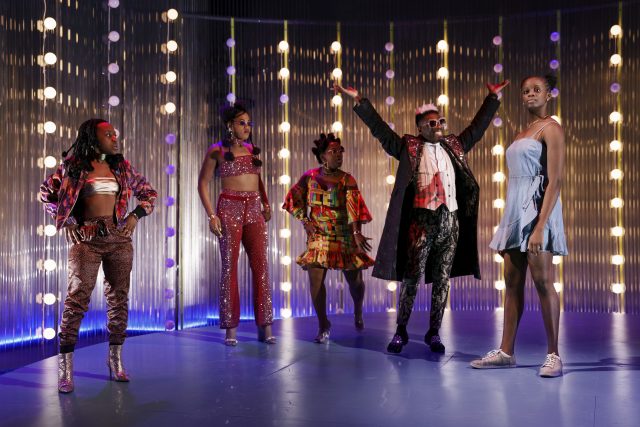
Adama (Mirirai Sithole), Massassi (Antoinette Crowe-Legacy), and Kaya (Phumzile Sitole) are like the three stepsisters in Cinderella in If Pretty Hurts Ugly Must Be a Muhfucka (photo by Joan Marcus)

Directed by Obie winner Leah C. Gardiner (Born Bad, The Ruins of Civilization) and choreographed by Raja Feather Kelly (The Death of the Last Black Man in the Whole Entire World, Everybody), If Pretty Hurts Ugly Must Be a Muhfucka is all over the place, with a scattershot, choppy narrative that often feels unfocused. However, it makes some smart observations about beauty, self-esteem, and envy in both poignant and humorous ways. “Beauty is neither your accomplishment nor your failure,” Akim points out, while Chorus, a living cellphone who is a wildly fashionable mix of the stage manager from Our Town, the Fairy Godmother from Cinderella, and Flavor Flav from Public Enemy, tells the audience, “Hierarchy makes the world go round, folks. And if given the chance, we’d all covet that number one spot.” Louisa Thompson’s bright set feels like a game show, with a round central platform surrounded by a semicircle of dozens of rows of lightbulbs that turn on and off to create frames and doorways while often evoking the feeling of a giant makeup mirror as the characters look at themselves and at us, letting us all know that each one of us is a star. (The lighting is by Matt Frey.) The bittersweet finale firmly situates the fable in the real world, reminding us of the struggle so many women face every day.

I WAS MOST ALIVE WITH YOU

I Was Most Alive with You

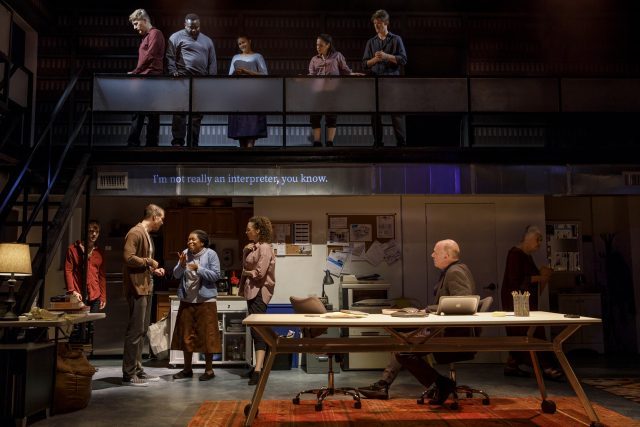
A shadow cast signs the dialogue from the balcony in Craig Lucas’s I Was Most Alive with You (photo by Joan Marcus)

Playwrights Horizons
Mainstage Theater
416 West 42nd St. between Ninth & Tenth Aves.
Tuesday – Sunday through October 14, $59-$99
www.playwrightshorizons.org

Craig Lucas’s I Was Most Alive with You serves up a Thanksgiving setting, but it’s not a genuine turkey. Rather, it’s a turducken of a play, an overwrought melodrama stuffed with everything but the kitchen sink, as troubles inside troubles inside yet more troubles pile onto the characters in this otherwise well-staged New York premiere. The show, which opened tonight at Playwrights Horizons, was inspired by real tragedies in Lucas’s life as well as the Book of Job. (Lucas also wrote the play specifically for deaf actor Russell Harvard after seeing him in the Paul Thomas Anderson film There Will Be Blood and Nina Raine’s off Broadway play Tribes.) The narrative unfolds in flashback; in California in March 2010, longtime TV writing partners Ash (Michael Gaston) and Astrid (Marianna Bassham) are trying to come up with ideas for their next collaboration, and they decide to tell the story of what happened the previous Thanksgiving, how an accident changed the lives and fortune of friends and family. A recovering alcoholic, the Jewish Ash has a strained relationship with his wife, Pleasant (Lisa Emery), who hopes he is having an affair with Astrid. Their son, Knox (Harvard), a deaf recovering alcoholic and drug addict, is in love with Farhad (Tad Cooley), an angry, hearing-impaired, drug-using Muslim. Ash’s mother, Carla (Lois Smith), a Jewish convert, has been battling cancer, attended to by Mariama (Gameela Wright), a nurse who became a Jehovah’s Witness while recovering from drug addiction and who has a son on death row. The cast is lost amid the narrative mess, overplaying underdeveloped characters we don’t care about, speaking in sermonettes and platitudes, many straight out of the recovery playbook. For example, at Thanksgiving dinner, Knox says he is grateful “for two, no, three things I used to think weren’t gifts at all: Deafness. . . . Being gay. . . . Addiction. . . . They are gifts. . . . Each brought me to great clarity.”

I Was Most Alive with You

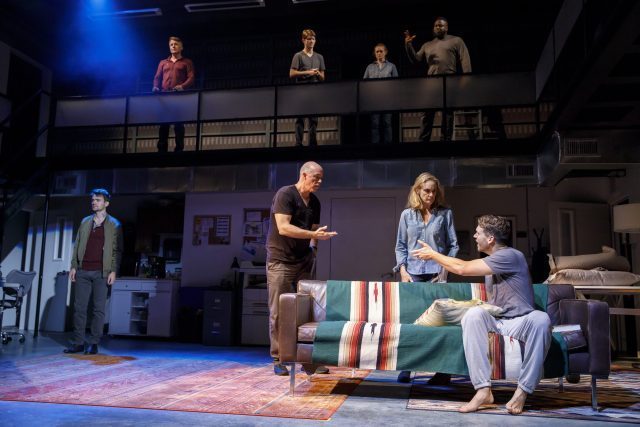
A family faces a series of Job-like catastrophes in I Was Most Alive with You at Playwrights Horizons (photo by Joan Marcus)

The play examines how we communicate with one another — and how we don’t — in person, electronically, verbally, and nonverbally. Most of the characters are at least partially deaf, either involving the actual ability to hear or to listen to what people are telling them, and most also have at least some knowledge of sign language. (Sabrina Dennison serves as director of artistic sign language.) Words that are signed but not spoken are projected onto Arnulfo Maldonado’s effective, if workmanlike, set. Taking a page from Michael Arden’s outstanding Broadway revival of Spring Awakening with Deaf West Theatre, in which each speaking actor was shadowed by someone signing, in I Was Most Alive with You the shadows are on the second level, shadowing their characters from above. The shadow cast consists of Beth Applebaum (Astrid), Harold Foxx (Knox), Seth Gore (Ash), Amelia Hensley (Pleasant), Christina Marie (Carla), Anthony Natale (Farhad), and Alexandria Wailes (Mariama). Unfortunately, occasionally one of the shadows emits sounds while signing, which might be inevitable but is distracting. Two-time Tony nominee Lucas (Prelude to a Kiss, The Light in the Piazza) throws in so much dizzying conflict that director Tyne Rafaeli (The Rape of the Sabine Women, Actually) never has a chance to navigate through the confusion. Not even God would have made Job suffer through I Was Most Alive with You. Playwrights Horizons’ next production is the world premiere of Larissa FastHorse’s The Thanksgiving Play; hopefully turducken will not be on the menu.