Tag Archives: Kenny Leon

BALANCING THE BALUSTRADE: A BRILLIANT NEW BROADWAY COMEDY

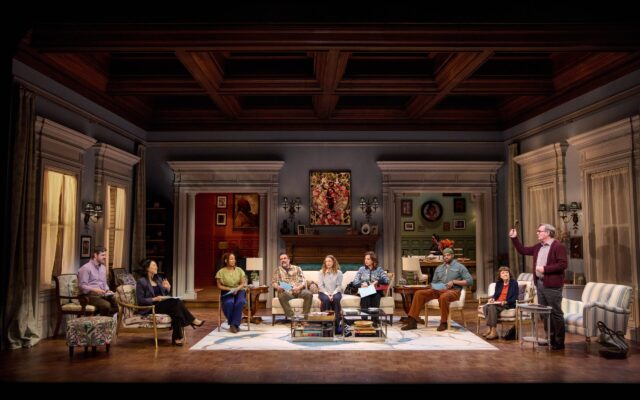
A series of meetings of the Vernon Point Neighborhood Association opens up old and new wounds in The Balusters (photo by Jeremy Daniel)

THE BALUSTERS
Samuel J. Friedman Theatre
261 West Forty-Seventh St. between Broadway & Eighth Ave.
Tuesday – Sunday through May 24, $58-$347
www.manhattantheatreclub.com

Yesterday afternoon I bumped into Richard Thomas on the Upper East Side. I told him how fabulous I thought The Balusters, the new Broadway play he’s starring in, is and what a great cast he’s working with. But as much fun as I had at the show, it appears that he is having even more, if that’s possible, gushing about David Lindsay-Abaire’s script and the entire ensemble. His smile was even bigger than mine.

Making its world premiere at MTC’s Samuel J. Friedman Theatre, The Balusters takes on a kitchen sink of contemporary issues, from homophobia, racism, classism, and corruption to toxic masculinity, privilege, bigotry, and furniture. And it does so in hilarious ways; I can’t remember the last time I laughed so long and hard during a play or clapped so often after side-splitting, sparkling lines of dialogue.

The hundred-minute comedy is set at several meetings of the Vernon Point Neighborhood Association, where a group of nine people regularly gather to discuss the state of their beloved community, a peaceful, old-fashioned enclave steeped in history, boasting well-manicured lawns, comfortable, attractive porches, and an overall flavor of Victorian elegance. The host is the newest member, Kyra Marshall (Anika Noni Rose), who has recently moved from Baltimore with her husband and their twin daughters. She lives in a beautifully designed home with fashionable chairs and couches, fancy china, and paintings of and by distinguished Blacks on the walls, as if overseeing the coming shenanigans, including, in the foyer, a print of George DeBaptiste’s 1978 portrait of Toussaint L’Ouverture, who was born a slave and went on to be a leader of the Haitian Revolution, and, above the fireplace, a flower-laden portrait of a Black feminist that evokes the work of contemporary Black American artists Harmonia Rosales and Kehinde Wiley. (The elegant set is by two-time Tony and two-time Emmy winner Derek McLane.)

The gavel-wielding president of the association is Elliot Emerson (Thomas), a fuddy-duddy real-estate broker intent on protecting the legacy of Vernon Point. The other members are Latino contractor Isaac Rosario (Ricardo Chavira); the acerbic, antagonistic Jewish treasurer, Ruth Ackerman (Margaret Colin); Willow Gibbons (Kayli Carter), a young, white vegan who sees microaggressions everywhere; Brooks Duncan (Carl Clemons-Hopkins), a gay Black travel writer who is married and has a son; the somewhat hapless Alan Kirby (Michael Esper), a white man in his fifties who considers himself an ally and doesn’t understand why he is so often ignored; Melissa Han (Jeena Yi), an ambitious Asian American lesbian and lawyer who is the vice president; and Penny Buell (Marylouise Burke), the elderly white secretary who used to work for Elliot and is not nearly as doddering as she might let on, surprising everyone with sharply focused acerbic quips. Also present is Luz Baccay (Maria-Christina Oliveras), Kyra’s ultra-efficient Filipino housekeeper who left the Emersons’ employ for unstated reasons.
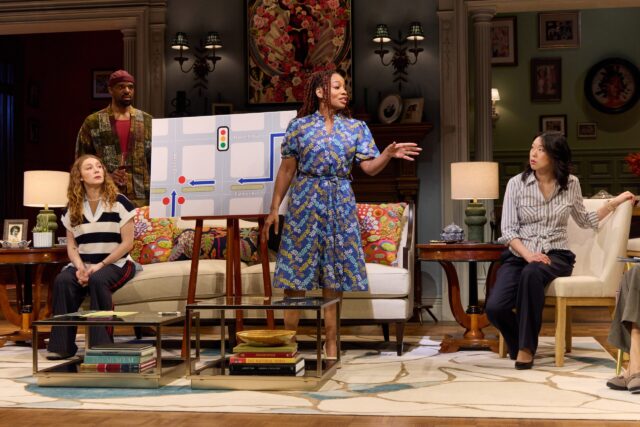
New resident Kyra Marshall (Anika Noni Rose) has no idea what she’s in for after joining group (photo by Jeremy Daniel)

Among the topics of discussion are expanding the hours of the safety van to catch porch pirates, how to handle kids who don’t live in Vernon Point but hang out there, and the plain, ahistorical balusters the Crawfords may be installing, which insult Elliot and lead to the following exchange, which helps define the characters while establishing the play’s central metaphor.

Elliot: Farmhouse balusters aren’t true to the period or style of the original railing. They’d look ridiculous on that Queen Anne.
Melissa: But we don’t police our neighbors.
Elliot: It’s not policing. If you live here, you’ve agreed to certain guidelines.
Kyra: I hate to ask, but what exactly are balusters?
Elliot: I’m sorry, Kyra. We should’ve started with that.
Isaac: They’re the posts that support a railing. They’re like spindles but with footings.
Kyra: Okay, I’m gonna nod and pretend I know what that means.
Melissa: You’re gonna learn so much useless information here.
Elliot: It’s not useless. The balusters are important. They hold everything up. A porch’ll fall to pieces without the right support.
Ruth: As riveting as this is, may we move on?

When Kyra suggests that the group request stop signs for a corner where numerous accidents have occurred, heated arguments ensue, eventually becoming personal over the course of several meetings and leaving no one unscathed, their biases revealed via revenge, gossip, and carelessness.
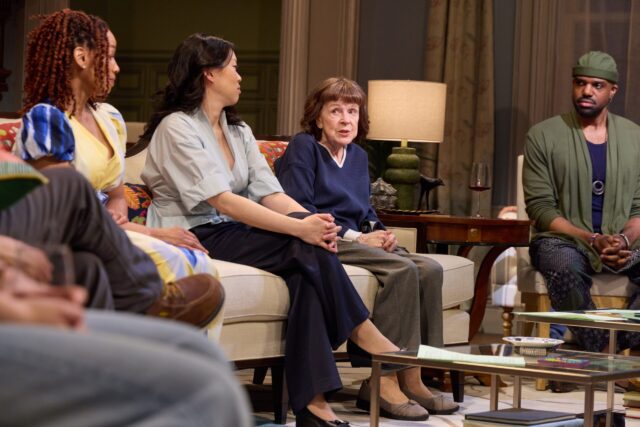
Penny Buell (Marylouise Burke) is deceptively clever and prescient in brilliant new Broadway comedy (photo by Jeremy Daniel)

The Balusters is brilliantly written by Tony and Pulitzer winner Lindsay-Abaire (Rabbit Hole, Kimberly Akimbo) and expertly directed with a wry sense of humor by Tony winner Kenny Leon (Purlie Victorious: A Non-Confederate Romp Through the Cotton Patch, Home). It is reminiscent of both Bruce Norris’s Tony- and Pulitzer-winning Clybourne Park and Jonathan Spector’s Tony-winning Eureka Day, two plays that explore what can go wrong when small groups of people think they can decide what’s right and wrong for others. It will also likely remind New Yorkers of why they don’t want to be on their coop board.

Five-time Tony nominee Emilio Sosa’s costumes are impeccable, and four-time Tony nominee Allen Lee Hughes’s lighting and six-time Tony nominee Dan Moses Schreier’s sound — he also composed the excellent interstitial music, which features a rap bent — are in sync throughout, especially when thunder and lightning strike at just the right instances.

The terrific ensemble forms an outrageously funny extended family, led by Emmy winner Thomas (Our Town, The Little Foxes) as an older man seeing his carefully curated life slip away and Tony winner Rose (Caroline, or Change, A Raisin in the Sun) as a younger woman who is not afraid to get in Elliot’s way, but theater treasure Burke (Ripcord, Infinite Life), in her seventh collaboration with Lindsay-Abaire, steals the show as Penny, who always knows just what to say.

“I’d just like to remind us that everyone in this room is a decent person,” Penny interjects at one point when things are threatening to get out of hand. “We wouldn’t be here if we didn’t care about our neighbors. At the same time, no one is perfect, and sometimes people make mistakes.”

Now, where’s my gavel?

[Mark Rifkin is a Brooklyn-born, Manhattan-based writer; you can follow him on Substack here.]

LEAVING TOMORROW TO TOMORROW: TOM HANKS AT THE SHED

Bert Allenberry (Tom Hanks) meets Virginia (Kayli Carter) and Carmen (Kelli O’Hara) at the 1939–40 World’s Fair in This World of Tomorrow (photo by Marc J. Franklin)

THIS WORLD OF TOMORROW
The Shed’s Griffin Theater
545 West 30th St. at Eleventh Ave.
Tuesday – Sunday through December 21, $169-$299
theshed.org

The 1939–40 World’s Fair was an extraordinary moment in New York City history, as people from around the globe descended on Flushing Meadows to see such attractions as the Trylon and Perisphere, Elektro the Moto Man, the Fountains of Light at the Lagoon of Nations, General Motors’ Futurama, the Life Savers Parachute Jump, the Helicline, the Aquacade, and a Rembrandt self-portrait. It’s been memorialized in books, movies, and museum exhibits, and now it’s the setting of a new play cowritten by and starring Tom Hanks, running at the Shed through December 21.

This World of Tomorrow gets off to a rousing start, with jazzy entrance music by Louis Armstrong, the Dorsey Brothers, Lionel Hampton, Benny Goodman — and Nina Simone, who is from the next generation. In the opening scene, two people from the future, Bert Allenberry (Hanks) and Cyndee (Kerry Bishé), have traveled back in time to the World’s Fair, to June 8, 1939; while Bert is fascinated by everything he is experiencing, Cyndee is less enthusiastic. When looking at four sculptures by Leo Friedlander, Bert reverentially reads to Cyndee, “All citizens of the world are entitled to these four Freedoms: Of Religion, Speech, Assembly, and that one there. The Press. . . . Never has the world held a brighter promise of things to come. The Present is but an instant between an Infinite Past and a Hurrying Future.”

They then meet Carmen Perry (Kelli O’Hara) and her teenage niece, Virginia (Kayli Carter), who are playing hooky from work and school, respectively. Bert is instantly smitten with Carmen as much as he is excited by the fair. When he offers them his VIP pass and pin that says, “I have seen the future,” Virginia turns him down, explaining that she is learning to approach life with patience and so will wait in line like most everyone else. “Enjoy the anticipation,” Bert says, surprised.

Bert and Cyndee return to 2089, where they work at SKAEL, the Salina Kansas Alternating Enterprise Lab, which he runs with M-Dash (Ruben Santiago-Hudson). While Bert gleefully talks about hot dogs, cake, and coffee, which apparently aren’t available in 2089, M-Dash wonders why he didn’t kill Adolf Hitler and reminds him about the racism that was prevalent 150 years before, two classic time-traveling genre tropes. (Other tropes, like how Bert has to avoid changing anything that could impact the space-time continuum, are either ignored or given short shrift.) Bert and M-Dash get caught up in a discussion filled with techno-jargon — Finite Atomic Structure, DODEKA, VOX-PAC, Impulse coding, Inner-Structurals — and seek answers from ELMA (Jamie Ann Romero), an External Learning Machine Associate, a sort of AI robot who speaks without emotion.

The narrative shifts back to the morning of June 8, 1939, as Carmen, a divorced bookkeeper, gets ready to take Virginia to the fair. Carmen lives in the Bronx with her brother, Max (Jay O. Sanders), Max’s wife, Sylvia (Romero), and Virginia in a cramped apartment. Max is a tough-talking butcher, and Sylvia is a nurse who works the late shift at Bellevue. Max plays pinochle with his buddies. Carmen has lunch every day at a Greek diner off Sheridan Square owned by an immigrant named Costas (Sanders), a larger-than-life figure who promises his food is “number one the best.”

After several trips to the past, Bert is warned by Honoria (Michelle Wilson) and Dr. Tanner (Paul Murphy) of Chronometric Adventures that his portal-related Trillic Acid numbers are at dangerous levels and that he should not go on another journey, but his fondness for Carmen makes him consider risking it all.

This World of Tomorrow is like an hourlong episode of The New Twilight Zone (without commercials), except it’s two hours and fifteen minutes (with intermission), along with a dash of the 1980 romantasy Somewhere in Time, more than a hint of Back to the Future, and a touch of the 1985 anthology series Amazing Stories thrown in. (In fact, the 1939 New York World’s Fair is a key plot point in the time-traveling TZ episode “The Odyssey of Flight 33.”) There’s a lot of repetition and explication; it could benefit from being trimmed down to a leaner ninety minutes or so.

The Salina Kansas Alternating Enterprise Lab has an important meeting in 2089 (photo by Marc J. Franklin)

The play is based on two short stories from Hanks’s 2017 collection Uncommon Type, “The Past Is Important to Us” and “Go See Costas,” but Tony-winning director Kenny Leon (Topdog/Underdog, Home) can’t quite merge them on Derek McLane’s ever-shifting set, which switches from a Bronx kitchen and a Greek diner to a conference room and the fair and features archival projections on more than two dozen pillars. Dede Ayite’s costumes help differentiate the various time periods, but it still feels like multiple stories unsuccessfully merged into one.

Oscar and Emmy winner and Tony nominee Hanks is most well known as a television and film star, but he cut his teeth with the Riverside Shakespeare Company in New York and the Great Lakes Shakespeare Festival in Cleveland in the late 1970s; he made his Broadway debut in Lucky Guy in 2013, and he played Falstaff in the Shakespeare Center of Los Angeles’ Henry IV in 2018. Clearly comfortable on the stage, he is as appealing as ever as Bert, an eminently likable man who doesn’t have a bad thing to say about anyone. He has instant chemistry with Tony winner and Emmy and Grammy nominee O’Hara (The Light in the Piazza, The King and I), who mostly appears in musicals but is at home here, lending a working-class elegance to Carmen. You desperately want them to fall in love and be together, but not all the obstacles they face make sense.

The rest of the cast is trapped in thankless roles that only get in the way of the central story. And the dialogue is overladen with scientific concepts that weigh down the narrative with confusing verbiage — it lacks the fun charm of, say, Star Trek’s invented technological language — and Hanks and cowriter James Glossman preach too much about peace and love.

“Let’s leave tomorrow to tomorrow,” Carmen suggests. That’s not necessarily a bad idea.

And as Lee (Lee Aaron Rosen), one of Bert’s colleagues at SKAEL, emphasizes, “Learning that ‘The Past Is Important to Us’ don’t come cheap.”

Neither does learning about the future.

[Mark Rifkin is a Brooklyn-born, Manhattan-based writer and editor; you can follow him on Substack here.]
SUMP’N LIKE OUR TOWN: AMERICA ONSTAGE

The Mint produciton of Lynn Riggs’s Sump’n Like Wings is worthy of much applause (photo by Maria Baranova)

SUMP’N LIKE WINGS
The Mint Theater at Theatre Row
410 West 42nd St. between Ninth & Tenth Aves.
Tuesday – Sunday through November 2, $39-$99
minttheater.org
www.theatrerow.org

In 1938, Thornton Wilder, who was born in Wisconsin in 1897, wrote what many consider one of the greatest American plays, the Pulitzer Prize–winning Our Town. The drama, a perennial favorite in high schools and community theater and off and on Broadway, is set in the small, fictional town of Grover’s Corners, New Hampshire, in 1901, where ordinary people go about their ordinary lives, including going to church, falling in love, and facing tragedy. It can currently be seen in an all-star version at the Ethel Barrymore through January 19. Wilder, who was gay, also won Pulitzers for his 1927 novel, The Bridge of San Luis Rey, and his 1942 play, The Skin of Our Teeth.

In 1925, Lynn Riggs, who was born in Oklahoma in 1899, wrote Sump’n Like Wings, a little-known play that was published in 1928 and premiered in 1931. The rarely performed drama is set in the small, fictional town of Claremont, Oklahoma, where ordinary people go about their ordinary lives, including going to church, falling in love, and facing tragedy. It concluded its too-short run at Theatre Row on November 2. Riggs, who was gay, also wrote the 1931 play Green Grow the Lilacs, which was the basis for the classic musical Oklahoma!, which won a Pulitzer in 1944 in addition to several Tonys and Oscars over the years.

The New York premiere of Sump’n Like Wings is presented by the Mint, the theater world’s finest purveyor of lost, forgotten plays, but this one is a welcome change of pace for the company, which specializes in British and American working-class tales and drawing-room comedies that often explore sociopolitical issues of their time. The splendid two-hour, two-act play takes place in the Old West of the 1910s, where the characters speak in western drawl and rhythm unusual for the Mint but as exquisitely rendered as ever.

The strict Mrs. Baker (Julia Brothers), a widow, operates the dining room of the St. Francis Hotel for Ladies and Gents in Claremont, where she is raising her sixteen-year-old daughter, the wild child Willie (Mariah Lee), with the help of her brother, Jim Thompson (Richard Lear), who owns the hotel. The town is aghast when shoplifter Elvie Rapp (Lindsey Steinert) lets all the prisoners out of the local jail; to rehabilitate her, Sheriff Beach (Andrew Gombas) is forcing her to work for Mrs. Baker. Instead of going to school, Willie waits tables for her mother, but she is being pursued by the married Boy Huntington (Lukey Klein), who wants to run away with her. Judging them all is Jim’s housekeeper, Hattie (Joy Avigail Sudduth).

Talking about why she let the men go, Elvie tells Willie, “You don’t know whut it is to be locked up, locked up away from the sun and the air. You don’t know whut it means not to be free to go and come whenever you please — with no one to stop you, and no iron bars a-shuttin you in like a animal —.” Willie cuts her off, declaring, “I — do — too.” Elvis responds, “You don’t! You cain’t know! And you don’t know how fin’lly you git sick, sick inside of yer head, so you’d do anything — anything at all to git free, to git away. It ain’t that you wanta go anywheres. It’s the idy of the bars that makes you mad. The bars git in yer mind, and you’d do anything to break em down, to git rid of em —.”

Lynn Riggs’s Sump’n Like Wings explores life in a small Oklahoma town in the 1910s (photo by Maria Baranova)

Therein lies the theme of the play; nearly every character is trying to escape something, searching for freedom from the bars that have surrounded them. They hop railroad cars, go to church, fight over a game of checkers, fall in and out of love, bury themselves in the newspaper, or break the law, challenging societal norms or getting swept up in them. In the first scene, Mr. Clovis (Buzz Roddy), Mrs. Clovis (Traci Hovel), and Osment (Mike Masters) are eating in the dining room and gossiping about Elvie. While the Clovises see the former prisoners as “crimernals, ever one of em!,” cowman Osment insists, “They was men, Mis’ Clovis. They was men.

They then hear fierce noises coming from behind a closed door; it’s Willie, screaming to be let out, threatening to kick the door down. Mrs. Baker yells right back at her, threatening her. It ultimately turns out that the door is not locked, that Willie could have opened it at any time by herself. But not everyone in Claremont — or anywhere, in the past, present, or future — knows that.

The Mint is justifiably renowned for its fashionably detailed sets, but Junghyun Georgia Lee keeps it relatively simple this time, employing a handful of unadorned wooden chairs and tables that are moved around as the scene shifts from the dining room to a hotel office to a rooming house, with a closed door at one end and an open one at the other. In the back are rows of horizontal slats with enough space between them that the outside world is temptingly visible, filled with both hope and fear. Emilee McVey-Lee’s period costumes maintain the mostly brown color palette. As always with the Mint, the cast is impeccable, transporting the audience to 1910s Oklahoma. Raelle Myrick-Hodges’s (Dirty White Teslas Make Me Sad, Flyin’ West) intricate direction adds contemporary relevancy to the play nearly a century after it was written; who isn’t seeking some form of escape from something these days?

Riggs, who was part Cherokee and served in the US military, died in New York City in 1954 at the age of fifty-four, leaving behind twenty-one full-length plays, about a dozen screenplays (The Plainsman, Sherlock Holmes and the Voice of Terror), and numerous short stories. He was inducted into the Oklahoma Hall of Fame in 1943 and deserves to be better remembered for more than just one play.

Jim Parsons stars as the Stage Manager in Broadway revival of Our Town (photo by Daniel Rader)

OUR TOWN
Ethel Barrymore Theatre
243 West Forty-Seventh St. between Broadway & Eighth Ave.
Through January 19, $74 – $321
www.ourtownbroadway.com

Two-time Tony winner Kenny Leon’s streamlined adaptation of Thornton Wilder’s Our Town suffers from trying too hard to be all things to all people. Like Sump’n Like Wings, it has a spare, rustic set, with various chairs and tables being moved around and a large distressed wood barn wall in the back, with one door and a pair of windows that open up like the Laugh-In joke wall. Fifteen audience members sit in boxes on either side of the stage, more like a jury than part of the neighborhood being celebrated between them. Meanwhile, rows of lanternlike lights extend like stars over the stage and the audience, as if we’re part of this neighborhood too. (The set is by Beowulf Boritt, with costumes by Dede Ayite, lighting by Allen Lee Hughes, and sound by Justin Ellington.)

The first words we hear are “Shema Yisrael,” which begins the Jewish prayer of affirmation, here from the 2019 Abraham Jam song “Braided Prayer,” which features sacred words from multiple religions; the cover of the album features three silhouetted figures in three doorways, holding different phases of the moon, surrounded by religious-tinged quotes in English, Hebrew, Arabic, and other languages. The Stage Manager, played with frantic charm by Jim Parsons as if he’s trying to end services early — Parsons previously played the Supreme Being in 2015’s An Act of G-d at Studio 54 on Broadway — points out, “Religiously, we’re eighty-five per cent Protestants; twelve per cent Catholics; rest, indifferent.” Thus, there appear to be no Jews (or Muslims) in 1901 Grover’s Corners, New Hampshire, although, near the end of the play, a Jewish star is visible on a gravestone in the cemetery.

In addition, the diverse casting is strongly evident, as if making its own case, including deaf milkman Howie Newsome (John McGinty), who communicates with his customers in sign language. And to insist on the play’s relevance in the twenty-first century — the time and setting in noted as “now” — two characters pull out cell phones, only to be chastised by the Stage Manager. It’s less cute than it is annoyingly disconcerting. And when a belligerent woman, portrayed by Bryonha Marie, who is Black, asks, “Is there no one in town aware of social injustice and industrial inequality?,” it takes on a different meaning today than it would have when performed by a white actor seventy-five years ago. (The question might sound like it’s been added for this production, but it’s in the original script, again revealing Wilder’s talent for the universal.)

George Gibbs (Ephraim Sykes) chats with Mr. and Mrs. Webb (Katie Holmes and Richard Thomas) in Kenny Leon’s Our Town (photo by Daniel Rader)

Wilder populates his imaginary world with mostly respectably people doing mostly respectable things. “Nice town, y’know what I mean?” the Stage Manager says. “Nobody very remarkable ever come out of it, s’far as we know.”

Dr. Gibbs (Billy Eugene Jones), the town MD, chats with the paper deliverer, Joe Junior, while Mrs. Gibbs (Michelle Wilson) tends to her garden and their son, George (Ephraim Sykes), dreams of being a baseball player and is falling for his next-door neighbor, Emily Webb (Zoey Deutch), who lives with her brother, Wallee (Hagan Oliveras), and their parents, Mrs. Webb (Katie Holmes), who also has a garden, and the knowledgeable Mr. Webb (a standout Richard Thomas, yet again), editor of the Grover’s Corners Sentinel. Shorty Hawkins flags the 5:45 train to Boston. The town drunk, Simon Stimson (Donald Webber Jr.), conducts the church choir. State university professor Willard (Shyla Lefner) encapsulates the town’s history.

Constable Warren (Bill Timoney) walks the beat, engaging in small talk with the citizenry. Mrs. Soames (Julie Halston) raves on and on about a wedding. Undertaker Joe Stoddard (Anthony Michael Lopez) hates to supervise when they’re burying a young person.

In Grover’s Corners, people live and people die. There are no spoiler alerts when the Stage Manager tells us what is going to become of some of the characters. Leon has eliminated the two intermissions; the three acts — “Daily Life,” “Love and Marriage,” and “Death and Eternity” — are identified by the Stage Manager, who hustles things along, getting the audience out in a mere hundred minutes. This Our Town is a pleasant experience; there are plenty of untidy edges and few lofty moments. But it doesn’t quite feel like real life either; the manipulation is evident, including at the end, where tears flow.

Wilder, who was Protestant and served in the military, died in Hamden, Connecticut, in 1975 at the age of seventy-eight, leaving behind dozens of full-length and short plays, seven novels, and one screenplay (Shadow of a Doubt), but he will forever be remembered first for Our Town.

[Mark Rifkin is a Brooklyn-born, Manhattan-based writer and editor; you can follow him on Substack here.]
HOME

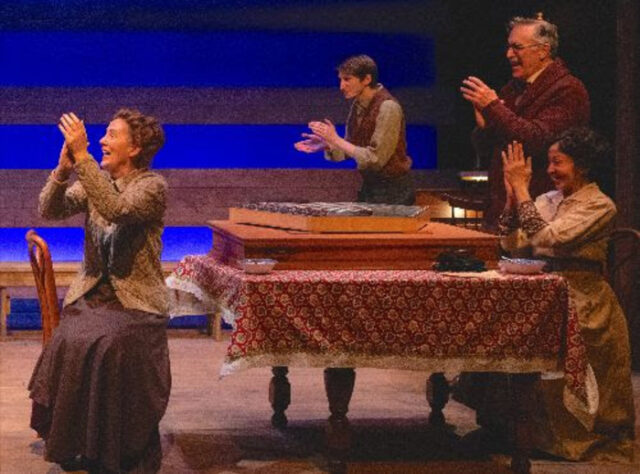
Tory Kittles is flanked by Brittany Inge and Stori Ayers, who play forty characters in Samm-Art Williams’s Home (photo by Joan Marcus)

HOME
Todd Haimes Theatre
227 West Forty-Second St. between Broadway & Eighth Ave.
Tuesday – Sunday through July 21, $49-$149
212-539-8500
www.roundabouttheatre.org

Tony-winning director Kenny Leon describes his Broadway revival of Samm-Art Williams’s rhythmic, poetic Home as a two-hundred-yard dash. It’s more like an Olympic relay, and his team wins the gold.

In December 1979, the Negro Ensemble Company debuted Home at St. Marks Playhouse, with Charlie Brown, Michele Shay, and L. Scott Caldwell, directed by Douglas Turner Ward; the show transferred to the Cort Theatre on Broadway in May, earning Tony nominations for Best Actor and Best Play. A 1982 DC version featured Samuel L. Jackson, S. Epatha Merkerson, and Elain Graham. Sadly, Williams, who was also an actor and television writer and producer, working on such series as The Fresh Prince of Bel-Air, Martin, and Frank’s Place, passed away in his hometown of Burgaw, North Carolina, on May 13 at the age of seventy-eight, just a few days before the first preview of Leon’s throughly engaging Roundabout production at the Todd Haimes Theatre.

Home takes place on Arnulfo Maldonado’s low-tech, cozy set, centered by a rocking chair on a wooden platform in front of a tall row of vegetables and a backdrop of vast green fields under a cloudy sky in the town of Cross Roads, North Carolina, a storm sometimes visible in the distance. Occasionally, a black cutout of a silhouetted house narrows the stage. The show begins with Cephus Miles (Tory Kittles) taking a deep breath — as if getting ready for the race — and two unnamed women who serve as a Greek chorus (Brittany Inge and Stori Ayers) singing, “In the great gitt’n up morning fare you well. Fare you well.” The second woman adds, “If there was ever a woman or man, who has everlasting grace in the eyes of God. It’s the farmer woman . . . and man.”

Cephus Miles (Tory Kittles) searches for home in fast-paced Roundabout revival (photo by Joan Marcus)

However, everlasting grace does not necessarily mean success and happiness. A moment later, after the first woman agrees that Cephus is blessed, the second woman says, “Shit. Big deal. He can think about grace while he’s chopping wood this winter to go in that ‘pop belly’ stove that he cooks on. Or when he has to pack mud in the cracks of his house to keep the wind out, or when he has to use newspaper to wipe his ‘behind’ because toilet paper is just not in his budget.”

Cephus is a simple man with simple desires. He cultivates the fields with his uncle Lewis and granddaddy and appears destined to marry the young and innocent Pattie Mae Wells (Inge). Though not a religious man, he agrees to be baptized by Rev. Doris (Ayers), who warns Pattie Mae, “Keep your eyes on this one, honey. He ain’t a whole Christian yet.”

The chorus lets us know early on that Cephus, like many local men before him, headed off to the big city but didn’t find what he was looking for. “Maybe they’ll all leave,” the first woman says. The second woman responds, “Most of them have. He left. But he came back. Fool.” Cephus also runs afoul of the draft board when his number comes up to go to Vietnam, as he was taught to love thy neighbor and thou shalt not kill. And to make matters more complicated, Pattie Mae decides to go to college, promising to write him every day.

Cephus undertakes a personal Great Migration in an attempt to find a new home, but amid all that befalls him, he sticks to his roots, explaining, “I have no regrets. No bitterness. I’m thankful. And I pray from time to time.”

Stori Ayers, Tory Kittles, and Brittany Inge make the Todd Haimes Theatre feel like home (photo by Joan Marcus)

Serving as the offstage anchor for this wise and very funny and intimate play that never stops once Cephus draws that first deep breath, Leon further establishes himself as contemporary theater’s most consistently successful Broadway revivalist; in the last ten years, he has directed memorable productions of A Raisin in the Sun, A Soldier’s Play, Topdog/Underdog, Ohio State Murders, and Purlie Victorious (among several off-Broadway shows and Shakespeare in the Park). Next up for Leon is Thornton Wilder’s Our Town in the fall, with Jim Parsons, Zoey Deutch, Katie Holmes, Billy Eugene Jones, Ephraim Sykes, Richard Thomas, Michelle Wilson, and Julie Halston.

Williams (The Montford Point Marine, The Dance on Widows’ Row) wrote Home while taking a bus back to where he was born and raised, Burgaw, North Carolina, influenced by the many characters he met on his journey. The play introduces us to such fanciful figures as Joe-Boy Smith, One Arm Ike, Old Chief, Hard Headed Herbert, Lottie Bell McKoy, Aunt Hannah, Pearlene Costin, Sydney Joe Murphy, Mr. Hezekiah Simmons, Miss Lizzie, and Dingles the invisible dog, each worthy of their own individual story as they tend to the fields, go to church, throw craps in the graveyard, or enjoy the fish fry.

Inge (Father Comes Home from the Wars, The Ballad of Klook and Vinette), and Ayers (Blood at the Root, Travisville) are phenomenal, taking on some forty roles between them, metaphorically passing the baton as they swiftly move from one part to the next with only small changes to their voice and demeanor and to Dede Ayite’s naturalistic southern costumes. Allen Lee Hughes’s tender lighting sharpens the focus on the character-driven narrative, while Justin Ellington’s sound maintains the sense of place even as the basic set stays the same as Cephus experiences life outside of Cross Roads, traveling miles away from his family farm (hence his last name).

Kittles (8 Hotels, Richard II) gives a career-defining performance as Cephus, a kind of southern Odysseus wondering what awaits him when he returns to a land he left years before. Kittles fully embodies the unpredictable Cephus, whether sitting in a rocking chair contemplating his fate, relaxing on the wooden platform sharing sweet memories, standing firm for his principles, or, perhaps, becoming a ghost, his right hand shaking.

The ninety-minute play concludes with a glorious finale that crosses the finish line with pure genius, reminding us all that there’s no place like home.

[Mark Rifkin is a Brooklyn-born, Manhattan-based writer and editor; you can follow him on Substack here.]
GO PUBLIC! THE COMEDY OF ERRORS AND MORE

PUBLIC THEATER MOBILE UNIT: THE COMEDY OF ERRORS
Multiple locations in all five boroughs
May 28 – June 30, free (no RSVP necessary)
publictheater.org

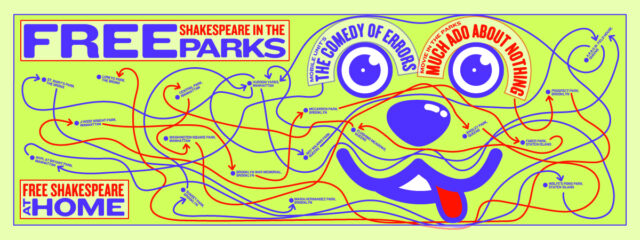
Last year the Public Theater’s Mobile Unit presented Rebecca Martínez and Julián Mesri’s terrific bilingual adaptation of William Shakespeare’s The Comedy of Errors. The production is back for the 2024 summer season, on the road May 28 through June 30, making stops in all five boroughs: the New York Public Library/Bryant Park, Wolfe’s Pond, J. Hood Wright Park, Hudson Yards, Roy Wilkins Park, A.R.R.O.W. Field House, the Cathedral Church of St. John the Divine, Sunset Park, Travers Park, Maria Hernandez Park, Astor Place, St. Mary’s Park, and the Peninsula at Prospect Park.

No advance reservations are necessary, but you should get there early if you want to get up close and personal with the show; last year I caught it in the Richard Rodgers Amphitheater in Marcus Garvey Park, where some audience members sat on the stage, surrounding the action. If you’re not familiar with the Mobile Unit, you need to be; the program is now in its thirteenth year of bringing free Shakespeare to all five boroughs, presenting works in prisons, shelters, and underserved community centers as well as city parks.

With the Delacorte undergoing renovation, the Mobile Unit is part of “Go Public!,” a festival of free Shakespeare events that includes The Comedy of Errors, outdoor screenings of Kenny Leon’s 2019 Shakespeare in the Park production of Much Ado about Nothing starring Danielle Brooks, Chuck Cooper, Margaret Odette, and Billy Eugene Jones, online streaming of that show as well as 2021’s Merry Wives, 2022’s Richard III, and 2023’s Hamlet, and a block party on July 28.

Below is my review of The Comedy of Errors from last year; I cannot recommend it highly enough.

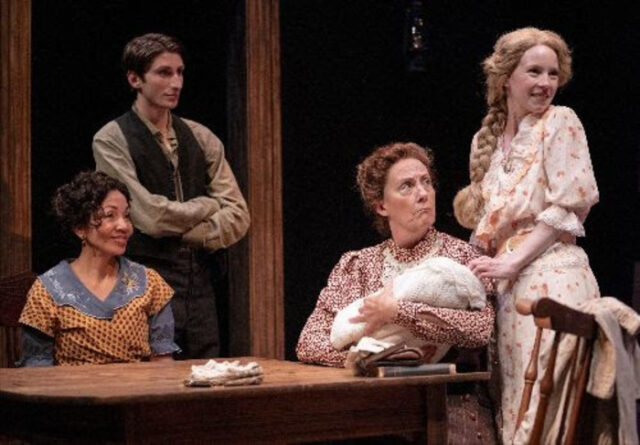
A fab cast sings and dances its way through exuberant production of The Comedy of Errors (photo by Peter Cooper)

PUBLIC THEATER MOBILE UNIT: THE COMEDY OF ERRORS
Multiple locations in all five boroughs
Through May 21, free (no RSVP necessary)
Shiva Theater, May 25 – June 11, free with RSVP
publictheater.org

The Public Theater’s Mobile Unit touring production of The Comedy of Errors is the most fun I’ve ever had at a Shakespeare play.

The Mobile Unit is now in its twelfth year of bringing free Shakespeare to all five boroughs, presenting works in prisons, shelters, and underserved community centers as well as city parks. On May 13, it pulled into the Richard Rodgers Amphitheater in Marcus Garvey Park, where part of the audience sat on the stage, on all four sides of a small, intimate square area where the action takes place; attendees could also sit in the regular seats, long concrete benches under the open sky.

Emmie Finckel’s spare set features a wooden platform and a bright yellow stepladder that serves several purposes. Lux Haac’s attractive, colorful costumes hang on racks at the back, where the actors perform quick changes. Music director and musician Jacinta Clusellas and guitarist Sara Ornelas sit on folding chairs, performing Julián Mesri’s Latin American–inspired score; Ornelas is fabulous as a troubadour and musical narrator, often wandering around the space and leading the cast in song. The lyrics, by Mesri and director and choreographer Rebecca Martínez, who collaborated on the adaptation, are in English and Spanish and are not necessarily translated word for word, but you will understand what is going on regardless of your primary tongue. As the troubadour explains, “I should mention that most of / this show will be performed in English / though it’s supposed to / take place in two states in Ancient Greece. / But don’t be surprised / if these actors switch their language.”

Trimmed down to a smooth-flowing ninety minutes, the show tells the story of a pair of twins, Dromio (Gían Pérez) and Antipholus (Joel Perez), who were separated at birth. In Ephesus, Dromio serves Antipholus, a wealthy man married to the devoted Adriana (Danaya Esperanza) but cheating on her with a lusty, demanding courtesan (Desireé Rodriguez). The other Dromio and Antipholus arrive in Ephesus and soon have everyone running around in circles as the mistaken identity slapstick ramps up.

Adriana (Danaya Esperanza) and Dromio (Gían Pérez) are all mixed up in The Comedy of Errors (photo by Peter Cooper)

Meanwhile, the merchant Egeon (Varín Ayala) is facing execution because he is from Syracuse, whose citizens are barred from Ephesus, per a decree from the Duchess Solina (Rodriguez); the goldsmith Angelo (Ayala, to be played in 2024 by Glendaliris Torres-Greaux) has made a fancy gold rope necklace for Antipholus but gives it to the wrong one; the Syracuse Dromio is confounded when Adriana’s kitchen maid claims to be his wife; the Syracuse Antipholus falls madly in love with Luciana (Keren Lugo), Adriana’s sister; and an abbess (Rodriguez) is determined to protect anyone who seeks sanctuary.

In case any or all of that is confusing, the troubadour clears things up in a series of songs that explain some, but not all, of the details, and the Public also provides everyone with a cheat sheet. Again, the troubadour: “In case you missed it / or took a little nap / Here’s what’s been happening / since we last had a chat / We’ll do our best / but we confess / this plot is really putting our skills to the test.”

It all comes together sensationally at the conclusion, as true identities are revealed, conflicts are resolved, and love wins out.

Martínez (Sancocho, Living and Breathing) fills the amphitheater with an infectious and supremely delightful exuberance. The terrific cast interacts with the audience, as if we are the townspeople of Ephesus. Gían Pérez (Sing Street) and Joel Perez (Sweet Charity, Fun Home) are hilarious as the two sets of twins, who switch hat colors to identify which brother they are at any given time. Esperanza (Mary Jane, for colored girls . . .) shines as the ever-confused, ultradramatic Adriana, Lugo (Privacy, At the Wedding) is lovely as Luciana and the duchess, Rodriguez is engaging as Emilia and the courtesan, and Ayala (The Merchant of Venice, The Taming of the Shrew) excels as Angelo, Egeon, and Dr. Pinch.

But Ornelas (A Ribbon About a Bomb, American Mariachi) all but steals the show, switching between leather and denim jackets as she portrays minor characters and plays her guitar with a huge smile on her face, words and music lifting into the air. Charles Coes’s sound design melds with the wind blowing through the trees and other people enjoying themselves in the park on a Saturday afternoon. There are no errors in this comedy.

[Mark Rifkin is a Brooklyn-born, Manhattan-based writer and editor; you can follow him on Substack here.]
SHAKESPEARE IN THE PARK: HAMLET

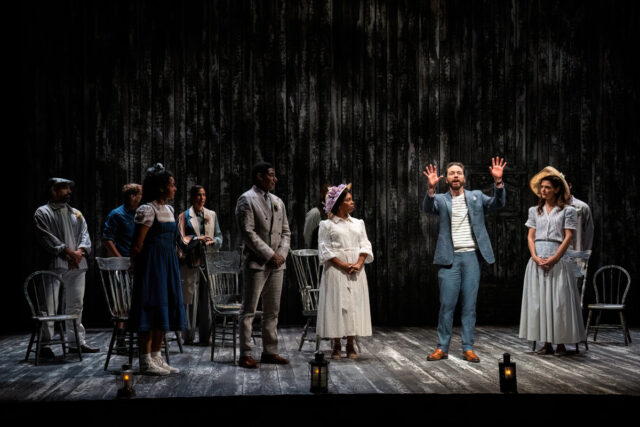
Kenny Leon’s Hamlet follows his Much Ado About Nothing at the Delacorte (photo by Joan Marcus)

HAMLET
Central Park
Delacorte Theater
Tuesday – Sunday through August 6, free, 8:00
shakespeareinthepark.org

Don’t let the recent parade of Hamlets stop you from seeing Kenny Leon’s incisive adaptation that opened last week at the Public’s Delacorte Theater in Central Park.

There has been a surfeit of faithful versions and unique reimaginings of William Shakespeare’s 1599–1601 tragedy in New York City since 2015, from Robert Icke’s staging at Park Ave. Armory with Alex Lawther in the title role, Yaël Farber’s variation at St. Ann’s Warehouse starring Ruth Negga, and James Ijames’s Pulitzer Prize–winning Fat Ham at the Public and on Broadway with Marcel Spears to the Public Theater Mobile Unit’s traveling show with Chukwudi Iwuji, Michael Laurence’s Hamlet in Bed at Rattlestick, and Thomas Ostermeier and Theater Schaubühne Berlin’s iteration at BAM with Lars Eidinger.

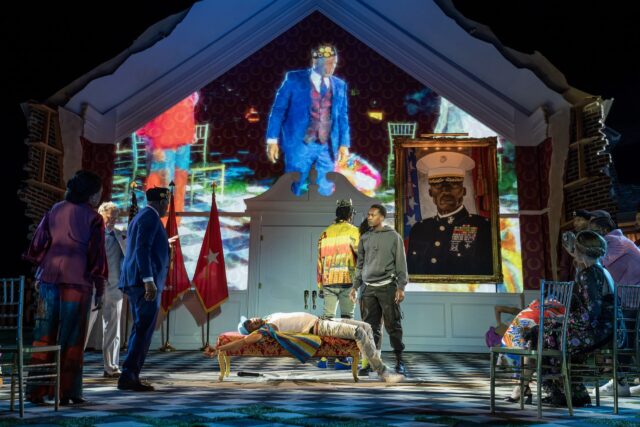
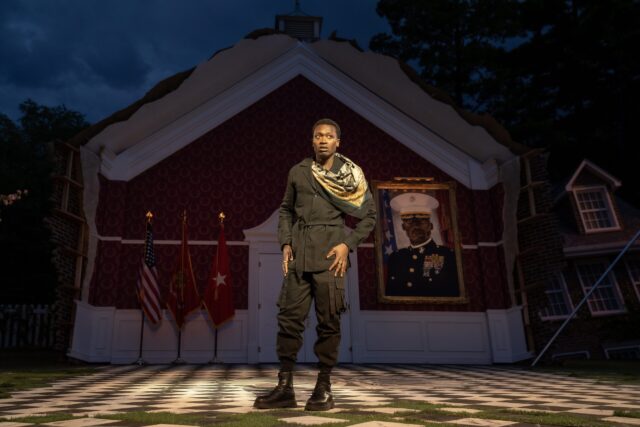
Tony winner Leon turns this Hamlet into a kind of sequel to his 2019 Delacorte triumph, a rollicking modern-day interpretation of Much Ado About Nothing that took place at a Georgia estate prominently displaying “Abrams 2020” banners, referring to two-time former Georgia gubernatorial candidate Stacey Abrams. Set designer Beowulf Boritt is back, tearing the estate in half; one part of the house is sinking into the ground, an Abrams poster sticking out at an angle, like a lonely, overturned grave marker, while a black SUV is stuck in the mud on the other side. It is as if a tornado, or a dangerous presidency, ripped through the land, leaving America in tatters, the white tiles on the grass evoking a cemetery. (The Delacorte itself will be torn down after this summer’s Hamlet and Public Works presentation of The Tempest to undergo a major renovation; it is scheduled to reopen in 2025.)

The central facade features a large portrait of a military hero in full dress uniform, looking like a dictator: the previous king’s funeral is just getting underway as a quartet performs three biblical hymns alongside a flag-draped coffin. “When you go, you’ll have to go alone / When you go, you’ll have to go alone / No one in this world / Can take your journey / When you go, you’ll have to go alone,” they sing. Leon adds in Harry Belafonte’s “Day-o,” an out-of-place tribute to the recently deceased artist and activist, but he also gives us a lovely introduction to Ophelia (Solea Pfeiffer), who offers, “You and Me (No Love Stronger).” Ophelia is given more agency than usual in this adaptation as she considers her affection for Hamlet (Ato Blankson-Wood).

Ato Blankson-Wood is impressive as the introspective Hamlet in latest Shakespeare in the Park production (photo by Joan Marcus)

“For Hamlet, and the trifling of his favor, / Hold it a fashion and a toy in blood, / A violet in the youth of primy nature, / Forward, not permanent, sweet, not lasting, / The perfume and suppliance of a minute, / No more,” Laertes (a firm Nick Rehberger) warns his sister before leaving.

Ophelias’s father and Claudius’s chief counsel, Polonius (Daniel Pearce), admonishes, “In few, Ophelia, do not believe his vows, / I would not, in plain terms, from this time forth / Have you so slander any moment leisure / As to give words or talk with the Lord Hamlet. / Look to ’t, I charge you. Come your ways.”

The dead king’s brother, Claudius (John Douglas Thompson), has quickly gained the throne by marrying his brother’s widow, Gertrude (Lorraine Toussaint). Deeply affected by this turn of events, Hamlet feels like he is alone. “A little more than kin and less than kind,” he whispers to the audience about his new stepfather. Blankson-Wood is brilliant as Hamlet slowly descends into madness, with Leon exploring the character’s state of mind more insightfully than I can remember ever seeing before.

Hamlet is soon visited by the ghost of his father, who appears like a distorted monster, projected onto the gable of the house, his otherworldly voice (recorded by Samuel L. Jackson) explaining to his son that Claudius murdered him; he proclaims, “Revenge his foul and most unnatural murder.” At one point Allen Lee Hughes’s lighting casts the shadow of Hamlet’s head across his father’s portrait, suggesting that he will never be able to escape from the former king’s legacy. (The lighting is by Allen Lee Hughes, with sound by Justin Ellington and projections by Jeff Sugg.)

Claudius calls for Hamlet’s old friends Rosencrantz (Mitchell Winter) and Guildenstern (Brandon Gill) to spy on him. Meanwhile, Hamlet arranges for a traveling troupe of players (Mikhail Calliste, Lauryn Hayes, LaWanda Hopkins, and Colby Lewis) to put on a show that will reveal to the king that Hamlet knows that he is a liar and a murderer. “The play’s the thing / Wherein I’ll catch the conscience of the king,” he says. The players perform a rap song, Jason Michael Webb’s “Cold World,” which features such un-Shakespearean lyrics as “Days are precious when you’re livin’ in a warzone / Tryna live, heart heavy like a diamond / City’s cold, but the streets are even colder / Gotta get out ’fore they say my time is over.” When Hamlet describes the plot, with its murder and marriage, Claudius gets up and storms off. The battle is on.

Leon (Topdog/Underdog, A Soldier’s Play) streamlines the play to a mere two hours and forty-five minutes with intermission, eliminating the subplot of the Norwegian crown prince Fortinbras, who mounts a challenge to Hamlet after Hamlet’s father slays his father. We don’t see Barnardo (Trí Lê), Horatio (Warner Miller), and Marcellus (Lance Alexander Smith) initially encounter the ghost. There is no mention of any state being “rotten,” no “to the manner born,” no “thoughts be bloody,” but none of that is missed.

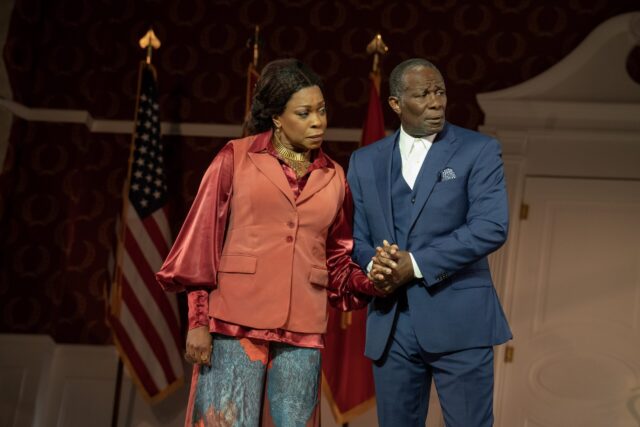
Polonius is wonderfully portrayed by Pearce (Mother of the Maid, Timon of Athens) as a persnickety, bow-tied southern gentleman in a seersucker suit. Thompson, one of our greatest classical actors whether doing Shakespeare (The Merchant of Venice), Eugene O’Neill (The Iceman Cometh), or August Wilson (Jitney), is stirring as Claudius, commanding the stage with a moving vulnerability, while Toussaint (A Midsummer Night’s Dream, Stuff Happens) is a worthy cohort, finding compassion for her son even as her husband grows more combative. Greg Hildreth (Company, Moscow Moscow Moscow Moscow Moscow Moscow) nearly steals the show as the gravedigger, who uses skulls like bowling balls.

Lorraine Toussaint and John Douglas Thompson sparkle as Gertrude and Claudius in Hamlet (photo by Joan Marcus)

The staging does supply some significant problems. As opposed to Leon’s Much Ado About Nothing, which was set in modern-day Atlanta, it is not clear when and where his Hamlet unfolds, in Denmark, Georgia, or a different location. While Much Ado had an all Black and brown cast, Hamlet has several Caucasian actors. There are subtle references to what is happening in Trump-era America, the dialogue is spoken with a flowing style, and Jessica Jahn’s costumes are contemporary dress, from Claudius’s blue suit to Laertes’s dungaree jacket to Hamlet’s hoodie and Ophelia’s revealing bustier. So impressive in Much Ado, the car now seems like an excess prop. Leon might be attempting to meld past with present, but it can cause confusion, as when letters are delivered during a time when SUVs and 2020 placards are present.

Following in the footsteps of such actors as Sarah Bernhardt, Laurence Olivier, Richard Burton, Nicol Williamson, Mel Gibson, Kenneth Branagh, and Ethan Hawke — and, at the Delacorte itself, Michael Stuhlbarg in 2000, Sam Waterston in 1975, Stacy Keach in 1972, and Albert Ryder in 1964 — Blankson-Wood (Slave Play, The Total Bent) is a Hamlet for these times. His journey into madness has a method in it, a young man troubled by what he sees going on all around him, with his parents, his girlfriend, and the ruling class.

“I will be brief. Your noble son is mad. / ‘Mad’ call I it, for, to define true madness, / What is ’t but to be nothing else but mad?” Polonius says to Claudius. Blankson-Wood’s Hamlet is no skulking college student or shy mama’s boy; he is a prince trying to find his way in a complex and dangerous world, one that provides no sympathy. He delivers six of Hamlet’s seven soliloquies (“How all occasions do inform against me” has been cut) with a thoughtful, understated tenderness, not demanding attention to himself but instead to the character’s search for an unreachable inner peace.

It’s heartbreaking but, after all, Hamlet is a tragedy, no matter where or when it is set.

[Mark Rifkin is a Brooklyn-born, Manhattan-based writer and editor; you can follow him on Substack here.]
FRIENDSHIP: SUMMER, 1976 / KING JAMES

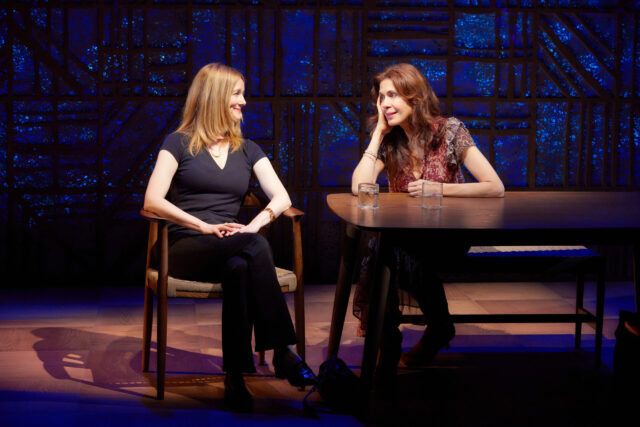
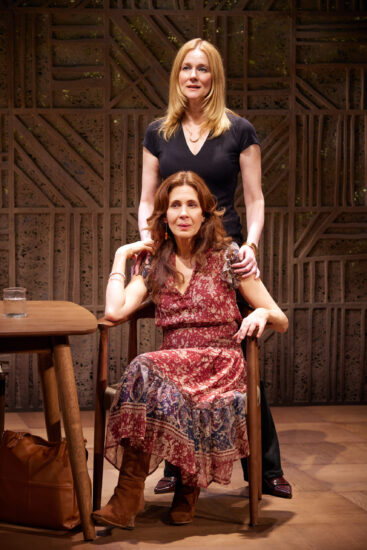
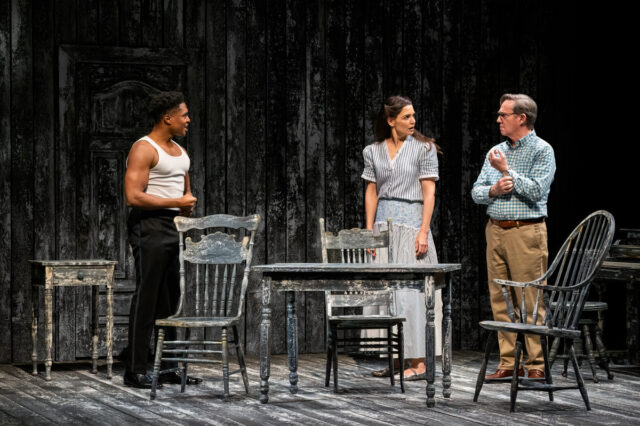
Diana (Laura Linney) and Alice (Jessica Hecht) are forced to become friends in Summer, 1976 (photo © Jeremy Daniel, 2023)

SUMMER, 1976
Samuel J. Friedman Theatre
261 West Forty-Seventh St. between Broadway & Eighth Ave.
Tuesday – Sunday through June 18, $84-$338
www.manhattantheatreclub.com

“Life is an awful, ugly place to not have a best friend,” Sarah Dessen writes in her 1998 young adult novel Someone Like You.

YA novels are often obsessed with portraying teen friendships, while adult friendships generally receive less attention. Two current plays anchored by terrific performances remedy that neglect, focusing exclusively on adult same-sex cisgender platonic relationships. In Pulitzer Prize winner David Auburn’s Summer, 1976 two women meet through their young children, while in Pulitzer Prize finalist Rajiv Joseph’s King James two men bond over their love of basketball star LeBron James. While neither two-character show is a slam dunk, they both got plenty of game.

In MTC’s Summer, 1976 at the Samuel J. Friedman Theatre, Diana (Laura Linney) and Alice (Jessica Hecht) spend most of the ninety-minute play sitting on opposite sides of a long, rectangular table, their chairs facing the audience, who they address directly. At the beginning, Diana, an artist and teacher at Ohio State, tells us how much she doesn’t like Alice’s daughter, Holly. Alice, whose husband, Doug, is an economist at the university, then explains how she “sort of immediately hated” Diana but realizes she will have to put up with her because Alice’s daughter, Gretchen, is getting along with Holly. Diana is a much stricter mother who doesn’t hide what she believes is her superiority over Alice. “Parents who can’t or won’t control their kids aren’t upset when you do it for them. They’re grateful and ashamed,” she says, describing Alice as a “sleepy-eyed little hippie.”

Laura Linney and Jessica Hecht play two very different women in David Auburn world premiere (photo © Jeremy Daniel, 2023)

After passing a joint to the serious, sophisticated Diana, the free-spirited Alice complains, “She fucking bogarted it for like five minutes, and I was like, come on, lady, I only took it out because it was the only way I could imagine getting through the next ten minutes before I could make an excuse and leave.” But soon after that they actually become friends, sharing intimate details about their fears and desires, discussing interior decoration choices, a sexy house painter, the sanctity of marriage, highbrow vs. lowbrow television, music, and literature, and a complicated “cashless, self-sustaining system” Doug has developed to barter baby-sitting time in their community.

The final scene takes place about twenty-five years later, when we learn how their two-month friendship impacted the rest of their lives.

John Lee Beatty’s set features a three-sided gridlike wooden backdrop with two doorways that the characters can use as an exit but don’t, sticking around to hear what the other one has to say. Japhy Weideman’s lighting and Hana S. Kim’s projections change day to night, adding blue sky and twinkling stars. Tony winner Daniel Sullivan (If I Forget, Lost Lake) can’t quite get a firm grasp of Auburn’s (Proof, The Columnist, Lost Lake) narrative, which is too slight and gets bumpier as the conclusion approaches.

Tony nominee and four-time Emmy winner Linney (My Name Is Lucy Barton, The Little Foxes) and Tony nominee Hecht (Letters from Max, The Orchard) form a terrific duo, the former firm and direct, the latter loose and quixotic. For much of the show they are separated by the length of the table, occasionally reaching for each other but unable to make contact.

At a talkback following the matinee I saw, they couldn’t stop touching hands and shoulders, as if they suddenly required meaningful physical connection. It also was clear that the two of them have become real-life friends because of the show, which added a lovely note to the afternoon.

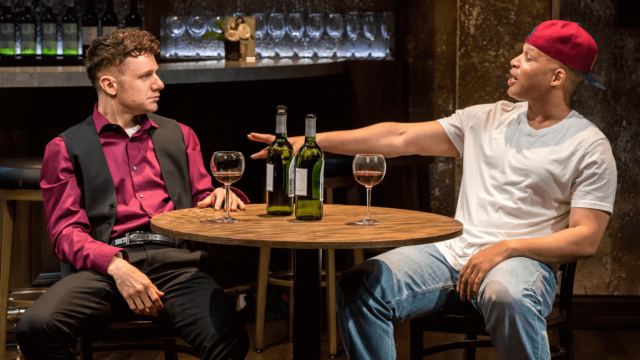
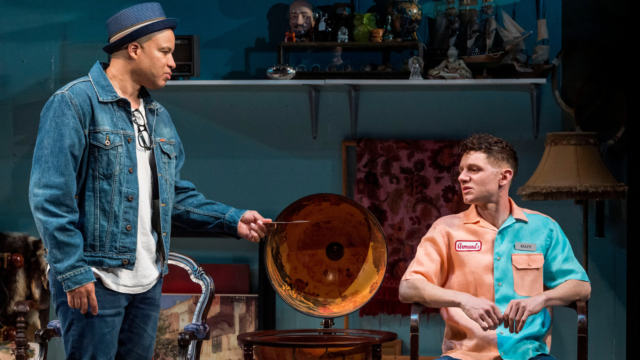
Matt (Chris Perfetti) and Shawn (Glenn Davis) bond over basketball and LeBron in King James (photo by Craig Schwartz)

KING JAMES
MTC at New York City Center – Stage I
131 West Fifty-Fifth St. between Sixth & Seventh Aves.
Tuesday – Sunday through June 18, $79-$99
www.manhattantheatreclub.com

Rajiv Joseph shoots and scores with King James, making its New York premiere at MTC at New York City Center.

The play is divided into four quarters, like a basketball game, as two lonely twenty-one-year-old Cleveland Cavaliers fans unexpectedly come together as they follow the exploits of superstar LeBron James, beginning in 2004 and jumping to 2010, 2014, and 2016, four seasons that served as turning points in the career of the leading scorer in the history of the sport — as well as for the two characters.

In February 2004, during the King’s rookie campaign, inexperienced bartender Matt (Chris Perfetti) is desperate to sell the remainder of his family’s season tickets so he can pay off at least some of his numerous debts. Matt, who wants to open a downtown sports bar, is biding his time at the empty La Cave du Vin, playing around with a ball of newspaper and a trash bin, when wannabe writer Shawn (Glenn Davis) arrives, seeking to purchase the tickets. Both men are from Cleveland Heights, Ohio, not far from LeBron’s hometown of Akron; Matt grew up going to games with his father, while Shawn has never been to the arena to see a Cavs match.

After they come to an agreement, their friendship builds over the years: Shawn gets to know Matt’s parents, who run a curiosity shop called Armand’s, the name of their treasured stuffed armadillo; they argue over whether LeBron is better than Michael Jordan; Matt repeatedly explains what the problem with America is; and LeBron moves on to several different teams, forcing Matt and Shawn to reevaluate their loyalty as well as their relationship.

“Being a fan is like having a religion,” Matt says. Shawn replies, “Yeah, and like most religions, it’s rotten to the core. Like at Sunday school, the way they talked to us about Jesus? That’s exactly how I feel right now. Like I’m being punished because He happened to be a Savior.” Matt wisely asks, “Jesus or LeBron?”

Shawn is always the more introspective of the two, pushing LeBron’s choices onto his own identity. “LeBron for the win. LeBron for the win, all these times, and then he just fucking leaves,” he opines after James signs with the Miami Heat. “And I’m like . . . You get burned and you’re like . . . Who am I? Why am I like this? I don’t know. I think maybe I just need to work on myself for a little bit.” It’s those kinds of rationalizations and realizations that lift King James above a mere play about sports to a drama about anyone searching inside themselves, looking to have a better season; the beauty of the show is that you don’t have to know anything about basketball to appreciate it, although it certainly helps if the names Mark Price, Brad Daugherty, David Robinson, and Isiah Thomas ring a bell.

Unfortunately, it takes one seriously bad bounce when it forces race into the equation — Matt is white and Shawn is Black — but it manages to overcome that miss well before time runs out.

Shawn (Glenn Davis) and Matt (Chris Perfetti) reach a turning point in MTC production (photo by Craig Schwartz)

Todd Rosenthal’s set switches from La Cave du Vin, an elegant wine bar that used to be a church, complete with stained glass that gives it a holy feel, further equating LeBron with Jesus, to Armand’s, a messy shop overstuffed with random tchotchkes and knickknacks that are like lost parts of people’s lives. Samantha C. Jones’s costumes range from Cavs jerseys to the cheesy bowling-style shirts Armand’s employees must wear. DJ Khloe Janel keeps the joint rocking in a booth to the right of the stage, where she pumps tunes by Prince, Fleetwood Mac, and others before and after the show and during halftime — er, intermission — just as if we were at an NBA arena. Feel free to sing and dance and say hello.

Tony-winning director Kenny Leon (Topdog/Underdog, A Soldier’s Play) coaches it all like a champion, keeping the rock in play, slowing things down and then going in for the jam.

Joseph (Bengal Tiger at the Baghdad Zoo, Describe the Night) grew up a Cavaliers fan in the 1980s and ’90s, so he clearly knows his stuff, understanding just how much sports is and isn’t life. (The play arrives in New York City at a fascinating point as James, currently a Los Angeles Laker, might retire following a four-game sweep at the hands of the Denver Nuggets for the Western Conference Championship.)

Joseph wrote the part of Shawn specifically for Davis (Bengal Tiger at the Baghdad Zoo, Downstate), knowing when to shoot and when to dish it off to Perfetti (Moscow x 6, The Low Road), who takes the ball and runs with it, hitting layups and swishing from beyond the three-point line.

Basketball metaphors aside, King James is an all-star (sorry) examination of male friendship, the ups and the downs, the victories and the defeats — which I know only too well, having been a Knicks fan for more than fifty years.

As O. Henry wrote in Heart of the West, “No friendship is an accident,” which is ably demonstrated by both Summer, 1976 and King James.