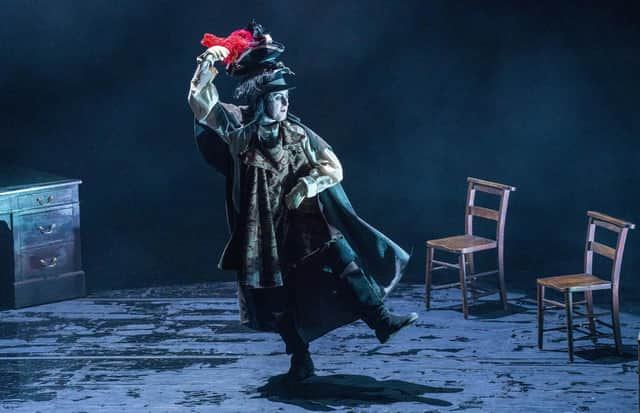
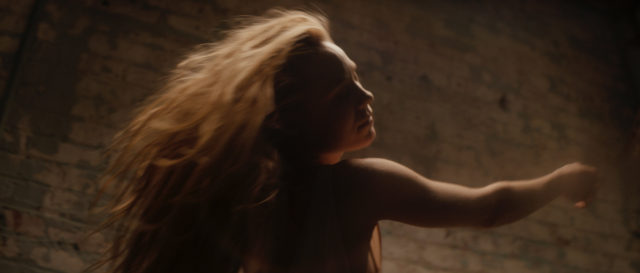
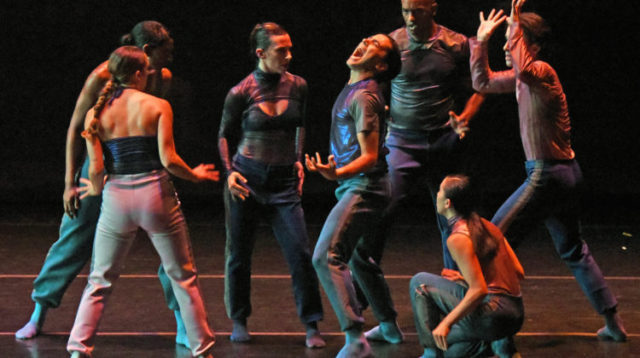
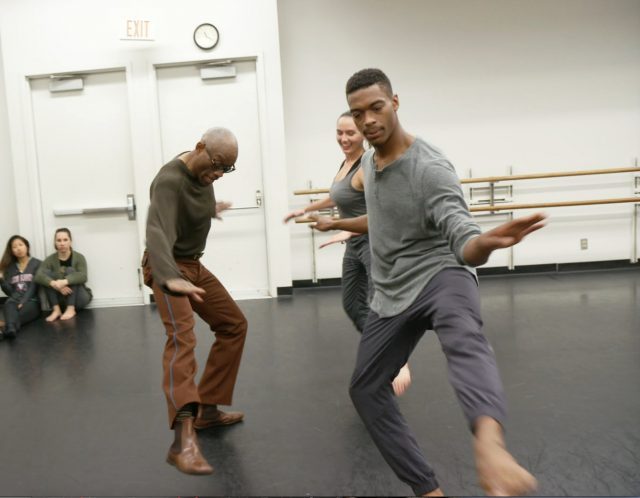
Alan Cumming brings his debut solo dance-theater piece, Burn, to the Joyce this week (photo by Jane Blarlow/PA Wire)
Who:Alan Cumming What: North American premiere of solo dance-theater piece Where:The Joyce Theater, 175 Eighth Ave. at Nineteenth St. When: September 21-25, $76-$106 Why: “You must not deny me!” Alan Cumming declares in his portrayal of eighteenth-century Scottish poet Robert Burns in Burn, making its North American premiere at the Joyce this week. The solo dance-theater work was created by Olivier- and Tony-winning actor Cumming with Olivier- and Obie-winning choreographer Steven Hoggett, who choreographed the piece with Vicki Manderson, and is set to the music of British composer Anna Meredith, including such songs as “Solstice In,” “HandsFree,” “Blackfriars,” “Descent,” and “Return.” The set design is by Ana Inés Jabares Pitz, with costumes by Katrina Lindsay, lighting by Tim Lutkin, projections by Andrzej Goulding, and sound by Matt Padden.
In a program note, Cumming — who has appeared on Broadway in Cabaret and a one-man reinterpretation of Macbeth and off Broadway in “Daddy” and has lent his voice to such films as They’ll Love Me When I’m Dead and numerous animated children’s films (while spectacularly lending his body to the hybrid documentary My Old School) — explains, “In 2015, I has just turned fifty and realised I would never be as fit or asked to dance in a show in the same way again. But I still felt I had one more in me! I meant a play or a musical that was dance heavy. Little did I think I would end up making my solo dance theater debut at fifty-seven!” Together, Cumming and Hoggett (Black Watch,Once,Harry Potter and the Cursed Child) point out, “An early intention was to explore the idea of Burns as national icon and a figure who, under modern scrutiny, was becoming something more complex than the beloved face on tourists’ souvenir biscuit tins.” There will be a curtain chat with members of the creative team following the September 21 performance. Some shows are already sold out, so get your tickets now if you want to experience what should be an exhilarating evening of dance, theater, music, and poetry.
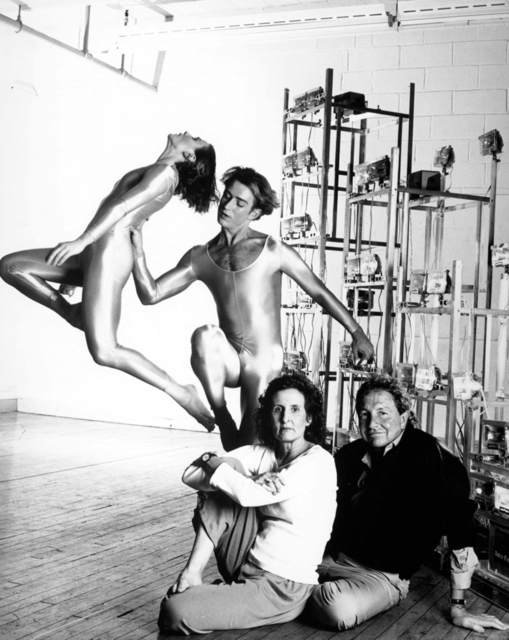
TBDC fiftieth anniversary celebrates collaboration between Trisha Brown and Robert Rauschenberg (photo by Jack Mitchell)
Who:Trisha Brown Dance Company What: Fiftieth anniversary season Where:The Joyce Theater, 175 Eighth Ave. at Nineteenth St. When: May 24-29, $51-$71 Why: “I feel like this is the one time I can let the cat out of the bag and let you know just how dear this man is to me,” Trisha Brown said about her friend and longtime collaborator Robert Rauschenberg. “Bob understands how I construct movement.” Bob returned the compliment: “Particularly with Trisha, it’s always a challenge because she remains so unpredictably fresh.” Founded in 1970, Trisha Brown Dance Company will be celebrating its fiftieth anniversary — delayed two years because of Covid — with a special program at the Joyce celebrating the work Trisha and Bob did together.
Beginning with the fundraising UnGala on May 24, TBDC will present 1990’s Foray Forêt, which kicked off the Back to Zero cycle, a twenty-eight-minute piece of “delicate aberrations” for nine dancers, with costumes and visual design by Rauschenberg, set to marching band music; and 1991’s Astral Converted, part of Brown’s Valiant Cycle, a piece for eleven dancers, with motion-activated metal frame towers by Rauschenberg, set to John Cage’s specially commissioned hourlong “Eight,” for which Cage explained, “Intonation need not be agreed upon.” The works will be performed by former and current dancers including Cecily Campbell, Marc Crousillat, Kimberly Fulmer, Hsiao-jou Tang, Leah Ives, Amanda Kmett’Pendry, Kyle Marshall, Patrick McGrath, Jennifer Payán, and Stuart Shugg. There will be a curtain chat with members of the company following the May 25 performance.
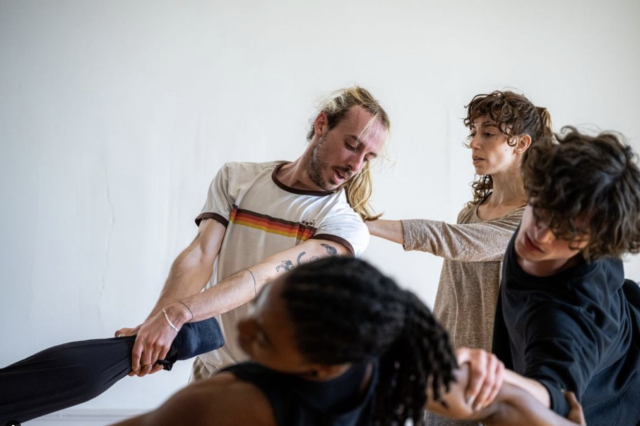
Stephen Petronio Company rehearses at Snug Harbor for Joyce season (photo by Lance Reha)
STEPHEN PETRONIO COMPANY
Joyce Theater
175 Eighth Ave. at 19th St.
May 17-22, $10-$71
212-645-2904 www.joyce.org petron.io
“What does it mean to be out in front of you tonight, to show up for you after so long?” Stephen Petronio asks in a program note for his company’s upcoming season at the Joyce, running May 17-22. “SPC has been coming to the Joyce each spring for almost forty years — a rite, a contract as celebration. To have that interrupted by Covid is like having our oxygen taken away. We are back and breathing now! We come before you tonight to show you that we have survived, that we are still here, in some ways stronger than ever, and that dance is a kind of social glue that keeps us all connected.”
SPC’s Joyce program begins with the world premiere of New New Prayer for Now, created as a virtual piece for the company during the lockdown to celebrate online collaboration, set to original music by Monstah Black and renditions of “Balm in Gilead” and “Bridge Over Troubled Water” recorded with the Young People’s Chorus of New York City (YPC), directed by Francisco J. Nuñez; the costumes are by Marine Penvern, with lighting by Ken Tabachnick. Following a pause, SPC continues its “Bloodlines” series honoring important choreographers who influenced Petronio with his mentor Trisha Brown’s 1973 Group Primary Accumulation, restaged by Shelley Senter. The online version with four dancers in white on a wooden bridge was breathtaking, so it will be fascinating to see it now live indoors.
After an intermission, the company presents a restaging of Petronio’s Bloom, which premiered at the Joyce in 2006 and features music by Rufus Wainwright based on the poetry of Walt Whitman (“Unseen Buds,” “One’s-Self I Sing”) and Emily Dickinson (“‘Hope’ is the thing with feathers”) and the Latin Mass, sung live by YPC, with choral arrangements by Nuñez; the costumes are by Rachel Roy, with lighting by Tabachnick. The May 19 performance will be followed by a Curtain Chat with members of the company, which consists of Jaqlin Medlock, Kris Lee, Larissa Asebedo, Liviya England, Mac Twining, Nicholas Sciscione, Ryan Pliss, Tess Montoya, and Tiffany Ogburn. “It’s an emotional time,” Petronio says in the above preview of the Joyce season. If you haven’t yet seen this extraordinary company, you have only yourself to blame.
SARA MEARNS: PIECE OF WORK
Joyce Theater
175 Eighth Ave. at 19th St.
March 8-13, $10-$71
212-645-2904 www.joyce.org saramearns.com
During the pandemic lockdown, I covered more than a thousand online events created since March 2020. I had many favorite performers over those nearly two years, from actress Kathleen Chalfant and musician Richard Thompson to Arlekin Players Theatre and White Snake Projects to dancer-choreographer Jamar Roberts and Stars in the House hosts Seth Rudetsky and James Wesley. You can check out them and other stalwarts in twi-ny’s three-part Pandemic Awards.
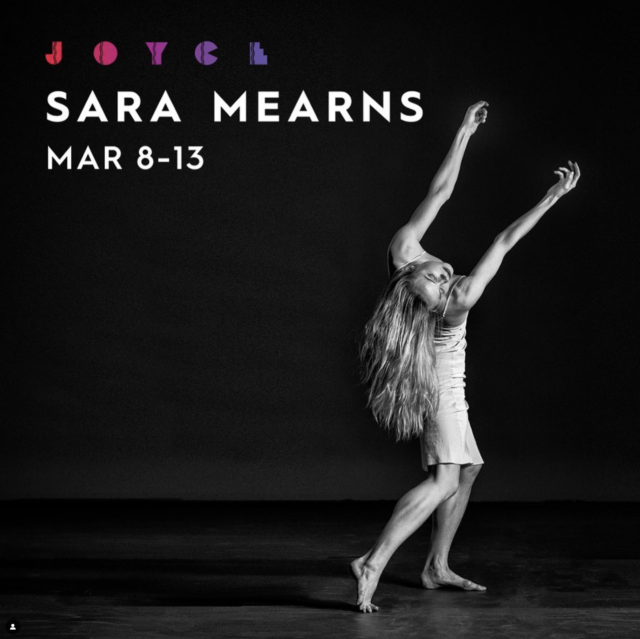
But for me no one stood out like Sara Mearns. The extraordinary New York City Ballet principal dancer expanded her horizons in a series of breathtaking performances, including her Le Cygne (The Swan) variation for Swans for Relief, the Works & Process commission Storm, Lee Mingwei and Bill T. Jones’s durational Our Labyrinth at the Metropolitan Museum of Art, Justin Peck’s Thank You, New York for the New York City Ballet New Works Festival, Christopher Wheeldon’s The Two of Us for Fall for Dance, L.A. Dance Project’s Sonata for Saras (Mearns as her own trio!), Henry Joost and Ariel Schulman’s Another Dance Film shot at the East River Park Amphitheater, and Molissa Fenley’s State of Darkness solo onstage at the Joyce.
Austin Goodwin’s carefully is part of Sara Mearns program at the Joyce (photo by Drew Dawson)
But in October 2021, Mearns had to take a break to deal with a personal issue she eventually discussed on social media several months later: She was diagnosed with depression and extreme burnout and was getting help from a sports psychologist. “This is never something I saw happening to me,” she wrote on Instagram. “I thought I was invincible, that maybe I was just tired, that maybe it’s just a phase, and to get over it. I’m here to tell you it’s a very real thing,”
From March 8 to 13, Mearns will return to performing, and to the Joyce, with her own program, “Piece of Work,” a kind of coming-out, coming-back party in which she will perform with eight dancers in works by six choreographers, including five world or NYC premieres created specifically for Mearns. “I have been lucky enough to perform in the biggest houses in the world, doing grand productions, pouring my heart out. It’s what comes naturally to me. It doesn’t feel like a risk,” she explains in a program note. “Three years ago, I decided it was time to go a different route, a route that was vulnerable for me artistically and that would be the biggest challenge for me thus far in my career. . . . I would like to say that I curated this evening, but the truth is, New York did. It will be raw, honest, and at times messy.”
The evening begins with Jodi Melnick’s Opulence, a duet with Melnick commissioned for the 2019 Jacob’s Pillow Dance Festival, with music by drummer Kid Millions and guitarist Zach Lehrhoff. Choreographer and director Austin Goodwin’s film carefully pairs Mearns with Paul Zivkovich inside an empty house. Mearns teams with Vinson Fraley Jr. in Fraley’s On the Margins, set to an original score by Rahm Silverglade for violin, electronics, guitar, and sax.
Following intermission, Mearns will perform with Melnick, Taylor Stanley, Jaquelin Harris, Chalvar Monteiro, and Burr Johnson in a special JoycEvent, excerpts from “Night of 100 Solos: A Centennial Event” and other works by Merce Cunningham, arranged and staged here by Rashaun Mitchell and Silas Riener, featuring live music by John King. Beth Gill’s SSSara is a solo for Mearns with music by Ryan Seaton. The night concludes with Guillaume Côté’s Spir, a duet with the Canadian dancer and choreographer set to German pianist, producer, and composer Nils Frahm’s “Corn” and Woodkid and Frahm’s “Winter Morning I.” In between each piece will be audio interludes directed and edited by Ezra Hurwitz.
Mearns also wrote on Instagram, “This show has been thru so many lives, revisions, faces, versions, and I wouldn’t take any of it back. A big influence was the pandemic; it gave me a clear path of what I wanted this show to be about. I’m not the same person or artist I was before the pandemic, and I wanted the evening to reflect that & acknowledge it. How art, specifically dance, is created in New York; what artists go thru in New York is unlike anywhere else in the world.” Mearns will talk about that and more in a curtain chat at the March 9 show.
Micaela Taylor’s SNAP is part of BODYTRAFFIC program at the Joyce
BODYTRAFFIC
Joyce Theater
175 Eighth Ave. at 19th St.
March 1-6, $41-$61
212-645-2904 www.joyce.org bodytraffic.com
“There’s nothing quite like coming home,” BODYTRAFFIC artistic director Tina Finkelman Berkett writes in a program note about the LA company’s upcoming presentation at the Joyce. “Growing up in NYC, I dreamt of performing on the Joyce stage, and each time our company returns is incredibly meaningful.”
Finkelman Berkett used the pandemic lockdown to reimagine the troupe, which she founded in 2007 with Lillian Barbeito, and the results can be seen March 1-6. The show begins with the world premiere of Baya & Asa’s The One to Stay With, which takes on corporate greed; the cast consists of associate artistic director Guzmán Rosado, Joan Rodriguez, Katie Garcia, Pedro Garcia, Whitney Schmanski, Jordyn Santago, Tiare Keeno, and dance captain Ty Morrison, with music by Tchaikovsky, Russian Brass Brand, and Béla Bartók.
Following a set change, Finkelman Berkett truly returns to the Joyce stage with the New York premiere of Fernando Hernando Magadan’s (d)elusive minds, a duet she will perform with Rosado, set to Schubert’s Trio Pour Piano, Violon Et Violoncelle En Mi Bemol, Op. 100. It was inspired by Dora Garcia’s “All the Stories” and the true story of a man with Capgras syndrome who killed his wife, thinking she was a duplicate, and spent fifteen years in an institution believing his real wife was still alive, writing to her every day. Magadan’s scenic design includes a near-semicircle of paper along with a chair and a typewriter.
After intermission, TL Collective artistic director and former BODYTRAFFIC dancer Micaela Taylor’s SNAP will make its New York premiere, with Alana Jones, Joseph Davis, Katie Garcia, Santiago, Keeno, Rodriguez, and Morrison moving and grooving to James Brown, with original music by Shockey and costumes by Kristina Marie Garnett. The piece is meant to snap people out of their complacency while celebrating the diversity of Los Angeles.
The evening concludes with Alejandro Cerrudo’s PACOPEPEPLUTO, a work for three male soloists originally choreographed for Hubbard Street Chicago in 2011, with Rodriguez, Pedro Garcia, and Rosado or Davis hoofing it to Dean Martin’s “In the Chapel in the Moonlight,” “Memories Are Made of This,” and “That’s Amoré.” In addition, there will be a curtain chat on March 2.
Documentary explores the creation and legacy of Bill T. Jones/Arnie Zane Company’s D-Man in the Waters (photo courtesy Rosalynde LeBlanc)
CAN YOU BRING IT: BILL T. JONES AND D-MAN IN THE WATERS (Rosalynde LeBlanc & Tom Hurwitz, 2020)
Film Forum
209 West Houston St.
Opens Friday, July 16
212-727-8110 www.d-mandocumentary.com filmforum.org
In 1989, the Bill T. Jones/Arnie Zane Company presented the world premiere of D-Man in the Waters at the prestigious Joyce Theater in New York City, a physically demanding, emotional work born out of the AIDS crisis, dealing with tragedy and loss in the wake of the death of Zane, Jones’s personal and professional partner, at the age of thirty-nine in 1988. Directors Rosalynde LeBlanc and Tom Hurwitz take a deep dive into the history of the dance and its lasting impact more than thirty years later in the captivating documentary Can You Bring It: Bill T. Jones and D-Man in the Waters, opening July 16 at Film Forum.
“What is D-Man? Is it alive now? Is it a cautionary tale? Is it one of inspiration?” Jones tells fifteen Loyola Marymount dancers who are staging the piece under the direction of LeBlanc, a former company member who runs the Jones/Zane Educational Partnership at the school, where she is an associate professor in the Department of Dance. Jones continues, “Makes you want to get all your shit together, your community together, take responsibility, be beautiful, be fierce — is that what it is? I don’t know what it is. . . . What do they share that is so big, so tragic that you need a piece like this to move it and give it body?”
LeBlanc, who also produced the film, and two-time Emmy-winning cinematographer Hurwitz, the son of longtime Martha Graham dancer, choreographer, and teacher Jane Dudley, talk to most of the original cast of D-Man, many of whom have gone on to form their own companies: Arthur Avilés, Seán Curran, Lawrence Goldhuber, Gregg Hubbard, Heidi Latsky, Janet Lilly, and Betsy McCracken, who, along with Jones and his sister Johari Briggs, share intimate stories of working with Jones and Zane and the importance of the piece as the arts community was being ravaged by AIDS. Sometimes holding back tears, they speak lovingly of Zane and Demian Acquavella, nicknamed “D-Man,” who died at the age of thirty-two in 1990. “He was always a boy, but always a bit of a devilish boy, and the dancing was also that way,” Jones remembers.
Through new and old interviews, home video and archival photographs, and exciting footage from the dance’s original rehearsals and Joyce premiere, LeBlanc, Hurwitz, and editor Ann Collins choreograph a gracefully flowing, compelling narrative as the documentary participants discuss specific movements — Latsky’s attempts at a jump and Curran’s memories of a duet with Acquavella in which their foreheads have to keep touching are wonderful — and LeBlanc tries to reach inside the Loyola Marymount performers to motivate them. They might have the movement down, but D-Man requires more than that to be successful. “Do you dare to let the stakes really be high?” she asks as they search for contemporary issues that impact them similarly to how AIDS affected the creation of the work, which is set to Felix Mendelssohn’s 1825 Octet for Strings, which the German composer wrote at the age of sixteen. “There was some healing, cathartic ritual in the making and the doing of this dance that sustained us,” Curran says, a feeling LeBlanc wants to instill in the college students.
“This work is not about anybody’s epidemic,” Jones, a Kennedy Center Honoree, MacArthur Grant awardee, and Tony winner who is the artistic director of New York Live Arts, said in a statement about the film. “It is about the dark spirit of what is happening in the world and how you push back against it.” Can You Bring It: Bill T. Jones and D-Man in the Waters gets to the heart of that spirit by revealing the legacy, and the future, of a seminal dance piece that continues to find its place on an ever-evolving planet.
LeBlanc and Hurwitz will be at Film Forum to discuss the film at the 7:00 shows on July 16 and 17 and will participate in a live, virtual Q&A with Jones at 8:00 on July 21. Jones, whose riveting Afterwardsness at Park Avenue Armory in May explored the Covid-19 pandemic, isolation, and racial injustice, will return to the space this fall with Deep Blue Sea, a monumental work for more than one hundred community members and dancers that begins with a solo by Jones and incorporates texts by Martin Luther King Jr. and Herman Melville, with water again playing a critical role.
STATE OF DARKNESS
Joyce Theater
175 Eighth Ave. at 19th St.
June 16-20, $500-$1,000 for one-to-four-seat pods
212-242-0800 www.joyce.org/state-darkness
Last October, the Joyce presented a digital version of Molissa Fenley’s State of Darkness, in which seven dancers performed Fenley’s thirty-five-minute solo onstage, the first shows to take place at the Joyce since the pandemic lockdown began, albeit without an audience. Now, from June 16 to 20, six of those dancers will be back onstage, playing to a socially distanced crowd organized in pods of one to four people who paid between $250 to $2,000 in a benefit for the theater. The lineup features Annique Roberts on June 16 at 8:00, Jared Brown on June 17 at 8:00, Sara Mearns on June 18 at 8:00, Lloyd Knight on June 19 at 2:00, Michael Trusnovec on June 19 at 8:00, and Cassandra Trenary on June 20 at 2:00. Each performance, set to Stravinsky’s “Le Sacre du Printemps” (“The Rite of Spring”), will be followed by a Q&A with the dancer and Fenley, along with a Champagne toast.
In October, Joyce executive director Linda Shelton said, “It has been truly inspiring and uplifting to see the dancers and Molissa tackle State of Darkness during this difficult and unprecedented interruption to our lives. To me, this piece is about emerging from the darkness we have been coping with since March.” Fenley added, “In 1988, environmental, political, and social unrest inspired me to create State of Darkness. Today, a response to similar influences affecting us feels even more urgent and necessary.” With theaters back open and audiences allowed in, “urgent” and “necessary” only begin to tell the story.