Tag Archives: joyce theater

THE TIME IS NOW: CELEBRATING RONALD K. BROWN, WUNMI, AND TONI PIERCE-SANDS AT THE JOYCE

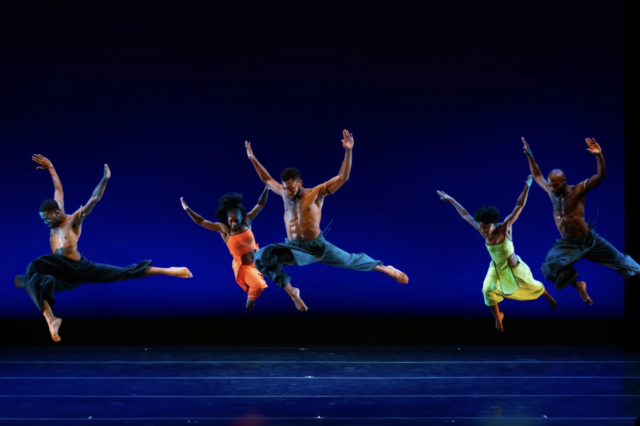
Ronald K. Brown/EVIDENCE returns to the Joyce for fortieth anniversary celebration

Ronald K. Brown/EVIDENCE, a Dance Company
Joyce Theater
175 Eighth Ave. at 19th St.
February 25 – March 1 (Curtain Chat February 25), $32-$82
212-645-2904
www.joyce.org
evidencedance.com

Ronald K. Brown/EVIDENCE celebrates its past while looking toward the future in its annual winter season at the Joyce, running February 25 through March 1. Because of the blizzard, opening night, February 24, has been canceled, but a 7:00 show has just been added, and great seats are available if you hurry.

The Brooklyn-based company will be presenting two exciting programs as part of its fortieth anniversary. The first honors longtime collaborator Wunmi Olaiya, a composer, costume designer, dancer, and visual artist who has been working with Brown since 1992, while the second pays tribute to TU Dance cofounding artistic director Toni Pierce-Sands, who danced with Alvin Ailey and EVIDENCE and would begin every TU Dance production with the Ulysses Dove mantra “Nothing to prove, only to share”; Pierce-Sands passed away in November at the age of sixty-three.

“Celebrating Wunmi” — born in London and raised in Lagos, she goes by one name — begins with Ebony Magazine: To a Village, a 1996 piece for Cleo Parker Robinson Dance Ensemble that EVIDENCE debuted in March 1998, featuring music and costumes by Wunmi centered around the repeated phrase “do you see what I see.” Clear as Tear Water is a 2006 solo originally choreographed for Pierce-Sands; at the Joyce, six different dancers will perform the work, which will be set to Wunmi’s “Woman Child” in Program A and Meshell Ndegeocello’s “Heaven” in Program B. Next is 1999’s Gatekeepers, a piece originally for Philadanco that delves into Native American mythology and African traditions, with music and costumes by Wunmi. Following intermission, the evening concludes with the rousing, nonstop Upside Down, an exhilarating excerpt from Brown’s 1998 Destiny, in which the company cuts loose to music by Wunmi, which she will play live with two drummers.

“With the trust Ron affords me, I dare to dream and visualize what the work he is creating is speaking on,” Wunmi explains in a Joyce interview. “Ron tells stories of human beings making their way . . . and, in there, I create costumes to make them visible. Thankful, trust is alive and well.”
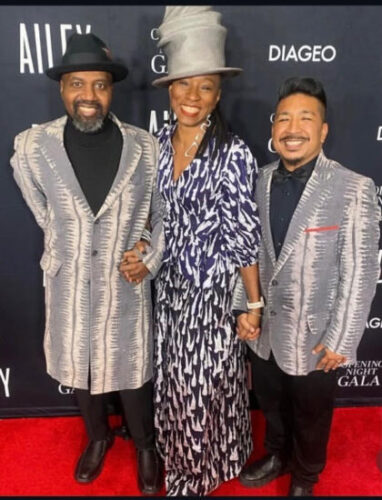
Ronald K. Brown, Wunmi Olaiya, and Arcell Cabuag at the 2024 Alvin Ailey American Dance Theater gala

Planned prior to Pierce-Sanders’s death from cancer, “A Celebration of the Life and Legacy of Toni Pierce-Sands” kicks off with 2012’s Torch, a touching tribute to former Brown student and dance enthusiast Beth Young, who passed away in January 2012, followed by Clear as Tear Water. The company premiere of 2017’s Where The Light Shines Through, originally commissioned for TU at the Ordway, is choreographed by Brown and his partner, Arcell Cabuag, and set to music by Ndegeocello, Susana Baca, Ballet Folklórico Cutumba de Santiago, and Black Motion. The finale is the spectacular 1999 favorite Grace, originally choreographed for Alvin Ailey, which features twelve dancers moving, in costumes by Wunmi, to a melding of modern dance and West African idioms as only Brown and Cabuag can do, with music by Duke Ellington, Roy Davis Jr., and Fela Aníkúlápó Kuti and live vocals by Gordon Chambers; the beats will stay with you long after the show is over.

“This celebration is long overdue and I am happy the time is now,” Brown says in a program note.

The time is always now to see this extraordinary company, still going strong after forty marvelous years.

[Mark Rifkin is a Brooklyn-born, Manhattan-based writer; you can follow him on Substack here.]
GRAHAM100: PSYCHODRAMAS AND MYTHOLOGY AT THE JOYCE

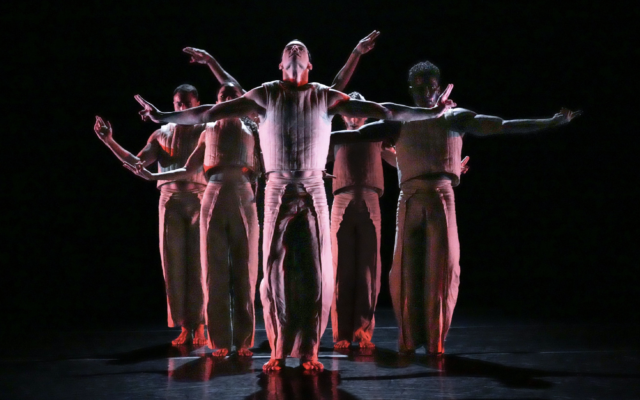
Martha Graham Dance Company will perform Baye & Asa’s Cortege and more in Joyce season (photo by Steven Pisano)

MARTHA GRAHAM DANCE COMPANY: DANCES OF THE MIND
Joyce Theater
175 Eighth Ave. at 19th St.
April 1-13, $62-$82
212-645-2904
www.joyce.org
marthagraham.org

What’s old is new again.

The Martha Graham Dance Company brings its ninety-ninth season to the Joyce for two weeks of classics, world premieres, and reimaginings of familiar pieces, in one case using — gasp! — AI.

From April 1 to 13, MGDC will present “Dances of the Mind,” three programs as part of its continuing GRAHAM100 celebration, preparing for its official centennial next year. Program A consists of Graham’s 1958 Clytemnestra Act II, with an original score by Halim El-Dabh and set by Isamu Noguchi; Baye & Asa’s Cortege, a world premiere about Charon the ferryman, inspired by Graham’s 1967 Cortege of Eagles, with music by Jack Grabow and costumes by Caleb Krieg; Xin Ying’s Letter to Nobody, based on Graham’s 1940 Letter to the World, this time honoring Graham and her legacy, incorporating generative media and AI technology, along with an Emily Dickinson poem (“I’m Nobody! Who are you? / Are you – Nobody – too? / Then there’s a pair of us!”), to craft a duet with Graham, Erick Hawkins, and Merce Cunningham; and Hofesh Shechter’s kinetic 2022 CAVE, with music by Âme and Shechter and costumes by Krieg.

Program B comprises Graham’s 1935 solo Frontier: American Perspective of the Plains, honoring the spirit of the pioneer woman, with a score by Louis Horst and set by Isamu Noguchi; two lost 1920s solos, Revolt and Immigrant, reimagined by Graham 2 director Virginie Mécène through extensive research; a new production of Agnes de Mille’s Rodeo, with Gabe Witcher’s bluegrass arrangement of Aaron Copland’s famous score, costumes by Oana Botez, and set by two-time Tony winner Beowulf Boritt; and Jamar Roberts’s 2024 We the People, which Roberts explains “is equal parts protest and lament, speculating on the ways in which America does not always live up to its promise,” with music by Rhiannon Giddens (arranged by Witcher) and costumes by Karen Young.

The third program brings together Graham’s 1943 Deaths and Entrances, made while Graham was contemplating faith and despair and inspired by the lives of Anne, Emily, and Charlotte Brontë, with music by Hunter Johnson, set by Arch Lauterer, and costumes by Oscar de la Renta; Graham’s 1947 Errand into the Maze, a duet based on the myth of Theseus and the Minotaur, with a score by Gian Carlo Menotti and set by Noguchi; and CAVE.

In addition, the April 1 gala features Clytemnestra Act II and Cortege, the April 5 University Partners Showcase highlights university and high school dancers performing works by Graham, Hawkins, José Limón, and others, the April 12 family matinee presents Graham’s 1935 call-to-action Panorama, Rodeo, and We the People, and there will be a Curtain Chat following the April 9 show.

Founded in 1926 in a tiny Carnegie Hall studio in midtown Manhattan, MGDC has an illustrious history involving a wide range of remarkable collaborators; the current troupe includes So Young An, Ane Arieta, Laurel Dalley Smith, Zachary Jeppsen-Toy, Meagan King, Lloyd Knight, Rayan Lecurieux-Durival, Antonio Leone, Devin Loh, Amanda Moreira, Ethan Palma, Jai Perez, Anne Souder, Matthew Spangler, Richard Villaverde, Leslie Andrea Williams, and Xin Ying.

[Mark Rifkin is a Brooklyn-born, Manhattan-based writer and editor; you can follow him on Substack here.]
NIGHT AND DAY: COMPAGNIE HERVÉ KOUBI AT THE JOYCE

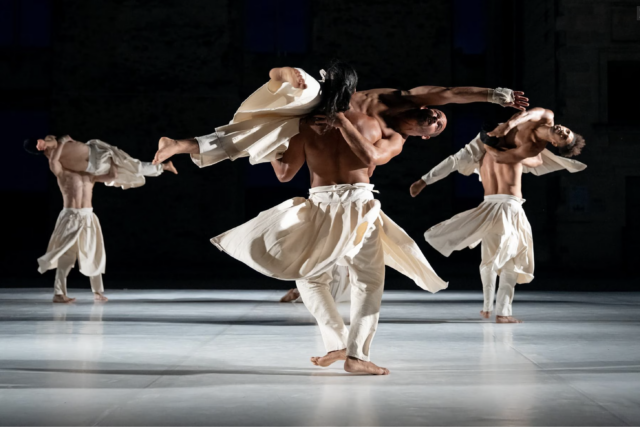
Compagnie Hervé KOUBI brings What the Day Owes to the Night back to the Joyce (photo ©-Didier Philispart)

DANCE REFLECTIONS: WHAT THE DAY OWES TO THE NIGHT
Joyce Theater
175 Eighth Ave. at 19th St.
January 28 – February 2, $12-$82
212-645-2904
www.joyce.org
www.cie-koubi.fr

Last January, French choreographer Hervé Koubi brought down the house at the Joyce with his troupe’s stirring 2023 production, Sol Invictus, so it’s no surprise that Compagnie Hervé KOUBI sold out in advance its encore engagement of 2013’s What the Day Owes to the Night. A later production dazzled Joyce audiences in 2018, and it’s back to once again push the limits of what the human body can do.

In a program note, Koubi, who discovered his family’s Algerian roots when he was twenty-five, explains, “This project is at the crossroads of two preoccupations: my taste for the construction and the danced composition and a deep need to bring me closer to my origins in the land of Algeria. Links to be found, others to be renewed, and still others to be built.” Upon learning of his heritage, he spent four years in Algeria and came back with a movement language that incorporates hip-hop, the Afro-Brazilian martial art of capoeira, break-dancing, gymnastics, ballet, and contemporary dance, performed by an all-male North African ensemble.

The sixty-five-minute presentation is named after the 2008 novel by Yasmina Khadra, the pseudonym of Algerian author Mohammed Moulessehoul; the show does not follow the plot of the romantic drama as much as the feel and setting, structured around the midcentury battle of Mers El-Kebir, the Algerian War for Independence, and the hours in a day.

The insanely talented dancers — Badr Benr Guibi, Giacomo Buffoni, Mohammed Elhilali, Vladimir Gruev, Youssef El Kanfoudi, Abdelghani Ferradji, Oualid Guennoun, Bendehiba Maamar, Nadjib Meherhera, Houssni Mijem, Ismail Oubbajaddi, Matteo Ruiz, and El Houssaini Zahid — are dressed in white cotton pants with panels that swirl and shirts that eventually come off, revealing duly impressive torsos. The flowing costumes are by assistant choreographer Guillaume Gabriel, who also arranged the score, which features Johann Sebastian Bach, Sufi music, and the Kronos Quartet performing songs by Egyptian Nubian musician Hamza El Din, in addition to moments of poetic silence.

The dancers begin in a pile in a far corner, then stir in a hazy, smokey dawn. Over time, as Lionel Buzonie’s lighting gets sharper and brighter, resulting in different shades of shadows on the white floor and, for one section, two dozen golden circles, the men do jaw-dropping head spins; shoot our their arms as if defending themselves; lift up one man high into the sky; and form two groups that each toss a dancer up and others catch him.

They swirl like whirling dervishes, writhe on the floor, and arch and angle their bodies in unison. They run forward and backward, perform cartwheels and diving somersaults, and hold hands in a circle. At one point, twelve men line up on one side and all watch a dazzling solo. At another, they come together and do simultaneous handstands, their bare feet dangling in the air like roots growing out of the earth. They occasionally slow down, most likely to gather their breath before the next action-packed moments.

Part of the Dance Reflections by Van Cleef & Arpels initiative, What the Day Owes to the Night does become a bit repetitive — is it possible for remarkable head spins to become de rigeur? — but it is also utterly thrilling, a unified piece that immerses you in Koubi’s world, radically changed by his discovery of his secret family identity. It will likely make you think about your own ancestors and wonder what beauty might be hidden there.

[Mark Rifkin is a Brooklyn-born, Manhattan-based writer and editor; you can follow him on Substack here.]
COMPAGNIE HERVÉ KOUBI: SOL INVICTUS

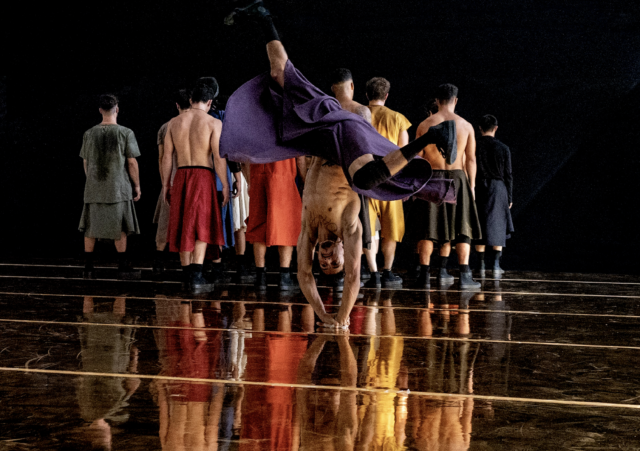
Compagnie Hervé KOUBI worships the sun in Sol Invictus (photo by Nathalie Sternalski)

DANCE REFLECTIONS: SOL INVICTUS
Joyce Theater
175 Eighth Ave. at 19th St.
January 23-28, $10-$71
212-645-2904
www.joyce.org

French choreographer Hervé Koubi studied dance and biology at the University of Aix-en-Provence, and he combines the two elements gorgeously in Sol Invictus as his company of eighteen performers pushes the limits of what the human body can do.

In a program note, Koubi calls the seventy-five-minute piece “a manifesto for life,” and he fills it with sections that explore ritual, worship, faith in a higher power — in this case, the sun — and life, death, and rebirth.

Continuing at the Joyce through January 28, Sol Invictus, which means “invincible sun,” is named for the Roman Sun God, a deity that inspired cult followings. It begins in silence with Allan Sobral Dos Santos running around in a circle, faster and faster, moving lower and lower until his hand touches the reflective floor. The other dancers watch him from either side.

Soon the soundtrack starts — the score features music and soundscapes by Mikael Karlsson, Maxime Bodson, Beethoven (the funeral procession from the Seventh Symphony), and Steve Reich — and a friendly street dance battle breaks out. Koubi’s movement language melds hip-hop, capoeira, ballet, and contemporary dance, heavily influenced by his discovery in 2009 of his Algerian heritage; his troupe comes primarily from North Africa.

They twirl, jump, slide, shake, lift, toss, and dash around the stage, doing flips, cartwheels, head- and handstands, and dazzling twists and spins in musical arranger Guilaume Gabriel’s muted-palette culottes, loose-fitting skirts or shorts, several of the men going bare-chested, revealing impressive, heavily tattooed bodies. For the first time, Compagnie Hervé KOUBI includes women (Francesca Bazzucchi, Joy Isabella Brown, Hsuan-Hung Hsu), toning down a bit of the beefy masculinity on display.

Lionel Buzonie’s lighting ranges from heavenly glows to ominous fog; the eight spots at the top back bounce off the floor, casting ululating shadows on the Joyce’s ceiling. At one point a handful of dancers, each with a light behind them, approaches the stage slowly, like zombies. The narrative shifts from dance-off to postapocalyptic survival to West Side Story jubilance.

A long stretch of fabric in the back becomes a glittering gold translucent parachute enveloping first Bazzucchi, then later the one-legged Samuel Da Silveira Lima.

The dancers spend most of the show closely observing one another, but occasionally a single performer comes to the front and looks out at the audience, both warning us and beckoning us to join in the group worship of the sun as a way to rise out of the hazy darkness.

Koubi, who previously presented The Barbarian Nights, or The First Dawns of the World in 2020 and What the Day Owes to the Night in 2018 at the Joyce, can get a bit lost in all the razzle-dazzle, as impressive as it is, but he finds hope and love in the gathering itself, and it’s hard not to find the joy on his journey.

[Mark Rifkin is a Brooklyn-born, Manhattan-based writer and editor; you can follow him on Substack here.]
MOVEMENT AT THE STILL POINT: AN EVENING OF DANCE

Who: Mark Mann, Sara Mearns, Megan LeCrone, Georgina Pazcoguin, Lloyd Knight, Xin Ying, Terese Capucilli, Skye Mattox, Karla Garcia, David Guzman, Ricardo Zayas, Morgan Marcell, Ryan Vandenboom, Curtis Holland, Rena Butler, Amadeo “Remy” Mangano, Ousmane “Omari” Wiles, Dardo Galletto, Alonso Guzman, Evan Ruggiero, Jie-Hung Connie Shiau, Maleek Washington, Francesca Harper, Carmen de Lavallade, Gus Solomons Jr., more
What: Book launch with live performances
Where: The Joyce Theater, 175 Eighth Ave. at Nineteenth St.
When: Monday, April 10, $81-$131, 7:30
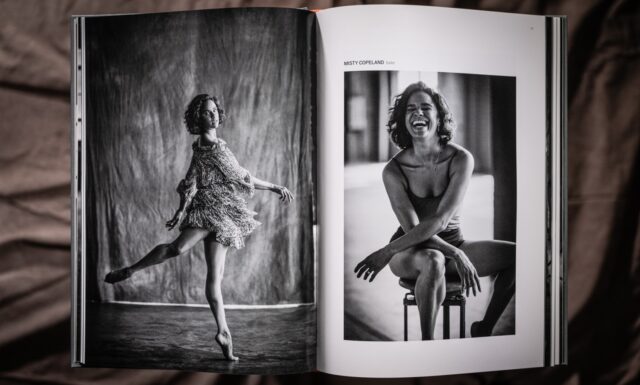
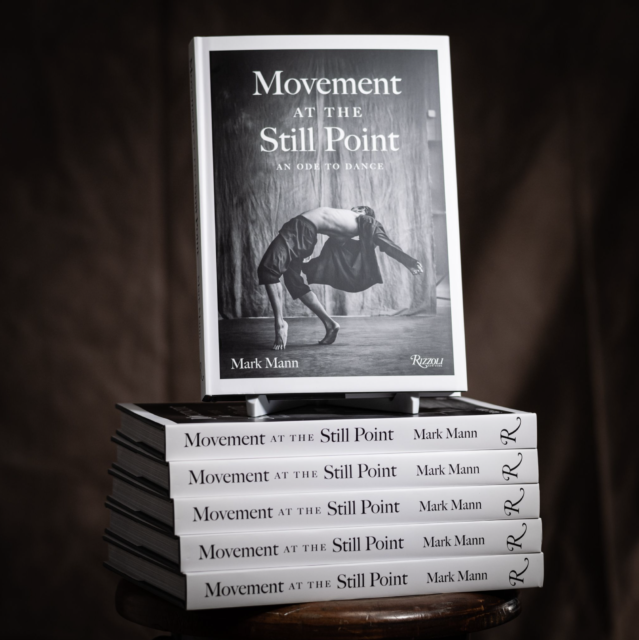
Why: Photographer Mark Mann has assembled quite a group of all-stars to launch his coffee-table book, Still Point: An Ode to Dance (Rizzoli, March 2023, $60), at the Joyce on April 10. The book features photographs of more than 140 people in the dance world, several dozen of whom will be at the Joyce to celebrate with Mann, including New York City Ballet’s Sara Mearns, Martha Graham principals Lloyd Knight and Xin Ying, Broadway’s Skye Mattox and Ryan Vandenboom, voguers Amadeo “Remy” Mangano and Ousmane “Omari” Wiles, tango dancers Dardo Galletto and Alonso Guzman, tap dancer Evan Ruggiero, Ailey II artistic director Francesca Harper, and legends Carmen de Lavallade and Gus Solomons Jr. “Mark is one of a rare breed of photographers who understands dancers: how we move, the way we say things with our bodies that other people say in words, how much we love to perform for an audience — even an audience of one,” Chita Rivera writes in the foreword. “So I put on my top hat, white tie and tails, and we did our own little dance, and it shows in the images he made of me, and of all the dancers in this beautiful collection.”

Misty Copeland is among more than 140 dancers who posed for Mark Mann’s new book (photo courtesy Mark Mann / Rizzoli USA)

The Glasgow-born Mann, who had not photographed the dance community before, was inspired to do the project when commiserating with his sister-in-law, choreographer Loni Landon, about the pandemic lockdown, during which there were no live, in-person performances and Mann’s professional portraiture business had dried up. He accidentally discovered an empty warehouse space on the West Side, where he invited subjects to pose for him, with his beloved medium format Leica S that he calls Gretta. “When our first dancer, Rena Butler, came into the studio in February of 2021, I was speechless,” Mann explained in a statement. “I realized I was watching a performance tailored exclusively for my camera, and for the first few minutes I was so captivated that I actually forgot I was supposed to be taking photos. In that moment, as I began to photograph, my whole life as a photographer was turned upside down.”

In the book, many of the subjects contribute personal thoughts about their chosen discipline. “During the shoots, we spoke to the dancers about identity. The pandemic challenged a lot of us in terms of facing our true selves in a moment when we lost what had defined us,” Landon writes in the afterword. “Everyone figured out how to survive in their own way. It was astonishing to see perseverance paired with vulnerability — the resilience of these artists.” They now take the next step together on April 10 at the Joyce.

RONALD K. BROWN/EVIDENCE AT THE JOYCE

Ronald K. Brown/EVIDENCE presents New York premiere at the Joyce next week (photo by Rose Eichenbaum)

Ronald K. Brown/EVIDENCE, a Dance Company
The Joyce Theater
175 Eighth Ave. at 19th St.
January 17-22, $51-$71
212-691-9740
www.joyce.org
www.evidencedance.com

Discussing “the grief and the weight of everything that we feel,” choreographer Ronald K. Brown says, in a Jacob’s Pillow behind-the-scenes video of the making of his latest work, The Equality of Night and Day (TEND), “I want us to find that joy and make sure that everyone understands that this is the destination in the word equality. That it’s the destination of this kind of . . . serenity.”

Since 1985, Bed-Stuy native Brown has been choreographing illuminating works for his Brooklyn-based troupe, EVIDENCE, melding classical ballet and traditional West African movement to create powerful and exhilarating contemporary pieces steeped in social justice, honoring the ancestors, and celebrating community. Through January 15, Brown is curating American Dance Platform at the Joyce, featuring Les Ballet Afrik, B. Moore Dance, and waheedworks. “I remember the first time EVIDENCE, a Dance Company was on the Joyce stage over twenty years ago,” Brown writes in the program. “It was a monumental moment for us and I hope that these three companies will benefit from the exposure that the platform provides.”

Following American Dance Platform, EVIDENCE returns to the Joyce stage for its 2023 home season, presenting three works. Commissioned for Alvin Ailey American Dance Theater in 1999 and added to the EVIDENCE repertory in 2004, Grace is a rapturous tribute to Ailey’s legacy, set to music by Duke Ellington, Roy Davis Jr., and Fela Anikulapo Kuti. Also choreographed for AAADT, 2015’s Open Door will have its company premiere, a twenty-six-minute piece with live music by Arturo O’Farrill’s Afro Latin Jazz Ensemble.

The centerpiece is the New York premiere of TEND, which explores balance, equity, and fairness, with a score by pianist and visual artist Jason Moran, spoken word by Angela Davis, flowing costumes by Omotayo Wunmi Olaiya, set design and lighting by Tsubasa Kamei, and photographs curated by Debra Wills; the company consists of associate artistic director Arcell Cabuag, rehearsal directors Demetrius Burns and Shayla Caldwell, assistant rehearsal director Joyce Edwards, Stephanie Chronopoulos, Austin Coats, Isaiah Harvey, and Breana Moore, with guest artists Randall Riley, Christopher Salango, Shaylin D. Watson, Kirven Douthit-Boyd, Daniel Harder, Hannah Alissa Richardson, Annique S. Roberts, and Keon Thoulouis. There will be a Curtain Chat following the January 18 performance and a family matinee on January 21.

Don’t miss what is sure to be one of the highlights of the dance year. Brown/EVIDENCE knows how to get the crowd going like no other company; every time I see them feels monumental.

COMPLEXIONS CONTEMPORARY BALLET AT THE JOYCE

Who: COMPLEXIONS Contemporary Ballet
What: Twenty-eighth anniversary season
Where: The Joyce Theater, 175 Eighth Ave. at Nineteenth St.
When: November 22 – December 4, $61-$81
Why: Founded in 1994 by artistic directors Dwight Rhoden and Desmond Richardson, COMPLEXIONS Contemporary Ballet (CCB) espouses its own “nique,” which “uses a classical ballet structure as its foundation yet allows momentum and the integration of a fully mobile torso, weight shift, and dynamics to enhance the outcome. Contemporary in its perspective, nique places a special emphasis on coordination, physical integration, precision, efficiency, and clarity of form.” CCB will exhibit that discipline in its upcoming season at the Joyce, running November 22 to December 4.

The New Rochelle–based troupe will be presenting two programs plus a gala. The first program (November 23-27) consists of Rhoden’s twenty-eight-minute Hissy Fits, a work for ten dancers set to music by J. S. Bach, and his 2021 Snatched Back from the Edges, which began life as a series of Black Is Beautiful films made during the pandemic lockdown, taking on racial injustice, with spoken word and music by Terrell Lewis, Tye Tribbett, Shirley Caesar, and Jon Batiste. The second program (November 29 – December 4) includes an excerpt from Snatched Back from the Edges, Jae Man Joo’s Serenity, William Forsythe’s Slingerland Pas de Deux, and the world premieres of Francesca Harper’s System and Rhoden’s Endgame/Love One. (The works will be performed by Christian Burse, Jacopo Calvo, Kobe Atwood Courtney, Jasmine Cruz, Jillian Davis, Thomas Dilley, Vincenzo Di Primo, Joe Gonzalez, Harrison Knostman, MaryAnn Massa, Marissa Mattingly, Tatiana Melendez, Miguel Solano, Lucy Stewart, Candy Tong, April Watson, Elijah Mack, and Angelo De Serra.)

The gala, hosted by Whoopi Goldberg, will be held on November 22, with highlights from the company’s twenty-eighth season and its collaboration with the American Ballet Theatre Jacqueline Kennedy Onassis School. There will be a Curtain Chat following the November 30 performance and a family matinee on December 3 at 2:00.