Tag Archives: Jon Norman Schneider

CITY OF

CITY OF

Claude (Jon Norman Schneider), Eleanor (Suzanne Bertish), and Dash (Devin Norik) try to make their dreams come true in Paris in Anton Dudley’s CITY OF

Peter Jay Sharp Theater
416 West 42nd St. between Ninth & Tenth Aves.
Daily through February 21, $10-$35
www.playwrightsrealm.org

Self-taught French artist and Customs agent Henri Rousseau never left Paris, but he often visited the city’s natural history museum, zoo, and botanical gardens, which influenced such famous paintings as his 1910 masterpiece, “The Dream,” in which a nude woman reclines on a sofa in the middle of a jungle. The painting serves as the jumping-off point of Anton Dudley’s second work for the Playwrights Realm, City of (following 2007’s Substitution, the Realm’s inaugural production). As the hundred-minute one-act opens, a young man named Claude (Jon Norman Schneider) is in MoMA, enraptured by “The Dream”; meanwhile, nearby, the tall, aristocratic Dash (Devin Norik), who turns out to be the wealthy owner of the work (now that his beloved mother has passed on), is enraptured by Claude. Soon the two are off to Paris, along with Cammie (Colby Minifie), who wants to sing on the stage of the Paris Opera House, and Eleanor (Suzanne Bertish), who is seeking out her dead father as she ventures into old age. Paris is represented by a pigeon with a sweet tooth (Cheryl Stern) and a gargoyle on the facade of the Cathedral of Notre-Dame (Steven Rattazzi, who also plays the ghost of Paul Verlaine and others). All of the main characters search for their dreams — or nightmares — as they make their way through a magical, haunted Paris. The play gets its name from how characters regularly are unable to finish descriptions of Paris, saying over and over again, “City of . . .” without filling in that last noun. Just as Claude, Dash, Cammie, and Eleanor can’t seem to quite put their finger on what makes Paris tick, Dudley and director Stephen Brackett (Buyer & Cellar) can’t seem to quite put their finger on what might make City of tick. Choppy dialogue has characters speaking on top of one another or sharing lines in unison as well as reading stage directions about themselves in the third person, confusing the action or reinforcing relationships to the point of overkill. Virtually everything is overstylized until it is understylized; the best scene in the play is Eleanor’s late soliloquy, passionately delivered by Royal Shakespeare Company veteran Bertish. Rousseau’s surreal painting can be interpreted many different ways by each viewer, deserving of extended attention; unfortunately, the same cannot be said for Dudley’s muddled theatrical homage.


THE OLDEST BOY

THE OLDEST BOY

A lama (James Saito), a mother (Celia Keenan-Bolger), and a monk (Jon Norman Schneider) sip Tibetan butter tea in THE OLDEST BOY

Lincoln Center Theater at the Mitzi E. Newhouse
150 West 65th St. between Broadway & Amsterdam Ave.
Tuesday – Sunday through December 28, $87
212-362-7600
www.lct.org

Inspired by a true story told to her by her children’s Tibetan babysitter, playwright Sarah Ruhl explores motherhood, Buddhism, and monastic tradition in The Oldest Boy. Three-time Tony nominee Celia Keenan-Bolger (The Glass Menagerie, The 25th Annual Putnam County Spelling Bee) stars as a Cincinnati-born mother who is surprised when a monk (Jon Norman Schneider) and a lama (James Saito) arrive at her home (in an unnamed American city), claiming that her three-year-old son is the living reincarnation of the monk’s beloved teacher. Both she and her husband (James Yaegashi) — a Buddhist owner of a Tibetan restaurant who was born and raised in India, where the Dalai Lama and many Tibetans have lived in exile since the Chinese army crushed the 1959 Tibetan uprising — are honored that their child might be a tulku, or reincarnated Rinpoche. However, they face a dilemma, for the monk and the lama have come to take the boy to be enthroned in Dharamsala, where he will study in a monastery and become a Rinpoche himself, the teacher now being taught by his student in the endless circle of life. While the thought of giving up her son is shocking to the mother, the father is much more accepting of the situation, as it is part of his family’s culture.

THE OLDEST BOY

A mother has an impossible decision to make in Sarah Ruhl’s THE OLDEST BOY

The Oldest Boy is set on a round wooden floor that evokes a mandala. Two-time Pulitzer finalist Ruhl (The Clean House, In the Next Room, or the vibrator play) and director Rebecca Taichman (Ruhl’s Stage Kiss and Orlando) open up the back wall of the Mitzi Newhouse, where performers enact symbolic rituals that highlight Tibetan culture but detract from the central narrative, more David Henry Hwang than Sarah Ruhl. Keenan-Bolger and Schneider are both excellent, their difficult relationship wholly believable. The boy is portrayed by a wooden puppet operated by Takemi Kitamura, Nami Yamamoto, and Ernest Abuba, with Abuba providing the speaking voice. It’s a conceit that is odd and uncomfortable at first but ends up working rather well. Also influenced by such documentaries as Unmistaken Child and My Reincarnation, The Oldest Boy is a moving, if uneven, portrait of faith and family, of the value of belief and tradition in the modern world.

AWAKE AND SING!

AWAKE AND SING!

Ralph (Jon Norman Schneider), Uncle Morty (Andrew Ramcharan Guilarte), and Grandpa Jacob (Alok Tewari) face a series of crises in all-Asian revival of Clifford Odets’s AWAKE AND SING! (photo by William P. Steele)

Walkerspace
46 Walker St.
Tuesday – Sunday, through September 8, $25
866-811-4111
www.naatco.org

It’s been fifty years since writer and director Clifford Odets died of stomach cancer at the age of fifty-seven, and it is thrilling to see his work currently undergoing a kind of renaissance. Late last year, a seventy-fifth anniversary production of Golden Boy opened on Broadway and was nominated for a Tony, and this past spring brought the first Broadway revival of the 1949 Hollywood drama The Big Knife. But the National Asian American Theatre Co. (NAATCO) takes a somewhat different approach in its wonderfully small-scale, deeply intimate version of Odets’s first, and one of his best, plays, Awake and Sing! Written for Odets’s Group Theatre in 1935, the play follows the exploits of the Berger family, who live together in a cramped Bronx apartment. It’s 1933, and the Great Depression is continuing to take its toll. The household is run by domineering mother Bessie (NAATCO cofounder and artistic producing director Mia Katigbak), who is married to the meek and often clueless Myron (Henry Yuk). Son Ralph (Jon Norman Schneider) has no career direction and a girlfriend his mother disapproves of, while daughter Hennie (Teresa Avia Lim) has just gotten knocked up, with the man who did it out of the picture. While Bessie tries to orchestrate and control everyone’s lives, her father, Jacob (Alok Tewari), spouts Marxist doctrine and her well-dressed brother, Morty (Andrew Ramcharan Guilarte), waxes poetic about success in business. Also hanging around is Moe Axelrod (Sanjit De Silva), a street-smart character who offers his own take on the future.

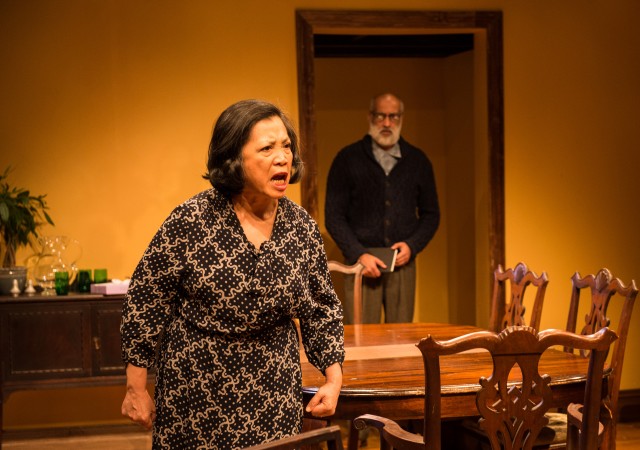
Bessie Berger (Mia Katigback) will do whatever it takes to protect the honor of her family in NAATCO revival of Clifford Odets’s first play (photo by William P. Steele)

Bessie Berger (Mia Katigback) will do whatever it takes to protect the honor of her family in NAATCO revival of Clifford Odets’s first play (photo by William P. Steele)

As opposed to its two big-time Broadway productions — Awake and Sing! premiered on the Great White Way in 1935, directed by Harold Clurman and starring Luther Adler, Stella Adler, Morris Carnovsky, John Garfield, and Sanford Meisner, while the Tony-winning 2006 revival was directed by Bartlett Sher and featured Ben Gazzara, Zoe Wanamaker, Mark Ruffalo, Lauren Ambrose, and Pablo Schreiber — NAATCO’s three-act production takes place in the reconfigured Walkerspace theater in SoHo, where Anshuman Bhatia’s set design consists of a dining-room table, a couch, and some chairs in a narrow rectangular center area, with the fifty-member audience seated in two rows on the longer sides, making them feel like part of the family. The all-Asian cast gives splendid performances as the Jewish clan, a conceit that lends additional insight into the general themes of poverty, class, and pride, resulting in a more universal scope. Katigbak is particularly effective as the manipulative mother, while De Silva stands out as Axelrod, a voice of reason amid the escalating chaos. Directed by Shakespearean Stephen Fried, the play benefits strongly from the intense eye contact the characters make with one another, something that gets lost on larger stages but is powerful and dramatic here. The Bergers might not find that the streets of America are paved with gold, but this production of Awake and Sing! is very rich indeed.