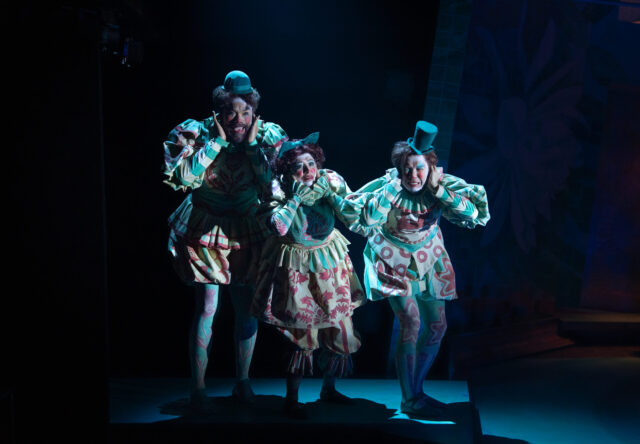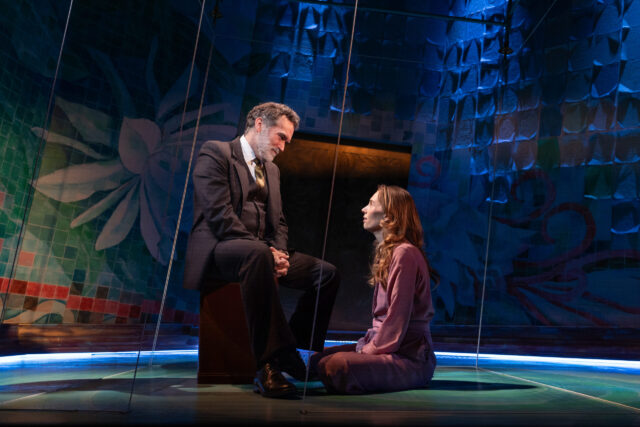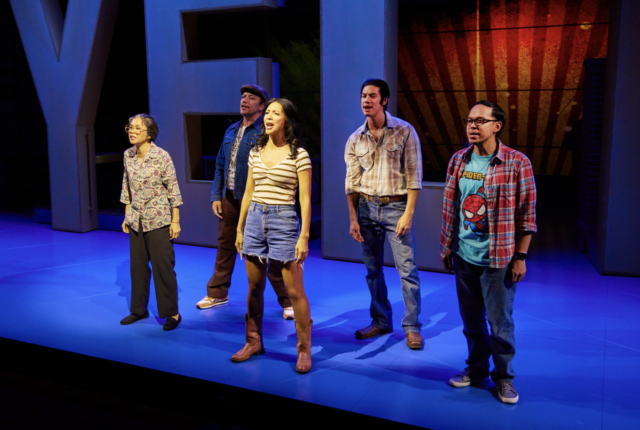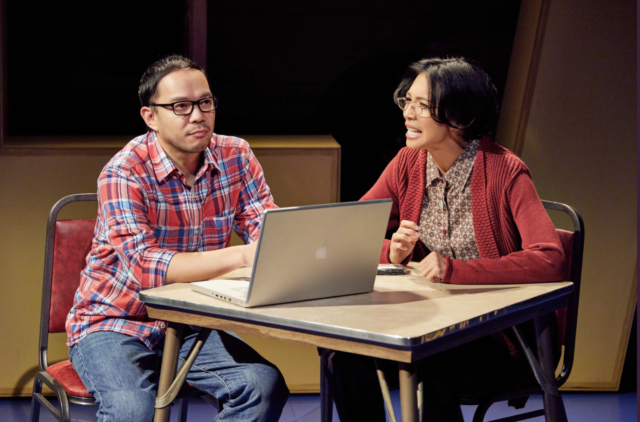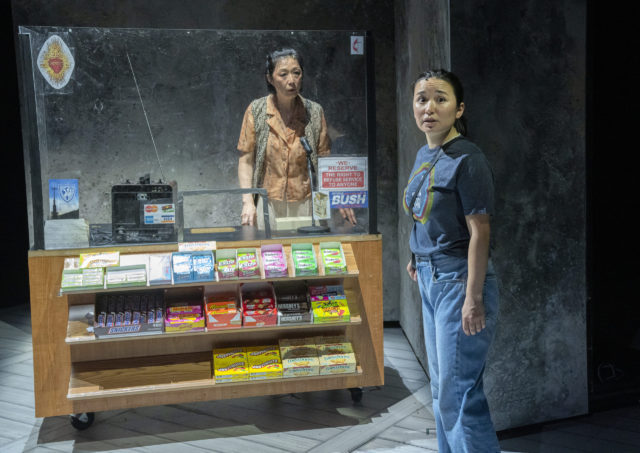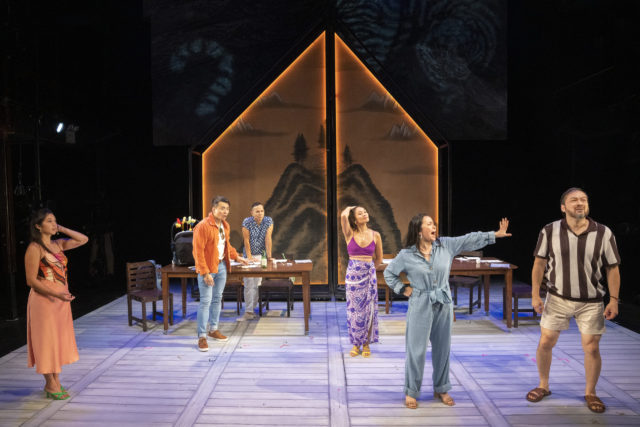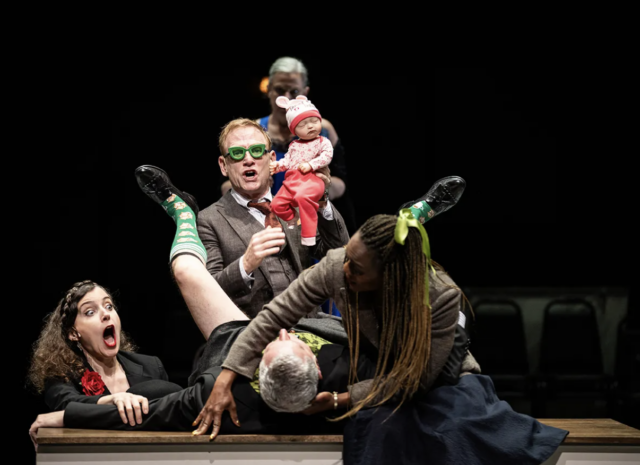
Elevator Repair Service’s Ulysses is a highlight of the January performance festival season (photo by Maria Baranova)
Every January, many of us begin the new year with resolutions to make positive changes in our lives; I find the best way to start that is by checking out the latest in cutting-edge and experimental theater, music, dance, opera, film, and other forms of entertainment. Performance festivals abound this month, at tiny venues you’ve never heard of, places you’ve always wanted to go to but haven’t yet, and well-known spaces you haven’t been to in years.
You now have the chance to fill those voids at such festivals as Under the Radar, Prototype, Exponential, Out-Front!, Live Artery, Winter Jazzfest, New Ear, the Fire This Time, and PhysFestNYC, none of them costing nearly as much as a Broadway show. As sound designer Mark Anthony Thompson says in the below video, “Get out of your house and be with people.”
Here are only some of the highlights of this exhilarating time to try something that might be outside your comfort zone — or right up your alley.
UNDER THE RADAR: IN HONOR OF JEAN-MICHEL BASQUIAT
New York Theatre Workshop
79 East Fourth St. between Second & Third Aves.
Tuesday – Sunday, January 7–18, $35
www.nytw.org
utrfest.org
Obie-winning actor, playwright, rapper, and director Roger Guenveur Smith has staged such solo shows as A Huey P. Newton Story, about the founder of the Black Panthers, Frederick Douglass Now, in which he embodies the nineteenth-century abolitionist and orator, and Juan and John, which explored the real-life 1965 fight between Major League pitcher Juan Marichal and catcher John Roseboro. For the 2026 Under the Radar festival, he will perform In Honor of Jean-Michel Basquiat, about his friendship and collaboration with the highly influential Brooklyn-born artist and musician who died of a heroin overdose in 1988 at the age of twenty-seven. Smith and Basquiat met during their LA club years in the 1980s; Smith created the character of Smiley, inspired by Basquiat, for the 1989 Spike Lee film Do the Right Thing. The sixty-minute piece features live sound design by Mark Anthony Thompson; the January 8 and 15 performances will be followed by a Q&A.
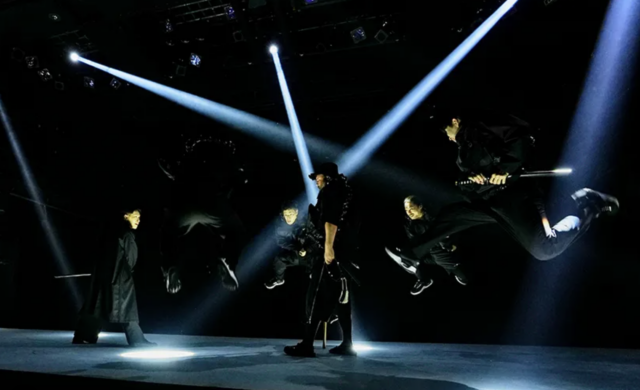
Kinoshita Kabuki offers a modern take on an 1840 classic at Japan Society (photo © 2023 by Shinji Hosono)
UNDER THE RADAR: KANJINCHO
Japan Society
333 East 47th St. at First Ave.
January 8–11, $63
japansociety.org
utrfest.org
Yuichi Kinoshita reimagines the 1840 Kabuki classic Kanjincho (“The Subscription List”) as a contemporary hip-hop and pop-culture-infused theatrical experience, making its North American premiere at Japan Society January 8–11 as part of Under the Radar. The eighty-minute show is set in the twelfth century, around the Genpei War, a civil clash between the Taira and Minamoto clans. The work is performed by the Kyoto-based Kinoshita Kabuki, all dressed in black, and directed by Sugio Kunihara on a runway-like hanamachi (“flower path”) platform that juts into the audience, with the first two rows on the stage itself. The story concerns war, betrayal, race, and class as refugees attempt to cross borders, giving it a modern-day relevance. The company’s previous works include Musume Dojoji, Shinju Ten no Amijima, and Sannin Kichisa. The 7:30 show on January 8 will be followed by a reception; the 7:30 performance on January 9 will conclude with an artist Q&A. Ticket holders are invited to visit the immersive exhibition “Chiharu Shiota: Two Home Countries” with complementary same-day admission.
UNDER THE RADAR: ALL THAT FALL
Mabou Mines@122CC
150 1st Ave. at Ninth St.
January 8–26
www.maboumines.org
utrfest.org
“It is our desire to create, as Beckett says, ‘a text written to come out of the dark,’” director JoAnne Akalaitis says about Mabou Mines’s tenth production of a work by Samuel Beckett, the absurdist black comedy All That Fall, following such presentations as Cascando, Happy Days, Play, and Worstward Ho over the course of the company’s fifty-six-year history. The seventy-five-minute one-act radio play will be performed by Randy Danson, Jesse Lenat, Steven Rattazzi, Tony Torn, Tẹmídayọ Amay, Wendy vanden Heuvel, Lila Blue, and Sylvan Schneiderman as part of Under the Radar. “What have I done to deserve all this, what, what?” the frail Mrs Maddy Rooney moans to bill broker Mr Tyler, later adding, “Have you no respect for misery?” I saw Trevor Nunn’s splendid version in 2013 starring Michael Gambon and Eileen Atkins and can’t wait to see what Akalaitis (Beckett’s First Love, BAD NEWS! I was there . . .) has in store for us this time around, with a set by Thomas Dunn, lighting by Jennifer Tipton, sound by Bruce Odland, costumes by Andreea Mincic, and projections by Jeri Coppola. Expect the unexpected.
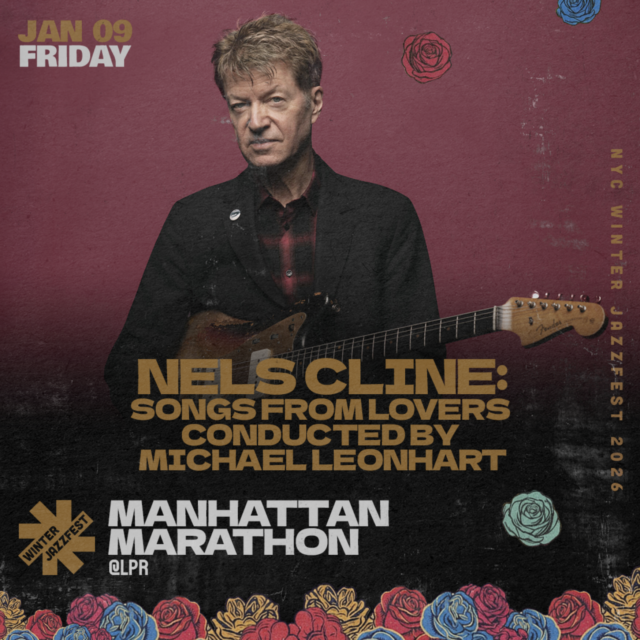
WINTER JAZZFEST: MANHATTAN MARATHON
Multiple venues
Friday, January 9, $85-$550
www.winterjazzfest.com
Founded in 2005, “Winter Jazzfest celebrates the music as a living entity, wherein history collides with the future in every note. Creative improvisation in the digital age continues to stimulate thought and emotion of its listeners, embracing innovation, defying instrumental boundaries and the old cliches of ‘What is Jazz?’” The festival runs January 8–13 and is highlighted by the Manhattan Marathon on January 9, boasting forty-five shows at Le Poisson Rouge, Nublu, DROM, City Winery, Close Up, Zinc, and the Bitter End, featuring Nels Cline’s “Songs from Lovers,” the Getdown, James Carter, David Murray, Lady Blackbird, and many more.
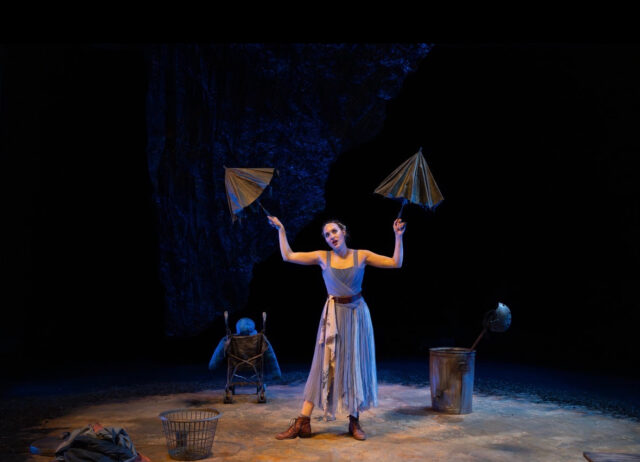
Drita Kabashi stars in Sara Farrington’s Euripides adaptation at the Tank (photo by Carol Ostrow)
APAP: A TROJAN WOMAN
Theater 98 at the Tank
312 West Thirty-Sixth St. between Eighth & Ninth Aves.
January 10-11, $23-$42
apap365.org/conference
thetanknyc.org
“A Trojan Woman exists inside an act of modern warfare, inspired by an early moment in the Russian war against Ukraine that affected me deeply,” playwright Sara Farrington explains in a note about her adaptation of Euripides’s 415 BCE Greek tragedy The Trojan Women. Originally performed at the outdoor Theatro Attikou Aldous/Katina Paxinou Attica Grove Theater in Athens, Greece, in July 2023, A Trojan Woman will be at the Tank January 10-11 as part of the APAP (Association of Performing Arts Professionals) festival, directed by Meghan Finn and starring Drita Kabashi as Irina; the costumes are by Suzanne Bocanegra, with video by Ana Veselic. Farrington has previously collaborated with her husband, Reid Farrington, on such productions as BrandoCapote, CasablancaBox, and Dora Maar, always providing a unique take on the world and theater itself; Sara is currently working on Dr. Uncanny Presents: Moreau ’96, a musical based on the 2014 documentary Lost Soul: The Doomed Journey of Richard Stanley’s Island of Dr. Moreau. She is also the author of the popular Theater Is Hard. on Substack.
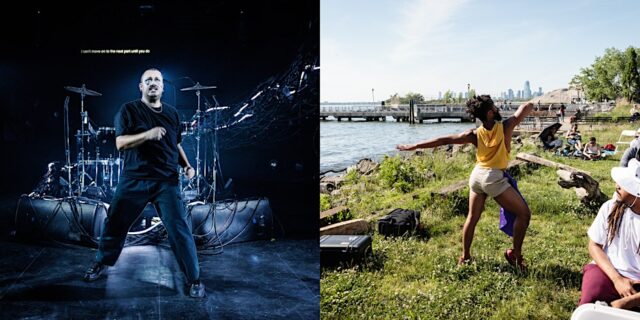
Ian Andrew Askew and Johnnie Cruise Mercer will present world premieres at Out-FRONT! Fest (photos by Maria Baranova and Johnnie Cruise Mercer)
OUT-FRONT! FESTIVAL: IAN ANDREW AND JOHNNIE CRUISE MERCER
Judson Memorial Church
243 Thompson St. at 55 Washington Square South
Saturday, January 10, and Sunday, January 11, free with advance RSVP (suggested donation $28.52)
pioneersgoeast.org
www.judson.org
Pioneers Go East Collective’s multidisciplinary Out-FRONT! Fest “champions the voices of LGBTQ and Feminist artists for a lively exchange of art and culture.” Curated by Gian Marco Riccardo Lo Forte, Remi Harris, Philip Treviño, and Joyce Isabelle, the 2026 edition runs January 5–11, with works by such performers as Dominica Greene, Suzzanne Ponomarenko, Alexa Grae, Sugar Vendil, Jo Warren, Owen Prum, and Corentin JPM Leven at Judson Memorial Church. On January 10 and 11, Ian Andrew Askew will present the world premiere of SLAMDANCE punk lessons, which explores sociopolitical aspects of moshing and violence, followed by the world premiere of Johnnie Cruise Mercer’s Mercies of a Butterfly, “a movement allegory about resilience.” All tickets are free with suggested donation and are going fast.
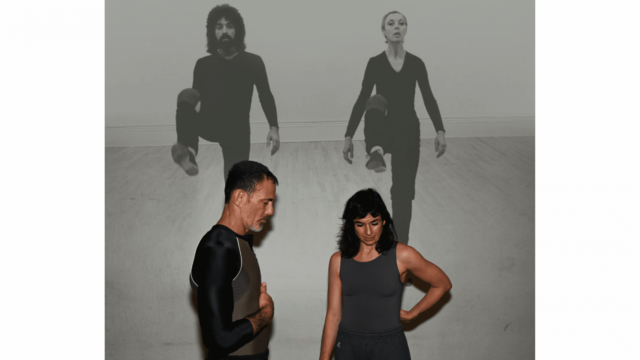
Wally Cardona and Molly Lieber restage David Gordon’s 1975 duet in original SoHo loft (b&w photo by Babette Mangolte; color photo by Daqi Fang)
LIVE ARTERY: TIMES FOUR / DAVID GORDON: 1975/2025
New York Live Arts / Pick Up Performance Co. Studio
541 Broadway between Spring & Prince Sts.
January 11–13, $33.85
newyorklivearts.org
Two of my favorite dancer-choreographers, Wally Cardona and Molly Lieber, have teamed up for Times Four / David Gordon: 1975/2025, an adaptation of David Gordon’s 1975 duet with his wife and muse, Valda Setterfield, that will run January 11–13 as part of New York Live Arts’ Live Artery festival. The work will be presented in the same SoHo loft where Obie and Bessie winners Gordon and Setterfield debuted it fifty years ago; Times Four has not been seen in its entirety since then. In 2021, Gordon asked Cardona, who is married to playwright Ain Gordon, David and Valda’s son, if he wanted to perform something from his archives. Cardona was instantly interested in Times Four, an unusual, relatively unknown piece, but Gordon rejected that. However, after both Gordon and Setterfield died, the former in 2022 at the age of eighty-five, the latter in 2023 at eighty-eight, Cardona decided to resurrect Times Four in their honor. “I think that they, especially Valda, would be very happy that we are doing this piece and that we are performing something,” Cardona told choreographer, dancer, director, and NYLA head Bill T. Jones in an online interview. Cardona (Interventions, The Set Up) and Lieber (Rude World, Gloria) reconstructed the piece from a video rehearsal, Setterfield’s handwritten notes, photographs, and other ephemera, as no footage of the full original duet, which is done in silence, exists. The audience will sit in folding chairs on all four sides of the loft.
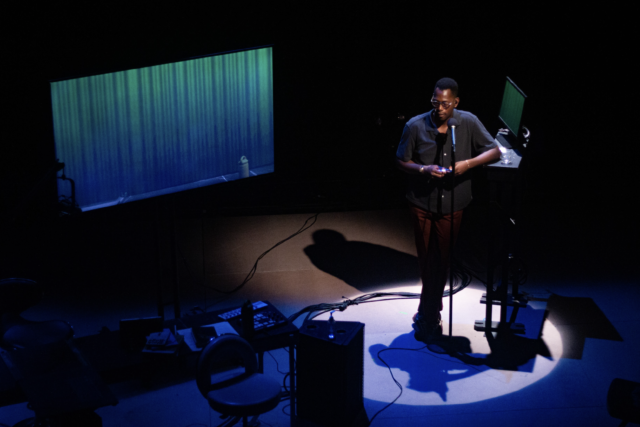
Eric Berryman shares African American toasts in Wooster Group’s Get Your Ass in the Water and Swim Like Me (photo by Marika Kent)
UNDER THE RADAR: GET YOUR ASS IN THE WATER AND SWIM LIKE ME
Joe’s Pub, the Public Theater
425 Lafayette St. at Astor Pl.
Monday, January 12, and Tuesday, January 13, $36
utrfest.org
publictheater.org
In 2019, the Wooster Group production of The B-Side: “Negro Folklore from Texas State Prisons,” a Record Album Interpretation earned a Drama Desk nomination for Unique Theatrical Experience for Eric Berryman’s multimedia adaptation of a 1965 LP compiled by Bruce Jackson, consisting of performances by inmates of color on segregated agricultural prison farms. Writer and actor Berryman and director Kate Valk followed that up with Get Your Ass in the Water and Swim Like Me, which is having an encore presentation at Joe’s Pub as part of Under the Radar. This time Berryman dives deep into Jackson’s 1974 book and 1976 disc, Get Your Ass in the Water and Swim Like Me: Narrative Poetry from Black Oral Tradition, a collection of folktales known as toasts, made for heroes and antiheroes in the Black storytelling canon. The tales are filled with tawdry sex and extreme violence — bullets are flying everywhere — but as funny as they are, there’s also an underlying sense of discomfort, particularly with a primarily white audience, as the stories contain stereotypes reminiscent of minstrelsy. Berryman compares over-the-top characters to Greek myths, where such figures as Hercules and Jason “would do stupid shit because they knew it would help them uh, uh, more quickly achieve kleos, and get kleos . . . A community creates the heroes that they need.” Berryman (Primary Trust, Toni Stone) is not just sharing old fables but exploring Black identity then and now. At one point he digresses into a discussion of his own name, how disappointed he is to be anchored with the plain “Eric” when he has relatives called Qasim, Idris, Indira, Akeem, Alenka, and Adia. (He does note that there is a Gary but does not share that it’s his uncle, Grammy-winning jazz saxophonist Gary Bartz.) The show concludes with the all-time favorite “Stackolee,” a tale of murder and mayhem that has been recorded in different versions by Mississippi John Hurt, Doc Watson, Wilbert Harrison, Long Cleve Reed, Lloyd Price, and Nick Cave and the Bad Seeds, among others, its familiarity spotlighting the centrality rather than the marginalization of the Black experience in American popular culture.
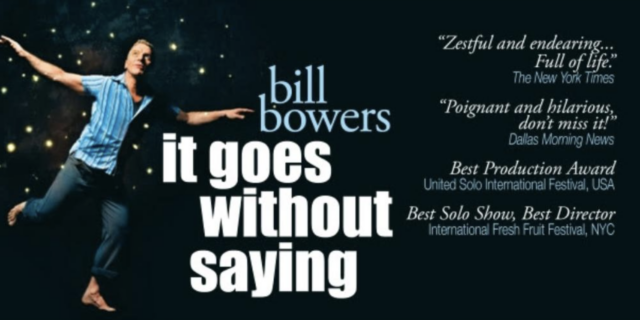
PhysFestNYC: BILL BOWERS: IT GOES WITHOUT SAYING
Stella Adler Center for the Arts
65 Broadway
Tuesday, January 13, $20, 7:30 & 9:00
www.physfestnyc.org
PhysFestNYC was started in 2024 as “a community-focused festival that celebrates, enriches, and envisions our field of physical theater . . . [which] tends to be experimental, innovative, and genre-breaking.” The third annual event, taking place January 8–18 at the Stella Adler Center for the Arts, consists of workshops, panel discussions, masterclasses, and live performances. On January 13, Bill Bowers will present the one-man show It Goes without Saying, which delves into his life and career from his childhood in Montana to studying with Marcel Marceau and appearing in several Broadway productions.
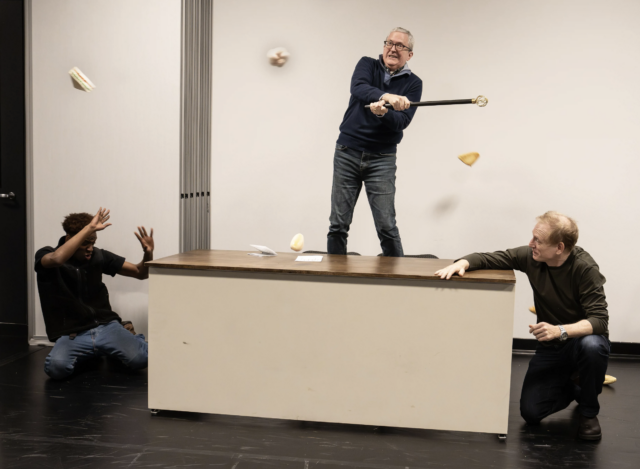
Christopher-Rashee Stevenson, Vin Knight, and Scott Shepherd rehearse for NYC premiere of ERS’s Ulysses (photo by Joan Marcus)
UNDER THE RADAR: ULYSSES
Martinson Theater, the Public Theater
425 Lafayette St. at Astor Pl.
January 13 – February 15, $109
publictheater.org
utrfest.org
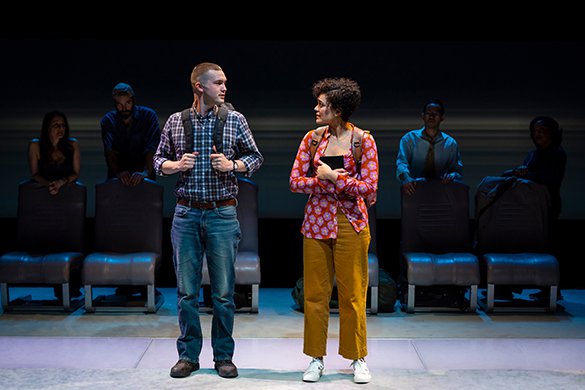
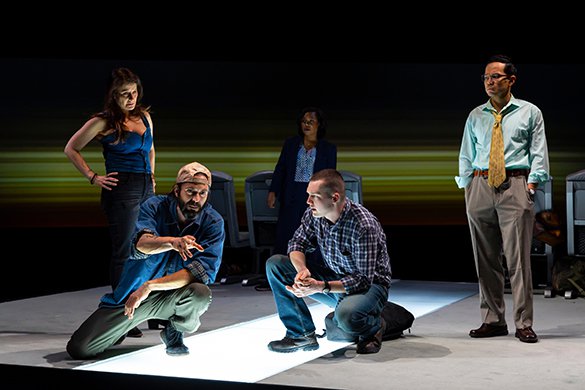
Elevator Repair Service follows up its farewell performance of the eight-hour Gatz at the Public with its adaptation of James Joyce’s Ulysses, clocking in at a mere two hours and forty minutes. Directed by John Collins, who has previously tackled such literary biggies for ERS as The Sound and the Fury and The Sun Also Rises in addition to Gatz, the show stars Dee Beasnael, Kate Benson, Maggie Hoffman, Vin Knight, Christopher-Rashee Stevenson, Stephanie Weeks, and codirector and dramaturg Scott Shepherd, with sets by dots, costumes by Enver Chakartash, and projections by Matthew Deinhart. Joyce is having a bit of a renaissance onstage recently, with a rare revival of Joyce’s only play, Exiles, last winter and Colin Murphy’s The United States vs. Ulysses at the Irish Arts Center last spring; ERS’s Ulysses, part of Under the Radar, promises to be the best of the bunch.
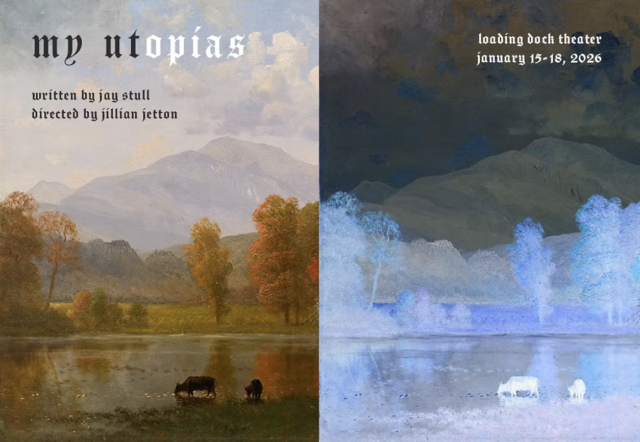
THE EXPONENTIAL FESTIVAL: MY UTOPIAS
Loading Dock Theatre
170 Tillary St.
January 15–18
www.theexponentialfestival.org
Writer Jay Stull (The Capables, Rantoul and Die) and director Jillian Jetton have put together a fantastic cast for my utopias, running at the Loading Dock Theatre as part of the Exponential Festival: Brittany Bradford, Ugo Chukwu, Fernando Gonzalez, Melissa Hurst, Jon Norman Schneider, Colleen Werthmann, and Julyana Soelistyo. The show is about a kind of postapocalyptic nightmare in New York City as a group of survivors wonder what the future holds.
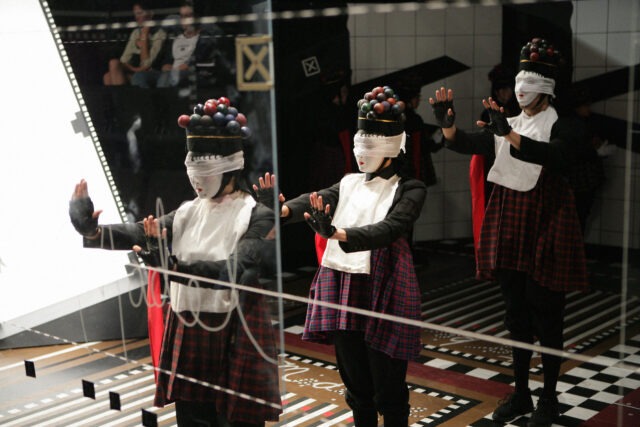
Paul Lazar and Annie-B Parson stage first revival of Richard Foreman’s What to wear at BAM (photo by Scott Groller)
PROTOTYPE: WHAT TO WEAR
Brooklyn Academy of Music
BAM Strong Harvey Theater
651 Fulton St. at Ashland Pl.
January 15-18
www.bam.org
www.prototypefestival.org
“Don’t finish what you start,” reads one of ninety-four notecards collected in experimental theater maestro Richard Foreman’s posthumously published book No Title. Fortunately, Foreman, the founder of the Ontological-Hysteric Theater who died last January at the age of eighty-seven, finished much of what he started, including more than eighty plays, operas, films, and books. The seven-time Obie winner and Guggenheim and MacArthur Fellow turned the theater and opera community inside out and upside down with such influential avant-garde works as Sophia = (Wisdom) Part 3: The Cliffs, Pandering to the Masses, and Elephant Steps. In the past year and a half, Object Collection presented the world premiere of Foreman’s Suppose Beautiful Madeline Harvey, the Wooster Collective staged 1987’s Symphony of Rats, and the Segal Center Film Festival on Theater and Performance held a retrospective of Foreman’s movies and videos. Big Dance Theater’s Paul Lazar and Annie-B Parson are now reviving, for the first time since its premiere, Foreman and Michael Gordon’s 2006 surreal post-rock opera What to wear, running January 15–18 at the Harvey as part of the Prototype and BAM’s Next Wave festivals. Foreman wrote the libretto and directed the original; Gordon composed the music, which will be performed by Bang on a Can All-Stars. The cast is highlighted by St. Vincent, sopranos Sarah Frei and Sophie Delphis, mezzo Hai-Ting Chinn, and tenor Morgan Mastrangelo, along with an ensemble of more than a dozen vocalists and dancers.
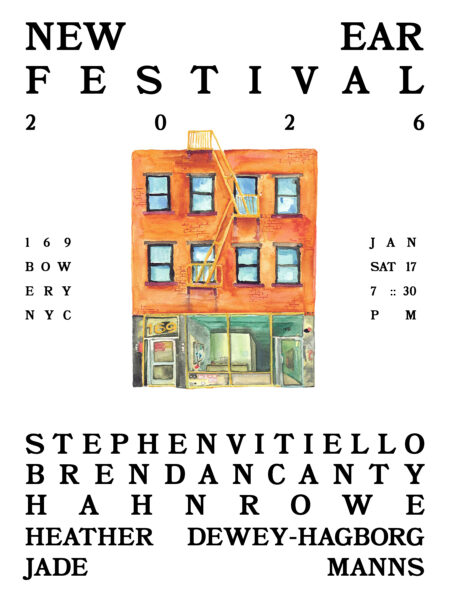
NEW EAR FESTIVAL: NIGHT 02
Fridman Gallery
169 Bowery between Delancey & Broome Sts.
Saturday, January 17, $22.46–$43.57, 8:00
withfriends.events
The Fridman Gallery’s annual New Ear multimedia festival showcasing “time-based art in all its forms” is highlighted by an impressive roster of performers on January 17, consisting of dancer and choreographer Jade Manns, artist and biohacker Dr. Heather Dewey-Hagborg, and the live debut of the trio of sound artist Stephen Vitellio, Fugazy drummer Brendan Canty, and multi-instrumentalist and producer-engineer Hahn Rowe, supporting their sophomore LP, Second. Talullah Calderwood, Sue Huang, and Konjur Collective open the three-day fest on January 16, while La Frae Sci, Ben Shirken x Dorothy Carlos, and Lucky Dragons close things out on January 18.
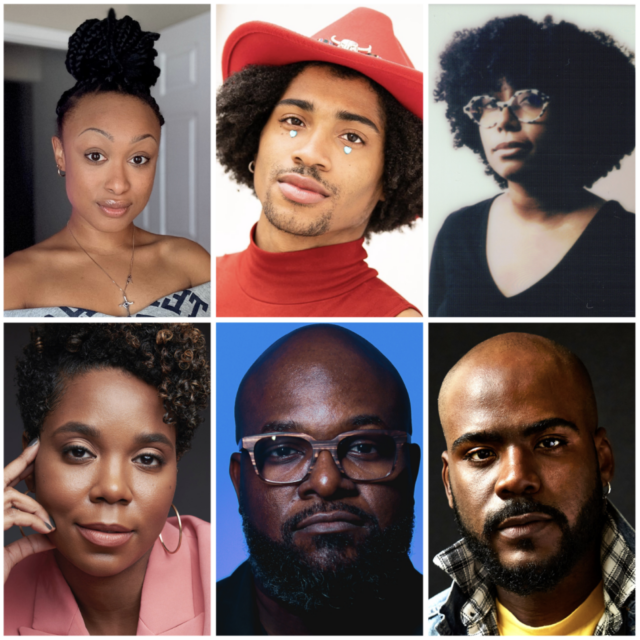
Fire This Time fest features ten-minute works by six playwrights
THE FIRE THIS TIME FESTIVAL: TEN-MINUTE PLAY PROGRAM
The Apollo Stages at the Victoria
233 West 125th St. between Frederick Douglass & Adam Clayton Powell Jr. Blvds.
January 23–31, $51.25
www.firethistimefestival.com
Founded in 2009 by Kelley Nicole Girod, the Fire This Time Festival, now in its seventeenth year, “provides a platform for early career playwrights of African and African American descent.” The 2026 iteration comprises six ten-minute shows at the Apollo Stages at the Victoria: Teniia Micazia Brown’s Everything But–, Preston Crowder’s Black to Save the Day, Mo Holmes’s Clumsy, Naomi Lorrain’s DNR, DeLane McDuffie’s Goose, and Donathan Walters’s White Diamond.
[Mark Rifkin is a Brooklyn-born, Manhattan-based writer and editor; you can follow him on Substack here.]