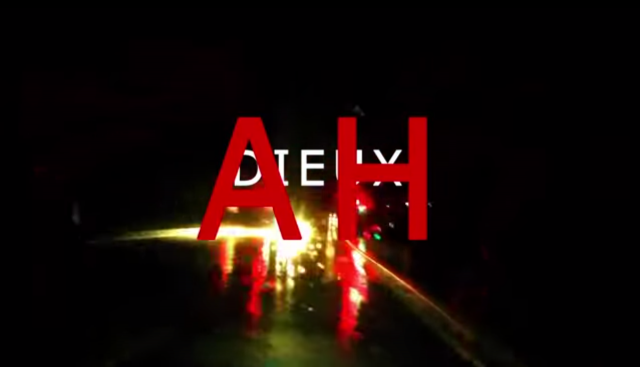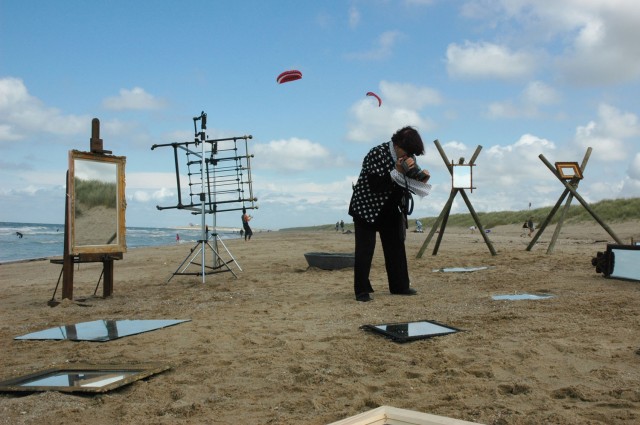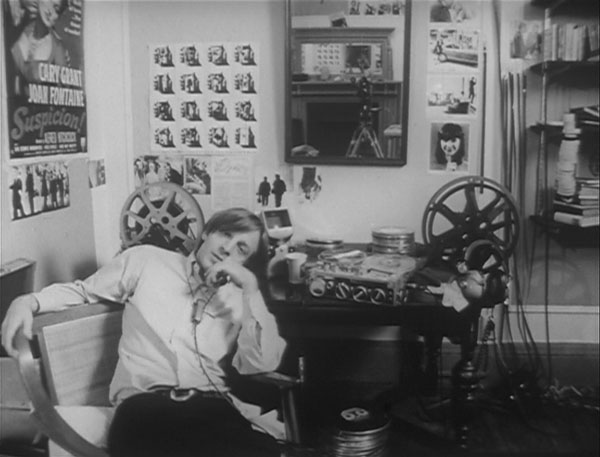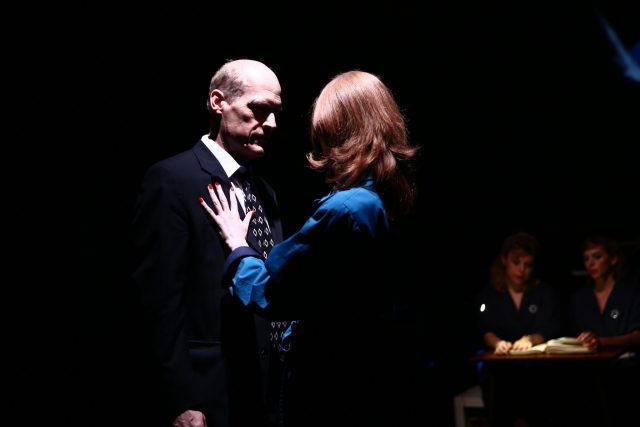
Lemmy Caution (Jim Fletcher) and Natacha Von Braun (Elizabeth Carena) get caught up in mysterious intrigue in Why Why Always (photo by Paula Court)
Abrons Arts Center, Underground Theater
466 Grand St. at Pitt St.
Wednesday – Sunday through October 29, $25
212-352-3101
www.abronsartscenter.org
whywhyalways.automaticrelease.org
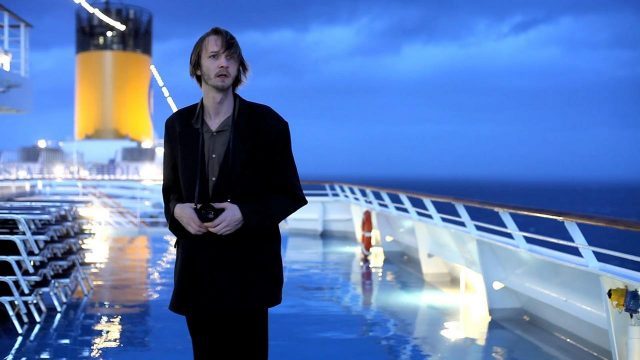
Jean-Luc Godard’s Alphaville meets the ASMR phenomenon in Shaun Irons and Lauren Petty’s multimedia futuristic sci-fi noir, Why Why Always, continuing at Abrons Arts Center’s Underground Theater through October 29. The prescient 1965 man vs. machine film starred Eddie Constantine as secret agent Lemmy Caution, who leaves the Outerlands and enters Alphaville posing as reporter Ivan Johnson in order to find out what happened to fellow agent Henry Dickson and to track down mysterious scientist Professor Von Braun. Irons and Petty reimagine the story using multiple monitors and cameras, live feeds and prerecorded scenes, overlapping dialogue, disembodied voices, mirrors and scrims, and more, in black-and-white and color. Longtime New York City Players member Jim Fletcher (Isolde, The Evening) stars as Caution, driving through darkness and moving through Alphaville in his trench coat, gun at the ready. Natacha (Elizabeth Carena), the professor’s daughter, is assigned to accompany him, making sure he doesn’t break any of Alpha 60’s rules, while a pair of seductresses (Laura Bartczak and Marion Spencer) hover around to take care of his more private needs. Wooster Group and Elevator Repair Service veteran Scott Shepherd (who currently can be seen in Measure for Measure at the Public) appears with Madeline Best on video, and Irons and Petty (Keep Your Electric Eye on Me, Standing By: Gatz Backstage) handle the technological aspects and live processing, including going onstage to reposition the cameras as necessary.
Meanwhile, Carena, Bartczak, and Spencer occasionally break out of character and engage in ASMR (Autonomous Sensory Meridian Response), slow, repetitive movements that have little to do with the plot but create both calm and stimulating atmospheres. Christina Campanella does the narration, with voiceovers by Olivier Conan and Irons, additional music by the Chocolate Factory’s Brian Rogers, costumes and props by Amy Mascena (clothing changes are made at front stage right, visible to some of the audience), complex sound design by Irons and Petty and implemented by Ian Douglas-Moore, and moody lighting courtesy of Jon Harper, referencing Raoul Coutard’s cinematography from the film. The production style of Why Why Always evokes such works as Reid and Sara Farrington’s Casablancabox and Big Dance Theater’s Comme Toujours Here I Stand, tech-heavy, complicated re-creations of Casablanca and Cléo from 5 to 7, respectively. What does it all mean? “That’s always how it is,” Caution says. “You never understand anything. And in the end, it kills you.” It won’t kill you, but it will keep you calmly stimulated and entertained throughout its ninety-minute running time.

 “We’ll have fun making a film,” legendary eighty-eight-year-old Belgian-born French auteur Agnès Varda tells thirty-three-year-old French photographer and street artist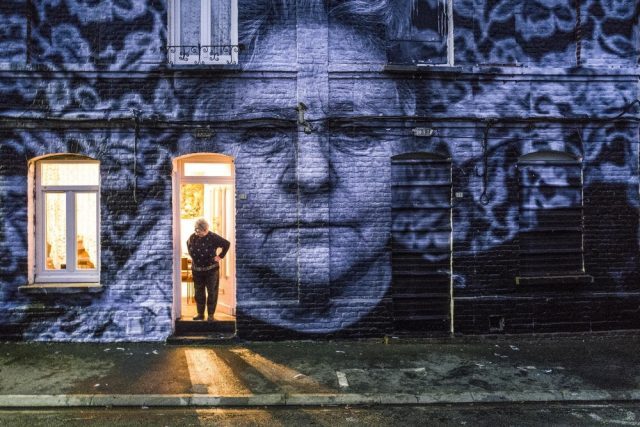


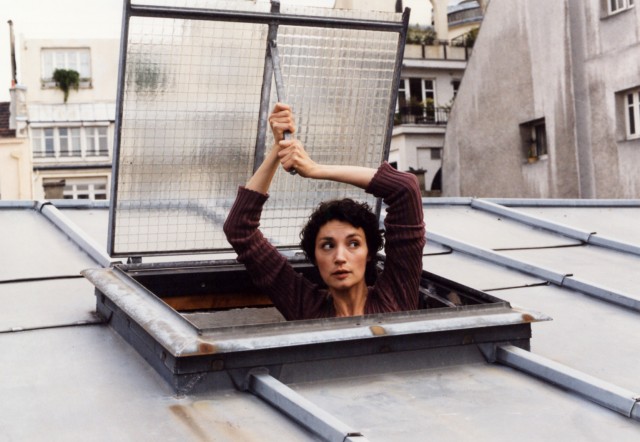

 Legendary cat lover and filmmaker Chris Marker (La Jetée, Sans Soleil) goes on a search for a friendly feline in the slight, playful hour-long documentary The Case of the Grinning Cat. In post-9/11 Paris, when much of the world was proclaiming “We are all Americans,” Marker discovered a series of stenciled yellow cats showing up in odd places, from the sides of buildings to internet sites to classical works of art. After disappearing for a short time — causing Marker great frustration — they return as placards and masks at protest movements against U.S. imperialism and other causes. Although the film is fun to watch, it never quite connects all the dots. The Case of the Grinning Cat is screening at 2:00, 5:15, and 8:30 on September 10 in the BAMcinématek series “Plus ça change: French New Wave in the New Millennium.”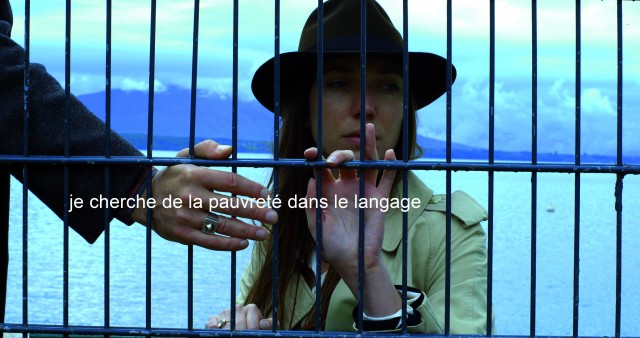
 After the New York Film Festival advance press screening of Jean-Luc Godard’s 3D Goodbye to Language in 2014, a colleague turned to me and said, “If this was Godard’s first film, he would never have had a career.” While I don’t know whether that might be true, I do know that Goodbye to Language is the 3D flick Godard was born to make, a 3D movie that couldn’t have come from anyone else. What’s it about? I have no idea. Well, that’s not exactly right. It’s about everything, and it’s about nothing. It’s about the art of filmmaking. It’s about the authority of the state and freedom. It’s about extramarital affairs. It’s about seventy minutes long. It’s about communication in the digital age. (Surprise! Godard does not appear to be a fan of the cell phone and Yahoo!) And it’s about a cute dog (which happens to be his own mutt, Miéville, named after his longtime partner, Anne-Marie Miéville). In the purposefully abstruse press notes, Godard, eighty-three at the time, describes it thusly: “the idea is simple / a married woman and a single man meet / they love, they argue, fists fly / a dog strays between town and country / the seasons pass / the man and woman meet again / the dog finds itself between them / the other is in one / the one is in the other / and they are three / the former husband shatters everything / a second film begins / the same as the first / and yet not / from the human race we pass to metaphor / this ends in barking / and a baby’s cries.” Yes, it’s all as simple as that. Or maybe not.