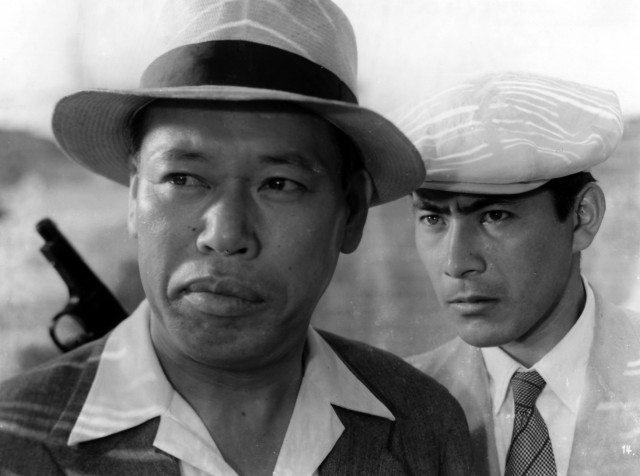
Takashi Shimura and Toshirō Mifune team up as detectives tracking a stolen gun in Akira Kurosawa’s STRAY DOG
STRAY DOG (野良犬) (NORA INU) (Akira Kurosawa, 1949)
Japan Society
333 East 47th St. at First Ave.
Friday, April 1, $12, 7:00
Series continues first Friday of every month
212-715-1258
www.japansociety.org
 Akira Kurosawa’s thrilling police procedural, Stray Dog, is one of the all-time-great film noirs. When newbie detective Murakami (Toshirō Mifune) gets his Colt lifted on a trolley, he fears he’ll be fired if he does not get it back. But as he searches for the weapon, he discovers that it is being used in a series of robberies and murders — for which he feels responsible. Teamed with seasoned veteran Sato (Takashi Shimura), Murakami risks his career — and his life — as he tries desperately to track down his gun before it is used again. Kurosawa makes audiences sweat, showing postwar Japan in the midst of a brutal heat wave, with Murakami, Sato, dancer Harumi Namiki (Keiko Awaji), and others constantly mopping their brows — the heat is so palpable, you can practically see it dripping off the screen. (You’ll find yourself feeling relieved when Sato hits a button on a desk fan, causing it to turn toward his face.) In his third of sixteen films made with Kurosawa, Mifune plays Murakami with a stalwart vulnerability, working beautifully with Shimura’s cool, calm cop who has seen it all and knows how to handle just about every situation. (Shimura was another Kurosawa favorite, appearing in twenty-one of his films.)
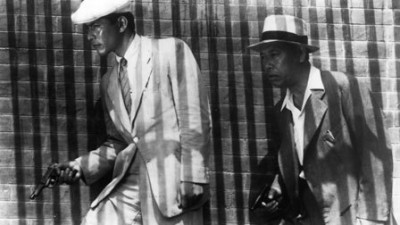
Rookie detective Murakami (Toshirō Mifune) often finds himself in the shadows in STRAY DOG
Mifune is often seen through horizontal or vertical gates, bars, curtains, shadows, window frames, and wire, as if he’s psychologically and physically caged in by his dilemma — and as time goes on, the similarities between him and the murderer grow until they’re almost one and the same person, dealing ever-so-slightly differently with the wake of the destruction wrought on Japan in WWII. Inspired by the novels of Georges Simenon and Jules Dassin’s The Naked City, Stray Dog is a dark, intense drama shot in creepy black and white by Asakazu Nakai and featuring a jazzy soundtrack by Fumio Hayasaka that unfortunately grows melodramatic in a few key moments — and oh, if only that final scene had been left on the cutting-room floor. It also includes an early look at Japanese professional baseball. Kurosawa would soon become the most famous Japanese auteur in the world, going on to make Rashomon, Ikiru, Seven Samurai, Throne of Blood, The Hidden Fortress, The Bad Sleep Well, The Lower Depths, and I Live in Fear in the next decade alone. Stray Dog will be screening on April 1 in Japan Society’s “Monthly Classics” series, and it well deserves its place there. The series continues May 6 with Yasujirō Ozu’s I Was Born, But . . . and June 3 with Sion Sono’s Love Exposure.
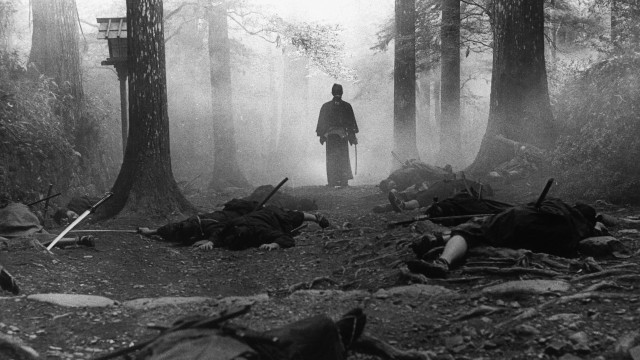
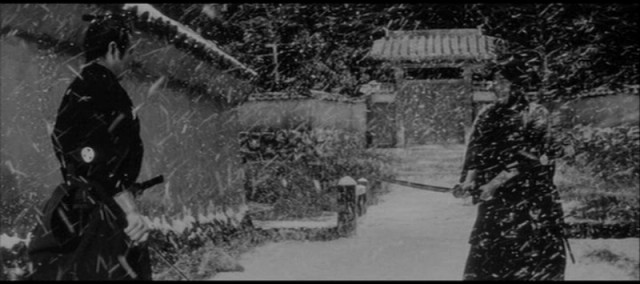
 Japan Society’s Monthly Classics series continues February 5 with the story of one of the screen’s most brutal antiheroes, a samurai you can’t help but root for despite his coldhearted brutality, a heartless killer called “a man from hell.” Based on Kaizan Nakazato’s forty-one-volume serial novel Dai-bosatsu Tōge, Kihachi Okamoto’s The Sword of Doom, aka The Great Bodhisattva Pass, begins in 1860 with Ryunosuke Tsukue (Tatsuya Nakadai) slaying an elderly Buddhist pilgrim (Ko Nishimura) apparently for no reason as the man visits a far-off mountain grave. Shortly before Ryunosuke is to battle Bunnojo Utsuki (Ichiro Nakaya) in a competition using unsharpened wooden swords, the man’s wife, Ohama (Michiyo Aratama), comes to him, begging for Ryunosuke to lose the match on purpose to save her family’s future. A master swordsman with an unorthodox style, Ryunosuke takes advantage of the situation in more ways than one. As emotionless as he is fearless, Ryunosuke is soon ambushed on a forest road, but killing, to him, comes natural, whether facing one man or dozens — or even hundreds. The only person he shows even the slightest respect for is Toranosuke Shimada (Toshirō Mifune), the instructor at a sword-fighting school. “We have rules concerning strangers,” Toranosuke tells him, but Ryunosuke plays by no rules. “The sword is the soul. Study the soul to know the sword. Evil mind, evil sword,” Toranosuke adds, words that torment Ryunosuke, who tries to start a family in spite of his hard, detached demeanor. But regardless of circumstance, Ryunosuke continues on his bloody path, culminating in an unforgettable battle that is one of the finest of the jidaigeki genre.