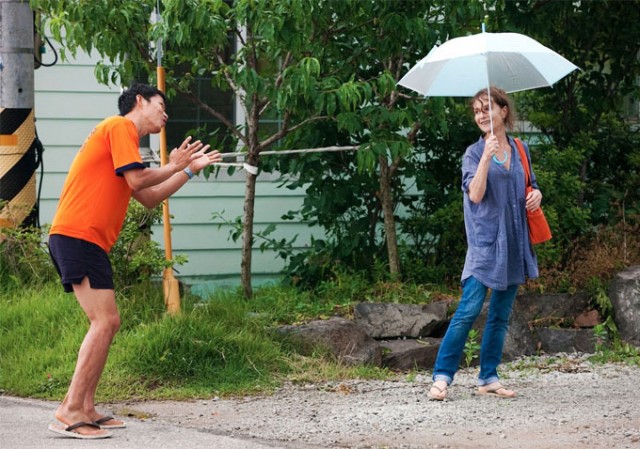
A lifeguard (Yu Jun-sang) makes the first of several offers to Anne (Isabelle Huppert) in Hong Sang-soo’s IN ANOTHER COUNTRY
IN ANOTHER COUNTRY (DA-REUN NA-RA-E-SUH) (Hong Sang-soo, 2012)
BAMcinématek, BAM Rose Cinemas
30 Lafayette Ave. between Ashland Pl. & St. Felix St.
Sunday, February 24, 2:00
Series runs February 22-24
718-636-4100
www.bam.org
 Korean auteur Hong Sang-soo continues his fascinating exploration of cinematic narrative in In Another Country, although this one turns somewhat nasty and tiresome by the end. After being duped in a bad business deal by a family member, an older woman (Youn Yuh-jung) and her daughter, Wonju (Jung Yumi), move to the small seaside town of Mohjang, where the disenchanted Wonju decides to write a screenplay to deal with her frustration. Based on an actual experience she had, she writes three tales in which a French woman named Anne (each played by an English-speaking Isabelle Huppert) comes to the town for different reasons. In the first section, Anne is a prominent filmmaker invited by Korean director Jungsoo (Kwon Hye-hyo), who has a thing for her even though he is about to become a father with his very suspicious wife, Kumhee (Moon So-ri). In the second story, Anne, a woman married to a wealthy CEO, has come to Mohjang to continue her affair with a well-known director, Munsoo (Moon Sung-keun), who is careful that the two are not seen together in public. And in the final part, Anne, whose husband recently left her for a young Korean woman, has arrived in Mohjang with an older friend (Youn), seeking to rediscover herself. In all three stories, Anne searches for a lighthouse, as if that could shine a light on her future, and meets up with a goofy lifeguard (Yu Jun-sang) who offers the possibility of sex, but each Anne reacts in different ways to his advances. Dialogue and scenes repeat, with slight adjustments made based on the different versions of Anne, investigating character, identity, and desire both in film and in real life. Hong wrote the film specifically for Huppert, who is charming and delightful in the first two sections before turning ugly in the third as Anne suddenly becomes annoying, selfish, and irritating, the plot taking hard-to-believe twists that nearly undermine what has gone on before. As he has done in such previous films as Like You Know It All, The Day He Arrives, Tale of Cinema, and Oki’s Movie, Hong weaves together an intricate plot that is soon commenting on itself and coming together in unexpected, surreal ways, but he loses his usual taut narrative thread in the final, disappointing section. In Another Country is screening on February 24 as part of the New York Korean Film Festival at BAMcinématek, which begins February 22 with Kim Ki-Duk’s Golden Lion-winning Pieta and also includes Jo Byeong-ok’s All Bark, No Bite, Lee Suk-hoon’s Dancing Queen, Choo Chang-min’s Masquerade, Jo Sung-hee’s A Werewolf Boy, Yong-Joo Lee’s Architecture 101, and Jeong-woo Park’s Deranged. (In Another Country is also screening on February 22 at 7:00 as the final film in the Museum of the Moving Image series “Curators’ Choice: The Best of 2012” series, consisting of exemplary works from last year selected by chief curator David Schwartz and assistant film curator Rachael Rakes.)
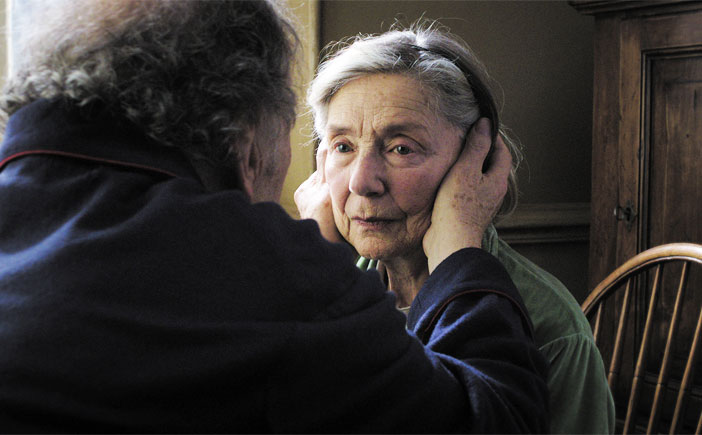
 Legendary French actor Jean-Louis Trintignant puts an exclamation point on his long, distinguished career with Amour, one of the most beautiful love stories ever told. In his first film in nearly a decade, Trintignant, the star of such classics as Z, My Night at Maud’s, A Man and a Woman, and The Conformist, plays Georges, an octogenarian who is immediately concerned when his wife, Anne (Emmanuelle Riva), suddenly freezes for a few moments, unable to speak, hear, move, or recognize anything. So begins a downward spiral in which Georges takes care of his ailing wife by himself, refusing help from his daughter, Eva (Isabelle Huppert), as he faces the grim situation with grace and dignity. A genuine romance for the ages, Amour is brilliantly written and directed by Michael Haneke, earning the German filmmaker his second Palme d’Or, following 2009’s The White Ribbon. Haneke (Cache, The Piano Teacher) and cinematographer Darius Khondji allow the heartbreaking tale to unfold in long interior shots with very little camera movement, spread across more than two hours. Despite its length, the film is far from torturous; instead, it is filled with quietly beautiful moments. Trintignant, who just turned eighty-two, is magnificent as Georges, his every physical movement and eye glance rendered with powerful yet gentle emotions, whether he’s preparing food for Anne or trying to catch a bird that has flown into the apartment. It’s an unforgettable performance in an unforgettable film.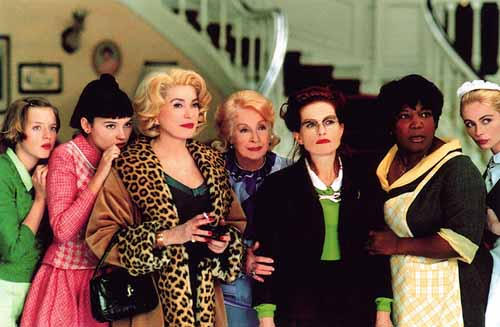
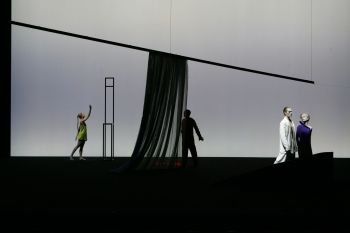
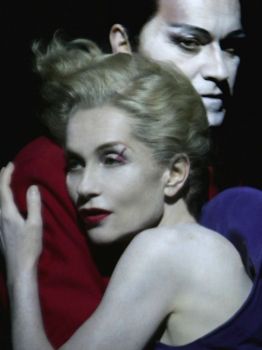
 This should have been a great one, but controversial director François Ozon couldn’t leave well enough alone. Somewhere in 8 Women is a fabulously entertaining murder mystery set in a mansion in which the title characters are trapped — and any one of the eight could be guilty of the murder of the dude in the bedroom who has a knife in his back. The eight women embody much of the history of French cinema of the previous fifty years: Danielle Darrieux (who began making films in the early 1930s), Catherine Deneuve (who, when this movie was made, was nearly sixty!), Fanny Ardant (who had recently turned fifty), a nearly unrecognizable Isabelle Huppert (who was approaching fifty), the beguiling Emmanuelle Béart (who was nearing forty), twentysomethings Virginie Ledoyen and Ludivine Sagnier, and Firmine Richard. Inexplicably, Ozon has each of the characters perform a silly song-and-dance number that neither furthers the plot nor expands on the characters’ motives or mental state. He bit off more than he could chew; he made a compelling takeoff of the British drawing-room mystery and blew it by deciding to play off the Hollywood Technicolor musical as well. But Ardant’s lips, Deneuve’s eyelashes, and Béart’s curves are nearly worth the price of admission nonetheless. 8 Women is screening as part of BAMcinématek’s “Deneuve” series, which concludes March 31 with Arnaud Desplechin’s outstanding A Christmas Tale.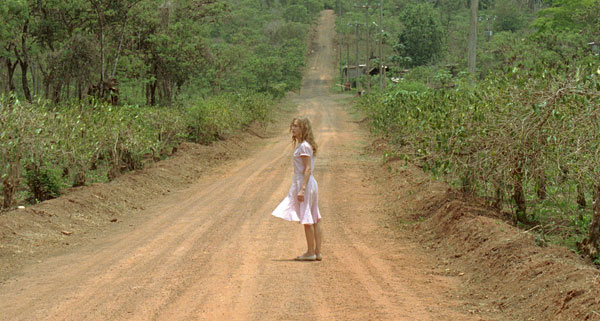
 In an unnamed West African nation besieged by a bloody civll war between rebels and the military government, Maria Vial (Isabelle Huppert) steadfastly refuses to leave her coffee plantation, determined to see the last crop through to fruition. Despite pleas from the French army, which is vacating the country; her ex-husband, André (Christophe Lambert), who is attempting to sell the plantation out from under her; and her workers, whose lives are in danger, Maria is unwilling to give up her home and way of life, apparently blind to what is going on all around her. She seems to be living in her own world, as if all the outside forces exploding around her do not affect her and her family. Without thinking twice, she even allows the Boxer (Isaach De Bankolé) to stay there, the seriously wounded leader of the rebel militia, not considering what kind of dire jeopardy that could result in. But when her slacker son, Manuel (Nicolas Duvauchelle), freaks out, she is forced to take a harder look at reality, but even then she continues to see only what she wants to see. A selection of both the New York and Venice Film Festivals, WHITE MATERIAL is an often obvious yet compelling look at the last remnants of postcolonial European domination as a new Africa is being born in disorder and violence. Directed and cowritten (with French playwright Marie Ndiaye) by Claire Denis (CHOCOLAT, BEAU TRAVAIL), who was born in Paris and raised in Africa, the film has a central flaw in its premise that viewers will either buy or reject: whether they accept Maria’s blindness to the evolving situation that has everyone else on the run. Watching Maria’s actions can be infuriating, and in the hands of another actress they might not have worked, but Huppert is mesmerizing in the decidedly unglamorous role.
 Screening at Film Forum in a new 35mm print in honor of its thirtieth anniversary, Jean-Luc Godard’s EVERY MAN FOR HIMSELF marked a return to a somewhat more accessible narrative for the Nouvelle Vague auteur, although that does not mean it is by any means a traditional story or that it follows mainstream conventions. Arranged in four sections — the Imaginary (Slow Motion), Fear (Run for Your Life), Commerce (Trade), and Music — the film focuses on a smarmy, unlikable cigar-smoking video director, unironically named Paul Godard (Jacques Dutronc), who fights with his ex-wife (Paule Muret), wonders why he can’t touch his eleven-year-old daughter (Cécile Tanner) in rather sensitive areas, has driven away his bicycle-riding girlfriend, Denise Rimbaud (Nathalie Baye), and pays for a visit from Isabelle (Isabelle Huppert), a prostitute who recites lines from Charles Bukowski in her head while plying her trade and seeking her independence. Godard frames many of the images like paintings, coming alive with bright, bold colors. Nearly all of the interior scenes are filmed in long takes with no camera movement or cross-cutting (with two notable exceptions), while other scenes are filled with slow-motion shots, forcing viewers to question what they are seeing. Meanwhile, snippets of Gabriel Yared’s score and incidental music are often heard by only some of the characters, who wonder where the sounds are coming from. Godard infuses the film with various thoughts on Marxism, feminism, capitalism, pedophilia, incest, and violence against women; in one unforgettable scene, a businessman arranges a ridiculously funny Rube Goldberg-like foursome, acting like a film director, mocking Jean-Luc Godard’s own profession. Thirty years down the road, EVERY MAN FOR HIMSELF, also known as SLOW MOTION and, in French, SAUVE QUI PEUT (LA VIE), feels as relevant, as challenging, and as entertaining as ever. (Note: Film critic and Godard biographer Richard Brody will introduce the 8:20 screening on November 19.)