Tag Archives: Irene Diamond Stage

NOT JUST BLACK AND WHITE: MEET THE CARTOZIANS AND ARMENIAN AMERICAN HERITAGE

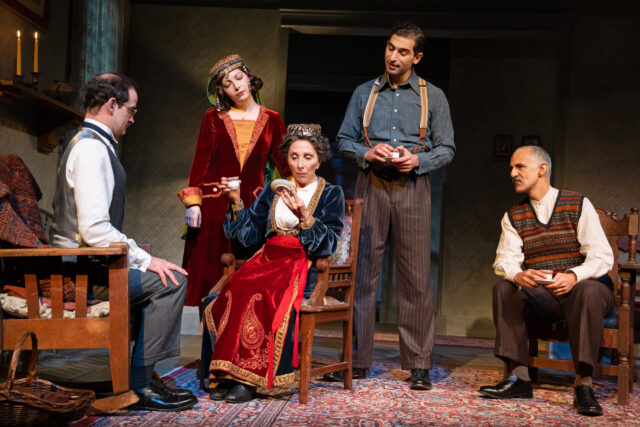
Lawyer Wallace McCamant (Will Brill) seeks to help Armenian immigrants gain US citizenship in Meet the Cartozians (photo by Julieta Cervantes)

MEET THE CARTOZIANS
Second Stage Theater at the Pershing Square Signature Center
The Irene Diamond Stage
305 West 43rd St. between Eighth & Ninth Aves.
Tuesday – Sunday through December 14, $69-$125
2st.com/shows

Talene Yeghisabet Monahon makes a giant leap forward with her exquisitely rendered new play, Meet the Cartozians, a timely and sensitive tale of immigration, assimilation, racial profiling, and culture. The first act takes place in 1923–24 in Portland, Oregon, as Tatos Cartozian (Nael Nacer), an Armenian-born Christian, and his family must fight to prove he is white to prevent the US government from canceling his naturalization. The second act occurs one hundred years later in Glendale, California, as four American-born Armenians prepare to share stories celebrating their heritage on a reality show hosted by an immensely popular celebrity influencer (Tamara Sevunts) who is a descendant of that family.

“We are all trying to uh, let’s say, make sense? Of why this is happening now,” Hazel (Obie winner Susan Pourfar), Tatos’s daughter, says to their well-heeled lawyer, Wallace McCamant (Tony winner Will Brill), in 1923, a sly reference to the treatment of immigrants and people of color today.

A century later, Alan O’Brien (Brill), a production tech on the TV program Meet the Cartozians, tells the guests, “So let me get this straight. The original Cartozians fought to be white so that Armenians could have privileges, right? And now, it sort of feels like Armenians are fighting to not be white . . . so you can like, get more privileges. Am I right about that?”

In 1923, Tatos, a soft-spoken man who speaks heavily accented broken English, lives in a lovely home with his wife (Sevunts), their daughter, Hazel, and his mother, Markrid (two-time Tony winner Andrea Martin). While Hazel and her brother, the impeccably attired Vahan (Raffi Barsoumian), are adapting to the American way of life, the stern Markrid is trying to preserve as much Armenian tradition as she can. After insisting that Wallace take a piece of her homemade kadayif, a sweet dessert, and seeing that he has not finished it, she is offended. Hazel asserts, “I’m sorry. In Armenia, it is a bit rude not to eat. But in America, I think maybe it is rude to force someone to eat.” When Markrid brings out a plate of the sesame-based simit, Wallace declines to taste one, further upsetting Markrid.

Talking about the case, Wallace says, “In 1790, the good men who founded this country extended the offer of naturalized citizenship to all ‘free white persons of good character.’ That was who they felt oughta become American citizens.” Vahan, who works with his father, sister, and naturalized uncle in the family’s successful oriental rug business, proclaims that they are solid white Christians, but Wallace explains that other factors are involved, including skin and hair color, eye and face shape, and “the terrific tendency of Armenians to intermingle and procreate with white populations all over the world.” Wallace commiserates with the Cartozians, pointing out that his paternal grandfather emigrated from Ireland during the potato famine and experienced bigotry when he first came to America.

They also refer several times indirectly to the genocide of approximately 1.5 million Armenians at the hands of the Ottoman Empire during WWI, leaving them without a nation. “It is no longer a place,” Tatos says. Hazel counters, “I think it is fine to say Armenia still. I say Armenia when I speak of home.” Tatos responds, “This is our home. Portland. America.”
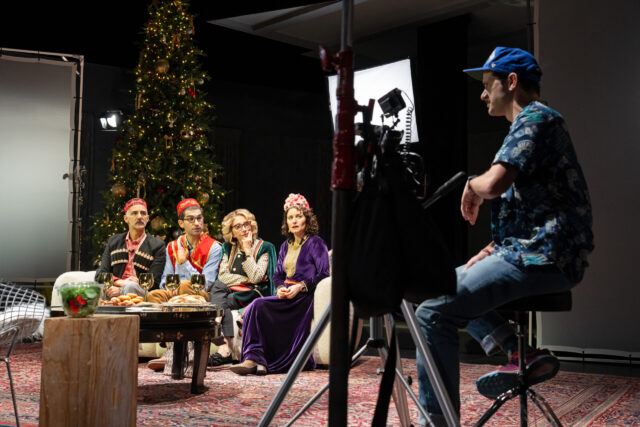
The cast of Meet the Cartozians portrays different characters in 1924 and 2024 (photo by Julieta Cervantes)

In 2024, Robert Zakian (Nacer), Rose Sarkisian (Martin), and Nardek Vartoumian (Barsoumian) are in the home of Leslie Malconian (Pourfar), which features a Christmas tree, a rack of clothes, film equipment, an oriental rug, and an empty chair facing a table and a couch. The four TV guests, who have never met before, select over-the-top costumes that are supposed to represent their heritage, but they have become so Americanized that they don’t really know that much about where they came from.

When Leslie brings out two plates of homemade simit, one gluten-free, Rose starts an argument about Armenian cuisine, which she is not fond of. “I miss the food Mama made,” Robert says wistfully, a potent comment since the actors portraying Robert and Rose played Tatos and Markrid in the first act. Alan, whose family, like Wallace’s, emigrated from Ireland, tries to commiserate with the Armenians, pointing out that his paternal grandfather experienced bigotry when he first came to America and was not considered to be white; Brill plays both Alan and Wallace.

As the characters await the arrival of the host, they get into heated discussions about Armenian history, cultural appropriation, skin color, politics, and the genocide. Praising an episode of the series in which the host visited Armenia, Rose notes, “Most people in the world never knew what the Armenian genocide was before that. Many people didn’t even know that Armenia was a country before that.” Nardek adds, “A lot of people still don’t, sadly.”

They certainly will know after seeing Meet the Cartozians.

The play was inspired by the pop-culture phenomenon Keeping Up with the Kardashians, the reality show that detailed the lives of the Armenian American Kardashian clan for twenty seasons, and the actual 1925 court case United States v. Cartozian, in which the Portland firm of McCamant & Thompson represented rug dealer Tatos Osgihan Cartozian in his quest to gain American citizenship.

Monahon, a Massachusetts-born, New York City–based actor and playwright of Armenian and Irish descent, has previously explored historical fiction in The Good John Proctor (the Salem witch trials), Jane Anger (the 1606 London plague), and How to Load a Musket (Revolutionary and Civil War reeanactors). In Meet the Cartozians, Monahon has superbly melded fact and fiction, expertly linking the two different time periods and relating the action in both eras to today’s arrest, deportation, and murder of legal and illegal immigrants, often based on racial profiling. Tatiana Kahvegian’s sets and Enver Chakartash’s costumes further delineate the differences Armenians experienced in 1924 and 2024.

Monahon and Tony-winning director David Cromer (Prayer for the French Republic, A Case for the Existence of God) have created believable characters involved in convincing situations that, although they are specifically about Armenian Americans, also relate to so many others who have come to the United States in search of a better life. The outstanding cast includes three actors of Armenian descent, Barsoumian, Sevunts, and Martin, whose name adorns the Andrea Martin Performing Arts Auditorium in Armenia.

As funny as Meet the Cartozians is, it also tackles ongoing complex sociopolitical issues that are pervasive in modern-day America, under the current administration; even Kim Kardashian herself went public with criticism of President Donald Trump’s immigration policies, particularly how ICE is tearing families apart. Somewhere, the Cartozians are smiling down on her and Monahon as the battle continues.

[Mark Rifkin is a Brooklyn-born, Manhattan-based writer and editor; you can follow him on Substack here.]

UNHAPPY ENDINGS: THE LONELINESS OF THE WELL-MEANING THEATER CRITIC

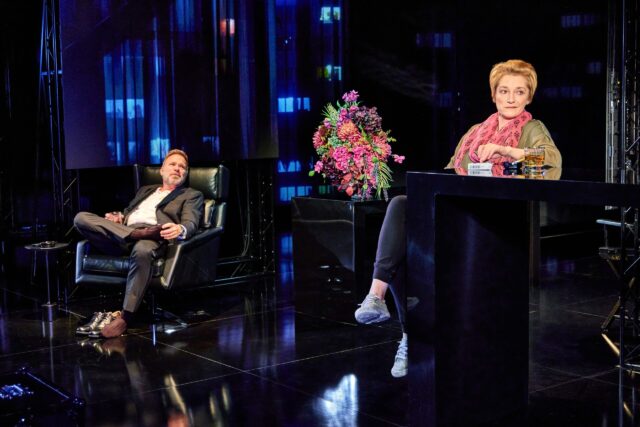
Peter Gallagher and Juliana Margulies star in Delia Ephron’s Left on Tenth (photo by Joan Marcus)

One of the most fun parts of being a theater critic is engaging with your fellow stage pundits. We greet one another before and after shows and during intermissions, discussing what we’ve seen lately that we’ve liked — and what we haven’t.

We have an unofficial community on social media, where we post our reviews and comment on those of others. While some appreciate different opinions, acknowledging that we all approach theater with personal biases, both conscious and unconscious, others are more insistent that their take is right and anyone who disagrees got it wrong.

One particular critic becomes dismayed on those rare occasions when she and I actually agree on a show.

Like I said, it’s fun.

But it can become disheartening when you find yourself on the opposite side of the fence from nearly all of your respected colleagues, which has happened to me often these last few extremely busy weeks.

I was charmed and delighted by author and screenwriter Delia Ephron’s Left on Tenth at the James Earl Jones Theatre, her adaptation of her 2022 memoir about finding love at the age of seventy-two shortly after losing her husband, Peter Kass, and right before finding out she has acute myeloid leukemia (AML). Julia Margulies stars as Delia, who often breaks the fourth wall and talks directly to the audience. Speaking of her childhood, she explains early on, “Every time I said something funny, my dad shouted, that’s a great line write it down. All four of us sisters grew up to be writers. But my parents were also angry alcoholics. My childhood was scary, often violent. With Jerry, I found my first true home. My first safe place. Now he wasn’t going to be here . . . Now . . . what?”

After writing an article in the Times about the trouble she had reconnecting online when Verizon canceled Jerry’s landline and, mistakenly, her internet access, she is contacted by Peter Rutter, a Jungian psychoanalyst who had briefly dated her in college, even though she does not remember him. Peter is elegantly portrayed by the ever-handsome Peter Gallagher. They rekindle their once-upon-a-time almost-relationship with passion and excitement — yes, older people can get hot and heavy — and he stands by her when she is hospitalized and things look bleak.

The play is directed by five-time Tony winner Susan Stroman and features Peter Frances James and Kate MacCluggage as multiple characters who make unbelievably fast costume changes. Although the show does get treacly, there was more than enough quality scenes for me to recommend it. My colleagues have not been kind to the play, writing, “Left on Tenth has the energy and the color scheme of a drugstore greeting card,” “Left on Tenth, billed as a romantic comedy, only fulfills half that description,” and “more suitable to the Hallmark Hall of Fame than Broadway.”

Although I don’t think so, perhaps my longtime admiration of Gallagher got in the way of my judgment? Thirty years ago, my wife and I moved into an apartment that was previously owned by him. (There was a lawyer in between who purchased it but never lived there, selling it to us.)

About twenty years ago, I met Gallagher at Powerhouse Theater’s annual New York Stage & Film benefit in Manhattan. Standing behind him, I said my address out loud so he could hear me. He whipped around and barked, “Who are you!” I calmed him down and explained that I now was in that apartment and told him that we occasionally still received junk mail for him. We talked about some of the unique advantages to the place. He then turned serious.

“You have to promise me something,” he said. “What?” I asked. Peter: “Is the yellow bookcase in the hall still there?” Me: “Yes.” Peter: “Promise me you’ll never take it down.” Me: “Why?” Peter: “Because I built in with my own two hands.”

I couldn’t help but think of that bookcase as I entered the James Earl Jones Theatre and saw that Beowulf Borritt’s main set is anchored by a gorgeous, filled-to-the-brim semicircular bookcase in Delia’s apartment. (It switches between that room, a restaurant, and the hospital where Delia is treated.) Books are discussed throughout the hundred-minute play; having worked my entire career in children’s and adult publishing, that was another plus for me, especially because it got the details of the industry right, which is rarely the case in theater, TV, and movies.

However, four other shows left me cold and dry, awash in disappointment.

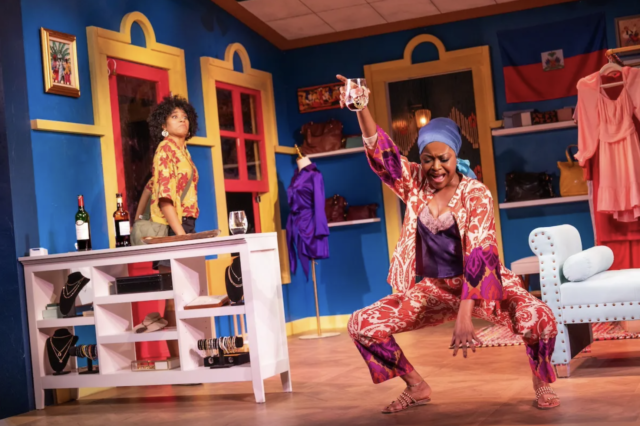
Cousins Simone (Kelly McCreary) and Gigi (Pascale Armand) try to reconnect in Dominique Morisseau’s Bad Kreyòl (photo by Matthew Murphy)

Over at the Signature, I was all set for Dominique Morisseau’s Bad Kreyòl, a coproduction with Manhattan Theatre Club that has been extended through December 1. The Detroit native has been on a thrilling roll with Pipeline in 2017, Paradise Blue in 2018, Skeleton Crew and Confederates in 2022, and Sunset Baby earlier this year. Maybe it was a bad night — critics generally have several performances to choose from, so they are not seeing the same exact show — but Bad Kreyòl felt like a work-in-progress, unfinished, its characters not yet fully developed.

Simone (Kelly McCreary), a Haitian American, is returning to the island for the first time in thirty years, staying with her cousin Gigi (Pascale Armand), who runs a boutique with the help of Pita (Jude Tibeau), a gay restavek whose rural family sent him to the city when he was a child in order to get an education and learn a trade. Simone is concerned that the restavek system means Pita is more like an indentured servant; she is also worried about Lovelie (Fedna Jacquet), who sews pillows, ties, scarves, and other items for an import-export company run by Thomas (Andy Lucien), who might be ignoring how women workers such as Lovelie are being abused by one of his male employees. Simone, Gigi, and Pita feel out of place in their dangerous country; they run into trouble as they try to firmly establish their identities and decide what they want out of life.

The night I went, the Irene Diamond Stage at the Signature was about half empty. The audience was almost too quiet during the show’s two hours and fifteen minutes (with intermission) as jokes fell flat and key moments flirted with clichés. Directed by Tiffany Nichole Greene, the play felt muted, lacking energy; I was more interested in the person sitting off to the side who kept taking photos and short videos of the drama.

Meanwhile, here’s what some of my colleagues had to say: “an illuminating reminder that Haiti and its people are much more than just bad headlines,” “a story told with care and intelligence, both warm-hearted and sharp-eyed,” and “confirms her as one of our most consistently interesting playwrights; where will she take us next?”

A young, energetic cast appears in the Lazours’ We Live in Cairo(photo by Joan Marcus)

In the early 2010s, I saw Stefano Savano’s intense documentary Tahrir: Liberation Square and Jehane Noujaim’s powerful fiction film The Square, extraordinary works about the 2010 Arab Spring in Egypt. So I was excited for New York Theatre Workshop’s We Live in Cairo, a musical by Daniel and Patrick Lazour, directed by Taibi Magar, that follows a group of twentysomethings risking their freedom and safety as they carefully take part in the resistance against President Hosni Mubarak and the Muslim Brotherhood during the revolution of 2011.

The score, performed by an onstage band, is sensational, and Tilly Grimes’s ramshackle set is evocative, as are David Bengali’s street-art projections. But the lyrics and staging are too plain, and the acting is merely standard — and I don’t know what I was going to do if one more character ran out in a tizzy through the door at stage left. At two and a half hours with intermission, the show is too long; perhaps it would have been more effective if it had been condensed into a streamlined ninety minutes.

While We Live in Cairo did not receive across-the-board raves, here are some of the favorable quotes from professional reviewers: “a welcome blast of excitement and intelligence,” “underscores the appeal, the importance — and the fragility — of democracy,” “pulses with the promise and enthusiasm of idealistic youth,” and “the most hypnotic, moving, and unique original score so far this year!”

Erika Sheffer’s Vladimir traces one journalist’s attempts to take on Putin (photo by Jeremy Daniel)

Although it closed November 10, MTC’s Vladimir also baffled me. The first act was so unsatisfying that I told my guest that I wouldn’t mind if she went home, but I had to stay for the second act, as is my responsibility. She stayed, and the second act was significantly better, but not enough so to recommend it.

Erika Sheffer’s play was inspired by the real-life story of Russian journalist Anna Politkovskaya, who continued to write negative reports about new Russian president Vladimir Vladimirovich Putin and his government even after she was poisoned. Mark Wendland’s overdesigned set with seemingly endless screens makes you wonder where you should be looking. Francesca Faridany is fine as Raya, but the rest of the cast — two-time Tony winner Norbert Leo Butz, Erin Darke, Erik Jensen, David Rosenberg, and Jonathan Walker — have trouble finding their way through numerous scenes, as Tony-winning director Daniel Sullivan attempts to figure out the convoluted stage. Everything becomes more assured after intermission, although a few of the key subplots border on the absurd.

What did my colleagues think? “Vladimir, beyond many other excellent qualities, feels distressingly current,” “as tough and uncompromising a piece of writing to be seen on a New York stage right now,” “accumulates enough awful truth to leave you sore and shaken,” and “Francesca Faridany and Norbert Leo Butz are towering in this Stoppardian Moscow-set drama.”

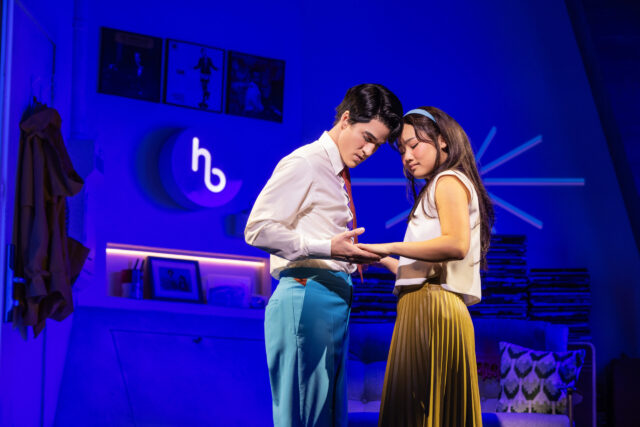
Darren Criss and Helen J Shen play Helperbots who fall in love in Maybe Happy Ending (photo by Matthew Murphy and Evan Zimmerman)

Which brings me to the reason I decided to write about this in the first place: Maybe Happy Ending. The instant-smash musical is about two retired Helperbots, Oliver (Darren Criss), a model 3, and Claire (Helen J Shen), the later model 5. They live across the hall from each other in a Seoul apartment complex where they are left to eventually power off forever. They meet-cute when Claire knocks on Oliver’s door because her charger is broken and can’t be fixed — replacement parts for both HBs are disappearing, so it’s clear, and very sad, that their time is limited, just like that of humans. “We have a shelf life, you know that,” Claire explains. “It’s the way that it has to be.”

When Oliver decides to return to his previous owner, James (Marcus Choi), he is joined by Claire for a road trip to Jeju Island; he is sure that James has been waiting years for him to come back because he needs him, while she wants to see the last colony of fireflies on the planet.

Director Michael Arden’s staging is nothing short of spectacular on Dane Laffrey’s magical set. Rectangular boxes open and close on a black screen, revealing the HBs’ differently decorated apartments similar to the way silent films irised in and out of scenes. Red LED lines stream across the screen. Crooner Gil Brentley (Dez Duron) rises from below to sing jazzy tunes. Round shapes are everywhere, representing the circle of life (for robots and humans), from windows, Claire’s soft and pillowy chair, and the moon to the HB logo, images on jazz posters, and Oliver’s beloved records, which he plays on an old-fashioned turntable. It might be 2064, but it’s jam-packed with nostalgic elements from the twentieth century, while George Reeves’s projections are filled with magic.

So why were my guest and I supremely bored through most of the show’s 105 minutes? The book, by Will Aronson and Hue Park, is littered with gaping plot holes that drain the narrative, while the music, by Aronson, and the lyrics, by Park, are more saccharine than sweet. Criss and Shen do an admirable job as the HBs, the former stiff and steady, the latter freewheeling, referencing how technology, especially AI, is becoming more human and personable. But I was not able to get past the numerous shortcomings and found the Brentley character wholly unnecessary and distracting.

Alas, nearly every other reviewer has been gushing with effusive praise: “In its gentle robot way, it helps us see ourselves through freshly brushed eyes,” “an undeniably moving, well-made, adorable musical,” “rapturous music and lyrics,” “an original show, charmingly acted and cleverly staged, with a touching take on love,” and “visually stunning, it epitomizes the journey of appreciation of the human world.”

Of course, when it comes right down to it, I’m right and they’re wrong, as any critic worth his salt should claim, even if, in some cases, I’m alone in, as HB3 calls it, “the world within my room.”

How’s that for a maybe happy ending?

[Mark Rifkin is a Brooklyn-born, Manhattan-based writer and editor; you can follow him on Substack here.]

EVERYBODY

photo © 2017 Monique Carboni)

Branden Jacobs-Jenkins’s EVERYBODY is an ingenious look at life, death, and the theater itself (photo © 2017 Monique Carboni)

The Pershing Square Signature Center
The Irene Diamond Stage
480 West 42nd St. between Tenth & Eleventh Aves.
Tuesday-Sunday through March 19, $30 through March 12, $40 after
212-244-7529
www.signaturetheatre.org

Branden Jacobs-Jenkins’s endlessly inventive Everybody is a magical, mysterious theatrical experience that is a must-see for adventurous theatergoers who relish being challenged over and over again. Rising stars Jacobs-Jenkins (An Octoroon, War, Gloria) and director Lila Neugebauer (The Wayside Motor Inn, The Wolves) explore love and death, dreams and reality, the fear of G-d, the human need for companionship, and the value of each individual life in the ninety-minute play, which opened last night at the Signature Theater’s Irene Diamond Stage for an extended run through March 19. The less you know about Everybody, the more surprises are in store, and the Signature is helping out in several ways. The wall outside the theater, which is usually bedecked with wide-ranging information about whatever play is being performed inside, putting it into sociohistorical context, only contains reproductions of paintings about death by such artists as Rubens and Breugel the Elder, and the audience doesn’t receive a program until the show is over. What we do know and can say, without giving anything away, is that Everybody is an adaptation of the late-fifteenth-century morality/mortality play Everyman, which was an English translation of the Dutch Elckerlijc, which was inspired by a Buddhist fable. At each performance, five members of the cast — Brooke Bloom, Michael Braun, Louis Cancelmi, David Patrick Kelly, and Lakisha Michelle May — line up to find out which abstract, conceptual character they will play, so each show is very different. The wonderfully cheeky Marylouise Burke is always Death, while the terrifically energetic Jocelyn Bioh is always G-d. (The excellent cast also includes Lilyana Tiare Cornell and Chris Perfetti.) “How can it be / that of all my productions, / it is you who have deteriorated / so severely, so vastly disappointing? / And don’t you hear the remainder of my creation, / the wonder that is everything, / crying out for justice against you?” G-d declares early on. To paraphrase Shakespeare, the world is indeed a stage, and we men, women, and children are merely players, with only so much time to justify our existence and get our things in order.

Laura Jellinek’s set is just about as basic as it comes, although with a major twist, consisting of eighteen chairs, the same kind that ticket holders sit in, lined up on a narrow section of the stage in front of a dark wall, blurring the line between audience and performer. Every so often Matt Frey’s lighting goes pitch black and Brandon Wolcott’s sound design takes over as voices are heard throughout the theater; keep your eyes and ears ready, because just about anything can happen anywhere and with anyone as the surprises keep mounting. The second of three works that will make up Jacobs-Jenkins’s Residency Five stay at the Signature (following 2014’s Appropriate), Everybody is an ingenious piece of theater that is involving from the moment you step inside the Irene Diamond. Incorporating splashes of Brecht and Beckett, Jacobs-Jenkins delves into topics that will have you taking a good, long look at yourself, regardless of whether you believe in G-d and the afterlife. You’re also likely to want to go back and see the allegorical show again; there are 120 variations of actors and roles, and the emotional resonance is sure to be very different depending on who gets cast as whom; on any night the main character may be a young woman or an old man. Regardless, just keep your faith in Jacobs-Jenkins and Neugebauer, who take you on quite an existential journey; when the play’s over, facing its own demise, it will of course rise again, living on in more performances and in the memories of those who have experienced it. The Signature has scheduled numerous special events in conjunction with Everybody, including talkbacks with members of the cast and crew after the February 23, 28, and March 7 performances, a Backstage Pass talk with Jellinek before the March 2 show, and a book club gathering on March 16 discussing Paul Kalanithi’s memoir, When Breath Becomes Air, which asks the question, “What makes human life meaningful?”

BIG LOVE

(photo by T Charles Erickson)

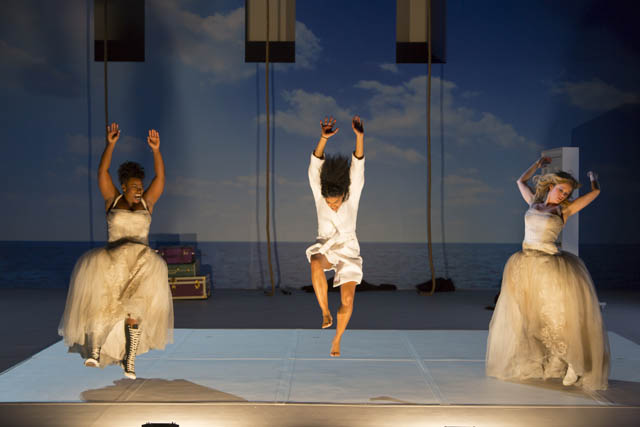
Thyona (Stacey Sargeant), Lydia (Rebecca Naomi Jones), and Olympia (Libby Winters) strut their stuff in Tina Landau’s new production of Charles Mee’s BIG LOVE at the Signature (photo by T Charles Erickson)

The Pershing Square Signature Center
The Irene Diamond Stage
480 West 42nd St. between Tenth & Eleventh Aves.
Tuesday – Sunday through March 15, $25
212-244-7529
www.signaturetheatre.org
www.charlesmee.org/plays.shtml

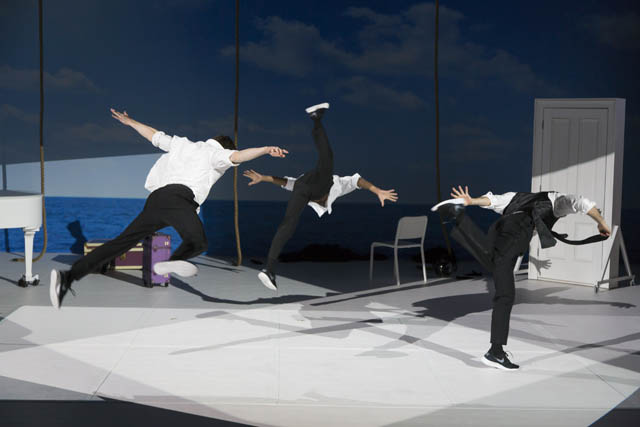
The night we went to see the new production of Charles Mee’s 2000 play, Big Love, at the Signature, technical difficulties delayed the start of the show, but it didn’t bother us one bit. Instead, we enjoyed extra time to take in the glorious beauty of Brett J. Banakis’s breathtaking set. The Irene Diamond theater is dazzlingly bright, mainly white and aglow in shimmering colors, with Austin Switser’s projection of a calm blue ocean at the back of the stage and smaller projections of hummingbirds, flowers, and other heartwarming scenes popping up at various places on the walls and floor. Above, dozens and dozens of flower arrangements hang from the ceiling, a heavenly garden in the sky. Meanwhile, romantic music plays, as gentle as the waves lapping gently out at sea. Onstage is a white claw-foot tub and a white door. Eventually the show got under way, as Lydia (Rebecca Naomi Jones) enters, removes her dirty wedding dress, and settles into the bath. She is interrupted by Giuliano (Preston Sadleir), a young man who is somewhat surprised to find a naked woman in the bathroom. Lydia explains that she is part of a contingent of women who have escaped their native Greece, where their fathers had signed a deal to marry them off to their cousins, and they are now seeking asylum in Italy as refugees. Lydia is joined by Olympia (Libby Winters) and Thyona (Stacey Sargeant), while first Giuliano’s grandmother, Bella (Lynn Cohen), shares some thoughts about husbands and sons with the young women, followed by the arrival of Giuliano’s uncle Piero (Christopher Innvar), a wealthy, slick-talking Mediterranean man who is not so sure he wants all of the women staying at his expansive villa; he finally relents, letting them stay for dinner. The three women are very different; Lydia is the most realistic, Olympia is an immature dreamer, and Thyona is the tough one, ready to take on the world if she has to. “The male is a biological accident, an incomplete female,” she says, “the product of a damaged gene, trapped in a twilight zone somewhere between apes and humans, always looking obsessively for some woman.” Lydia responds, “That’s maybe a little bit extreme,” to which Thyona argues, “Any woman, because he thinks if he can make some connection with a woman that will make him a whole human being! But it won’t. It never will.” Just as she is completing her rant, the women’s prospective husbands, Constantine (Ryan-James Hatanaka), Nikos (Bobby Steggert), and Oed (Emmanuel Brown), show up looking for their brides, and all hell is about to break loose.

(photo by T Charles Erickson)

Three cousins fly in from Greece, having followed their prospective brides to an Italian seaside villa in Charles Mee’s Aeschylus update (photo by T Charles Erickson)

Big Love is a contemporary restructuring of Aeschylus’s The Suppliant Maidens, one of the oldest known plays and the only existing section of the Danaid Tetralogy by the Father of Tragedy. Mee, whose other classicist works include Iphigenia 2.0, Trojan Women 2.0, and Orestes 2.0 and who has cited German dance-theater guru Pina Bausch as a major influence, throws just about everything he possibly can at this tale of fifty brides-to-be being chased by fifty determined cousins, from cake and tomatoes to Tiffany boxes and the heads of Ken and Barbie dolls. The potentially kissing cousins serve as their own Greek chorus, occasionally breaking out into song, a conceit that works best the first time around, when Lydia, Olympia, and Thyona suddenly grab microphones and, under hot spotlights, deliver a rousing rendition of the recently deceased Lesley Gore’s “You Don’t Own Me.” The play is directed with a controlled abandon by frequent Mee collaborator Tina Landau (A Civil War Christmas, Old Hats), who holds nothing back in this kitchen-sink production where anything can happen. The uniformly solid cast, sporting Anita Yavich’s delightful costumes, also includes Piero’s house guests Eleanor (Ellen Harvey) and Leo (Nathaniel Stampley), who are excited by all the festivities, but it’s Jones, Winters, and Sargeant who clearly command the center of attention. Big Love, which is part of Signature’s Legacy Program — Mee was the theater’s 2007-8 playwright-in-residence — doesn’t always hit its ambitious targets, but it’s an awful lot of fun, taking advantage of every little detail it can, from the way Oed, Constantine, and Nikos enter in helicopters to the absurdist use of a movable door to the appearance of a trampoline for no apparent reason. But what, no cake for the audience?

OUR LADY OF KIBEHO

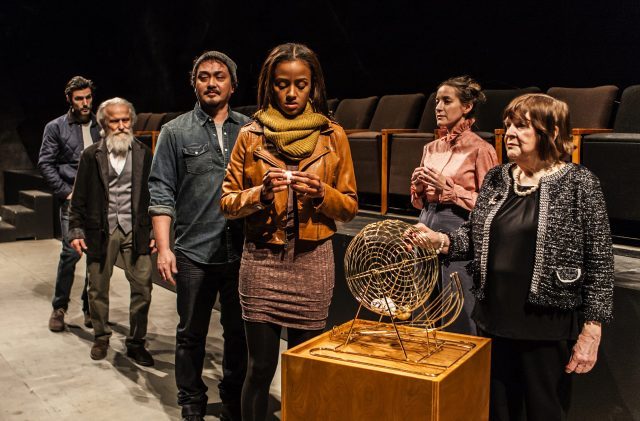
Alphonsine Mumureke (Nneka Okafor) is in a trance as she believes she is seeing the Virgin Mary in Katori Hall’s OUR LADY OF KIBEHO (photo © 2014 by Joan Marcus)

Alphonsine Mumureke (Nneka Okafor) is in a trance as she believes she is seeing the Virgin Mary in Katori Hall’s OUR LADY OF KIBEHO (photo © 2014 by Joan Marcus)

The Pershing Square Signature Center
The Irene Diamond Stage
480 West 42nd St. between Tenth & Eleventh Aves.
Tuesday – Sunday through December 7, $25
212-244-7529
www.signaturetheatre.org

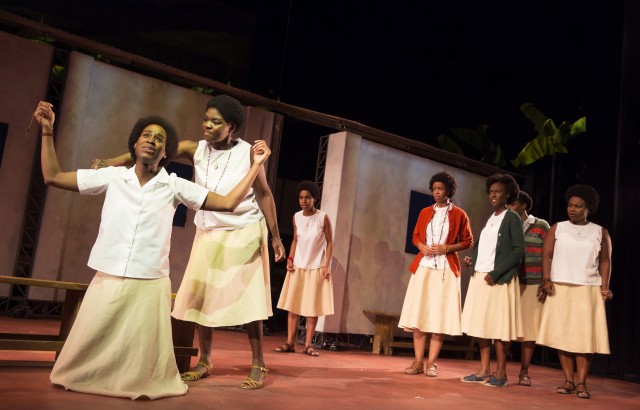
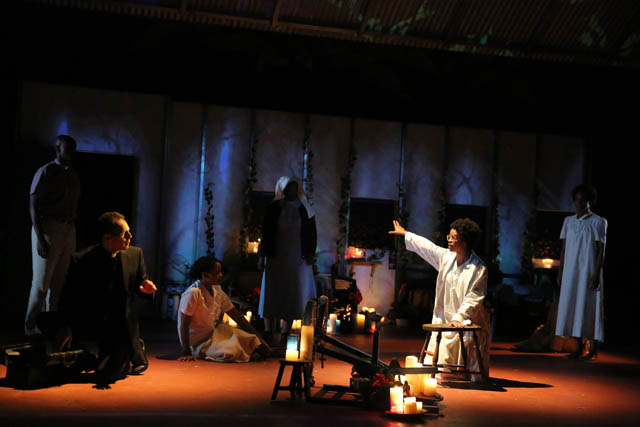
Inspired by several trips to Rwanda, Memphis-born playwright Katori Hall approaches the horror of the 1994 genocide from a different perspective in Our Lady of Kibeho, the second play of her three-work Signature Theatre residency and the follow-up to Hurt Village. Based on actual events, the play, set in 1981-82, tells the story of sixteen-year-old Alphonsine Mumureke (Nneka Okafor), a student at an all-girls Catholic school in the small village of Kibeho in Rwanda. As a choir sings a religious hymn in the Kinyarwanda language, the mean Sister Evangelique (Starla Benford) and the handsome headmaster Father Tuyishime (Owiso Odera) are arguing over what to do with Alphonsine, who claims to have seen a vision of the Virgin Mary, known as Our Lady of Kibeho. While the sister wants to severely punish the girl for telling such obvious lies, the father wants to first find out more about what happened. “I am not lying. I promise. I only speak the truth,” Alphonsine says, desperate for everyone to believe her, for she needs to spread the message Our Lady is imparting to her. Sister Evangelique and student leader Marie-Clare Mukangango (Joaquina Kalukango) conspire to prove Alphonsine wrong, but when more girls begin to see the visions, soon Father Flavia (T. Ryder Smith) arrives from the Vatican to attempt to validate the claim.

(photo by Joan Marcus)

A Vatican priest arrives in a small Rwandan village to validate a vision of the Virgin Mary in OUR LADY OF KIBEHO (photo © 2014 by Joan Marcus)

Our Lady of Kibeho takes place on the Signature’s Irene Diamond Stage, with three video projections by Peter Nigrini of the Rwandan mountains around Kibeho set high on the walls; combined with Rachel Hauck’s village set, Emily Rebholz’s costumes, and Michael McElroy’s African music, the design places the audience right in the middle of the action, especially as director Michael Greif (Next to Normal, The Intelligent Homosexual’s Guide…) has members of the cast literally walk through the crowd. It’s as if the audience is being asked to believe just as much as the characters are, especially during a fantastic, otherworldly scene that closes the first act. But Hall (The Mountaintop, Children of Killers) never proselytizes, incorporating the ethnic battle between Hutu and Tutsi as the girls fight among themselves, their relationships changing as more of them believe what Alphonsine is telling them, a call for prayer to prevent a frightening prophecy of Rwanda’s future. The fine cast is led by Okafor, Benford, Odera, and Mandi Masden as Anathalie Mukamazimpaka, the second disciple. Our Lady of Kibeho is a moving, powerful, terrifically staged play about innocence and faith, about prejudice and belief, an involving tale no matter what religion, if any, you might be. (As with all Signature productions, the wall outside the theater is filled with information about the play and the real story, but it’s better to read it all afterward so as not to spoil the narrative surprises as the drama unfolds.)

PIECE OF MY HEART: THE BERT BERNS STORY

(photo by Jenny Anderson)

The forgotten legacy of Bert Berns is brought to colorful life in new musical (photo by Jenny Anderson)

The Pershing Square Signature Center
The Irene Diamond Stage
480 West 42nd St. between Tenth & Eleventh Aves.
Tuesday – Sunday through August 31, $31.50 – $99.50
212-244-7529
www.pieceofmyheartmusical.com
www.signaturetheatre.org

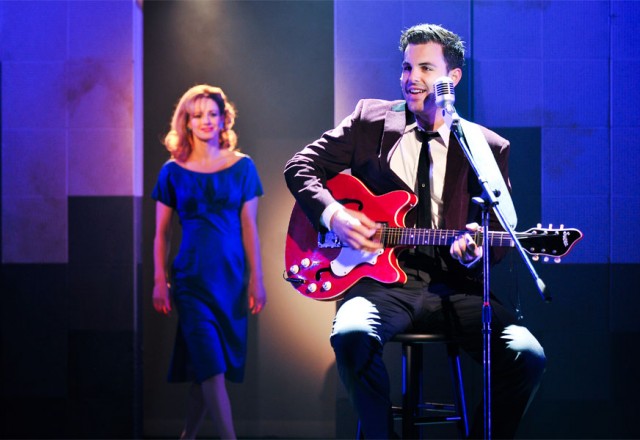
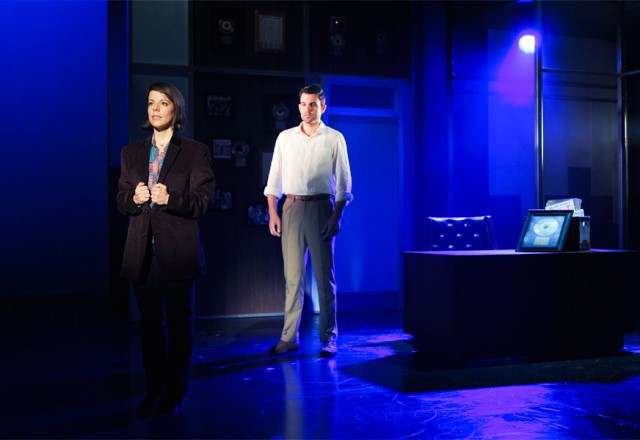
Art imitates life in the engaging, bittersweet off-Broadway musical Piece of My Heart: The Bert Berns Story. In a prolific period between 1961 and 1967, Bert Berns wrote and/or produced more than two dozen big-time pop hits, recorded by such singers and bands as the Beatles, David Bowie, the Rolling Stones, the Drifters, Janis Joplin, the Animals, Solomon Burke, the Isley Brothers, and Van Morrison, while also founding the seminal Atlantic offshoot BANG Records. Born and raised in the Bronx, Berns died in 1967 at the age of thirty-eight, and today his legacy is all but nonexistent, although his surviving family is in the midst of rebuilding his reputation with this show; the first major authorized biography, Joel Selvin’s Here Comes the Night: The Dark Soul of Bert Berns and the Dirty Business of Rhythm and Blues; and the upcoming documentary BANG — The Bert Berns Story. In Piece of My Heart, Leslie Kritzer stars as Jessie, Berns’s fictional daughter who receives an unexpected call that her mother, Ilene (Linda Hart), is going to close up Bert’s Broadway office and sell the rights to all of his songs. Disturbed by her mother’s intentions, Jessie, who didn’t know anything about the office, heads to New York City, where she finds her father’s former manager and right-hand man, Wazzel (Joseph Siravo), waiting for her. Wazzel tells Jessie how Bert (Zak Resnick), vocalist Hoagy Lands (Derrick Baskin), and the young Wazzel (Bryan Fenkart) got started, with the events unfolding right in front of them. Jessie sees her father going to Cuba and working with a revolutionary named Carlos (Sydney James Harcourt), meeting high-powered producer Jerry Wexler (Mark Zeisler), challenging the legendary Phil Spector, and falling in love with Ilene (Teal Wicks), a blonde dancer who would become Bert’s wife and Jessie’s mother. But when the current-day Ilene shows up at her husband’s office, she kicks out Wazzel and has a somewhat different tale to tell Jessie while trying to convince her that signing over the songs is the right thing to do, leaving Jessie trapped in the middle as she learns more and more about her father.

(photo by Jenny Anderson)

Jessie (Leslie Kritzer) wonders what her father (Zak Resnick) was really like in PIECE OF MY HEART (photo by Jenny Anderson)

For much of its two hours and twenty minutes (with intermission), Piece of My Heart walks that fine line between bio show and vanity project. As pointed out numerous times in Daniel Goldfarb’s fairly standard book, Berns was determined to become famous; also, knowing that he was living on borrowed time because of a heart problem, he often said, “My children will know me by my music.” The show is produced by Berns’s son, Brett, and daughter, Cassandra, with the express purpose of finally bringing fame to their father, and the narrative sometimes gets bogged down with whitewashed scenes that turn Berns into a kind of heroic, misunderstood figure. It’s not helped by the casting of Resnick (Mamma Mia!, Disaster!) in the title role; while his singing packs a powerful punch, his acting is akin to a David Wright press conference, all white-bread clichés with no nuance. However, the rest of the cast of seasoned pros is outstanding, including Hart (Hairspray, Anything Goes) and Wicks (Wicked, Jekyll & Hyde) as the feisty Ilene, Siravo (Conversations with My Father, The Light in the Piazza) and Fenkart (Memphis) as the tough-talking Wazzel, De’Adre Aziza (Passing Strange) as Candace, Berns’s sexy first love, and Kritzer (A Catered Affair, Legally Blonde) as a kind of onstage stand-in for the audience. Oh, and let’s not forget about the music, which is performed admirably by a live band led by Lon Hoyt; the songs range from the somewhat obscure to the familiar to the super famous, but it’s best if you go without knowing what they are so you can be surprised by each new well-choreographed musical number (by director Denis Jones) on Alexander Dodge’s simple but effective sets, energized by Ben Stanton’s colorful lighting. The songs are listed in the Playbill and detailed on a large board outside the Signature’s Irene Diamond theater, but it’s better to read about them after the show, which got an instant and rousing standing ovation the night we went.

KUNG FU

(photo by Joan Marcus)

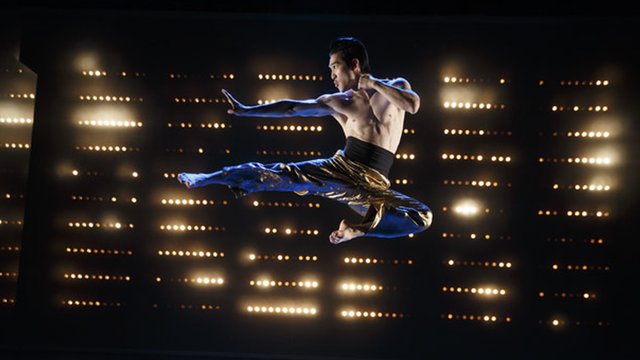
SO YOU THINK YOU CAN DANCE second runner-up Cole Horibe makes New York stage debut as Bruce Lee in new David Henry Hwang play (photo by Joan Marcus)

The Pershing Square Signature Center
The Irene Diamond Stage
480 West 42nd St. between Tenth & Eleventh Aves.
Extended through April 6, $75
212-244-7529
www.signaturetheatre.org

Tony-winning playwright David Henry Hwang concludes his Signature Theatre Residency One year with the world premiere of Kung Fu, a flashy but flat portrait of martial arts master Bruce Lee. Hwang (M. Butterfly, Chinglish) focuses on Lee’s (Cole Horibe) life in America, after he was sent there in 1959 by his father, Chinese opera performer Hoi-Chuen (Francis Jue), because of his penchant for street fighting in Hong Kong. Still in high school, Lee starts teaching martial arts — a defensive style he calls “fighting without fighting” — in a room above the restaurant where he works for Ruby Chow (Kristen Faith Oei), but he has dreams of making it big. When classmate Linda Emery (Phoebe Strole) comes to study with him, Lee immediately falls for her, and soon she is pregnant and they get married. Determined to succeed, Lee is hired to play Kato on the short-lived television series The Green Hornet, but he wants to break out of stereotypical, subservient Asian roles, developing a Western built around a wandering kung fu warrior and going to India to make a film with one of his more famous students, James Coburn (Clifton Duncan). But things don’t quite go as planned, leaving him to reconsider his life in Hollywood.

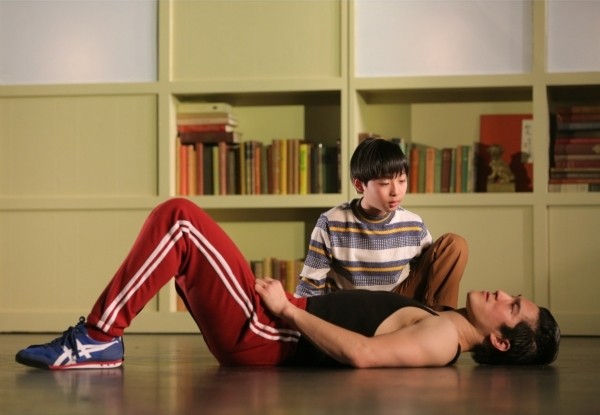
Bruce Lee (Cole Horibe) teaches his son, Brandon (Bradley Fong), in KUNG FU (photo by Joan Marcus)

Bruce Lee (Cole Horibe) teaches his son, Brandon (Bradley Fong), in KUNG FU (photo by Joan Marcus)

Hwang initially intended Kung Fu to be a musical, and it shows. There are several exhilarating set pieces in which Horibe, a So You Think You Can Dance second runner-up making his New York theater debut, and the cast (most of whom take on multiple characters) incorporate martial arts into exciting dance numbers choreographed by Sonya Tayeh (the fight scenes are directed by Emmanuel Brown, who also plays Marcus), including one eye-popper featuring bold yellow and blue Chinese opera costumes by Anita Yavich. But the dialogue is static and repetitive, filled with genre clichés, offering no real insight into who Lee really was, and there’s little sense of time and place. Hwang was far more successful blending movement and story in The Dance and the Railroad; unfortunately, this new work has more in common with his stale revival of Golden Child, both of which were part of his Signature residency. On film, Lee proved to have fists of fury, but onstage, this Lee lacks sufficient kick.