Alejandro Jodorowsky takes viewers on quite an acid trip in surreal Western EL TOPO
LATE-NIGHT FAVORITES: EL TOPO (Alejandro Jodorowsky, 1970)
IFC Center
323 Sixth Ave. at West Third St.
February 15-17, $13.50, 12:15 am
212-924-7771
www.ifccenter.com
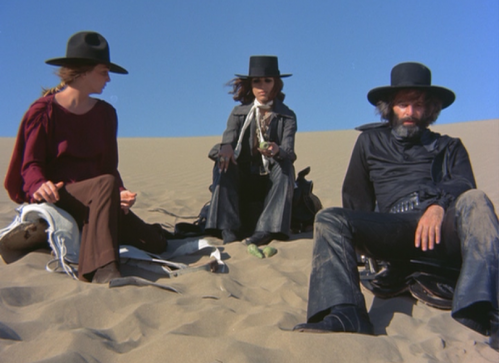
 Chilean-born Mexican filmmaker Alejandro Jodorowsky’s El Topo is a psychedelic head trip, an acid Western that will blow your mind. Jodorowsky stars as the title character, a gunslinger traveling through a deserted landscape accompanied by his naked young son, who already knows his way around a firearm. After coming upon a town that has been decimated by a nasty group of marauders working for the Colonel, El Topo seeks violent revenge, eventually taking off with a woman and leaving his boy behind as he meets four masters on his path to proving he is the best there is. But soon El Topo is praying for redemption with a community of inbred cripples trapped in a cave. El Topo is a wild and bizarre journey through religious imagery, romance, and vengeance, a surreal spaghetti Western strained through the mad mind of Jodorowsky, widely hailed as the creator of the midnight movie. The film melds Bergman with Leone, Tod Browning’s Freaks with Hiroshi Inagaki’s Samurai Trilogy, filtered through Kazuo Koike and Goseki Kojima’s Lone Wolf and Cub. It’s like nothing you’ve ever seen before and, despite your better instincts, will lure you into the cult of Jodorowsky. El Topo is screening Friday, Saturday, and Sunday night at 12:15 am in a high-definition digital restoration as part of the IFC Center series “Waverly Midnights: Late-Night Favorites,” which continues March 1-2 with James Cameron’s Aliens, March 8-9 with a new 4K digital restoration of Steven Spielberg’s Raiders of the Lost Ark, and March 15-16 with a 35mm print of Jodorowsky’s radical 1973 flick The Holy Mountain.
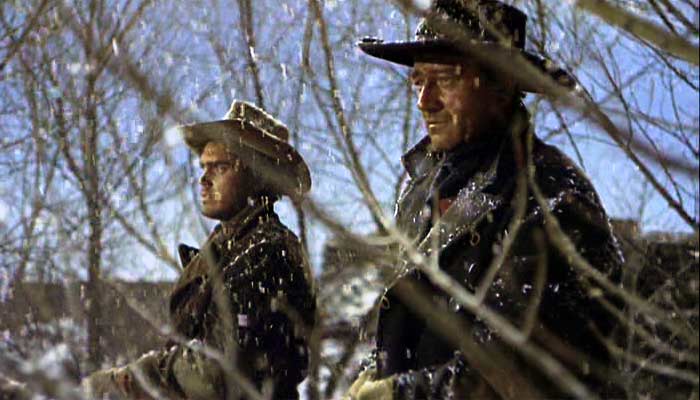
 That’ll be the day when someone tries to claim there’s a better Western than John Ford’s ethnocentric look at the dying of the Old West and the birth of the modern era. Essentially about a gunfighter’s attempt to find and kill his young niece, who has been kidnapped and, ostensibly, ruined by Indians, The Searchers is laden with iconic imagery, inside messages, and not-so-subtle metaphors. Hence, it is no accident that John Wayne’s son, Patrick, plays an ambitious yet inept officer named Greenhill. The elder Wayne stars as Ethan Edwards, a tough-as-nails Confederate veteran seeking revenge for the murder of his brother’s family; he’s also out to save Debbie (Natalie Wood) from the Comanches, led by a chief known as Scar (Henry Brandon), by ending her life, because in his world view, it’s better to be dead than red. Joining him on his trek is Debbie’s adopted brother, Martin Pawley (Jeffrey Hunter), who wants to save her from Edwards. The magnificent film balances its serious center with a large dose of humor, particularly in the relationships between Ethan and Martin and Ethan with his Indian companion, Look (Beulah Archuletta). And keep your eye on that blanket in front of the house. The Searchers is screening in a DCP projection February 15-18 at 11:00 as part of the IFC Center series “Weekend Classics: John Ford,” which continues with such other Ford fare as Young Mr. Lincoln, The Whole Town’s Talking, and The Last Hurrah.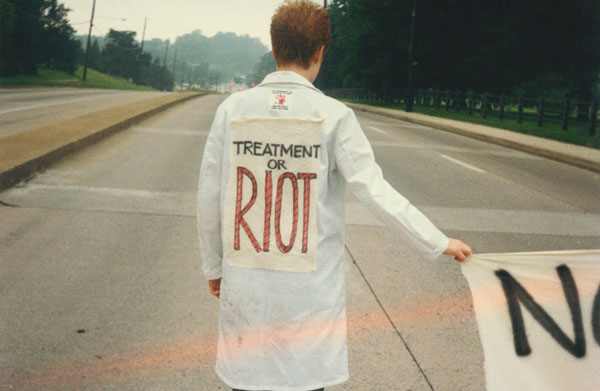
 Contemporary activists stand to learn a lot from the gripping documentary How to Survive a Plague. For his directorial debut, longtime journalist David France, one of the first reporters to cover the AIDS crisis that began in the early 1980s, scoured through more than seven hundred hours of mostly never-before-seen archival footage and home movies of protests, meetings, public actions, and other elements of the concerted effort to get politicians and the pharmaceutical industry to recognize the growing health epidemic and do something as the death toll quickly rose into the millions. Focusing on radical groups ACT UP and TAG (Treatment Action Group), France follows such activist leaders as Peter Staley, Mark Harrington, Larry Kramer, Bob Rafsky, and Dr. Iris Long as they attack the policies of President George H. W. Bush, famously heckle presidential candidate Bill Clinton, and battle to get drug companies to create affordable, effective AIDS medicine, all while continuing to bury loved ones in both public and private ceremonies. France includes new interviews with many key activists who reveal surprising details about the movement, providing a sort of fight-the-power primer about how to get things done. The film also shines a light on lesser-known heroes, several filled with anger and rage, others much calmer, who fought through tremendous adversity to make a difference and ultimately save millions of lives. How to Survive a Plague is screening at the Film Society of Lincoln Center through January 24, celebrating its Oscar nomination for Best Documentary Feature.
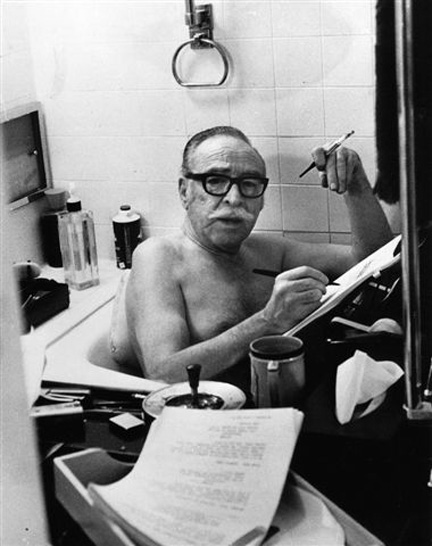
 In 2004-5, Christopher Trumbo’s play Trumbo: Red, White, and Blacklisted, based on the writings of his father, jailed Hollywood Ten screenwriter and novelist Dalton Trumbo (1905-76), toured the country, a staged reading directed by Peter Askin and starring such actors as Nathan Lane, Joe Mantegna, Bill Irwin, Brian Dennehy, and F. Murray Abraham in the title role. Christopher and Askin turned the show into a documentary film, with decidedly mixed results. Although Trumbo’s letters are works of art on their own, funny and incisive, biting and cynical, with a wry, dry sense of humor that summarizes the social and political climate of the cold war era, they lose much of their power when read overdramatically onscreen by Dennehy, Josh Lucas, Paul Giamatti, and others. The camera will linger on Michael Douglas or David Strathairn as they contemplate what they have just read, adding an unnecessary sense of seriousness and importance. It is almost impossible to concentrate on Trumbo’s words as you wonder why Joan Allen was selected, whether Liam Neeson should have tried an American accent, how long and white Donald Sutherland’s hair is, or how many sly gestures Lane will make as he relates a riotous treatise on onanism. Interviews with such friends and colleagues as Manny Azenberg, Kate Lardner, Kirk Douglas, and Trumbo’s children, Christopher and Mitzi, dig deeper into the kind of man Trumbo was, along with archival footage of Trumbo on talk shows, in home movies, and telling the House Un-American Committee to go to hell. Askin tries so hard to focus on the actual words of the Oscar-winning screenwriter behind such classics as Johnny Got His Gun, Roman Holiday, Spartacus, Exodus, and Papillon that he ends up obscuring the portrait as a whole. But oh, what words they are. Trumbo will be screening January 22 at the IFC Center as part of the Tuesday-night series “Stranger than Fiction,” with Askin on hand to participate in a Q&A. The series continues through February 26 with such other documentaries as Neil Barsky’s Koch, Amy Nicholson’s Zipper: Coney Island’s Last Wild Ride, and Terence Nance’s An Oversimplification of Her Beauty.