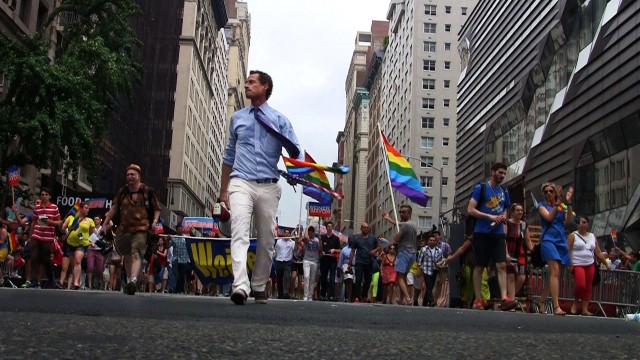
The colorful Anthony Weiner marches in the Gay Pride Parade as he runs for mayor in 2013, a bright future potentially ahead of him
WEINER (Josh Kriegman & Elyse Steinberg, 2016)
IFC Center, 323 Sixth Ave. at West Third St., 212-924-7771
Lincoln Plaza Cinema, 1886 Broadway between 62nd & 63rd Sts., 212-757-2280
Opens Friday, May 20
www.ifcfilms.com
 Near the end of Weiner, one of the most revealing and entertaining documentaries about a political figure you’re ever likely to see, one of the directors, Josh Kriegman, asks subject extraordinaire Anthony Weiner, “Why have you let me film this?” It’s a great question, and one that can be inquired of Weiner’s wife as well, Huma Abedin, who stands alongside her scandal-ridden husband nearly every step of the way. In May 2011, during his seventh term as a fierce, fiery congressman representing parts of Brooklyn and Queens, Weiner was forced to resign in disgrace after it was discovered that he had sent lewd pictures of himself to several women over a public social media account while lying about it as well. Just two years later, the Brooklyn-born Weiner decided to get back in the game, running for mayor of New York City. Kriegman, who was a senior aide to Weiner in 2004-5 and his New York chief of staff in 2005-6, thought the comeback campaign would make a fascinating story, and Weiner agreed, giving him virtually unlimited access to his family and staffers. Initially, everything is going better than expected: Weiner is leading in the polls and getting his message across. But then the sexting scandal rises up again, and it all starts falling apart. Weiner tries hard to fight the good fight, concentrating on communicating his political platform, but the media only wants to ask him and his brave wife about the sexting, even when it is clear that the people of New York City prefer to talk about the issues. “I guess the punch line is true about me. I did the things . . . but I did a lot of other things too,” Weiner acknowledges. Of course, maybe Weiner never really had a fair chance. The movie begins with a telling quote from Marshall McLuhan: “The name of a man is a numbing blow from which he never recovers.”
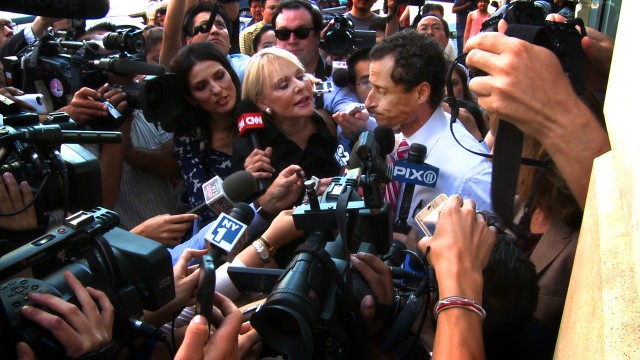
Yet another texting scandal forces Anthony Weiner to reconsider his options under media scrutiny
PBS and MTV veterans Kriegman and codirector Elyse Steinberg amassed more than four hundred hours of footage for their feature debut, and very rarely does Weiner or Abedin shut them out, even when things appear to hit rock bottom. Kriegman focuses his camera on Weiner, who doesn’t flinch as he considers all his options and, all too often, takes the wrong path, whether it’s getting angry with a patron in a Jewish deli or arguing with Lawrence O’Donnell on a videolink interview. Weiner continually performs self-defeating acts that Abedin, a longtime Hillary Clinton supporter who is now vice chairwoman of the presumptive Democratic presidential nominee’s campaign, gracefully and painfully points out to him, but she sticks with her husband and his campaign to the bitter end. Kriegman and Steinberg show Weiner hanging out at home, walking around barefoot, and playing with son Jordan, who was born in December 2011. But it’s truly heartbreaking when the directors zero in on Abedin’s forlorn face as the scandal grows and grows and the media has a field day with it. Weiner is seamlessly edited by Eli Despres (Blackfish, Red Army), who keeps the tension high even when we know what is coming, as the narrative plays out like a unique kind of political thriller. It’s impossible to take your eyes off the screen, to stop watching Weiner and Abedin as they have to deal with his dirty laundry in public. In addition to allowing Kriegman and Steinberg to follow him everywhere, the usually charismatic Weiner is decidedly dour as he sits down for a candid wraparound interview with the filmmakers. “Shit. This is the worst. This is the worst. Doing a documentary on my scandal,” Weiner opines at one point, displaying a rare moment of genuine regret as opposed to his usual hubris. But the film, which makes no judgments — and which Weiner and Abedin have refused to see so far — is as much about the relationship between media and politics as it is about one specific politician who made some personal mistakes, and it does not bode well for our future. Will Weiner ever be able to stage another comeback? He’s a determined guy, almost to the point of obsession, with a deep desire to help the people of New York City and the country, but then there’s that name, and the photos he posted, and the strange faces that he makes, so a third chance might just be one too many. A most human drama that won the U.S. Grand Jury Documentary Prize at Sundance, the extraordinary Weiner opens at Lincoln Plaza and IFC Center on May 20, with the filmmakers at IFC for Q&As following the 8:00 show on Friday night and the 7:15 and 8:00 shows on Saturday.

 Motherhood is not necessarily for everyone, as depicted in Maya Vitkova’s impressive feature-film debut, Viktoria. Vitkova wrote, directed, and produced the darker-than-dark absurdist epic black comedy and intense family drama, which has won awards at festivals around the globe. Irmena Chichikova gives a boldly stark, devastating performance as Boryana, a young Bulgarian woman in 1980 trying to do everything she can — short of having an illegal abortion — to end her pregnancy. Her husband, Ivan (Dimo Dimov), and mother, Dima (Mariana Krumova), are furious with her, enraged at what she is doing. When she ultimately does have a baby girl, the child is born without a belly button, a symbol of the lack of connection between mother and daughter. Boryana is further incensed when the infant is selected as Baby of the Decade by Todor Zhivkov (Georgi Spasov), the real-life Bulgarian president and longtime head of the Communist Party. The state bestows special gifts on the family, but Boryana grows more and more disenchanted with the situation, her unhappiness evident in her every movement and blank stare. Meanwhile, Viktoria, who is played at nine years old by Daria Vitkova and at fourteen by Kalina Vitkova, keeps a close connection to Zhivkov, reveling in being a showpiece for the government; she even has a special phone line that links her and Zhivkov, a kind of umbilical cord between the two. But the fall of Communism in 1989 leads to sociopolitical changes that affect the relationship between Boryana, Ivan, Dima, and Viktoria as they have to find their place in the new world order.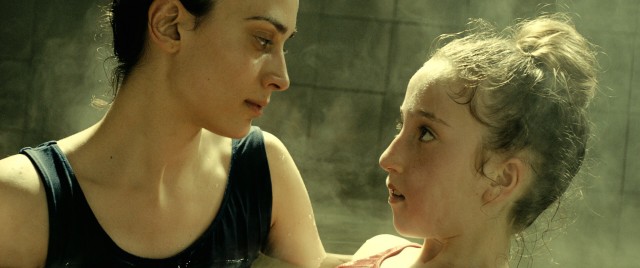


 Being gay and an Orthodox Jew just doesn’t mix. Sandi Simcha DuBowski’s award-winning documentary, Trembling Before G-d, takes a close look at gay Orthodox and Hasidic Jews in Brooklyn, Miami, Jerusalem, and London who are either rejected by their religious community or remain hidden in the closet, unable to express in public who they are. Many of the subjects use fake names and are shot in silhouette or by a handheld camera that never shows their full faces, in order to protect their identity; these powerful images get right to the heart and soul of the matter. The naysayers point out that the Bible clearly states that homosexuality is wrong, and they still believe that gays can be “cured” through therapy and atonement ceremonies for sexual sins or by eating figs. The film is having a special fifteenth-anniversary screening at the IFC Center as part of the Stranger than Fiction series and will be followed by what should be a lively and fascinating Q&A with DuBowski and subjects Rabbi Steve Greenberg, Michelle, Naomi, and Mark that should explore whether anything has changed in the last decade and a half. The series continues through May 31 with such other documentaries as Lynn True’s In Transit, Holly Morris’s The Babushkas of Chernobyl, and Ido Haar’s Presenting Princess Shaw, with Princess Shaw present for a Q&A.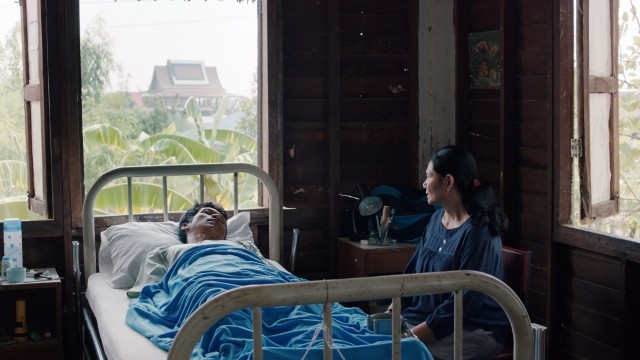
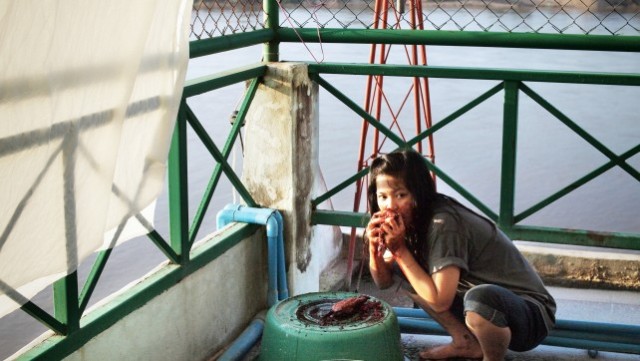
 At the end of the closing credits of Thai director Apichatpong Weerasethakul’s Mekong Hotel, a disclaimer reads, “All characters appearing in this work are actual persons. Any resemblance to other real beings, living or dead, is not coincidental.” As with so many of the Palme d’Or-winning director’s films, Mekong Hotel walks the fine line between fact and fiction, fantasy and reality. The slight work, a meditative tone poem that runs fifty-seven minutes, was shot at the Sam Oar Guesthouse and Resort in Nong Khai in northeast Thailand, near the Friendship Bridge that links Thailand and Laos. Weerasethakul (Blissfully Yours, Syndromes and a Century) plays himself in the film, a director auditioning a guitarist (real-life musician and composer Chai Bhatana), whose playing serves as the musical score for the elegiac tale. (Assistant director Chatchai Suban also makes a cameo.) Meanwhile, an otherworldly narrative is taking place, between Tong (Sakda Kaewbuadee), a banana plantation owner whose dog was just eaten, and Phon (Maiyatan Techaparn), a young woman who lives next door with her mother, Jen (Jenjira Pongpas), a Pob ghost who has a hankering for entrails. (The relationship between the mother and daughter was inspired by one of Weerasethakul’s unrealized projects, Ecstasy Garden.) The slow, contemplative mood never changes as the characters discuss love, a coming flood, refugees, spirits, and jet skiing, often in abstract ways. Weerasethakul wrote, directed, produced, edited, and photographed the film, which features beautiful cinematography, the camera never moving as the characters walk in and out of the frame and the lovely views of the Mekong River linger. Unfortunately, the sum of the intriguing parts don’t make for a cohesive whole; Weerasethakul has been justly celebrated for his short films and full-length works, but Mekong Hotel falls somewhere in between, lost in a kind of no-man’s land. Still, there’s much to admire about this film, especially for the auteur’s longtime fans. Mekong Hotel is having its theatrical premiere at the IFC Center from March 4 to 10 in the series “Mysterious Splendors: The Films of Apichatpong Weerasethakul,” running alongside his latest film, Cemetery of Splendor.