Tag Archives: Grace Rainey Rogers Auditorium

PLAY IT LOUD: INSTRUMENTS OF ROCK AND ROLL

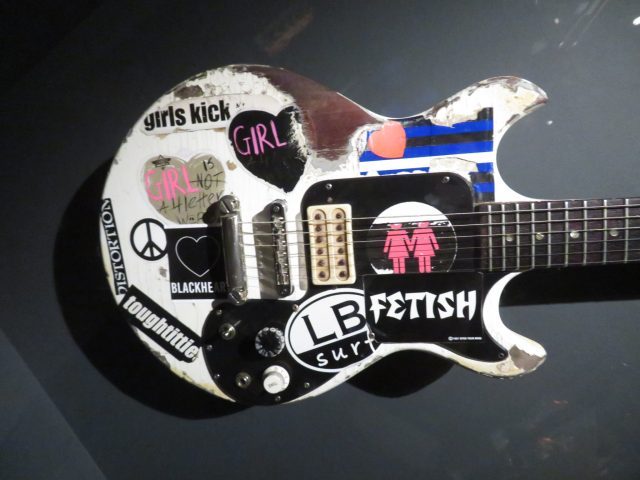
Joan Jett Melody Maker, 1977 Gibson (photo by twi-ny/mdr)

Joan Jett’s 1977 Melody Maker Gibson is part of Met exhibition “Play It Loud” (photo by twi-ny/mdr)

Metropolitan Museum of Art, Met Fifth Ave.
Gallery 199
1000 Fifth Ave. at 82nd St.
Through Through October 1, $25 suggested admission
212-535-7710
www.metmuseum.org

In 2011, the Met hosted “Guitar Heroes: Legendary Craftsmen from Italy to New York,” focusing on the lutherie tradition of Italian Americans in New York and New Jersey, artisans making violins, mandolins, guitars, and other stringed instruments. In the current exhibition “Play It Loud: Instruments of Rock & Roll,” the Met turns it up to eleven, celebrating the stringed and nonstringed apparatus of rock and pop music since the 1950s. In Mott the Hoople’s 1973 staple “All the Way from Memphis,” Ian Hunter refers to his guitar as a “six-string razor,” an “axe,” and “electric junk.” He continues: “Some dude said, ‘Rock ’n’ rollers, you’re all the same / Man, that’s your instrument.’ / I felt so ashamed.” Ian and Mott might not be represented in the Met exhibit — or in the Rock and Roll Hall of Fame — but there’s nothing for anyone to be ashamed of regarding this exciting collection of nearly two hundred items, with most of the instruments displayed in vitrines, like sculptural works of art, which of course they are.
(photo by twi-ny/mdr)

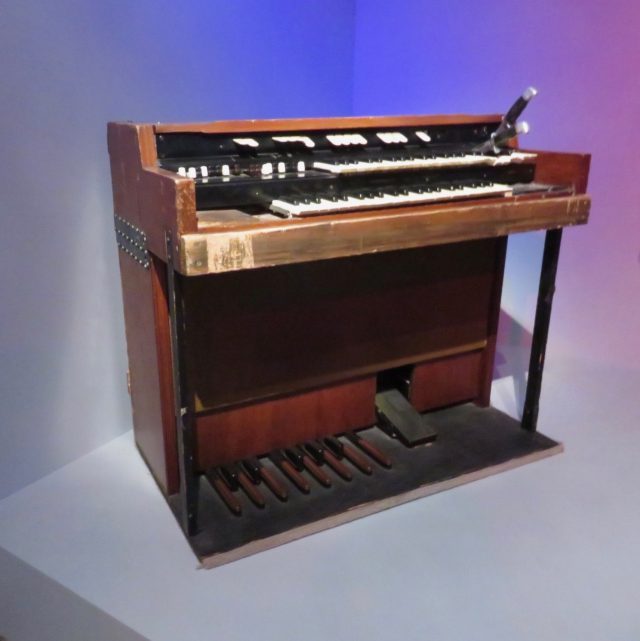
Keith Emerson’s 1960s Modified Hammond L-100 organ features two knives Emerson would stab the keys with (photo by twi-ny/mdr)

Don’t go straight to the labels, which contain information about who made the instrument and who played it on what songs; it’s a lot of fun trying to figure out whose instrument it is. You’re likely to guess twangers by Rick Nielsen of Cheap Trick, Prince, Bo Diddley, Buddy Holly, Ravi Shankar, and Bruce Springsteen, but others will surprise and delight you. One of the first items you’ll encounter is Jerry Lee Lewis’s 1955 Petite Grand Piano; for some reason, the signage refers to Lewis, who is eighty-three, in the past tense. Among the many gems are Chuck Berry’s 1958 Gibson, Louis Jordan’s 1954 Mark VI alto saxophone, Muddy Waters’s 1958 Telecaster known as “the Hoss,” Les Paul’s 1942 “Klunker,” Jimi Hendrix’s 1967 “Love Drops” Flying V, Joni Mitchell’s 1978 GB10NT George Benson Signature, Jack White’s 1964 Airline Res-O-Glas, Joe Perry’s 1985-86 X-100 Blade Runner, Stevie Ray Vaughan’s 1963 “Number One” composite Stratocaster, Robert Trujillo’s 2007–08 “Aztec De La Chloe” five-string bass, Keith Emerson’s 1968 Customized Moog Modular Synthesizer with keyboard, ribbon controllers, and stand, Ian Anderson’s 1975 Model 18-0 flute, Lady Gaga’s 2014 ARTPOP piano with custom housing, and Paul Stanley’s 1979–80 Cracked Mirror Iceman in addition to instruments played by Duane Allman, the Edge, Angus Young, Jeff Beck, Flea, Patti Smith, Ray Manzarek, Paul Butterfield, Nancy Wilson, Clarence Clemons, Steve Vai, Neil Young, Tina Weymouth, Bob Dylan, and dozens more.
(photo by twi-ny/mdr)

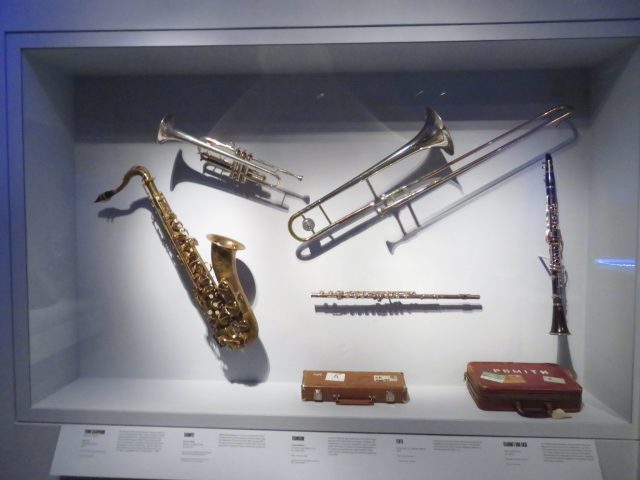
Met exhibition is not just about classic guitars (photo by twi-ny/mdr)

These are not mere artifacts; Jerry Garcia’s Wolf was taken out of the museum so John Mayer could play it at a recent Dead & Co. show at CitiField, and a Stones guitar is out on the road with the band right now. There are several striking guitars from Met fave Steve Miller, who will playing a show in the Grace Rainey Rogers Auditorium on September 28 and contributed to the 2011 “Guitar Heroes” exhibit. Don’t miss Kurt Cobain’s destroyed 1993 left-handed Fender Stratocaster, Eric Clapton’s trippy 1964 “The Fool” SG (and the original headstock, which earns its own vitrine), Pete Townshend’s 1973 Gibson SG Special (which he smashed during a photo shoot and is now encased in Lucite), and a fragment of Hendrix’s 1967 Monterey Pop Fender Stratocaster, which he famously lit on fire. Four guitar greats tell their stories in a circular case that houses their gear and video monitors: Jimmy Page, Keith Richards, Eddie Van Halen, and Tom Morello. (Having seen Morello shred live, I understand exactly why he’s part of this elite quartet.) Several bands display their stage setup, including the Beatles, the Who, Metallica, and the Roots. The exhibition, which was inspired by Brad Tolinski and Alan di Perna’s book Play It Loud: An Epic History of the Style, Sound, and Revolution of the Electric Guitar and is co-organized by the Met’s Jayson Kerr Dobney and the Hall of Fame’s Craig J. Inciardi, is supplemented by vintage concert posters by Lee Conklin, Bonnie MacLean, Rick Griffin, and others. It’s easy to argue why certain musicians are not part of the show (What, no Richard Thompson or Lou Reed?!? Where’s Ritchie Blackmore, Bob Mould, and Johnny Ramone?), but it’s better to just enjoy who is in it. Below are the remaining special events being held in conjunction with the exhibition, which runs through October 1.
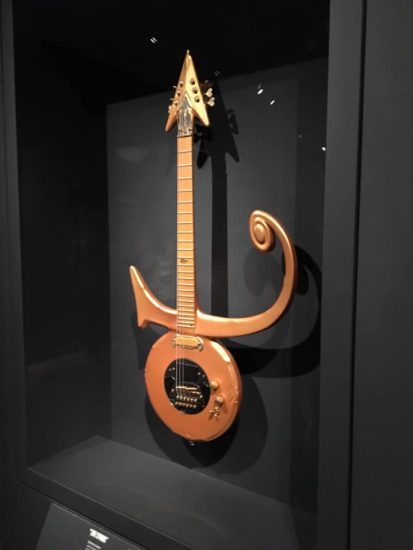
Prince Love Symbol, 1993

Prince’s 1993 Love Symbol captures his trademark glyph (photo by Cathy Hapka for twi-ny)

Saturday, September 7
Black Rock Coalition: History of Our Future, with the BRC Orchestra, Fantastic Negrito, Nona Hendryx, Vernon Reid, Corey Glover, and Will Calhoun, “Captain” Kirk Douglas, Stew, the Family Stand, Carl Hancock Rux, and Toshi Reagon, Grace Rainey Rogers Auditorium, $25, 7:00

Sunday, September 8
Sunday at the Met — Play It Loud: Instruments of Rock and Roll, panel discussion with Anthony DeCurtis, David Fricke, Holly George-Warren, Jayson Dobney, and Craig J. Inciardi, Grace Rainey Rogers Auditorium, free with Museum admission, 2:00

Friday, September 13
MetFridays: Play It Loud — ETHEL and Friends: Four for Fighting, Great Hall Balcony Bar, 5:00–8:00; screening of Woodstock (Michael Wadleigh, 1970), Bonnie J. Sacerdote Lecture Hall, 6:00; Conversations with . . . curators Jayson Dobney and Craig J. Inciardi, Gallery 199, 6:00; Signs and Symbols of Rock and Roll, with designers from ThoughtMatter, a band-name generator, and a button workshop, Great Hall, 6:00; Building Instruments with Atelier Rosenkrantz, Gallery 681, 6:00; Tie-Dye Workshop, Carroll Classroom, 6:00; Reflections on Woodstock with Chris Molanphy, Art Study Room, 6:30; Lez Zeppelin Live, preceded by discussion with Steph Paynes and Brad Tolinski, free with advance RSVP, Grace Rainey Rogers Auditorium, 7:15; all free with museum admission, 5:00–9:00

Saturday, September 28
Steve Miller Band and Jimmie Vaughan Band in Concert, Grace Rainey Rogers Auditorium, 7:00
HOLIDAY MUSIC AND COMEDY 2018

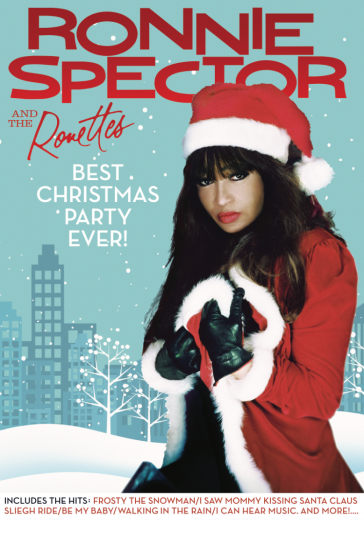
Ronnie Spector will present annual holiday show at City Winery on December 22

Ronnie Spector will present annual holiday show at City Winery on December 22

Hanukkah is about to start and Christmas is only a few weeks away, so the city is filling up with holiday-themed comedy shows, concerts, and special events. They range from classical performances at the Met and Carnegie Hall to hip-hop, soul, and rock extravaganzas at smaller clubs to Jewish takes on the season. Below is a sampling of some of the cooler events; keep watching this space for more additions.

Sunday, December 2
Hanukkah Family Day, art, music, and more for children ages three and up, with Josh & the Jamtones, Jeff Hopkins, Jewish Museum, free with museum admission (children eighteen and under free), 11:00 am – 4:00 pm

Sunday, December 2
through
Sunday, December 9

The 8 Nights of Hanukkah with Yo La Tengo, Bowery Ballroom, $40, 7:30

Monday, December 3
Tenth Annual Latke Festival, benefiting the Sylvia Center, Brooklyn Museum, $75-$120, 6:00

Holiday Cheer for FUV, with John Prine, the Lone Bellow, and Shannon Shaw, Beacon Theatre, $90.50 – $301, 8:00

Elon Gold and Modi: A Hanukkah Miracle, with Sherrod Small and Talia Reese, Stand Up NY, $20-$40, 8:00 & 9:45

Thursday, December 6
Festival of Light w/ Matisyahu and special guests the Soul Rebels and GRiZ plus friends, Brooklyn Steel, $30-$35, 8:00

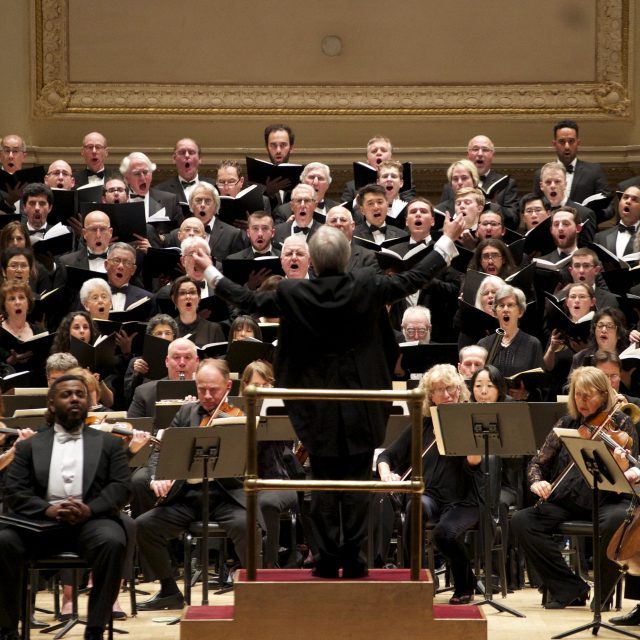
The Cecilia Chorus of New York will perform Handel’s Messiah at Carnegie Hall on December 8

The Cecilia Chorus of New York will perform Handel’s Messiah at Carnegie Hall on December 8

Saturday, December 8
The Cecilia Chorus of New York with Orchestra: HANDEL Messiah, with soprano Shakèd Bar, tenor Michael St. Peter, bass William Guanbo Su, and countertenor Nicholas Tamagna, Carnegie Hall, Stern Auditorium / Perelman Stage, $25-$85, 8:00

Cyndi Lauper & Friends: Home for the Holidays, benefit for True Colors Fund, with Amanda Palmer, Angie Stone, A$AP Rocky, Bebe Rexha, Bishop Briggs, Charlie Musselwhite, Dr. Elmo, Gina Yashere, Natalie Merchant, Regina Spektor, Robert Glasper, Sara Ramirez, Shea Diamond, and the Knocks, hosted by Carson Kressley, Beacon Theatre, $50-$150, 8:00

Sunday, December 9
For the Miracles: A Holiday Celebration, with the Young People’s Chorus of New York City performing Samuel Adler’s The Flames of Freedom and Benjamin Britten’s A Ceremony of Carols, conducted by Elizabeth Núñez, Met Fifth Ave., Grace Rainey Rogers Auditorium, $65 (bring a child for $1), 3:00

Holiday Concert, featuring Scandinavian and American holiday favorites and Saint Lucia procession with traditional gowns and glowing candles, with members of the Swedish Church Choir in New York, Scandinavia House, $25, 5:00

The 12th Annual Menorah Horah Hanukkah Burlesque Show, with the Schlep Sisters (Minnie Tonka and Darlinda Just Darlinda), Sapphire Jones, Zoe Ziegfeld, the Great Dubini, Allegra, host Bastard Keith, DJ Momotaro, Rara Darling, and Madame Brassiere, Highline Ballroom, $25-$50, 8:00

Friday, December 14
Yule Dogs: A Very Mercury Christmas, with Wormburner, Christopher John Campion with Mad Staggers, and special guests Lifeguard Nights, Mercury Lounge, $12-$15, 7:00

Sunday, December 16
Unsilent Night, participatory boombox concert with Phil Kline, Washington Square Park, free, 6:00

Ingrid Michaelson’s twelfth annual Holiday Hop takes place at the Beacon on December 17

Ingrid Michaelson’s twelfth annual Holiday Hop takes place at the Beacon on December 17

Monday, December 17
Ingrid Michaelson’s Twelfth Annual Holiday Hop, Beacon Theatre, $44.50 – $64.50, 8:00

Oratorio Society of New York: HANDEL Messiah, conducted by Kent Tritle, with soprano Leslie Fagan, countertenor Daniel Moody, tenor Isaiah Bell, bass-baritone Joseph Beutel, and the Chorus and Orchestra of the Society, Carnegie Hall, Stern Auditorium / Perelman Stage, $28-$100, 8:00

Tuesday, December 18
KTU Holiday House Party w/ Why Don’t We, Highline Ballroom, $10 (proceeds benefit Cookies for Kids Cancer), 6:00

Saturday, December 22
Ronnie Spector & the Ronettes: Best Christmas Party Ever!, City Winery, $55-$75, 8:00

Sunday, December 23
Christmas Ball — A Merry Evening of Opera, Operetta, and Christmas Songs: Talents of the World Festival at Carnegie Hall, with bass William Meinert, baritone David Gvinianidze, baritone Oleksandr Kyreiev, tenor Arsen Soghomonyan, soprano Ruslana Koval, soprano Tamar Iveri, soprano Olga Lisovskaya, and the winner of the Talents of the World International Competition, Zankel Hall, $65-$95, 7:00

Monday, December 24
A Very Jewish Christmas, with Marion Grodin, James Goff, Sam Morril, Jared Freid, and others, Gotham Comedy Club, $25, 7:00 & 9:00

Tuesday, January 1
Ninth Annual New Year’s Day w/ Joseph Arthur & Lee Ranaldo, City Winery, $20-$28, 8:00

WANGECHI MUTU: BANANA STROKE

Wangechi Mutu, Banana Leaves on Fallen Tree Trunk,

Wangechi Mutu, “Banana Stroke,” site-specific action painting, 2017 (courtesy of the artist / photo by Andrew Dru Mungai)

MetLiveArts / Performa 17
Metropolitan Museum of Art, Grace Rainey Rogers Auditorium
1000 Fifth Ave. at 82nd St.
Performance: Monday, November 13, and Tuesday, November 14, free with advance registration, 7:00
Talk: Wednesday, November 15, Performa Hub, 427 Broadway at Canal St., free, 1:00
212-570-3949
www.metmuseum.org
17.performa-arts.org

Kenyan-born artist and activist Wangechi Mutu, who is based in New York and Nairobi, will be at the Met Fifth Ave. on November 13 and 14 presenting the Performa 17 commission and MetLiveArts program Banana Stroke. The sculptor, collage painter, and multidisciplinary, multimedia artist is the founder of AFRICA’SOUT!, an organization that seeks to raise awareness and “advance radical change” regarding freedom of creative expression in Africa and the diaspora, with a particular focus on gender equality and gay rights. Banana Stroke is an immersive environment constructed from collages made with dyed, fermented, or saturated paper, a live performance, and a site-specific action painting. “A lot of my work reflects the incredible influence that America has had on contemporary African culture. Some of it’s insidious, some of it’s innocuous, some of it’s invisible. It’s there,” Mutu told Mother Jones in 2013. On November 15 at 1:00, she will be at the Performa 17 Biennial Hub at 427 Broadway for a free talk with writer and scholar Adrienne Edwards, concentrating on Mutu’s use of abstraction and performance over the last two years. The conversation is being held in conjunction with Performa’s AFROGLOSSIA program, curated by Edwards and featuring work by Mutu, Teju Cole, Tracey Rose, Julie Mehretu and Jason Moran, Yto Barrada, and others.

Wangechi Mutu, “Banana Stroke,” site-specific action painting, 2017 (courtesy of the artist / photo by Andrew Dru Mungai)

Wangechi Mutu, “Banana Stroke,” site-specific action painting, 2017 (courtesy of the artist / photo by Andrew Dru Mungai)

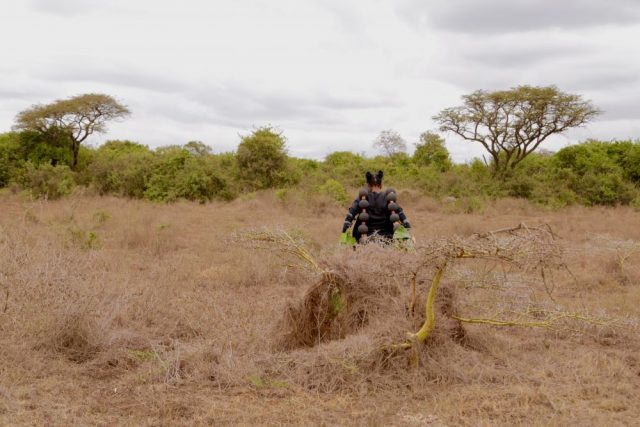
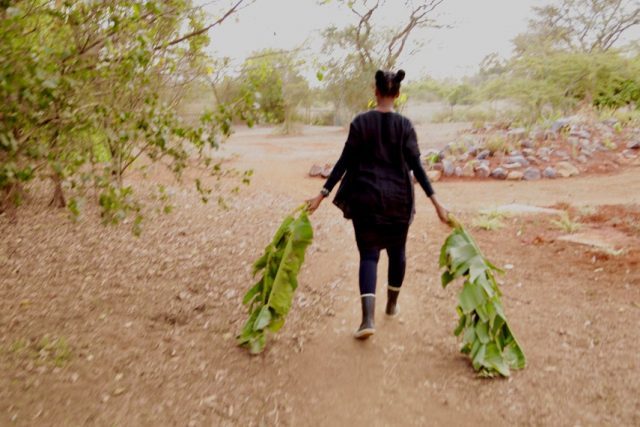
Update: Wangechi Mutu’s Banana Stroke is an intimate, immersive experience reminiscent of the Happenings of the 1960s and ’70s. A small, extremely lucky crowd is ushered into the Met’s Grace Rainey Rogers Auditorium and onto the stage, where they take seats on white benches of various heights and lengths, placed to the right and left. In between is an empty space with large white canvas boards at the front and back. Sounds of nature seep in and two related videos produced, edited, and photographed by Andrew Dru Mungai are projected onto the boards, in which the Kenyan-born Mutu rises from the ground wearing long banana branches on both hands. The videos switch from color to black-and-white while Mutu gently recites Nobel Prize–winning St. Lucian writer Derek Walcott’s “A Far Cry from Africa,” including: “Again brutish necessity wipes its hands / Upon the napkin of a dirty cause, again / A waste of our compassion, as with Spain, / The gorilla wrestles with the superman. / I who am poisoned with the blood of both, / Where shall I turn, divided to the vein? / I who have cursed / The drunken officer of British rule, how choose / Between this Africa and the English tongue I love?” In addition, such words as “Wail,” “Cry,” “Promise,” “Profane,” and “Stroke” appear on one of the walls and are spoken. The lights go out, and Mutu walks into the center, two long banana branches shackled to her arms. She moves slowly while going back and forth between the two canvases, dipping the banana leaves in metal containers of black ink and banging, dotting, and swirling them onto the stark whiteness and dragging them over the floor, the ink at times threatening to touch the audience as Mutu dances and throws her arms in the air.

 Banana Stroke, 2017 Site Specific Action Painting Courtesy of the Artist. Photo Credit: Andrew Dru Mungai

Wangechi Mutu, “Banana Stroke,” site-specific action painting, 2017 (courtesy of the artist / photo by Andrew Dru Mungai)

Satisfied with her stark creations, she leaves the stage in darkness, and soon two more videos are projected over the artwork, similar to the earlier films but not exactly the same. The action paintings are essentially abstract, but Mutu carefully crafted some very specific patterns that now make sense with what’s happening onscreen. The images and words clash with the black strokes on the white screens, calling into question the effects of the artistic intervention as well as that of the colonialists. And about sixty minutes before it all started, it’s over; the audience leaves in silence, Mutu not coming out to take a bow. Banana Stroke is a powerful, provocative experience layered with meaning that will take time and effort to decipher, but it’s well worth further investigation; perhaps Mutu will shed more light on it during her November 15 talk with curator Adrienne Edwards.

PERFORMA 17 BIENNIAL

performa 17

Multiple venues
November 1-19, free – $40
17.performa-arts.org

The seventh Performa biennial takes place November 1-19 in multiple venues around the city, featuring an impressive roster of international artists pushing the limits of what live performance can be. This year’s lineup includes ten Performa commissions and dozens of events, from film, poetry, and dance to architecture, music, and comedy, arranged in such categories as Performa Projects, Performa Premieres, and Pavilion without Walls. In addition to the below recommendations for this always exciting festival, there will be presentations by Kendell Geers, Xavier Cha, Yto Barrada, Brian Belott, Flo Kasearu, Jimmy Robert, Mohau Modisakeng, Kelly Nipper, Kemang Wa Lehulere, Nicolas Hlobo, Kris Lemsalu with Kyp Malone, the Marching Cobras of New York, and others at such venues as Abrons Arts Center, BAM, the Met, White Box Arts Center, Marcus Garvey Park, the Connelly Theater, St. Mark’s Church in-the-Bowery, Harlem Parish, and the Glass House in New Canaan.

Thursday, November 2, 7:00
Friday, November 3, 7:00 & 9:00
Saturday, November 4, 7:00

Teju Cole: Black Paper, BKLYN Studio at City Point, 445 Albee Square West, $15-$25

Thursday, November 2, 9, 16
Barbara Kruger: The Drop, Performa 17 Hub, 47 Walker St., $5, 4:00 – 8:00

Sunday, November 5
Monday, November 6

William Kentridge: Ursonate, Harlem Parish, 258 West 118th St., $25-$40, 7:00

Sunday, November 5, 12, 19
Eiko Otake: A Body in Places, Metropolitan Museum of Art, free with museum admission, 10:30 am

Wednesday, November 8
Estonian Pavilion Symposium: Call for Action — Key Moments of Estonian Performance Art, lecture and screening with curators Anu Allas and Maria Arusoo, free, Performa 17 Hub, 47 Walker St., 5:00

Thursday, November 9
Friday, November 10
Saturday, November 11

The Tracey Rose Show in Collaboration with Performa 17 and Afroglossia Presents: The Good Ship Jesus vs The Black Star Line Hitching a Ride with Die Alibama [Working Title], the Black Lady Theatre, 750 Nostrand Ave., $15-$25, 7:30

Friday, November 10
Zanele Muholi on Visual Activism, grand finale of two weeks of meetings, performances, discussions, and art-making, the Bronx Museum, 1040 Grand Concourse, free, 7:00

Friday, November 10
through
Sunday, November 19

Alex Schweder and Ward Shelley: The Newcomers, with Lena Kouvela and Sarah Burns, 28 Liberty Plaza, free, all day

be here now

Saturday, November 11
Architecture Conference, with Giovana Borasi, Lluís Alexandre Casanovas Blanco, Yve Laris Cohen, Cooking Sections (Daniel Fernández Pascual & Alon Schwabe), and Elizabeth Diller, Performa 17 Hub, 47 Walker St., free, 2:00 – 6:00

Monday, November 13
Tuesday, November 14

Wangechi Mutu: Banana Stroke, Metropolitan Museum of Art, Grace Rainey Rogers Auditorium, free with museum admission, 7:00

Monday, November 13
through
Friday, November 17

Kwani Trust: Everyone Is Radicalizing, multimedia installation and public programs, Performa 17 Hub, 47 Walker St., free, 12 noon – 6:00 pm

Wednesday, November 15
Thursday, November 16
Friday, November 17

Anu Vahtra: Open House Closing. A Walk, Performa 17 Hub, 47 Walker St., free, 5:00

Thursday, November 16
Julie Mehretu and Jason Moran: MASS (HOWL, eon), Harlem Parish, 258 West 118th St,, $25-$40, 7:00 & 9:00

Thursday, November 16
Friday, November 17
Saturday, November 18

Gillian Walsh: Moon Fate Sin, Danspace Project, St. Mark’s Church in-the-Bowery, 131 East Tenth St., $22-$25, 8:00

CROSSING THE LINE — RYOJI IKEDA: SUPERCODEX [LIVE SET]

Supercodex [live set], 2013, © Ryoji Ikeda photo by Ryo Mitamura

Ryoji Ikeda’s Supercodex [live set] makes its New York premiere at the Met as part of Crossing the Line Festival (photo by Ryo Mitamura / © Ryoji Ikeda)

MetLiveArts
Metropolitan Museum of Art, Grace Rainey Rogers Auditorium
1000 Fifth Ave. at 82nd St.
September 6-7, $45-$60 (including same-day museum admission), 7:00
212-570-3949
crossingthelinefestival.org
www.metmuseum.org

At FIAF’s 2014 Crossing the Line Festival, Japanese multimedia artist Ryoji Ikeda dazzled audiences at the Metropolitan Museum of Art with the sold-out U.S. premiere of superposition, an audiovisual marvel that explored technology, philosophy, probability, and the future of existence. He’s now back with the follow-up, supercodex [live set], which kicks off the 2017 festival, again at the Met. (Ikeda’s gallery show, “the transcendental,” was part of the 2010 festival, at FIAF.) The piece, which was conceived and composed by Ikeda and features computer graphics and programming by Tomonaga Tokuyama, is the culmination of Ikeda’s Raster-Norton trilogy of albums that began with Dataplex and continued with Test Pattern, as Ikeda investigates the limits of technological-human connection. Viewers will be enveloped in black-and-white digital imagery while experimental music blasts throughout the space. Ikeda, who lives and works in Japan and Paris and also blew people’s minds with the immersive, site-specific the transfinite at the Park Avenue Armory in 2011, mines the “data of sound” and the “sound of data” in his work, incorporating scientific and mathematical elements, and the New York premiere of supercodex [live set] should bring that to a whole new level. (Tickets include museum admission, so be sure to go early and check out such exhibits as “The Theater of Disappearance,” “Talking Pictures: Camera-Phone Conversations Between Artists,” “Sara Barman’s Closet,” and “Japanese Bamboo Art: The Abbey Collection.”)

KERRY JAMES MARSHALL: MASTRY

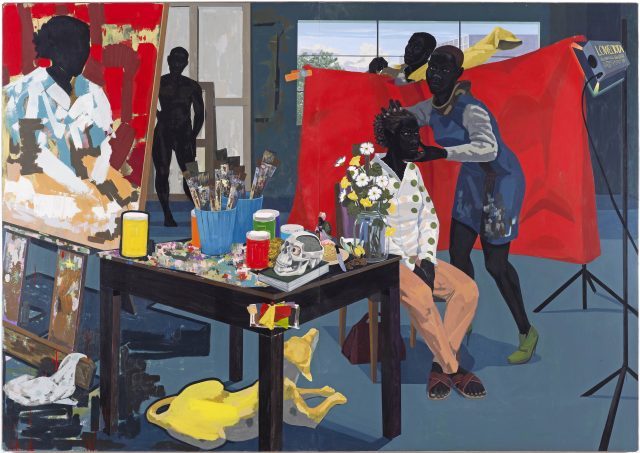
4.  Kerry James Marshall.  American, b orn Birmingham, Alabama 1955 Untitled (Studio) 2014 Acrylic on PVC panels 83 5/16 × 119 1/4 in . (211.6 × 302.9 cm) The Metropolitan Museum of Art Purchase, The Jacques and Natasha Gelman Foundation Gift, Acquisitions Fund and The  Metropolitan Museum of  Art Multicultural Audience Development Initiative Gift, 2015 © Kerry James Marshall.

Kerry James Marshall, “Untitled (Studio),” acrylic on PVC panels, 2014 (the Metropolitan Museum of Art Purchase, the Jacques and Natasha Gelman Foundation Gift, Acquisitions Fund and the Metropolitan Museum of Art Multicultural Audience Development Initiative Gift, 2015 © Kerry James Marshall)

The Met Breuer, third and fourth floors
945 Madison Ave. at 75th St.
Tuesday – Sunday through January 29, suggested admission $12-$25
212-731-1675
www.metmuseum.org

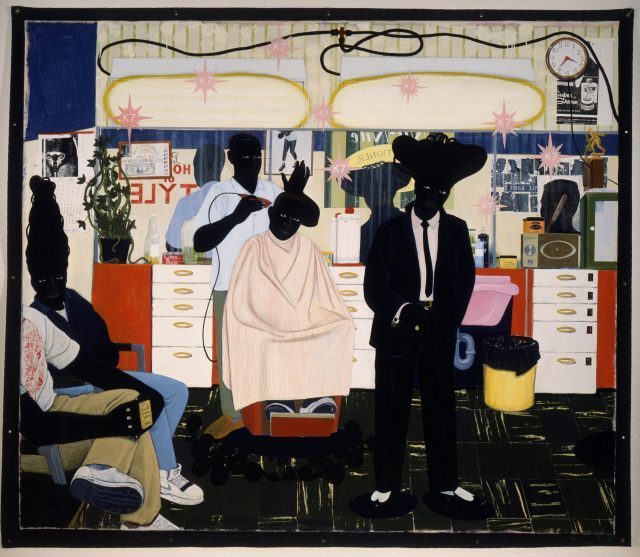
The Met Breuer’s exciting inaugural year continues with the timely and revelatory “Kerry James Marshall: Mastry,” a beautifully curated retrospective that arrives as the country remains split over the Black Lives Matter movement and shortly after the gutting of the Civil Rights Voting Act. Marshall, who was born in Birmingham, Alabama, in 1955, moved to Los Angeles when he was seven, and has lived and worked in Chicago for more than twenty-five years, investigates sociocultural mores through an art-historical lens in his work, which primarily consists of dramatic large-scale canvases that often echo classic paintings from the Western canon. Initially inspired by Ralph Ellison’s Invisible Man, Marshall peoples his paintings with men, women, and children of such a deep, dark, rich black that they sometimes almost disappear. The show begins on the third floor with a pair of powerful side-by-side acrylic-and-collage 1993 works that set the stage for the rest of the exhibition. “De Style” depicts a scene in a barbershop, a traditional gathering place for African Americans, evoking an Old Master painting while also referencing the Dutch art movement known as De Stijl, which focused on the fusion of form and function. Four men, so dark that their eyes are nearly disembodied from their faces, look directly at the viewer. Marshall fills the shop with intricate details and geometric splashes of color, from rectangular blues and reds to a yellow trashcan and a pink sink, but it’s the black that grabs the viewer’s attention. Next to “De Style” is “The Lost Boys,” which pays tribute to two black children who were killed by guns. The canvas features a blue-leafed tree wrapped in yellow police tape, a red background, a haloed orange votive figure, and, between the two boys, the word “Power.” At the press preview, Marshall, a graduate of the Otis Art Institute in Los Angeles, highlighted a quote from University of Chicago professor W. J. T. Mitchell’s What Do Pictures Want?, “a phrase that really defines what it means for me to be an artist: ‘Images don’t only express our desires, they teach us how to desire in the first place.’” He continued, “And for me, that seems to encapsulate fully everything that I experienced in my first encounter with images that brought me to this place, and because I understand something about the power of images, and things you see actually matter, and the more things you see that are different from each other, the more it matters. And when you come to the museum, if you only saw images that were out of the European tradition, and you never saw images that came from another perspective or that pictured other people, and not just incidentally or every now and then but in substantial and critical mass, then there’s always going to be something missing, something missing that I think really cripples our ability to imagine the world in the fullness of its possibility.” Starting the exhibit with “De Style” and “The Lost Boys” immediately places you within Marshall’s world, one that you don’t usually see in museums.

2.  Kerry James Marshall.  American, born Birmingham, Alabama 1955 De Style 1993 Acrylic and collage on canvas 8 ft. 8 in. × 10 ft. 2 in. (264.2 × 309.9 cm) Los Angeles County Museum of Art © Kerry James Marshall

Kerry James Marshall, “De Style,” acrylic and collage on canvas, 1993 (Los Angeles County Museum of Art, © Kerry James Marshall)

Marshall is an exquisitely talented, technically adroit artist, with a compelling sense of color and perspective, creating affecting narrative works with simple yet bold stories to tell. The canvases might reference Rembrandt, Boucher, Fragonard, Holbein, Hopper, Stella, Newman, and various genres throughout the centuries, but they are so much more than that. In “Beauty Examined,” a dead woman is on a slab; her body is all the same dark black except for her left arm, from which the skin has been removed, revealing muscles and bones alongside which Marshall writes, “Beauty is only skin deep.” In “Slow Dance,” a black couple sways romantically to the Originals’ “Baby I’m for Real,” the musical notes floating in the background of an otherwise naturalistic domestic scene. “School of Beauty, School of Culture” is a companion piece to “De Style,” this time set in a women’s hair salon, where, in the front, a young child is looking at the twisted anamorphic head of Walt Disney’s Sleeping Beauty floating like an ever-present Caucasian ghost. The five spectacular large-scale paintings that make up the Garden Project, which depict ordinary life in public housing developments, envelop visitors in their celebration of the everyday while threats are never far away. People are most familiar with photographs of Harriet Tubman that show her as an old, stern woman, but Marshall humanizes her in “Still Life with Wedding Portrait,” depicting her as a younger, sexually attractive woman standing in front of her husband; the painting within the painting is being handled by four gloved hands, three white, one black. And in “Portrait of Nat Turner with the Head of His Master,” the leader of the 1831 slave rebellion in Virginia stands in the foreground holding an ax, his ghostly master lying behind him in bed, his head separated from the res of his body.

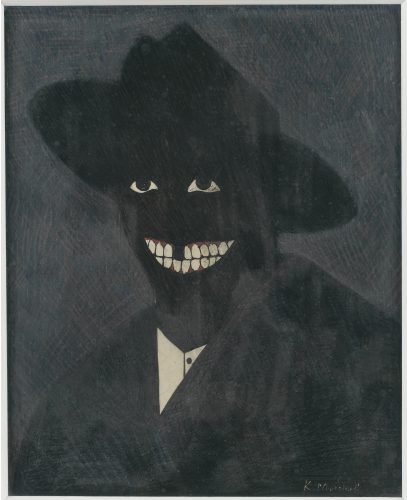
Kerry James Marshall, “A Portrait of the Artist as a Shadow of His Former Self,” egg tempera on paper, 1980 (Steven and Deborah Lebowitz)

Kerry James Marshall, “A Portrait of the Artist as a Shadow of His Former Self,” egg tempera on paper, 1980 (Collection of Steven and Deborah Lebowitz, © Kerry James Marshall; photo: Matthew Fried, © MCA Chicago)

In Invisible Man, Ellison wrote, “I am invisible, understand, simply because people refuse to see me.” Marshall takes that thought to bear in much of his work, including such pieces as “A Portrait of the Artist as a Shadow of His Former Self,” which is dominated by a man with a Cheshire-cat-like smile with a missing front tooth; “Two Invisible Men (The Lost Portraits),” consisting of two portraits, one completely white, the other showing the artist smiling, his eyes glowing in the darkness; “Untitled (Studio),” a dazzling tour de force that is one of the five hundred works that make up the new book The Metropolitan Museum of Art: Masterpiece Paintings; and “Black Artist (Studio View),” a blue-tinted inkjet print of the artist working on the Hopper-inspired “7 am Sunday Morning,” only the sleeve of his white shirt at first visible, a representation of how photography was optimized for white skin tones. Other works to watch out for are “Voyager,” the comic-book-like “Rhythm Mastr,” “Past Times,” and the photography installation “Art of Hanging Pictures,” which again emphasizes the kinds of subjects and scenes not usually on display in museums unless attached to a specific political or social theme. The exhibition is supplemented by “Kerry James Marshall Selects,” more than three dozen works chosen by Marshall from the Met’s collection, including paintings by Jean Auguste Dominique Ingres, Albrecht Dürer, Jacob Lawrence, Georges Seurat, Frank Stella, Paul Cadmus, Ad Reinhardt, Paolo Veronese, Horace Pippin, Walker Evans, and Tsukioka Yoshitoshi, lending further insight into Marshall’s taste and inspirations. You can find out even more about Marshall at three special events being held in conjunction with the exhibition, which runs through January 29. On December 15 at 6:30, “An Evening with Kerry James Marshall” takes place at the Met Fifth Ave., in the Grace Rainey Rogers Auditorium, with Marshall discussing his career with journalist William C. Rhoden; although it is sold out, it will be live-streamed on the Met’s Facebook page. On January 27, the MetFridays program “Art School — The Studio” features artist-led drawing sessions and curator talks from 6:30 to 8:30 at the Met Fifth Ave. and the Met Breuer; and on January 28, the all-day symposium “Kerry James Marshall — A Creative Convening” brings together Marshall, Black Girls Code founder Kimberly Bryant, Olympic gold medalist Michelle Carter, director and cinematographer Arthur Jafa, physicist Hank Thomas, vocalist and composer Imani Uzuri, exhibition cocurators Helen Molesworth and Ian Alteveer, and others for an examination of Marshall’s work and putting it in context in today’s society.

A CHARLIE BROWN CHRISTMAS 2015

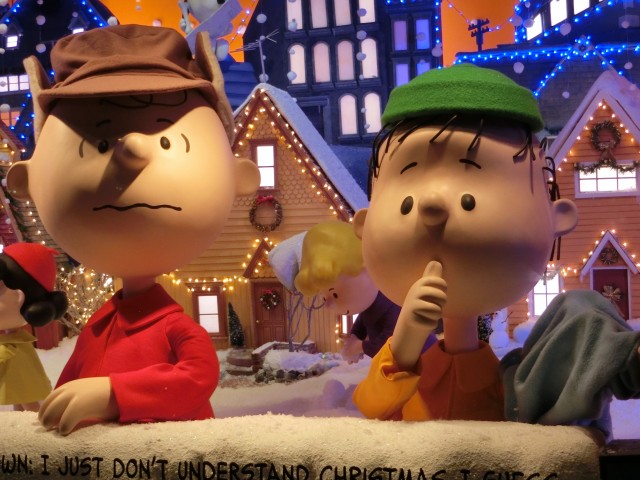
Macy’s holiday window display celebrates fiftieth anniversary of A CHARLIE BROWN CHRISTMAS (photo byt twi-ny/mdr)

Macy’s holiday window display celebrates fiftieth anniversary of A CHARLIE BROWN CHRISTMAS (photo by twi-ny/mdr)

Fifty years ago, on December 9, 1965, CBS broadcast what was to become an all-time holiday favorite, Charles M. Schulz’s A Charlie Brown Christmas. The twenty-five-minute animated program was directed by Walt Disney and Warner Bros. veteran Bill Melendez and featured a jazzy score by the Vince Guaraldi Trio that quickly became part of the national lexicon. The golden anniversary of the television show, which focuses on the noncommercial aspects of the Christmas season, is being celebrated with several special events this month, following the November release of the big-screen Peanuts Movie, in which Charlie Brown declares, “I just need to know the secret for doing something great.” A Brooklyn staple for seven years, A Charlie Brown Christmas Live is moving from the Lyceum to Redwood Studios in Gowanus, being performed December 11-13 and 18-20 ($12), with adults Justin Tyler as Charlie Brown, Gillian Smith-Esposito as Lucy, Susan Forman and Lauren Orkus as Snoopy, and Alden Ford, Doug Aho, and Sean Bradley as Linus; the show is directed by Mollie Vogt-Welch, with music by Stephanie Sanders on keyboards and Jon Shaw on bass. At the Metropolitan Museum of Art, you can catch A Charlie Brown Christmas in the Grace Rainey Rogers Auditorium on December 19 & 20 ($45-$80), with the big-screen projection accompanied by an inventive live musical score by the Rob Schwimmer Trio, followed by an audience sing-along of holiday tunes. Tickets include museum admission, so you can also check out the Met’s Christmas Tree and Neapolitan Baroque Crèche while you’re there.

Over at David Geffen Hall, the New York Philharmonic Principal Brass Quintet and the Canadian Brass join together again for the twentieth annual Holiday Brass concert on December 13 ($49-$69), consisting of tunes from A Charlie Brown Christmas as well as a Chanukah medley, Bach’s Bells, “Penny Lane,” “Joy to the World,” and other holiday songs, performed with the New York Philharmonic Percussionists. The festivities continue December 20 at the Carnegie Hall Family Holiday Concert, as music director and conductor Steven Reineke and the New York Pops play A Charlie Brown Christmas and sing-along favorites with the TADA! Youth Theater, Essential Voices USA, and members of the New York Theatre Ballet. But you don’t need any tickets to see Macy’s Herald Square Christmas windows, which depict six scenes, designed by Roya Sullivan, from the classic Charlie Brown Christmas show, with interactive elements that allow visitors to play Schroeder’s piano and to add their own character to the celebration. The windows will remain on view through January 4; you can see all the windows here.