Tag Archives: Grace Rainey Rogers Auditorium

WITNESSING THE HUMANITY OF JOHN WILSON AT THE MET

John Wilson, Maquette for Martin Luther King, Jr. (United States Capitol, Washington, DC, bronze, 1985 (collection of Julia Wilson / courtesy of Martha Richardson Fine Art, Boston / photo by twi-ny/mdr)

WITNESSING HUMANITY: THE ART OF JOHN WILSON
Met Fifth Avenue
Metropolitan Museum of Art
1000 Fifth Ave. at 82nd St.
Through February 8, $17-$30
www.metmuseum.org

“I wanted people to recognize him, but also I wanted to suggest the intangible energy and strength, this sense of dogged strength he had that allowed him to carry out these impossible campaigns,” John Wilson (1922–2015) said of the Rev. Dr. Martin Luther King, Jr. “He was able to use his verbal skills to convince masses of ordinary people to do these extraordinary things . . . all of that is what I’m trying to put into a head.”

Several depictions of Dr. King are included in the revelatory and necessary exhibition “Witnessing Humanity: The Art of John Wilson,” featuring more than one hundred paintings, lithographs, drawings, sculptures, and children’s books by artist and educator John Wilson, on view at the Met through February 8. Talking about his monumental bust of Dr. King, Wilson further explained, “King’s head is titled forward — not bowed — so that someone standing below will have a kind of eyeball-to-eyeball confrontation with him. I wanted to show that kind of brooding, contemplative, inner-directed person that’s the essence of the man.”

Born in Roxbury, Massachusetts, in 1922, Wilson was driven by community activism against racial injustice, creating works that detailed the Black experience in America. “An artist is ipso facto critical of society . . . constantly dissecting,” he noted. “I want my art to reach people. I want people to get the message that my art has. I want their social attitudes to change as a result of the things I do.”

The exhibition is splendidly curated by the Met’s Jennifer Farrell, Maryland Institute College of Art’s Leslie King-Hammond, and the MFA’s Patrick Murphy and Edward Saywell, with detailed information and lots of powerful quotes by Wilson, who died in Brookline in 2015, leaving behind a remarkable legacy that is finally reaching people, getting the attention it deserves. On January 23 at 6:00, printmaker Karen J Revis will present an “Artists on Artworks” talk on the exhibit, and on February 3 at 6:00, the Met is hosting the free program “A Celebration of John Wilson” in Grace Rainey Rogers Auditorium with Lisa Farrington, Lowery Stokes Sims, Derrick Adams, and King-Hammond.

Below are Wilson’s own words accompanying several important works.
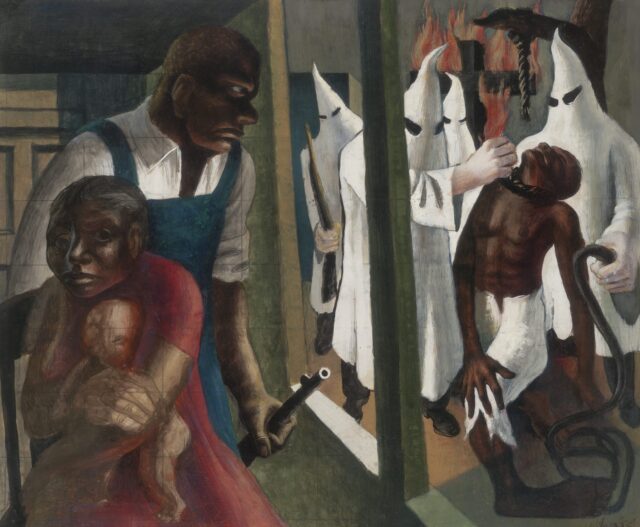
John Wilson, study for the mural The Incident, opaque and transparent watercolor, ink, and graphite, 1952 (Yale University Art Gallery [courtesy the Estate of John Woodrow Wilson] / licensed by VAGA at Artists Rights Society (ARS), New York)

“He put into words what I wanted to express visually, the struggle of African Americans to maintain their human dignity in an oppressive world,” Wilson said of Richard Wright.
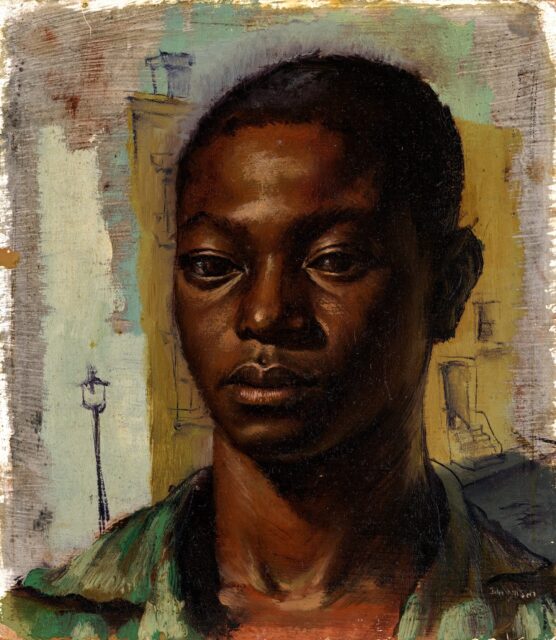
John Wilson, My Brother, oil on panel, 1942 (Smith College Museum of Art / courtesy the Estate of John Wilson)

“I am a Black artist. I am a Black person. To me, my experience as a Black person has given me a special way of looking at the world and a special identity with others who experience some injustices. . . . Themes I have dealt with are not because I sat down and said I wanted to make a political statement but because of emotional experiences.”
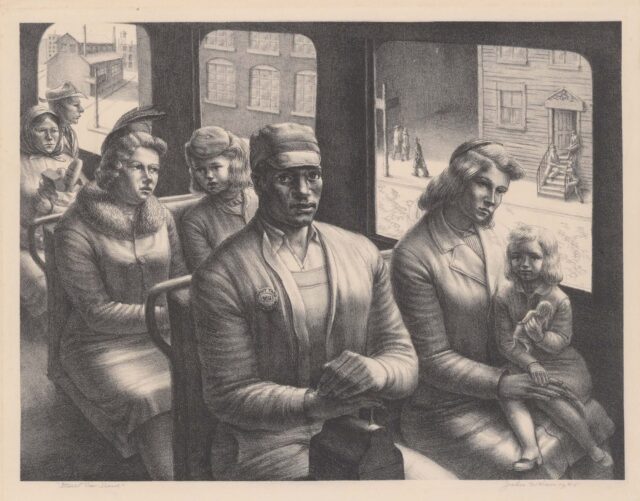
John Wilson, Streetcar Scene, lithograph, 1945 (the Metropolitan Museum of Art / courtesy the Estate of John Wilson)

“I drew scenes of the world around me which reflected the sense of alienation I felt as a Black artist in a segregated world. I saw no examples of art that depicted the people and the realities of the Black neighborhood I lived in.”
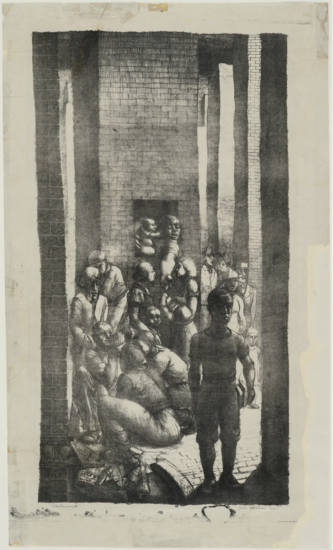
John Wilson, Adolescence, lithograph, 1943 (courtesy the Estate of John Wilson/Artists Rights Society (ARS), Museum of Fine Arts, Boston)

Adolescence is “an imaginative interpretation of the street I lived on . . . [an attempt to express] the bewilderment and search for understanding of a Negro boy growing up in the midst of the inconsistencies, the squalor, and the cramped poverty-stricken confusion of life in a typical North American Negro ghetto. . . . I don’t even know if I was conscious of that boy in the foreground as a self-portrait or not. But I look back on it, [and] clearly it’s a self-portrait.”
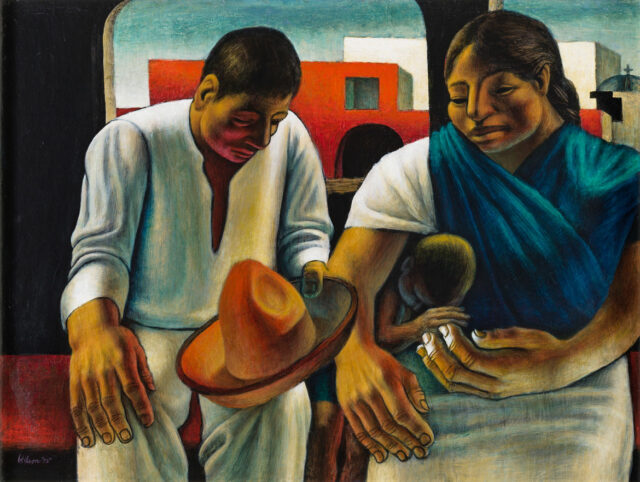
John Wilson, Campesinos (Peasants), oil on paper mounted on board, 1953 (private collection, Boston / © Estate of John Wilson / photo © Museum of Fine Arts, Boston)

“The aim of the Mexican muralist movement was to be spokespeople for the common man. They wanted to create works of art expressing the reality of the forgotten ones, revealing their history, their celebrations, and struggles. . . . Through Mexican art I began to experience a sense of how to depict my reality.”
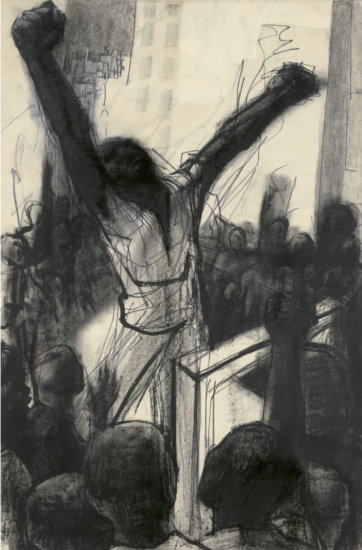
John Wilson, Oracle, ink, chalk, and collage on paper, 1965 (courtesy the Estate of John Wilson / licensed by VAGA at Artists Rights Society (ARS), New York)

“As a Black art student in 1940–41, I became increasingly aware that the illustrations in art history books and the great works in this museum which were statements of profound truth and beauty did not include images of Black people. By omission this seemed to be saying that Black people were not significant. I lived in a world in which the only public images of Blacks were stereotypical, dehumanized caricatures. These were the only images that I saw of Blacks in the newspapers and films and all public media of that time.”
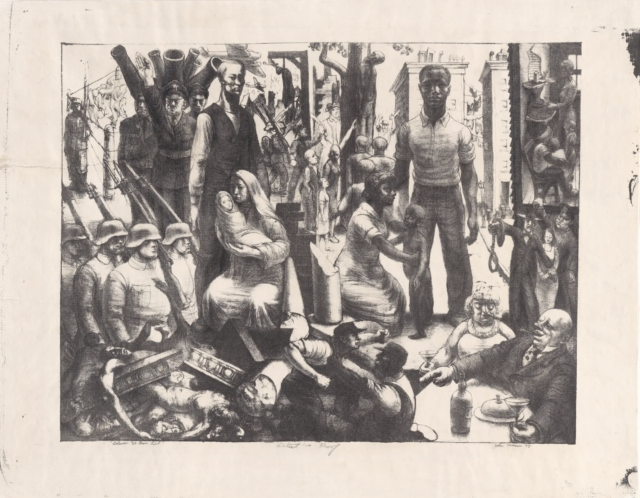
John Wilson, Deliver Us from Evil, lithograph, 1943 (courtesy the Estate of John Wilson/Artists Rights Society (ARS), New York)

“I was an idealistic young African American art student, struggling to find a way to express my fears and anger about the oppression of African American people in America. For me, the ruthless, efficient, invincible German storm troopers became a symbol of all-powerful forces of oppression, in which individuals were modeled into collective killing machines, fueled by ideologies of hate and racial superiority. I identified with the victims of this [Nazi] army, and [War Machine] is my attempt to make a graphic image of the terror engendered by these troops.”

“This business of the terror that was used to keep Black people in their place really worked. I wasn’t born in the South, but the South was a microcosm. There was actual physical lynching in the North. . . . I heard someone make a speech once in which he said, ‘Well, this lynching and the threat of lynching is what keeps Black people in their place.’”

[Mark Rifkin is a Brooklyn-born, Manhattan-based writer and editor; you can follow him on Substack here.]
ROOFTOP MUSIC: JENNIE C. JONES AND ICE AT THE MET

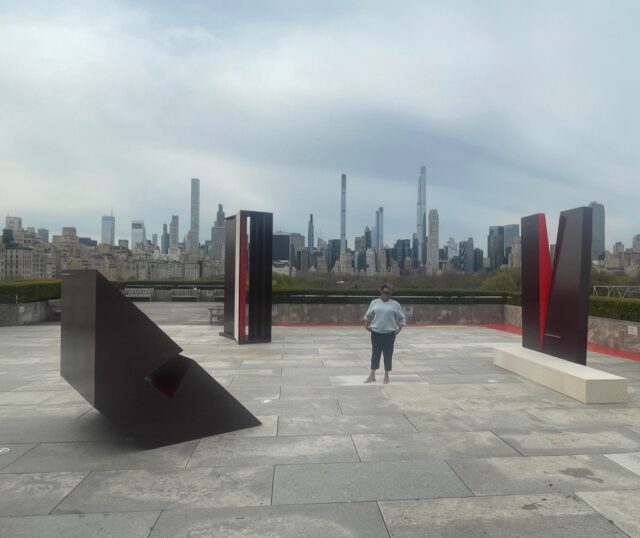
Jennie C. Jones celebrates the opening of Ensemble on Met roof (photo by twi-ny/mdr)

Who: International Contemporary Ensemble, Jennie C. Jones, George Lewis
What: Live performance and discussion
Where: The Grace Rainey Rogers Auditorium, the Met Fifth Ave., 1000 Fifth Ave. at Eighty-Second St.
When: Sunday, October 5, $35-$70 (use discount code ENSEMBLE20 to save 20%), 2:00
Why: “What I hope for this work is that it ignites the sonic imagination. The pieces are not always singing, they’re not always performing, they’re not always activated. I think for me that’s also a tremendous part of the work, the way to hold space, and nuance, not always full of an outward expression but to hold a rich, interior imagination, and to hold a rich sonic imagination,” Jennie C. Jones said at the opening of Ensemble, her stunning installation on the Met’s Iris and B. Gerald Cantor Roof Garden. On view through October 19, Ensemble consists of three large-scale pieces inspired by a few of Jones’s previous works, the extraordinary skyline of the buildings surrounding the roof, and the Met’s musical instruments collection and use of travertine; one recalls a zither, another an Aeolian harp, and the third a one-string, in addition to a red path that expands in one corner.

The Roof Garden Commission rewards the viewer’s attention through close contemplation and intimate enjoyment; if you’re lucky, you might even hear the wind gently playing the strings.

On October 5 at 2:00, you’ll be able to hear the International Contemporary Ensemble (ICE) play their strings in the Met’s Grace Rainey Rogers Auditorium, as the Brooklyn-based collective performs Jones’s 2022 Oxide Score and 2024 Met Color Study, featuring Emmalie Tello on clarinet, Mike Lormand on trombone, Nuiko Wadden on harp, Clara Warnaar on percussion, Modney on violin, Kyle Armbrust on viola, and Brandon Lopez on bass. The Cincinnati-born, Hudson-based Jones will be on hand for a discussion with ICE artistic director George Lewis.

“This is one of Jennie’s things, right? The sculpture changes the sound. See, you stick your head in here, it kind of echoes,” composer, musicologist, and trombonist Lewis says in a video of him walking around Ensemble. “My first encounter with Jennie’s work was probably around 2015. She was finding all these incredible parallels between visual art and music. Jennie taught me a lot about graphic scores. You could say they’re open-ended, but she is definitely weighing in on what she feels could be a perspective. . . How do we transmit these energies to everyone around us, and how do we make these scores part of a larger listening and visual environment? Jennie engages sound as a medium and as a subject. . . . One of the great parts about this work is that it’s not telling you what or how to think or how to hear or how to feel or any of that. You have a lot of agency to decide that for yourself. And once you do, there’s discovery there.”

There’s lots to discover with Ensemble, but you’ll need to get to the Met fast, before the installation closes and the museum begins a five-year renovation of the roof.

[Mark Rifkin is a Brooklyn-born, Manhattan-based writer and editor; you can follow him on Substack here.]
THE HARLEM RENAISSANCE AND TRANSATLANTIC MODERNISM: A CREATIVE CONVENING

Who: Jordan Casteel, Joy Bivins, Rhea L. Combs, Thelma Golden, Tayari Jones, Christopher McBride, Tayari Jones, NSangou Njikam, Denise Murrell, more
What: All-day symposium with lectures, conversations, and performances
Where: The Grace Rainey Rogers Auditorium, the Met Fifth Ave., 1000 Fifth Ave. at Eighty-Second St.
When: Saturday, April 27, free with RSVP, 10:00 am – 6:00 pm
Why: The exhibit of the year thus far is the Met’s “The Harlem Renaissance and Transatlantic Modernism,” an eye-opening collection of more than 160 paintings, sculptures, photographs, films, and ephemera from the “New Negro” movement in Harlem between the 1920s and 1940s. Featuring works by Horace Pippin, Charles Alston, Aaron Douglas, Jacob Lawrence, William H. Johnson, Winold Reiss, Augusta Savage, Hale Woodruff, James Van Der Zee, and others — alongside pieces by Henri Matisse, Edvard Munch, Chaim Soutine, Pablo Picasso, and more to provide context — the show is divided into such sections as “The Thinkers,” “Everyday Life in the New Black Cities,” “Portraiture and the Modern Black Subject,” “Debate and Synthesis: African and Western Aesthetics,” “A Language of Artistic Freedom,” “Cultural Philosophy and History Painting,” “European Modernism and the International African Diaspora,” “Luminaries,” “Nightlife,” “Family and Society,” and “Artist and Activist.”

On April 27, the Met will host “The Harlem Renaissance and Transatlantic Modernism: A Creative Convening,” a free, all-day symposium consisting of live performances, lectures, and conversations with an outstanding lineup of artists, authors, educators, curators, museum directors, and other experts. The full schedule is below.

“Art must discover and reveal the beauty which prejudice and caricature have obscured and overlaid,” Alain Locke, who is featured prominently in the exhibition, explained in The New Negro in 1925. “All vital art discovers beauty and opens our eyes to beauty that previously we could not see.”

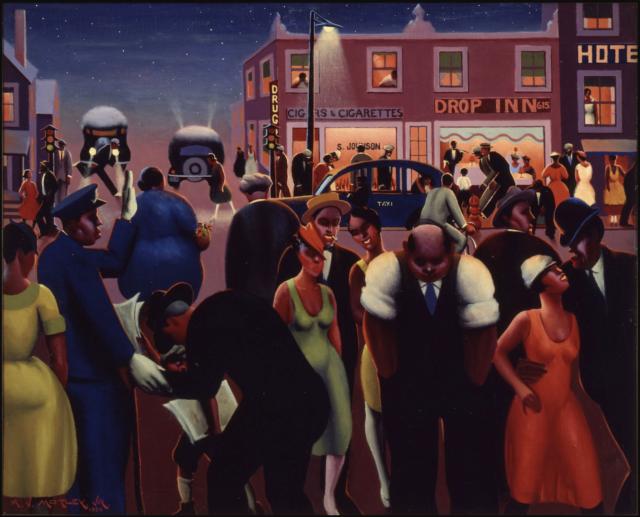
The revelation of the show is the little-known Archibald J. Motley Jr., a painter of extraordinary quality who immerses visitors in his dramatic scenes bursting with life; among his striking canvases on view are Jockey Club, Dans la rue, Blues, Cocktails, and Black Belt. He even gets his own section, “The New Negro Artist Abroad: Motley in Paris.”

Archibald J. Motley Jr., Black Belt, oil on canvas, 1934 (Hampton University Museum / courtesy the Chicago History Museum. © Valerie Gerrard Browne)

“We younger Negro artists who create now intend to express our individual dark-skinned selves without fear or shame. If white people are pleased we are glad. If they are not, it doesn’t matter. We know we are beautiful. And ugly too,” Langston Hughes wrote in 1926. “If colored people are pleased we are glad. If they are not, their displeasure doesn’t matter either. We build our temples for tomorrow, strong as we know how, and we stand on top of the mountain, free within ourselves.”

Be sure not to miss the final room, which contains Romare Bearden’s monumental 1971 six-panel Harlem tribute The Block, its own temple for tomorrow.

Saturday, April 27
Opening Performance: The National Jazz Museum in Harlem House Band led by Christopher McBride, 10:00

Welcome and Introduction, with Max Hollein, Heidi Holder, and Denise Murrell, 10:35

Keynote, by Isabel Wilkerson, 10:45

Session I
Presentations: Harlem as Nexus, with Emilie Boone, Rhea L. Combs, Ego Ahaiwe Sowinski, and Richard J. Powell, 11:30

Session II
Conversation: Legacies of Harlem on My Mind, with Bridget R. Cooks and Lowery Stokes Sims (virtually), moderated by Denise Murrell, 2:00

Conversation: Visioning the Future — The Collections of Historically Black Colleges and Universities, with Kathryn E. Coney, Jamaal Sheats, Danille Taylor, and Vanessa Thaxton-Ward, moderated by Joy Bivins, 3:00

Session III
Conversation: New Renaissance — Harlem Today, with Jordan Casteel, Anna Glass, and Sade Lythcott, moderated by Thelma Golden, 4:30

Reading, by NSangou Njikam, 5:30

Closing Remarks, by Denise Murrell, 5:45

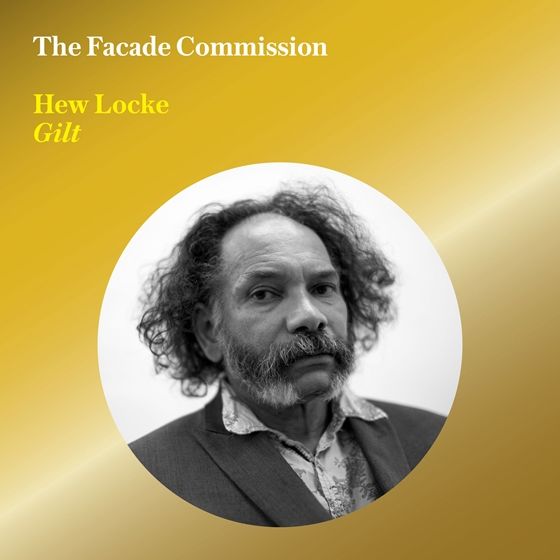
THE FACADE COMMISSION: AN EVENING WITH ARTIST HEW LOCKE

Who: Hew Locke, Tumelo Mosaka, Kelly Baum
What: Conversation about “The Facade Commission: Hew Locke, Gilt
Where: Metropolitan Museum of Art, Grace Rainey Rogers Auditorium, 1000 Fifth Ave. at 82nd St.
When: Thursday, September 15, free with RSVP, 6:30
Why: On September 15, Scotland-born, Guyana-raised, London-based sculptor Hew Locke will unveil his Met Museum facade commission, Gilt, which will be on view through May 23, 2023. The four-piece work references the Met collection, focusing on appropriation, power, and colonialism through a theatrical lens.

“Hew Locke creates emotionally powerful and visually striking work that will stop you in your tracks. This site-responsive commission for the museum’s facade will be informed by Locke’s deep knowledge of the Met’s collection and will reference the institution in ways both direct and indirect, recovering and connecting histories across continents, oceans, and time periods,” Met director Max Hollein said in a statement. Curator Sheena Wagstaff added, “Hew Locke uses a delirious aesthetic of abundance and excess to reflect themes of deep urgency in the past and present, including wealth, imperial power, and prestige, astutely critiquing their visual iconography through reclamation.”

The third facade commission, following Wangechi Mutu’s The NewOnes, will free Us and Carol Bove’s The séances aren’t helping, Locke’s aptly titled Gilt will be explored in a panel discussion September 15 at 6:30 with Locke, Columbia University director and curator Tumelo Mosaka, and Met curator Kelly Baum; you can attend in person at the Met’s Grace Rainey Rogers Auditorium or watch the livestream online.

BIJAYINI SATPATHY: DOHĀ

Bijayini Satpathy concludes her MetLiveArts residency on September 13 (photo courtesy Metropolitan Museum of Art)

Who: Bijayini Satpathy
What: MetLiveArts performance
Where: Grace Rainey Rogers Auditorium, Metropolitan Museum of Art, 1000 Fifth Ave. at 82nd St.
When: Tuesday, September 13, $35+ (includes museum admission), 7:00
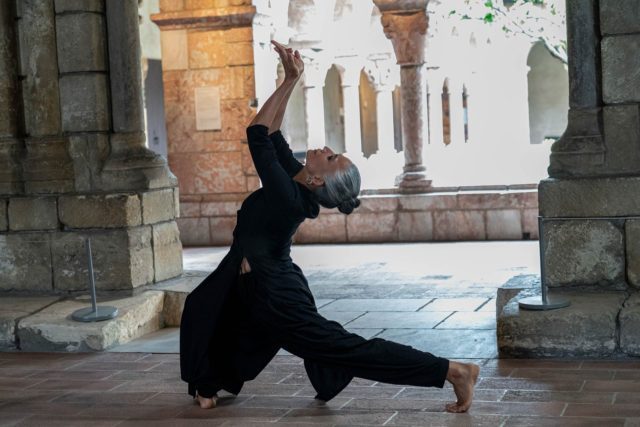
Why: MetLiveArts artist in residence Bijayini Satpathy concludes her residency with Dohā, taking place September 13 at 7:00 in the Grace Rainey Rogers Auditorium. In the evening-length work, the Indian principal dancer, master teacher, and respected scholar explores ritualized prayer while embracing playfulness as she searches for the divine. Satpathy will also give give a talk on Odissi dance at the New York Public Library on September 19 at 6:00 as part of the new Dr. Sunil Kothari Honorary Lecture series; admission is free with advance registration.

AN EVENING WITH CHARLES RAY: FIGURE GROUND

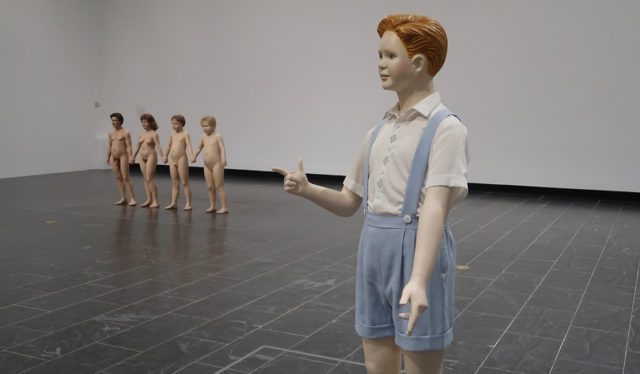
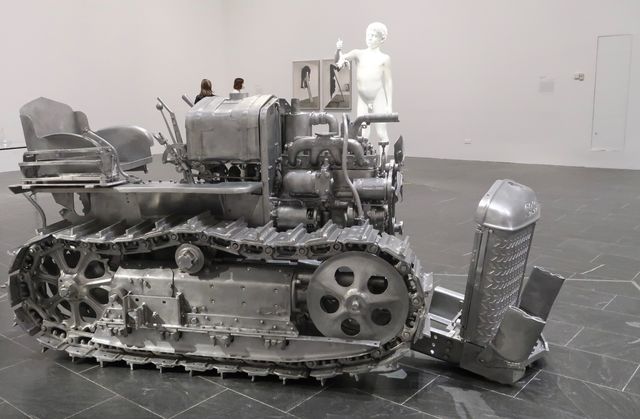
Charles Ray’s Boy points out Family romance at the Met (photo by twi-ny/mdr)

Who: Charles Ray, Hamza Walker, Kelly Baum, Leon Polsky
Brinda Kumar
What: Live panel discussion on exhibition “Charles Ray: Figure Ground”
Where: Grace Rainey Rogers Auditorium, Metropolitan Museum of Art, 1000 Fifth Ave. at 82nd St.
When: Tuesday, March 15, free with RSVP, 6:30 (will be recorded for on-demand viewing)
Why: In his essay in “A Questionnaire on Materialisms,” Chicago-born, LA-based sculptor, photographer, and performance artist Charles Ray wrote of encountering an odd phenomenon every time he approached a particular rock with his flashlight during his every-day early morning walk: The flashlight would always suddenly turn off. He becomes obsessed with discovering why it keeps happening, with no success at first. “Could there be a spirit or a ghost about, some being traumatized in the vicinity of this rock, and I was disturbing it every morning with my light? And was it this specter that was turning the light off?” he ponders. When he eventually finds out why it is turning off by the same rock every day, he admits, “I had found the location of my problem, and somehow it was still just as scary as before I knew the solution.”

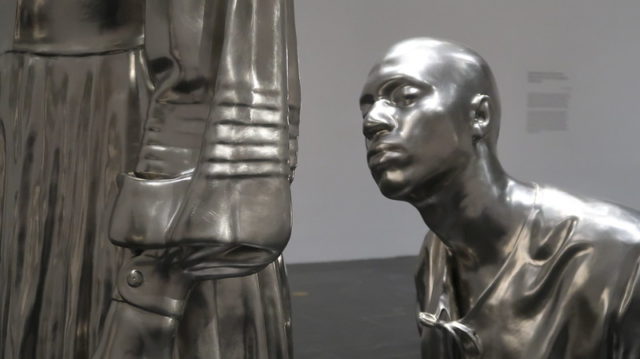
Detail, Charles Ray, Sarah Williams, stainless steel, 2021 (photo by twi-ny/mdr)

Ray’s relationship with the rock is not unlike viewers’ relationship with his art, particularly his sculptures, which range from ultrarealistic works that you will double check to make sure they’re not breathing to oversized and undersized depictions of characters in shiny metal or wood. Nineteen such objects are on display in “Charles Ray: Figure Ground,” continuing at the Met Fifth Ave. through June 5. The show opens with No, what appears to be a photograph of Ray but is actually a picture of a mold of his head and torso fitted with a wig and his glasses and shirt, letting us know from the very start that not everything we are about to see is what we think it is.

“Figure Ground” is a menagerie of sculptural objects that both confuse and delight. Boy is an adult-size mannequin-like child pointing away, questioning conventions of race, gender, and sexuality. Family romance consists of a naked mother, father, son, and daughter all the same size, holding hands, their faces not appearing to be too happy. For Tractor, Ray reconstructed an existing vintage farm vehicle part by part out of clay and wax, then cast it in aluminum, restoring a childhood memory. A vitrine containing the small sculptures Chicken, Hand Holding Egg, and Handheld Bird bring up ideas of birth and creation, nature and nurture, as well as the fragility of life; Chicken was designed to be touched but it is now too brittle.

Charles Ray’s Boy with Frog stands behind Tractor in Met exhibit (photo by twi-ny/mdr)

Boy with Frog, a large-scale stainless-steel sculpture of a boy dangling a frog from his right hand, is painted white to evoke classical marble statuary. The stainless-steel Huck and Jim is left in glittering, reflective metal; both are naked, with Huck bent over, Jim’s hand almost touching Huck’s back, thoughts of monument destruction, homoeroticism, and cancel culture coming to mind. Mark Twain’s Adventures of Huckleberry Finn is also the impetus for Sarah Williams, in which Jim is on his knees behind Huck, who is disguised as a woman, a scene from chapter ten. Ray references Henri Matisse and Henry Moore in Reclining woman, which is like a Renaissance painting come to life in stainless steel, machined in stunning detail. Archangel was carved out of one block of Japanese cypress, a large-scale male who is a new kind of mythological figure, wearing flip-flops and rolled-up jeans and sporting a man bun. And you’re likely going to have to look at least twice to spot Rotating circle, a slowly spinning circle cut out of the wall that is scaled to Ray’s precise height, as if we are seeing it through his eyes.

In conjunction with “Charles Ray: Figure Ground,” the Met is hosting “An Evening with Charles Ray,” a panel discussion on March 15 at 6:30 in Grace Rainey Rogers Auditorium with Ray, Met curator Kelly Baum, and Met associate curator Brinda Kumar. If you can’t make it in person, it will be recorded and available for on-demand viewing afterward. Just be sure to see the show itself, which is captivating and beautifully curated, with the works spread out to give them maximum affect.

THE ROOF GARDEN COMMISSION: AS LONG AS THE SUN LASTS by ALEX DA CORTE

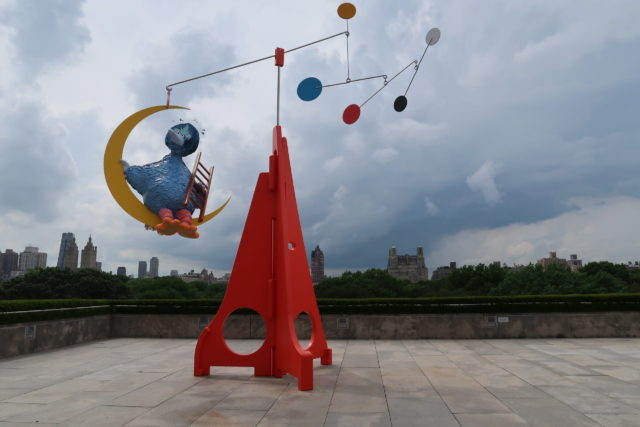
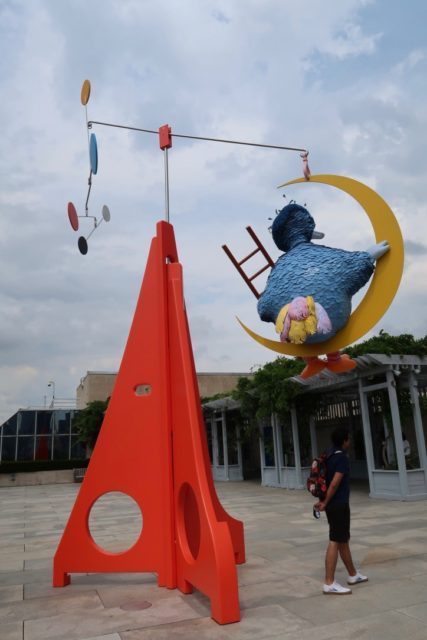
Big Bird rides on a crescent moon on Met roof (photo by twi-ny/mdr)

Who: Alex Da Corte, Shanay Jhaveri
What: In-person discussion of Alex Da Corte’s Roof Garden Commission
Where: The Grace Rainey Rogers Auditorium, the Met Fifth Avenue
When: Friday, October 29, free with museum admission and advance RSVP, 5:30 (installation on view through October 31)
Why: In previous works, Camden-born, Philadelphia-based artist Alex Da Corte has embodied such famous real and fictional figures as Eminem, Mr. Rogers, and the Wicked Witch of the West. For his commission on the Met’s Iris and B. Gerald Cantor Roof Garden, As Long as the Sun Lasts, Da Corte took on the persona of Jim Henson in creating a work that melds childhood memories with visions of the endless sky, inspired by Alexander Calder’s mobiles and sculpture, Little Tikes plastic outdoor activity gyms, Donna Summer’s Four Seasons of Love album cover, the blue Garibaldo character from the Brazilian version of Sesame Street that he watched as a kid in Venezuela, the song from the 1985 movie Follow That Bird in which Big Bird gets painted blue, and the Italo Calvino titular short story.

Alex Da Corte’s As Long as the Sun Lasts continues through Halloween (photo by twi-ny/mdr)

The result is a playful and colorful kinetic sculpture that moves with the wind as Big Bird, covered in more than seven thousand handmade feathers, rides around on a crescent moon, holding on to a ladder of hope. Referring to his transformation into Henson, Da Corte says in a Met interview with curator Shanay Jhaveri, “It stems from thinking about characters I loved or didn’t understand and wanted to understand more. And I see Jim as quite a thoughtful maker.” For those who want to understand more about the installation, which is on view through October 31, Da Corte — likely in costume as Henson — and Jhaveri will sit down for another talk, in the Grace Rainey Rogers Auditorium at the Met on October 29 at 5:30.