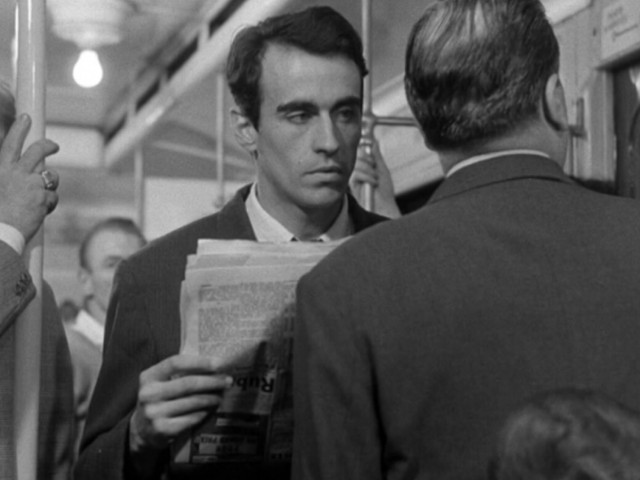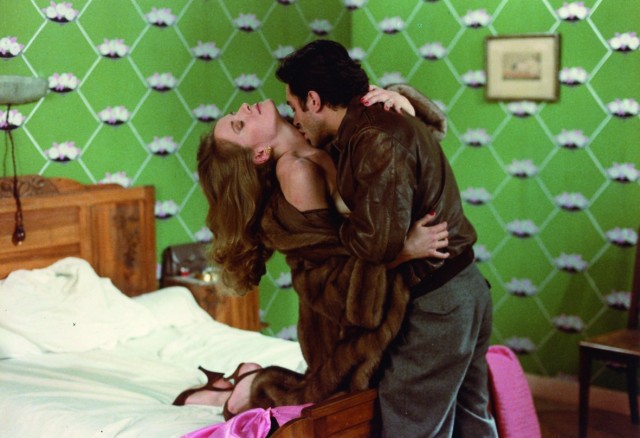
Edith (Dominique Sanda) and François (Richard Berry) find each other in Jacques Demy’s dark but colorful French musical
CINÉSALON: UNE CHAMBRE EN VILLE (A ROOM IN TOWN) (Jacques Demy, 1982)
French Institute Alliance Française, Florence Gould Hall
55 East 59th St. between Madison & Park Aves.
Tuesday, February 11, $13, 4:00 & 7:30
212-355-6100
www.fiaf.org
From the very opening of Une Chambre en Ville (A Room in Town), French New Wave director Jacques Demy announces that the 1982 musical melodrama is going to be something a little different. As a rising sun changes color over a construction site across the Loire River, what appear to be closing credits run up the screen, set to Michel Colombier’s romantic score, as if the film is ending. But Demy and cinematographer Jean Penzer are only getting started, shifting from black-and-white to color to black-and-white again as they cut to the hard streets of 1955 Nantes, where a shipyard strike is under way. Riot police are in a stand-off with hundreds of male and female strikers, characters on both sides singing instead of talking and shouting — in a scene that eerily evokes Tom Hooper’s Les Misérables, which came thirty years later. Soon the intricate plot unfolds, as the striking, and broke, François Guilbaud (Richard Berry), who is renting a room from former baroness Margot Langlois (Danielle Darrieux) and dating doe-eyed Violette Pelletier (Fabienne Guyon), instantly falls for femme fatale Edith Leroyer (Dominique Sanda), Mme. Langlois’s recently married daughter, who is already fed up with her impotent cheapskate of a husband, television salesman Edmond Leroyer (Michel Piccoli). The over-the-top drama plays out in wonderfully garish rooms of deep, intoxicating colors, which are echoed by Rosalie Varda’s (daughter of Demy and Agnès Varda) costumes, which even go so far as to have Violette wearing violet and Edith going bare beneath her luxurious fur coat, with no one changing clothes over the course of the two days in which the story takes place. As the strike continues, the main characters connect with one another in good and bad ways, especially when straight razors and guns are involved.
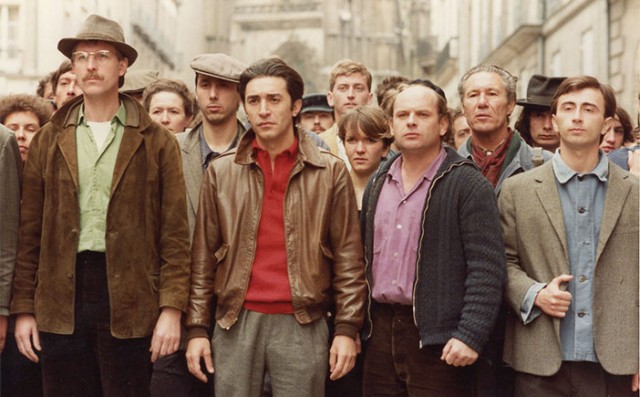
Striking workers are ready to fight for their rights in Jacques Demy’s UNE CHAMBRE EN VILLE
Writer-director Demy, who transformed the movie musical in the 1960s with The Umbrellas of Cherbourg and The Young Girls of Rochefort (the latter also featuring Darrieux), includes no Hollywood-like set pieces in Une Chambre en Ville, no dancing, no choruses — essentially, no real songs at all. Instead, all of the dialogue is sung by the actors (or dubbed in by someone else) as if in regular conversation. Inspired by a real shipyard strike in his hometown of Nantes in 1955, Demy takes on such concepts as wealth, class, authority, home, family, and, most of all, love — both real and imagined, unrequited and lustful — in the vastly underrated film, which is quite entertaining and very funny despite its dark themes. And be on the lookout for more echoes of Les Misérables throughout. A new digital restoration of Une Chambre en Ville is screening February 11 at 4:00 & 7:30 as part of the FIAF CinéSalon series “Remastered & Restored: Treasures of French Cinema”; the later screening will be presented by New Yorker writer Adam Gopnik, and both shows will be followed by a wine reception. The three-month festival continues with such other recently restored French classics as Max Ophüls’s Lola Montès (introduced by Lola Montes Schnabel), Claude Chabrol’s The Color of Lies (costar Jacques Gamblin will no longer introduce the film), and Jean-Pierre Melville’s Two Men in Manhattan.
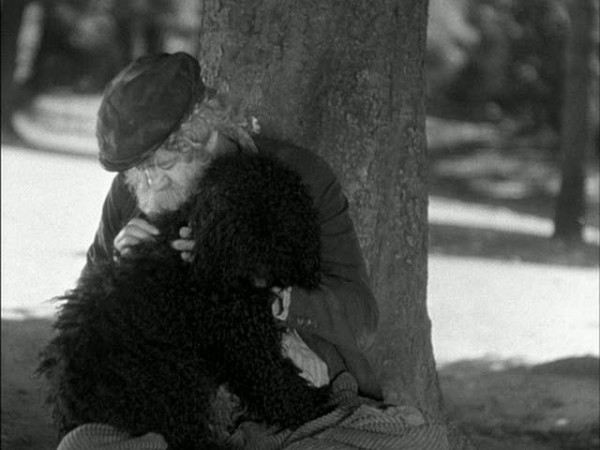
 After his dog runs away, a homeless tramp jumps into the Seine, only to be rescued by a bookseller who brings him home to stay with his family in Jean Renoir’s 1932 masterpiece, Boudu Saved from Drowning. Adapted by Renoir from René Fauchois’s play — the brief opening scene takes place onstage, announcing that what is to follow is essentially a fable — the depression-era social satire centers on the relationship between the wacky, unpredictable bum, Priapus Boudu (Michel Simon, who also played the lead in the play), and Edouard Lestingois (Charles Granval), a bourgeois bookstore owner cheating on his wife, Emma (Marcelle Hainia), with one of their maids, Anne-Marie (Sévérine Lerczinska). Lestingois first spots Boudu while looking through his telescope at the masses on the Pont des Arts, like a filmmaker shooting a documentary; “I’ve never seen such a perfect tramp!” he declares. (Indeed, Renoir regularly comments on the art of filmmaking in Boudu, especially with his use of music, nearly all of which is eventually revealed to be coming from natural sources.) Lestingois helps save the suicidal Boudu, nursing him quickly back to health and letting him stay at the house, much to the chagrin of his wife. Rather than being thankful, Boudu is a whirling dervish of ill manners, breaking dishes, using fancy lingerie to shine his shoes, and daring to eat sardines with his hands. Despite Boudu’s rudeness, Edouard, Emma, and Ann-Marie are all drawn to him in different ways, particularly Edouard, who dresses Boudu in his clothes as if he were a kind of doppelgänger, an alternate version with a completely different set of expectations and responsibilities. But there’s no controlling the bushy-haired Boudu, who reacts to all stimuli like a child who does whatever he wants, not caring about the consequences. One of the keys to the film is that very barrier, the question as to whether Boudu is a conniving tramp who knows exactly what he’s doing or just a pitiable poor soul with no self-control. Boudu — and, therefore, Simon, who gives a towering, spectacular performance, one of the greatest of early cinema — is part Charlie Chaplin, part Buster Keaton, part Little Rascal, and the influence of the character extends to Denis Lavant’s underground creature in Léos Carax’s Merde short in the Tokyo! omnibus and Eddie Murphy’s Billy Ray Valentine in John Landis’s Trading Places. (The film has also been remade twice; Paul Mazursky’s Down and Out in Beverly Hills stars Nick Nolte as the tramp, while Gérard Depardieu plays the role in Gérard Jugnot’s 2005 Boudu.)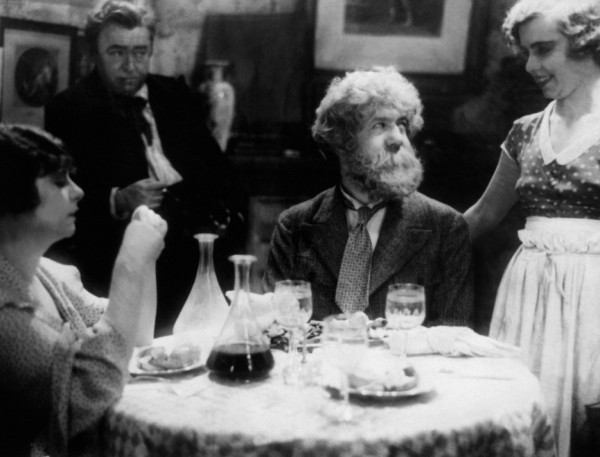
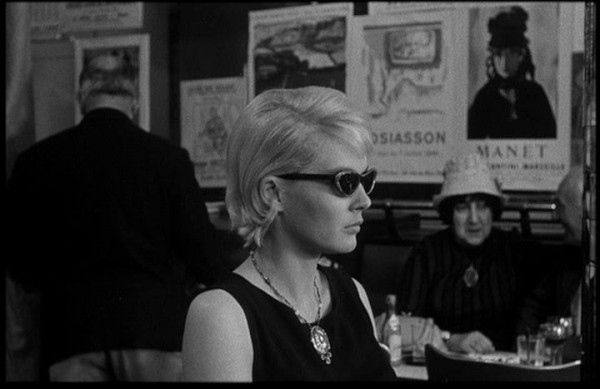
 After getting a biopsy taken and drawing the death card while consulting a fortune-teller, popular French singer Cléo (Corinne Marchand) begins looking back at her life — and wondering just what’s left of it — while awaiting the dreaded results. The blonde beauty talks with old friends, asks her piano player (Michel Legrand, who composed the score) to write her a song, and meets a dapper gentleman in the park, becoming both participant and viewer in her own existence. As Cléo makes her way around town, director (and former photographer) Agnès Varda (Le Bonheur, Vagabond) shows off early 1960s Paris, expertly winding her camera through the Rive Gauche. Just as Cléo seeks to find out what’s real (her actual name is Florence and that gorgeous hair is a wig), Varda shoots the film in a cinema verité style, almost as if it’s a documentary. She even sets the film in real time (adding chapter titles with a clock update), enhancing the audience’s connection with Cléo as she awaits her fate, but the movie runs only ninety minutes, adding mystery to what is to become of Cléo, as if she exists both on-screen and off, alongside the viewer. A central film in the French Nouvelle Vague and one of the first to be made by a woman, Cléo de 5 à 7 is an influential classic even as it has lost a step or two over the years. A new digital restoration of Cléo de 5 à 7 is screening January 28 at 4:00 & 7:30 as part of the FIAF CinéSalon series “Remastered & Restored: Treasures of French Cinema”; the later screening will be introduced by French author Catherine Cusset. The three-month festival continues with such other recently restored French classics as Jean Renoir’s Boudu Saved from Drowning (introduced by Henry Bean), Jacques Demy’s Une chambre en ville (introduced by Adam Gopnik), and Max Ophüls’s Lola Montès (introduced by Lola Montes Schnabel).