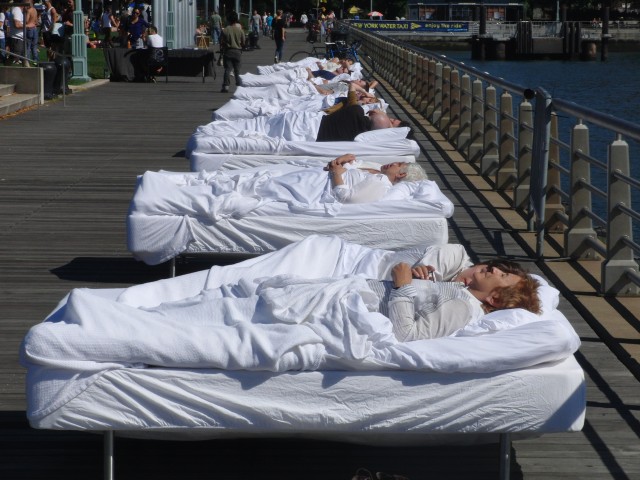
Seven actresses and seven audience members share seven beds in Fernando Rubio’s EVERYTHING BY MY SIDE (photo by twi-ny/mdr)
Hudson River Park
Pier 45, Greenwich Village
September 26-28, $5, 2:00 – 7:00
Crossing the Line festival continues through October 20
www.ps122.org
www.fiaf.org
everything by my side slideshow
Argentinian multidisciplinary artist Fernando Rubio makes his U.S. debut this weekend with the site-specific interactive performance piece Everything by my side. A copresentation of PS122, Hudson River Park, and the French Institute Alliance Française as part of FIAF’s annual Crossing the Line festival, the work, alternately referred to as a play and an event, features seven local actresses in white costumes on seven white beds on Pier 15 in the park. One audience member is invited onto each mattress (shoes off, please), where the actress whispers childhood memories to them. Each cycle lasts fifteen minutes; admission is five dollars, and you must reserve a spot in advance here, selecting English or Spanish as your language of choice. (There is an onsite wait list as well.) A professor of dramaturgy at Escuela Metropolitana de Arte Dramático in Buenos Aires, Rubio has been creating theatrical events, installations, and interventions with his company, INTIMOTETROITINERANTE, since 2001. Everything by my side should be a fascinating, intimate experience, whether you are participating or merely watching from the wings.
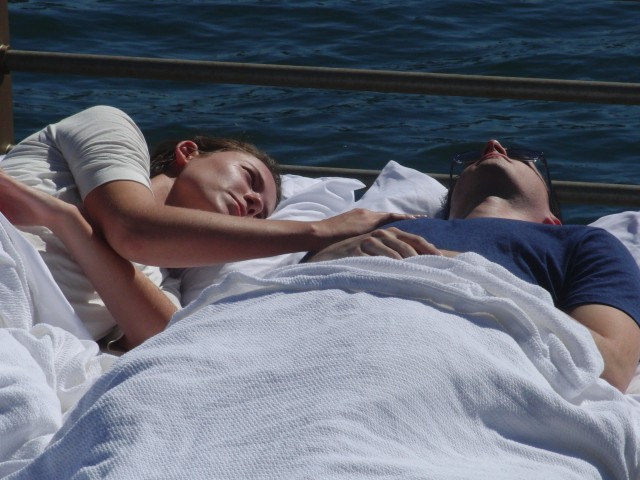
Fernando Rubio’s EVERYTHING BY MY SIDE offers an intimate, personal experience September 26-28 in Hudson River Park as part of Crossing the Line festival (photo by twi-ny/mdr)
Update: For Everything by my side, Argentinian artist Fernando Rubio has set up seven white beds in a horizontal row at the southwest end of Hudson River Park’s Pier 45. Directly behind the beds and across the water are downtown Manhattan and the Freedom Tower, with New Jersey off to the west. As the piece begins, seven actresses (Nanda Abella, Lenora Champagne, Kate Douglas, Rachel Lin, Hannah Mitchell, Rebecca Robertson, and Jessica Weinstein), dressed in white, walk slowly to their respective beds, sit down, pause meditatively, then crawl under the covers. Then seven audience members, instructed to remain completely silent throughout the performance, are each assigned to one of the beds, and in unison they walk over, take off their shoes, and get under the covers as well. Each actress then relates a scripted story, told in four parts in the second person, exploring good and bad childhood memories. The dialogue is general enough that it can evoke real, powerful memories in the listener — at least it did in me, as Douglas (a singer and musician who is also currently appearing in the interactive, immersive Sleep No More at the McKittrick Hotel) guided me to recollections that were both sad and happy and wholly unexpected. For most of the time, we looked deep into each other’s eyes, studying each other’s faces, making for a deep, intimate experience despite the very public setting. For those moments, it was as if we were the only two people in the world, especially as she stroked my face and placed a hand gently on my chest. (Although we could have done without the shrill, noisy Water Taxi that passed by at an inopportune moment.) For a few minutes, a warm, caring connection was made between complete strangers, but it’s likely to be different for each person, as some other audience members spent the duration of the performance on their back, eyes closed, and also had strong emotional reactions, while others reported little effect. As with most interactive theater pieces, the more you open yourself mentally and psychologically, the more you can get out of it. I ended up getting a whole lot out of Everything by my side, which I’m extremely thankful for.
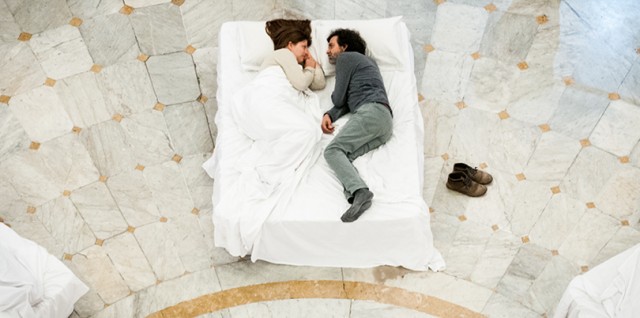

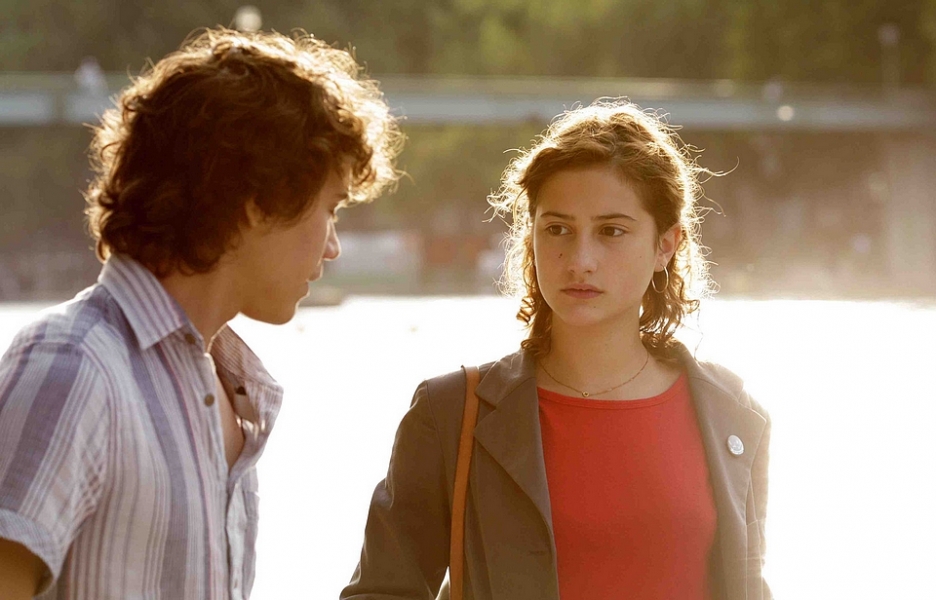
 French filmmaker Mia Hansen-Løve’s third film is an infuriating yet captivating tale that runs hot and cold. Goodbye First Love begins in Paris in 1999, as fifteen-year-old Camille (Lola Créton) frolics naked with Sullivan (Sebastian Urzendowsky), her slightly older boyfriend. While she professes her deep, undying lover for him, he refuses to declare his total dedication to her, instead preparing to leave her and France for a long sojourn through South America. When Camille goes home and starts sobbing, her mother (Valérie Bonneton), who is not a big fan of Sullivan’s, asks why. “I cry because I’m melancholic,” Camille answers, as only a fifteen-year-old character in a French film would. As the years pass, Camille grows into a fine young woman, studying architecture and dating a much older man (Magne-Håvard Brekke), but she can’t forget Sullivan, and when he eventually reenters her life, she has some hard choices to make. Créton (Bluebeard) evokes a young Isabelle Huppert as Camille, while Urzendowsky (The Way Back) is somewhat distant as the distant Sullivan. There is never any real passion between them; Hansen-Løve (All Is Forgiven,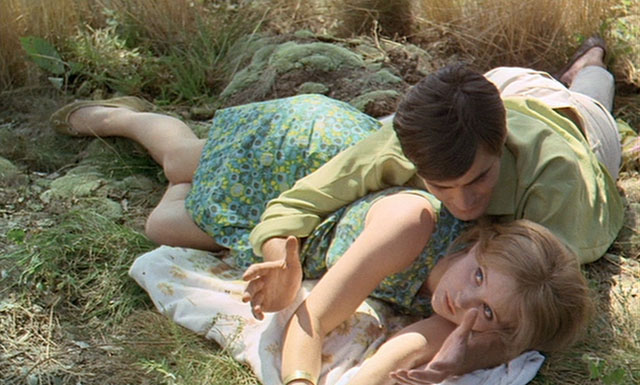
 In 1965, French Nouvelle Vague auteur Agnès Varda said about her third film, Le Bonheur, which translates as Happiness: “Happiness is mistaken sadness, and the film will be subversive in its great sweetness. It will be a beautiful summer fruit with a worm inside. Happiness adds up; torment does too.” That is all true nearly fifty years later, as the film still invites divided reaction from critics. “Miss Varda’s dissection of amour, as French as any of Collette’s works, is strikingly adult and unembarrassed in its depiction of the variety of love, but it is as illogical as a child’s dream,” A. H. Weiler wrote in the New York Times in May 1966. “Her ‘Happiness,’ a seeming idyll sheathed in irony, is obvious and tender, irresponsible and shocking and continuously provocative.” All these decades later, the brief eighty-minute film is all that and more, save for the claim that it is illogical. In a patriarchal society, it actually makes perfect, though infuriating, sense.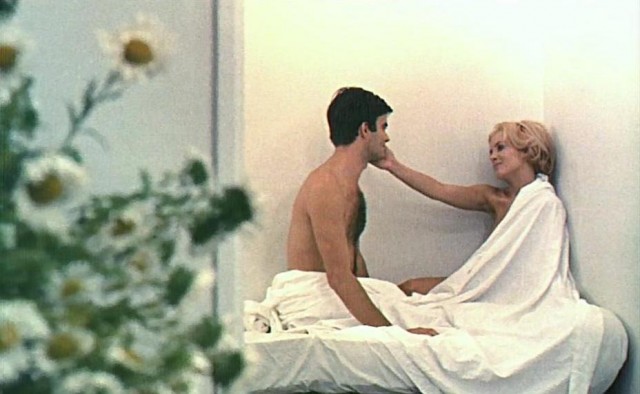

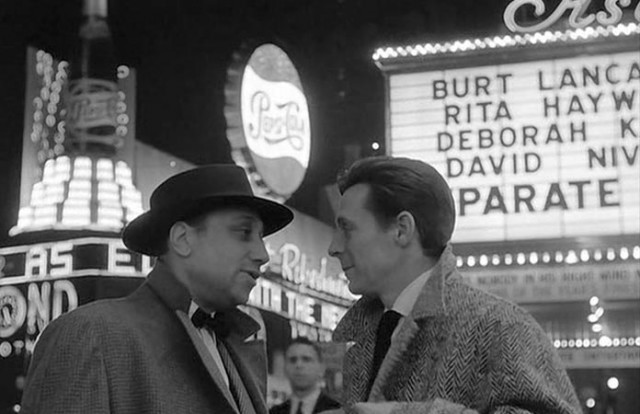
 When French U.N. delegate Fèvre-Berthier goes missing in director Jean-Pierre Melville’s 1959 noir, Two Men in Manhattan, reporter Moreau (Melville) of the French Press Agency and freelance photographer Pierre Delmas (Pierre Grasset) go out on the town, trying to find out what happened. While Moreau is seeking the truth, Delmas is after a sensationalist photograph he can sell to the highest bidder. They meet up with several women who knew the married diplomat — some much better than others — including his secretary, Françoise Bonnot (Colette Fleury), actress Judith Nelson (Ginger Hall), stripper Bessie Reid (Michèle Bailly), and jazz singer Virginia Graham (Glenda Leigh). As the men make their way through Rockefeller Plaza, Times Square, Greenwich Village, Broadway, the subway, and the United Nations, Marial Solal’s and Christian Chevallier’s jazzy score dominates the outdoor scenes, soaking the viewer in the New York at night atmosphere. And all the while, the reporter and photographer are trailed by someone in a mysterious car. As they get closer to their destination, they are faced with some serious ethical choices, not just about journalism, but about life itself. Nearly fifty-five years after its release, Two Men in Manhattan feels as stiff and dated as Melville’s (Bob le Flambeur, Le Doulos, Le Samouraï) lead performance, his only starring role and his sole appearance in one of his own films. It’s difficult to tell if Two Men in Manhattan is a serious procedural, an homage to classic noirs, a tribute to New York City, or a sly genre parody — perhaps it’s all of them, but far too many of the twists and turns are hard to swallow, especially when it comes to Delmas’s selfish decisions and Moreau’s often absurd brainstorms that seem to exist just to quicken the plot despite their incredulity. Still, it’s beautifully shot in shadowy darkness by Nicholas Hayer, and it was proclaimed by Jean-Luc Godard to be the second best film of the year. A digitally remastered version of Two Men in Manhattan is screening March 4 at 4:00 & 7:30 as part of the FIAF CinéSalon series “Remastered & Restored: Treasures of French Cinema”; the later screening will be presented by Phillip Lopate, and both shows will be followed by a wine reception. The three-month festival continues March 11 with Claire Denis’s Chocolat, introduced by African Film Festival founder Mahen Bonetti, before concluding March 18 with Henri-Georges Clouzot’s The Truth.