
Thirteen-year-old Vicgtor (Romain Paul) has to pull off quite a balancing act in Alix Delaporte’s poignant THE LAST HAMMER BLOW
CINÉSALON: THE LAST HAMMER BLOW (LE DERNIER COUP DE MARTEAU) (Alix Delaporte, 2014)
French Institute Alliance Française, Florence Gould Hall
55 East 59th St. between Madison & Park Aves.
Tuesday, July 5, $14, 4:00 & 7:30 (later screening introduced by Mathieu Fourne)
212-355-6100
fiaf.org
www.palacefilms.com
 For their work in Alix Delaporte’s 2010 drama, Angèle et Tony, Clotilde Hesme, as Angèle, won the César for Most Promising Actress and Grégory Gadebois, as Tony, was named Most Promising Actor. For his film debut in Delaporte’s 2014 follow-up, the gentle, tender-hearted The Last Hammer Blow, playing at FIAF on July 5, teenager Romain Paul, portraying Victor, the illegitimate son of characters played by Hesme and Gadebois, won the Marcello Mastroianni Award for Best New Young Actor at the Venice International Film Festival. (Hesme and Gadebois also both starred in the French television series The Returned.) Victor is a sullen thirteen-year-old soccer phenom living with his mother, Nadia (Hesme), in a lonely trailer park. They have run out of money as Nadia battles cancer and considers selling their home and moving in with her estranged parents. When Victor’s father, famous conductor Samuel Rovinski (Gadebois), arrives to lead a performance of Mahler’s Sixth Symphony at the local opera house, Victor confronts him, but Rovinski at first denies that he has a son. But Victor persists in visiting the maestro, all the while not telling his mother that he is being considered for a spot in a prestigious soccer program. In addition, his hormones start raging as he begins noticing that one of his neighbors, Luna (Mireia Vilapuig), is blossoming into quite a beautiful young girl. The various parts of his life converge suddenly, putting him in a precarious position as he is forced to make some difficult decisions.
The Last Hammer Blow is a touching, sensitively told coming-of-age tale, anchored by a breakout performance by Paul, who imbues Victor with a mixture of compassion and ennui, keeping him at an even keel no matter what he faces. Hesme (Love Songs, Mysteries of Lisbon) is heartbreaking as a mother running out of options, and Gadebois (One of a Kind, Une femme dans la Révolution) excels as a bold, strong man who can’t just wave his conductor’s baton and make the past go away. Delaporte’s second film is a character-driven study filled with a poignant humanity that avoids melodrama and cliché in favor of honesty and genuine surprise. Claire Mathon (Angèle et Tony, Mon roi, Two Friends) earned her first of three Lumières Award nominations for her evocative cinematography, and Evgueni and Sacha Galperine’s soundtrack is bittersweet and subtle, especially in the shadow of the grand Mahler symphony. The Last Hammer Blow is screening at 4:00 and 7:30 on July 5 in FIAF’s CinéSalon series “Burning Bright: New French Filmmakers”; the later screening will be introduced by Mathieu Fournet of the French Embassy. The series continues Tuesday nights in July with Arnaud Viard’s Paris, Love, Cut, Thomas Salvador’s Vincent, and Jean-Charles Hue’s Eat Your Bones.
 As it turns out,

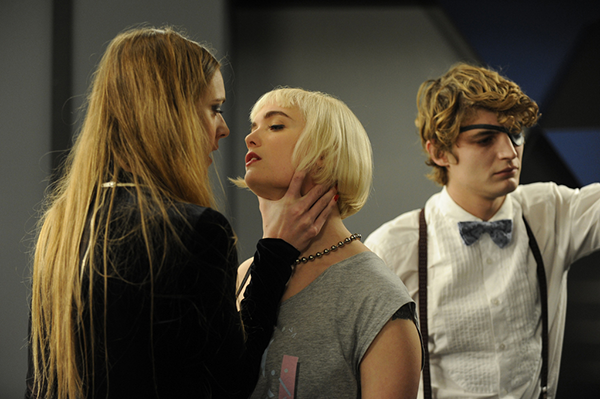
 An orgy doesn’t go quite as planned in Yann Gonzalez’s dark, lurid, and silly directorial debut, You and the Night. The erotic tragicomedy evokes the films of Derek Jarman along with Stanley Kubrick’s Eyes Wide Shut and, primarily, Jean Cocteau’s Orpheus as seven characters gather one evening for a night of debauchery in the name of love, desperate to fill the gaps in their sad lives. “It’s our secret vice. A little break from the eternal, maddening class struggle,” the Star (Fabienne Babe) tells a pair of cops who show up looking for a runaway boy. The party is hosted by trans gypsy maid Udo (Nicolas Maury); the other guests are Ali (Kate Moran), an older woman joined by her younger lover, Matthias (Niels Schneider); the Stud (soccer star Éric Cantona), who boasts of his enormous manhood (and then proves it); the Teen (Alain Fabien Delon, son of French screen idol Alain Delon), who has not developed his own identity yet; and the Slut (Julie Brémond), who can’t wait to do anyone and everyone. Over the course of the night, they share their dreams, relate their pasts, and search for love, set to a score by French electronic band M83, which is led by Anthony Gonzalez, Yann’s brother. The movie’s supposed to be dreamy and poetic, but instead it’s cold and artificial, often bathed in an unfeeling blue light that furthers the distance between the characters and the audience. It’s often hard to tell what’s supposed to be “real” and what’s meant to be tongue-in-cheek, although Béatrice Dalle’s cameo as a whip-touting commissioner is, well, it just is. You and the Night is screening in FIAF’s “EDM Anthems: French Touch on Film” series on March 15 at 4:00 and 7:30; the series continues on Tuesdays through April 26 with such other films as Mia Hansen-Løve’s Eden, Nicolas Winding Refn’s Drive, and Céline Sciamma’s Girlhood, which are either set in the club scene or feature EDM-based soundtracks.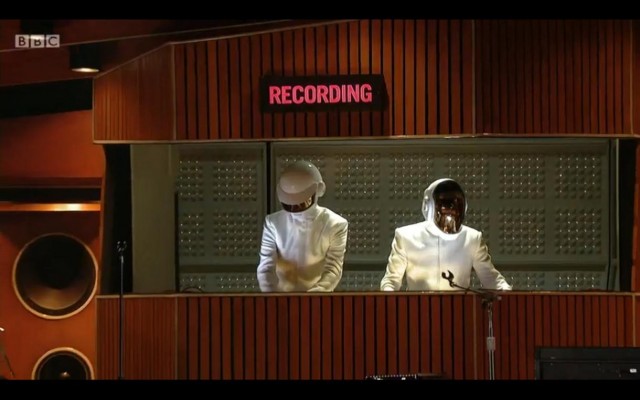
 You might think that the phrase “the French Touch,” which is part of the title of FIAF’s March-April edition of its CinéSalon series, refers to the unique style of such French auteurs as François Truffaut, Jean Renoir, Jean-Luc Godard, Louis Malle, Jean Cocteau, Éric Rohmer, and others whose films are often included in these Tuesday-night festivals. But the term actually describes a group of DJs and bands associated with electronic dance music, or EDM, in France. So it is rather appropriate for the series, “EDM Anthems: French Touch on Film,” to kick off with Daft Punk Unchained, a thumping documentary about the patron saints of that movement, the iconoclastic duo of Thomas Bangalter and Guy-Manuel de Homem-Christo, better known as Daft Punk. Director Hervé Martin Delpierre, who cowrote the film with Marina Rozenman, had his work cut out for him, as he had to make the film without the participation of Daft Punk itself, Bangalter and de Homem-Christo, who have not shown their faces in public this century and rarely give interviews of any kind. But Delpierre gets just about everyone else who has ever worked with them to open up, allowing others to interpret the band’s musical evolution and cultural impact as he traces DP’s career from 1992, when they were in the somewhat more traditional bass-guitar-drum combo Darlin’, to the worldwide sensation of their 2013 album, Random Access Memories, as they melded American disco, German techno, and Manchester industrial into something wholly new. A special focus is placed on their mind-blowing show at Coachella in 2006, which single-handedly changed the future of EDM.