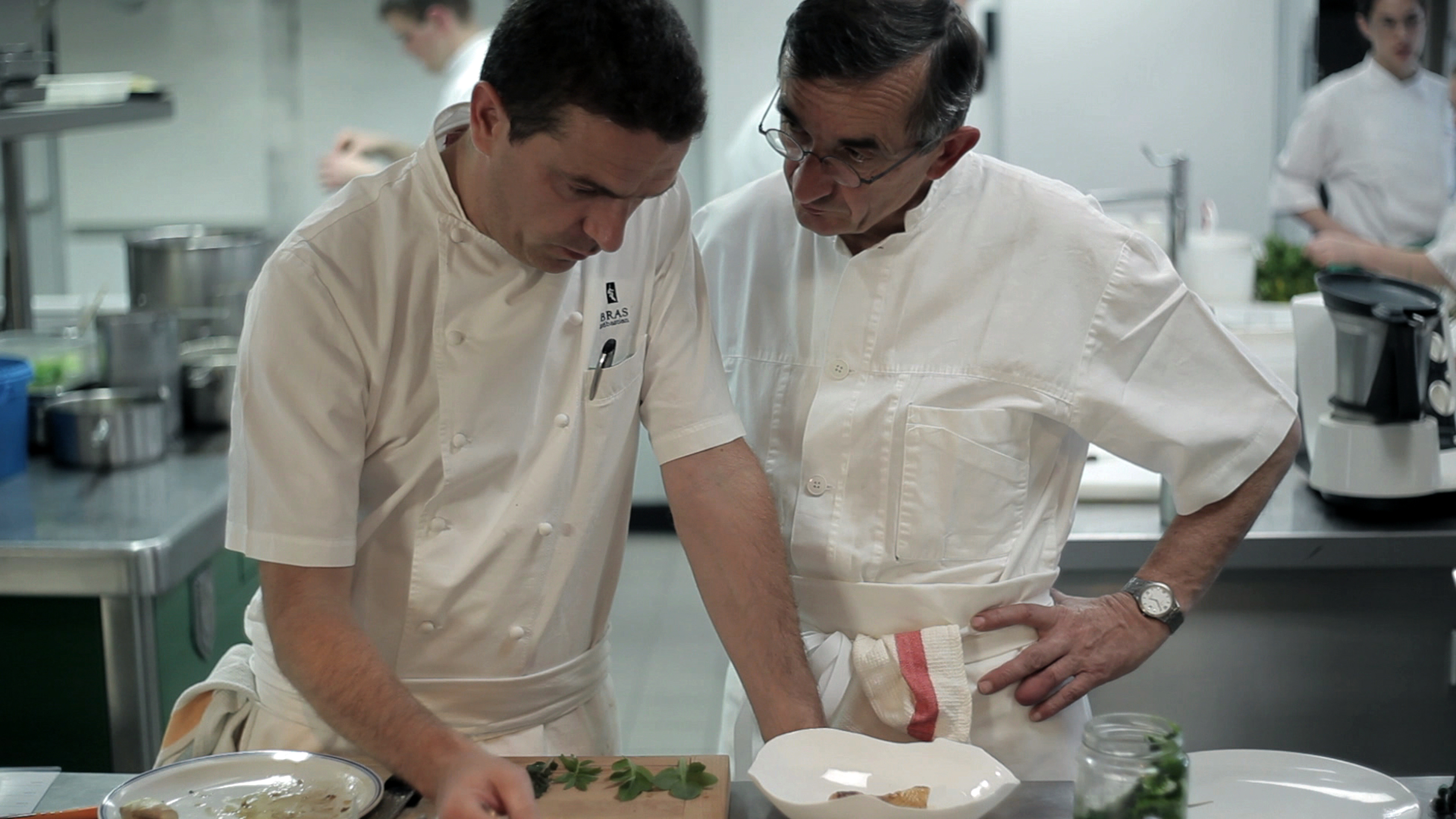
Father and son examine a possible new addition to their world-renowned restaurant in STEP UP TO THE PLATE
STEP UP TO THE PLATE (ENTRE LES BRAS) (Paul Lacoste, 2012)
French Institute Alliance Française, Florence Gould Hall
55 East 59th St. between Madison & Park Aves.
Tuesday, October 9, $10, 7:00
212-355-6160
www.fiaf.org
www.cinemaguild.com
 Culinary documentarian Paul Lacoste details the handing over of a world-renowned restaurant business from father to son in the appetizing if not wholly satiating Step Up to the Plate. In 1999, Lacoste kicked off his “Inventing Cuisine” series with an inside look at gourmet chef Michel Bras, followed by episodes focusing on Pierre Gagnaire, Gérald Passédat, Michel Troisgros, Olivier Roellinger, Michel Guérard, Pascal Barbot, Alain Passard, and Nadia Santini. Ten years later, when he learned that Michel was retiring and his son, Sébastien, would be taking over, Lacoste asked if he could document the transition, resulting in the Bras family welcoming the director into their restaurants and homes, although the results are sometimes surprisingly distant and empty rather than intimate and revealing. Over the course of four seasons, Lacoste follows Michel and his wife, Ginette, and Sébastien and his wife, Véronique, and their two kids from their franchise three-Michelin-star restaurant in the Aubrac region in the south of France to the glorious, stunning Michel Bras Toya Japon situated atop a mountain in Japan. Much of the film focuses on Sébastien creating a new dish, a special request from the director; the deeply intent chef stares at the plate, knowing something is missing but not sure what it is, the camera lingering, a bit too long, on his consternation. When he ultimately brings the dish to his demanding father, Sébastien declares, “Stop looking, taste it! Food is for eating,” to which Michel responds, “But you look at it first, you know.” It is fascinating to watch just how central a role food as both reality and concept plays in this close family’s life, especially as they entertain thoughts of a fourth generation someday grabbing the reins. But while Step Up to the Plate will leave you hungry to eat at their restaurants, it will also leave you hungry for more from the film itself. Step Up to the Plate is screening on October 30 at 12:30, 4:00, and 7:00, concluding FIAF’s “Films for Foodies!” series; the 7:00 show will be presented by chef Jean-Louis Gerin, curator John Mariani, and film producer Jaime Mateus-Tique. [Ed. note: Because of Hurricane Sandy, this presentation has been canceled.]
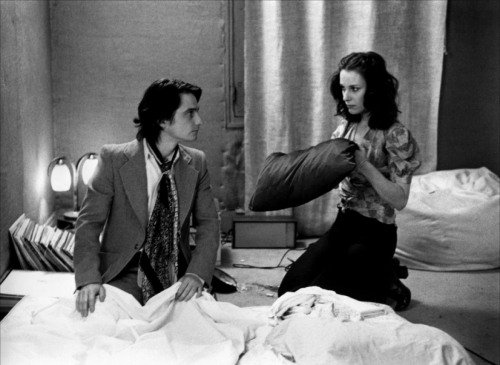
 Jean-Pierre Léaud gives a bravura performance in Jean Eustache’s Nouvelle Vague classic about love and sex in Paris following the May 1968 cultural revolution. Léaud stars as Alexandre, a jobless, dour flaneur who rambles on endlessly about politics, cinema, music, literature, sex, women’s lib, and lemonade while living with current lover Marie (Bernadette Lafont), obsessing over former lover Gilberte (Isabelle Weingarten), and starting an affair with new lover Veronika (Françoise Lebrun), a quiet nurse with a rather open sexual nature. The film’s three-and-a-half-hour length will actually fly by as you become immersed in the complex characters, the fascinating dialogue, and the excellent performances. Much of the movie consists of long takes in which Alexandre shares his warped view of life and art in small, enclosed spaces, the static camera focusing either on him or his companion. The Mother and the Whore is screening on April 3 at 7:30 as part of FIAF’s retrospective of the fifty-plus-year career of French New Wave star Lafont, which also includes Claude Chabrol’s The Good Time Girls, Nelly Kaplan’s A Very Curious Girl, François Truffaut’s The Mischief Makers and Such a Gorgeous Girl Like Me, and Olivier Peyon’s Stolen Holidays. Lafont will be at FIAF on April 17 to participate in a Q&A following the April 17, 7:00, Truffaut double feature and will also read published and unpublished letters from Truffaut (in French) on April 18 in Le Skyroom.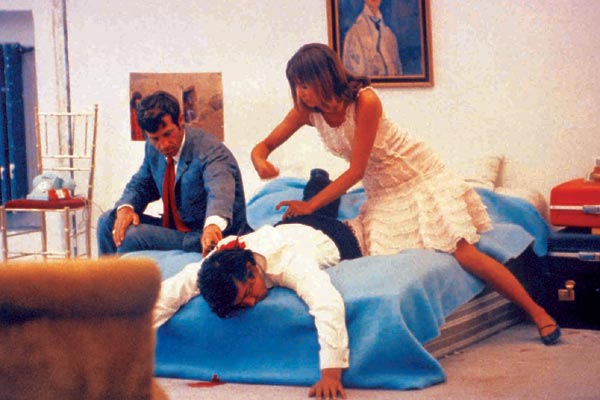
 Art, American consumerism, the Vietnam and Algerian wars, Hollywood, and the cinema itself get skewered in Jean-Luc Godard’s fab feaux gangster flick / road comedy / romance epic / musical Pierrot Le Fou. Based on Lionel White’s novel Obsession, the film follows the chaotic exploits of Ferdinand Griffon (Jean-Paul Belmondo) and Marianne Renoir (Anna Karina, Godard’s then-wife), former lovers who meet up again quite by accident. The bored Ferdinand immediately decides to leave his wife and family for the flirtatious, unpredictable Marianne, who insists on calling him Pierrot despite his protestations. Soon Ferdinand is caught in the middle of a freewheeling journey involving gun running, stolen cars, dead bodies, and half-truths, all the while not quite sure how much he can trust Marianne. Filmed in reverse-scene order without much of a script, the mostly improvised Pierrot Le Fou was shot in stunning color by Raoul Coutard. Many of Godard’s recurring themes and style appear in the movie, including jump cuts, confusing dialogue, written protests on walls, and characters speaking directly at the audience, which is more or less along for the same ride as Ferdinand. And as with many Godard films, the ending is a doozy. Pierrot Le Fou is screening February 21 at 7:30 as part of FIAF’s “Cinema & Fashion: Carte Blanche to agnès b.” series, which also includes Godard’s Vivre sa vie the same day at 12:30 & 4:00 and concludes February 28 with Jacques Becker’s Casque d’or.