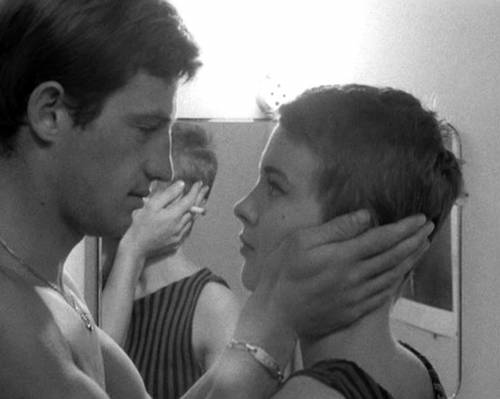
Jean-Paul Belmondo and Jean Seberg star in Jean-Luc Godard’s anarchic, iconic BREATHLESS (courtesy Rialto Pictures/StudioCanal)
BREATHLESS (À BOUT DE SOUFFLE) (Jean-Luc Godard, 1960)
Film Forum
209 West Houston St.
May 28 – June 10
212-727-8110
www.filmforum.org

The fiftieth-anniversary restoration of Jean-Luc Godard’s Nouvelle Vague classic, BREATHLESS, will leave audiences, well, breathless. Godard’s first feature-length film, buoyed by an original treatment by François Truffaut and with Claude Chabrol serving as technical adviser, is as much about the cinema itself as it is about would-be small-time gangster Michel Poiccard (an iconic Jean-Paul Belmondo), an ultra-cool dude wandering from girl to girl in Paris, looking for extra helpings of sex and money and having trouble getting either. Along the way he steals a car and shoots a cop as if shooing away a fly before teaming up with Patricia Franchini (Jean Seberg) and heading out on the run. Godard references William Faulkner and Dashiell Hammett, Humphrey Bogart and Sam Fuller as Michel and Patricia make faces at each other, discuss death, and are chased by the police. Anarchy prevails, both in Belmondo’s character and the film as a whole, which can go off in any direction at any time. Godard himself shows up as the man who identifies Michel, and there are also cameos by New Wave directors Jean-Pierre Melville and Jacques Rivette. The beautiful restoration, supervised by the film’s director of photography, Raoul Coutard, also includes a brand-new translation and subtitles that breathe new life into one of cinema’s greatest treasures. Although many of the restored movies that play at Film Forum do so immediately prior to DVD release, no DVD is currently planned for this version of BREATHLESS, so you’ll have to catch it on West Houston St. during its limited two-week run.
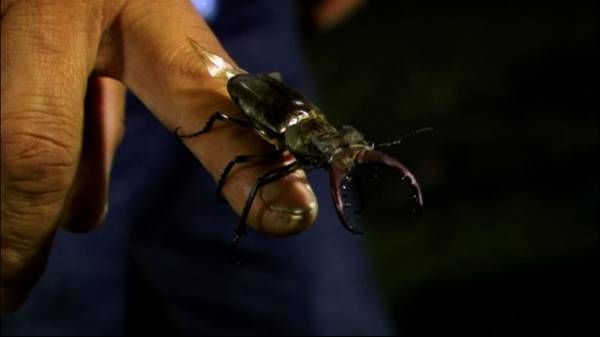
 Collecting insects as pets is a way of life in Japan, and first-time director Jessica Oreck captures this obsession with bugs in the surprisingly effective and highly unusual documentary BEETLE QUEEN CONQUERS TOKYO, playing at Film Forum May 12-18. Oreck, a docent and animal keeper at the American Museum of Natural History, traces the history of the relationship between Japan and bugs in a nonlinear narrative that often plays like a fiction film, especially when showing a young boy shopping for a particular insect – his favorite costs fifty-seven dollars – much the way children in the West look for dogs or cats, or following an insect hunter as he searches the forest for specimens to sell. Oreck cuts between dazzling, colorful shots of fast-paced, modern-day Tokyo backed by a thumping, bass-heavy soundtrack and calmer, more subtle scenes of nature as people discuss their love of beetles, crickets, and other creepy crawlers. But Oreck doesn’t present the Japanese treatment of insects as a strange fad or craze, instead seeing it as yet another relationship with nature and beauty that Westerners are unable to understand. Oreck will be at Film Forum for the 6:30 and 8:20 screenings on May 12 and 14, bringing with her some live exotic insects, and will also be at the 4:40 show on May 16 with INSECTOPEDIA author Hugh Raffles.

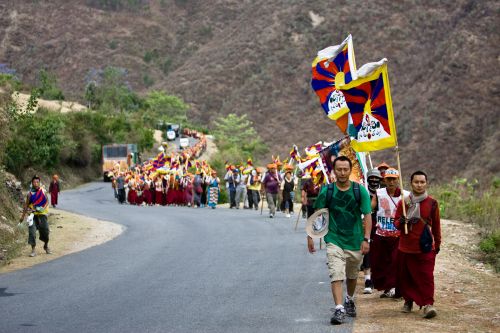
 At the Palm Springs International Film Festival earlier this year, China withdrew Lu Chuan’s CITY OF LIFE AND DEATH and Ye Kai’s QUICK, QUICK, SLOW in protest of the festival’s inclusion of the pro-Tibet documentary THE SUN BEHIND THE CLOUDS. CITY OF LIFE AND DEATH, which examines the 1937 Rape of Nanking, was scheduled to open at Film Forum on March 31, but the distributor could not guarantee that China would allow it to be shown, so Film Forum filled the open slot with THE SUN BEHIND THE CLOUDS. Subtitled TIBET’S STRUGGLE FOR FREEDOM, the seventy-nine-minute film, made by husband-and-wife team Ritu Sarin and Tenzing Sonam, delves into the battle between those Tibetans who follow the Dalai Lama’s Middle Way Approach, in which Tibet would seek autonomy from China but not full independence, and those that want their country back completely. Sarin and Sonam, who have been documenting the situation in Tibet for nearly twenty years in such films as THE TRIALS OF TELO RINPOCHE (1994), THE SHADOW CIRCUS: THE CIA IN TIBET (1998), the narrative feature DREAMING LHASA (2005), and THE THREAD OF KARMA (2007), focus on the March 2008 uprising, the biggest since the Chinese invasion of 1959.