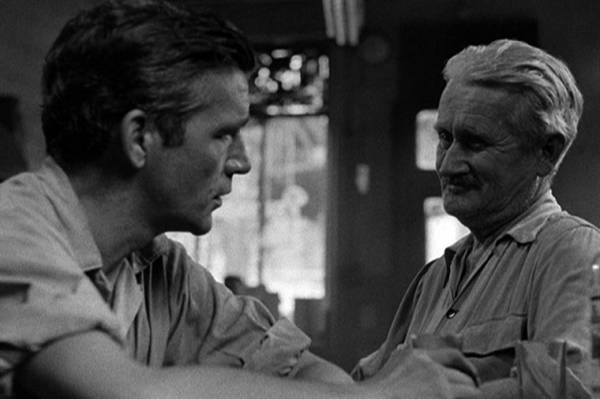
Ray Salyer and Gorman Hendricks are two of the forgotten men in Lionel Rogosin’s unforgettable ON THE BOWERY, back for a return engagement at Film Forum
ON THE BOWERY (Lionel Rogosin, 1956)
Film Forum
209 West Houston St.
November 19-25
212-727-8110
www.filmforum.org
www.ontheboweryfilm.com
 If you missed one of the greatest documentaries ever made about New York this past September, you’ll be given another chance to see the stunning 35mm restoration of ON THE BOWERY, which is returning to Film Forum by popular demand for a one-week run November 19-25. The restoration offers a new look at this underground classic, which caused a stir upon its release in 1956, winning prizes at the Venice Film Festival while earning criticism at home for daring to portray the grim reality of America’s dark underbelly. After spending six months living with the poor, destitute alcoholics on Skid Row as research, idealistic young filmmaker Lionel Rogosin spent the next four months making ON THE BOWERY, a remarkable examination of the forgotten men of New York, ne’er-do-wells who can’t find jobs, sleep on the street, and will do just about anything for another drink. Rogosin centers the film around the true story of Ray Salyer, a journeyman railroad drifter stopping off in New York City seeking temporary employment. Salyer is quickly befriended by Gorman Hendricks, who not only shows Salyer the ropes but also manages to slyly take advantage of him. Although the film follows a general structure scripted by Mark Sufrin, much of it is improvised and shot on the sly, in glorious black and white by Richard Bagley. The sections in which Bagley turns his camera on the streets, showing the decrepit neighborhood under the El, set to Charles Mills’s subtle, jazzy score and marvelously edited by Carl Lerner, are pure poetry, yet another reason why ON THE BOWERY is an American treasure. The film is screening with THE PERFECT TEAM, a behind-the-scenes look at the making of ON THE BOWERY directed by Rogosin’s son, Michael, which includes a terrific 1999 interview with Lionel in which he talks about his attempt to get James Agee on board, his firing of Helen Levitt as editor, the relationships he developed with the cast and crew, and his intense desire to get at the truth. Suzanne Wasserman, director of the Gotham Center for New York City History at CUNY, will introduce the 7:40 show on November 19, while Rob Hollander of the Lower East Side History Project will introduce the 7:40 show on November 20.
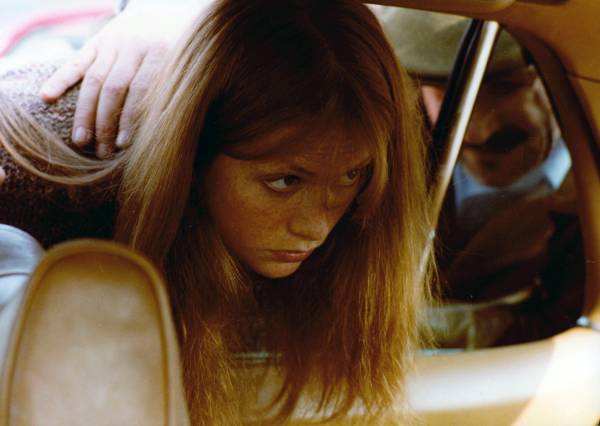
 Screening at Film Forum in a new 35mm print in honor of its thirtieth anniversary, Jean-Luc Godard’s EVERY MAN FOR HIMSELF marked a return to a somewhat more accessible narrative for the Nouvelle Vague auteur, although that does not mean it is by any means a traditional story or that it follows mainstream conventions. Arranged in four sections — the Imaginary (Slow Motion), Fear (Run for Your Life), Commerce (Trade), and Music — the film focuses on a smarmy, unlikable cigar-smoking video director, unironically named Paul Godard (Jacques Dutronc), who fights with his ex-wife (Paule Muret), wonders why he can’t touch his eleven-year-old daughter (Cécile Tanner) in rather sensitive areas, has driven away his bicycle-riding girlfriend, Denise Rimbaud (Nathalie Baye), and pays for a visit from Isabelle (Isabelle Huppert), a prostitute who recites lines from Charles Bukowski in her head while plying her trade and seeking her independence. Godard frames many of the images like paintings, coming alive with bright, bold colors. Nearly all of the interior scenes are filmed in long takes with no camera movement or cross-cutting (with two notable exceptions), while other scenes are filled with slow-motion shots, forcing viewers to question what they are seeing. Meanwhile, snippets of Gabriel Yared’s score and incidental music are often heard by only some of the characters, who wonder where the sounds are coming from. Godard infuses the film with various thoughts on Marxism, feminism, capitalism, pedophilia, incest, and violence against women; in one unforgettable scene, a businessman arranges a ridiculously funny Rube Goldberg-like foursome, acting like a film director, mocking Jean-Luc Godard’s own profession. Thirty years down the road, EVERY MAN FOR HIMSELF, also known as SLOW MOTION and, in French, SAUVE QUI PEUT (LA VIE), feels as relevant, as challenging, and as entertaining as ever. (Note: Film critic and Godard biographer Richard Brody will introduce the 8:20 screening on November 19.)
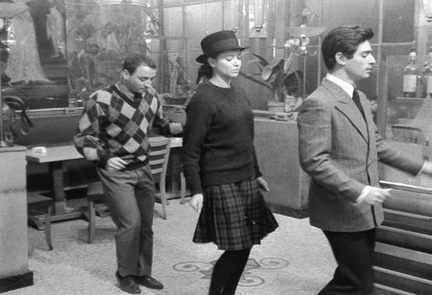
 When a pair of disaffected Parisians, Arthur (Claude Brasseur) and Franz (Sami Frey), meet an adorable young woman, Odile (Anna Karina), in English class, they decide to team up and steal a ton of money from a man living in Odile’s aunt’s house. As they meander through the streets of cinematographer Raoul Coutard’s black-and-white Paris, they talk about English and wealth, dance in a cafe while director Jean-Luc Godard breaks in with voice-over narration about their character, run through the Louvre in record time, and pause for a near-moment of pure silence. Godard throws in plenty of commentary on politics, the cinema, and the bourgeoisie in the midst of some genuinely funny scenes. BAND OF OUTSIDERS is no ordinary heist movie; based on Dolores Hitchens’s novel FOOL’S GOLD, it is the story of three offbeat individuals who just happen to decide to attempt a robbery while living their strange existence, as if they were outside from the rest of the world. The trio of ne’er-do-wells might remind Jim Jarmusch fans of the main threesome from STRANGER THAN PARADISE (1984), except Godard’s characters are more aggressively persistent. BAND OF OUTSIDERS is screening as part of Film Forum excellent series “The Heist,” in a double feature with Jean-Pierre Melville’s BOB LE FLAMBEUR.