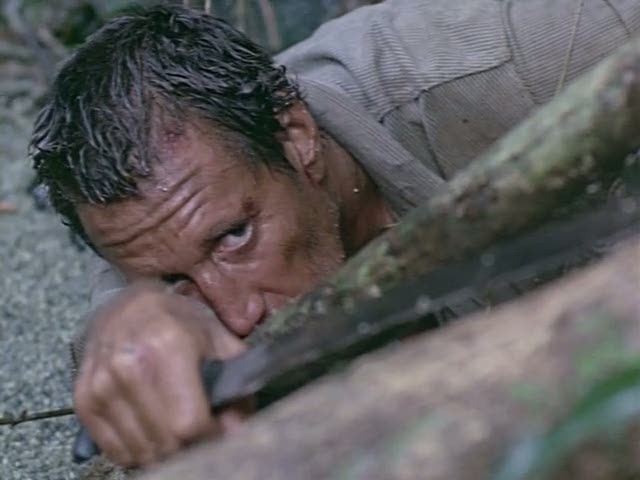
Roy Scheider goes on an existential voyage of the soul in William Friedkin’s SORCERER
SORCERER (William Friedkin, 1977)
Film Forum
209 West Houston St.
May 30 – June 5
212-727-8110
www.filmforum.org
 In the mid-1970s, Chicago-born director William Friedkin was riding high, earning an Oscar for The French Connection and another nomination for The Exorcist, two huge critical and box-office successes. For his next film, he decided to reimagine a seminal work that had had a profound influence on him, Henri-Georges Clouzot’s haunting 1953 suspense thriller, The Wages of Fear. “It turned out to be the most difficult, frustrating, and dangerous film I’ve ever made, and it took a toll on my health as well as my reputation,” Friedkin wrote in his 2013 memoir, The Friedkin Connection. Friedkin’s adaptation of Clouzut’s classic, itself based on a novel by Georges Arnaud, follows four unlikable men — a thief (Roy Scheider), a hit man (Francisco Rabal), an embezzler (Bruno Cremer), and a terrorist (Amidou) — hiding out under fake identities in a depressed, nowhere village in South America. When a nearby oil well catches fire, the company needs four men to drive two rickety trucks more than two hundred miles over treacherous terrain to deliver cases of rotting, highly unstable dynamite that will be used to blow the whole thing up and put out the fire. Oil man Corlette (Ramon Bieri) is sending two trucks — dubbed “Lazaro” and “Sorcerer” — because he thinks only one, if any, will make it through. The journey includes a harrowing twelve-minute scene as the men try to navigate a dilapidated rope bridge in a rainstorm as well as a psychedelic trip through a fantastical landscape (shot in the Bisti Badlands in New Mexico).
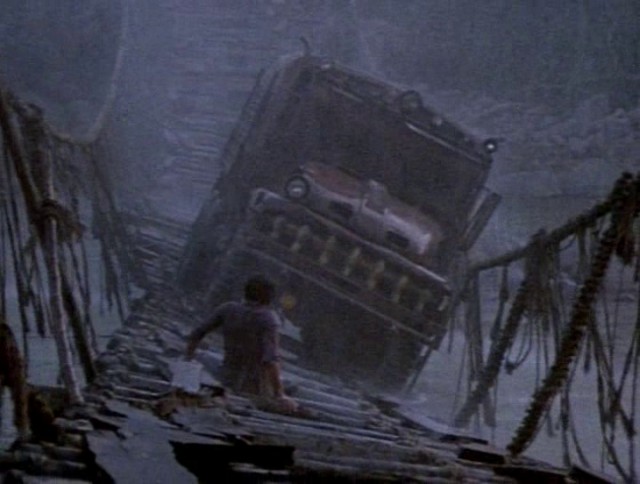
Harrowing bridge crossing is one of the most suspenseful scenes ever caught on film
What began as a dream project — Friedkin was pretty much given carte blanche by the studio, and he initially had his ideal cast lined up, consisting of Steve McQueen, Marcello Mastroianni, Lino Ventura, and Amidou — quickly turned into a nightmare as the cast changed, location problems flared up, a cinematographer had to be fired because of improper lighting, a narc forced Friedkin to get rid of some drug-using crew members, “Marvin the Torch” had to be called in to help with an explosion, and malaria ran rampant, as did the budget. When the film was finally released in June 1977, it got lost in all the Star Wars hoopla, resulting in a critical and box-office failure that shattered Friedkin, whose next three films were The Brink’s Job, Cruising, and Deal of the Century. But Friedkin has always stood behind Sorcerer: “I had persevered to make a film that I would want to see,” he wrote in his memoir, “a relentless existential voyage that would become my legacy.” After fighting for the rights to the film, he supervised a digital restoration that confirms the film as a towering achievement, a gripping, intense work of suspense that digs deep into the soul. Scheider, who was nominated for a Best Supporting Actor Oscar for The French Connection and then was extremely upset when Friedkin refused to cast him as Father Damien in The Exorcist, gives an extraordinary performance as Jackie Scanlon, a New Jersey Irish gang member now going by the name Juan Dominguez, ready to do whatever it takes to get out of the hell he is in. Friedkin and editor Bud Smith cut the film to match Tangerine Dream’s electronic score — the German group wrote the music to the script, without seeing a single frame of the finished product — creating an intense pace that never lets up. The digital restoration, which premiered at the Venice International Film Festival, was just released on Blu-ray and DVD, and is currently playing at Film Forum, restores Friedkin’s Sorcerer legacy, as critics and audiences reevaluate it as a remarkable triumph after all these years. The title is still terrible and the final scene highly questionable, but Sorcerer is an unforgettable, powerfully realistic work of magic.
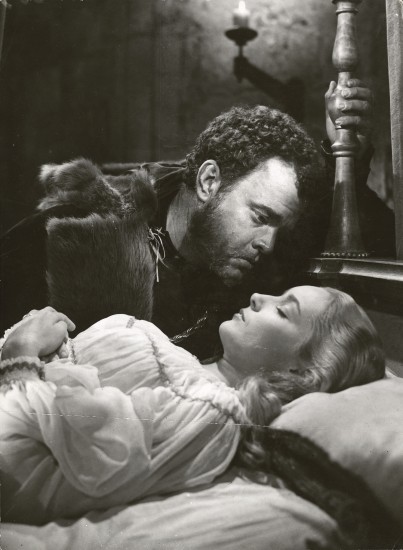
 Filmed in black-and-white over three years in multiple locations and ultimately employing five cinematographers, four editors, three Desdemonas, and two scores, it’s rather amazing that Orson Welles’s 1952 independent production of William Shakespeare’s Othello was ever completed — of course, many Welles projects were not. That the final work turned out to be a masterpiece that won the Palme d’Or at Cannes speaks yet more to Welles’s genius. A newly restored version of Othello is in the midst of a two week-run at Film Forum, in conjunction with “Celebrate Shakespeare 2014!,” a worldwide festival honoring the Bard’s 450th birthday. Welles, who directed the picture and plays the title character, streamlined the story into ninety-five minutes, getting to the heart of the most intense tale of jealousy and betrayal ever told. The film opens with shadowy shots of the dead Othello and his deceased wife, Desdemona (Suzanne Cloutier), carried aloft on biers at their dual funeral, to the sounds of an ominous piano and a mournful vocal chorus. The credits soon follow, after which Welles returns to the beginning, as the villainous ensign Iago (Micheál MacLiammóir) plots with Roderigo (Robert Coote) to convince Othello that his loyal and devoted wife is actually in love with the heroic soldier Michael Cassio (Michael Laurence).
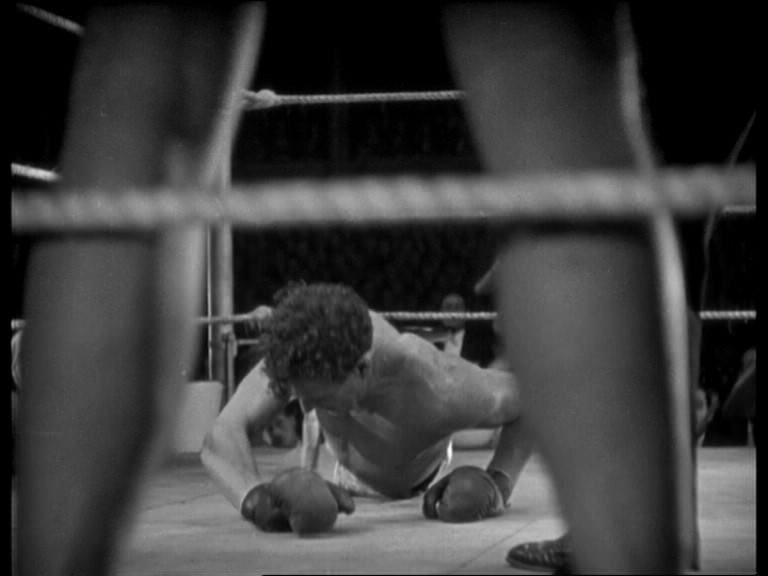
 When one thinks of Alfred Hitchcock, such psychological thrillers as North by Northwest, Psycho, Vertigo, Notorious, and Rear Window come to mind, not The Manxman, Easy Virtue, The Pleasure Garden, and The Farmer’s Wife. But it is these early, British silent films that are the focus of Film Forum’s “The Hitchcock 9,” which is part of the larger series “The Complete Hitchcock,” consisting of every other picture Sir Alfred made, including those abovementioned films. The dual festival features DCP restorations of nine romantic melodramas made by the Master of Suspense, each one with live musical accompaniment by pianist Steve Sterner. The series continues with 1927’s The Ring, a tantalizing tale of a love triangle set in the world of boxing, a favorite sport of Hitchcock’s. When Bob Corby (Ian Hunter) shows up at a county fair and takes a liking to Mabel (Lillian Hall-Davis), who sells tickets to see her fiance, “One-Round” Jack Sander (Carl Brisson), battle all comers for a cash prize, Corby decides to get in the ring with Sander to impress Mabel; little do they know that Corby is a professional. Soon the two men are also fighting outside the ring, to win the heart of their beloved. Comic relief is supplied by Gordon Harker as Jack’s trainer, who makes some very funny faces throughout. One can see Hitchcock’s visual style emerging in The Ring, as he employs little dialogue in favor of dramatic montages, ghostly superimpositions, and shadowy lighting. The intriguing work, produced at Elstree Studios and the first film to be released by Gainsborough Pictures, also deals with issues of class and financial success, themes that will become prevalent in much of Hitchcock’s oeuvre.
 Winner of the Un Certain Regard prize at Cannes and nominated for a Best Foreign Language Film Academy Award, Rithy Panh’s The Missing Picture is a brilliantly rendered look back at the director’s childhood in Cambodia just as Pol Pot and the Khmer Rouge began their reign of terror in the mid-1970s. “I seek my childhood like a lost picture, or rather it seeks me,” narrator Randal Douc says in French, reciting darkly poetic and intimately personal text written by author Christophe Bataille (Annam) based on Panh’s life. Born in Phnom Penh in 1964, Panh, who has made such previous documentaries about his native country as S21, The Khmer Rouge Killing Machine and Duch, Master of the Forges of Hell and wrote the 2012 book L’élimination with Bataille, was faced with a major challenge in telling his story; although he found remarkable archival footage of the communist Angkar regime, there are precious few photographs or home movies of his family and the community where he grew up. So he had sculptor Sarith Mang hand-carve and paint wooden figurines that Panh placed in dioramas to detail what happened to his friends, relatives, and neighbors. Panh’s camera hovers over and zooms into the dioramas, bringing these people, who exist primarily only in memory, to vivid life. When people disappear, Panh depicts their carved representatives flying through the sky, as if finally achieving freedom amid all the horrors. He delves into the Angkar’s propaganda movement and sloganeering — the “great leap forward,” spread through film and other methods — as the rulers sent young men and women into forced labor camps. “With film too, the harvests are glorious,” Douc states as women are shown, in black-and-white, working in the fields. “There is grain. There are the calm, determined faces. Like a painting. A poem. At last I see the Revolution they so promised us. It exists only on film.” It’s a stark comparison to cinematographer Prum Mésa’s modern-day shots of the wind blowing through lush green fields, devoid of people.
 Loosely based on a Noël Coward play that was recently made into a film starring Colin Firth, Jessica Biel, and Kristin Scott Thomas, Alfred Hitchcock’s Easy Virtue is another of the Master of Suspense’s cleverly told melodramas, a risqué tale of a woman unfairly placed in a lurid situation. Isabel Jeans stars as Larita Filton, a loving wife whose husband, Aubrey (Franklin Dyall), has commissioned her portrait by painter Claude Robson (Eric Bransby Williams). Just as Claude makes a play for Larita, she fights him off and Aubrey walks in. He misinterprets the scene, shots ring out, the artist is dead, and Claude files for a highly publicized divorce case in which Larita is found guilty of misconduct. Trying to put her notorious past behind her, she heads for the Mediterranean, where she meets John Whittaker (Robin Irvine), a wealthy mama’s boy who falls instantly in love with her and brings her back to his parents’ country estate. But once there, Whittaker’s nasty mother (Violet Farebrother) and conniving sisters (Dacia Deane and Dorothy Boyd) do everything they can to ruin the relationship, seeking to uncover Larita’s history while also attempting to put her son back together with longtime family friend Sarah (Enid Stamp Taylor). Easy Virtue, which features yet another Hitchcock blonde, is a gripping film about honesty, reputation, individuality, and character as an innocent woman is forced to face undeserved consequences in the superficial world of high society. Hitchcock, who makes his cameo holding a walking stick, gliding past Larita while she sits by a tennis court, includes several wonderful touches involving circles and ovals, from a close-up of a judge’s wig to a shot through a tennis racket’s strings to a dining room dominated by a group of elongated, haloed saints on one wall. Easy Virtue is also one of Hitchcock’s dourest silent melodramas, lacking any comic relief as a wronged woman desperately tries to right her life. Easy Virtue is screening on March 4 at 6:45 as part of the Film Forum series “The Hitchcock 9,” with live piano music by Steve Sterner. “The Hitchcock 9” continues through May 4 with Blackmail, The Pleasure Garden, Champagne, The Farmer’s Wife, The Ring, Downhill, and The Manxman (all featuring Sterner on piano), in conjunction with “The Complete Hitchcock,” which runs through March 27 and includes all of Sir Alfred’s feature narratives. In addition, the Paley Center will be hosting