Tag Archives: film forum

IRIS

(photo courtesy Magnolia Pictures)

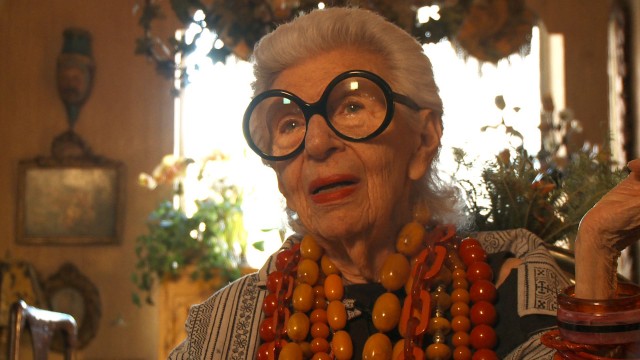
Iris Apfel shows off her unique and influential fashion sense in Albert Maysles documentary (photo courtesy Magnolia Pictures)

IRIS (Albert Maysles, 2014)
Film Forum, 209 West Houston St., 212-727-8110
Lincoln Plaza Cinema, 1886 Broadway between 62nd & 63rd Sts., 212-757-2280
Opens Wednesday, April 29
www.magpictures.com
mayslesfilms.com

“I like individuality,” self-described “geriatric starlet” and nonagenarian fashion doyenne Iris Apfel says at the beginning of octogenarian Albert Maysles’s penultimate film, Iris. “It’s so lost these days. There’s so much sameness. Everything is homogenized. I hate it. Whatever.” Iris celebrates that individuality, not only Apfel’s, who at ninety-three is still active in the fashion world, but Maysles’s, who passed away in March at the age of eighty-eight, leaving behind a legendary legacy that changed the face of documentary cinema, including such classics as Salesman, Grey Gardens, and Gimme Shelter. Throughout the film, Apfel speaks directly to Maysles, who ends up on camera several times, breaking that once-impenetrable fourth wall that he, his brother, David, and their partner, Charlotte Zwerin, helped tear down years ago. Maysles spent four years filming the Queens-born Apfel as she shared her lovely story, growing from an interior designer and textile-business owner to a world-renowned fashion collector, tastemaker, and rule breaker, accompanied all along the way by her husband of more than sixty-six years, Carl. Maysles shows Iris, in her trademark enormous circular-framed glasses and unique, colorful ensembles that mix designer clothing with a healthy dose of inexpensive accessories, as she bargains at a cheap local store, advises women at a special Loehmann’s event, prepares for her 2005 show at the Metropolitan Museum of Art’s Costume Institute, hawks her jewelry line on the Home Shopping Network, works on a window display at Bergdorf Goodman, and talks fashion with Martha Stewart, Tavi Gevinson, and others. Maysles interviews such designers as Alexis Bittar, Duro Olowu, Naeem Khan, and Dries van Noten, Met curator Harold Koda, Architectural Digest editor in chief Margaret Russell, and J. Crew head Jenna Lyons, who have only the most kind and generous things to say about the always positive Apfel, who has a genuine love of life. “It’s better to be happy than well dressed,” she tells friend and photographer Bruce Weber.

(photo courtesy of Magnolia Pictures)

Nonagenarian Iris Apfel and octogenarian Albert Maysles display a love of life in IRIS (photo courtesy of Magnolia Pictures)

Maysles also explores the Apfels’ inspiring relationship, filled with humor, a love of collecting knickknacks and tchotchkes (strewn about their cluttered apartment), and an infectious yen for trying anything and everything that life has to offer. The film concludes with Carl’s one-hundredth birthday party. Early on, Iris tells a story about one of her first jobs, toiling for Frieda Loehmann in Brooklyn. “One day she called me over and she said, ‘Young lady, I’ve been watching you.’ She said, ‘You’re not pretty, and you’ll never be pretty, but it doesn’t matter. You have something much better. You have style.’” Iris indeed has style, as this wonderful documentary extols, a marvelous tribute both to her and Carl as well as Albert Maysles. Who needs pretty when something this beautiful is what emerges? Iris opens April 29 at Lincoln Plaza and Film Forum, where it will be preceded by Vivian Ostrovsky’s fashion short, Losing the Thread. Producers Laura Coxson and Rebekah Maysles, one of Albert’s children, will be at Film Forum for the 6:20 show on April 29, while Iris herself will participate in a Q&A following the 6:20 screening on May 1 and will then introduce the 8:20 show.
STRICTLY STURGES: THE PALM BEACH STORY & THE LADY EVE

THE LADY EVE

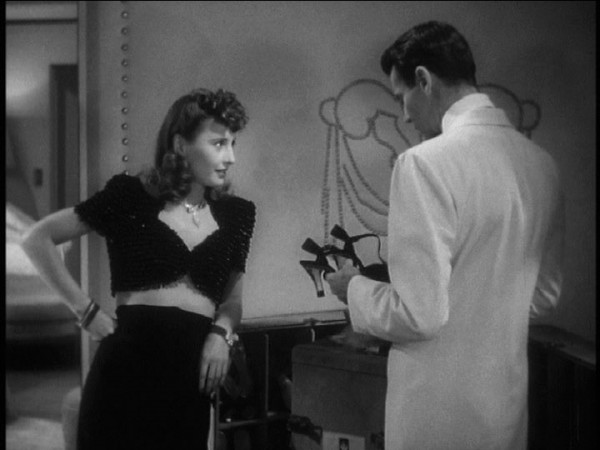
Barbara Stanwyck lures Henry Fonda into her alluring trap in THE LADY EVE

THE LADY EVE (Preston Sturges, 1941) / THE PALM BEACH STORY (Preston Sturges, 1942)
Film Forum
209 West Houston St.
Friday, April 17, and Saturday, April 18
Series runs through April 26
212-727-8110
filmforum.org

While it’s often lumped in with classic screwball comedies, Preston Sturges’s The Lady Eve is much darker and slower than its supposed brethren. An alluring, tough-talking Barbara Stanwyck is first seen as Jean Harrington, a con artist looking to trick a wealthy man on a cruise ship. At her side is her father, “Colonel” Harrington (Charles Coburn), a gambler and a cheat. As soon as Jean sees rich ale scion Charles Pike (a wonderfully innocent Henry Fonda), she digs her claws into the shy, humble man, challenging the Hays Code as she shows off her gams and leans into him with a heart-pounding sexiness. Pike, of course, falls for her, but when his right-hand man, Muggsy (William Demarest), discovers that she regularly preys on suckers, Charles is devastated. However, in this case, Jean’s feelings might actually be real, forcing her to go to extreme circumstances to try to get him back. Stanwyck is, well, a ball of fire as Jean/Eve, determined to win at all costs. Fonda, not usually known for his comedic abilities, is a riot as poor Hopsie, as Jean calls him; the looks on his face when she ratchets up the sex appeal are priceless, and a later scene when he keeps falling down at a party displays a surprising flair for physical comedy. The film was based on an original story by Irish playwright Monckton Hoffe, who was nominated for an Oscar. The opening and closing credits feature a corny animated snake in the Garden of Eden; in The Lady Eve, Stanwyck offers the apple, and Fonda can’t wait to take a bite. And there’s nothing shameful about that.

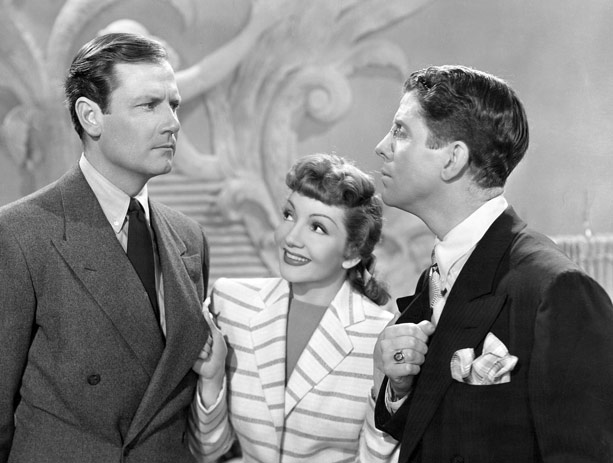
Joel McCrea, Claudette Colbert, and Rudy Vallée are caught up in a romantic triangle in Preston Sturges’s THE PALM BEACH STORY

Writer-director Sturges was on quite a roll in the early 1940s, making a string of memorable pictures that included The Great McGinty, Christmas in July, Sullivan’s Travels, Hail the Conquering Hero, The Miracle of Morgan’s Creek, and The Lady Eve. In the midst of that amazing run is The Palm Beach Story, one of the craziest of the classic screwball comedies. Running out of money, married couple Tom (Joel McCrea) and Geraldine Jeffers (Claudette Colbert) are preparing to leave their ritzy Park Ave. apartment until a straight-talking, shriveled old wienie king (Robert Dudley) hands Gerry a wad of cash so she doesn’t have to move out. She pays off their many bills, but Tom is suspicious of how she got the money, demanding to know if any sex was involved, a rather risqué question for a 1942 Hays Code-era romantic comedy. Gerry decides that she is no good for Tom and insists on getting a divorce even though they still love each other. So she grabs a train to Florida, meeting the wacky Ale & Quail Club and John D. Hackensacker III (Rudy Vallée), a kind, soft-spoken gentleman who takes a liking to her and helps her out of a jam. Things reach a manic pace as Tom heads to Palm Beach as well, trying to save the marriage while fending off the advances of the Princess Centimillia (Mary Astor). McCrea and Colbert make a great comic duo, displaying a fiery sex appeal that is still hot all these years later. What’s not hot is the film’s use of black characters, who are horribly stereotyped and are even referred to as “colored” in the credits. It might have been a different time, but there aren’t a whole lot of quality movies that were that blatant about it. In addition, the shooting scene with the Ale & Quail Club goes way over the top. But when the film focuses on Tom and Gerry, caught up in their own endlessly charming game of cat and mouse, The Palm Beach Story shines. A double feature of The Lady Eve and The Palm Beach Story is playing Film Forum on April 17 & 18 as part of “Strictly Sturges,” a two-week series, continuing through April 26, that celebrates the career of the playwright, screenwriter, and director who was born Edmund Preston Biden in Chicago in 1895 and passed away in New York City in 1959. The festival consists of all of his directorial and screenwriting efforts; among the other upcoming double features are The Miracle of Morgan’s Creek and Hail the Conquering Hero, Mad Wednesday and Never Say Die, and The Great McGinty and The Great Moment, in addition to solo screenings of Christmas in July, Sullivan’s Travels, If I Were King, and others.

DIOR AND I

Documentary follows Raf Simons as he becomes new creative director of Christian Dior

Documentary follows Raf Simons as he becomes new creative director of Christian Dior

DIOR AND I (Frédéric Tcheng, 2014)
Film Forum, 209 West Houston St., 212-727-8110
Film Society of Lincoln Center, Walter Reade Theater, 165 West 65th St., 212-875-5601
Opens Friday, April 10
www.diorandimovie.com

After working on two previous fashion-related films, Diana Vreeland: The Eye Has to Travel and Valentino: The Last Emperor, Frédéric Tcheng makes his solo directorial debut with Dior and I. In April 2012, fashion designer Raf Simons was named the new creative director of Christian Dior, bringing along his right-hand man, Pieter Mulier. Tcheng goes behind the scenes to follow Simons as he prepares his first-ever haute couture collection, which is due in a mere two months. Tcheng zooms in on the Belgian designer’s working methods and general anxiety as he takes over at the legendary company, developing important relationships with Dior CEO Sidney Toledano, première atelier flou Florence Chehet, première atelier tailleur Monique Bailly, the seamstresses, the models, and other employees. Simons chooses to pay homage to Dior’s past with his new collection while attempting to rid himself of the designation of “minimalist designer.” One of his most fascinating directions is attempting to incorporate the work of artist Sterling Ruby into his designs. All the while he is haunted by the ghost of company founder and New Look creator Christian Dior, who is shown by Tcheng in archival footage accompanied by a voice-over of Omar Berrada reading from Dior’s memoirs. Dior and I is a slight but affecting race against time, as one man in the present honors the past while laying the groundwork for a bright future. Dior and I opens April 10 at Film Forum and the Film Society of Lincoln Center, with Tcheng and Berrada appearing at Film Forum for the 7:30 show April 10 and the 5:20 show April 11; Tcheng will also be at the Walter Reade Theater for a Q&A following the 7:00 show April 11.
ABOUT ELLY

ABOUT ELLY

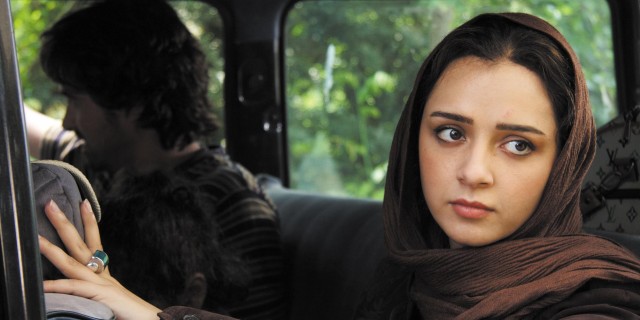
An uneasy Elly (Taraneh Alidoosti) is hiding something in Asghar Farhadi’s shattering ABOUT ELLY

ABOUT ELLY (DARBÂREYE ELI) (Asghar Farhadi, 2009)
Film Forum
209 West Houston St.
April 8-21, 12:45, 3:15, 6:45, 9:15
212-727-8110
filmforum.org
www.cinemaguild.com

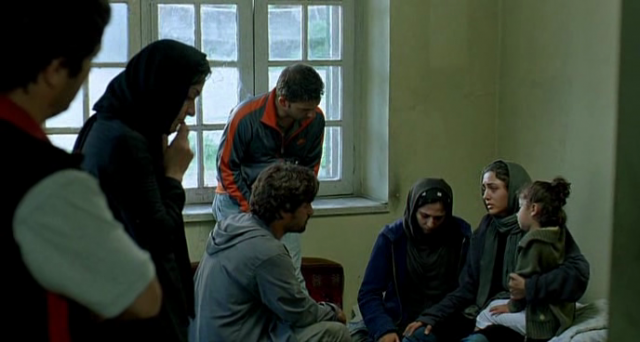
“A bitter ending is better than an endless bitterness,” Ahmad (Shahab Hosseini) tells Elly (Taraneh Alidoosti) in Asghar Farhadi’s shattering, masterful 2009 drama, About Elly. Iranian writer-director Farhadi, whose A Separation was named Best Foreign Language Film at the 2012 Oscars — the film also earned him an Academy Award nomination for Best Original Screenplay — won the Silver Bear for Best Director at the 2009 Berlinale for About Elly, which also nabbed Best Picture at the 2009 Tribeca Film Festival. But rights issues have held up its U.S. theatrical release, depriving American audiences of a chance to see the work. Now that the film is finally opening here, beginning a two-week run at Film Forum on April 8 in a new 35mm print, the story of the film’s distribution is no longer bitter, but the searing tale itself couldn’t be more harrowingly acerbic. A group of upper-middle-class law school friends have come to a Caspian Sea villa from Tehran for a getaway weekend organized by Sepideh (Golshifteh Farahani), who has brought along Elly, her daughter’s teacher, as a potential love match for the recently divorced Ahmad, who has been living in Germany. Because of a scheduling snafu, they have to stay in a seaside house in desperate need of renovation, but the friends just go with the flow, singing and dancing and making the best of the awkward situation. But the playful atmosphere turns sour when tragedy strikes, leaving everyone to reexamine who they are.

ABOUT ELLY

A group of friends has to face some hard truths during vacation gone terribly wrong

About Elly is a gripping, deeply thoughtful, and intensely intelligent exploration of class, romance, responsibility, culture, family, and, perhaps most of all, honesty in contemporary Iranian society. Although the film evokes such works as Michelangelo Antonioni’s L’Avventura and François Ozon’s Under the Sand, Farhadi (The Past, Fireworks Wednesday) infuses it with a profound sense of realism, involving the audience in its intricate, intimate mystery. You’ll feel like you’re on the beach with the friends, facing the same agonizing decisions. Shot in a naturalistic style by cinematographer Hossein Jafarian, About Elly takes place in a ramshackle vacation house, designed by Farhadi, that doubles for the characters’ psyche, with its broken windows, stuck doors, and lack of privacy. The scene in which a young boy goes missing in the ocean is as terrifying as it is heart-rending, a breathless extended sequence of events that feels like it will never let up. And indeed, the powerful emotions continue through the rest of the film — and will stay with you long after. The outstanding cast also includes Mani Haghighi as Amir, Sepideh’s husband; Peyman Moaadi and Merila Zarei as Peyman and Shohreh, the parents of the boy; and Ahmad Mehranfar and Rana Azadivar as another couple caught up in the tragedy. Fingers are pointed, bonds are tested, and relationships are fractured forever in Farhadi’s exquisite jewel of a film.

LA SAPIENZA

LA SAPIENZA

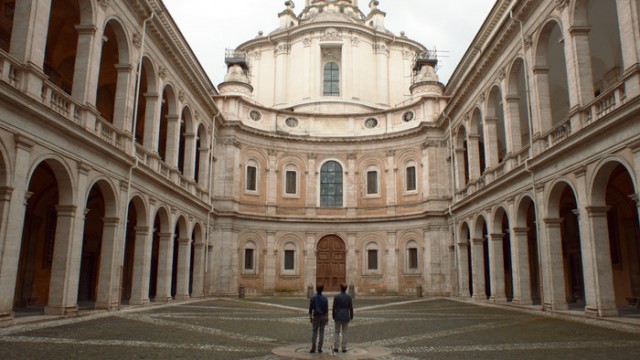
LA SAPIENZA feature glorious sights and sounds as a couple tries to rekindle their spark

LA SAPIENZA (THE SAPIENCE) (Eugène Green, 2014)
Film Forum
209 West Houston St.
March 27 – April 9
212-727-8110
filmforum.org

New York City-born French filmmaker Eugène Green equates humanity and architecture in the lush, rich film La Sapienza. Named for the concept of gaining wisdom as well as Italian architect Francesco Borromini’s seventeenth-century Roman Catholic Baroque church Sant’Ivo alla Sapienza, the film follows an older couple who rediscover their personal and professional passion after meeting a young pair of siblings. Architect Alexandre Schmidt (Fabrizio Rongione) and his wife, sociologist Aliénor (Christelle Prot Landman), are walking through a park in Switzerland when they see a teenage girl (Arianna Nastro) nearly collapse into the arms of a slightly older boy (Ludovico Succio). It turns out that Lavinia is suffering from incapacitating dizzy spells and is cared for by her brother, Goffredo, who is interested in studying architecture. Aliénor becomes involved in Lavinia’s situation while Alexandre, an intense, cynical man, returns to the book he is writing on Borromini (who famously worked in the shadow of Bernini) and travels to Italy with Goffredo as the boy’s reluctant mentor. Green’s (Toutes les nuits, Le monde vivant) first digital feature opens with the glorious sounds of Claudio Monteverdi accompanying cinematographer Raphaël O’Byrne’s magisterial shots of statuary and architecture in Rome. The acting at the start, particularly Rongione’s, is purposefully stiff and mannered, cold and stonelike, but it warms up as the characters learn (or relearn) about the myriad possibilities life offers. Green, who also appears in the film as the grizzled Chaldean, uses the metaphor of Baroque architecture’s role in the Counter-Reformation as a symbol for Alexandre and Aliénor’s relationship, as they finally face long-held emotions and reconsider their future, all while Green lingers on magnificent structures.

CHARLES LAUGHTON

Charles Laughton series at Film Forum actually deserves a big thumbs-up

Charles Laughton series at Film Forum actually deserves a big thumbs-up

Who: Charles Laughton
What: Three-week retrospective
Where: Film Forum, 209 West Houston St., 212-727-8110
When: Daily through February 26
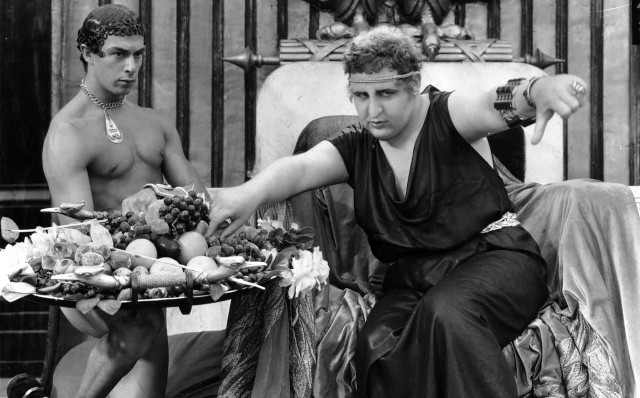
Why: We might have learned just a little too much about English stage and screen actor and director Charles Laughton from Scotty Bowers’s 2012 tell all, Full Service: My Adventures in Hollywood and the Secret Sex Lives of the Stars, so it’s probably best to keep what we know about Laughton to his legendary career, which is being celebrated at Film Forum with a wide-ranging retrospective through February 26. The series continues Monday night with E. A. Dupont’s 1929 silent Piccadilly (with live piano accompaniment by Steve Sterner), in which Laughton has a cameo as a nightclub diner, followed on Tuesday by Lewis Milestone’s Arch of Triumph, with Charles Boyer and Ingrid Bergman, and a double feature of Henry Koster’s romantic comedy It Started with Eve and Richard Wallace’s theater-set Because of Him. Wednesday pairs Robert Z. Leonard’s crime film The Bribe, which stars Laughton and Robert Taylor, Ava Gardner, and Vincent Price, with Burgess Meredith’s The Man on the Eiffel Tower, in which Laughton plays George Simenon’s Inspector Maigret. The festival concludes on Thursday with Laughton as Nero in Cecil B. DeMille’s 1932 epic The Sign of the Cross, as South Carolina senator Seabright Cooley in Otto Preminger’s Advise and Consent, Laughton’s last film, and his lone solo directorial effort, the gripping thriller The Night of the Hunter.

ORSON WELLES 100: THE LADY FROM SHANGHAI & THE THIRD MAN

Orson Welles

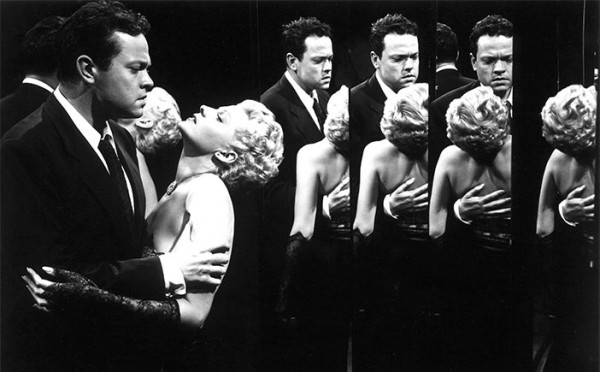
Orson Welles and Rita Hayworth get caught up in romantic intrigue in THE LADY FROM SHANGHAI

THE LADY FROM SHANGHAI (Orson Welles, 1947)
Film Forum
209 West Houston St.
Friday, January 23, and Saturday, January 24, 2:40, 6:35, 10:30
“Orson Welles 100” continues through February 3
212-727-8110
www.filmforum.org

Film Forum’s “Orson Welles 100” festival, a wide-ranging celebration of the centennial of the iconoclastic auteur’s birth, continues with another terrific double feature on January 23-24. In 1947, Welles followed up the creepy black-and-white Holocaust thriller The Stranger with The Lady from Shanghai, a colorful, in-your-face noir about a rogue Irish sea captain and the gorgeous wife of a crippled rich man. Welles plays the shifty seaman, Michael O’Hara, with an in-and-out Irish accent; his estranged wife, Rita Hayworth, is simply breathtaking as the femme fatale, Elsa “Rosalie” Bannister; Everett Sloane is terrifically annoying as Elsa’s husband, wealthy lawyer Arthur Bannister; and Glenn Anders shows off one of the great all-time voices as Grisby, Bannister’s unsuspecting partner. Like The Stranger, the film suffers from awkward moments — Welles famously fought with studio head Harry Cohn over the editing and various stylistic touches — but even as minor Welles it’s an awful lot of fun. Columbia wanted Welles to make sure to show off Hayworth’s beauty, which had recently been on display in such hits as Gilda and Cover Girl, so he goes way overboard here, changing her hair color and zooming in far too close far too often. Based on Sherwood King’s novel If I Die Before I Wake, The Lady from Shanghai is a wicked tale of crime and corruption, lust and revenge. “Talk of money and murder,” O’Hara says at one point. “I must be insane, or else all these people are lunatics.” In another scene, Elsa says to him, “I’m not what you think I am. I just try to be like that.” The film is worth seeing for the spectacular ending alone, which takes place in a funhouse hall of mirrors.
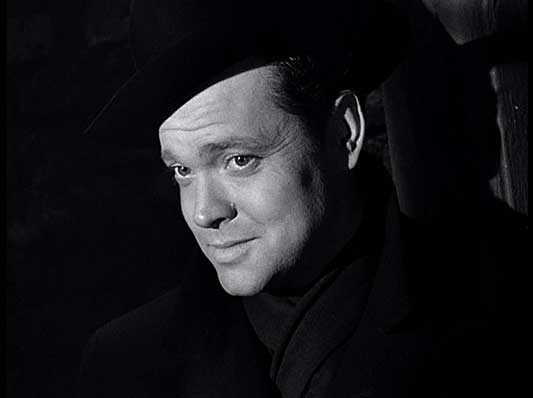
Orson Welles makes one of the greatest entrances in film history in THE THIRD MAN

THE THIRD MAN (Carol Reed, 1949)
Film Forum
209 West Houston St.
Friday, January 23, and Saturday, January 24, 12:35, 4:30, 8:25
“Orson Welles 100” continues through February 3
212-727-8110
www.filmforum.org

Carol Reed’s thriller is quite simply the most entertaining film you’re ever likely to see, the best Orson Welles film not directed by the man who gave us Citizen Kane and The Magnificent Ambersons. Set in a divided post-WWII Vienna amid a thriving black market, The Third Man is heavy in atmosphere, untrustworthy characters, and sly humor, with a marvelous zither score by Anton Karas. Joseph Cotten stars as Holly Martins, an American writer of Western paperbacks who has come to Vienna to see his old friend Harry Lime (Welles), but he seems to have shown up a little late. While trying to find out what happened to Harry, Martins falls for Harry’s lover, Anna (Alida Valli); is told to get out of town by Major Calloway (Trevor Howard) and Sergeant Paine (Bernard “M” Lee); meets a stream of Harry’s more interesting, mysterious friends, including Baron Kurtz (Ernst Deutsch) and Popescu (Siegfried Breuer); and is talked into giving a lecture to a literary club by old Mr. Crabbin (Wilfrid Hyde-White). Every scene is a finely honed work of art, filled with long shadows, echoing footsteps, dripping water, and unforgettable dialogue about cuckoo clocks and other strangeness. SPOILER: The shot in which Lime is first revealed, standing in a doorway, a cat brushing by his feet, his tongue firmly in cheek as he lets go a miraculous, knowing smile, is one of the greatest single moments in the history of cinema. “Orson Welles 100” continues through February 3 with such other gems as Othello, Macbeth, Chimes at Midnight, and A Man for All Seasons as well as such rarities as It’s All True and Too Much Johnsons.