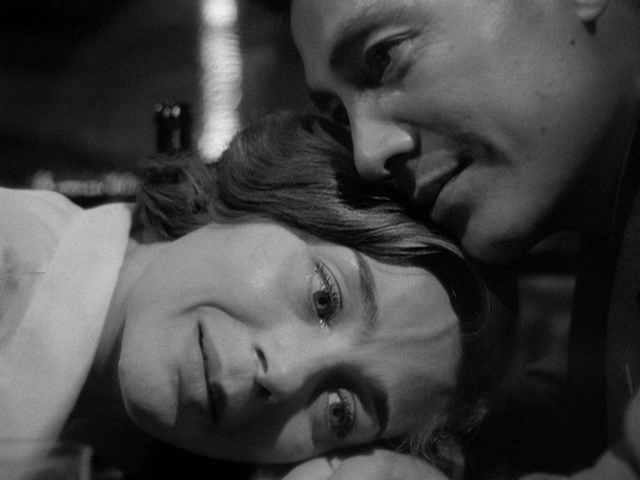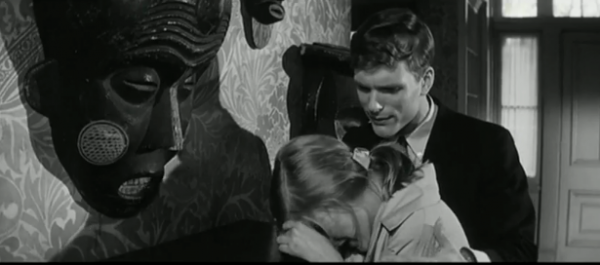
Stephen (Keir Dullea) tries to comfort his sister, Ann (Carol Lynley), in BUNNY LAKE IS MISSING
BUNNY LAKE IS MISSING (Otto Preminger, 1965)
Film Forum
209 West Houston St.
Sunday, September 20, $7, 5:30
212-727-8110
filmforum.org
 “I had heard all the rumors about Preminger, but I felt he wouldn’t do that to me. I was wrong, oh so wrong,” Keir Dullea told Foster Hirsch in the 2007 biography Otto Preminger: The Man Who Would Be King, referring to the making of the 1965 psychological noir thriller Bunny Lake Is Missing and Otto Preminger’s notorious treatment of actors. “I was playing a crazy character and the director was driving me crazy. . . . About halfway through the shoot, I began to wonder, Who do you have to f&ck to get off this picture?” On September 20, Dullea and Hirsch will be at Film Forum for a one-time-only screening of the fiftieth anniversary 4K digital restoration of Bunny Lake, which will be introduced by Dullea (2001: A Space Odyssey, David and Lisa) and followed by a Q&A with the actor, moderated by Hirsch. In the intensely creepy film, loosely based on the novel by Merriam Modell (under the pseudonym Evelyn Piper), Carol Lynley stars as Ann Lake, a young woman who has just moved to London from New York. She drops off her daughter, Bunny, for her first day of school, but when she returns later to pick her up, there is no evidence that the girl was ever there. When Superintendent Newhouse (Laurence Olivier) and his right-hand man, Sergeant Andrews (Clive Revill), begin investigating the case, they are soon wondering whether Bunny really exists, more than hinting that she might be a figment of Ann’s imagination.
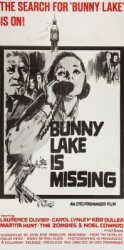
Television veteran Lynley, who seemed on the verge of stardom after appearing in such films as Return to Peyton Place, Bunny Lake Is Missing, Shock Treatment, and The Poseidon Adventure but never quite reached that next level, gives one of her best performances as Ann, a tortured woman who is determined to stop her world from unraveling around her. Dullea is a model of efficiency as the cold, direct Stephen, a character invented by Preminger and screenwriters John and Penelope Mortimer. Shot in black-and-white by Denys N. Coop on location in London, the film also features cameos by longtime English actors Martita Hunt, Anna Massey, and Finlay Currie as well as the rock group the Zombies and Noël Coward, who plays Ann’s very kooky landlord, Horatio Wilson. Saul Bass’s titles, in which a hand tears paper as if the story is being ripped from the headlines, set the tense mood right from the start. The ending offers some neat twists but is far too abrupt. “No actor ever peaked with him. How could you?” Dullea added to Hirsch about Preminger (Laura, Stalag 17). “The subtlety that I felt I was able to give to my work in 2001, because Stanley Kubrick created a safe atmosphere where actors were not afraid to be foolish or wrong, was missing on Otto’s set. I don’t hate him; it’s too long ago. But the experience was the most unpleasant I ever had.” It should be quite fascinating to hear more from Dullea and Hirsch at Film Forum on September 20.
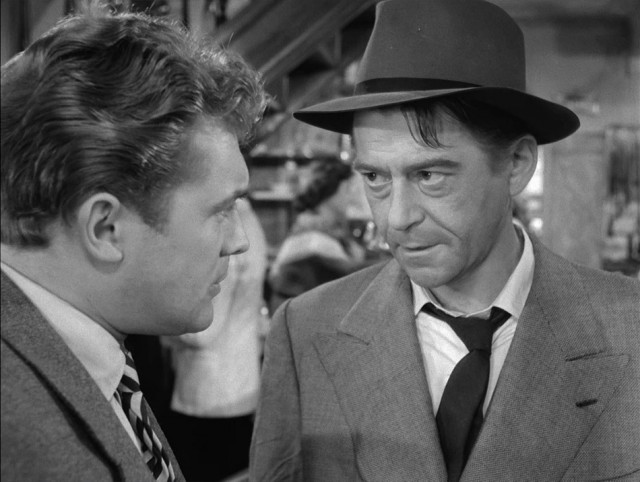
 After being blacklisted in Hollywood, American auteur Jules Dassin (The Naked City, Brute Force) headed to France, where he was hired to adapt Du Rififi Chez Les Hommes, a crime novel by Auguste le Breton that he made significant changes to, resulting in one of the all-time-great heist films. After spending five years in prison (perhaps not uncoincidentally, Dassin had not made a film in five years after Edward Dmytryk and Frank Tuttle declared him a communist to the House Un-American Activities Committee), Tony le Stephanois (Jean Servais) gets out and hooks up again with his old protégé, Jo le Suédois (Carl Möhner), who has settled down with his wife (Janine Darcy) and child (Dominique Maurin) for what was supposed to be a life of domestic tranquility. Joined by Mario Farrati (Robert Manuel), a fun-loving bon vivant with a very sexy girlfriend (Claude Sylvain), and cool and calm safecracker César le Milanais (Dassin, using the pseudonym Perlo Vita), the crew plans a heist of a small Mappin & Webb jewelry store on the Rue de Rivoli. Not content with a quick score, Tony lays the groundwork for a major take, but greed, lust, jealousy, and revenge get in the way in Dassin’s masterful film noir. The complex plan gets even more complicated as César falls for Viviane (Magali Noël), a singer who works at the L’Âge d’Or nightclub, which is owned by Pierre Grutter (Marcel Lupovici), who has taken up with Tony’s former squeeze, Mado (Marie Sabouret), and is trying to save his brother, Louis Grutter (Pierre Grasset), from a serious drug habit. (The club is named for Luis Buñuel’s 1930 film, which featured the same production designer as Rififi, Alexandre Trauner.)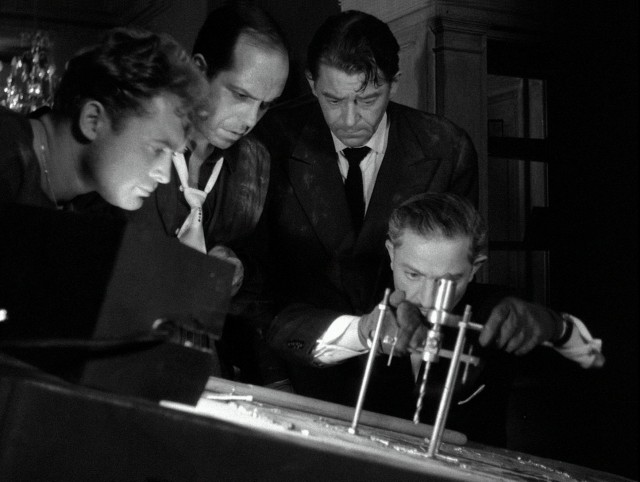
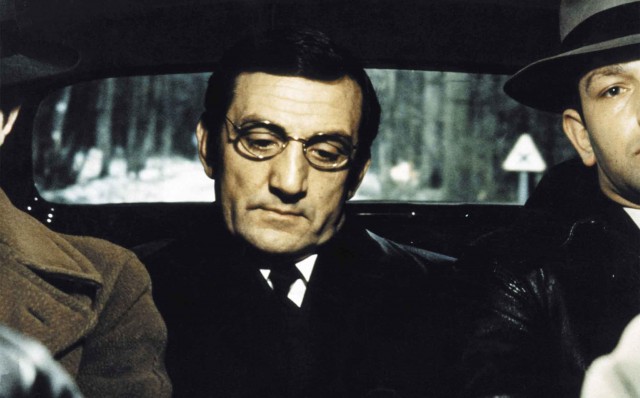
 Based on the novel by Joseph Kessel (Belle de Jour), Jean-Pierre Melville’s 1969 WWII drama Army of Shadows got its first theatrical release in America in 2006, in a restored 35mm print supervised by the film’s cinematographer, Pierre Lhomme, who shot it in a beautiful blue-gray palette. The film centers on a small group of French resistance fighters, including shadowy leader Luc Jardie (Paul Meurisse), the smart and determined Mathilde (Simone Signoret), the nervous Jean-François (Jean-Pierre Cassel), the steady and dependable Felix (Paul Crauchet), the stocky Le Bison (Christian Barbier), the well-named Le Masque (Claude Mann), and the unflappable and practical Gerbier (Lino Ventura). Although Melville, who was a resistance fighter as well, wants the film to be his personal masterpiece, he is too close to the material, leaving large gaps in the narrative and giving too much time to scenes that don’t deserve them. He took offense at the idea that he portrayed the group of fighters as gangsters, yet what shows up on the screen is often more film noir than war movie. However, there are some glorious sections of Army of Shadows, including Gerbier’s escape from a Vichy camp, the execution of a traitor to the cause, and a tense Mission: Impossible–like (the TV series, not the Tom Cruise vehicles) attempt to free the imprisoned Felix. But most of all there is Ventura, who gives an amazingly subtle performance that makes the overly long film (nearly two and a half hours) worth seeing all by itself. Army of Shadows is once again back at Film Forum for a special one-week return engagement August 26 – September 1.