Tag Archives: film forum

FORD TO CITY: DROP DEAD — NEW YORK IN THE 70s: THE LANDLORD

Young Elgar Winthrop Julius Enders’s (Beau Bridges) spoiled life of privilege is about to dramatically change in THE LANDLORD

Young Elgar Winthrop Julius Enders’s (Beau Bridges) spoiled life of privilege is about to dramatically change in The Landlord

THE LANDLORD (Hal Ashby, 1970)
Film Forum
209 West Houston St.
Sunday, July 23, 12:30, 4:30, and 8:30
Series runs through July 27
212-727-8110
filmforum.org

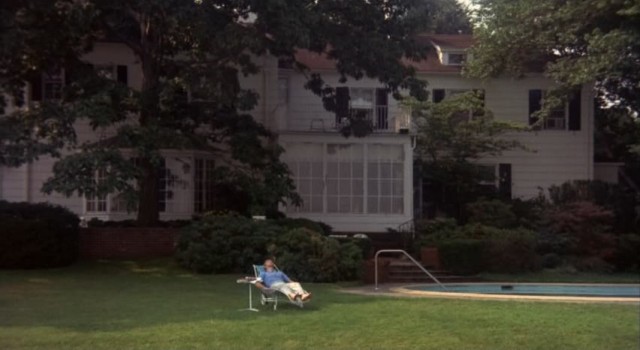
When rich kid Elgar Winthrop Julius Enders (Beau Bridges) finally decides to do something with his spoiled life of privilege, he takes a rather curious turn, buying a dilapidated tenement in a pregentrified Park Slope that resembles the South Bronx in Hal Ashby’s poignant directorial debut, The Landlord. At first, the less-than-worldly Elgar doesn’t quite know what he’s gotten himself into, believing it will be easy to kick out the current residents and then replace the decrepit building with luxury apartments. He pulls up to the place in his VW bug convertible, thinking he can just waltz in and do whatever he wants, but just as his car is vandalized, so is his previously charmed existence, as he gets to know wise house mother Marge (Pearl Bailey), the sexy Francine (Diana Sands), her activist husband, Copee (Louis Gossett Jr.), and Black Power professor Duboise (Melvin Stewart), none of whom is up-to-date with the rent. Meanwhile, Elgar starts dating Lanie (Marki Bey), a light-skinned half-black club dancer he assumed was white, infuriating his father, William (Walter Brooke), and mother, Joyce (a delightful, Oscar-nominated Lee Grant), who are in the process of setting up their daughter, Susan (Susan Anspach), with the white-bread Peter Coots (Robert Klein).
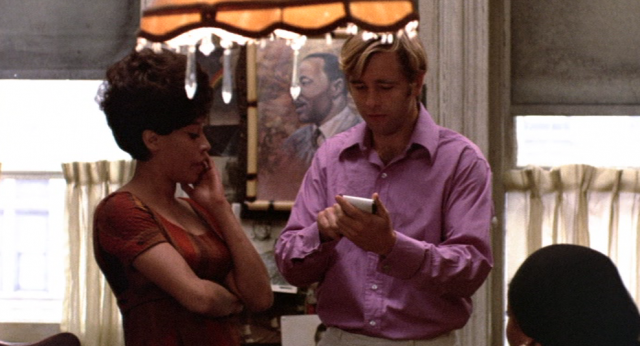
Elgar has a whole lot of learning to do in Hal Ashby’s New York City-set black comedy

Elgar has a whole lot of learning to do in Hal Ashby’s New York City–set black comedy

Based on the novel by Kristin Hunter, The Landlord is a telling microcosm of race relations and class conflict in a tumultuous period in the nation’s history, as well as that of New York City, coming shortly after the civil rights movement and the free-love late ’60s. The film is masterfully shot by Astoria-born cinematographer Gordon Willis (Klute, Annie Hall, Manhattan, all three Godfather movies), who sets the bright, open spaces of the Enderses’ massive estate against the dark, claustrophobic rooms of the dank tenement. Screenwriter Bill Gunn (Ganja and Hess) and Ashby avoid getting overly preachy in this at-times outrageous black comedy, incorporating slapstick along with some more tender moments; the scene in which Joyce meets Marge is a marvel of both. And just wait till you see Coots’s costume at a fancy fundraiser. The Landlord began quite a string for Ashby, who followed it up with Harold and Maude, The Last Detail, Shampoo, Bound for Glory, Coming Home, and Being There in a remarkable decade for the former film editor (In the Heat of the Night) who died in 1988 at the age of fifty-nine. The Landlord is screening July 23 at 12:30, 4:30, and 8:30 in Film Forum’s terrific “Ford to City: Drop Dead — New York in the 70s” series, which continues through July 27 with such other Gotham favorites as Taxi Driver, Midnight Cowboy, Saturday Night Fever, and Marathon Man and such inspired double features as Shaft and Super Fly, Across 110th Street and Cops and Robbers, Dressed to Kill and Death Wish, Three Days of the Condor and The Eyes of Laura Mars, and The Warriors and Escape from New York.

FORD TO CITY: DROP DEAD — NEW YORK IN THE 70s: NEWS FROM HOME

NEWS FROM HOME

Chantal Akerman combines footage of 1970s New York with letters from her mother in News from Home

NEWS FROM HOME (Chantal Akerman, 1977)
Film Forum
209 West Houston St.
Wednesday, July 19, 8:30, and Tuesday, July 25, 5:40
Series runs through July 27
212-727-8110
filmforum.org

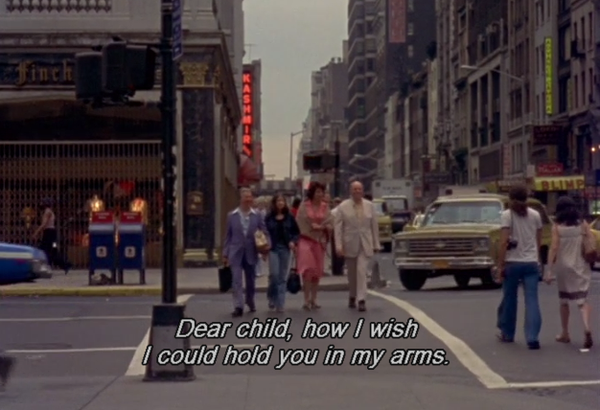
In 1971, twenty-year-old Chantal Akerman moved to New York City from her native Belgium, determined to become a filmmaker. Teaming up with cinematographer Babette Mangolte, she made several experimental films, including Hotel Monterey and La Chambre, before moving back to Belgium in 1973. But in 1976 she returned to New York City to make News from Home, a mesmerizing work about family and dislocation, themes that would be prevalent throughout her career. The film consists of long, mostly static shots, using natural sound and light, depicting a gray, dismal New York City as cars move slowly down narrow, seemingly abandoned streets, people ride the graffiti-laden subway, workers and tourists pack Fifth Ave., and the Staten Island Ferry leaves Lower Manhattan. The only spoken words occur when Akerman, in voice-over, reads letters from her mother, Natalia (Nelly) Akerman, sent during Chantal’s previous time in New York, concerned about her daughter’s welfare and safety. “I’m glad you don’t have that job anymore and that you’re liking New York,” Akerman reads in one letter. “People here are surprised. They say New York is terrible, inhuman. Perhaps they don’t really know it and are too quick to judge.” Her mother’s missives often chastise her for not writing back more often while also filling her in on the details of her family’s life, including her mother, father, and sister, Sylviane, as well as local gossip.
news from home

Although it was not meant to be a straightforward documentary, News from Home now stands as a mesmerizing time capsule of downtrodden 1970s New York, sometimes nearly unrecognizable when compared to the city of today. The film also casts another light on the relationship between mother and daughter, which was recently highlighted in Akerman’s final film, No Home Movie, in which Chantal attempts to get her mother, a Holocaust survivor, to open up about her experiences in Auschwitz. Nelly died shortly after filming, and Akerman committed suicide the following year, only a few months after No Home Movie played at several film festivals (and was booed at Locarno). News from Home takes on new meaning in light of Akerman’s end, a unique love letter to city and family and to how we maintained connections in a pre-internet world. News from Home is screening July 19 at 8:30 and July 25 at 5:40 in Film Forum’s terrific “Ford to City: Drop Dead — New York in the 70s” series, which continues through July 27 with such other Gotham favorites as Mean Streets, Gloria, All That Jazz, and Marathon Man and such inspired double features as Shaft and Super Fly, Across 110th Street and Cops and Robbers, Dressed to Kill and Death Wish, Three Days of the Condor and The Eyes of Laura Mars, and The Warriors and Escape from New York.

BRONX GOTHIC

(photo courtesy of Grasshopper Film)

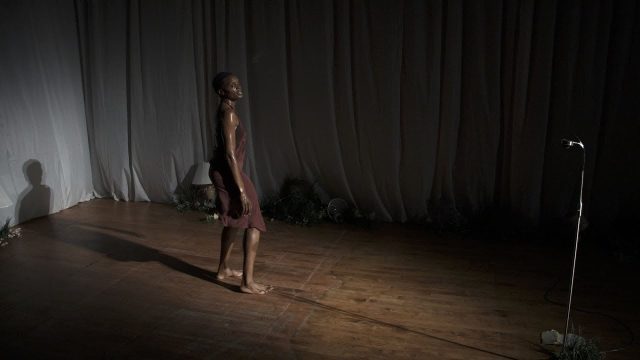
Okwui Okpokwasili takes viewers behind the scenes of her one-woman show in Bronx Gothic (photo courtesy of Grasshopper Film)

BRONX GOTHIC (Andrew Rossi, 2017)
Film Forum
209 West Houston St.
July 12-25
212-727-8110
www.filmforum.org
grasshopperfilm.com

“Okwui’s job is to scare people, just to scare them to get them to kind of wake up,” dancer, choreographer, and conceptualist Ralph Lemon says of his frequent collaborator and protégée Okwui Okpokwasili in the powerful new documentary Bronx Gothic. Directed by Okpokwasili’s longtime friend Andrew Rossi, the film follows Okpokwasili during the last three months of her tour for her semiautobiographical one-woman show, Bronx Gothic, a fierce, confrontational, yet heart-wrenching production that hits audiences right in the gut. Rossi cuts between scenes from the show — he attached an extra microphone to Okpokwasili’s body to create a stronger, more immediate effect on film — to Parkchester native Okpokwasili giving backstage insight, visiting her Nigerian-born, Bronx-based parents, and spending time with her husband, Peter Born, who directed and designed the show, and their young daughter, Umechi. The performance itself begins with Okpokwasili already moving at the rear of the stage, shaking and vibrating relentlessly, facing away from people as they filter in and take their seats. She continues those unnerving movements for nearly a half hour (onstage but not in the film) before finally turning around and approaching a mic stand, where she portrays a pair of eleven-year-old girls exchanging deeply personal notes, talking about dreams, sexuality, violence, and abuse as they seek their own identity. “Bronx Gothic is about two girls sharing secrets. . . . It is about the adolescent body going into a new body, inhabiting the body of a brown girl in a world that privileges whiteness,” Okpokwasili, whose other works include Poor People’s TV Room and the Bessie-winning Pent-Up: A Revenge Dance, explains in the film. National Medal of Arts recipient Lemon adds, “It’s about racism, gender politics — it’s not just about these two little black girls in the Bronx.” Rossi includes clips of Okpokwasili performing at MoMA in Lemon’s “On Line” in 2011, developing Bronx Gothic at residencies at Baryshnikov Arts Center and New York Live Arts, and participating in talkbacks at Alverno College in Milwaukee and the Bronx Academy of Arts and Dance, where the tour concluded, right next to her childhood church, which brings memories surging back to her.
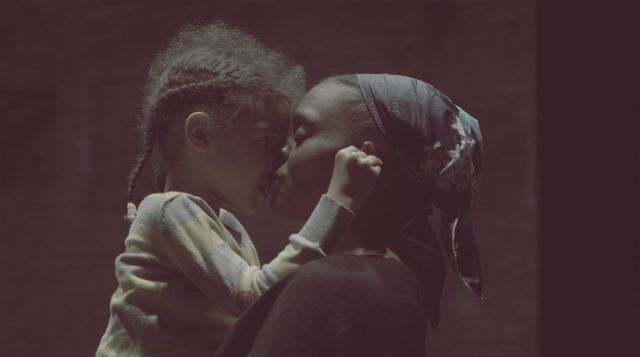

(photo courtesy of Grasshopper Film)

Okwui Okpokwasili nuzzles her daughter, Umechi, in poignant and timely documentary (photo courtesy of Grasshopper Film)

Rossi is keenly aware of the potentially controversial territory he has entered. “As a white man, I was conscious of the complexity and implications of embarking on a project that revolves around the experience of African American females,” he points out in his director’s statement. “But fundamentally, I believe in an artist’s creative ability to explore topics that are foreign to the artist’s own background. I think this takes on even more resonance when the work itself has an explicit objective to ‘grow our empathic capacity,’ as Okwui says of Bronx Gothic, [seeking] an audience that is composed of ‘black women, black men, Asian women, Asian men, white women, white men, Latina women, Latina men….’” Cinematographers Bryan Sarkinen and Rossi (Page One: Inside the New York Times, The First Monday in May) can’t get enough of Okpokwasili’s mesmerizing face, which commands attention, whether she’s smiling, singing, or crying, as well as her body, which is drenched with sweat in the show. “We have been acculturated to watching brown bodies in pain. I’m asking you to see the brown body. I’m going to be falling, hitting a hardwood floor, and hopefully there is a flood of feeling for a brown body in pain,” Okpokwasili says. Meanwhile, shots of the audience reveal some individuals aghast, some hypnotized, and others looking away. Editor Andrew Coffman and coeditors Thomas Rivera Montes and Rossi shift from Okpokwasili performing to just being herself, but the film has occasional bumpy transitions; also, Okpokwasili, who wrote the show when she was pregnant, does the vast majority of the talking, echoing her one-woman show but also at times bordering on becoming self-indulgent. (Okpokwasili produced the film with Rossi, while Born serves as one of the executive producers.) But the documentary is a fine introduction to this unique and fearless creative force and a fascinating examination of the development of a timely, brave work. Bronx Gothic opens July 12 at Film Forum, with Okpokwasili and Rossi taking part in Q&As at the 7:00 screenings on July 12, 14, and 15.

FORD TO CITY: DROP DEAD — NEW YORK IN THE 70s: THE TAKING OF PELHAM ONE TWO THREE

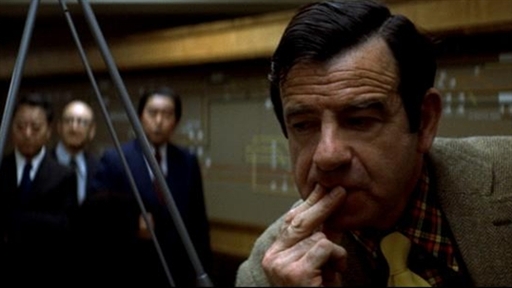
Walter Matthau tries to get to the bottom of a bizarre subway heist in The Taking of Pelham One Two Three

THE TAKING OF PELHAM ONE TWO THREE (Joseph Sargent, 1974)
Film Forum
209 West Houston St.
Saturday, July 8, 4:45, Sunday, July 16, 6:20, Friday, July 21, 5:00 & 10:00
Series runs through July 27
212-727-8110
filmforum.orgg

On October 29, 1975, President Gerald R. Ford refused to grant a federal bailout of New York, resulting in one of the all-time-great headlines in the Daily News: “Ford to City: Drop Dead.” Film Forum is looking back at that rather unique decade in Big Apple history in the fab series “Ford to City: Drop Dead — New York in the 70s.” Running through July 27, the festival features more than three dozen Gotham classics, beginning with Midnight Cowboy and Taking Off and continuing with such favorites as Mean Streets (shown with Film Forum master programmer Bruce Goldstein’s Les Rues de Mean Streets), Serpico, Saturday Night Fever, Network, Klute, and Marathon Man. With all the recent problems with the subway system, it’s definitely time to revisit Joseph Sargent’s underground thriller, The Taking of Pelham One Two Three. Loosely adapted from the book by John Godey, the film wonderfully captures the cynicism of New York City in the 1970s. Four heavily armed and mustached men — Mr. Blue (Robert Shaw), Mr. Green (Martin Balsam), Mr. Gray (Hector Elizondo), and Mr. Brown (Earl Hindman), colorful pseudonyms that influenced Quentin Tarantino’s Reservoir Dogs — hijack an uptown 4 train, demanding one million dollars in one hour from a nearly bankrupt city or else they will kill all eighteen passengers, one at a time, minute by minute. The hapless mayor (Lee Wallace) is in bed with the flu, so Deputy Mayor Warren LaSalle (Tony Roberts) takes charge on the political end while transit detective Lt. Zachary Garber (a great Walter Matthau) and Inspector Daniels (Julius Harris) of the NYPD team up to try to figure out just how in the world the criminals expect to get away with the seemingly impossible heist. Sargent (Sybil) offers a nostalgic look back at a bygone era, before technology radically changed the way trains are run and police work is handled.
The film also features a very funny, laconic Jerry Stiller as Lt. Rico Patrone and the beloved Kenneth McMillan as the borough commander. It was remade as a television movie in 1998, starring Edward James Olmos, Vincent D’Onofrio, and Lorraine Bracco, and as an embarrassingly bad big-budget bomb in 2009 by Tony Scott. The Taking of Pelham One Two Three is screening on July 8 (introduced by Goldstein), 16, and 21; the Film Forum series also includes such inspired double features as Shaft and Super Fly, Across 110th Street and Cops and Robbers, Dressed to Kill and Death Wish, Three Days of the Condor and The Eyes of Laura Mars, and The Warriors and Escape from New York. In addition, director Jerry Schatzberg will introduce The Panic in Needle Park on July 7, William Friedkin will introduce The French Connection via Skype on July 8, and New York Times media editor Bill Brink — whose father, William, wrote the infamous Daily News headline — will introduce Dog Day Afternoon on July 9.

RESTLESS CREATURE: WENDY WHELAN

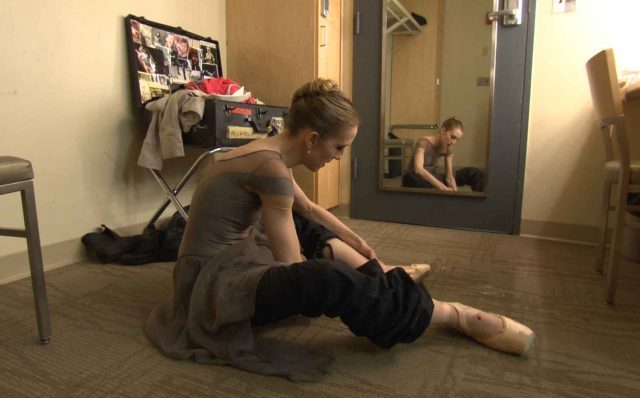
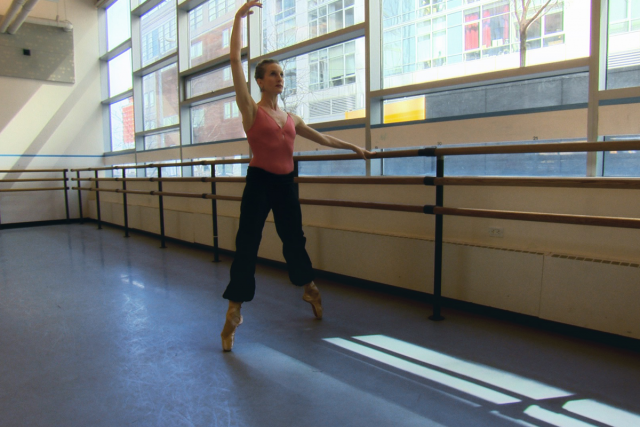
Ballet star Wendy Whelan invites audiences it to watch her attempt to get back onstage in Restless Creature

Ballet star Wendy Whelan invites audiences it to watch her attempt to get back onstage in Restless Creature

RESTLESS CREATURE: WENDY WHELAN (Linda Saffire & Adam Schlesinger, 2016)
Film Forum, 209 West Houston St., 212-727-8110
Film Society of Lincoln Center, Francesca Beale Theater, Elinor Bunin Munroe Film Center, 144 West 65th St. between Eighth Ave. & Broadway
Opens Wednesday, May 24
www.facebook.com/restlesscreatureww

“I’ve always been extremely devoted to what I do, and I love being a part of the New York City Ballet. But I do feel the ticking clock, and at times I’ve thought, if I don’t dance, I’d rather die. I’ve actually said that,” longtime New York City principal dancer Wendy Whelan says in the intimate and revealing documentary Restless Creature: Wendy Whelan. Whelan gave directors and producers Linda Saffire and Adam Schlesinger remarkable access as she faces a turning point in her life and career. In 2013, she began to notice she wasn’t getting the parts she used to excel in and decided to get reconstructive hip surgery, hoping that she could return to dancing full-time, at top level. She allows Saffire and Schlesinger into the operating room as Dr. Marc J. Philippon performs the procedure on her torn right labrum. “Ballerinas are probably God’s best athletes,” Dr. Philippon, says. The film then documents her hard-fought battle to return to the stage, as it’s unclear that she will ever regain her skills — or if Peter Martins and the New York City Ballet will even want her back. “What the fuck is this gonna be like when I can’t do this anymore,” she wonders, later adding, “I need to get back in the game, because I don’t have a ton of time left at my game.” With an inspiring dedication, brave honesty, and self-deprecating sense of humor, Whelan, who turned fifty earlier this month, works with physical therapists Marika Molnar and James Gallegro and discusses options with her husband, choreographer and creative director David Michalek; her manager, Ilter Abramowitz; her mother, Kay; and friends Adam Barrett and Maria Scherer, holding nothing back about the choices she must make. Concerned that soon she will not physically be able to be at her best in ballet, she starts the “Restless Creature” contemporary dance project with choreographers Kyle Abraham, Josh Beamish, Brian Brooks, and Alejandro Cerrudo. But she still aches to return to her home of thirty years, the New York City Ballet, where decades of balletomanes, twi-ny included, have thrilled to her technical precision, insight, musicality, and breathtakingly beautiful line.

Wendy Whelan faces a crossroads in her career in intimate and revealing documentary

Wendy Whelan faces a crossroads in her career in intimate and revealing documentary

Saffire and Schlesinger, who previously collaborated on such documentaries as Smash His Camera and Sporting Dreams, combine home movies and photos with lovely clips of Whelan in pieces by Christopher Wheeldon, George Balanchine, William Forsythe, Jerome Robbins, and Alexei Ratmansky. They mix in scenes of her being interviewed by dance writers, partying with friends and colleagues, talking with former dancers Jock Soto and Philip Neal, and rehearsing with NYCB soloist Craig Hall and principal dancer Tyler Angle. Only once during the year-and-a-half shoot did Whelan ask for privacy; otherwise, her life is an open book, and it’s both exhilarating and heartbreaking to watch, as the film is about much more than just one artist’s struggle to remain relevant; it’s an inherently relatable story about the effects of age, how each of us might react to the inevitable decline of the body. Whelan expresses how hard it is to know that there are certain moves she will never be able to perform again, no matter how well her rehab goes, so there is an underlying sadness throughout the film even as we cheer her on to accomplish her lofty goals. But what really makes the film work is Whelan herself; all of the behind-the-scenes intrigue and personal reflections are fascinating, but Whelan proves to be an extraordinary human being. “You changed how people behave in this profession,” former principal dancer and current Pacific Northwest Ballet artistic director Peter Boal tells her. Restless Creature: Wendy Whelan will likely make many viewers take a good look at their own future with new enthusiasm as they approach critical crossroads. The film opens May 24 at Film Forum and Lincoln Center; there will be Q&As with Whelan, Saffire, and Schlesinger (sometimes joined by executive producer Diana DiMenna) at the former on May 25 and May 26 at 7:00 and May 27 at 4:40 and at the latter on May 24 at 7:00, May 25 at 5:00, May 27 at 7:00, and May 28 at 1:00.

OBIT.

Bruce Weber

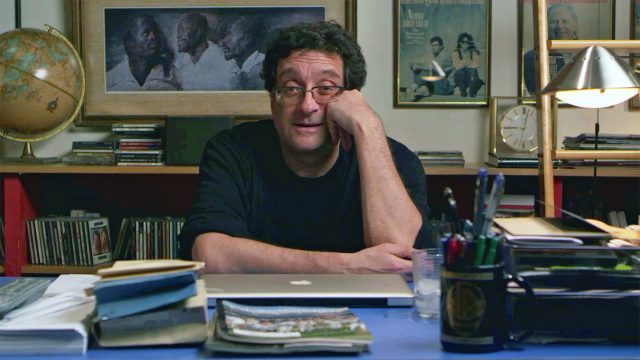
Bruce Weber discusses the intricacies of writing obituaries in surprisingly charming documentary

OBIT.: LIFE ON DEADLINE (Vanessa Gould, 2016)
Film Forum, 209 West Houston St., 212-727-8110
Lincoln Plaza Cinema, 1886 Broadway at 63rd St., 212-757-2280
Opens Wednesday, April 26
www.facebook.com

Vanessa Gould’s surprising charmer, Obit., might primarily be about the documentation of individual death by the New York Times obituaries desk, but at its heart it’s a celebration of life. “It’s almost never depressing because we’re almost always writing about someone in his or her eighties or nineties who has died after a long, rich, creative, fulfilling life,” obituaries senior writer Margalit Fox explains. “In an obit of eight hundred words or so, maybe a sentence or two will be about the death and the other ninety percent is about the life. So it’s counterintuitive, ironic even, but obits have next to nothing to do with death and, in fact, absolutely everything to do with the life.” Inspired by an obituary the New York Times ran about a friend of hers at her urging, Gould spent about a week in the Times offices, capturing the obit writers and editors in action as they do extensive research (online and on the phone), work hard on the lede, carefully fact check, and get just the right photo for what they consider legitimate news stories, not simply memorials to the deceased. “It’s a once-only chance to make the dead live again,” obituaries writer (and former food critic) William Grimes notes. They are shown deciding whose life was newsworthy, keeping to a specific word count, and pitching for better placement of their story while attempting to capture the essence of the individual they are writing about. When researching the death of typewriter repairman Manson Whitlock, Fox hits the keys of an old Royal, attempting to incorporate the sound and feel of the instrument in her article. In addition to the obviously famous and influential, they also cover such people as Slinky creator Richard T. James, Bill Haley bass player Marshall Lytle, television remote inventor Gene Polley, Brown v. Board of Education of Topeka plaintiff Zelma Henderson, aviatrix Elinor Smith, advertising executive Richie Rich, Skylab saviour Jack A. Kinzler, and William P. Wilson, the JFK aide who helped orchestrate John F. Kennedy’s critical televised debate win over Vice President Richard M. Nixon. Gould’s film includes archival photographs and film footage of many of the obituary subjects and the times in which they lived, although some of the clips are not completely relevant. Still, they are cool to see and flesh out the documentary with visual splendor and fun details.

archivist Jeff Roth OBIT.

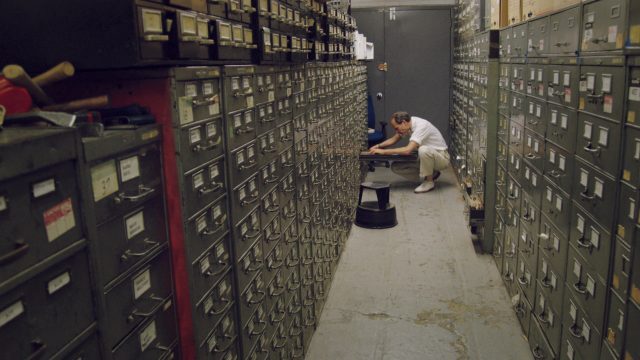
Archivist Jeff Roth runs the massive New York Times archives known as the morgue

The film also features obituaries desk editor William McDonald, who points out that they are writers who never get to meet or speak directly with their subjects; former obituaries writer Paul Vitello, who refers to himself as an obituarist; assistant obituaries editor Peter Keepnews; chief pop music critic Jon Pareles; former deputy obituaries editor Jack Kadden; former obituaries writer Douglas Martin; and Jeff Roth, who for nearly a quarter of a century has overseen the morgue, the vast archives filled with tens of thousands of files of newspaper clippings and photographs as well as nearly two thousand advance obituaries. Gould often asks the writer to read the obituary they have written while she shows film footage and rare photos of the subject: one memorable scene highlights Fox and her poetic obituary of British rower and adventurer John Fairfax. “This was an obit that broke all the rules and proudly announced obits in the twenty-first century can be just as rollicking and swaggering as their subjects,” she says. And the discussion about how to cover sudden, unexpected celebrity deaths — Michael Jackson, Prince, David Foster Wallace, Philip Seymour Hoffman, attempting to get something up on the Times website quickly while battling the six o’clock deadline for the next day’s print edition — is downright exciting. The film primarily works because the writers and editors themselves are intellectual eccentrics who love what they do even as it makes them consider their own mortality. “Literally, I show up in the morning and I say, ‘Who’s dead?’” Weber explains. “And somebody puts a folder on my desk and that’s what I do that day.” Obit. opens April 26 at Lincoln Plaza and Film Forum; Gould will be at Film Forum for Q&As with Weber at the 7:00 screenings on April 27 and 28, with Roth after the 7:00 show on April 29, and with Grimes at the 4:45 show on April 30, in addition to several introductions, while at Lincoln Plaza Fox and producer Caitlin Mae Burke will discuss the film on April 26 and 28, followed by Gould and obituary writer Dan Slotnik on April 29.

THE INCIDENT WITH DIRECTOR LARRY PEERCE IN PERSON

Tony Musante terrorizes Bea Bridges and others aboard a New York City subway train in THE INCIDENT

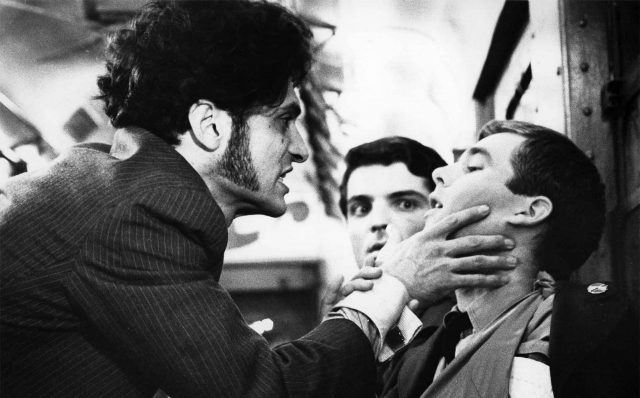
Joe Ferrone (Tony Musante) terrorizes Pfc. Felix Teflinger (Beau Bridges) and others aboard a New York City subway train in THE INCIDENT

THE INCIDENT (Larry Peerce, 1967)
Film Forum
209 West Houston St.
Sunday, November 3, $7, 11:00 am
212-727-8110
filmforum.org

One of the ultimate nightmare scenarios of 1960s New York City, Larry Peerce’s gritty black-and-white The Incident takes viewers deep down into the subway as two thugs terrorize a group of helpless passengers. Joe Ferrante (Tony Musante) and Artie Connors (Martin Sheen, in his first movie role) are out for kicks, so after getting some out on the streets, they head underground, where they find a wide-ranging collection of twentieth-century Americans to torture, including Arnold and Joan Robinson (Brock Peters and Ruby Dee), Bill and Helen Wilks (Ed McMahon and Diana Van der Vlis), Sam and Bertha Beckerman (Jack Gilford and Thelma Ritter, in her last role), Douglas McCann (Gary Merrill), Muriel and Harry Purvis (Jan Sterling and Mike Kellin), Alice Keenan (Donna Mills), soldiers Felix Teflinger and Phillip Carmatti (Beau Bridges and Robert Bannard), and others, each representing various aspects of contemporary culture and society, all with their own personal problems that come to the surface as the harrowing ride continues. It’s a brutal, claustrophobic, highly theatrical film that captures the fear that haunted the city in the 1960s and well into the ’70s, with an all-star cast tackling such subjects as racism, teen sex, alcoholism, homosexuality, war, and the state of the American family. A DCP restoration of the rarely shown drama, some of which was filmed in the actual subway system against the MTA’s warnings, is screening April 26 at Film Forum, with the Bronx-born Peerce, who made such other films as A Separate Peace, Two-Minute Warning, The Bell Jar, and Goodbye, Columbus, on hand to discuss the work.