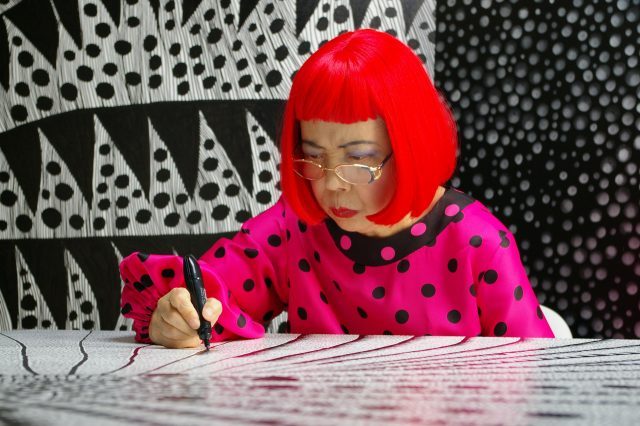
Documentary explores fascinating life and career of Japanese artist Yayoi Kusama (photo © Tokyo Lee Productions, Inc. / courtesy of Magnolia Pictures)
KUSAMA: INFINITY (Heather Lenz, 2018)
Film Forum
209 West Houston St.
Opens Friday, September 7
212-727-8110
filmforum.org
www.kusamamovie.com
 I remember the buzz in the room back in July 2012 at the press preview for the “Yayoi Kusama” retrospective at the old Whitney. Even among all the jaded art critics, there was palpable excitement at the rumor that Kusama herself might be attending the event. Alas, it was not to be. But now everyone can feel like they’re in the same room as the iconoclastic Japanese artist when watching Heather Lenz’s infinitely entertaining documentary, Kusama: Infinity, opening September 7 at Film Forum. Over the course of her seven-decade career, Kusama has explored the concepts of infinity and eternity through painting, sculpture, performance art, film, and installation, highlighted by an obsession with endless circles and mirrored reflections. “I convert the energy of life into dots of the universe. And that energy along with love flies into the sky,” she explains. Traumatic childhood experiences deeply influenced her life and art; she began painting when she was eight years old in rural Matsumoto City, where her unhappy parents ran a wholesale seed business (and her mother would tear up her drawings). Now eighty-nine, she still works every day, going from the Seiwa Hospital for the Mentally Ill, where she has lived voluntarily since 1977, to her studio, which is filled with her captivating works-in-progress. Lenz zooms in for extreme close-ups of the artist surrounded by canvases, as if she is the biggest dot (or seed?) in her universe. “So much of Kusama’s art seeks to re-create that [childhood] experience in one form or another,” notes Alexandra Munroe, senior curator of Asian Art at the Guggenheim. “It is literally an experience of being lost into her physical environment, of losing her selfhood in this space that is moving rapidly, and expanding rapidly.”
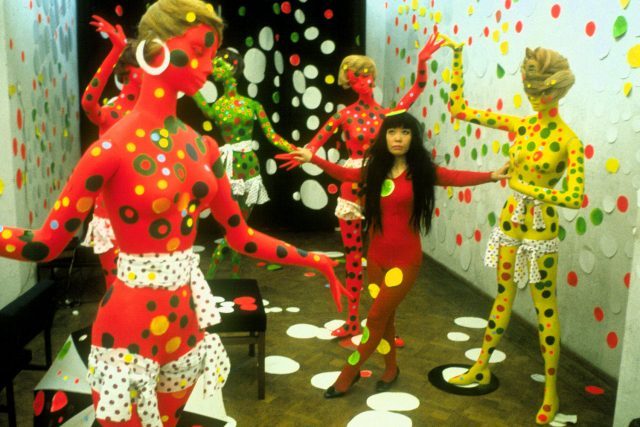
Artist Yayoi Kusama poses in the Orez Gallery in the Hague in 1965 (photo by Harrie Verstappen / courtesy of Magnolia Pictures)
Kusama was determined to be successful and to stand out from the crowd, as shown in dozens of color and black-and-white photographs of her in various kimono, dot-covered outfits, revealing apparel, and great hats, always sporting that unique bang hairstyle. “I promised myself that I would conquer New York and make my name in the world with my passion for the arts and my creative energy,” she explains. She was not about to let anything stop her, least of all her gender and her heritage. She was angry when it appeared that such artists as Andy Warhol, Claes Oldenburg, and Lucas Samaras copied specific aspects of her work and gained greater notice for it. She sought advice from Georgia O’Keeffe. She got involved in an odd relationship with reclusive artist Joseph Cornell. She was shunned in her home country because of her penchant for nudity. She occasionally gets teary looking back at her life. The film features sensational archival video and photographs from some of Kusama’s seminal happenings and exhibitions, from “Aggregation: One Thousand Boats Show” to “Yayoi Kusama: A Retrospective” at CICA, from her “Narcissus Garden” intervention at the 1966 Venice Biennale, where she was selling individual mirror balls she had arranged on a lawn, to 1969’s “Grand Orgy to Awaken the Dead,” in which the fiercely antiwar artist read “Thoughts on the Mausoleum of Modern Art” as eight participants ran around naked in MoMA’s sculpture garden. (This summer, Kusama brought “Narcissus Garden” to New York for MoMA PS1’s biannual Rockaway! show.) There are also clips from the revolutionary 1967 psychedelic art film Kusama’s Self-Obliteration, made by Jud Yalkut and Kusama.
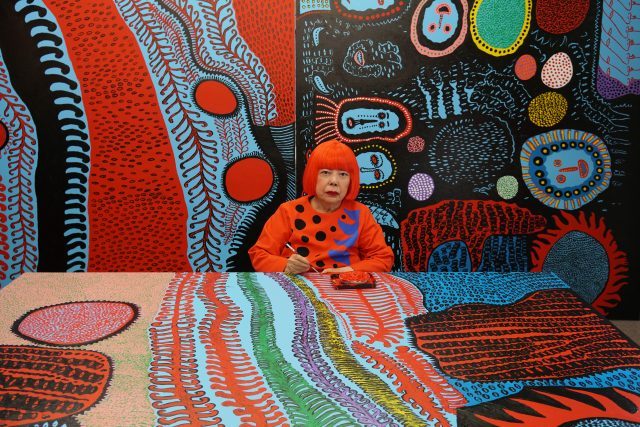
At the age of eighty-nine, Yayoi Kusama still works in her studio every day (Image © Yayoi Kusama / courtesy of David Zwirner, New York; Ota Fine Arts, Tokyo/Singapore/Shanghai; Victoria Miro, London; YAYOI KUSAMA Inc.)
Lenz, who will participate in a Q&A at Film Forum on September 7 after the 7:45 screening, talks to a wide range of people who provide intriguing perspectives on the artist and her work, including Kusama dancer Jeanette Hart Coriddi, former Matsumoto City mayor Tadashi Aruga, David Zwirner director Hanna Schouwink, psychoanalyst and art collector Judith E. Vida, MD, longtime best friend Akira Iinuma, artists Carolee Schneemann, Ed Clark, and Frank Stella, curators Marie Laurberg and Lynn Zelevansky, Joshua Light Show founder Joshua White, and Yayoi Kusama Museum director Akira Tatehata. CUNY Kingsborough art history professor Midori Yamamura says, “Her diagnosis is of obsessive-compulsive neuroses. Once something enters into her mind, she cannot get rid of it.” Former art dealer Beatrice Perry of the Gres Gallery adds of Kusama’s Infinity Net series, “I’d never seen anything like it. They had some kind of magic. You couldn’t stop looking at them, and you didn’t know where they were going. They were hypnotic.” And gallery owner Richard Castellane remembers, “She was taking away your ability to focus, breaking all boundaries of space. . . . This was the great breaking point in art. No longer are you the viewer the master; she’s the master.” Kusama’s mastery is still evident today, as prices paid for her artwork continue to skyrocket — she’s recognized as the top-selling woman artist in the world — and fans wait on long lines for hours and hours to spend thirty seconds inside one of her Infinity Mirrored Rooms. In addition, Lenz has done a masterful job giving us a Kusama we have never seen before. Despite her difficult, challenging life, the extraordinary Kusama declares, “I want to live forever.” And in the very personal, intimate, and infinite world she has created and Lenz has masterfully revealed, who’s to say she won’t?



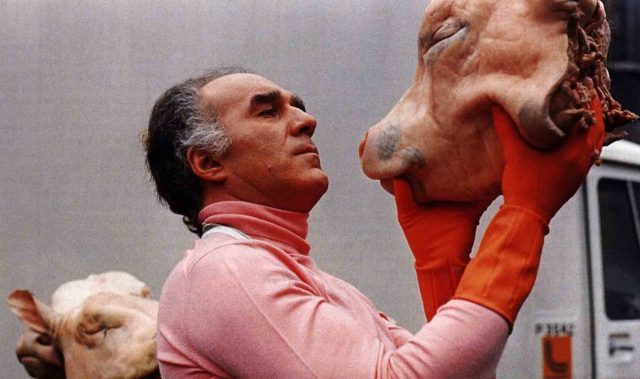
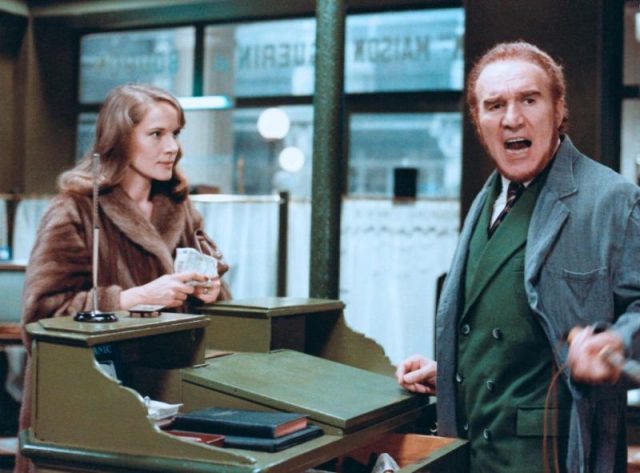
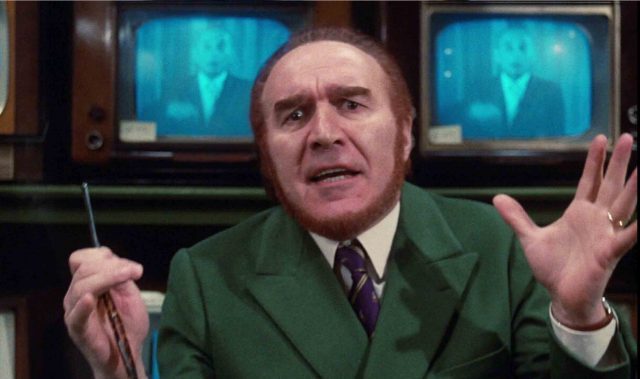
 Fed up with their lives, four old friends decide to literally eat themselves to death in one last grand blow-out. Cowritten and directed by Marco Ferreri (Chiedo asilo, La casa del sorriso), La Grande Bouffe features a cast that is an assured recipe for success, bringing together a quartet of legendary actors, all playing characters with their real first names: Marcello Mastroianni as sex-crazed airplane pilot Marcello, Philippe Noiret as mama’s boy and judge Philippe, Michel Piccoli as effete television host Michel, and Ugo Tognazzi as master gourmet chef Ugo. They move into Philippe’s hidden-away family villa, where they plan to eat and screw themselves to death, with the help of a group of prostitutes led by Andréa (Andréa Ferréol). Gluttons for punishment, the four men start out having a gas, but as the feeding frenzy continues, so does the flatulence level, and the men start dropping one by one. While the film might not be quite the grand feast it sets out to be, it still is one very tasty meal. Just be thankful that it’s not shown in Odoroma. Winner of the FIPRESCI Prize at the 1973 Cannes Film Festival, La Grande Bouffe is screening March 17, 18, 19, and 22 in Film Forum’s Michel Piccoli series. Bon appetit!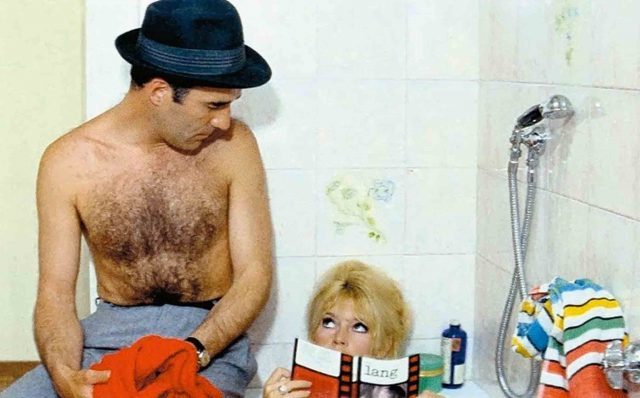
 French auteur Jean-Luc Godard doesn’t hold back any of his contempt for Hollywood cinema in his multilayered masterpiece Contempt. Loosely based on Alberto Moravia’s Il Disprezzo, Contempt stars Michel Piccoli as Paul Javal, a French screenwriter called to Rome’s famed Cinecittà studios by American producer Jeremy Prokosch (Jack Palance ) to perform rewrites on Austrian director Fritz Lang’s (played by Lang himself) adaptation of The Odyssey by ancient Greek writer Homer. Paul brings along his young wife, the beautiful Camille (Brigitte Bardot), whom Prokosch takes an immediate liking to. With so many languages being spoken, Prokosch’s assistant, Francesca Vanini (Giorgia Moll), serves as translator, but getting the various characters to communicate with one another and say precisely what is on their mind grows more and more difficult as the story continues and Camille and Paul’s love starts to crumble. Contempt is a spectacularly made film, bathed in deep red, white, and blue, as Godard and cinematographer Raoul Coutard poke fun at the American way of life. (Both Godard and Coutard appear in the film, the former as Lang’s assistant director, the latter as Lang’s cameraman — as well as the cameraman who aims the lens right at the viewer at the start of the film.)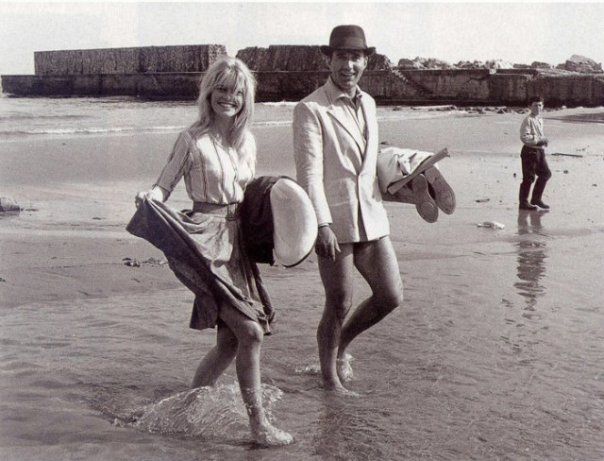
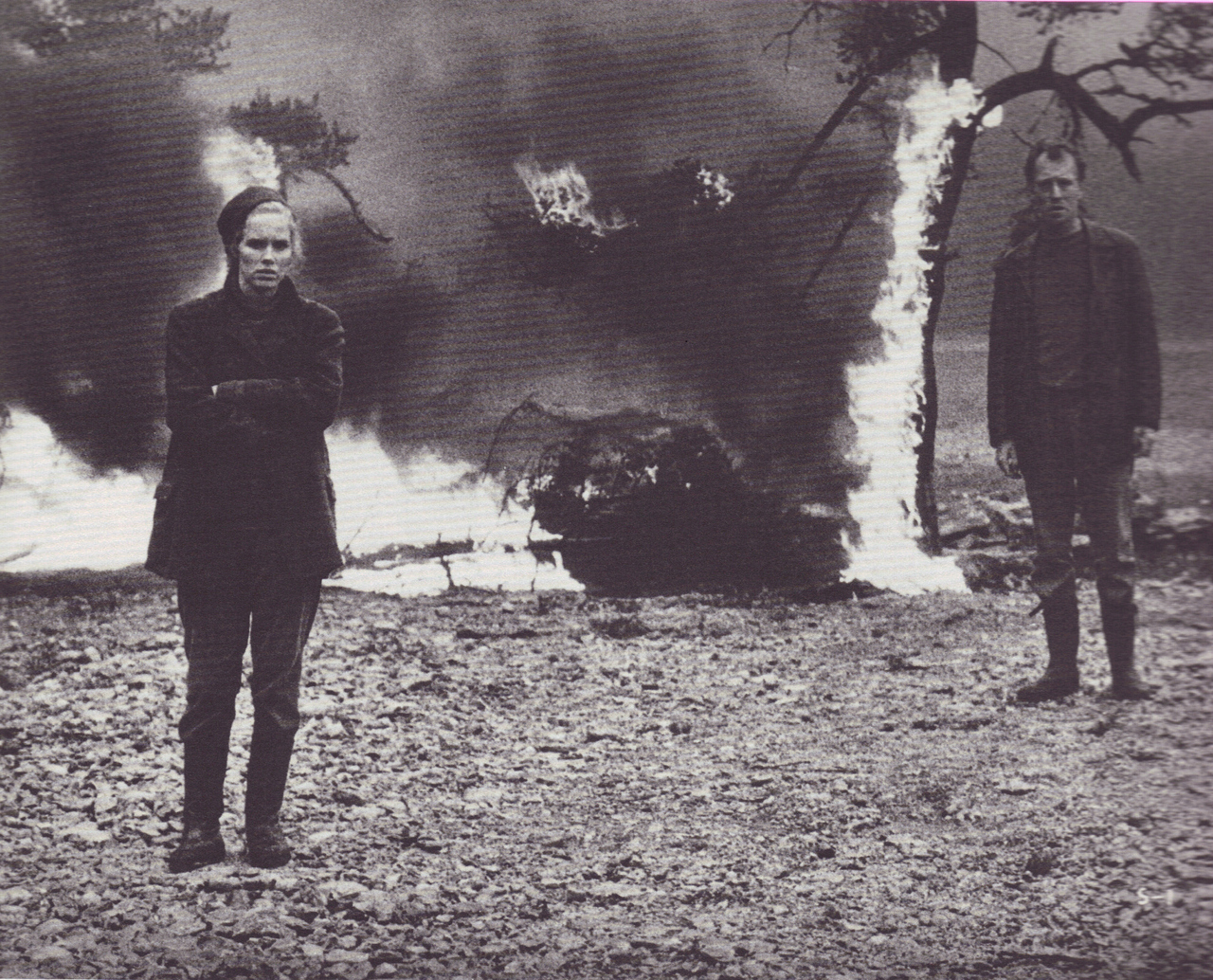
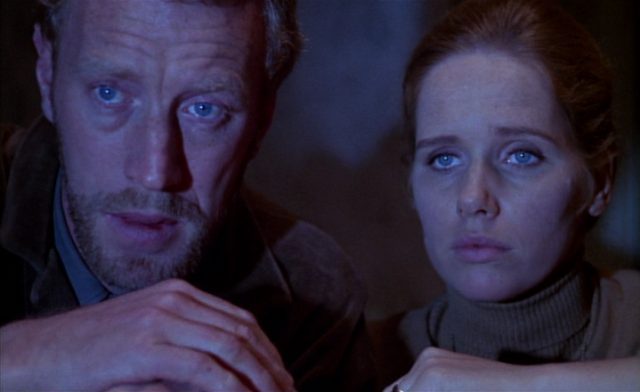
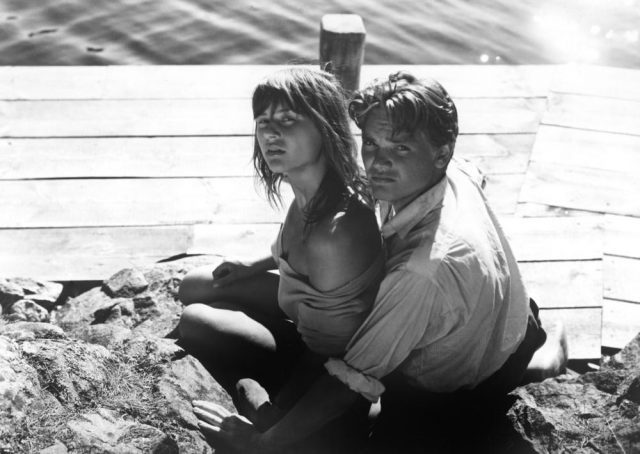
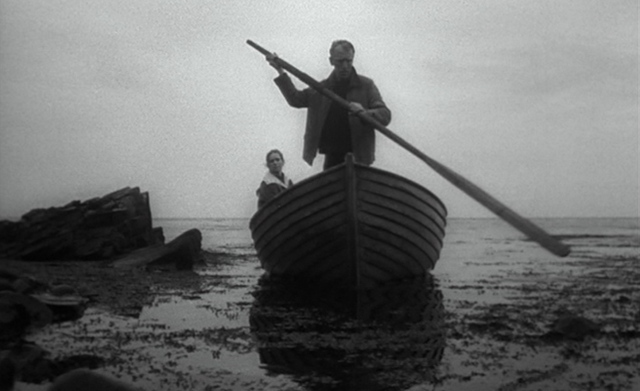
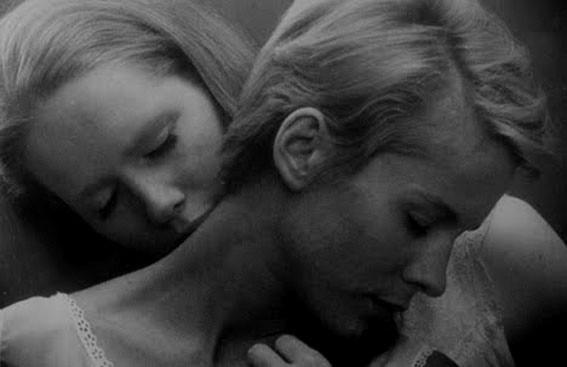
 Longtime Ingmar Bergman muse Liv Ullmann will bet at Film Forum on March 2 for a Q&A following the 6:15 screening of Shame, part of a five-week retrospective celebrating the hundredth anniversary of the Swedish director’s birth. Shame is a brilliant examination of the physical and psychological impact of war, as seen through the eyes of a happily married couple innocently caught in the middle of the brutality. Jan (Max von Sydow) and Eva Rosenberg (Liv Ullmann) have isolated themselves from society, living without a television and with a broken radio, maintaining a modest farm on a relatively desolate island a ferry ride from the mainland. As the film opens, they are a somewhat ordinary husband and wife, brushing their teeth, making coffee, and discussing having a child. But soon they are thrust into a horrific battle between two unnamed sides, fighting for reasons that are never given. As Jan and Eva struggle to survive, they are forced to make decisions that threaten to destroy everything they have built together. Shot in stark black-and-white by master cinematographer Sven Nykvist, Shame is a powerful, emotional antiwar statement that makes its point through intense visual scenes rather than narrative rhetoric. Jan and Eva huddle in corners or nearly get lost in crowds, then are seen traversing a smoky, postapocalyptic landscape riddled with dead bodies. Made during the Vietnam War, Shame is Bergman’s most violent, action-filled film; bullets can be heard over the opening credits, announcing from the very beginning that this is going to be something different from a director best known for searing personal dramas. However, at its core, Shame is just that, a gripping, intense tale of a man and a woman who try to preserve their love in impossible times. Ullmann and von Sydow both give superb, complex performances, creating believable characters who will break your heart. Shame is also being shown February 28, March 1, March 2 at 2:00 and 10:15, and March 3.