Tag Archives: Film at Lincoln Center

THE HONG SANGSOO MULTIVERSE: A RETROSPECTIVE OF DOUBLE FEATURES

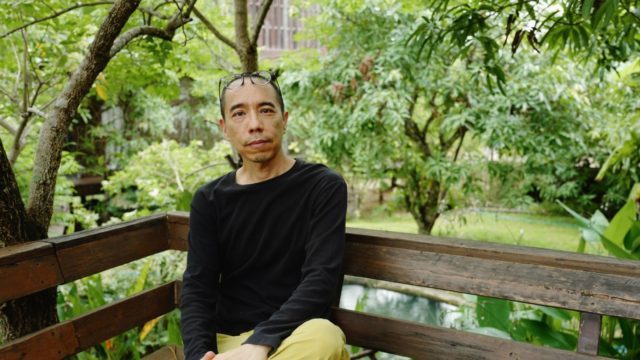
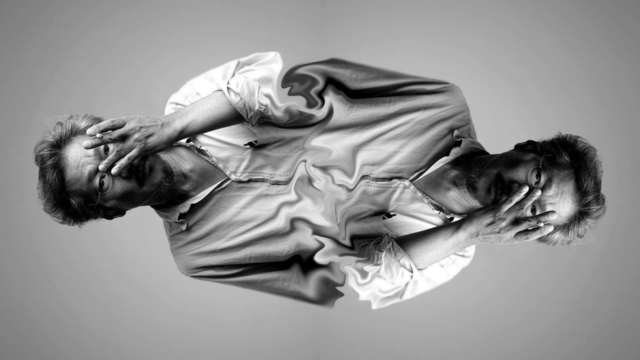
The many dualities of the films of Hong Sangsoo will be explored in two-part double feature series (photo by Sandro Baebler / image by Jasmine Abbasov)

THE HONG SANGSOO MULTIVERSE
Film at Lincoln Center, Walter Reade Theater
144 West Sixty-Fifth St. at Amsterdam Ave.
April 8-17, May 4-10 (two-for-one pricing)
www.filmlinc.org

In a July 2017 interview in Film Comment, which is published by Film at Lincoln Center, South Korean auteur Hong Sangsoo, when asked about connected themes and autobiography in his works, noted, “I’m a person who only responds to ‘what is given’ (at least in important choices), and the ‘what is given’ should be intrinsically something that I cannot know why and how it comes. . . . All my films are autobiographical in a sense that whatever I do, they all end up showing something of myself; all my films are not autobiographical in a sense that I’ve never meant to make a film that represents my life or a part of my life.”

For more than a quarter century, Hong (whose surname is sometimes spelled Sang Soo or Sang-soo) has been making fascinating films that cleverly question reality, playing with the concepts of time and space, often set in the world of film. His protagonists are writers or directors who develop different kinds of relationships with actors, fans, students, and other admirers amid a lot of drinking and smoking. His complex narratives are deeply intellectual, exploring the dual nature of life and art. When a character in one says, “I don’t think you really understood the film,” she’s talking to the audience as well, but not in a condescending way; Hong’s works are almost always satisfying on the surface, but there are myriad pleasures to uncover the more you dig.

Film at Lincoln Center is celebrating Hong’s career — and the dualities he exposes — with the two-part series “The Hong Sangsoo Multiverse: A Retrospective of Double Features,” running April 8-17 and May 4-10, consisting of pairings from his entire oeuvre, including rarely shown shorts and many works that are not available on streaming platforms. In addition, on April 8 at 6:00 in the Amphitheater, the free talk “The Hong Show with Dennis Lim” will examine Hong’s world, with Film Comment editors Clinton Krute and Devika Girish, and on May 7 at 5:00 Hong himself will be at the Walter Reade Theater for a talk with Lim, the author of the Hong monograph Tale of Cinema. Hong will also be on hand for several Q&As following screenings in the second half of the series. Oh, and there is a secret screening on May 10, the title of which will not be revealed until the film is about to start. Below are select reviews; keep watching this space for more insight into this extraordinary filmmaker who you need to discover if you haven’t already.
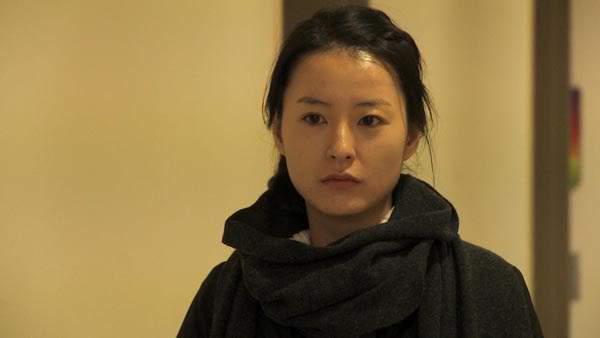
Oki (Jung Yumi) walks the fine line between fiction and reality in Oki’s Movie

OKI’S MOVIE (Hong Sangsoo, 2010)
Friday, April 8, 7:30 (with In Another Country)
Friday, April 15, 6:30 (with Tale of Cinema)

Throughout his prestigious career, Korean director Hong Sangsoo has explored the nature of his craft, using the creative process of filmmaking as a setting for his relationship-driven dramas. He examines the theme again in Oki’s Movie, a beautifully told tale told in four sections built around film professor Song (Moon Sung-keun) and students Jingu (Lee Sun-kyun) and Oki (Jung Yumi). Each chapter — “A Day for Chanting,” “King of Kiss,” “After the Snowstorm,” and “Oki’s Movie” — features a different point of view with a different narrator while walking the fine line between fiction and nonfiction. As in Tale of Cinema, certain parts are films within the film, shorts made by the characters for their class. Hong keeps viewers guessing what’s real as Oki balances a possible love triangle between her, Jingu, and Song; the final segment is a poetic masterpiece that brings everything together.
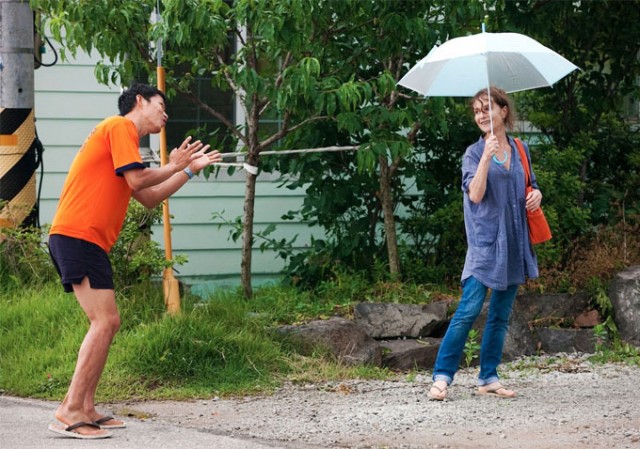
A lifeguard (Yu Jun-sang) makes the first of several offers to Anne (Isabelle Huppert) in In Another Country

IN ANOTHER COUNTRY (Hong Sangsoo, 2012)
Friday, April 8, 9:00 (with Oki’s Movie)
Saturday, April 9, 7:15 (with Our Sunhi and List)

Hong Sangsoo continues his fascinating exploration of cinematic narrative in In Another Country, although this one turns somewhat nasty and tiresome by the end. After being duped in a bad business deal by a family member, an older woman (Youn Yuh-jung) and her daughter, Wonju (Jung Yumi), move to the small seaside town of Mohjang, where the disenchanted Wonju decides to write a screenplay to deal with her frustration. Based on an actual experience she had, she writes three tales in which a French woman named Anne (each played by an English-speaking Isabelle Huppert) comes to the town for different reasons. In the first section, Anne is a prominent filmmaker invited by Korean director Jungsoo (Kwon Hye-hyo), who has a thing for her even though he is about to become a father with his very suspicious wife, Kumhee (Moon So-ri). In the second story, Anne, a woman married to a wealthy CEO, has come to Mohjang to continue her affair with a well-known director, Munsoo (Moon Sung-keun), who is careful that the two are not seen together in public. And in the final part, Anne, whose husband recently left her for a young Korean woman, has arrived in Mohjang with an older friend (Youn), seeking to rediscover herself.

In all three stories, Anne searches for a lighthouse, as if that could shine a light on her future, and meets up with a goofy lifeguard (Yu Jun-sang) who offers the possibility of sex, but each Anne reacts in different ways to his advances. Dialogue and scenes repeat, with slight adjustments made based on the different versions of Anne, investigating character, identity, and desire both in film and in real life. Hong wrote the film specifically for Huppert, who is charming and delightful in the first two sections before turning ugly in the third as Anne suddenly becomes annoying, selfish, and irritating, the plot taking hard-to-believe twists that nearly undermine what has gone on before. Hong once again weaves together an intricate plot that is soon commenting on itself and coming together in unexpected, surreal ways, but he loses his usual taut narrative thread in the final, disappointing section.
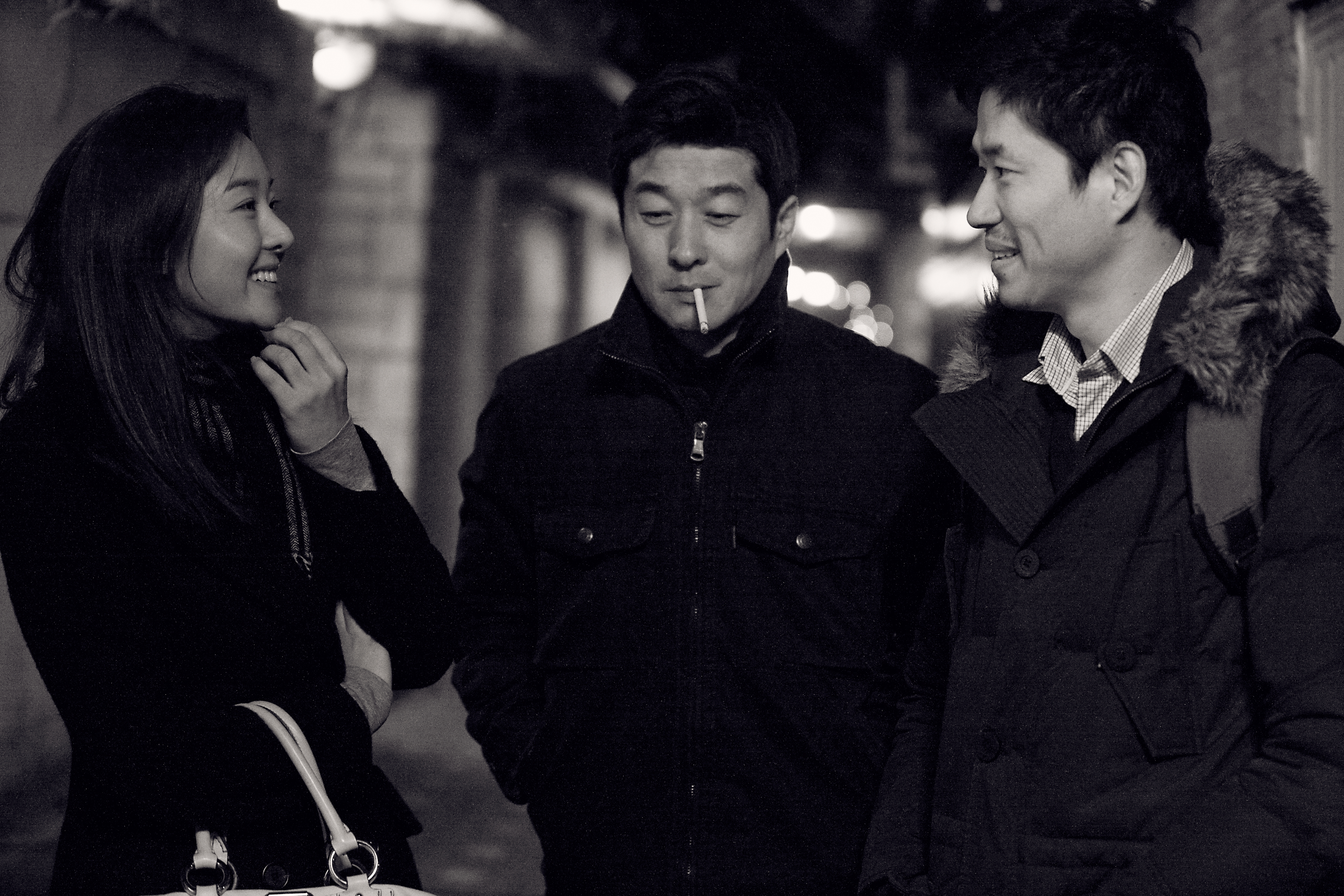
Boram (Song Sun-mi), Youngho (Kim Sang-joong), and Seongjun (Yu Jun-sang) examine their lives in fascinating ways in The Day He Arrives

THE DAY HE ARRIVES (Hong Sangsoo, 2011)
Saturday, April 9, 3:00 (with The Day After)
Monday, April 11, 6:30 (with Yourself and Yours)

For most of his career, South Korean auteur Hong Sangsoo has been making films about filmmakers, although not always about the filmmaking process itself. Often he delves into the more personal side of lead characters who are established or emerging directors. Hong reached a career peek with The Day He Arrives, a deeply intuitive, vastly intelligent, and surprisingly existential exploration of a young man at a crossroads in his life. After having made four little-seen films and deciding to become a country teacher instead, director Seongjun (Yu Jun-sang) returns to his hometown in Seoul to visit his friend Youngho (Kim Sang-joong), a film critic who has just left his wife and is hanging out with a film teacher named Boram (Song Sun-mi). Seongjun stops by to visit his old girlfriend, Kyungjin (Kim Bok-yung), keeps bumping into an actress who appeared in one of his films, goes drinking with a trio of fans, and meets Yejeon (also played by Kim Bok-yung), the owner of a local bar where Youngho and Boram take him.

As all of the main characters examine their lives, each one lacking something important, Hong has several scenes repeat multiple times with slight differences, as if they are alternate takes imbued with new meaning as the audience continues to learn more about the protagonists. Each revised scene contributes more insight and develops the characters further, even if the story seems to have backtracked in time. The nonlinear narrative and beautiful black-and-white cinematography evoke aspects of Woody Allen’s Stardust Memories, Harold Ramis’s Groundhog Day, and François Truffaut’s Day for Night, exceptional films that, like The Day He Arrives, carefully balance fantasy and reality, fiction and nonfiction while depicting the inherent dual nature of cinema and humanity. Earlier in his career, Hong seemed to have trouble ending his films, which would linger on well past the two-hour mark, but with the outstanding, poetic Oki’s Movie and its follow-up, The Day He Arrives, both of which run approximately eighty minutes, he has found an excellent length for his work — one that now almost feels too short, as he clearly has so much to say.
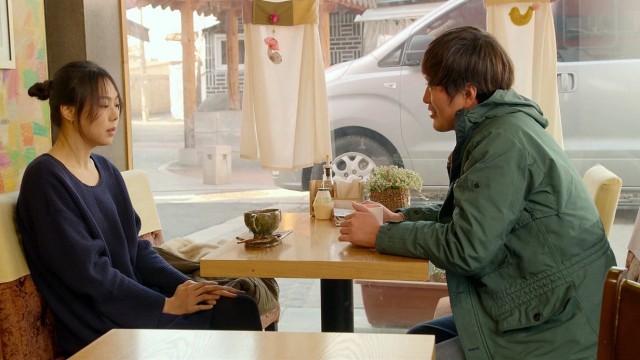
RIGHT NOW, WRONG THEN

Yoon Heejung (Kim Minhee) and Ham Chunsu (Jung Jaeyoung) get to know each other twice in Right Now, Wrong Then

RIGHT NOW, WRONG THEN (Hong Sangsoo, 2015)
Sunday, April 10, 3:00 (with The Power of Kangwon Province)
Wednesday, April 13, 3:15 (with Virgin Stripped Bare by Her Bachelors)

It’s déjà vu all over again in another of Hong Sangsoo’s masterpieces, Right Now, Wrong Then. Hong’s previous films explored the nature of cinematic storytelling: often, a film director is the protagonist, and scenes and characters repeat from different points of view. In Right Now, Wrong Then, Hong again plays with the temporal aspects of narrative; he essentially starts the film over at the halfway point, switching around the words of the title and repeating opening credits. Jung Jaeyoung won several Best Actor awards for his portrayal of art-house director Ham Chunsu, who has accidentally arrived a day early to the Korean province of Suwon, where he will take part in a Q&A following a screening of one of his films. Wandering around the town, he enters the blessing hall of an old palace and meets Yoon Heejung (Kim Minhee), a shy, aspiring painter. They talk about their lives, their hopes and dreams, as they go out for coffee and tea, eat sushi and drink soju, and meet up with some friends of Heejung’s. And then they do it again, primarily scene by scene, with variations in dialogue and temperament that offer sly twists on what happened in the first half. It’s as if Chunsu and Heejung are given the kind of second chance that one doesn’t get in real life, only in movies, or maybe Hong is showing us an alternate universe where myriad possibilities exist.
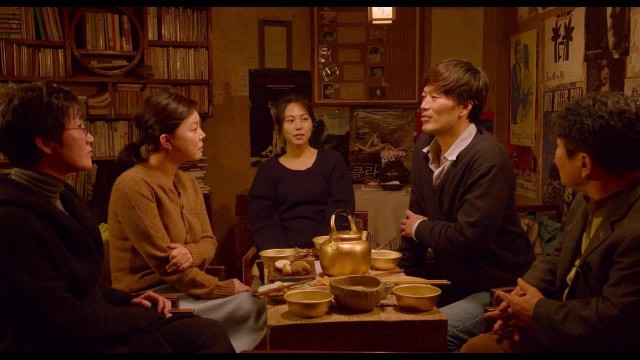
RIGHT NOW, WRONG THEN

Art-house director Ham Chunsu (Jung Jaeyoung) doesn’t mind being the center of attention in award-winning Right Now, Wrong Then

Winner of the Golden Leopard for Best Film at Locarno, Right Now, Wrong Then moves at the patient, naturalistic pace and rhythm of real life, with numerous long scenes lasting between five and ten minutes with no cuts. Cinematographer Park Hongyeol, who has photographed six other Hong films, occasionally zooms in on a character, a tree, or other objects, the movement of the camera often slightly awkward, reminding us that we are watching a movie. However, the camera placement and movement, which are decided by Hong, is not what we’re used to in conventional cinema; Park and Hong eschew standard speaker-reaction back-and-forth shots, instead allowing the camera to linger in the same spot for a while, or focus in on the person not talking, or concentrate on a minute detail that appears insignificant. Adding to the film’s vitality, Hong writes each scene the same day that it’s shot, resulting in a freshness that is intoxicating. Jung (Our Sunhi, Moss) is a marvel as Chunsu, a quirky, jittery figure who is not quite as cool or humble as he might think he is, while former model Kim (Hellcats, Very Ordinary Couple) is sweetly engaging as the tentative Heejung, who is trying to find her place in the world. Meanwhile, popping up every once in a while is Jeong Yongjin’s playful, carnivalesque music, as if we’re watching life’s endless circus, which, of course, we are.
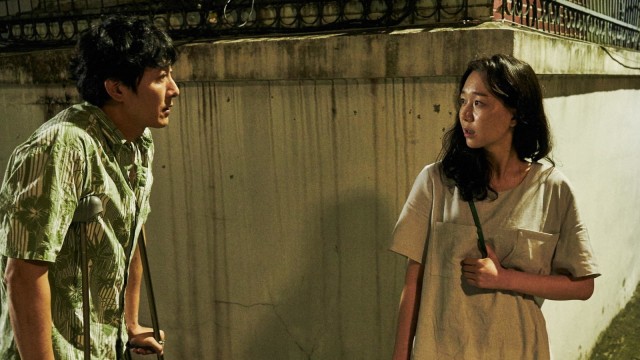
YOURSELF AND YOURS

Young-soo (Kim Joo-hyuk) tries to win back Min-jung (Lee Yoo-young) in Yourself and Yours

YOURSELF AND YOURS (Hong Sangsoo, 2016)
Monday, April 11 at 8:00 (with The Day He Arrives)
Monday, May 9, 4:15 (with On the Occasion of Remembering the Turning Gate)

“Don’t try to know everything,” Min-jung (Lee Yoo-young) says in Hong Sangsoo’s latest unusual and brilliant romantic drama, Yourself and Yours. It’s impossible to know everything that happens in Hong’s films, which set fiction against reality, laying bare cinematic narrative techniques. With a propensity to use protagonists who are directors, it is often difficult to tell what is happening in the film vs. the film-within-the-film. He also repeats scenes with slight differences, calling into question the storytelling nature of cinema as well as real life, in which there are no do-overs. In the marvelous Yourself and Yours, scenes don’t repeat, although the existence of a main character might. Min-jung is in a relationship with painter Young-soo (Kim Joo-hyuk), who is dealing with the failing health of his mother when he is told by a friend (Kim Eui-sung) that Min-jung was seen in a bar drunk and arguing with another man. Young-soo refuses to believe it, since he and Min-jung are facing her drinking problem by very carefully limiting the number of drinks she has when she goes out with him. But when the friend insists that numerous people have seen her in bars with other men and imbibing heavily, Young-soo confronts her, and she virulently defends herself, claiming that they are lies and that he should have more faith in her. She leaves him, and over the next several days she has encounters with various men, but she appears to be either a pathological liar or have a memory problem as she tells the older Jaeyoung (Kwon Hae-hyo), a friend of Min-jung’s, that she is a twin who does not know the painter; later, with filmmaker Sangwon (Yu Jun-sang), she maintains that they have never met despite his assertion that they have. Through it all, Young-soo is determined to win her back. “I want to love each day with my loved one, and then die,” he explains with romantic fervor. He also acknowledges Min-jung’s uniqueness: “Her mind itself is extraordinary,” he says.
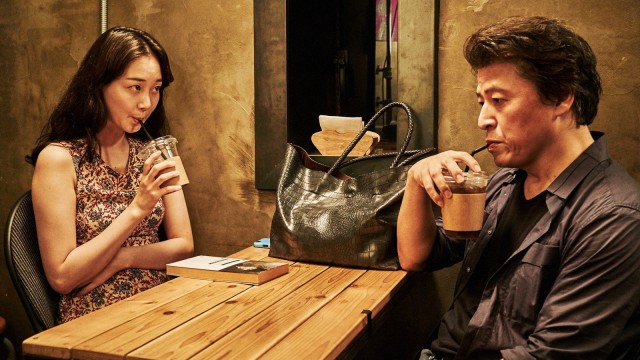
YOURSELF AND YOURS

Min-jung (Lee Yoo-young) tells Jaeyoung (Kwon Hae-hyo) she has a twin in Yourself and Yours

Yourself and Yours is an intelligent and witty exploration of fear and trust, built around a beautiful young woman who might or might not be lying, as she seems to reboot every time she meets a man, erasing her recent past. Lee (Late Spring, The Treacherous) is outstanding as Min-jung, keeping the audience on edge as to just what might be going through her “extraordinary” mind. Kim (Lovers in Prague, My Wife Got Married) plays Young-soo with just the right amount of worry and trepidation. As with most Hong films, there is a natural flow to the narrative, with long shots of characters just sitting around talking, smoking, and drinking — albeit primarily beer in this case rather than soju — with minimal camera movement courtesy of regular Hong cinematographer Park Hong-yeol (Hahaha, Our Sunhi), save for Hong’s trademark awkward zooms. There’s also an overtly cute romantic comedy score by Dalpalan to keep things light amid all the seriousness. Hong continually works on his scripts, so the actors generally get their lines the day of the shoot, adding to the normal, everyday feel of the performances. Many writers have compared the film to Luis Buñuel’s grand finale, 1977’s That Obscure Object of Desire, in which Carole Bouquet and Angelina Molina alternate playing a flamenco dancer, postulating that there are numerous Min-jungs wandering around town, a series of doppelgängers hanging out in bars. That’s not the way I saw it at all (and at the San Sebastian Film Festival, Hong denied it was a direct influence); instead, I see it as one Min-jung, dealing with the endless aspects of relationships, and one Young-soo, an artist who desperately wants to believe in true love and who does not want to be alone, particularly with his mother on her deathbed. There’s the smallest of cues near the end that explains it all, but I’m not about to give that away. And I’m not sure how much it even matters, as regardless of how many Min-jungs might populate this fictional world, Hong has crafted another mesmerizing and mysterious look at love and romance as only he can.
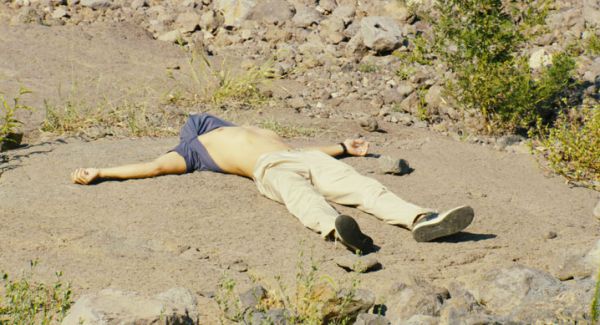
Kim Tae-woo is outstanding as annoying, self-obsessed auteur in Hong Sang-soo’s LIKE YOU KNOW IT ALL

Kim Tae-woo is outstanding as annoying, self-obsessed auteur in Like You Know It All

LIKE YOU KNOW IT ALL (Hong Sangsoo, 2009)
Tuesday, April 12, 8:45 (with Virgin Stripped Bare by Her Bachelors)
Thursday, April 14, 6:30 (with On the Beach at Night Alone)

Hong Sangsoo’s Like You Know It All is another intriguing examination of art and sex in contemporary society from the South Korean auteur. Hong, who has served as a juror at several film festivals and whose work has screened at fests all over the world, sets his latest self-reflexive story at the real Jecheon International Music and Film Festival, where director Ku will be part of the jury. But it turns out that Ku is a self-absorbed, insensitive, and subtly obnoxious filmmaker who cares only about himself, walking away from fans and colleagues in the middle of a conversation or in the midst of signing an autograph, interested only in listening to people praise his own talent, which has been relegated to art-house films that few people see and even fewer understand.

After leaving the festival to teach a class at a school on Jeju Island, he visits with a famous painter and former mentor who has unknowingly married Ku’s first love, setting the stage for the creepy Ku to perform yet more selfish acts. Kim Tae-woo is outstanding in the lead role, playing the self-obsessed director with an unerring casualness that makes him more absurdly ridiculous than conniving and mean-spirited. With a little bit of Federico Fellini’s 8 1/2 here and a touch of Woody Allen’s Stardust Memories there, Hong once again reveals the soft underbelly of ego within the film industry, but he also needs to edit himself more, as the bittersweet, slyly ironic Like You Know It All, made for a mere $100,000, is yet another of his films to clock in at more than two hours (though it feels longer).
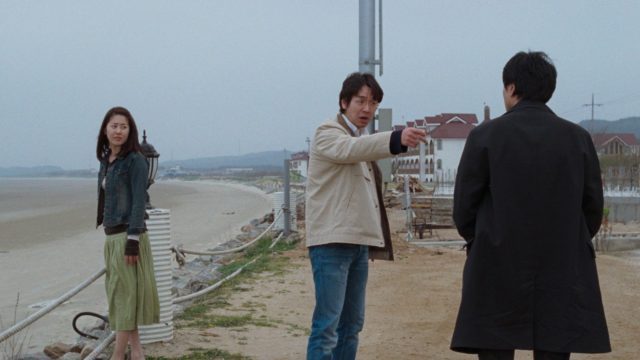
Woman on the Beach in another beautifully shot though overly long drama about art and love from Hong Sangsoo

WOMAN ON THE BEACH (Hong Sangsoo, 2006)
Saturday, April 16, 1:00 (with Nobody’s Daughter Haewon)
Sunday, April 17, 7:45 (with Woman Is the Future of Man)

In another film set in the world of cinema, Hong Sangsoo’s Woman on the Beach centers on director Joong-rae (Kim Seung-woo), who is having trouble with the script for his next project, so he gets production designer Chang-wook (Ki Tae-woo) to drive him out to Shinduri Beach for some quiet relaxation, away from the hustle and bustle of Seoul. Chang-wook brings along his girlfriend, Moon-sook (Ko Hyun-joung), an aspiring composer and singer who is immediately attracted to Joong-rae. As Chang-wook’s jealousy grows and Moon-sook and Joong-rae wonder if they have a future together, the director meets Sun-hee (Song Sun-mi), a soon-to-be divorcée who also has eyes for Joong-rae. Writer-director Hong Sang-soo’s moving romantic comedy features beautiful locations shot by Kim Hyung-koo, a sweet score by Jeong Yong-jin, and unusual but believable characters. At 127 minutes, the film, which was selected for the 2006 New York Film Festival, is far too long, not quite knowing how to end, but stick with it nonetheless.

HAEWON

A drunken night at a sake restaurant reveals some hard truths in another bittersweet cinematic tale

NOBODY’S DAUGHTER HAEWON (Hong Sangsoo, 2013)
Saturday, April 16, 3:30 (with Woman on the Beach)
Friday, May 6, 3:45 (with In Front of Your Face)

In South Korean director Hong Sangsoo’s bittersweet tale Nobody’s Daughter Haewon, nearly everyone who meets college student Haewon (Jeong Eun-chae) tells her that she’s “pretty,” from her mother (Kim Ja-ok), who has decided to pack up and move to Canada, to legendary star Jane Birkin (playing herself), whom she bumps into on the street, to a hot bookstore owner, to fellow students and teachers. Rather stuck up and direct on the outside but much more tender and lost on the inside, Haewon reaches out to a former lover, film professor Seongjun (Lee Sun-kyun), who is married with a baby. As they contemplate rekindling their affair, they wind up getting drunk on sake with a group of Seongjun’s students, who suspect the teacher-student romance and clearly do not like Haewon. Meanwhile, Haewon, who is reading Norbert Elias’s The Loneliness of the Dying, is intrigued by the flirtations of another film professor, Jungwon (Kim Eui-sung), who teaches in San Diego. From Seoul’s West Village to the historic Fort Namhan, Haewon tries to find her place in the world as writer-director Hong employs a chronological narrative that combines her dreams with reality over the course of a few weeks in springtime. Hong has explored similar terrain in previous films, but there’s just enough of an edge to Nobody’s Daughter Haewon to prevent it from feeling repetitive and more of the same. As always, Hong favors long establishing shots and a stationary camera that suddenly and awkwardly zooms in, instantly reminding viewers that they are watching a film. However, the scene in the restaurant goes on for several minutes with no cuts or camera movements, letting the acting and the dialogue tell the story without cinematic interference. Nobody’s Daughter Haewon also clocks in at a mere hour and a half, much shorter than most of his earlier work, which tends to go on way too long, but this one feels a little lighter in substance as well.
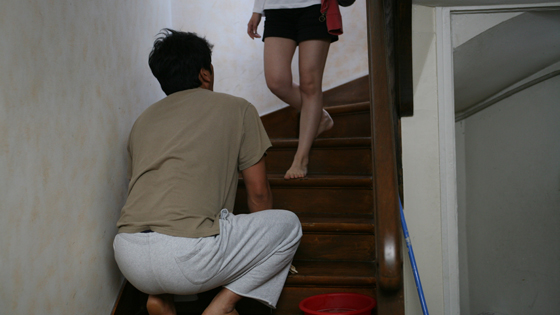
Sungam (Kim Young-ho) battles displacement and loneliness in Night and Day

NIGHT AND DAY (Hong Sangsoo, 2008)
Saturday, May 7, 6:30 (with On the Beach at Night Alone)
Sunday, May 8, 8:00 (with Claire’s Camera)

Hong Sangsoo returned to the New York Film Festival for the fifth time with Night and Day, a character-driven tale about displacement and loneliness. Kim Young-ho stars as Sungam, a married painter in his forties who flees South Korea for France after having been turned in for smoking marijuana with U.S. tourists. A fish out of water in Paris, he settles into a Korean neighborhood, spending most of his time with two young art students, Yujeong (Park Eun-hye) and Hyunju (Seo Min-jeong). He also meets an old girlfriend, Minsun (Kim You-jin), who is still attracted to him. And every night he calls his wife, Sungin (Hwang Su-jung), wondering when he’ll be able to return home. Hong tells the story in a diary-like manner, with interstitials acting like calendar pages. Sometimes a day can be filled with talk of art, a party, and a chance encounter, while others can consist of a brief, random event with no real bearing on the plot, reminiscent of Jim Jarmusch’s Stranger Than Paradise, just without the existential cynicism and dark humor. As with 2006’s Woman on the Beach, Hong lets Night and Day go on too long (it clocks in at 141 minutes), with too many inconsequential (even if entertaining) vignettes, but it’s so much fun watching Kim’s compelling performance that you just might not care about the length.
JOACHIM TRIER — THE OSLO TRILOGY

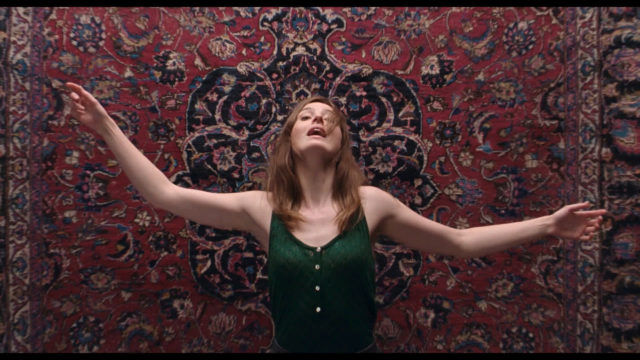
Renate Reinsve is captivating as a free spirit unable to settle down in The Worst Person in the World

THE OSLO TRILOGY
Film at Lincoln Center, Walter Reade Theater
165 West 65th St. at Amsterdam Ave.
January 28 – February 3
The Worst Person in the World opens February 4
212-875-5601
www.filmlinc.org
neonrated.com

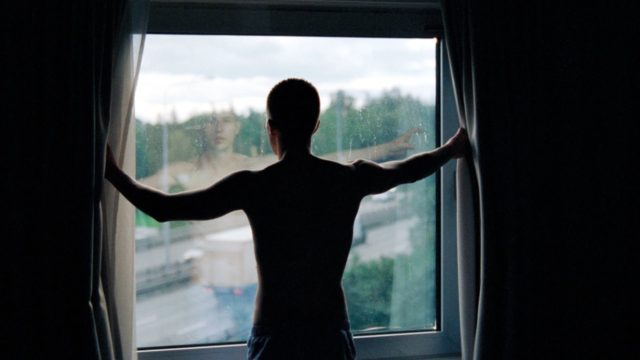
Norwegian director Joachim Trier concludes his Oslo Trilogy with the riveting The Worst Person in the World, which is having a preview screening at Lincoln Center on January 28 before opening there on February 4. Shortlisted for Best International Feature Film, it is part of a weeklong series that includes the first two parts of the trilogy, 2006’s Reprise and 2011’s Oslo, August 31st, along with works selected by Trier and cowriter Eskil Vogt that influenced them.

The Worst Person in the World is highlighted by an unforgettable, captivating performance by Renate Reinsve, who was named Best Actress at Cannes for her portrayal of a young woman who knows what she doesn’t want but isn’t sure about what she does desire. Divided into twelve chapters in addition to a prologue and epilogue, the film follows Julie as she goes from a medical student to a bookstore employee to a photographer, along the way falling in and out of love with a series of men she doesn’t always treat very well. We are often appalled by what Julie does and says, but it’s nearly impossible to turn our backs on her.

Kasper Tuxen’s camera utterly adores Reinsve, with alluring close-ups of her extraordinary eyes, which reveal both her need to be with someone and her craving for freedom. Shortly after meeting Aksel (Anders Danielsen Lie), an older comic book artist, Julie crashes a wedding party and is instantly drawn to Eivind (Herbert Nordrum); although both have significant others, they dive straight into a gorgeously filmed seduction that involves no touching, wondering whether that counts as cheating. It’s a marvelous scene that questions the very nature of relationships and fidelity and sets the stage for everything that comes next.

Despite Julie’s being the protagonist, the title does not refer only to her; at one point, Eivind thinks he might be the worst person in the world, and the film is likely to make you consider whether you have done anything in your life worthy of the designation. Trier and Vogt explore the dichotomy of intimacy and independence, resulting in a work of deep thought and intelligence. There will be a postscreening Q&A on January 28 at 6:00 with Trier, Reinsve, and Lie, who has major roles in all three part of the trilogy; Trier and Reinsve will be back at the Walter Reade Theater on February 4 for a Q&A following the 5:30 show.

The Oslo Trilogy began in 2006 with Trier’s feature debut, Reprise, in which Erik (Espen Klouman Høiner) and Phillip (Lie) are best friends who want to become literary sensations. Their lives spiral in and out of control as their dreams come within reach in a film swirling with a punk aesthetic. Reprise is screening January 29 and 31 and February 3, with Trier and Lie on hand for a Q&A at the January 29 show at 6:00.

Anders Danielsen Lie is brilliant as a young man trapped in a world of his own making in Oslo, August 31st

Lie is brilliant as a drug addict in Oslo, August 31st, the middle section of the trilogy. He stars as Anders, a junkie who, early on, attempts suicide by filling his pockets with heavy stones and walking into a lake, a la Virginia Woolf. At the last minute he changes his mind and returns to the rehab clinic where he’s trying to get clean. But when he gets a one-day leave in order to interview for a plum job, as an editorial assistant for a well-known literary journal, he challenges his sobriety by visiting old friends and an ex-lover he still pines for and seeking to see his sister, who is severely disappointed in him.

Lie is a powder keg of desperation as Anders, reminiscent of Jeremy Strong’s portrayal of Kendall Roy in Succession. He is lost in his own warped reality, refusing help when offered, sure that he is the only one who really understands what is going on inside him. It’s all the more painful to watch because he is wasting such promise, wandering from scene to scene in a fog of his own making. It’s a cautionary tale that begins with random people talking about their life in Oslo, as Trier and Vogt narrow down to the details of one man’s ills. Oslo, August 31st is screening January 30 and February 2 and 3, with Trier and Lie participating in a Q&A at the January 30 show 2:30.

Joachim Trier will introduce Arnaud Desplechin’s My Sex Life . . . or How I Got into an Argument at Lincoln Center on January 30

In conjunction with the theatrical opening of The Worst Person in the World on February 4, Trier and Cogt have chosen nine films that have impacted their work and/or they just plain love. The impressive list consists of Martin Scorsese’s The Age of Innocence (introduced by Trier on January 29), John Hughes’s The Breakfast Club, Agnès Varda’s Cléo from 5 to 7, Éric Rohmer’s The Green Ray (introduced by Trier on January 28), Alain Resnais’s Hiroshima mon amour, a digital restoration of Arnaud Desplechin’s My Sex Life . . . or How I Got into an Argument (introduced by Trier on January 30), George Cukor’s The Philadelphia Story, Erik Løchen’s Remonstrance, and Larisa Shepitko’s Wings.

CAMERA MAN: DANA STEVENS ON BUSTER KEATON

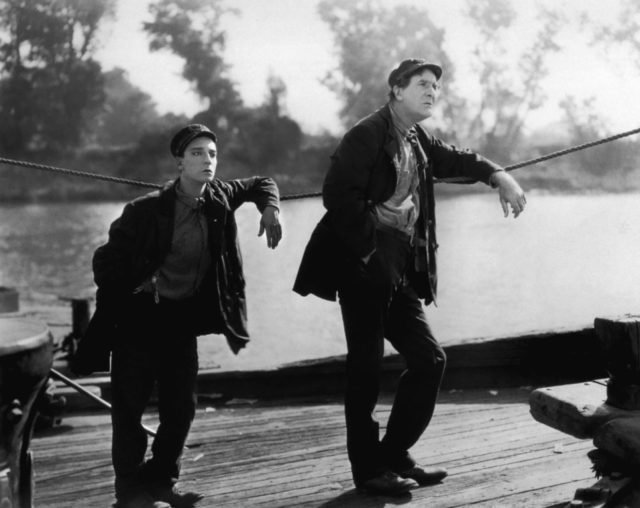
Bill Jr. (Buster Keaton) mimics his father, Bill Campbell (Ernest Torrence), in silent film classic

Who: Dana Stevens, Imogen Sara Smith
What: Screening and discussion about Buster Keaton
Where: Film at Lincoln Center, Elinor Bunin Munroe Film Center, Francesca Beale Theater, 144 West Sixty-Fifth St.
When: Thursday, January 27, $15, 7:00
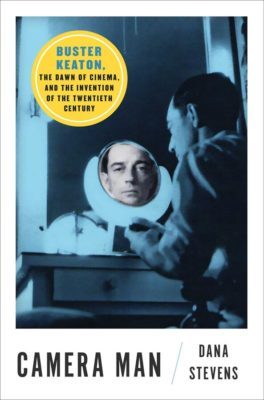
Why:Steamboat Bill, Jr. may be [Buster] Keaton’s most mature film, a fitting if too-early farewell to his period of peak creative independence,” Slate film critic Dana Stevens writes. “Its relationship to the rest of its creator’s work has been compared to that of Shakespeare’s last play, The Tempest.” Stevens gets serious about the Great Stone Face, one of silent film’s best comics, in her brand-new book, Camera Man: Buster Keaton, the Dawn of Cinema, and the Invention of the Twentieth Century (Atria, $29.99).

In celebration of the launch of the tome, Stevens will be at Lincoln Center’s Francesca Beale Theater on January 27 at 7:00 to screen a 4K restoration of the 1928 classic, directed by Charles Reisner, about a riverboat battle and true love, preceded by a 2K restoration of Keaton and Edward F. Cline’s twenty-five-minute masterpiece, One Week, about a pair of newlyweds (Keaton and Sybil Seely) and their unusual new home. (Both films feature orchestral scores by American composer Carl Davis.) Stevens will put Keaton’s life and work in sociocultural context with Criterion contributor Imogen Sara Smith, author of Buster Keaton: The Persistence of Comedy. If you’ve never seen Keaton on the big screen, now is the time, as no one could turn tragedy into comedy quite like Keaton.

NEW YORK JEWISH FILM FESTIVAL 2022

Alicia Jo Rabins offers a public kaddish for Bernie Madoff in new film

THIRTY-FIRST ANNUAL NEW YORK JEWISH FILM FESTIVAL
Walter Reade Theater, Film at Lincoln Center
165 West 65th St. between Broadway & Amsterdam Aves.
January 12-25, $12 virtual (all-access $85), $15 in person (all-access $95)
212-875-5050
www.filmlinc.org
thejewishmuseum.org

The 2022 New York Jewish Film festival goes hybrid this year, with more than two dozen shorts and features exploring Jewish art, history, culture, and politics around the world. Running January 12-25 both at the Walter Reade Theater and online, the thirty-first annual event, a collaboration between Film at Lincoln Center and the Jewish Museum, includes in-person introductions and Q&As for many screenings. The opening-night selection is Mano Khalil’s autobiographical Neighbours, about a six-year old Kurdish boy enamored with the last Jewish family in his village as nationalism and anti-Semitism rise up. The centerpiece is Kaveh Nabatian’s Sin La Habana, dealing with cross-cultural relationships in Cuba. And Aurélie Saada’s Rose closes things out, a tale about a suddenly widowed woman, played by French legend Françoise Fabian, who has to reevaluate her future as she approaches her eightieth birthday.

In addition, there will be a special tribute to film scholar, author, archivist, educator, activist, filmmaker, and independent distributor Pearl Bowser, with virtual screenings of Lloyd Reckord’s 1963 short Ten Bob in Winter and Oscar Micheaux’s 1925 classic, Body and Soul, along with a ten-minute November 2021 interview with Bowser at the Jewish Museum reflecting on the 1970 exhibition she curated there, “The Black Film.”

A KADDISH FOR BERNIE MADOFF (Alicia J. Rose, 2021)
Walter Reade Theater, Film at Lincoln Center
Monday, January 17, 1:00 & 7:00
www.filmlinc.org
www.akaddishforberniemadoff.com

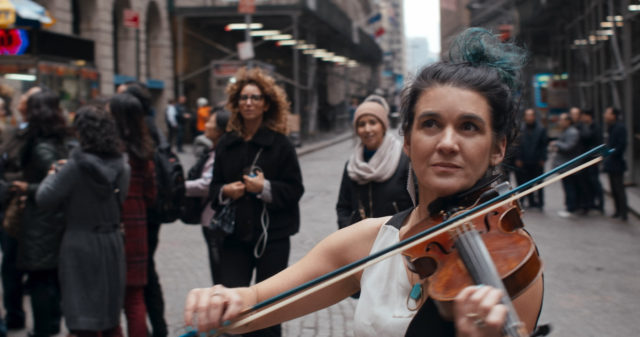
I kicked myself when I missed Alicia Jo Rabins’s one-woman show, A Kaddish for Bernie Madoff, when it debuted at Joe’s Pub in 2012. I had seen her play with the klezmer band Golem and had wanted to see the song cycle live. She released the album in 2014, but now she has collaborated with director and photographer Alicia J. Rose on a delightful, kooky film version, playing at the New York Jewish Film Festival on January 17 at 1:00 and 7:00, with Rose, Rabins, and producer Lara Cuddy at the Walter Reade Theater for postscreening Q&As.

Rose follows Rabins as she becomes endlessly fascinated with the story of Bernie Madoff, the financier who built an elaborate Ponzi scheme over forty years, bilking nearly five thousand clients out of billions of dollars. Rabins, in the midst of an arts residency in a Financial District office tower while earning money by teaching bat mitzvah girls how to chant from the Torah, spoke with numerous people impacted by Madoff’s fraud, from a credit risk officer (her mother’s college roommate), a whistleblower, and an FBI agent to a therapist, a lawyer, and a Buddhist monk.

“I wasn’t just obsessed with Bernie Madoff; I was obsessed with anyone who had a connection to him, and they kept coming, one after the other,” Rabins says in the film. “I interviewed them, went back to my studio, and turned their stories into songs. I was being sucked deeper and deeper into my obsession.”

Each song is its own set piece in a different space, with Rabins dressing up like the person (her wigs are particularly fun while evoking the work of Cindy Sherman) and detailing how they were affected by Madoff’s scheme in such pop tunes as “Due Diligence,” “No Such Thing as a Straight Line,” “Down on the Seventeenth Floor,” “My Grandfather Deserted the Czar’s Army,” and “What Was the Pathology There?” She is occasionally joined by members of her band (drummer David Freeman, cellist Jennifer Kersgaard), meets a couple of yentas by a Palm Beach pool (Robin McAlpine and Judy Silk), participates in synchronized swimming, and considers holding a ritual excommunication. “I hated thinking about Madoff as a Jew. I mean, he’s pretty much the definition of bad for the Jews,” she opines. She’s not the only one to feel that way.

A Kaddish for Bernie Madoff is a great fit for the festival because it is not only about Judaism but also about New York City, shot on location in and around Wall Street, the Lipstick Building in Midtown, the Williamsburg Bridge, and other familiar spots. There is cool animation by Zak Margolis and several Golem songs in the background as Rabins relates her life and art to Madoff’s legacy, incorporating what she refers to as a kabbalistic interconnectedness and a “messianic idea of perfection.” She questions the entire financial system as she explains, “Very few people knew he was just making shit up.” And she admits that “confronting Bernie was confronting myself.” You’re bound to connect with this film in more ways than you might think.

Documentary short explores little-known legacy of Poland-born Brooklyn artist known as Tania (© 2020 Rima Yamazaki)

SHORT FILMS ON CREATIVITY: UNTITLED (TANIA PROJECT) (Rima Yamazaki, 2020)
Available virtually January 20-25
www.filmlinc.org
rimayamazaki.com

In the fall of 2017, filmmaker Rima Yamazaki was invited by Ranger Mills, the widower of the late artist Tania Milicevic, to explore her legacy. Yamazaki, who has made previous films about still-life painter Ellen Altfest, on-site painter Rackstraw Downes, photographer James Casebere, and multimedia icon Joan Jonas, had never heard of Tania, but she took on the project, doing a deep dive into her work, which included painting, sculpture, collage, and public installations.

Yamazaki went through Tania’s letters, official documents, press clippings, family photographs, exhibition brochures, and personal writings to form a compelling portrait of the little-known artist, whose large-scale murals can still be seen at the corner of Mercer and Third St. in Manhattan (from 1970) and at 10 Evergreen Ave. in Brooklyn (1967), in addition to a Torah ark she designed for Tribeca Synagogue (1967). Tania was also an early feminist with intriguing statements about life and art — she favored geometric abstract patterns in multiple colors — that Yamazaki types out on the screen.

Rima Yamazaki uses split screens to explore the legacy of Tania (© 2020 Rima Yamazaki)

“I had four husbands . . . but I don’t think I’ve ever been married,” Tania, who was born Tatiana Lewin in Łódź, Poland, in 1920, wrote. “I want to escape gravity and the surfaces that prevent us from feeling our weight — Can we understand what we cannot feel?” she jotted down. And: “I never know what the art world is talking about. . . . I hope they do.”

Yamazaki visits the sites of Tania’s work while also going through her old studio. She uses split-screens to show photos of Tania’s oeuvre, including slides taken by Joel-Peter Witkin, known for his depictions of corpses and grotesque figures. We learn about the Construction Process Environment that Tania and Nasson Daphnis were commissioned to design in 1971 at 1500 Broadway in Times Square as well as her plans for city rooftops, which was left unfinished after her death from cancer in 1982. Yet we never see or hear Tania speak, or see others talk about her. It’s an intensely personal journey for Yamazaki, who shares only select tidbits.

The twenty-five-minute documentary will be available virtually January 20-25 as part of the New York Jewish Film Festival program “Short Films on Creativity,” which also includes Cynthia Madansky’s AA (about poet and photographer Anna Alchuk), Yoav Potash’s Beregovsky #136 (about folklorist Moshe Beregovsky), Asali Echols’s The Violin Upstairs (about the filmmaker’s violin), Eli Zuzovsky’s Mazel Tov (about Adam Weizmann’s wartime bar mitzvah), and Adrienne Gruben’s Lily (about comic-book artist Lily Reneé).

FRANCE

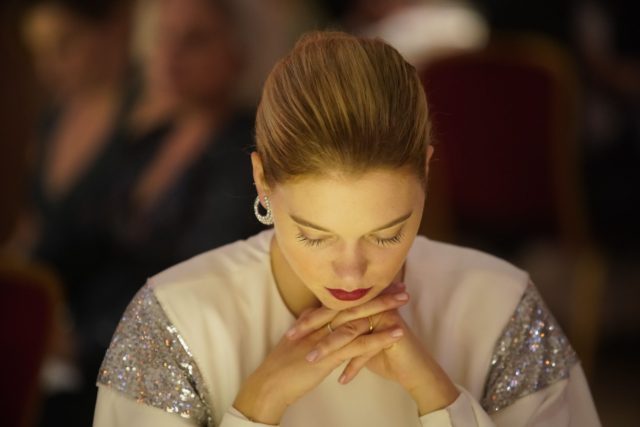
Léa Seydoux is radiant as a famous journalist facing a crisis in Bruno Dumont parable France

FRANCE (Bruno Dumont, 2021)
Film at Lincoln Center, Walter Reade Theater, Francesca Beale Theater
144/165 West Sixty-Fifth St. at Amsterdam Ave.
www.filmlinc.org

“Doing harm once doesn’t mean you’ll keep doing it. That said, if you don’t think someone can change. . . . You believe in nothing. Everyone can change,” an interview subject (Annick Lavieville) tells star television journalist France de Meurs (Léa Seydoux) in Bruno Dumont’s overstuffed social satire, France. The film’s title refers not only to the reporter but to the country itself, as de Meurs’s experiences are supposed to mimic those of the republic’s, although it’s not always clear how.

The film opens with France playing gotcha with President Emmanuel Macron at a press conference; reveling in her attack question, she makes funny faces with her producer, Lou (Blanche Gardin), as if Macron’s answers don’t matter. And indeed they don’t; on her flashy news show, A View of the World, the fearlessly ambitious France creates her own reality, whether it’s manipulating a meeting in the mountains with a Tuareg chief (Youannes Mohammed) battling ISIS jihadists, disregarding fans wanting autographs, hosting political debates on her program, or giving short shrift to her husband, Fred (Benjamin Biolay), and their young son, Jojo (Gaëtan Amiel). She is dismissive, cynical, selfish, and self-serving, as it’s all about the optics and furthering her furious need to succeed.

We might not like her — in fact, we might despise her, which is part of the point, as she represents the state of contemporary media — but every once in a while she lets some actual humanity seep in. When she accidentally injures a man named Baptiste (Jawad Zemmar), she seems genuinely concerned, as he is the sole support for his immigrant parents (Noura Benbahloouli and Abdellah Chadouat). But the North African family is so in awe that such a famous person is visiting them and trying to help, even though she caused the accident and injury, that they refuse to accept any money from her. It presages a later accident that will change her life in a very different way.

Written and directed by Dumont (Camille Claudel 1915, La Vie de Jésus), France keeps the viewer at a distance, perhaps just like the country does. Cinematographer David Chambille’s camera adores Seydoux (The French Dispatch, No Time to Die, Blue Is the Warmest Color), whether she’s dressed in glamorous outfits or wearing military gear in the middle of a firefight. Her shoulder-length blond hair and ruby-red lipstick light up the screen even when she is staring off into the distance, deep in thought that she is likely never to reveal, or perhaps even fully understand herself. France is like an old-fashioned movie star as the film comments on cinema itself in a digital age of reality television and the twenty-four-hour cycle of biased and fake news.

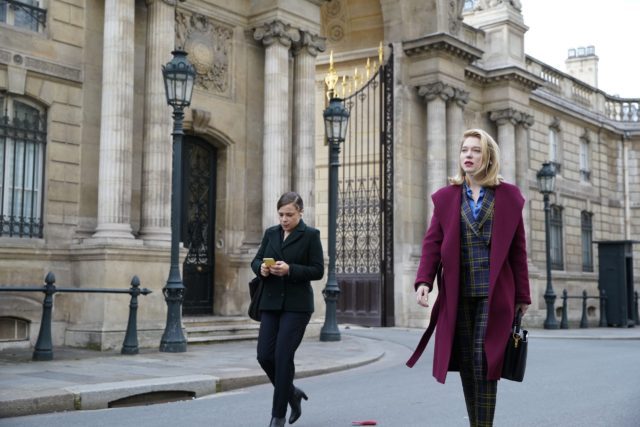
Lou (Blanche Gardin) and France de Meurs (Léa Seydoux) prepare to manipulate their next story in France

Dumont also takes on the social order. “The golden age of nations is over. Nations have lost their authority for good,” a speaker tells guests at a fundraiser. Talking about capitalism, redemption, and salvation, a man at France’s table says, “Believe me, we must give, we must give and keep giving. You won’t run out of money, we’re so rich. To die well, one must die poor. Once you’re dead, your kindness will remain.” But all of the kindness may have already been drained out of de Meurs, without her even realizing it.

The relationship between de Meurs and Lou evokes that of Midge (Rachel Brosnahan) and Susie (Alex Bornstein) on The Marvelous Mrs. Maisel, but here the pair of women are so unpleasant that you don’t want to see them together too much. And by the time we’re supposed to at last feel some sympathy and concern for France, it’s too late.

“France is sad,” a man says at one point. He could be referring to the country, the character, or the film itself.

BAD LUCK BANGING OR LOONY PORN: A SKETCH FOR A POSSIBLE FILM

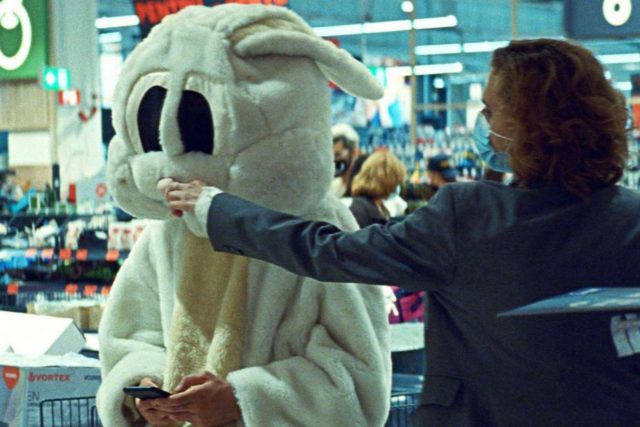
Emi (Katia Pascariu) goes on a strange journey in Rade Jude’s Bad Luck Banging or Loony Porn

BAD LUCK BANGING OR LOONY PORN: A SKETCH FOR A POSSIBLE FILM (BABARDEALA CU BUCLUC SAU PORNO BALAMUC) (Radu Jude, 2021)
Film at Lincoln Center, Walter Reade Theater, Francesca Beale Theater
144/165 West Sixty-Fifth St. at Amsterdam Ave.
Film Forum, 209 West Houston St.
Opens Friday, November 19
www.filmlinc.org
filmforum.org

Radu Jude’s brilliantly absurdist Bad Luck Banging or Loony Porn lives up to its title, a wildly satiric takedown of social mores that redefines what is obscene. Winner of the Golden Bear for Best Film at the 2021 Berlinale, the multipart tale begins with an extremely graphic prologue, a XXX-rated homemade porn video with a woman and an unseen man holding nothing back. In the first main section, the woman, a successful teacher named Emi (Katia Pascariu), is distressed to learn that the video is threatening to go viral. She determinedly walks through the streets of Bucharest, buying flowers (which she holds upside down), discussing her dilemma with her boss, the headmistress (Claudia Ieremia), and calling her husband, Eugen, trying to get the video deleted before her meeting with angry parents at the prestigious private school where she teaches young children.

Jude and cinematographer Marius Panduru follow the masked Emi — the film was shot during the pandemic, so masks are everywhere — on her journey, the camera often lingering on the scene well after Emi has left the frame, focusing on advertising billboards, couples in the middle of conversations, people waiting for a bus, and other random actions, before finding Emi again. She sometimes fades into the background, barely seen through the windows of a passing vehicle or amid a crowd crossing at a light. She gets into an argument with a man who has parked on the sidewalk, blocking her way; she insists that he move the car, but he unleashes a stream of misogynistic curses. Swear words are prevalent throughout the film, mostly adding poignant humor.

The second segment consists of a montage of archival and new footage that details some of Romania’s recent history, involving the military, the government, religion, fascism, Nazi collaboration, patriotism, the two world wars, the 1989 revolution, Nicolae Ceaușescu, domestic violence, jokes about blondes, and the value of cinema itself. The bevy of images also points out which NSFW word is most commonly looked up in the dictionary, as well as which is second. (The film is splendidly edited by Cătălin Cristuțiu, with a fab soundtrack by Jura Ferina and Pavao Miholjević.)

It all comes together in the third section, in the school garden, where Emi faces a few dozen masked, socially distanced, very angry parents and grandparents who want her fired immediately, while the headmistress demands a calm discussion. The masked Emi is a stand-in for all of us, facing the wrath of the unruly mob forcing its sanctimonious platitudes on others when it really needs to look at itself. It’s a riotously funny sitcomlike debate in which Jude roasts many common, hypocritical beliefs held by Romanians (and people all over the world) that have not necessarily changed much from the news clips shown in the previous part.

The cartoonish cast, which includes Olimpia Mălai as Mrs. Lucia, Nicodim Ungureanu as Lt. Gheorghescu, Alexandru Potocean as Marius Buzdrugovici, and Andi Vasluianu as Mr. Otopeanu, really gets to strut its stuff while making sure their masks are properly covering their mouths and noses. They argue about beloved national poet Mihai Eminescu and Russian writer Isaac Babel, delve into various sexual positions, repeat Woody the Woodpecker’s trademark call, and quote long, intellectual passages from the internet as Jude (I Do Not Care If We Go Down in History as Barbarians, Aferim!) reveals where society’s true obscenities lie. It’s an irreverent tour de force that offers three distinct endings to put a capper on the strangely alluring affair, turning a scary mirror on the sorry state of twenty-first-century existence.

Playfully subtitled A Sketch for a Possible Film in a reference to André Malraux’s description of Eugène Delacroix’s belief that his sketches could be of the same quality as his paintings, Bad Luck Banging or Loony Porn, Romania’s official Oscars submission, opens November 19 at Lincoln Center and Film Forum.

NYFF59: FREE TALKS

Apichatpong Weerasethakul will discuss his new film, Memoria,) at NYFF59 free talk

NYFF59 FREE TALKS
Film at Lincoln Center
Elinor Bunin Munroe Film Center Amphitheater
144 West Sixty-Fifth Street between Broadway & Amsterdam Ave.
September 25 – October 9, free (first come, first serve one hour before program)
www.filmlinc.org

The New York Film Festival, which opens today, has just announced its slate of free talks, taking place September 25 to October 9 at the Elinor Bunin Munroe Film Center Amphitheater (with one exception). Admission is first come, first served starting an hour before each event; the talks will also be recorded for later on-demand viewing on YouTube. The highlight is the inaugural Amos Vogel Lecture, honoring the centennial of the birth of the cofounder of the festival, who is also the subject of a centenary retrospective. The lecture will be given by Albert Serra, the director of previous NYFF selections The Death of Louis XIV and Liberté and who wrote the foreword for the French edition of Vogel’s seminal book, Film as a Subversive Art.

The rest of the panel discussions, in-depth conversations, and filmmaker dialogues are divided into “Deep Focus,” “Crosscuts,” and “Film Comment Live,” with such participants as Jane Campion (The Power of the Dog), Sofia Coppola, Mia Hansen-Løve (Bergman Island), Joachim Trier (The Worst Person in the World), Todd Haynes (The Velvet Underground), Apichatpong Weerasethakul (Memoria, Night Colonies), Ryûsuke Hamaguchi (Drive My Car, Wheel of Fortune and Fantasy), and Amy Taubin. The discussion about the thirtieth anniversary of Mississippi Masala with director Mira Nair, star Sarita Choudhury, and cinematographer Ed Lachman, moderated by Jhumpa Lahiri, follows the free screening of the film in Damrosch Park, for ticket holders only. Below is the full schedule.

Jane Campion will delve into her NYFF59 centerpiece selection, The Power of the Dog, with Sofia Coppola

Saturday, September 25
Deep Focus: The Making of Mississippi Masala, with Mira Nair, Sarita Choudhury, and Ed Lachman, moderated by Jhumpa Lahiri, Damrosch Park, 9:30

Sunday, September 26
Roundtable: Cinema’s Workers, with Abby Sun, Ted Fendt, Kazembe Balagun, and Dana Kopel, moderated by Gina Telaroli, Amphitheater, 7:00

Monday, September 27
Crosscuts: Mia Hansen-Løve & Joachim Trier, Amphitheater, 7:00

Saturday, October 2
Deep Focus: Jane Campion, moderated by Sofia Coppola, Amphitheater, 4:00

Crosscuts: Silvan Zürcher & Alexandre Koberidze, Amphitheater, 7:00

Sunday, October 3
Film Comment Live: The Velvet Underground & the New York Avant-Garde, with Todd Haynes, Ed Lachman, and Amy Taubin, Amphitheater, 4:00

Deep Focus: Ryûsuke Hamaguchi, Amphitheater, 7:00

Tuesday, October 5
Deep Focus: Maggie Gyllenhaal & Kira Kovalenko, Amphitheater, 7:00

Thursday, October 7
Deep Focus: Apichatpong Weerasethakul, Amphitheater, 6:30

Saturday, October 9
Film Comment Live: Festival Report, with Devika Girish, Clinton Krute, Molly Haskell, Bilge Ebiri, and Phoebe Chen, Amphitheater, 7:00