Tag Archives: Film at Lincoln Center

NEW YORK JEWISH FILM FESTIVAL 2023

Cecilia Suárez stars in NYJFF closing night selection, Violeta Salama’s Alegría

THIRTY-SECOND ANNUAL NEW YORK JEWISH FILM FESTIVAL
Walter Reade Theater, Film at Lincoln Center
165 West 65th St. between Broadway & Amsterdam Aves.
January 12-23, $15 in person, $10 virtual (bundle $15)
212-875-5050
www.filmlinc.org
thejewishmuseum.org

The thirty-second annual New York Jewish Film Festival comes along at a time with rising anti-Semitism in America and around the world, disarray in the Israeli government amid the controversial return of a former leader, and continuing battles in the Middle East over human rights and land possession. Why should this year be different from any other year?

Running January 12-23 at Film at Lincoln Center, the series comprises twenty-one feature-length narrative films and documentaries and a program of six shorts by women that explore the past, present, and future of Judaism and the diaspora. The festival kicks off with the New York premiere of Fred Cavayé’s Farewell, Mr. Haffmann, in which Daniel Auteuil plays the title character, a jeweler in Nazi-occupied Paris trying to preserve his family. The opening-night selection is Ofir Raul Graizer’s America, about an Israeli swimming coach (Michael Moshonov) who returns to Tel Aviv after living in Chicago, a reunion that doesn’t go quite as planned; the screening will be followed by a Q&A with writer, director, and editor Graizer.

Hannah Saidiner’s My Parent, Neal is part of special shorts program at NYJFF

The centerpiece film is Delphine Coulin and Muriel Coulin’s Charlotte Salomon: Life and the Maiden, a documentary about the German-Jewish artist who was murdered at Auschwitz at the age of twenty-six but left behind a remarkable legacy; the film includes the voices of Vicky Krieps, Mathieu Amalric, and Hanna Schygulla, and both screenings on January 18 will be followed by a Q&A with the directors. The festival closes with Violeta Salama’s Alegría, about a single mother (Cecilia Suárez) wrestling with her own faith and the patriarchy as she ventures from Mexico to her hometown in the autonomous North African city of Melilla for her niece’s Orthodox wedding. Salama will discuss her debut feature after both screenings on January 22.

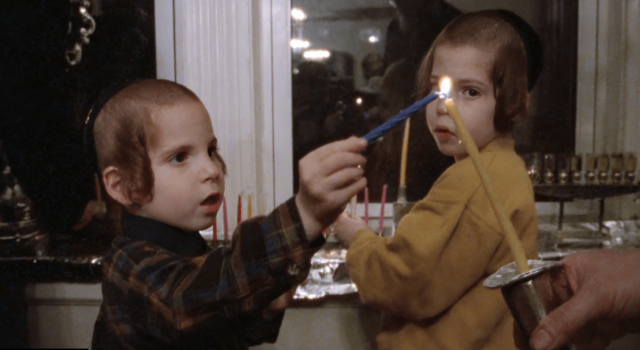
A Life Apart: Hasidism in America returns to the New York Jewish Film Festival in a twenty-fifth anniversary 4K restoration

Among the other highlights are Sylvie Ohayon’s Haute Couture, starring Nathalie Baye as a Dior seamstress in Paris; the New York premiere of Tomer Heymann’s I Am Not, a documentary about boarding school student Oren Levy, who shuns human contact, which will be followed by a hybrid Q&A with Heymann and several of the film’s subjects; the New York premiere of octogenarian Ralph Arlyck’s I Like It Here, a personal film about aging; Jake Paltrow’s June Zero, a fictionalized retelling of the 1961 trial of Adolf Eichmann from three different perspectives; and a pair of revivals, Joseph Green and Leon Trystand’s 1939 Yiddish film A Letter to Mother, and the world premiere of the twenty-fifth anniversary 4K restoration of Oren Rudavsky and Menachem Daum’s A Life Apart: Hasidism in America, a seminal documentary narrated by Sarah Jessica Parker and Leonard Nimoy and with a score by Yale Strom, followed by a panel discussion with Daum, Rudavsky, Ayala Fader, Marcus Allison, Pearl Gluck, and Rabbi Mayer Schiller.

(Keep watching this space for full and capsule reviews throughout the festival.)

Farewell, Mr. Haffmann offers a unique perspective on the Nazi occupation of Paris

FAREWELL, MR. HAFFMANN (Fred Cavayé, 2021)
Walter Reade Theater
Monday, January 16, 8:30
www.filmlinc.org

Fred Cavayé’s stunning Farewell, Mr. Haffmann offers several unique twists on the Holocaust drama, resulting in a breathtaking microcosm of so much of what happened, particularly during the Nazi occupation of France. The film is adapted from a play by Jean-Philippe Daguerre, with nearly all the action taking place in Joseph Haffmann’s jewelry shop, where Haffmann lives with his wife and three children. After getting his family out in May 1941, Haffmann finds himself trapped in Paris, cutting a deal with his assistant (Gilles Lellouche) and his wife (Sara Giraudeau) that grows ever-more dangerous as Nazi leaders start coming to the shop to buy jewelry for their wives and mistresses. Daniel Auteuil (Jean de Florette, Girl on the Bridge) is riveting as Haffmann, who experiences anti-Semitism and war from a fascinating perspective, both psychologically and physically.

Two men are at odds over religion and love in Ady Walter’s Shttl

SHTTL (Ady Walter, 2022)
Walter Reade Theater
Monday, January 16, 5:30, and Tuesday, January 17, 1:00
www.filmlinc.org

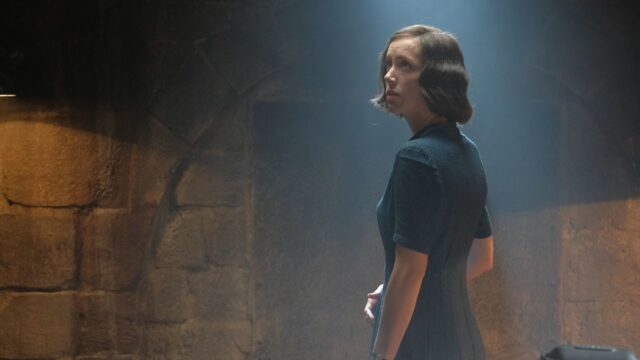
On the eve of Operation Barbarossa, the German invasion of the Soviet Union in June 1941, a small Yiddish-speaking village on the Polish border teeters on the edge as the citizens debate war, collaboration, religion, women’s roles in society, and true love. In the tense, gripping Shttl, Ady Walter pulls off quite an impressive directorial debut, shooting the 110-minute film in one continuous take, shifting between black-and-white and color as the narrative unfolds: Mendele (Moshe Lobel) joins the military, promising to come back for Yuna (Anisia Stasevich), but while he is gone she is wooed/harassed by the mean-spirited Folie (Antoine Millet), whose father (Saul Rubinek) is the community’s spiritual leader. The strange spelling of the title is an homage to Georges Perec’s 1969 novel, La Disparition (A Void), which never uses the fifth letter of the alphabet, its loss a symbol of profound absence. (Both of French novelist Perec’s parents were killed during the Holocaust, his father on the field of battle, his mother in Auschwitz.) The village, or shtetl, was built for the film and is being turned into a Jewish-Ukrainian museum. The screening on January 16 will be followed by a Q&A with Walter, New Yiddish Rep veteran Lobel, award-winning German-born Canadian actor Rubinek, and producer Jean-Charles Lévy.

Barren is a chilling look at faith and ritual

BARREN (Mordechai Vardi, 2022)
January 23-28, virtual only
www.filmlinc.org/films/barren

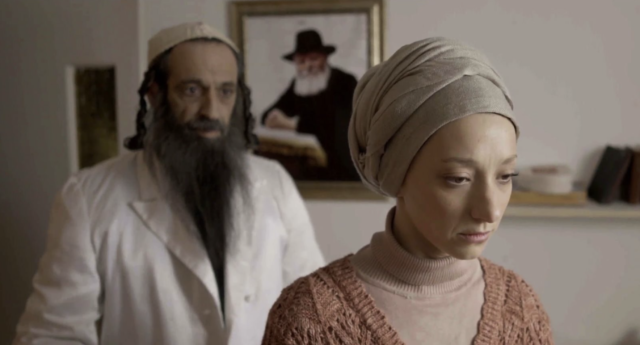
An intense melding of Unorthodox and Shtisel, Mordechai Vardi’s Barren is a heart-wrenching drama about an Orthodox couple, Naftali (Yoav Rotman) and Feigi (Mili Eshet), desperate to have a child. They live with his mother, a matchmaker (Ilanit Ben-Yaakov), and his father, a Torah scribe (Nevo Kimchi), both of whom were secular before becoming Orthodox. When Naftali goes on a pilgrimage to Uman for Rosh Hashanah to pray for fertility, his father invites over a mysterious man who has nowhere to spend the holiday. Rabbi Eliyahu (Gil Frank) claims to be able to heal by blowing the shofar; he offers to do so for Feigi, but their encounter turns terribly wrong, leading every member of the family to reconsider their faith and their personal responsibilities.

Eshet (Take the “A” Train, Beyond the Mountains and Hills) is haunting as Feigi, her eyes filled with yearning for what she imagined her life would be like. Based on actual events, the film focuses on the unjust treatment of women in Orthodox society, their rights determined by men, including local tribunals made up of supposedly wise scholars following religious doctrine, who decide what women should and should not do and whether they should remain married or get divorced. It’s a harrowing tale anchored by a powerful lead performance. The film will be available virtually January 23-28.

NYFF60 MAIN SLATE: ALL THAT BREATHES

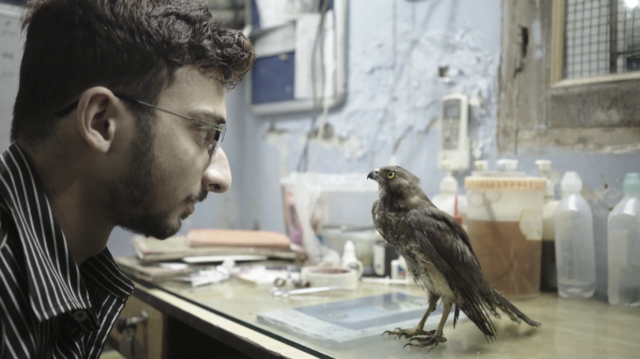
All That Breathes explores the fate of black kites in India as representative of so much more

ALL THAT BREATHES (Shaunak Sen, 2022)
New York Film Festival, Film at Lincoln Center
Tuesday, October 11, Walter Reade Theater, 6:30
Wednesday, October 12, Howard Gilman Theater, 9:00
www.filmlinc.org
www.allthatbreathes.com

Shaunak Sen’s All That Breathes opens with a long shot of rats scurrying about a filthy New Delhi area, then follows a man carrying four boxes with holes in them into a dingy, crowded basement garage. One starts to rock and falls awkwardly to the floor. The man walks over and takes out an injured bird. As Mohammad Saud, Nadeem Shehzad, and Salik Rehman examine the injured creature, they speak of a possible nuclear war between India and Pakistan.

“What’ll happen to the birds if there’s a nuclear war?” Rehman asks. “We’ll all die. Where will they go?”

A moment later, a young boy searches for a bullet, an announcement from the street advises, “We don’t want any harm to any public property,” and a black kite, a bird of prey that migrates to New Delhi every year, grips a small branch and then accusingly stares directly into the camera. Later street announcements declare, “This is a fight for empathy and unity! The Constitution has to be saved!” regarding the treatment of Islamic citizens.

For several decades, Indian Muslim brothers Saud and Shehzad have been rescuing and healing kites that have fallen from the sky, victim to pollution and the cotton threads of kites that slice their wings. “When we got our first kite . . . I’d stay up at night staring at it,” Shehzad says in voiceover as a lone kite soars in the air, the moon at its left. “It looked like a furious reptile from another planet. It’s said that feeding kites earns ‘sawab’ [religious credit]. When they eat the meat you offer, they eat away your difficulties. And their hunger is insatiable.”

When the brothers were teenage bodybuilders, they encountered their first injured kite. A bird hospital refused to help because the species is not vegetarian, so they used their own knowledge of flesh, muscles, and tendons to repair it. They’ve been rescuing and repairing hurt birds in their highly unsanitary quarters ever since.

Amid the social unrest and their legitimate fears of being turned into refugees because of their religion, Saud and Shehzad continue to fix the birds, as if fixing themselves as they worry about losing their freedom. Over one dinner they discuss with their families what they might do if the government kicks them out of the country. Meanwhile, the brothers are desperate to get a grant to keep their Wildlife Rescue operating.

“I’ve devoted my entire life to this. But this doesn’t feel enough to me,” Shehzad explains. “Things are getting from bad to worse here. Birds are plummeting from the sky. Delhi is a gaping wound. And we’re a tiny Band-Aid on it.”

Cinematographer Ben Bernhard focuses in on nature, from an icy river to an owl to dozens and dozens of kites filling the sky, set to a gentle yet ominous score by Roger Goula. Director and producer Sen (Cities of Sleep) is not just making a film about kites in India; he is accusing the world as a whole of misusing resources in ways that threaten the existence of such living creatures as kites and damage the planet’s ecological system.

“Man is the loneliest animal,” Saud says.

Winner of the Grand Jury Prize for Best Documentary (World Cinema) at Sundance and the L’OEil d’or for Best Documentary at Cannes, All That Breathes is screening at the New York Film Festival on October 11 and 12, with Sen on hand for Q&As after both shows. The film opens theatrically October 21 at Film Forum, with Sen participating in Q&As following the 7:00 shows on October 21 and 22.

NYFF60 MAIN SLATE: AFTERSUN

A father (Paul Mescal) and daughter (Francesca Corio) bond in Charlotte Wells’s Aftersun

AFTERSUN (Charlotte Wells, 2022)
New York Film Festival, Film at Lincoln Center
Saturday, October 8, Alice Tully Hall, 12:00
Sunday, October 9, Alice Tully Hall, 9:00
Monday, October 10, BAM Cinemas, 7:00
212-355-6160
www.filmlinc.org

At one point in Charlotte Wells’s hauntingly beautifully debut feature, Aftersun, a divorced father, Calum (Paul Mescal), and his eleven-year-old daughter, Sophie (Francesca Corio), are standing in the mountains, arms stretched to the sky as if the world is limitless for them, but nearby is an old, rotting sign that announces, “We know the perfect place,” once upon a time offering visitors “paradise.” The two are on vacation on the Mediterranean coast of Turkey, a bonding trip during which Calum assures Sophie, “You can live wherever you want to live. Be whoever you want to be.”

It is apparent that Calum and Sophie have not spent a lot of time together of late, as Calum has left their home country of Scotland following the divorce. In Turkey, they experience a warm and loving bond, as Calum learns how to be a father again and Sophie begins her transition into adolescence, neither one knowing exactly what comes next. Calum is watching his daughter grow up right in front of him, and he doesn’t always know quite how to react; as Sophie hangs out with a group of older teens as well as a boy her own age who has a crush on her, Calum allows her a freedom that threatens to be too much, sometimes acting more like a big brother or friend than a father. But as we discover, Sophie is an extraordinary capable young girl, coming of age in a world that is not a paradise for everyone.

Aftersun is a captivating adventure in which Scottish NYU grad Wells plays with genre tropes, gently turning them inside out as she makes the audience reevaluate their expectations from both real life and fictional drama. Many of the scenes are set up in a way that you anticipate a certain outcome — usually a dangerous one — but the bad result never happens, and we are disappointed in ourselves for having imagined a different conclusion.

The film is very much an extension of Wells’s early shorts, Blue Christmas, Laps, and Tuesday, in which she deals with such subjects as sexual abuse, the loss of a parent, and mental illness that threatens to tear a family apart. Wells favors a realistic pace, moving at the speed of life, with an expert sense of composition and a knack for avoiding unnecessary dialogue or explication while often using a handheld camera to keep things slightly off balance. We also get to see brief hints of Sophie as an adult (Celia Rowlson-Hall), thinking back on this critically formative vacation.

In Aftersun, Wells and cinematographer Gregory Oke incorporate pixelated digital shots and occasional grainy textures amid gorgeous images of the Turkish coast, lovingly edited by Blair McClendon and accompanied by a wistful score by Oliver Coates. The Irish Mescal (Normal People, The Lost Daughter) fully embodies the role of a father trying to redefine what’s important to him, while Corio, in her first film, having been chosen from a casting call of more than eight hundred actresses, is charming and delightful as Sophie; her eyes light up the screen with their sense of wonder at what awaits her, and us.

Aftersun is screening October 8-10 at the New York Film Festival with Wells participating in Q&As after the noon screening on October 8 (joined by Corio) and the October 9 show at 9:00; Wells will also take part in a free talk with Mia Hansen-Løve (One Fine Morning) on October 8 at 4:00 at the Elinor Bunin Munroe Film Center amphitheater. The film opens at Lincoln Center on October 21.

NYFF60 SPOTLIGHT: BONES AND ALL

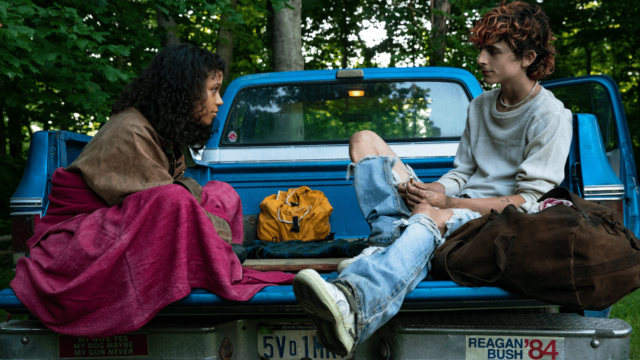
Maren (Taylor Russell) and Lee (Timothée Chalamet) try to find love among so much blood in Bones and All

BONES AND ALL (Luca Guadagnino, 2022)
New York Film Festival, Film at Lincoln Center
Thursday, October 6, Alice Tully Hall, 9:00
Saturday, October 8, Alice Tully Hall, 2:45
Tuesday, October 11, Alamo Drafthouse Staten Island, 6:00
Sunday, October 16, Walter Reade Theater, 5:45
www.filmlinc.org

Luca Guadagnino won the Silver Lion for Best Director at the Venice Film Festival for his horror/road movie/romance Bones and All, a Spotlight selection of NYFF60. The Italian director evokes Bonnie and Clyde and Dirty Mary, Crazy Larry in the tale of two young people who were born with a taste for human flesh. But they’re not vampires; they don’t come out only at night, and they don’t just suck out their victims’ blood but go for a much heartier meal.

At a sleepover with a few girls from her new high school, Maren Yearly (Taylor Russell) desperately wants to fit in, but things go astray when she starts munching on one of the girls’ fingers. Her father (André Holland), who has been shuttling her to small towns for years because of her needs, takes off, believing that he cannot protect her anymore, but he leaves behind a cassette tape in which he details her life; she listens to parts of the tape every day as her full story emerges.

On the run, she meets up with fellow cannibal and extremely creepy Sully (Mark Rylance), who is happy to have a companion and wants to become her mentor. But she eventually is back out on the road, hungry and desperate, not wanting to kill, when she meets up with cannibal drifter, Lee (Timothée Chalamet), who provides her with companionship, food, and love as they try to stay alive and not get caught.

Maren (Taylor Russell) and Lee (Timothée Chalamet) take a rare break in new horror romance

Russell (Lost in Space, Waves), who won the Marcello Mastroianni Award for emerging actor at Venice, is captivating as Maren, who just wants to have a normal life. Her eyes are filled with both fear and wonder at the world that awaits her. Chalamet (Call Me by Your Name, Dune) is compelling as the raggedy would-be hero with puppy-dog eyes. Oscar and Tony winner Rylance (Bridge of Spies, Wolf Hall) nearly steals the movie as Sully, until a misbegotten late scene, while Tony and Emmy nominee Michael Stuhlbarg (A Serious Man, Dopesick) is nearly unrecognizable as the wickedly devilish Jake. The film also features Oscar nominee Chloë Sevigny (Boys Don’t Cry, Big Love) as Maren’s mother, Anna Cobb as Kayla, Lee’s sister, Jessica Harper (Suspiria, My Favorite Year) as Maren’s grandmother, and filmmaker David Gordon Green (George Washington, Pineapple Express) as Brad, Jake’s friend.

Adapted by David Kajganich from Camille DeAngelis’s 2015 novel, Bones and All is riddled with plot holes and inconsistencies, asking the audience to suspend disbelief all too often, and its final scenes become clichéd and melodramatic, but it’s worth seeing for Russell’s performance alone, as well as the developing relationship between Maren and Lee, which is like a 1980s version of Bonnie Parker (Faye Dunaway) and Clyde Barrow (Warren Beatty) or Mary (Susan George) and Larry (Peter Fonda), although bloodier in its own way. The soundtrack is a blast, with a score composed by Trent Reznor and Atticus Ross and such songs as Leonard Cohen’s “You Want It Darker.” Guadagnino, Russell, and Sevigny will be at Alice Tully Hall on October 6 for a Q&A following the 9:00 screening.

NYFF60 REVIVALS: THE MOTHER AND THE WHORE

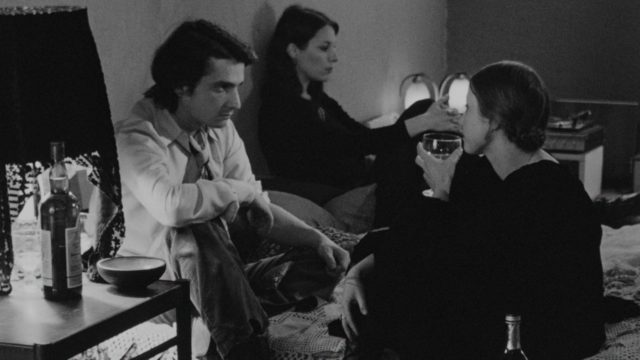
Jean-Pierre Léaud stars in Jean Eustache’s New Wave epic The Mother and the Whore, screening in a new 4K restoration at the New York Film Festival

THE MOTHER AND THE WHORE (LA MAMAN ET LA PUTAIN) (Jean Eustache, 1973)
New York Film Festival, Film at Lincoln Center
Wednesday, October 5, Walter Reade Theater, 6:15
Thursday, October 6, Howard Gilman Theater, 6:30
212-355-6160
www.filmlinc.org

Jean-Pierre Léaud gives a bravura performance in French auteur Jean Eustache’s Nouvelle Vague classic, The Mother and the Whore, about love and sex in Paris following the May 1968 cultural revolution. Léaud stars as Alexandre, a jobless, dour flaneur who rambles on endlessly about politics, cinema, music, literature, sex, women’s lib, and lemonade while living with current lover Marie (Bernadette Lafont), obsessing over former lover Gilberte (Isabelle Weingarten), and starting an affair with new lover Veronika (Françoise Lebrun), a quiet nurse with a rather open sexual nature. The film’s three-and-a-half-hour length will actually fly by as you become immersed in the complex characters, the fascinating dialogue, and the excellent cast. Much of the movie consists of long takes in which Alexandre shares his warped view of life and art in small, enclosed spaces, the static camera focusing either on him or his companion. “I’m convinced all recent happenings in the world were meant against me,” he narcissistically says.

Léaud previously appeared in Eustache’ss Le Père Noël a les yeux bleus; the director also made My Little Loves, Numéro zéro, and Une sale histoire in a career cut short by his death in 1981 at the age of forty-two. A new 4K restoration of the nearly fifty-year-old film is being shown October 5 at 6:15 and October 6 at 6:30 as part of the Revivals section of the sixtieth New York Film Festival; Lebrun and restoration producer Charles Gillibert will be at the Walter Reade for a Q&A following the October 5 screening, while Lebrun will introduce the October 6 screening at the Howard Gilman.

KEANE: 4K RESTORATION

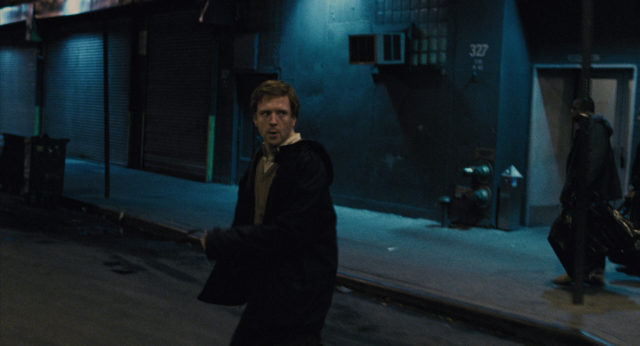
A 4K restoration of Keane, starring Damian Lewis, comes to Lincoln Center beginning August 19

KEANE (Lodge Kerrigan, 2004)
Film at Lincoln Center, Francesca Beale Theater, Elinor Bunin Munroe Film Center
144 West 65th St. between Eighth Ave. & Broadway
Opens Friday, August 19
www.filmlinc.org
grasshopperfilm.com

Lodge Kerrigan’s remarkable third feature, Keane, is mesmerizing, always teetering on the brink of insanity. Damian Lewis, years before Homeland and Billions, stars as William Keane, whom we first meet as he rants and raves in the Port Authority, filled with anger, paranoia, and a twitchiness that immediately sets you on edge and never lets up. He is trying to figure out what went wrong when his daughter was abducted from the area, but he now acts like just another crazy at the bus depot. As he befriends a desperate woman (Gone Baby Gone’s Amy Ryan) and her daughter (Little Miss Sunshine’s Abigail Breslin), you’ll feel a gamut of terrifying emotions rush through your body. The cast also features such familiar faces as Liza Colón-Zayas, Christopher Evan Welch, Chris Bauer, Frank Wood, Stephen McKinley Henderson, and others in tiny roles.

With Keane, Kerrigan, who made a big indie splash with his 1993 debut, Clean, Shaven, has created a brilliant psychological film centered on one man’s obsession that will leave you emotionally and physically spent. Filmed on location in 35mm with a handheld camera (with only one shot per scene) and natural sound, Keane has a taut realism that will knock you for a loop. You’ll love this film, but it will also scare the hell out of you.

A selection of the 2004 New York Film Festival, Keane is back at Lincoln Center beginning August 19 in a brand-new 4K restoration supervised by Kerrigan and TV and film editor Kristina Boden; Lewis and Kerrigan — who has made only one film since Keane, 2010’s Rebecca H. (Return to the Dogs), instead concentrating on directing episodes of such series as Homeland, The Killing, and The Girlfriend Experience — will participate in a Q&A following the 6:30 screening on August 20, moderated by Christopher Abbott.

“1962 . . . 1963 . . . 1964”

“1962 . . . 1963 . . . 1964”
Film Forum
209 West Houston St.
July 22 – August 11
212-727-8110
filmforum.org

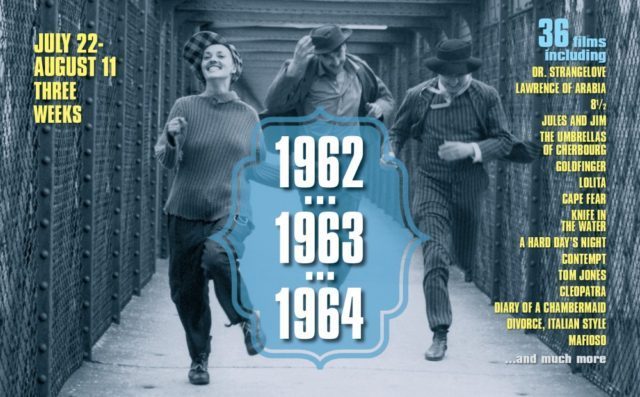
The years 1962, 1963, and 1964 were like no others in the history of America, and that evolving zeitgeist was captured on celluloid as the Hollywood studio system faded away. Film Forum is celebrating those three years with “1962 . . . 1963 . . . 1964,” a three-week series consisting of thirty-five cinematic works that, together, form a fascinating time capsule of the era. There are films by François Truffaut, David Lean, Stanley Kubrick, John Ford, Agnès Varda, Vittorio De Sica, Federico Fellini, Francis Ford Coppola, Alfred Hitchcock, Luis Buñuel, Sergio Leone, and many others, in multiple genres, with superstars ranging from Clint Eastwood, Marcello Mastroianni, and Sean Connery to Peter Sellers, Paul Newman, and the Fab Four.

The July 22 screening of Lolita will have a special prerecorded introduction from film critic and historian Stephen Farber. Below are select reviews from the festival, which is being held in conjunction with the Jewish Museum exhibition “New York: 1962-1964” and Film at Lincoln Center’s “New York, 1962-1964: Underground and Experimental Cinema.”
KNIFE IN THE WATER

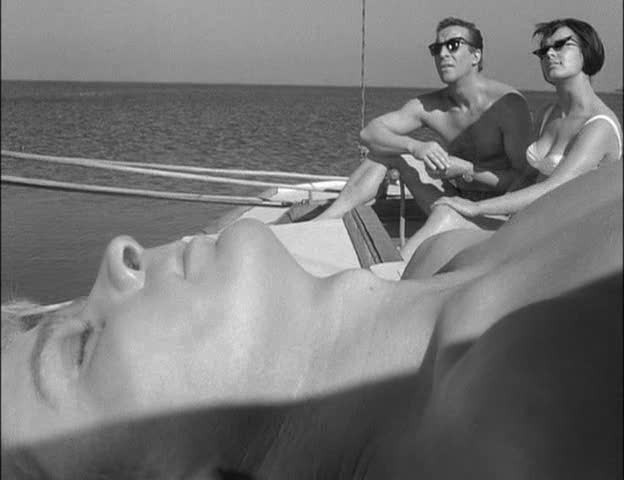
A young hitchhiker (Zygmunt Malanowicz) throws a kink in a couple’s sailing plans in Roman Polanski’s Knife in the Water

KNIFE IN THE WATER (NÓŻ W WODZIE) (Roman Polanski, 1962)
Saturday, July 23, 5:10, and Monday, July 25, 6:20
filmforum.org

“Even discounting wind, weather, and the natural hazards of filming afloat, Knife in the Water was a devilishly difficult picture to make,” immensely talented and even more controversial Roman Polanski wrote in his 1984 autobiography, Roman by Polanski. That is likely to have been a blessing in disguise, upping the ante in the Polish filmmaker’s debut feature film, a tense three-character thriller set primarily on a sailboat, filmed on location. Upper-middle-class couple Andrzej (theater veteran Leon Niemczyk) and Krystyna (nonprofessional actor Jolanta Umecka) are on their way to their sailboat at the marina when a young hitchhiker (drama school grad Zygmunt Malanowicz) forces them to pull over on an otherwise empty road. Andrzej and the unnamed man almost immediately get involved in a physical and psychological pissing contest, with Andrzej soon inviting him to join them on their sojourn, practically daring the hitchhiker to make a move on his wife.

Once on the boat, the two men continue their battle of wills, which becomes more dangerous once the young man reveals his rather threatening knife, which he handles like a pro. Lodz Film School graduate Polanski, who collaborated on the final screenplay with Jerzy Skolimowski (The Shout, Moonlighting) after initially working with Jakub Goldberg, envelops the black-and-white Knife in the Water — the first Polish film to be nominated for a Best Foreign Language Film Oscar and winner of the Critics’ FIPRESCI Prize at the 1962 Venice Film Festival — in a highly volatile, claustrophobic energy, creating gorgeous scenes intimately photographed by cinematographer Jerzy Lipman, from Andrzej and Krystyna in their small car to all three trying to find space on the boat amid the vast sea and a changing wind. Many of the shots are highlighted by deep focus in which one character is shown in close-up in the foreground with the others in the background, alerting the viewer to various potential conflicts — sexual, economic, class- and gender-based — all underscored by Krzysztof T. Komeda’s intoxicating jazz score featuring saxophonist Bernt Rosengren.
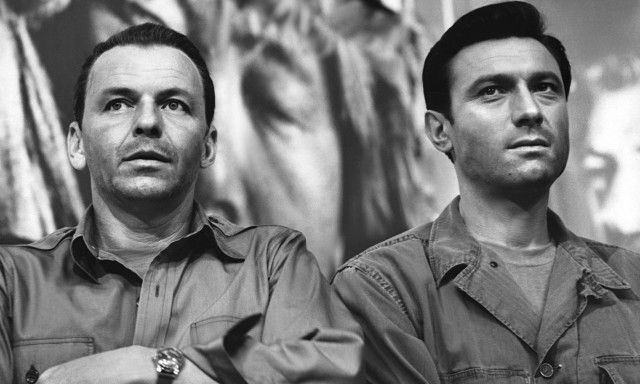
THE MANCHURIAN CANDIDATE

Bennett Marco (Frank Sinatra) and Raymond Shaw (Laurence Harvey) need to clear their heads in The Manchurian Candidate

THE MANCHURIAN CANDIDATE (John Frankenheimer, 1962)
Tuesday, July 26, 5:30, and Wednesday, August 10, 2:35
filmforum.org

John Frankenheimer’s unconventional Cold War conspiracy noir, The Manchurian Candidate, is, quite simply, one of the greatest political thrillers ever made. Ten years after fighting in Korea, Maj. Bennett Marco (Frank Sinatra) remains in the military, working in intelligence. He is haunted by terrifying nightmares in which his unit, led by Sgt. Raymond Shaw (Laurence Harvey), is at a woman’s gardening club lecture that turns into a Communist brainwashing session orchestrated by the menacing Dr. Yen Lo (Khigh Dheigh) of the Pavlov Institute. Meanwhile, the decorated but clearly tortured Shaw has to deal with his power-hungry mother, Mrs. Iselin (Angela Lansbury), who is manipulating everyone she can to ensure that her second husband, the McCarthy-like Sen. John Yerkes Iselin (James Gregory), becomes the Republican vice presidential nominee. As Marco gets to the bottom of the mystery, the clock keeps ticking toward an inevitable crisis with lives on the line and the very future of democracy at stake.

Written by George Axelrod based on the book by Richard Condon (Winter Kills, Prizzi’s Honor), The Manchurian Candidate is a tense, gripping work that feels oddly prescient when seen today. Frankenheimer (Birdman of Alcatraz, Seven Days in May, Seconds) keeps the suspense at Hitchockian levels, particularly as the finale nears, while throwing in doses of dark satire and complex romance. Shaw tries to reconnect with his lost love, Jocelyn Jordan (Leslie Parrish), daughter of erudite Democratic Sen. Thomas Jordan (John McGiver), while Marco is intrigued by Eugenie Rose Cheyney (Janet Leigh); their meeting scene in between cars on a train is an offbeat joy, thought to be impacted by Leigh’s real-life breakup with Tony Curtis that very day. Sinatra, whose previous films included From Here to Eternity and Suddenly — he played a presidential assassin in the latter — once again gets to show off his strong acting chops, especially in a long, uncut scene with Harvey (Room at the Top, Darling) and a fierce fight with Harvey’s servant, Chunjin (Ocean Eleven’s Henry Silva).

Oscar nominee Lansbury relishes her role as Shaw’s villainous mother (in reality, she was only three years older than he was), manipulating her blowhard husband like a puppet. The dramatic music is by composer David Amram (Pull My Daisy), the moody cinematography by Lionel Lindon (All Fall Down, I Want to Live!), with narration by Paul Frees, who went on to voice such cartoon characters as Burgermeister Meisterburger in Santa Claus Is Comin’ to Town and Santa Claus in Frosty the Snowman, in addition to many others. Among the New York City landmarks featured in the film are Central Park and the old Madison Square Garden. And you’ll never look at the Queen of Diamonds or play solitaire quite the same way again. The film’s cultlike status was enhanced because it was out of circulation for a quarter of a century until Sinatra, claiming he hadn’t known that he had owned the the rights since 1972, rereleased it in 1988.
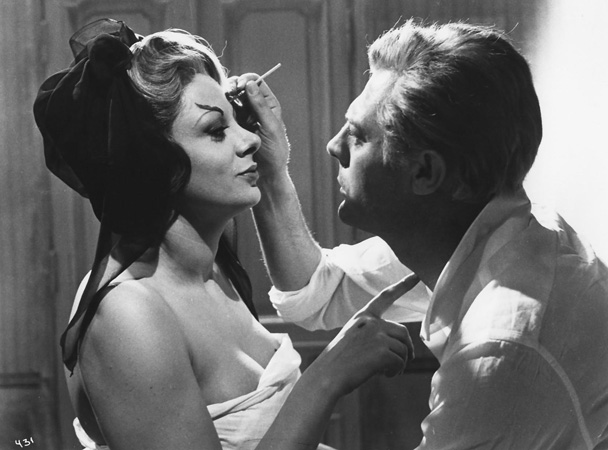
Guido Anselmi (Marcello Mastroianni) is in a bit of a personal and professional crisis in Fellini masterpiece

8½ (Federico Fellini, 1963)
Friday, July 29, 6:00, and Monday, August 1, 8:00
filmforum.org

“Your eminence, I am not happy,” Guido (Marcello Mastroianni) tells the cardinal (Tito Masini) halfway through Federico Fellini’s self-reflexive masterpiece 8½. “Why should you be happy?” the cardinal responds. “That is not your task in life. Who said we were put on this earth to be happy?” Well, film makes people happy, and it’s because of works such as 8½. Fellini’s Oscar-winning eighth-and-a-half movie is a sensational self-examination of film and fame, a hysterically funny, surreal story of a famous Italian auteur who finds his life and career in need of a major overhaul. Mastroianni is magnificent as Guido Anselmi, a man in a personal and professional crisis who has gone to a healing spa for some much-needed relaxation, but he doesn’t get any as he is continually harassed by producers, screenwriters, would-be actresses, and various other oddball hangers-on.

He also has to deal both with his mistress, Carla (Sandra Milo), who is quite a handful, as well as his wife, Luisa (Anouk Aimée), who is losing patience with his lies. Trapped in a strange world of his own creation, Guido has dreams where he flies over claustrophobic traffic and makes out with his dead mother, and his next film involves a spaceship; it doesn’t take a psychiatrist to figure out the many inner demons that are haunting him. Marvelously shot by Gianni Di Venanzo in black-and-white, scored with a vast sense of humor by Nino Rota, and featuring some of the most amazing hats ever seen on film — costume designer Piero Gherardi won an Oscar for all the great dresses and chapeaux — is an endlessly fascinating and wildly entertaining exploration of the creative process and the bizarre world of filmmaking itself.
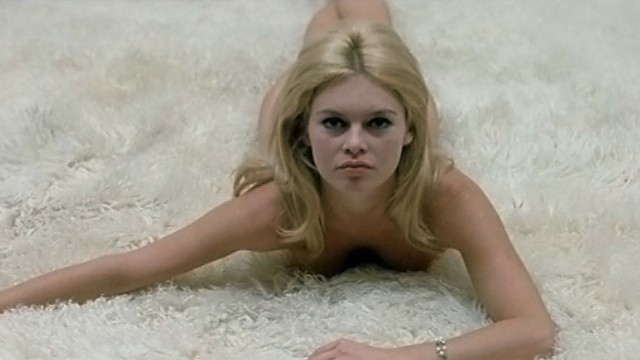
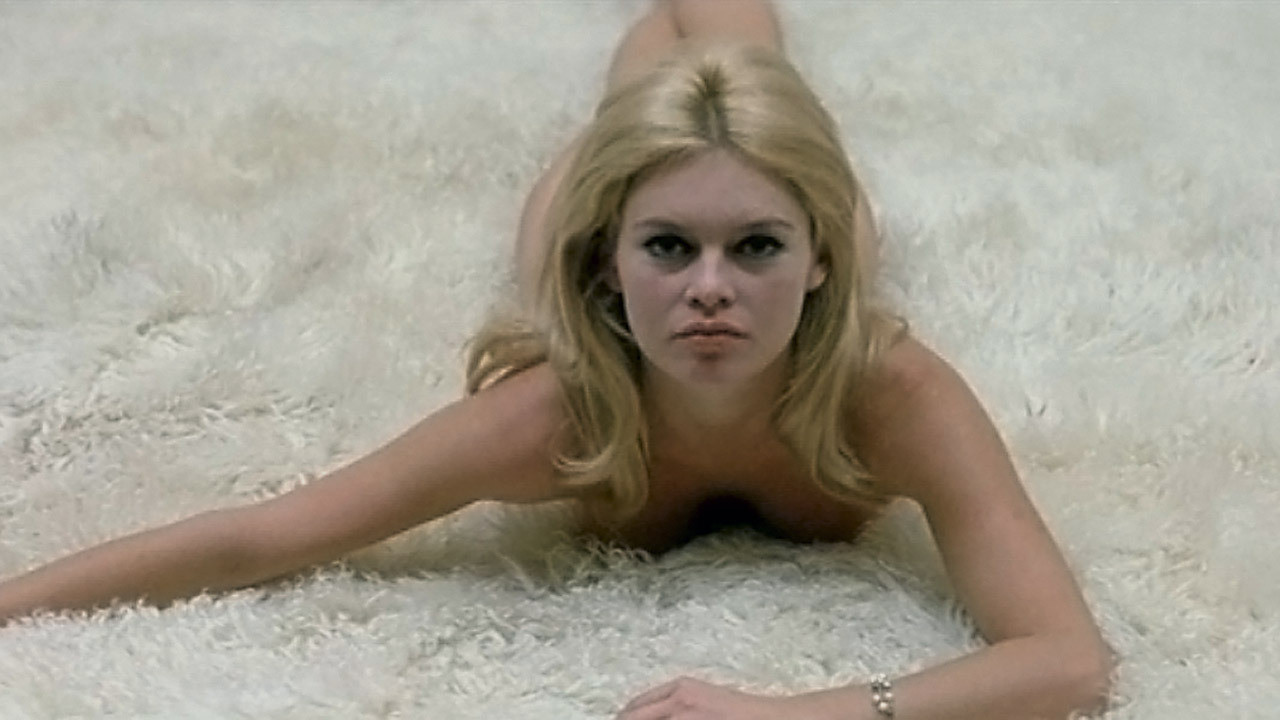
Brigitte Bardot shows off both her acting talent and beautiful body in Jean-Luc Godard’s Contempt

CONTEMPT (LE MEPRIS) (Jean-Luc Godard, 1963)
Saturday, July 30, 8:00, and Tuesday, August 9, 8:15
filmforum.org

French auteur Jean-Luc Godard doesn’t hold back any of his contempt for Hollywood cinema in his multilayered masterpiece Contempt. Loosely based on Alberto Moravia’s Il Disprezzo, Contempt stars Michel Piccoli as Paul Javal, a French screenwriter called to Rome’s famed Cinecittà studios by American producer Jeremy Prokosch (Jack Palance ) to perform rewrites on Austrian director Fritz Lang’s (played by Lang himself) adaptation of The Odyssey by ancient Greek writer Homer. Paul brings along his young wife, the beautiful Camille (Brigitte Bardot), whom Prokosch takes an immediate liking to. With so many languages being spoken, Prokosch’s assistant, Francesca Vanini (Giorgia Moll), serves as translator, but getting the various characters to communicate with one another and say precisely what is on their mind grows more and more difficult as the story continues and Camille and Paul’s love starts to crumble. Contempt is a spectacularly made film, bathed in deep red, white, and blue, as Godard and cinematographer Raoul Coutard poke fun at the American way of life. (Both Godard and Coutard appear in the film, the former as Lang’s assistant director, the latter as Lang’s cameraman — as well as the cameraman who aims the lens right at the viewer at the start of the film.)

Bardot is sensational in one of her best roles, whether teasing Paul at a marvelously filmed sequence in their Rome apartment (watch for him opening and stepping through a door without any glass), lying naked on the bed, asking Paul what he thinks of various parts of her body (while Coutard changes the filter from a lurid red to a lush blue), or pouting when it appears that Paul is willing to pimp her out in order to get the writing job. Palance is a hoot as the big-time producer, regularly reading fortune-cookie-like quotes from an extremely little red book he carries around that couldn’t possibly hold so many words. And Lang, who left Germany in the mid-1930s for a career in Hollywood, has a ball playing a version of himself, an experienced veteran willing to put up with Prokosch’s crazy demands. Vastly entertaining from start to finish, Contempt is filled with a slew of inside jokes about the filmmaking industry and even Godard’s personal and professional life, along with some of the French director’s expected assortment of political statements and a string of small flourishes that are easy to miss but add to the immense fun, all set to a gorgeous romantic score by Georges Delerue.
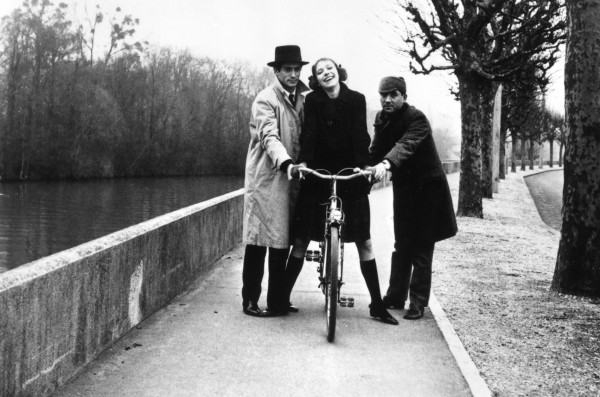
Jean-Luc Godard’s Band of Outsiders is a different kind of heist movie

BANDE À PART (BAND OF OUTSIDERS) (Jean-Luc Godard, 1964)
Tuesday, August 2, 8:10, Wednesday, August 3, 12:30, and Tuesday, August 9, 6:10
filmforum.org

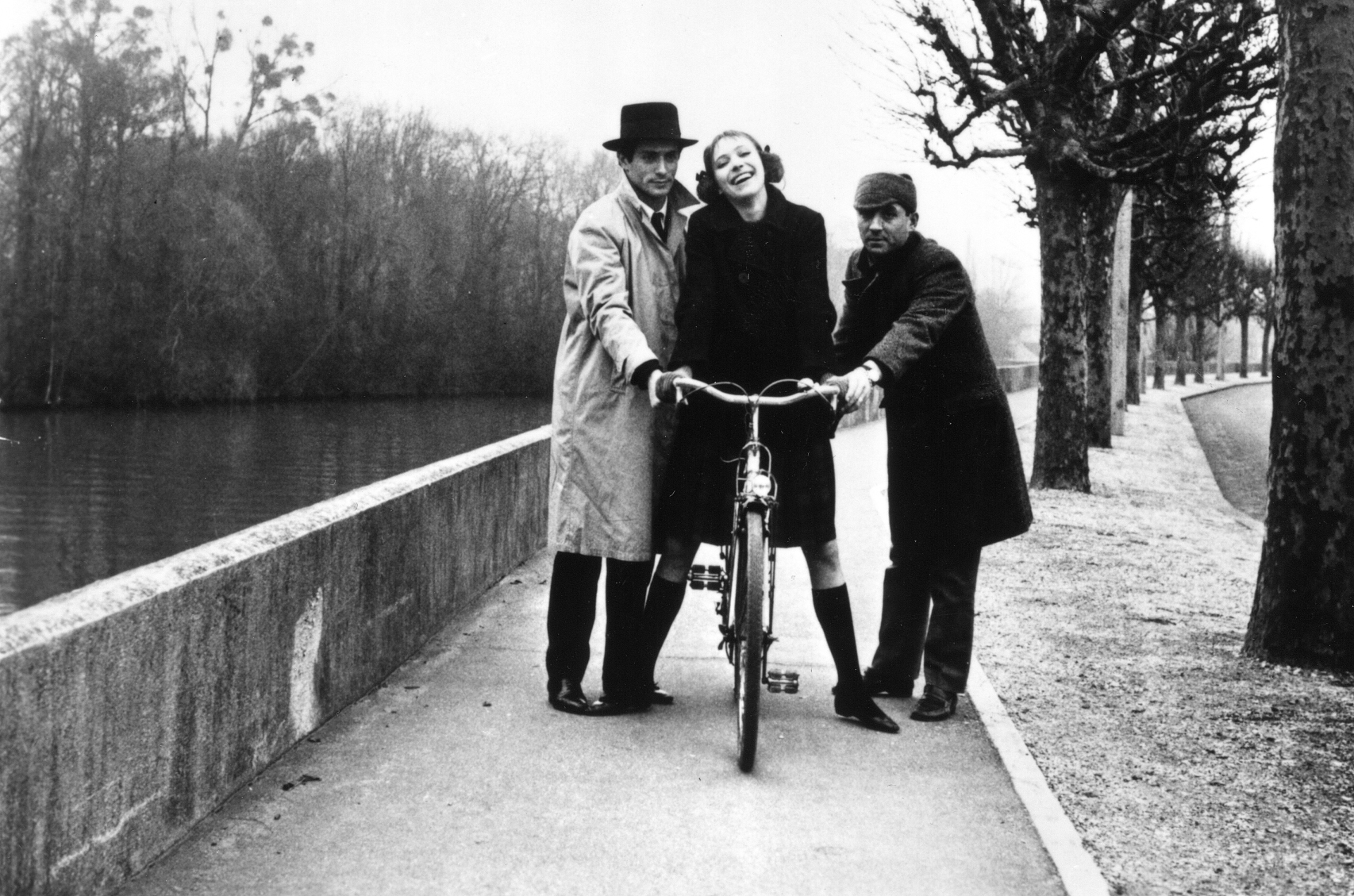
When a pair of disaffected Parisians, Arthur (Claude Brasseur) and Franz (Sami Frey), meet an adorable young woman, Odile (Anna Karina), in English class, they decide to team up and steal a ton of money from a man living in Odile’s aunt’s house. As they meander through the streets of cinematographer Raoul Coutard’s black-and-white Paris, they talk about English and wealth, dance in a cafe while director Jean-Luc Godard breaks in with voice-over narration about their character, run through the Louvre in record time, and pause for a near-moment of pure silence. Godard throws in plenty of commentary on politics, the cinema, and the bourgeoisie in the midst of some genuinely funny scenes. One of Godard’s most accessible films, Band of Outsiders is no ordinary heist movie; based on Dolores Hitchens’s novel Fool’s Gold, it is the story of three offbeat individuals who just happen to decide to attempt a robbery while living their strange existence, as if they were outside from the rest of the world. The trio of ne’er-do-wells might remind Jim Jarmusch fans of the main threesome from Stranger Than Paradise (1984), except Godard’s characters are more aggressively persistent.
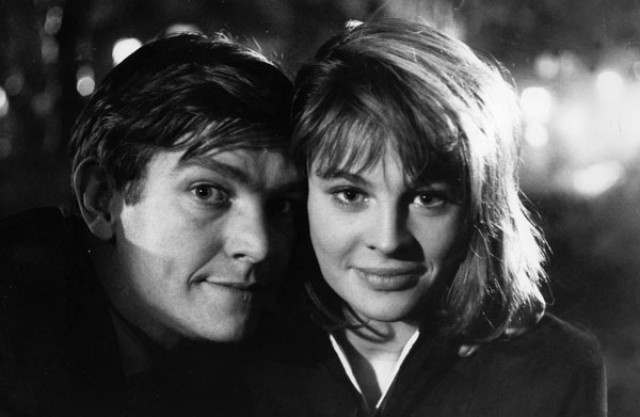
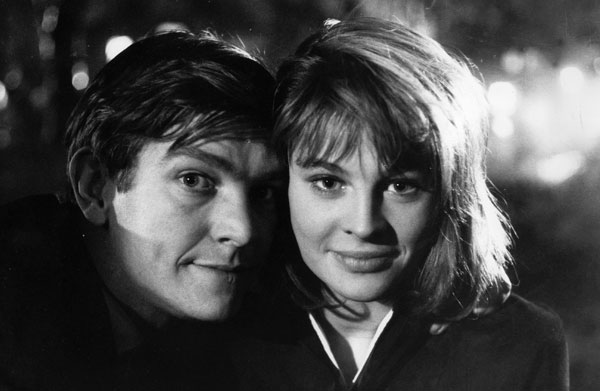
Tom Courtenay and Julie Christie get close in John Schlesinger’s Billy Liar

BILLY LIAR (John Schlesinger, 1963)
Wednesday, August 3, 2:40 & 6:00
filmforum.org

Based on the novel by Keith Waterhouse (which he also adapted into a play with Willis Hall and which later became a musical), John Schlesinger’s Billy Liar is a prime example of the British New Wave of the 1950s and 1960s, which features work by such directors as Lindsay Anderson, Joseph Losey, Ken Russell, Nicolas Roeg, and Karel Reisz. Tom Courtenay stars as William Fisher, a ne’er-do-well ladies’ man who drudges away in a funeral home and dates (and lies to) multiple women, all the while daydreaming of being the president of the fictional country of Ambrosia. Billy lives in his own fantasy world where he can suddenly fire machine guns at people who bother him and be cheered by adoring crowds as he leads a marching band. Reminiscent of the 1947 American comedy The Secret Life of Walter Mitty, in which Danny Kaye dreams of other lives to lift him out of the doldrums, Billy Liar is also rooted in the reality of post-WWII England, represented by Billy’s father (Wilfred Pickles), who thinks his son is a no-good lazy bum. Shot in black-and-white by Denys Coop (This Sporting Life, Bunny Lake Is Missing), the film glows every time Julie Christie appears playing Liz, a modern woman who takes a rather fond liking to Billy. The film made Christie a star; Schlesinger next cast her in Darling, for which she won the Oscar for Best Actress.
A HARD DAY’S NIGHT

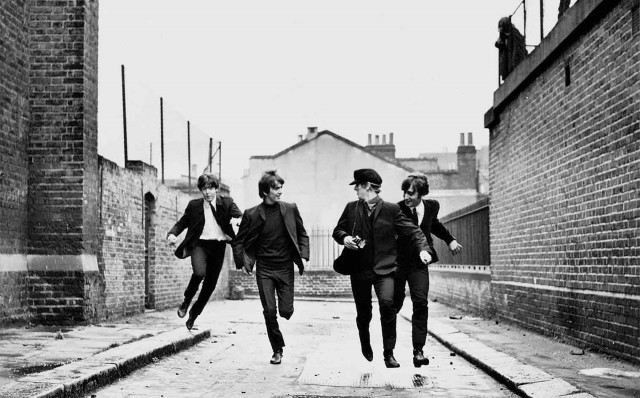
The Beatles’ A Hard Day’s Night gets back to Film Forum for 1962-63-64 series

A HARD DAY’S NIGHT (Richard Lester, 1964)
Friday, August 5, 2:35 & 9:25, Saturday, August 6, 12:30 & 4:35
filmforum.org

The Beatles recently invaded America again with Peter Jackson’s three-part documentary Get Back, about the making of Let It Be. The Film Forum series takes us back to their debut movie, the deliriously funny anarchic comedy A Hard Day’s Night. Initially released on July 6, 1964, in the UK, AHDN turned out to be much more than just a promotional piece advertising the Fab Four and their music. Instead, it quickly became a huge critical and popular success, a highly influential work that presaged Monty Python and MTV while also honoring the Marx Brothers, Buster Keaton, Jacques Tati, and the French New Wave. Directed by Richard Lester, who had previously made the eleven-minute The Running Jumping & Standing Still Film with Peter Sellers and would go on to make A Funny Thing Happened on the Way to the Forum, Petulia, and The Three Musketeers, the madcap romp opens with the first chord of the title track as John Lennon, Paul McCartney, George Harrison, and Ringo Starr are running down a narrow street, being chased by rabid fans, but they’re coming toward the camera, welcoming viewers into their crazy world. (George’s fall was unscripted but left in the scene.) As the song blasts over the soundtrack, Lester introduces the major characters: the four moptops, who are clearly having a ball, led by John’s infectious smile, in addition to Paul’s “very clean” grandfather (Wilfrid Brambell, who played a dirty old man in the British series Steptoe and Son, the inspiration for Sanford and Son) and the band’s much-put-upon manager, Norm (Norman Rossington). Lester and cinematographer Gilbert Taylor (Dr. Strangelove or: How I Learned to Stop Worrying and Love the Bomb, Repulsion, Star Wars) also establish the pace and look of the film, a frantic black-and-white frolic shot in a cinema-vérité style that is like a mockumentary taking off from where François Truffaut’s 400 Blows ends.

The boys eventually make it onto a train, which is taking them back to their hometown of Liverpool, where they are scheduled to appear on a television show helmed by a hapless director (Victor Spinetti, who would star in Help as well) who essentially represents all those people who are dubious about the Beatles and the sea change going on in the music industry. Norm and road manager Shake (John Junkin) have the virtually impossible task of ensuring that John, Paul, George, and Ringo make it to the show on time, but there is no containing the energetic enthusiasm and contagious curiosity the quartet has for experiencing everything their success has to offer — while also sticking their tongues out at class structure, societal trends, and the culture of celebrity itself. Lester and Oscar-nominated screenwriter Alun Owen develop each individual Beatle’s unique character through press interviews, solo sojourns (the underappreciated Ringo goes off on a kind of vision quest; George is mistaken by a fashion fop for a model), and an endless stream of spoken and visual one-liners. (John sniffs a Coke bottle; a reporter asks George, “What do you call your hairstyle?” to which the Quiet One replies, “Arthur.”) Oh, the music is rather good too, featuring such songs as “I Should Have Known Better,” “All My Loving,” “If I Fell,” “Can’t Buy Me Love,” “I’m Happy Just to Dance with You,” “This Boy,” and “She Loves You.” The working name for the film was Beatlemania, but it was eventually changed to A Hard Day’s Night, based on a Ringo malapropism, forcing John and Paul to quickly write the title track. No mere exploitation flick, A Hard Day’s Night is one of the funniest, most influential films ever made, capturing a critical moment in pop-culture history and unleashing four extraordinary gentlemen on an unsuspecting world. Don’t you dare miss this glorious eighty-five-minute explosion of sheer, unadulterated joy.