Tag Archives: Ennio Morricone

TRILOGIES: SERGIO LEONE’S DOLLARS TRILOGY

(images  courtesy  of  MGM  /  Cineteca  di  Bologna  /  Park  Circus)

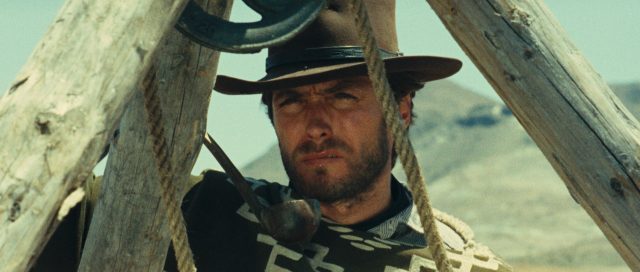
Clint Eastwood introduces the Man with No Name in Sergio Leone’s A Fistful of Dollars (photo courtesy MGM / Cineteca di Bologna / Park Circus)

A FISTFUL OF DOLLARS (PER UN PUGNO DI DOLLARI) (Sergio Leone, 1964)
Film Forum
209 West Houston St.
Saturday, April 20, 4:30, and Monday, April 22, 4:40
Series runs April 19 – May 16
212-727-8110
filmforum.org

Clint Eastwood made a name for himself on the big screen playing the Man with No Name in Sergio Leone’s 1964 spaghetti Western, A Fistful of Dollars, which is being shown April 20-23 at Film Forum as part of its awesome Trilogies series. In his first lead movie role, Eastwood, the costar of the television series Rawhide, is a gunslinger draped in a poncho and smoking a small cigar who rides on a mule into San Miguel, a tiny town in the middle of nowhere, home to an ongoing feud between the gun-running Baxters and the liquor-dealing Rojos. The stranger decides to play both sides against the middle, caring only that he earns lots of cash. “Never saw a town as dead as this one,” the stranger tells saloon owner Silvanito (Jose Calvo), who explains, “The place is only widows. Here you can only get respect by killing other men, so nobody works anymore.” The stranger hears the sound of banging outside and says, “Somebody doesn’t share your opinion.” Silvanito opens the window to reveal old man Piripero (Joe Edger) making coffins. “You’ll be a customer,” Silvanito tells the stranger with assurance. The stranger goes back and forth between the Baxters, led by the sheriff (W. Lukschy), and the Rojos, who follow the dangerous, unpredictable Ramón (Gian Maria Volontè). Also caught up in the Hatfield-McCoy battle are the sheriff’s wife, Consuelo (Margherita Lozano), and brother, Antonio (Bruno Carotenuto), along with Rojo brothers Benito (Antonio Prieto) and Esteban (S. Rupp) and their enforcer, Chico (Richard Stuyvesant). Ramón, meanwhile, has his eyes set on Marisol (Marianne Koch), who is married to Julio (Daniel Martín), who does not want to get involved in any fighting. Carefully watching it all is Juan de Díos (Raf Baldassarre), who rings the church bell at every death.

The Italian-German-Spanish production is a remake of Akira Kurosawa’s Yojimbo, which led to legal entanglements when the Japanese auteur demanded, well, a fistful of dollars in financial compensation. According to Christopher Frayling’s Sergio Leone — Something to Do with Death, Leone received a note from Kurosawa that read, “Signor Leone — I have just had the chance to see your film. It is a very fine film, but it is my film. Since Japan is a signatory of the Berne Convention on international copyright, you must pay me.” Frayling also suggests that Leone was influenced by Dashiell Hammett’s Red Harvest and Carlo Goldoni’s Servant of Two Masters and did not feel he was stealing only from Kurosawa. In The BFI Companion to the Western, Frayling quotes Leone as saying, “Kurosawa’s Yojimbo was inspired by an American novel of the serie-noire so I was really taking the story back home again.” (For a montage of similarities between the two films, check out this video.). Regardless, A Fistful of Dollars, made for about two hundred grand, set the standard for the new genre, and Eastwood was its antihero. He and Leone would team up again on the sequel, For a Few Dollars More, which is not a direct remake of Kurosawa’s Yojimbo follow-up, Sanjuro, as well as The Good, the Bad, and the Ugly, the best of the Dollars Trilogy.
(photo courtesy  MGM / Cineteca di Bologna / Park Circus)

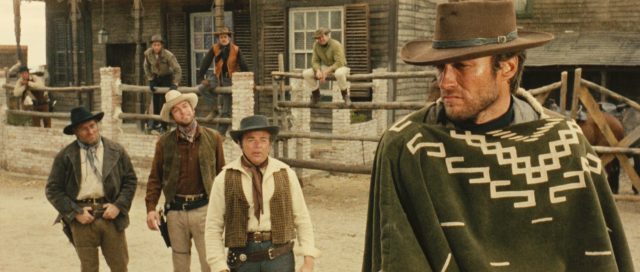
Clint Eastwood watches his back in first of the Dollars Trilogy (photo courtesy MGM / Cineteca di Bologna / Park Circus)

Fistful is steeped in violence and death, from Iginio Lardani’s rad title sequence of silhouettes in black, white, and blood red to an early shot of the stranger riding under a noose and giving it a long look. Whereas Toshirô Mifune played the bodyguard in Yojimbo with a devilish glee, Eastwood — in a role that had been previously offered to Henry Fonda, Charles Bronson, James Coburn, and others — is much more serious as the Man with No Name, who would become more sympathetic in future outings. The extremely poor dubbing only adds to the film’s magnificence. To enhance its foreign appeal to American audiences, several members of the cast and crew appear under pseudonyms in the credits, including Leone (Bob Robertson), cinematographer Massimo Dallamano (Jack Dalmas), actor Gian Maria Volontè (John Wells), and composer Ennio Morricone (Leo Nichols or Dan Savio). There is no mention of Kurosawa or Yojimbo anywhere.
Sergio Leone

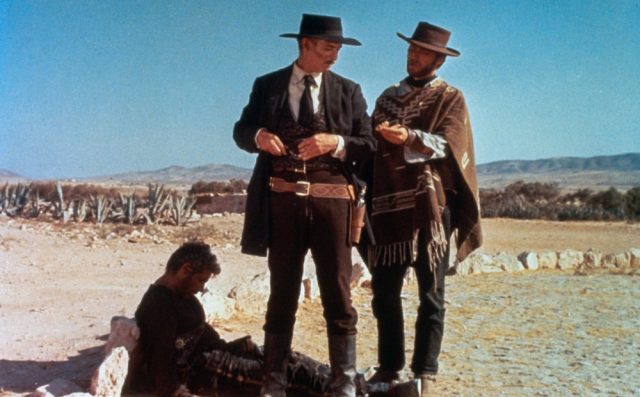
Rival bounty killers colonel Douglas Mortimer (Lee Van Cleef) and Manco (Clint Eastwood) join forces in Sergio Leone’s For a Few Dollars More

FOR A FEW DOLLARS MORE (PER QUALCHE DOLLARO IN PIÙ) (Sergio Leone, 1965)
Saturday, April 20, 4:30, and Tuesday, April 23, 4:40
filmforum.org

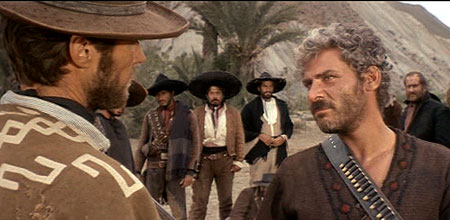
Determined to capitalize on the immediate success of A Fistful of Dollars, director and cowriter Sergio Leone and stars Clint Eastwood and Gian Maria Volonté quickly got back in the saddle to make the initially underrated, now celebrated follow-up, For a Few Dollars More. In the 1965 spaghetti Western, filmed in Almería, Spain, and at Rome’s Cinecittà Studios — and featuring a town doubling as El Paso built by production designer Carlo Simi that still stands today, part of the MiniHollywood theme park in Tabernas — Eastwood is a bounty killer that some call Manco, but he is essentially the Man with No Name again. He travels from wretched place to wretched place with his horse, poncho, cigar, squinty eyes, and guns, shooting criminals and collecting rewards. When he encounters a rival, former Confederate colonel Douglas Mortimer (Lee Van Cleef), they are initially at odds, going after the same trophies, but they ultimately decide to join forces to capture and kill El Indio (Volonté), a murderous psychopath who likes to use a pocket watch that plays a gentle tune when opened when he is getting ready to shoot someone, an element from his past (involving a mystery woman played by Rosemary Dexter) that haunts him. Manco embeds himself with Indio’s mangy gang, which includes Groggy (Luigi Pistilli), Niño (Mario Brega), Cuchillo (Aldo Sambrell), Tomaso (Lorenzo Robledo), Sancho Perez (Panos Papadopulos), Slim (Werner Abrolat), Blackie (Frank Braña), Chico (José Canalejas), Frisco (Antonio Molino Rojo), Hughie (Benito Stefanelli, who was in all three Dollars films), and Wild (the one and only Klaus Kinski). As Indio prepares to rob a bank in El Paso, a series of double crosses and personal vengeance lead to a memorable ending.
For a Few Dollars More

Manco (Clint Eastwood) becomes part of Indio’s (Gian Maria Volonté) gang in For a Few Dollars More

Written by Leone and Luciano Vincenzoni with added dialogue by Sergio Donati, For a Few Dollars More fits right in between A Fistful of Dollars and The Good, the Bad, and the Ugly, from its overall look and mood to Ennio Morricone’s stupendous score and Massimo Dallamano’s beautiful cinematography, both veterans of Fistful. Eastwood further established his ability to carry a film as a compelling antihero, Van Cleef (How the West Was Won, Escape from New York) earned one of the three title roles in Ugly, and Volonté, who would go on to make such classics as A Bullet for the General, Investigation of a Citizen Above Suspicion, and Christ Stopped at Eboli, is superbly grimy as a brutal villain hiding a soft spot. Genre tropes abound, highlighted by Leone’s love of close-ups of his characters’ eyes, shifting from one side to the other as they face their destinies.
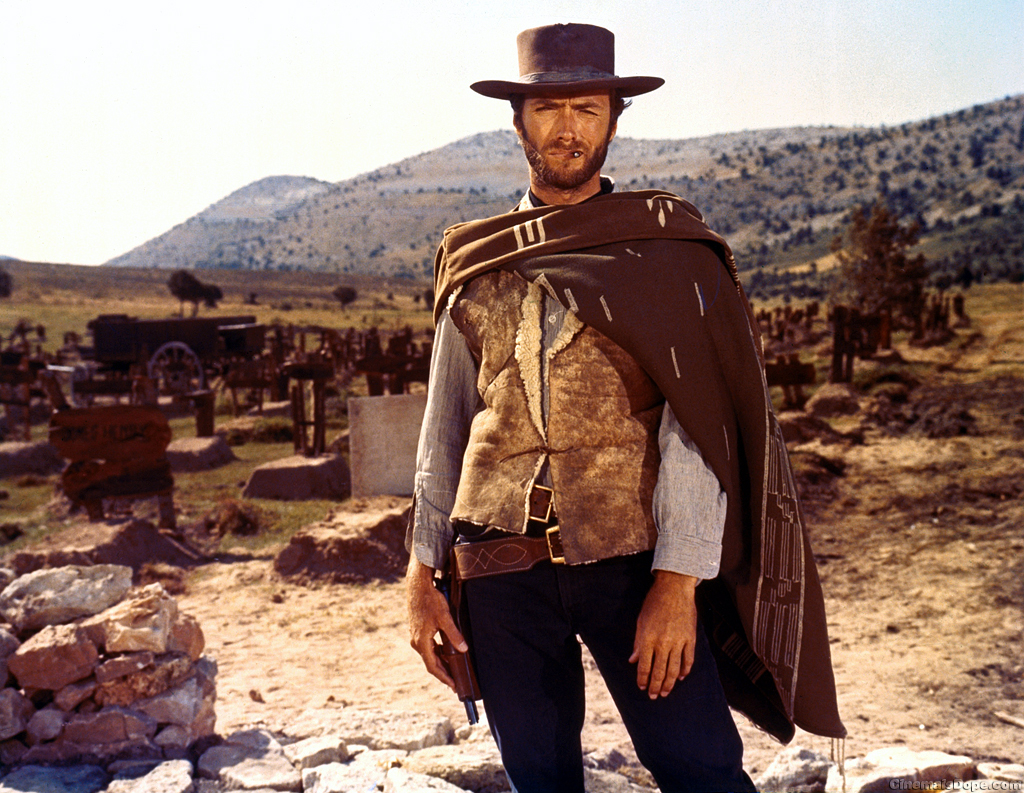
Clint Eastwood is the Good in classic Sergio Leone operatic oater

THE GOOD, THE BAD AND THE UGLY (Sergio Leone, 1966)
Saturday, April 20, 9:00, and Sunday, April 21, 4:40
filmforum.org

One of the all-time-great spaghetti Westerns, Sergio Leone’s dusty three-hour operatic oater stars Clint Eastwood as the Good (Blondie), Lee Van Cleef as the Bad (Angel Eyes), and Eli Wallach as the Ugly (Tuco Benedicto Pacifico Juan Maria Ramirez, whose list of criminal offenses is a riot), three unique individuals after $200,000 in Confederate gold buried in a cemetery in the middle of nowhere. Nearly twenty minutes of never-before-seen footage was added to the film several years ago, with Wallach and Eastwood overdubbing brand-new dialogue, so if you haven’t seen it in a while, it might just be time to catch it again. Ennio Morricone’s unforgettable score and Torino delli Colli’s gorgeous widescreen cinematography were also marvelously enhanced; their work in the scene when Tuco first comes upon the graveyard will make you dizzy with delight. And then comes one of the greatest finales in cinema history. The Film Forum trilogy series continues through May 16 with official and unofficial hat tricks by Fritz Lang, Wim Wenders, Carol Reed, Whit Stillman, Lucretia Martel, Michelangelo Antonioni, Rainer Werner Fassbinder, and many others.
LIVE SOUND CINEMA: DANGER: DIABOLIK (LIVE SCORE BY MORRICONE YOUTH)

Danger: Diabolik

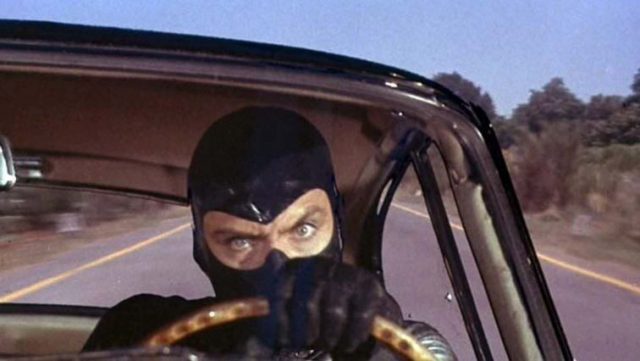
John Philip Law plays a criminal mastermind in Mario Bava’s Danger: Diabolik

DANGER: DIABOLIK (Mario Bava, 1968)
Nitehawk Cinema
136 Metropolitan Ave. between Berry St. & Wythe Ave.
Wednesday, January 23, 7:00
718-384-3980
nitehawkcinema.com

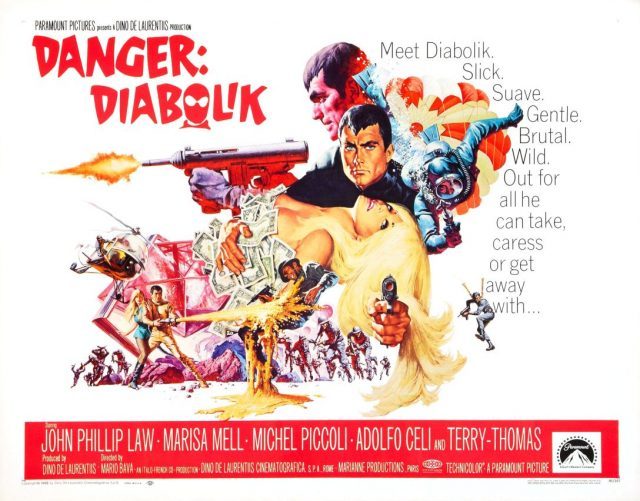
Nitehawk Cinema’s “Live Sound Cinema” series continues January 23 with an inspired selection: Morricone Youth performing a live re-score to Mario Bava’s Danger: Diabolik. The 1968 film was the last to be spoofed on Mystery Science Theater 3000 in 1999 — the year Morricone Youth was formed — prior to its 2017 reboot on Netflix, but don’t let that fool you; it’s no mere dated piece of schlock. The longtime underground fave has been steadily increasing its cred over the last decade, and deservedly so. The psychedelic crime thriller stars John Phillip Law as Diabolik, a criminal mastermind who pulls off seemingly impossible thefts right under the noses of the Minister of the Interior (Terry-Thomas), the intrepid Inspector Ginko (Michel Piccoli), and the frustrated chief of police (Claudio Gora), who eventually turns to mob boss Valmont (Adolfo Celi) for help. Wearing a body-hugging wetsuit of a costume, Diabolik is assisted by the love of his life, the gorgeous blonde Eva Kant (Marisa Mell), plotting their derring-do in an expansive underground lair. Based on the Italian comic book series by Angela and Luciana Giussani, the story rarely makes much sense, but it’s a hoot to watch, a trippy mix of Batman, James Bond, Robin Hood, and Austin Powers.

danger diabolik 2

The film was produced by Dino De Laurentiis, who fired the initial director and main cast, which included first George Raft and then Gilbert Roland as Diabolik’s archnemesis, and at one point considered Catherine Deneuve to play Eva, but ultimately giallo master Bava (Black Sunday, Planet of the Vampires) hired Mell. If some of the sets look familiar, it may be because De Laurentiis actually reused them, as well as actors, right after Diabolik finished shooting, going straight into production on another comic book movie, Roger Vadim’s Barbarella. Diabolik also features what very well might be Ennio Morricone’s grooviest soundtrack, which becomes a character unto itself; he might be most famous for composing the scores for myriad classic Westerns, but he also wrote music for Dario Argento, Elio Petri, and Pier Paolo Pasolini. The Nitehawk presentation is a great match of film and music; you can get a taste of what you’re in for here, when Morricone Youth performed to Danger: Diabolik at Nitehawk in 2013. And Beastie Boys fans should check out their 1998 video for “Body Movin’,” a campy tribute to the movie. “Live Sound Cinema” continues February 14 with Reel Orchestrette playing a live score to Buster Keaton’s 1925 classic, Seven Chances.

A FISTFUL OF DOLLARS

(images  courtesy  of  MGM  /  Cineteca  di  Bologna  /  Park  Circus)

Clint Eastwood introduces the Man with No Name in Sergio Leone’s A Fistful of Dollars (photo courtesy MGM / Cineteca di Bologna / Park Circus)

A FISTFUL OF DOLLARS (PER UN PUGNO DI DOLLARI) (Sergio Leone, 1964)
Metrograph
7 Ludlow St. between Canal & Hester Sts.
May 25-31
212-660-0312
metrograph.com

Clint Eastwood made a name for himself on the big screen playing the Man with No Name in Sergio Leone’s 1964 spaghetti Western, A Fistful of Dollars, which is being shown in a new 4K restoration at Metrograph May 25-31. In his first lead movie role, Eastwood, the costar of the television series Rawhide, is a gunslinger draped in a poncho and smoking a small cigar who rides on a mule into San Miguel, a tiny town in the middle of nowhere, home to an ongoing feud between the gun-running Baxters and the liquor-dealing Rojos. The stranger decides to play both sides against the middle, caring only that he earns lots of cash. “Never saw a town as dead as this one,” the stranger tells saloon owner Silvanito (Jose Calvo), who explains, “The place is only widows. Here you can only get respect by killing other men, so nobody works anymore.” The stranger hears the sound of banging outside and says, “Somebody doesn’t share your opinion.” Silvanito opens the window to reveal old man Piripero (Joe Edger) making coffins. “You’ll be a customer,” Silvanito tells the stranger with assurance. The stranger goes back and forth between the Baxters, led by the sheriff (W. Lukschy), and the Rojos, who follow the dangerous, unpredictable Ramón (Gian Maria Volontè). Also caught up in the Hatfield-McCoy battle are the sheriff’s wife, Consuelo (Margherita Lozano), and brother, Antonio (Bruno Carotenuto), along with Rojo brothers Benito (Antonio Prieto) and Esteban (S. Rupp) and their enforcer, Chico (Richard Stuyvesant). Ramón, meanwhile, has his eyes set on Marisol (Marianne Koch), who is married to Julio (Daniel Martín), who does not want to get involved in any fighting. Carefully watching it all is Juan de Díos (Raf Baldassarre), who rings the church bell at every death.

The Italian-German-Spanish production is a remake of Akira Kurosawa’s Yojimbo, which led to legal entanglements when the Japanese auteur demanded, well, a fistful of dollars in financial compensation. According to Christopher Frayling’s Sergio Leone — Something to Do with Death, Leone received a note from Kurosawa that read, “Signor Leone — I have just had the chance to see your film. It is a very fine film, but it is my film. Since Japan is a signatory of the Berne Convention on international copyright, you must pay me.” Frayling also suggests that Leone was influenced by Dashiell Hammett’s Red Harvest and Carlo Goldoni’s Servant of Two Masters and did not feel he was stealing only from Kurosawa. In The BFI Companion to the Western, Frayling quotes Leone as saying, “Kurosawa’s Yojimbo was inspired by an American novel of the serie-noire so I was really taking the story back home again.” (For a montage of similarities between the two films, check out this video.). Regardless, A Fistful of Dollars, made for about two hundred grand, set the standard for the new genre, and Eastwood was its antihero. He and Leone would team up again on the sequel, For a Few Dollars More, which is not a direct remake of Kurosawa’s Yojimbo follow-up, Sanjuro, as well as The Good, the Bad, and the Ugly, the best of the Dollars Trilogy.

(photo courtesy  MGM / Cineteca di Bologna / Park Circus)

Clint Eastwood watches his back in first of the Dollars Trilogy (photo courtesy MGM / Cineteca di Bologna / Park Circus)

Fistful is steeped in violence and death, from Iginio Lardani’s rad title sequence of silhouettes in black, white, and blood red to an early shot of the stranger riding under a noose and giving it a long look. Whereas Toshirô Mifune played the bodyguard in Yojimbo with a devilish glee, Eastwood — in a role that had been previously offered to Henry Fonda, Charles Bronson, James Coburn, and others — is much more serious as the Man with No Name, who would become more sympathetic in future outings. The extremely poor dubbing only adds to the film’s magnificence. To enhance its foreign appeal to American audiences, several members of the cast and crew appear under pseudonyms in the credits, including Leone (Bob Robertson), cinematographer Massimo Dallamano (Jack Dalmas), actor Gian Maria Volontè (John Wells), and composer Ennio Morricone (Leo Nichols or Dan Savio). There is no mention of Kurosawa or Yojimbo anywhere.

THE GREAT SILENCE

Jean-Louis Trintignant

Jean-Louis Trintignant stars as a mute antihero in Sergio Corbucci’s The Great Silence

THE GREAT SILENCE (IL GRANDE SILENZIO) (Sergio Corbucci, 1968)
Film Forum
209 West Houston St.
March 30 – April 10
212-727-8110
filmforum.org

After half a century, Sergio Corbucci’s underseen masterpiece, The Great Silence, is finally being released in the United States, in a gorgeous fiftieth anniversary restoration screening at Film Forum. Corbucci’s revisionist spaghetti Western was shot by Silvano Ippoliti in the Dolomites in northeastern Italy, where luxurious white snow (actually shaving cream) goes on forever until it is stained with so much blood. French star Jean-Louis Trintignant plays a variation of the quiet hero who lets his guns do his talking; Trintignant, who did not speak English, is Silence, who, as a young boy, witnessed the merciless murder of his parents by bounty killers and is rendered mute with a knife to prevent his testimony. Years later, now an adult, Silence, with his unusual Mauser C96, roams the land in search of bounty killers, getting them to draw first so he can then fire back in self-defense, shooting off their thumbs so they can never use a gun again. It’s 1898, and hard times have come to Snow Hill, leading many average citizens to break laws just to put food on the table. Greedy banker Henry Pollicut (Luigi Pistilli) puts a price on their heads, wanted dead or alive, attracting various bounty killers, including the notorious Loco (German star Klaus Kinski), aka Tigrero, who never brings his targets in breathing, no matter how minor their crimes. Relatively hapless sheriff Gideon Burnett (Frank Wolff) is caught somewhere in the middle, as it’s Loco who is on the right side of the law and Silence who is walking a fine line about what’s legal. After Loco kills James Middleton, his widow, Pauline (Vonetta McGee), hires Silence to gain revenge, setting the stage for one of the most brutal endings in the history of cinema.
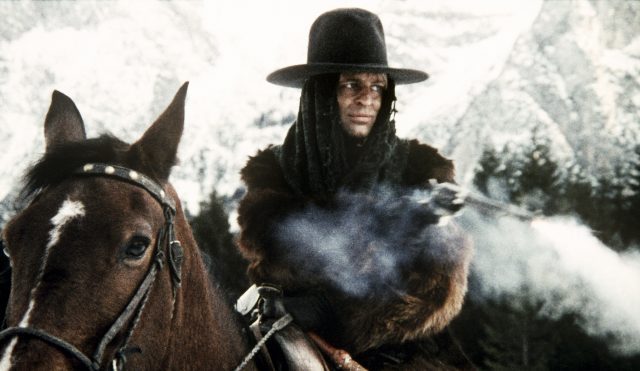
Klaus Kinski

Klaus Kinski is a vicious bounty killer on the right side of the law in Corbucci masterpiece

The pairing of Trintignant, who had gained international fame in Claude Lelouch’s A Man and a Woman, and Kinski, who had made such previous Westerns as Damiano Damiani’s A Bullet for the General and Sergio Leone’s For a Few Dollars More, has a dark magic, particularly since their characters are not clear representations of good vs. evil. Each one uses their eyes to intense dramatic effect, with Trintignant particularly effective since he doesn’t speak a word — just wait till you see him scream. In her film debut, McGee (Blacula, Repo Man) brings a stark sensitivity to Pauline; her interracial love scene was shocking for the genre, especially with Corbucci (Django, Navajo Joe) handling it in such a gentle way. Meanwhile, composer Ennio Morricone (Once Upon a Time in the West; The Good, the Bad, and the Ugly) delivers one of his most emotional and wide-ranging scores. Fifty years on, The Great Silence can still be read as a parable attacking rampant injustice in society while also subverting the Western genre itself, a dark and bleak tale about the hopelessness of life. (If the ending is too much for you, you can watch the absurdly ridiculous alternate happy ending made for some foreign markets here.)

TRUE WEST: SAM SHEPARD ON FILM

Sam Shepard in Terrence Malick’s Days of Heaven

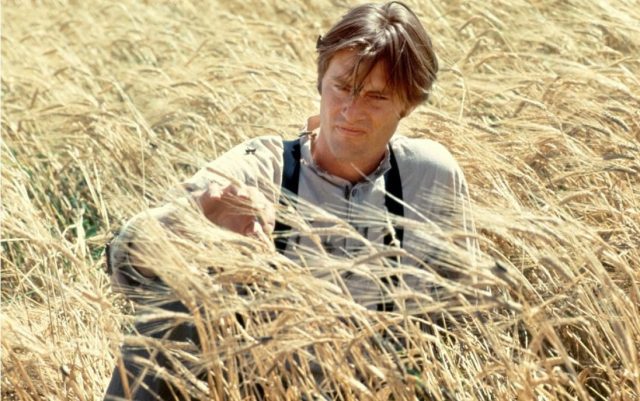
Sam Shepard gets involved in a complex love triangle in Terrence Malick’s Days of Heaven

DAYS OF HEAVEN (Terrence Malick, 1978)
BAMcinématek, BAM Rose Cinemas
30 Lafayette Ave. between Ashland Pl. & St. Felix St.
Friday, November 3, 4:30, 7:00, 9:30
Series runs November 3-9
718-636-4100
www.bam.org

BAMcinématek wishes Sam Shepard, who passed away in July at the age of seventy-three, a happy birthday with the ten-movie tribute “True West: Sam Shepard on Film,” running November 3-9. The Pulitzer Prize-winning, Oscar- and Emmy-nominated, Tony-winning actor, writer, director, and playwright was born Samuel Shepard Rogers IV in Illinois on November 5, 1943. His legacy includes such work as Steel Magnolias, Crimes of the Heart, Snow Falling on Cedars, and Black Hawk Down and such plays as Buried Child, Fool for Love, and Curse of the Starving Class. Ruggedly handsome and fiercely independent, Shepard leaves behind a vast legacy that ranged from the American West to Hollywood to downtown New York and beyond.

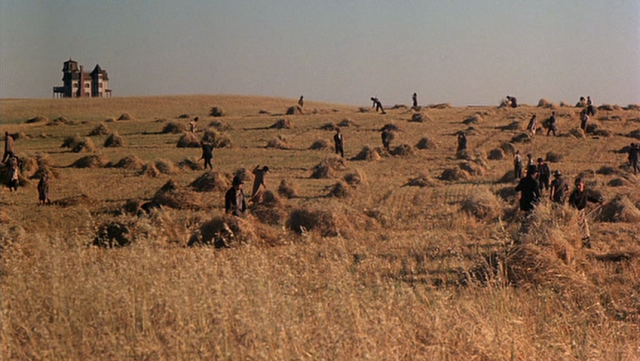
Justifiably recognized as one of the most beautiful films ever made, writer-director Terrence Malick’s sophomore effort, Days of Heaven, is a visually breathtaking tale of love, desperation, and survival in WWI-era America. After accidentally killing his boss (Stuart Margolin) in a Chicago steel mill, Bill (Richard Gere) immediately flees to the Texas Panhandle with his girlfriend, Abby (Brooke Adams), and his much younger sister, Linda (Linda Manz). Because they are unmarried, Bill and Abby pretend to be brother and sister — evoking the biblical story of Abraham introducing his wife Sarah as his sibling — and get a job working in the wheat fields owned by a reserved, possibly ill farmer (Sam Shepard) who is instantly smitten with Abby. Soon a complex love triangle develops in which money, class, and power play a key role. As beautiful as the main characters are — Gere and Shepard particularly are shot in ways that emphasize their tender but rugged good looks — they are outshone by the gorgeous landscapes and sunsets photographed by Nestor Almendros (who won an Oscar for Best Cinematography) and Haskell Wexler, as well as Jack Fisk’s stunning art direction, all of which were directly inspired by Edward Hopper’s “House by the Railroad” and Andrew Wyeth’s “Christina’s World,” among other paintings. Like Stanley Kubrick’s Barry Lyndon, freezing nearly any frame will produce an image that could hang in a museum.

DAYS OF HEAVEN

The award-winning Days of Heaven is one of the most beautiful-looking movies ever made

The soundtrack is epic as well, composed by Ennio Morricone along with songs by Leo Kottke and Doug Kershaw (who plays the fiddler). It took two years for Malick and editor Bill Weber to assemble the vast amount of footage they shot into a comprehensible story, helped by the late addition of Manz’s character’s voice-over narration, but the results were well worth all of the time and effort. Days of Heaven came five years after Malick’s breakthrough debut, Badlands, and it would be another twenty years before his next film, The Big Red One, then seven more until 2005’s The New World. Days of Heaven kicks off the BAMcinématek series “True West: Sam Shepard on Film,” which runs November 3-9 and includes such other Shepard films that he either wrote and/or appeared in as Philip Kaufman’s The Right Stuff, Robert Altman’s Fool for Love, and Graeme Clifford’s Frances.

PARIS, TEXAS

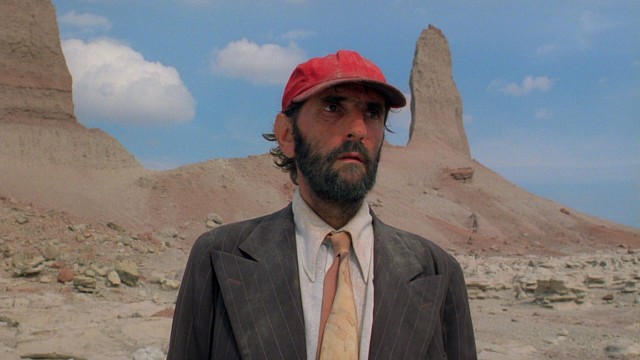
Harry Dean Stanton gives a staggering performance as a lost soul in Wim Wenders’s Paris, Texas, cowritten by Sam Shepard

PARIS, TEXAS (Wim Wenders, 1984)
Saturday, November 4, 2:00 & 7:45
www.bam.org

Winner of both the Palme d’Or and the Critics Prize at the 1984 Cannes Film Festival, Wim Wenders’s Paris, Texas is a stirring and provocative road movie about the dissolution of the American family and the death of the American dream. Written by Sam Shepard and adapted by L. M. Kit Carson, the two-and-a-half-hour film opens with a haggard man (Harry Dean Stanton) wandering through a vast, deserted landscape. A close-up of him in his red hat, seen against blue skies and white clouds, evokes the American flag. (Later shots show him looking up at a flag flapping in the breeze, as well as a graffiti depiction of the Statue of Liberty.) After he collapses in a bar in the middle of nowhere, he is soon discovered to be Travis Henderson, a husband and father who has been missing for four years. His brother, Walt (Dean Stockwell), a successful L.A. billboard designer, comes to take him home, but Travis, remaining silent, keeps walking away. He eventually reveals that he is trying to get to Paris, Texas, where he has purchased a plot of land in the desert, but he avoids discussing his past and why he walked out on his wife, Jane (Nastassja Kinski), and son, Hunter (Hunter Carson, the son of L. M. Kit Carson and Karen Black), who is being raised by Walt and his wife, Anne (Aurore Clément). An odd man who is afraid of flying (a genuine fear of Shepard’s), has a penchant for arranging shoes, and falls asleep at key moments, Travis sets out with Hunter to find Jane and make something out of his lost life.

PARIS, TEXAS

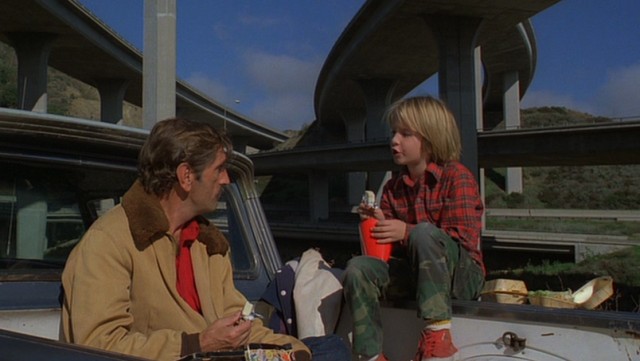
Travis (Harry Dean Stanton) and Hunter (Hunter Carson) bond while searching for Jane in Wim Wenders road movie

Longtime character actor Stanton (Repo Man, Wise Blood) is brilliant as Travis, his long, craggy face and sad, puppy-dog eyes conveying his troubled soul and buried emotions, his slow, careful gait awash in loneliness and desperation. The scenes between Travis and Jane are a master class in acting and storytelling; Stanton and Kinski (Tess, Cat People) will break your heart over and over again as they face the hardest of truths. Wenders and regular cinematographer Robby Müller use a one-way mirror to absolutely stunning effect in these scenes about what is hidden and what is revealed in a relationship. Wenders had previously made the Road Movie Trilogy of Alice in the Cities, The Wrong Move, and Kings of the Road, which also dealt with difficult family issues, but Paris, Texas takes things to another level. Ry Cooder’s gorgeous slide-guitar soundtrack is like a requiem for the American dream, now a wasteland of emptiness. (Cooder would later make Buena Vista Social Club with Wenders. Another interesting connection is that Wenders’s assistant director was Allison Anders, who would go on to write and direct the indie hit Gas Food Lodging.) A uniquely told family drama, Paris, Texas is rich with deft touches and subtle details, all encapsulated in the final shot. (Don’t miss what it says on that highway billboard.) Paris, Texas is screening November 4 at 2:00 and 7:45 in the BAMcinématek series “True West: Sam Shepard on Film.”

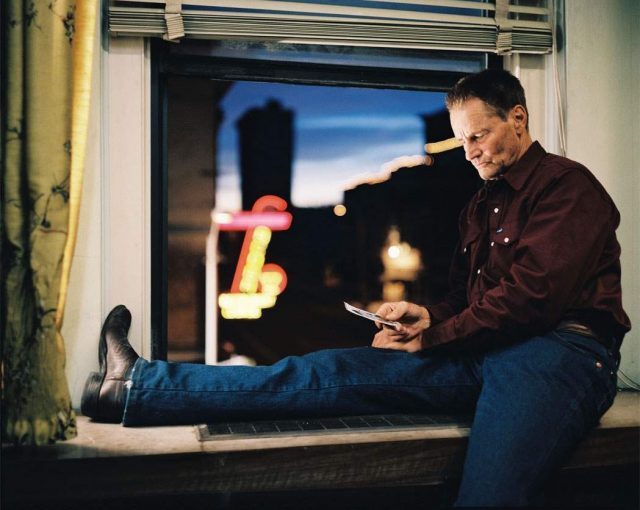
Sam Shepard

Sam Shepard wrote and stars in Wim Wenders underseen and underrated Don’t Come Knocking

DON’T COME KNOCKING (Wim Wenders, 2005)
Saturday, November 4, 5:00
www.bam.org
www.sonyclassics.com

Reteaming with Sam Shepard for the first time since the indie classic Paris, Texas more than twenty years earlier, German director Wim Wenders continued his exploration of the American psyche with this dark comedy set in the wide-open prairie. The movie begins the way many Westerns end — with the hero riding away into the distance, but in this case it is the sunrise, not the sunset, signaling a new start. Shepard stars as Howard Spence, a former big-time movie star whose career has fallen apart in a whirlwind of drugs, alcohol, and women. After a wild night in his trailer, he takes off from the set of his latest film, being made in Moab, Utah (and directed by the great George Kennedy), and decides to disappear, first going home to Elko, Nevada, to see his mother (Eva Marie Saint), whom he hasn’t spoken to in thirty years, and then heading to Butte, Montana, to find an old love (Jessica Lange, Shepard’s real-life longtime partner at the time) — and perhaps some lasting meaning to his miserable, wasted life. Meanwhile, Sutter (Tim Roth), a detective who works for the bond company that financed the film, is after him, determined to bring him back to finish the picture. Gorgeously photographed by Franz Lustig (Wenders’s Land of Plenty, Palermo Shooting) and featuring a great soundtrack by T Bone Burnett, Don’t Come Knocking is a fascinating character study and a whole lot of fun. The excellent cast also includes Gabriel Mann, Sarah Polley, and Fairuza Balk as an offbeat trio representing the next generation. Don’t Come Knocking is screening November 4 at 5:00 in the BAMcinématek series “True West: Sam Shepard on Film.”

L.A. DANCE PROJECT

Murder Ballades

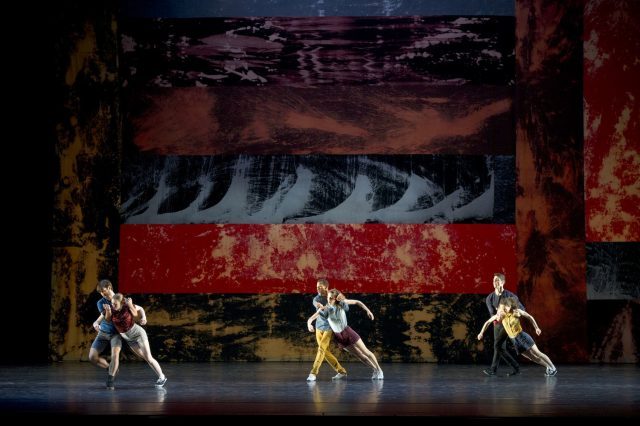
Sterling Ruby created the scenic design for Justin Peck’s Murder Ballades, part of the L.A. Dance Project’s two-week season at the Joyce

The Joyce Theater
175 Eighth Ave. at 19th St.
June 13-25, $26-$66
212-242-0800
www.joyce.org
www.ladanceproject.com

The innovative and exciting L.A. Dance Project follows up its 2016 Joyce debut with a two-week run at the Chelsea institution, performing a pair of what promise to be terrific programs, boasting an impressive array of collaborators. For the first program, the company, which was founded in 2012 by former New York City Ballet principal dancer Benjamin Millepied, will be presenting 2015’s Hearts & Arrows, choreographed by Millepied, with music by Philip Glass performed live by PUBLIQuartet, sets by English conceptual artist Liam Gillick, lighting by Roderick Murray, and costumes by company dancer Janie Taylor; Ohad Naharin’s Yag, a forty-minute piece for six dancers, set to music by John Zorn, Gaetano Donizetti, John Taverner, Ennio Morricone, Ran Slavin, and Maxim Waratt and for which LADP rehearsed with ballet masters from Naharin’s Batsheva Dance Company; and the world premiere of Millepied’s In Silence We Speak, a duet, inspired by Michelangelo Antonioni’s L’Avventura, for Taylor and Carla Korbës that you can get a sneak peek at here. The second program consists of New York City Ballet resident choreographer Justin Peck’s 2013 Murder Ballades, with an original score by Bryce Dessner of the National, sets by American artist Sterling Ruby, and lighting by Brandon Stirling Baker; Merce Cunningham’s MinEvent, a collage of excerpts from Cunningham’s oeuvre, with live piano by Adam Tendler; In Silence We Speak; and the world premiere of Millepied’s multimedia Orpheus Highway, set to Steve Reich’s Triple Quartet, played live by PUBLIQuartet. The company also includes Stephanie Amurao, Aaron Carr, David Adrian Freeland Jr., Rachelle Rafailedes, Nathan B. Makolandra, Julia Eichten, Robbie Moore, Morgan Lugo, and Lilja Rúriksdóttir. There will be a Curtain Chat following the June 15 performance of Program 2. LADP’s 2016 season at the Joyce sold out, so you better hurry if you want to see this sizzling hot company.

COUNTRY BRUNCHIN’: THE GOOD, THE BAD AND THE UGLY

Clint Eastwood is the Good in classic Sergio Leone operatic oater

NITEHAWK BRUNCH SCREENINGS: THE GOOD, THE BAD AND THE UGLY (Sergio Leone, 1966)
Nitehawk Cinema
136 Metropolitan Ave. between Berry St. & Wythe Ave.
August 6-7, 11:00 am
718-384-3980
www.nitehawkcinema.com

One of the all-time-great spaghetti Westerns, Sergio Leone’s dusty three-hour operatic oater stars Clint Eastwood as the Good (Blondie), Lee Van Cleef as the Bad (Angel Eyes), and Eli Wallach as the Ugly (Tuco Benedicto Pacifico Juan Maria Ramirez, whose list of criminal offenses is a riot), three unique individuals after $200,000 in Confederate gold buried in a cemetery in the middle of nowhere. Nearly twenty minutes of never-before-seen footage was added to the film several years ago, with Wallach and Eastwood overdubbing brand-new dialogue, so if you haven’t seen it in a while, it might just be time to catch it again. Ennio Morricone’s unforgettable score and Torino delli Colli’s gorgeous widescreen cinematography were also marvelously enhanced; their work in the scene when Tuco first comes upon the graveyard will make you dizzy with delight. And then comes one of the greatest finales in cinema history. The Good, the Bad and the Ugly is screening at Nitehawk Cinema on August 6 & 7 at eleven in the morning in the dual series “Nitehawk Brunch Screenings” and “Country Brunchin’” (will spaghetti be on the menu?) and will kick off with a set by Arthur Vint & Associates, led by Arizona-born, Brooklyn-based drummer Vint; the group’s debut album, Through the Badlands, came out in January, mixing jazz, rock, and Native American spiritual music. “Nitehawk Brunch Screenings” continues in August with such other films as Gillian Robespierre’s Obvious Child, Richard Donner’s The Goonies, and Susan Seidelman’s She-Devil, among others.