Tag Archives: Dick Cavett

HOLLYWOOD BABBLE-ON: CHANNELING AVA GARDNER, GENE WILDER, AND GILDA RADNER OFF-BROADWAY

Elizabeth McGovern wrote and stars in off-Broadway premiere of Ava: The Secret Conversations (photo by Jeff Lorch)

AVA: THE SECRET CONVERSATIONS
New York City Center Stage I
131 West 55th St. between Sixth & Seventh Aves.
Tuesday – Sunday through September 14, $63-$219
avagardnerplay.com
nycitycenter.org

There are currently two off-Broadway premieres that feature fine performances by actors portraying film and television royalty, but each play struggles to get past frame stories that detract from the overall production.

Oscar-nominated actress Elizabeth McGovern wrote and stars in Ava: The Secret Conversations, a touring show running through September 14 at New York City Center Stage I. It’s based on the 2013 biography Ava: The Secret Conversations by British journalist Peter Evans and Oscar-nominated Hollywood legend Ava Gardner, compiled from interview sessions between the two in Gardner’s lavish London apartment initiated in 1988. Gardner had suffered a stroke in 1986 and had not appeared on camera since.

The play opens with Gardner (McGovern) in silhouette, calling Evans (Aaron Costa Gani) on the phone, talking about possibly ending her life. The narrative then cuts back to the first time they spoke; Gardner had chosen Evans to ghostwrite her memoir for Dick Snyder at Simon and Schuster. Evans, who wants to move away from celebrity gossip and instead work on his novel, thought it was a gag and insults her, but he soon realizes from his agent, Ed Victor (John Tufts), that the project is the real deal. While Evans gets excited about the prospect of exploring the Golden Age of Hollywood, Gardner just wants to barrel through it without making it a kiss-and-tell.

“I gotta write a book, or sell the jewels. I’m kinda sentimental about the jewels,” she admits to him.

He wants to start the memoir with her childhood on a farm in North Carolina, but she wants to talk about her recent stroke. Meanwhile, Victor, in voice-over, advises him, “Dick Snyder says he wants you to ask her about it. Frank’s penis. . . . I can get close to 800K if she talks Sinatra.”

Evans and Gardner quickly get down to business; she reveals the details of meeting and marrying Mickey Rooney, Artie Shaw, and Sinatra and enjoying a lot of sex. They touch on such films as The Killers, Mogambo, The Sun Also Rises, and The Barefoot Contessa and such key figures as Marlon Brando, John Ford, Howard Hughes, and Omar Sharif. Alex Basco Koch’s projections range from archival news footage to clips from Gardner’s films, immersing the audience in her glamorous world.

As she recounts her past relationships, Gani morphs into Rooney, Shaw, and Sinatra, re-creating scenes from Gardner’s past, focusing on her three husbands; none of whom were saints. Evans, who was married with two kids, spends a lot of time with Gardner, who does not hide her flirtatious nature from him. Although she doesn’t have full use of her left arm because of the stroke, she smokes and drinks and curls up seductively on the couch, which initially bothers Evans — until it doesn’t.

Just as Gardner is really opening up, outside forces suddenly stop the interviews and put the kibosh on the book. Gardner went on to publish the 1990 memoir Ava: My Story without Evans’s input; it took more than twenty years for Evans to acquire the rights to the interviews and release them in the 2012 book Ava: The Secret Conversations, which is credited to him and Gardner.

“When you get blown up so big, Peter, you end up paper thin,” she tells him late in the play, summarizing her life as well as her attempts to tell her story her way.
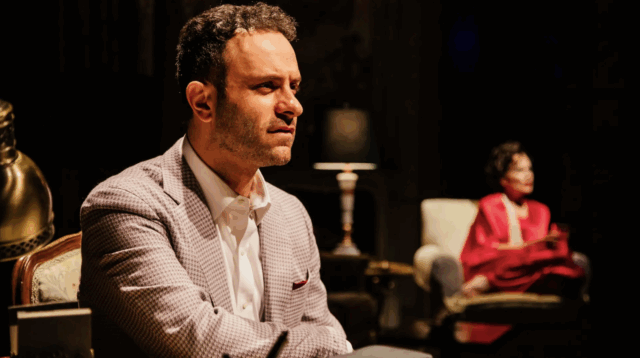
British journalist Peter Evans’s (Aaron Costa Gani) life is turned inside out when he is hired to ghostwrite Ava Gardner’s memoir (photo by Jeff Lorch)

McGovern (Time and the Conways, Downton Abbey) is lovely as Gardner; her accent may waver in and out, but her facial gestures, hair (by Matthew Armentrout), and costumes (by Toni-Leslie James) help her transform into the glamorous silver screen star in a mesmerizing performance. Ganis (Bernhardt/Hamlet, Homos or Everyone in America) does not fare as well, primarily because his characters — Evans, Rooney, Shaw, Sinatra — basically steal time away from Gardner, who merits all the attention.

McGovern the writer and Tony-nominated director Moritz von Stuelpnagel (Hand to God, The Thanksgiving Play) are exploring the creative process, but we learn only so much about Evans and instead want to know everything about Gardner. The pace comes to a screeching halt whenever Peter is not speaking with Ava and is instead talking to Ed or someone else; it’s a shame it couldn’t have been a one-woman show, but that would have been a different play.

In addition, there are bothersome plot holes; for example, Evans has a tiny notebook and only occasionally jots down notes, so it seems impossible for him to have gotten so many direct quotes; in actuality, he used a tape recorder, which would have been useful to point out so we don’t wonder about it.

Ava: The Secret Conversations might not be The Killers, Mogambo, or The Night of the Iguana, but it’s also not Ghosts on the Loose, The Sentinel, or The Naked Maja, falling somewhere in the middle of Gardner’s diverse oeuvre.
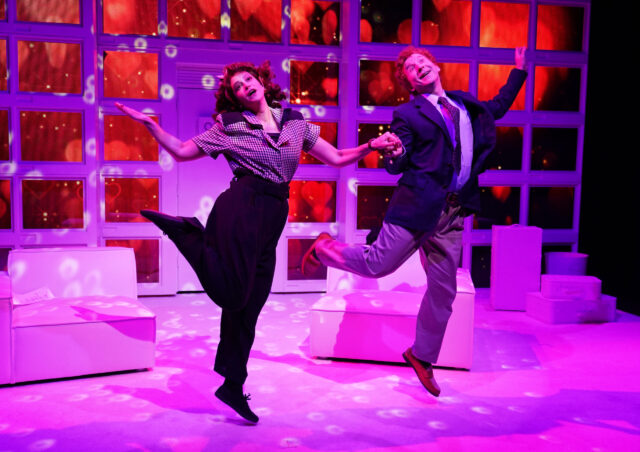
The whirlwind romance between Gilda Radner (Jordan Kai Burnett) and Gene Wilder (Jonathan Randell Silver) comes to life in off-Broadway premiere (photo by Carol Rosegg)

GENE & GILDA
59E59 Theaters
59 East 59th St. between Park & Madison Aves.
Tuesday – Sunday through September 7, $66-$86
212-279-4200
www.59e59.org

Cary Gitter’s Gene & Gilda, a Penguin Rep production running through September 7 at 59E59, details the whirlwind romance between Saturday Night Live superstar Gilda Radner (Jordan Kai Burnett) and comedy legend Gene Wilder (Jonathan Randell Silver). The show opens as Wilder is sitting down for his first interview since Radner’s tragic death. He’s hesitant to discuss his personal life with talk show host Dick Cavett, who appears here only in voice-over.

“I thought we agreed we wouldn’t discuss that,” Wilder says, but Cavett pushes him. “I’d rather keep that off limits,” Wilder answers, but is then interrupted by the sudden apparition of Radner, who declares, “Off limits? You wanna keep me off limits? . . . We can tell our story together. The good, the bad, and the ugly. The whole megillah.” The rest of the eighty-five-minute show flashes between the interview and reenacted scenes from Radner and Wilder’s relationship.

The two met on August 13, 1981, on the set of Hanky Panky, a 1982 comic thriller directed by Sidney Poitier that did not fare very well. At the time, Radner, who was born in 1946 in Detroit, was married to future SNL bandleader G. E. Smith, who had worked on her 1979 one-woman Broadway show, Gilda Radner — Live from New York. Wilder, who was born in 1933 in Milwaukee, had been divorced twice and was coming off the huge success of Stir Crazy, the second of his four collaborations with Richard Pryor. Although Radner knew in advance that she was going to fall in love with Wilder, he took a bit of convincing before being swept away by the gale force that was Gilda Radner. “But — but what about my vertigo, and the comfort handkerchief, and the praying?” he says to her, referring to some of his neuroses. She replies, “I love all of it. We complement each other’s craziness. A match made in meshugas.

They both suffer creative crises but find solace in each other and their home away from home, the south of France, where they wed in 1984. At one point, Wilder complains that he is only being offered parts in “Crap! Trash! Garbage!,” telling Radner, “I’m seeing clearly for the first time in years! I wanted to be a thespian. When I was a kid, I saw Death of a Salesman on Broadway, and it changed my life. That was art. I studied at the Actors Studio. I wanted to impact people. And now I’m nothing but a, a cheap Hollywood commodity, making stupid comedies like Hanky Panky! No offense.”

Radner reassures him that making people laugh is his gift. “What do you think people would rather do on a Saturday night — watch me give a speech about the hardships of life, or crack up over Roseanne
Roseannadanna? What we do is a — it’s a public service.”

But their idyllic life is turned upside down when Radner falls ill, experiencing mysterious symptoms that doctors cannot diagnose — until it’s too late.
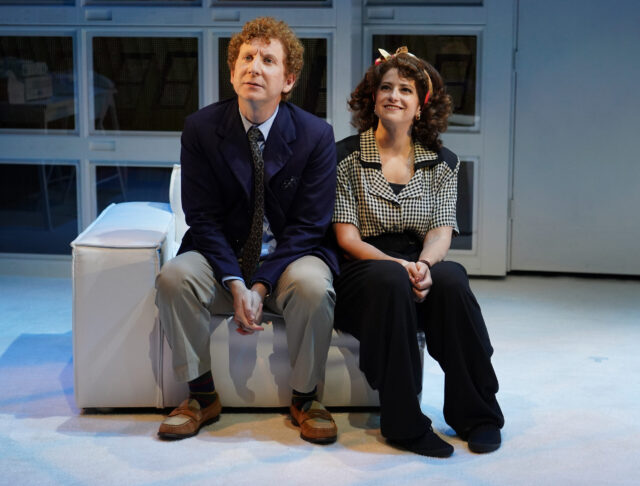
Gene Wilder (Jonathan Randell Silver) looks back at his life with Gilda Radner (Jordan Kai Burnett) in Gene & Gilda (photo by Carol Rosegg)

Christian Fleming’s set features all-white furniture, from a two-section couch and a desk with a typewriter to luggage and a big box (perhaps to make the room seem ghostly or to keep the spotlight more on the couple — except at least twice, the night I went, when the spotlight loses Wilder). Wilder occasionally sits in a black director chair when being interviewed by Cavett; those segments slow down the pace dramatically.

The backdrop is a wall of television monitors where Brian Pacelli’s projections range from hearts and flowers to a shot of the south of France and live video of Wilder answering Cavett’s questions; at the center is a door marked “On the Air,” a constant reminder that we’re watching a TV show. Gregory Gale’s costumes put Wilder in relatively conservative suits and Radner in frumpy yet wacky outfits, while Bobbie Zlotnik’s hair and wigs hit their mark. Sound designer Max Silverman’s treacly score evokes telephone hold music.

In the script, Gitter (The Steel Man, The Sabbath Girl) explains that Gene & Gilda “is a work of fiction, based freely on fact.” Among his sources were Wilder’s 2005 memoir, Kiss Me Like a Stranger, Radner’s posthumous 1989 autobiography, It’s Always Something, and Lisa Dapolito’s 2018 documentary, Love, Gilda, as well as archival footage; although Wilder did sit down with Cavett for an interview in 1991, they did not delve into detail about Radner, instead talking about how ovarian cancer could and should be diagnosed earlier. Director Joe Brancato (The Devil’s Music, The Sabbath Girl) can’t quite find the balance between fact and fiction, fantasy and reality. There is too much telling, describing what happened, and not enough showing.

Burnett (Found, Romy & Michele the Musical), who previously portrayed Radner in a December 2023 workshop reading of Not Ready for Prime Time, a play about SNL’s first five years that is scheduled to debut in New York City in October, is adorable as the determined star, who is not afraid to say what she wants and go after it, although a brief skit in which she channels Roseanne Roseannadanna, Emily Litella, Baba Wawa, Judy Miller, and Candy Slice is a tough challenge.

Silver (Please Continue, Shear Madness!), who portrayed Richard Dreyfuss in regional productions of The Shark Is Broken for the fiftieth anniversary of Jaws, captures the essence of the mild-mannered, tentative Wilder. A scene in which they re-create one of the funniest bits from The Producers — when Max Bialystock (Zero Mostel) attempts to calm down a hysterical Leo Bloom (Wilder) — is another challenge, but there are several lovely moments between them, especially when they dance together.

Gene & Gilda is reminiscent of an episode of Saturday Night Live, with some good sketches, some okay ones, and some, well, not so memorable. It might not be Willy Wonka & the Chocolate Factory, Young Frankenstein, or Silver Streak, but it’s also not Hanky Panky, Haunted Honeymoon, or Rhinoceros. It’s more like The Frisco Kid, The Woman in Red, and Quackser Fortune Has a Cousin in the Bronx. And no need to worry; you won’t need your comfort hankie.

[Mark Rifkin is a Brooklyn-born, Manhattan-based writer and editor; you can follow him on Substack here.]
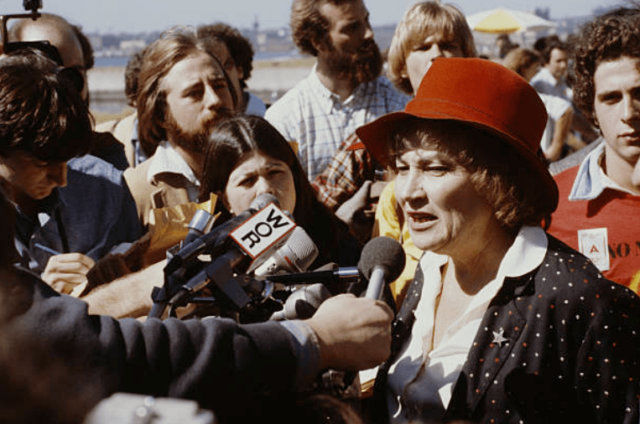
BELLA! THIS WOMAN’S PLACE IS IN THE HOUSE

Bella Abzug defiantly makes her case in Jeff L. Lieberman’s new documentary opening at the Quad

BELLA (Jeff L. Lieberman, 2023)
Village East by Angelika
181-189 Second Ave. at Twelfth St.
August 18-24
www.angelikafilmcenter.com

When I was a kid, we often wondered, “WWBD?” — “What would Bella do?,” referencing Bella Abzug, a towering New York City political figure beginning in the 1970s. Today too many people might answer that question with “Bella who?”

Jeff L. Lieberman’s new documentary, Bella! This Woman’s Place Is in the House, lays out precisely who she is and what she did during her roller-coaster career as an ahead-of-her-time advocate for change whose campaign slogan was, in pure Bella fashion: “This Woman’s Place Is in the House.”

“She came out and screamed about what was going on with women. It really upset the white male power structure, who was being frightened by women coming in and taking over their power. That didn’t stop Bella,” one of her campaign aides, Arnie Weiss, says. “She talked about the issues that mattered to me: women’s rights, gay rights, civil rights, nuclear disarmament, protecting the environment, ending the war in Vietnam,” actress, singer, and activist Barbra Streisand explains. And former House Speaker Nancy Pelosi points out: “She knew that she wasn’t there just for Bella and her generation, that she was there to make sure that the doors were open for what came next.”

Born Bella Savitzky in the Bronx in 1920, the year that women got the right to vote, Bella was a fighter from the start, challenging the traditions at her parents’ synagogue and enrolling as one of only six women out of 120 in her Columbia Law School class. She married Martin Abzug, had two daughters, and then, in 1950, began five decades of battling for minorities and the underprivileged, defending the wrongly accused Willie McGee in a rape case in Mississippi. She railed against Joe McCarthy, befriended Malcolm X’s family after he was assassinated, and joined the “Women Strike for Peace” movement, protesting against nuclear weapons.

After helping New York City mayor John Lindsay get reelected in 1969, she decided to run for office herself, challenging seven-term incumbent Leonard Farbstein in the primary and talk show host Barry Farber in the general election for Manhattan’s 19th Congressional District seat. She was unrelenting, feisty, and loud, adopting a trademark look by always wearing a hat, building up a wealth of supporters as well as plenty of detractors.

“She was called all kinds of names. She was loved and definitely hated,” her daughter Eve, a social worker, says. She had to take “all those barbs and even worse from men who should have known better . . . a real organized effort to create a monster who’s not liked,” Phil Donahue explains. “She went with the hat, and she took off the gloves,” actress and activist Shirley MacLaine emphasizes.

Through archival news footage, home movies, audio diaries, photographs, and new interviews, Lieberman celebrates Abzug’s fierce courage as she refused to allow anything or anyone to get in her way as she sought equality across the board. “To all of us young kids, Bella represented the mother that we all wished we had,” gay rights activist Allen Roskoff says, recalling a night when Abzug campaigned at the Continental Baths in front of a bevy of naked men.

Among those who discuss Abzug and her legacy are many people who were with her in the trenches, including journalist and activist Gloria Steinem, activist and politician Ronnie Eldridge, Congresswoman Elizabeth Holtzman, campaign aide and undersecretary of commerce Eric Hirschhorn, actress and activist Marlo Thomas, press secretary and historian Harold Holzer, activist and author Letty Cottin Pogrebin, political consultant Dick Morris, Congresswoman Maxine Waters, Treasury secretary Jack Lew, jewelry designer Lois Sasson, poet and activist Robin Morgan, author and actress Renée Taylor, administrative aide and later literary agent Esther Newberg, and Congressman Charles Rangel in addition to former first lady and senator Hilary Rodham Clinton, New York Times editor Max Frankel, former NYC mayor David Dinkins, Battling Bella author Leandra Zarnow, and Bridgette McGee, granddaughter of the executed Willie McGee.

Lieberman (The Amazing Nina Simone, Re-Emerging: The Jews of Nigeria) tracks Abzug as she argues for the Equal Credit Opportunity Act, runs for the Senate and mayor, shakes up the seminal 1977 Women’s Conference in Houston, and confronts CIA director George H. W. Bush about a file on her, all the while enjoying a loving relationship with Martin. Former traffic reporter Captain Dan Rosenson relates a remarkable story of attempting to helicopter Abzug into a 1971 antiwar protest that had turned violent.

Abzug, who died in 1998 at the age of seventy-seven, was not always successful — she lost several elections, and many of the policies she supported failed to make it into law — but she paved a trail for others to follow. She was so far ahead of her time that it would be fascinating to see how she would fare in today’s painfully divisive America.

“She was just too real,” Steinem says.

“She was just too early,” Tomlin adds.

“I never felt like I couldn’t have it all,” Abzug herself said.

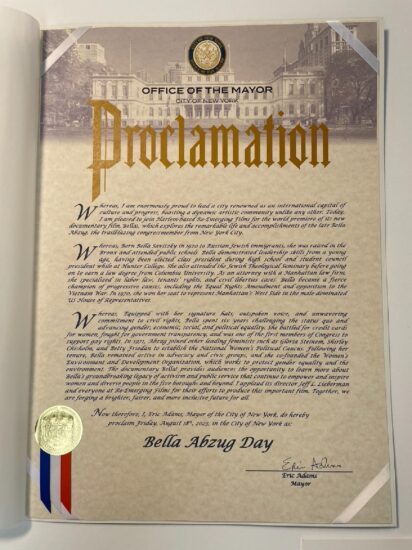
The film passionately reestablishes Abzug’s well-earned credentials and importance to America’s modern sociopolitical history. In 2015, Bank St., where she lived, was renamed Bella Abzug Way; Bella Abzug Park opened in Hudson Yards in 2022; and Mayor Eric Adams has proclaimed August 18, 2023, as Bella Abzug Day, in honor of the world premiere of Bella! in the Village.

[Mark Rifkin is a Brooklyn-born, Manhattan-based writer and editor; you can follow him on Substack here.]
MATTHEW BARNEY AND JONATHAN BEPLER: RIVER OF FUNDAMENT

(photo by Hugo Glendinning)

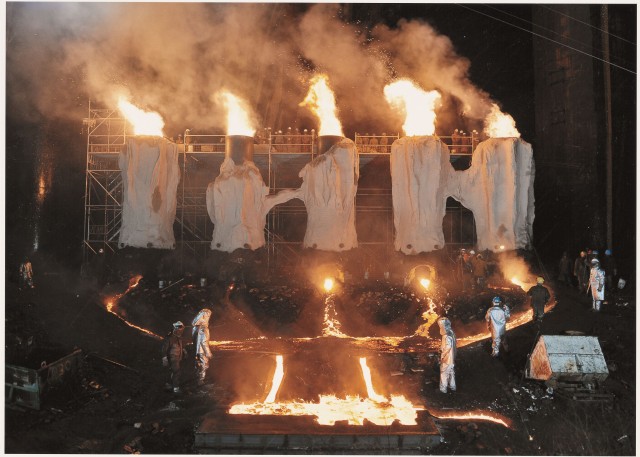
Matthew Barney’s five-and-a-half-hour epic makes its Manhattan debut this weekend (photo by Hugo Glendinning)

RIVER OF FUNDAMENT (Matthew Barney & Jonathan Bepler, 2014)
IFC Center
323 Sixth Ave. at West Third St.
December 4-10, $14 per act, $40 series pass
212-924-7771
www.ifccenter.com

In February 2014, I experienced the entirety of Matthew Barney and Jonathan Bepler’s fecal epic, River of Fundament, in one marathon evening at the BAM Harvey, coming away impressed, confused, exhausted, and in need of a long, hot shower. And now you can feel the same as the bizarrely mesmerizing and surreal five-and-a-half-hour adventure flows into the IFC Center for a one-week engagement. Fortunately, you have the choice of seeing the cinematic journey in three acts on different days, or you can just check them out back-to-back-to-back, depending on your general level of comfort for these kinds of things. To help you make sense of it, Barney will be at the IFC Center for a Q&A following the 7:20 screening of act three on December 6; of course, that also has the potential to, er, clog your mind even further.

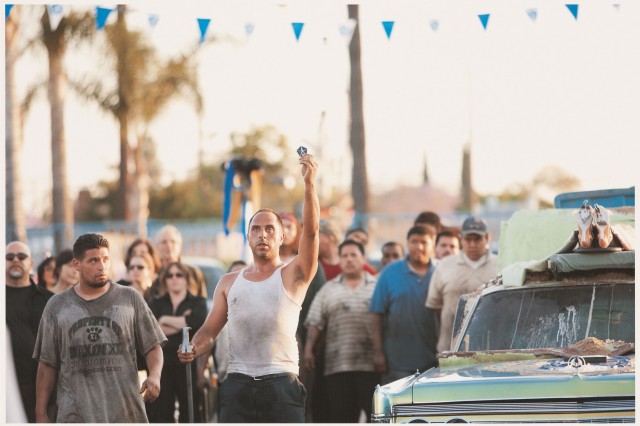
RIVER OF FUNDAMENT is built around episodes in Los Angeles, Brooklyn, and Detroit (photo by Ivano Grasso)

RIVER OF FUNDAMENT is built around episodes in Los Angeles, Brooklyn, and Detroit (photo by Ivano Grasso)

“Crude thoughts and fierce forces are my state. I do not know who I am. Nor what I was. I cannot hear a sound. Pain is near that will be like no pain felt before,” Norman Mailer writes at the beginning of his 1983 novel, Ancient Evenings. “Is this the fear that holds the universe? Is pain the fundament? All the rivers veins of pain? The oceans my mind awash? I have a thirst like the heat of earth on fire. Mountains writhe. I see waves of flame. Washes, flashes, flashes, waves of flame.” New York-based visual artist Barney and Berlin-based composer and musician Bepler have transformed Mailer’s seven-hundred-page epic about death and rebirth in Egypt into quite the cinematic spectacle. In his five-part, seven-hour Cremaster Cycle, Barney explored the ascension and descension of the cremaster muscle, which determines sexual differentiation, with a cast that included Mailer as Harry Houdini and Barney as Gary Gilmore in a section inspired by Mailer’s book The Executioner’s Song while focusing on cars and petroleum jelly in others. River of Fundament begins with Mailer’s wake at an intricate reconstruction of his Brooklyn Heights home, with Mailer’s son John Buffalo Mailer playing his father’s spirit. The second act follows the reincarnation of Mailer (Milford Graves) as he is born in the River of Feces and meets medium Hathfertiti (Maggie Gyllenhaal) and a gold 1979 Pontiac Firebird Trans Am. The third act returns to Brooklyn, with Mailer’s next reincarnation played by a 2001 Ford Crown Victoria Police Interceptor and Ellen Burstyn taking over as Hathfertiti. The primary cast also features Paul Giamatti, Cremaster star Aimee Mullins, Elaine Stritch, Lila Downs, Chief Dave Beautiful Bald Eagle, Joan La Barbara, and Madyn G. Coakley, with a multitude of cameos by Dick Cavett, Luc Sante, Larry Holmes, Salman Rushdie, Lawrence Weiner, Fran Lebowitz, Marti Domination, James Toback, David Amram, and dozens of others as the myth of Isis, Osiris, Nephthys, Set, and Horus plays out as well.

Cars once again are featured prominently in epic new Matthew Barney film (photo by Ivano Grasso)

Cars once again are featured prominently in epic new Matthew Barney film (photo by Ivano Grasso)

The action, much of which consists of filmed performance art presentations that were held in public spaces, moves from New York City to Los Angeles to Detroit as Egyptian mythology and ritual play out in unusual ways. Barney, whose multidisciplinary Cremaster exhibition at the Guggenheim in 2002-3 was one of the best of the decade, gave New Yorkers an advance sneak peek at the making of River of Fundament via the ”DJED” show at the Gladstone Gallery in the fall of 2011 and the wide-ranging “Subliming Vessel” at the Morgan Library in 2013. Not that they gave any real indication of what to expect, because with Barney, the only thing to expect is the unexpected. And even then, don’t expect to understand what is unfurling before you. Just know that once you take it all in, you will never be able to flush it out of your mind, where it will simmer and stew most likely for the rest of your natural life.

HAUTE COUTURE ON FILM — DIANA VREELAND: THE EYE HAS TO TRAVEL

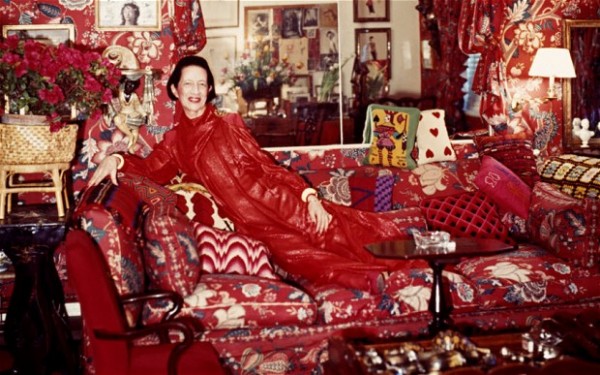
Documentary about Diana Vreeland is a colorful look inside the High Priestess of Fashion

Documentary about Diana Vreeland is a colorful look inside the High Priestess of Fashion

CinéSalon: DIANA VREELAND: THE EYE HAS TO TRAVEL (Lisa Immordino Vreeland, 2011)
French Institute Alliance Française, Florence Gould Hall
55 East 59th St. between Madison & Park Aves.
Tuesday, April 21, $13, 4:00 & 7:30
Festival runs through May 26
212-355-6100
www.fiaf.org
www.facebook.com

“There’s not many people like her. She’s unique,” photographer David Bailey says about his former boss, Diana Vreeland, in the DVD extras of the wonderful documentary Diana Vreeland: The Eye Has to Travel. “You could easily put her in a list of people like Cocteau and, in a funny sort of way, Proust. She was very Proustian in a way. She loved the detail of things, the memory of things,” he adds. The 2011 film, directed and produced by Lisa Immordino Vreeland, who is married to Diana Vreeland’s grandson Alexander, and codirected and edited by Bent-Jorgen Perlmutt (Havana Motor Club) and Frédéric Tcheng (Dior and I, Valentino: The Last Emperor), is a fun and fanciful look inside one of the most important, and entertaining, fashion figures of the twentieth century. Immordino Vreeland focuses on her husband’s grandmother’s extremely influential years as editor of Harper’s Bazaar and Vogue and then curating the Costume Institute at the Metropolitan Museum of Art. Among those sharing stories about the rather eccentric, demanding, intuitive, opinionated, cultured, respected, feared, difficult, loyal, spontaneous, self-aware, critical, and always fashionable woman are designers Oscar de la Renta, Manolo Blahnik, Hubert de Givenchy, Carolina Herrera, Calvin Klein, Pierre Bergé, Anna Sui, and Diane von Furstenberg, models Marisa Berenson, Anjelica Huston, Lauren Hutton, Penelope Tree, and Veruschka von Lehndorff, and former Vreeland assistant Ali MacGraw. There are also marvelous archival clips of television interviews Vreeland did with Dick Cavett, Jane Pauley, and Diane Sawyer, as well as scenes from Stanley Donen’s Funny Face and William Klein’s Who Are You, Polly Magoo?, both of which feature characters inspired by Vreeland. In addition, the film contains voice-over narration (performed by Annette Miller and Jonathan Epstein) based on 1983 recordings made of conversations between Vreeland and George Plimpton when the two were collaborating on her autobiography, D.V. About the only thing lacking in the film is more exploration of Vreeland’s personal life, although some of her children and grandchildren do admit that family did not come first with her. And oh, the photos, by Bailey, Cecil Beaton, Richard Avedon, Irving Penn, Bert Stern, and many others; The Eye Has to Travel is chock-full of amazing pictures that reveal Vreeland to be a consummate storyteller who changed the fashion world in remarkably prescient ways.
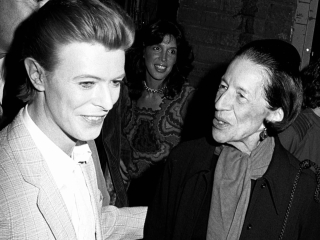
Documentary depicts Diana Vreeland as a superstar in her own right

Documentary depicts Diana Vreeland as a superstar in her own right

Everyone has fascinating things to say about Vreeland — including Vreeland herself, who is eminently quotable, her bold, brash, insightful, and funny proclamations instantly memorable — so much so that the above David Bailey opening quotation was taken from the DVD extras so as not to spoil any of the gems in the film itself, which is screening April 21 in the FIAF CinéSalon series “Haute Couture on Film,” part of the French Institute Alliance Française’s third annual “Fashion at Fiaf” festival; Immordino Vreeland will introduce the 7:30 show, and both screenings will be followed by a wine reception. The festival continues through May 26 with such other films as John Cassavetes’s Gloria, Jean Renoir’s The Rules of the Game, and Jean Negulesco’s How to Marry a Millionaire. “Fashion at Fiaf” also includes talks with Jack McCollough and Lazaro Hernandez of Proenza Schouler, Kate Betts, and Garance Doré and a gallery exhibition of the work of photographer Grégoire Alexandre.

LUCKY THEM

LUCKY THEM

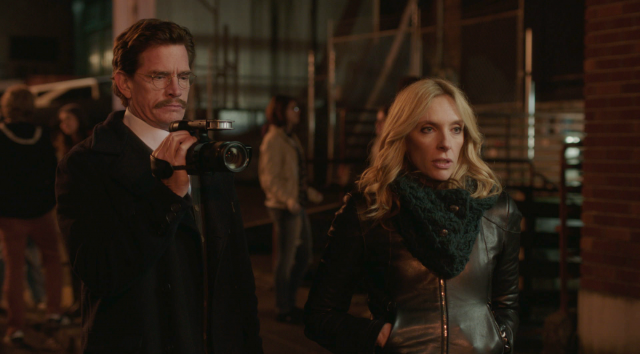
Thomas Haden Church and Toni Colette search for the truth about a mystery musician in LUCKY THEM

LUCKY THEM (Megan Griffiths, 2014)
IFC Center
323 Sixth Ave. at West Third St.
Opens Friday, May 30
212-924-7771
www.ifccenter.com
www.ifcfilms.com

With the music magazine she works for facing financial difficulties, longtime rock writer Ellie Klug (Toni Colette) is assigned by her editor, Giles (Oliver Platt), the one story she doesn’t want to cover: the mysterious death of Seattle musician Matthew Smith, who made one highly influential album, then drove his car over a waterfall. The main problem is that the jaded Ellie, who has a penchant for sleeping with her subjects, had a relationship with Matthew, one she wants to keep buried. But soon she is on the road with former fling Charlie (Thomas Haden Church), a straitlaced, wealthy bore who decides to make a documentary about her search. At the same time, Ellie is pursued by singer-songwriter Lucas (Ryan Eggold), a younger man who has the hots for her. When she gets a tip that Matthew might actually still be alive, she has to decide whether holding on to her career is worth dredging up the past. Inspired by cowriter and producer Emily Wachtel’s real life as a singles columnist for the Fairfield County Weekly and a contributing writer for Westport magazine, for which she used the pseudonym Ellie Klug, Lucky Them can’t decide whether it’s Eddie and the Cruisers, Velvet Goldmine, or Almost Famous, resulting in a tedious drama filled with genre clichés and dull, predictable scenes. Even a supposed shock near the end ultimately feels trite and obvious. Haden Church’s character is so ludicrously unbelievable that it drags down the entire film by itself, but he gets no help from the overwrought script, mediocre music, and stagnant direction by Megan Griffiths (Eden, The Off Hours). The film is dedicated to Paul Newman, whose widow, Joanne Woodward, is one of the executive producers; Woodward and Wachtel previously teamed up with director Treva Wurmfeld on the documentary Shepard & Dark. But this disappointing follow-up is more like a vanity project that should never have seen the light of day. Lucky Them opens May 30 at the IFC Center, with Griffiths and Wachtel participating in Q&As Friday night with Ira Glass following the 7:15 screening and Saturday night with Dick Cavett after the 7:15 show and Lauren Hutton after the 9:30 screening.

HELLMAN v. McCARTHY

(photo by Kim T. Sharp)

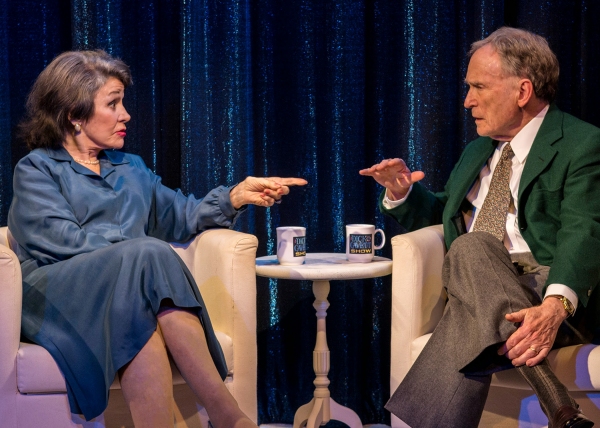
Mary McCarthy (Marcia Rodd) shares her blunt opinions with Dick Cavett in HELLMAN v. McCARTHY (photo by Kim T. Sharp)

June Havoc Theatre
Abingdon Theatre Arts Complex
312 West 36th St. between Eighth & Ninth Aves.
Wednesday – Sunday through April 13, $25
www.abingdontheatre.org

On October 18, 1979, one of the most dramatic literary feuds of the twentieth century kicked off on The Dick Cavett Show when writer and critic Mary McCarthy called Lillian Hellman a “dishonest writer,” explaining that “I said once in some interview that every word she writes is a lie, including ‘and’ and ‘the.’” An irate Hellman sued McCarthy, Cavett, and PBS for more than two million dollars, leading to a vitriolic back-and-forth between the writer of such works as The Children’s Hour, The Little Foxes, and Watch on the Rhine and the author of such books as The Company She Keeps, Memories of a Catholic Girlhood, and The Group — the last of which was made into a film starring, among others, Cavett’s wife, Carrie Nye. Various versions of the famous story have already been told onstage, by Nora Ephron in her musical, Imaginary Friends, Ben Pleasants in Contentious Minds: The Mary McCarthy, Lillian Hellman Affair, and William Wright in The Julia Wars. Now Brian Richard Mori is taking on this battle of literary bigs with a unique twist: The character of Dick Cavett is being played by, well, Dick Cavett himself, and Cavett is by far the best thing about the Abingdon Theatre’s otherwise doleful Hellman v. McCarthy. The proverbial gloves come off as soon as McCarthy (Marcia Rodd) calls Hellman (Roberta Maxwell) a liar; as it turns out, when the recorded show aired, Hellman was watching with her nurse, Ryan Hobbs (Rowan Michael Meyer), and she did not react well to McCarthy’s statement, immediately calling her attorney.

Lillian Hellman’s nurse jumps for joy upon meeting Dick Cavett (photo by Kim T. Sharp)

Lillian Hellman’s (Roberta Maxwell) nurse (Rowan Michael Meyer) jumps for joy upon meeting Dick Cavett (photo by Kim T. Sharp)

Hellman’s lawyer, Lester Marshall (Peter Brouwer), and McCarthy’s, Burt Fielding (Jeff Woodman), can’t get their clients to reach an agreement as the nasty words keep flying. “I’d rather eat my own vomit,” Hellman says when told by Marshall that they can read everything they want about McCarthy as part of discovery. “I refuse to make it easy for her,” McCarthy tells Fielding upon deciding to appeal. Ultimately, Mori has the two women go face-to-face at a meeting that never actually took place, continuing the nearly constant drone of unpleasantness at an even higher pitch as these two extremely unlikable women have it out. The only respite is the occasional appearance of Cavett to fill in some of the details and share his own thoughts on the matter; he is, as ever, witty, charming, and intellectual, although he does too many Woody Allen references. Abingdon artistic director Jan Buttram cuts between two primary sets designed by Andrew Lu: on the left side of the stage is a room in Hellman’s home on Martha’s Vineyard, while to the right is a room in McCarthy’s house in Castine, Maine. Virtually all the furniture is white, with empty picture frames, as if implying that neither of the women has any friends or family. Travis McHale’s lighting design turns the back walls various pastel shades of pink, green, and other colors, offering just about the only amiable visuals aside from Cavett’s appearances. Hellman v. McCarthy sheds no new light on the feud, instead letting two nasty souls blather on in nasty ways; the production probably would have been much better if it was simply a one-man show featuring Cavett.

NYC FABMANIA WEEK

fabmania

On February 7, 1964, John Lennon, Paul McCartney, George Harrison, and Ringo Starr landed at JFK to a wild welcome as they came to America for the first time to appear on The Ed Sullivan Show. New York City is paying tribute to that seminal moment in the history of the Fab Four with Fabmania Week, featuring a host of special events celebrating this golden anniversary. The centerpiece of it all is the fortieth anniversary of the Fest for Beatles Fans, taking place February 7-9 at the Grand Hyatt in Midtown ($32.50-$225). Among the many guests are Cousin Brucie (broadcasting live), Donovan, Billy J. Kramer, Peter Asher, Chad & Jeremy, Freda Kelly, Bob Guren, and Allan Tannenbaum; the Fest also features a re-creation of the Cavern Club, screenings of Ryan White’s Good Ol’ Freda, a marketplace of memorabilia, look-alike and costume contests, and yoga sessions in an ashram, in addition to book signings, art exhibitions, and other tributes. On February 6, Donovan, Asher, Kramer, Kelly, Vince Calandra, and moderator Martin Lewis will take part in the friends-of-the-Beatles panel discussion “It Was 50 Years Ago Today . . . Celebrating 50 Years of the Beatles in the USA” at the 92nd St. Y ($15-$29, 8:15). The Morrison Hotel Gallery exhibit “50th Anniversary of the Beatles’ First US Tour,” curated by Julian Lennon, opens on February 7 and runs through February 28, consisting of twenty-five images, some never before shown in public, of John, Paul, George, and Ringo taken by such photographers as Ken Regan, Charles Trainor, Curt Gunther, Robert Whitaker, Rowland Scherman, and Terry O’Neill.

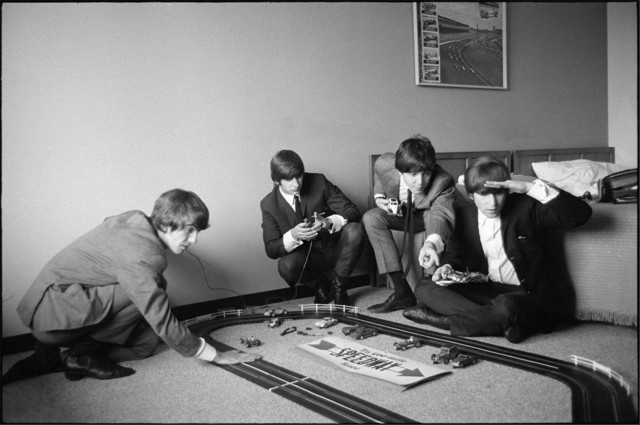
Curt Gunther’s photograph of the Beatles playing with slot cars is included in Morrison Hotel Gallery exhibit curated by Julian Lennon (photo © Curt Gunther, 1964)

Curt Gunther’s photograph of the Beatles playing with slot cars is included in Morrison Hotel Gallery exhibit curated by Julian Lennon (photo © Curt Gunther, 1964)

The New York Public Library for the Performing Arts will be home to the multimedia exhibition “Ladies and Gentlemen . . . the Beatles!” from February 6 through May 10, examining the effects Beatlemania had on American pop culture during the mid-1960s, comprising interviews, instruments, posters, music, and an oral history booth where fans can share their own memories; there will also be a free symposium on February 9 in the library’s Bruno Walter Auditorium with presentations by Bruce Spizer (“The Beatles Are Coming! The Birth of Beatlemania in America”), Dennis Elsas (“It Was 50 Years Ago Today — The Beatles Invade America”), Chuck Gunderson (“Some Fun Tonight! The Backstage Story of the 1964 Summer North American Tour”), Allan Kozinn (“Studio Days / Touring Years”), and Russ Lease (“The Drop-T Logo and the Most Significant Drumkit in Popular Music History”), emceed by curator Robert Santelli. On February 8, the Town Hall will hold the “America Celebrates the Beatles’ 50th Anniversary All-Star Concert” ($63-$272, 7:30), with a wide-ranging lineup playing songs by and inspired by the Liverpudlian quartet, including Melissa Manchester, Tommy James, Al Jardine, Danny Aiello, Marshal Crenshaw, Larry Kirwin, Aztec Two-Step, Melanie, along with appearances by such Beatles fans as Dick Cavett, Len Berman, the Amazing Kreskin, and Charles Grodin. And on February 8 & 9 at 1:00, the Paley Center will present “The Beatles Invasion 50-Year Celebration: See the Fab Four on the Big Screen, Yeah, Yeah, Yeah,” with showings of the complete Ed Sullivan Show broadcast from February 9, 1964, and the Maysles brothers’ original What’s Happening! The Beatles in the U.S.A. documentary.