
Jasmine (Cate Blanchett) has to start her life all over again with her sister (Sally Hawkins) in Woody Allen’s latest
BLUE JASMINE (Woody Allen, 2013)
Opened Friday, July 26
www.sonyclassics.com
 Woody Allen’s best film in years, Blue Jasmine is a modern-day Streetcar Named Desire filtered through the Bernie Madoff scandal. Cate Blanchett gives a marvelously nuanced and deeply textured performance as Jasmine French, an elegant socialite whose immensely wealthy husband, Hal (a wonderfully smarmy Alec Baldwin), amassed his fortune the new-fashioned way: by lying and cheating—only he was the rare financier who got caught and ended up in jail. Now broke and distraught, Jasmine moves in with her sister, Ginger (the delightful Sally Hawkins), a single mother with two kids living in a cramped apartment in San Francisco. Ginger and her ex-husband, Augie (an excellent Andrew Dice Clay), lost all their money by investing with Hal, and she is now trying to rebuild her life, working as a cashier and dating the gruff but dedicated Chili (a strong Bobby Cannavale). Not used to taking care of herself, Jasmine seems lost in a world that no longer treats her like a princess; she takes a job working for a dentist (Michael Stuhlbarg) and attends a computer class, but she is determined to regain her previous status. And that chance comes when she meets Dwight (a gentle Peter Sarsgaard), a man with grand plans who just might be the one to lead her back to the level to which she is accustomed.

Sisters Jasmine (Cate Blanchett) and Ginger (Sally Hawkins) go on an awkward double date in San Francisco
With Blue Jasmine, Allen has written his best screenplay since 1989’s Crimes and Misdemeanors, creating a complex, multilayered narrative that intelligently examines both sides of the financial crisis, as the rich Jasmine loses everything and the lower-middle-class Ginger can’t quite reach the next level. The relationship between the two sisters is bittersweet, evoking Tennessee Williams’s Blanche and Stella, with Jasmine the delusional sibling and Ginger as the much more realistic one, in this case dealing with a pair of Stanley Kowalski-type brutes. The story travels seamlessly back and forth between the past and the present, concentrating on Jasmine’s downward emotional and psychological spiral, which is supremely evident in Suzy Benzinger’s dazzling costume design and the detailed makeup, which focuses particularly on Blanchett’s stunningly emotive eyes. She physically dominates the screen like no previous Allen leading lady, with cinematographer Javier Aguirresarobe (Vicky Cristina Barcelona) making sure she fills the screen again and again. It’s a sensational star turn in a film loaded with superb acting. Blue Jasmine is a joy to watch from beginning to end, a deft commentary from a master back at the very top of his game.
Nominated for three Academy Awards: Best Actress (Cate Blanchett), Best Actress in a Supporting Role (Sally Hawkins), and Best Original Screenplay (Woody Allen)
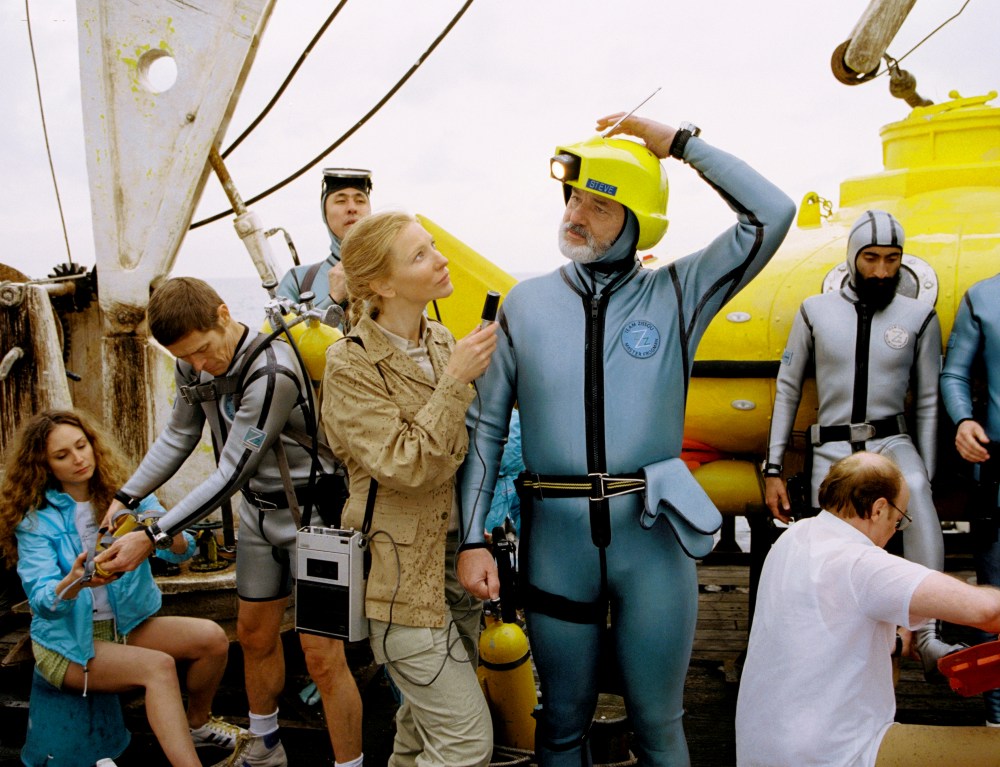
 Wes Anderson’s fourth film, following Bottle Rocket, Rushmore, and The Royal Tenenbaums, is, once again, zany, unique, offbeat, and creative, although in this case the sum of the parts do not add up to a worthwhile whole. Bill Murray stars as Steve Zissou, a minor-league Jacques Cousteau type who has been making cult underwater documentaries for years, but his last adventure could turn out to be his final one in more ways than one. His crew includes longtime right-hand man Klaus Daimler (Willem Dafoe), who is jealous of the new guy in Steve’s life, a pipe-smoking Kentucky pilot who might be his son (Owen Wilson); a pregnant reporter profiling Steve for an oceanography magazine (Cate Blanchett); a Brazilian safety expert who has a fondness for playing acoustic versions of David Bowie songs in Portuguese (Seu Jorge); the bond company stooge protecting his company’s investment (Bud Cort); and Zissouss mad producer (Michael Gambon), among others. There’s also wealthy rival Alistair Hennessey (Jeff Goldblum), who used to be married to Zissou’s wife Eleanor (Anjelica Huston). After Zissou’s best friend, Esteban (Seymour Cassel), gets eaten supposedly by the rare “jaguar shark,” Zissou goes on a personal mission of underwater vengeance that is just too dry for its own good. Henry Selick (The Nightmare Before Christmas) did the stop-motion animation of the sea creatures. The Life Aquatic with Steve Zissou is screening May 26-27 as part of the Museum of the Moving Image retrospective “Wes Anderson’s Worlds,” being held in conjunction with the opening of Anderson’s latest, Moonrise Kingdom, which hits theaters May 25.
 Russell Crowe and Cate Blanchett join the long line of illustrious acting duos that have teamed up as Robin Hood and Maid Marion (or Marian), following in the footsteps of Errol Flynn and Olivia de Havilland (THE ADVENTURES OF ROBIN HOOD), Sean Connery and Audrey Hepburn (ROBIN AND MARIAN), Kevin Costner and Mary Elizabeth Mastrantonio (ROBIN HOOD: PRINCE OF THIEVES), Cary Elwes and Amy Yasbeck (ROBIN HOOD: MEN IN TIGHTS), and even Brian Bedford and Monica Evans (Disney’s animated ROBIN HOOD) in Ridley Scott’s potential franchise starter, ROBIN HOOD. Although they do generate some heat, the Aussies are led astray by vastly overrated screenwriter Brian Helgeland (THE POSTMAN, THE TAKING OF PELHAM 1 2 3) and the game but misguided Scott (ALIEN, BLADE RUNNER, GLADIATOR), who tinker way too much with the tale in the first half of the film and then devolve into a boring retread of TROY meets BRAVEHEART in the second. Their version is the superhero origin story of the man who will later steal from the rich and give to the poor, seen here first marching with King Richard the Lionheart (Danny Huston), who seeks to reclaim his throne after ten years of fighting in the Crusades. But his immature brother, Prince John (Oscar Isaac), has other plans, enlisting the villainous Godfrey (Mark Strong) to do his dirty work for him. The movie has all the pomp and circumstance associated with such adventure flicks, with swordfights, expert archery, heavy chainmail, a raucous, mead-filled celebration, and lusty romance, but it loses itself halfway through, leading up to an epic battle that gets just plain ridiculous. This ROBIN HOOD steals too much from previous films while ultimately giving audiences the shaft.