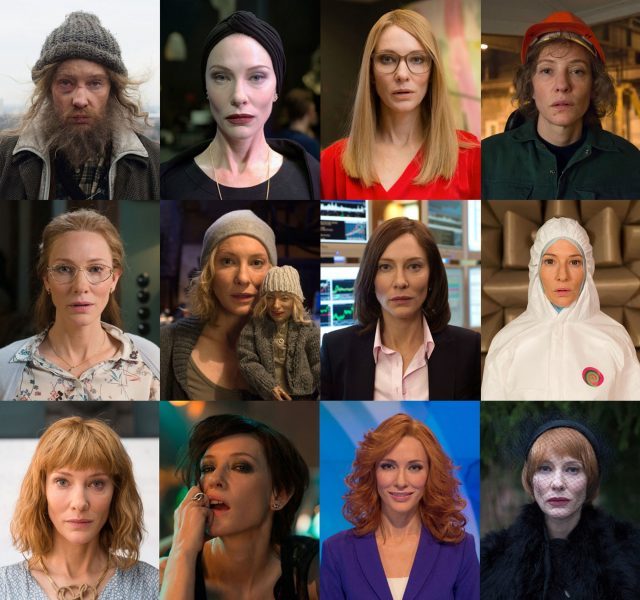
Cate Blanchett plays multiple characters in Julian Rosefeldt’s MANIFESTO
Park Ave. Armory, Wade Thompson Drill Hall
643 Park Ave. at 67th St.
Daily through January 8, $20
212-933-5812
www.armoryonpark.org
As visitors go from screen to screen in Julian Rosefeldt’s thirteen-channel installation, Manifesto, at the Park Ave. Armory, they’re bombarded with declarations from cultural missives by artists and philosophers dating back more than 150 years. Various words and phrases stick out, hanging in the air like bees buzzing around flowers: “originality,” “conflict,” “infinite and shapeless variation,” “decay,” “revolution,” “recklessness,” “absolute reality,” “glorious isolation,” “obsession,” freedom,” “everlasting change,” “the unconsciousness of humanity.”
I am against action; I am for continuous contradiction: for affirmation, too. I am neither for nor against and I do not explain because I hate common sense. I am writing a manifesto because I have nothing to say.
Art requires truth, not sincerity.
Logic is a complication. Logic is always wrong.
The words are all spoken by Oscar-winning actress Cate Blanchett (Notes on a Scandal, Blue Jasmine), who plays thirteen characters in twelve of the films, which each runs ten and a half minutes and are looped concurrently. She does not appear in the shorter prologue but does provide the narration. Among the characters she portrays are a homeless man, a grade school teacher, a factory worker, a punk rocker, a scientist, a news anchor, a choreographer, and a puppeteer.
Our art is the art of a revolutionary period, simultaneously the reaction of a world going under and the herald of a new era.
Originality is nonexistent.
Purge the world of intellectual, professional, and commercialized culture!
Rosefeldt (Trilogy of Failure, Deep Gold, The Ship of Fools), a photographer and filmmaker who was born in Munich and lives and works in Berlin, has an MA in architecture, so location plays a key role in the films, many of which take place in spectacular surroundings, interiors and exteriors, that would make Andreas Gursky drool, including an abandoned Olympic village, the Klingenberg CHP Plant, the Palasseum housing project, a former fertilizer factory, the ZDF Hauptstadtstudio, and the Humboldt Universität Department of Engineering Acoustics (in which a 2001-like monolith floats in the air). Each film begins and ends with Christoph Krauss’s camera lingering on the often jaw-dropping visuals.
We must create. That’s the sign of our times.
Fluxus is a pain in art’s ass.
Existence is elsewhere.
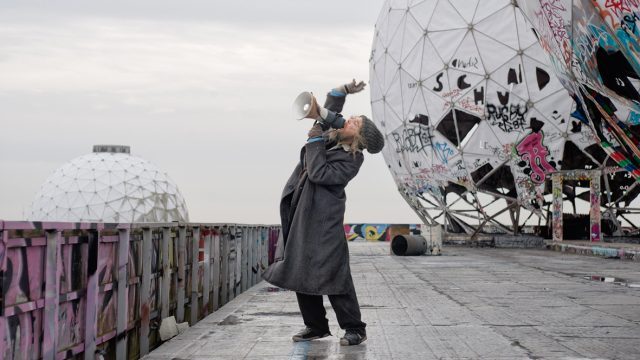
A homeless man screams out his thoughts on art in Julian Rosefeldt’s MANIFESTO (© 2015 Julian Rosefeldt and VG Bild-Kunst, Bonn)
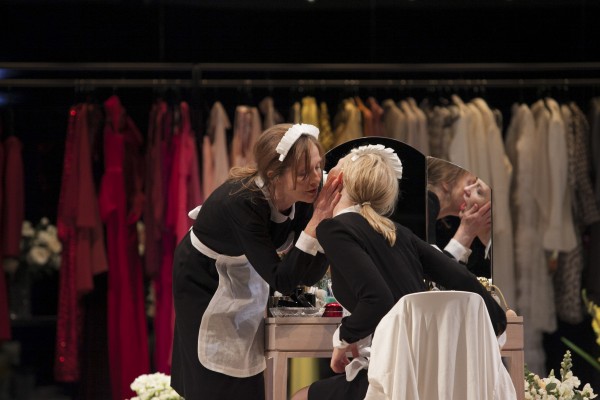
The statements are delivered in unique and inventive ways, with Blanchett, looking vastly different in each scene courtesy of Bina Daigeler’s costumes, Morag Ross’s makeup, and Massimo Gattabrusi’s hairstyling, playing a mourner giving a eulogy, a mother saying grace, a teacher presenting a lesson, a choreographer yelling at her troupe, a financial analyst spouting data, a crane operator incinerating garbage, and a CEO offering a new concept at a private board meeting in a seaside villa.
I am for art that is put on and taken off, like pants; which develops holes, like socks; which is eaten, like a piece of pie, or abandoned with great contempt, like a piece of shit.
No to the heroic. No to the anti-heroic.
Temporal and geographical alienation are forbidden.
Each section is dedicated to a separate artistic theory, discussing Pop Art, Conceptual Art / Minimalism, Fluxus, Surrealism / Spatialism, Dadaism, Suprematism / Constructivism, Stridentism / Creationism, Abstract Expressionism, Architecture, Futurism, Situationism, and Film. Heard today in this context, the statements range from the very funny to the extremely dry and boring, from the downright elitist to the realistic and relevant, from the sublime to the ridiculous.
Farewell to absurd choices.
Nothing is original.
In this period of change, the role of the artist can only be that of the revolutionary: it is his duty to destroy the last remnants of an empty, irksome aesthetic, arousing the creative instincts still slumbering unconscious in the human mind.
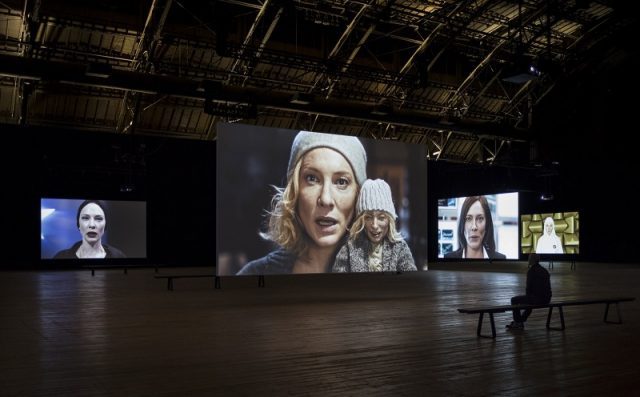
Close-ups of Cate Blanchett appear simultaneously in thirteen-screen installation at Park Ave. Armory (photo by James Ewing)
The quotations come from a wide variety of sources, from little-known essays to major influential texts. They include Karl Marx and Friedrich Engels’s Manifesto of the Communist Party, Kazimir Malevich’s Suprematist Manifesto, Dziga Vertov’s WE: Variant of a Manifesto, André Breton’s Manifesto of Surrealism, Lucio Fontana’s White Manifesto, Stan Brakhage’s Metaphors on Vision, Elaine Sturtevant’s Man Is Double Man Is Copy Man Is Clone, Lars von Trier and Thomas Vinterberg’s Dogma 95, and Claes Oldenburg’s I am for an art . . . , in addition to writings by Francis Picabia, Barnett Newman, Yvonne Rainer, Kurt Schwitters, Tristan Tzara, Sol LeWitt, Paul Eluard, Wassily Kandinsky and Franz Marc, Guillaume Apollinaire, and Werner Herzog.
The past we are leaving behind us as carrion. The future we leave to the fortune-tellers. We take the present day.
All of man is fake. All of man is false.
I believe in the pure joy of the man who sets off from whatever point he chooses, along any other path save a reasonable one, and arrives wherever he can.
About two-thirds of the way through each film, all of the characters portrayed by Blanchett, seen in extreme close-up, suddenly speak their lines in monotone unison, a kind of choral cacophony of chanting and singing that echoes throughout the massive Wade Thompson Drill Hall, an exhilarating moment that makes up for some of the pompous diatribe and intellectual masturbation that preceded it. It also is a grand statement for the critical importance of art, especially during tough times when countries face cultural and sociopolitical battles that threaten personal freedoms and liberties. But the best reason to experience Manifesto, which continues through January 8, is to watch a remarkable actress in a marvelous and memorable tour de force; Blanchett fans will also want to catch her in Anton Chekhov’s The Present, which is running on Broadway through March 19.
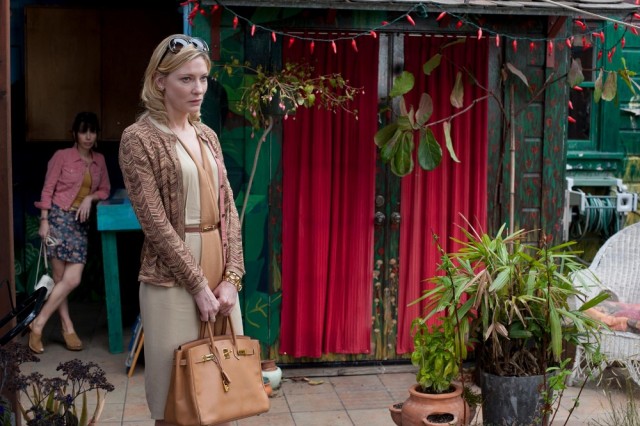
 Woody Allen’s best film in years, Blue Jasmine is a modern-day Streetcar Named Desire filtered through the Bernie Madoff scandal. Cate Blanchett won an Oscar for her marvelously nuanced and deeply textured performance as Jasmine French, an elegant socialite whose immensely wealthy husband, Hal (a wonderfully smarmy Alec Baldwin), amassed his fortune the new-fashioned way: by lying and cheating—only he was the rare financier who got caught and ended up in jail. Now broke and distraught, Jasmine moves in with her sister, Ginger (the delightful Sally Hawkins), a single mother with two kids living in a cramped apartment in San Francisco. Ginger and her ex-husband, Augie (an excellent Andrew Dice Clay), lost all their money by investing with Hal, and she is now trying to rebuild her life, working as a cashier and dating the gruff but dedicated Chili (a strong Bobby Cannavale). Not used to taking care of herself, Jasmine seems lost in a world that no longer treats her like a princess; she takes a job working for a dentist (Michael Stuhlbarg) and attends a computer class, but she is determined to regain her previous status. And that chance comes when she meets Dwight (a gentle Peter Sarsgaard), a man with grand plans who just might be the one to lead her back to the level to which she is accustomed.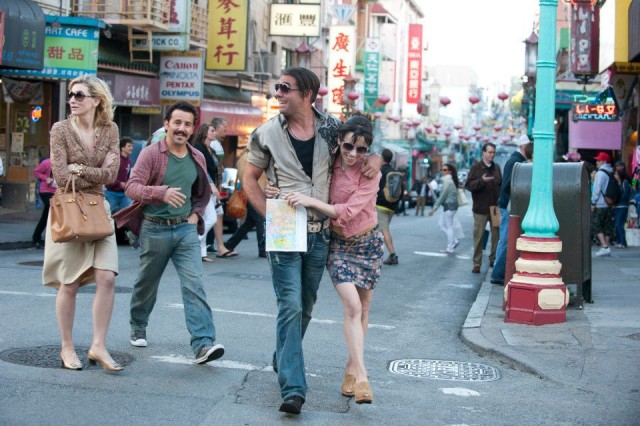
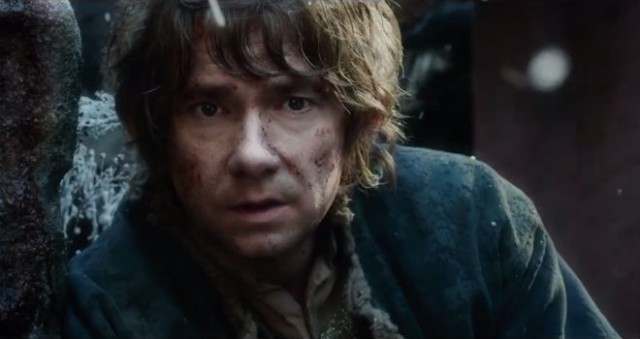
 Peter Jackson’s sixteen-year adventure through J. R. R. Tolkien’s Middle-earth comes to its inevitable conclusion with The Hobbit: The Battle of the Five Armies, the third film in the prequel trilogy that began with An Unexpected Journey and The Desolation of Smaug. The story picks up as the enormous fire-breathing flying dragon Smaug (voiced by Benedict Cumberbatch) is laying waste to the island of Lake-town as the thirteen Dwarves of Erebor watch from the Lonely Mountain. But soon after the brave Bard (Luke Evans) dispatches the evil beast in spectacular fashion, the Men of the Lake, the Orcs, the Elves, and the Goblins all descend on Erebor seeking either refuge, revenge, or the massive amount of gold that fills the abandoned castle. However, Dwarves king Thorin Oakenshield II (Richard Armitage) has been overcome with dragon-sickness, an unbounded greed that has him protecting every single piece of the vast treasure, refusing to share it with anyone but his thirteen cohorts as he searches for the powerful Arkenstone that Bilbo Baggins (Martin Freeman) is hiding. Meanwhile, Gandalf the Grey (Ian McKellen), Galadriel (Cate Blanchett), Elrond (Hugo Weaving), and Saruman (Christopher Lee) take on Sauron the Necromancer (voiced by Cumberbatch); the Elf Tauriel (Evangeline Lilly) and the Dwarf Kíli (Aidan Turner) explore their forbidden love; and a stream of frightening creatures join the fray. Also along for this final ride is Legolas (Orlando Bloom), his father, Thranduil (Lee Pace), Thorin’s cousin Dáin (Billy Connolly), the brutal, scimitar-armed Azog the Defiler (Manu Bennett) and his brutal son, Bolg (John Tui), and the pompous, greedy Master of Lake-town (Stephen Fry).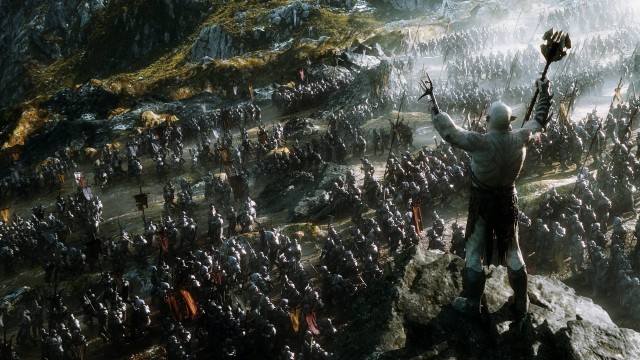
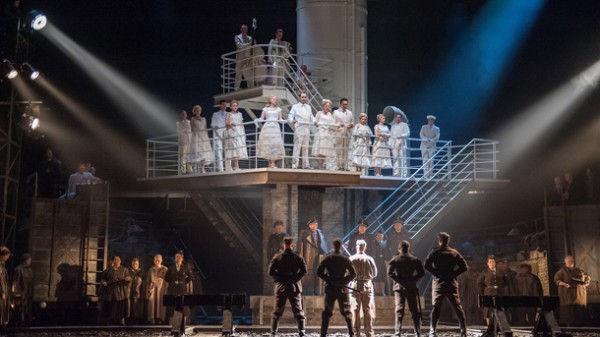
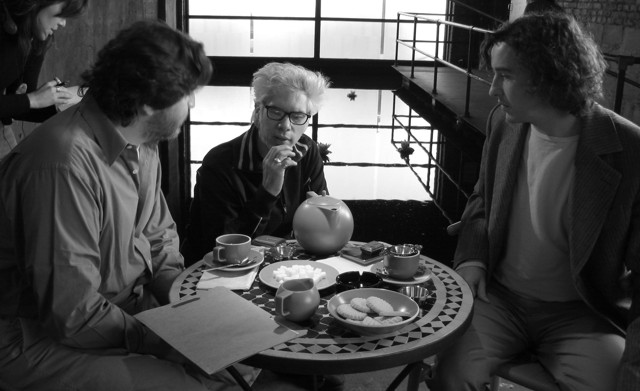
 Jim Jarmusch’s entertaining, offbeat, and often frustrating Coffee & Cigarettes consists of eleven vignettes, filmed over the course of more than fifteen years, that pair actors at bars, diners, and the like, drinking coffee, smoking cigarettes, and talking about drinking coffee and smoking cigarettes. Although the actors use their real names, they are put in fictional situations. While Steven Wright and Roberto Benigni are a hoot, Alex Descas and Isaach de Bankolé are annoying. Alfred Molina and Steve Coogan make the best team, while Iggy Pop and Tom Waits should have been better. So should GZA, RZA, and Bill Murray. Jack White and Meg White, despite a liking for Tesla, show they can’t act. Cate Blanchett with Cate Blanchett is okay but not as good as the riotous team of Joe Rigano and Vinny Vella. The film is a must-see for Jarmusch fans and those who need a nicotine/java jolt. All others beware. Coffee & Cigarettes is screening February 10 with The Garage Tapes, three shorts starring Waits, as part of the Film Society of Lincoln Center series “Permanent Vacation: The Films of Jim Jarmusch,” a tribute to the eclectic writer-director upon the occasion of the release of his latest work, Only Lovers Left Alive. The festival continues through April 10 with all of his feature films, which include such gems as Dead Man, Down by Law, Ghost Dog: The Way of the Samurai, Stranger than Paradise, Mystery Train, and Night on Earth.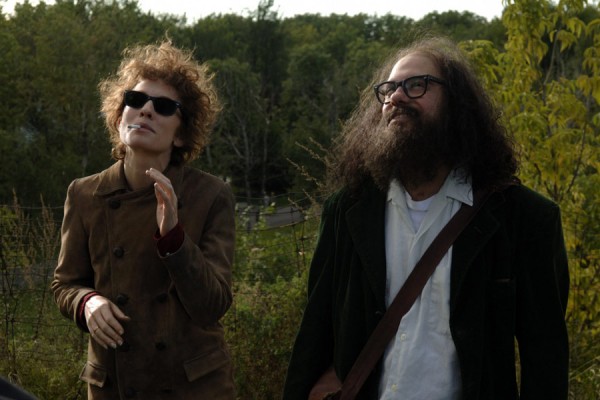
 Todd Haynes’s dramatization of the musical life of Bob Dylan is ambitious, innovative, and, ultimately, overblown and disappointing. Working with Dylan’s permission (though not artistic input), Haynes crafts a nonlinear tale in which six actors play different parts of Dylan’s psyche as the Great White Wonder develops from a humble folksinger to an internationally renowned and revered figure. Dylan is seen as an eleven-year-old black traveling hobo who goes by the name Woody Guthrie (Marcus Carl Franklin); Jack (Christian Bale), a Greenwich Village protest singer who later becomes a pastor; Robbie (Heath Ledger), an actor who has portrayed a Dylan entity and is having marital problems with his wife, Claire (Charlotte Gainsbourg); Arthur Rimbaud (Ben Whishaw), a staunch defender of poetry and revolution; an old Billy the Kid (Richard Gere), who has settled down peacefully in the small town of Riddle; and Jude Quinn (Cate Blanchett), who is attacked by her audience when she goes electric. Each story line is shot in a different style; for example, Jude’s is influenced by Fellini and the Dylan documentary Eat This Document!, Robbie’s by Godard, and Billy’s by Peckinpah. Excerpts from Dylan’s own version of his songs are interwoven with interpretations by Tom Verlaine, Yo La Tengo, Ramblin’ Jack Elliott, Stephen Malkmus, the Hold Steady, Sonic Youth (who do a killer version of the unreleased Basement Tapes–era title track over the closing credits), and many more, with cameos by Kris Kristofferson (as the opening narrator), Richie Havens, Julianne Moore, Kim Gordon, Paul Van Dyck, Michelle Williams, and David Cross (looking ridiculous as Allen Ginsberg). The most successful section by far is Blanchett’s; she takes over the role with relish, and cinematographer Edward Lachman and production designer Judy Becker nail the feel of the mid-’60s energy surrounding Dylan. But the rest of the film is all over the place, a great concept that bit off more than it could chew. I’m Not There is screening November 8 at 7:00 as part of the Museum of the Moving Image’s “See It Big!” series, with Lachman present to talk about the making of the film.