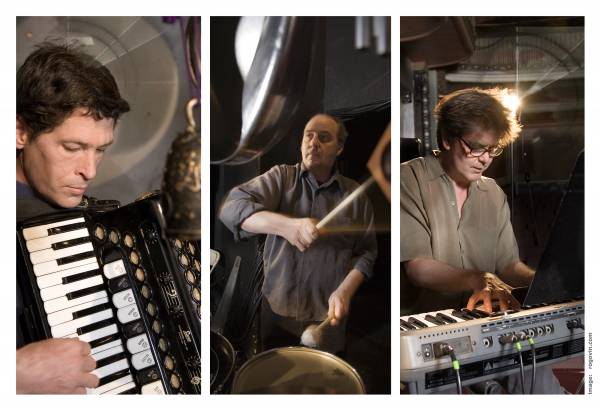
The Alloy Orchestra will play new scores for silent films at the World Financial Center this week (photo by Bruce Rogovin)
NEW SOUNDS LIVE SILENT FILM SERIES
World Financial Center Winter Garden
220 Vesey St.
February 2-4, free, 7:00
212-417-7050
www.wnyc.org
www.artsworldfinancialcenter.com
For nearly a quarter of a century, WNYC host John Schaefer has been presenting New Sounds Live, a series of live music events held in such locations as Merkin Concert Hall and the World Financial Center, featuring an eclectic lineup of musicians that has ranged from Ryuchi Sakamoto, Kitka, and David Hykes and the Harmonic Choir to One Ring Zero with authors Paul Auster, Siri Hustvedt, and Rick Moody. As part of the festival, Schaefer has been curating the New Sounds Live Silent Film Series, in which individuals or groups play live, original scores to silent classics in the WFC Winter Garden. Past years have paired the Club Foot Orchestra with THE PHANTOM OF THE OPERA (Rupert Julian, 1925), the Cinematic Orchestra with MAN WITH A MOVIE CAMERA (Dziga Vertov, 1929), the BQE Ensemble with THE GOLEM (Paul Wegener, 1920), and, last year, Lori Goldston, Wayne Horvitz, and Robin Holcomb with three Yasujio Ozu films. This year Schaefer has enlisted the Alloy Orchestra — keyboardist Roger Miller (Mission of Burma) with multi-instrumentalists Terry Donahue and Ken Winokur — to perform their scores to Buster Keaton’s ONE WEEK (1920), Fatty Arbuckle’s BACK STAGE (1919), and Charlie Chaplin’s EASY STREET (1917) on February 2, Harold Lloyd’s SPEEDY (1928) on February 3, and Douglas Fairbanks’s THE BLACK PIRATE (1926) on February 4. Schaefer discussed the series and more in the latest twi-ny talk.
twi-ny: How did you decide on the specific films that are included in this year’s New Sounds Live Silent Film Series program?
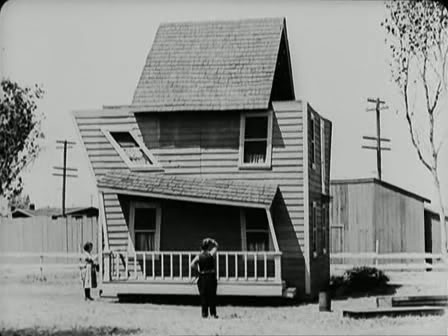
Buster Keaton’s 1920 classic ONE WEEK should bring the house down February 2 at the World Financial Center
John Schaefer: Well, there’s a lot to be said for the Principle of Restricted Choice. In this case, there were several things we wanted to do: One was a series of lighter works, more comic films than the Yasujiro Ozu movies we presented last year. And we also didn’t want to repeat films we’d shown before. Alloy has quite a film repertoire at its disposal, but we’ve worked with them several times over the years so there were a number of films we’d already done. The Harold Lloyd seemed a no-brainer, especially given its New York-centric storyline. And the score that Alloy did for that movie is smart and catchy — an important factor for a series that features live music. The Douglas Fairbanks film, probably best known for the scene where Fairbanks slides down a ship’s mainsail by holding on to a knife that is ripping into the fabric, is not a comedy but it is so over-the-top that you can hardly watch it without grinning — a quality reflected in Alloy’s score, by the way. And the collection of shorts gave us the opportunity to present three of the enduring geniuses of cinema comedy in one fell swoop. That’s what we’ll start the series with, on Wednesday the 2nd.
twi-ny: There are several piano players and groups that specialize in playing live to silent films. What does the Alloy Orchestra bring to these silent films that is different from other accompanists?
JS: The main thing they bring is their Rack of Junk — a ton (and I think I mean that literally) of percussive and other noise-making gear that augments the keyboards, clarinet, accordion, and other instruments that the three musicians also play. Also, this series of films with live music has always focused on music that does not sound like traditional movie-score material. Alloy doesn’t go in for “period pieces”; they create genuinely new music for these old films. As a result, the films seem less like period pieces themselves and more like a still-living art form.
twi-ny: You are the host of WNYC’s “New Sounds” and “Soundcheck,” for which you also write a blog nearly every day, covering a wide range of topics from across the musical spectrum. How has the internet changed the relationship between you and your listeners?
JS: The biggest change since the internet came along is to make communication with the listeners much easier. We get comments every day on “Soundcheck,” many of which we read on the air; “New Sounds” listeners can access web-only content; Facebook and Twitter allow us to keep our audience up to speed on live events (like these films), special guests, etc. And the ability to archive audio is a huge boost; especially with a show that isn’t in prime listening hours. Now, if you don’t want to stay up till midnight, you can still hear “New Sounds” — and hear it anytime you like. And even after all these years, I feel like the digital communication with our listeners is still growing up, unsure of what it’s eventually going to be. For example, we have a sizable treasure trove of videos of live in-studio performances on “Soundcheck,” and at some point we’re gonna figure out how best to organize these things in a way that allows people to easily find and use them. The internet has already made it so much easier to access information about the shows, the music, and more, but there are lots of other ways in which it can and will deepen the audience’s experience, and that’s a real major area of growth for us.
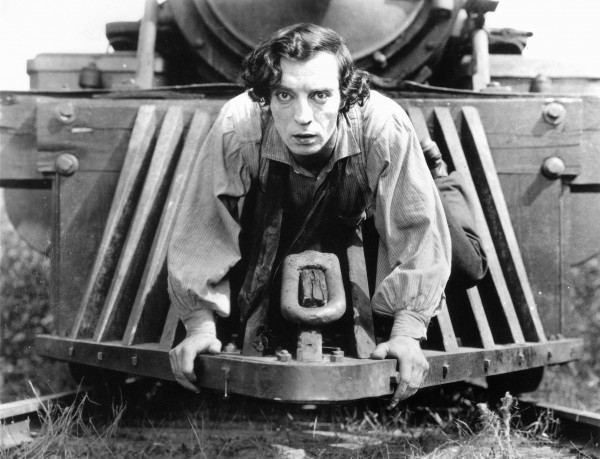
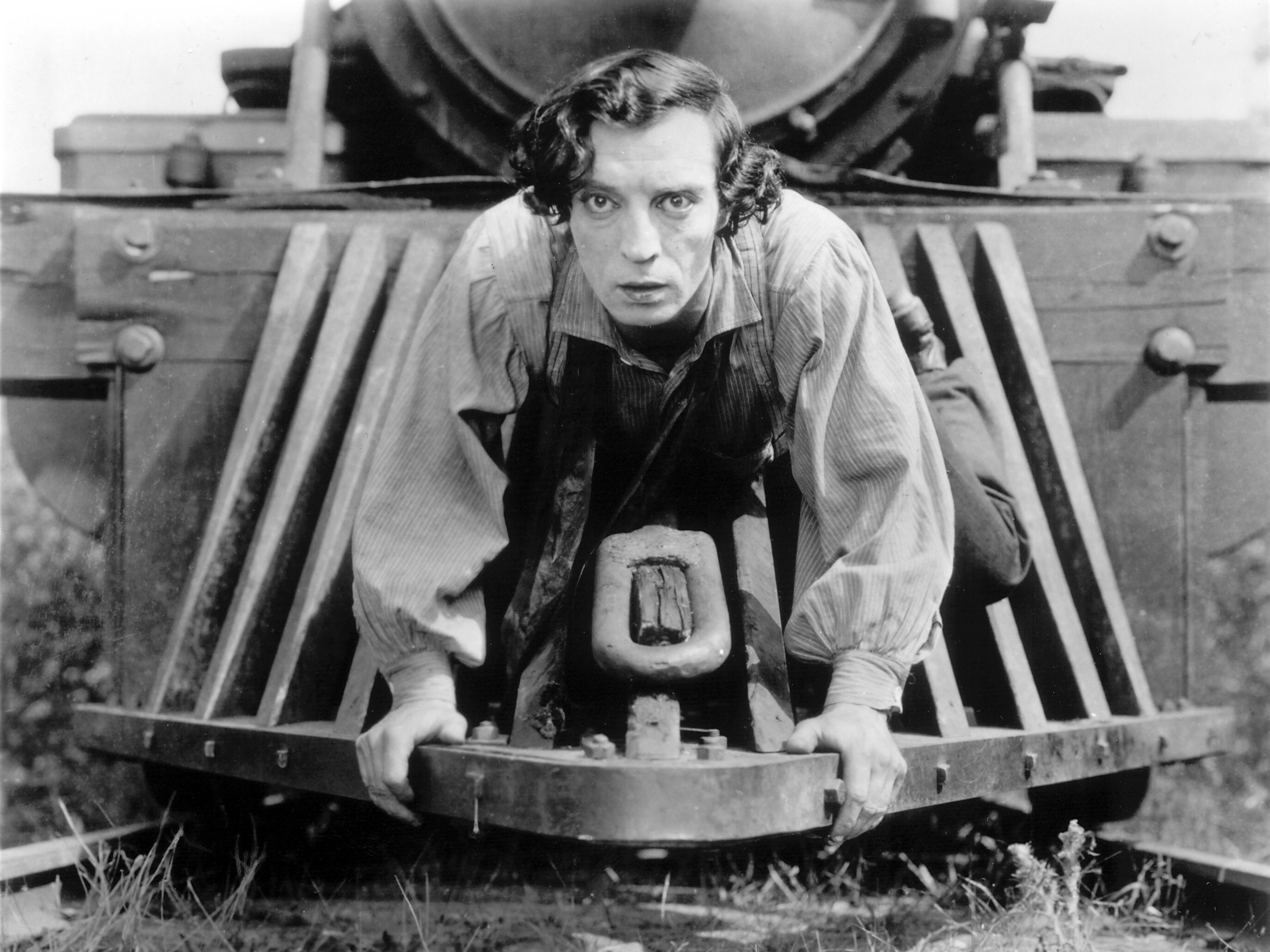
 Buster Keaton’s Civil War-set The General was a box-office failure upon its release in 1926-27, but it is now deservedly recognized as a silent-film classic. Based on William Pittenger’s memoir, The Great Locomotive Chase, the film stars Keaton as Johnnie Gray, a Georgia train man who is rejected by the Confederate army when he tries to enlist to impress his fiancée, Annabelle Lee (Marion Mack). Little does he know that he was turned away because the Confederacy believes he will be more valuable to them as a civilian engineer; meanwhile, Annabelle and her family think he’s a coward, not believing he even tried to sign up to fight in the first place. But when Union spies led by Captain Anderson (Glen Cavender) steal his beloved train, affectionately known as the General — and capture Annabelle in the process — Johnnie steams into action, doing whatever it takes to get his two loves back while also trying the save the South from a sneak attack. Directed by the Great Stone Face with regular collaborator Clyde Bruckman, The General is a thrilling ride chock-full of dangerous stunts that Keaton performed himself, often involving the moving Western & Electric Railroad train. Keaton manages to make the South sympathetic, depicting the North as evil and conniving, while avoiding any political aspects of the war. And in another sly turn, he casts his father, Joe, who appeared in more than a dozen of his films, as a Union general. The riotous romp was entered into the Library of Congress’s National Film Registry in its inaugural year, 1989, alongside such other classics as The Best Years of Our Lives, Casablanca, Citizen Kane, Dr. Strangelove, Gone with the Wind, The Grapes of Wrath, High Noon, Modern Times, Mr. Smith Goes to Washington, On the Waterfront, Singin’ in the Rain, The Searchers, Sunrise, The Wizard of Oz, and others, which is high praise indeed. The General is screening on December 7 at 5:30 at Anthology Film Archives; at 3:30, Anthology will be showing four of Keaton’s shorts, One Week, Neighbors, The Scarecrow, and The Play House.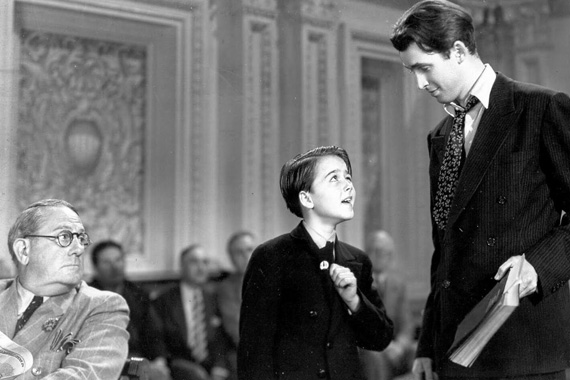
 We love Jimmy Stewart; we really do. Who doesn’t? But last year we had the audacity to claim that Jim Parsons’s performance as Elwood P. Dowd in the 2012 Broadway revival of
 Lovingly restored five years ago by Janus Films in a new 35mm print, Albert Lamorisse’s The Red Balloon, which won the Palme d’Or at Cannes and an Oscar for Best Original Screenplay, tells the story of a young boy (Pascal Lamorisse, the director’s son) who makes friends with an extraordinary red balloon, which follows him through the streets of Belleville in Paris, waits for him while he is in school, and obeys his every command. But the neighborhood kids are afraid of this stranger and go on a mission to burst the young boy’s bubble. Lamorisse gives life and emotion to the balloon (more than twenty-five thousand were used in the making of the film) in a masterful use of simple special effects well before CGI and other modern technology. The Red Balloon, which also features the splendid music of Maurice Leroux and the fine photography of Edmond Séchan, is kicking off the new series “Film Forum Jr.” on January 6 along with Robert Cannon’s Oscar-winning 1950 animated short Gerald McBoing McBoing (followed by a Gerald McBoing McBoing sound-alike contest) and Claude Berri’s Oscar-winning live-action short Le Poulet. The new Film Forum series will be screening family-friendly movies at 11:00 on Sunday mornings; upcoming programs include Buster Keaton’s Sherlock Jr., Creature from the Black Lagoon in 3D, the Marx Brothers’ Horse Feathers, and the original Frankenstein and King Kong.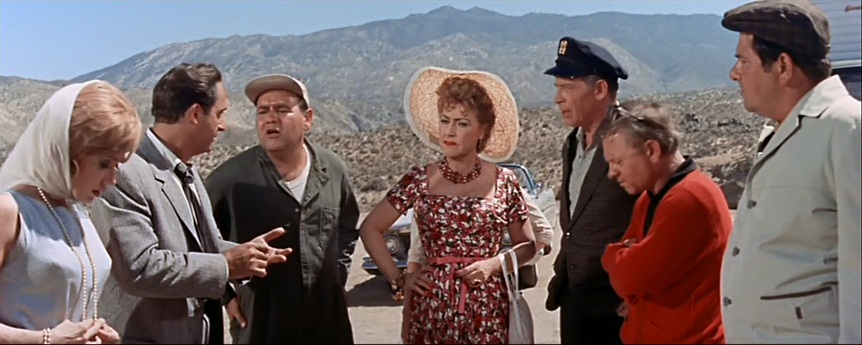
 They don’t come much crazier than the madcap 1963 comedy It’s a Mad Mad Mad Mad World. Producer-director Stanley Kramer takes a sharp turn with the wacky film, clearly needing a laugh following his rather serious string of issue pictures: The Defiant Ones, On the Beach, Inherit the Wind, and Judgment at Nuremberg. As he lays dying after a car crash, master thief Smiler Grogan (Jimmy Durante) tells a group of onlookers that there is $350,000 buried under a “big W” in Santa Rosita State Park. And off they go in search of the prize, willing to do just about anything and everything in order to get their greedy hands on the money. Hot on their trail is police captain T. G. Culpeper (Spencer Tracy), trying to solve one last case before he retires. It’s a Mad, Mad, Mad, Mad World lives up to its title, a mad, mad, mad, mad epic featuring the greatest all-star comedic cast ever assembled, including Sid Caesar, Edie Adams, Mickey Rooney, Buddy Hackett, an absolutely lunatic Jonathan Winters, Terry-Thomas, Phil Silvers, Dick Shawn, Peter Falk, Eddie “Rochester” Anderson, and Ethel Merman in addition to cameos by Jerry Lewis, Jack Benny, Joe E. Brown, Howard Da Silva, Andy Devine, Norman Fell, Selma Diamond, Leo Gorcey, Jim Backus, Marvin Kaplan, Stan Freberg, Arnold Stang, Jesse White, Carl Reiner, Don Knotts, Buster Keaton, and the Three Stooges. Basically, you can’t blink during the film’s 161 minutes or you’ll miss someone or some incredibly silly slapstick moment. And the ending is a laugh riot — literally. It’s a Mad, Mad, Mad, Mad World is screening December 22 and December 28 as part of the Film Society of Lincoln Center series “See It in 70MM!,” comprising fifteen films being shown in their original 70mm glory, beginning December 21 with Stanley Kubrick’s 2001: A Space Odyssey and continuing through January 1 with such other works as Ron Fricke’s Baraka, John Ford’s Cheyenne Autumn, Kenneth Branagh’s Hamlet, Basil Dearden’s Khartoum, Richard Brooks’s Lord Jim, and Jacques Tati’s Playtime.